Towards Low-Power on-Chip Auditory Processing
Sourabh Ravindran
Department of Electrical and Computer Engineering, Georgia Institute of Technology, Atlanta, GA 30332-0250, USA Email:[email protected]
Paul Smith
Department of Electrical and Computer Engineering, Georgia Institute of Technology, Atlanta, GA 30332-0250, USA Email:[email protected]
David Graham
Department of Electrical and Computer Engineering, Georgia Institute of Technology, Atlanta, GA 30332-0250, USA Email:[email protected]
Varinthira Duangudom
Department of Electrical and Computer Engineering, Georgia Institute of Technology, Atlanta, GA 30332-0250, USA Email:[email protected]
David V. Anderson
Department of Electrical and Computer Engineering, Georgia Institute of Technology, Atlanta, GA 30332-0250, USA Email:[email protected]
Paul Hasler
Department of Electrical and Computer Engineering, Georgia Institute of Technology, Atlanta, GA 30332-0250, USA Email:[email protected]
Received 18 September 2003; Revised 16 August 2004
Machine perception is a difficult problem both from a practical or implementation point of view as well as from a theoretical or algorithmic point of view. Machine perception systems based on biological perception systems show great promise in many areas but they often have processing requirements and/or data flow requirements that are difficult to implement, especially in small or low-power systems. We propose a system design approach that makes it possible to implement complex functionality using cooperative analog-digital signal processing to lower power requirements dramatically over digital-only systems, as well as provide an architecture facilitating the development of biologically motivated perception systems. We show the architecture and application development approach. We also present several reference systems for speech recognition, noise suppression, and audio classification.
Keywords and phrases:low power, noise suppression, classification, speech recognition, cooperative analog digital, feature ex-traction.
1. INTRODUCTION
This paper describes our efforts toward making on-chip au-ditory perception systems. With these systems we hope to achieve human-like performance in various auditory tasks. Part of the motivation in this arena comes from the fact that humans outperform machines in most tasks of audio per-ception; therefore, one way to improve the current machine perception implementations is to mirror biological systems as best as we can in hopes of obtaining comparable results.
In keeping with the current mainstream ideas in audio sig-nal processing, the characteristics of biology could be pro-grammed into a digital processing system, and the results would likely be good. However, this is at the cost of high power consumption and longer time requirements due to the computational complexity. It is time we looked at different perspectives of performing these tasks both in terms of hard-ware innovation and algorithm development [1].
A/D
converter processorDSP
Real world (analog)
Computer (digital)
ASP IC
Specialized A/D
A/D processorDSP
Figure1: The traditional approach is to put an analog-to-digital (A/D) converter as close to the sensor signals as possible, imple-menting nearly all functionality in digital systems. An alternate approach is to perform some of the computations using advanced analog signal processing, requiring simpler A/D converters, and re-ducing the computational load of resulting digital processors. The question of where to put this boundary line strongly depends upon the particular requirements of an application.
the actual hardware. In order to address these issues, we de-scribe a two-pronged approach to developing on-chip solu-tions using both programmable analog processing and digital signal processing (an approach that we call CADSP for co-operative analog-digital signal processing [2]). The resulting systems are very low-power, small, and can efficiently imple-ment a large class of signal processing systems.
In this paper, we present CADSP as a vehicle for imple-menting auditory perception on a chip. The rest of the pa-per is divided into four main sections. Section 2 discusses the system technology.Section 3introduces signal processing algorithms that can be implemented using this technology and some results.Section 4gives a comparative analysis be-tween CADSP and digital approaches.Section 5discusses fu-ture work towards the goal of implementing all stages (noise suppression, feature extraction, symbol representation, and higher-end processing such as recognition) in the signal pro-cessing pathway on the CADSP platform.
2. CADSP SYSTEM OVERVIEW
Our approach to machine perception is unique in that it in-troduces a novel hardware processing platform [4,7] that is low power, programmable, and versatile. In the works is the development of a prototyping platform [8] that would con-siderably reduce the hardware design cycle. The next section introduces some of the basic ideas and guiding principles of CADSP.
2.1. Introduction to CADSP
The CADSP approach addresses the problem of runaway hardware complexity by adding increased functionality to the analog subsystem. For example, offloading the task of ex-tracting signal features to the analog circuits can reduce the analog-to-digital converter requirements (i.e., reduction in bits of resolution and bandwidth required) and reduce the load on the digital processor. This is in contrast to the recent trend of moving the analog-to-digital converter earlier in the
2030 2020
2010 2000
1990 1980
Year 10−6
10−4
10−2
100
102
mW/MIPS
A 20-year leap in power consumption
Gene’s law DSP power CADSP power
Figure2: Data showing the power consumption trends in DSP mi-croprocessors [3] along with data taken from a recent analog signal processing IC [4,5,6].
signal path and doing increasingly more computation digi-tally. However, there are many operations that may be easier, cheaper, and more efficient to perform with analog circuits. CADSP allows for freedom of movement of the partition be-tween the analog and digital systems. By adding functionality to our analog systems, we enhance the capabilities of the con-trolling digital system, and therefore, the entire product un-der consiun-deration (seeFigure 1). Many of the tradeoffs have yet to be investigated, but we include a brief discussion of power, size, and resolution.
The CADSP approach of building machine perception systems promises increased algorithmic sophistication at substantially reduced power consumption. In particular, a power reduction of 3–4 orders of magnitude over currently available digital signal processing (DSP) systems is expected for certain classes of systems. As shown in Figure 2, such a gain in power efficiency is approximately equal to a 20-year leap ahead relative to the projected power efficiency of digital signal processors.
The analog circuits we present are very small—a char-acteristic made possible by CMOS floating-gate technology which allows for easy tuning and programming of the cir-cuits. Each analog system discussed in this paper occupies less than 2.25 mm2in a standard (digital) CMOS 0.5µm
pro-cess. These circuits are generally operated in subthreshold mode, yielding tremendous power savings.
Switch matrix
Switch matrix Lines to pins
CAB CAB CAB CAB
CAB CAB CAB CAB
CAB CAB CAB CAB
CAB CAB CAB CAB
· · ·
· · · · · ·
· · ·
. . .
. . .
. . .
. . .
. . .
. . .
. . .
. . .
· · ·
· · · · · ·
· · ·
(a)
Analog circuits
CAB
Switch matrix
(b)
Figure 3: Block diagram of our generic FPAA chip. (a) Architecture diagram of our generic analog programmable computing blocks. Although in many cases, a generic, mesh-connected structure will be inefficient for many computations, small mesh-connected arrays will be important in more optimized implementations. Also, this chip will allow for partitioning between medium-scale analog-digital design problems. We expect to build a generic FPAA block with 100 computational analog blocks (CAB), each with 24 ports, to the mesh-switching matrix. (b) Signal flow in a single CAB.
When implementing machine perception on a chip, the use of low-power analog circuits provides increased compu-tational ability while requiring less space and power. In par-ticular, this is useful for creating biologically motivated per-ception systems, since the complexity involved in such sys-tems often makes them difficult to implement in low-power systems. For instance, implementation of the biologically motivated modulation spectra representation [10] would be relatively straightforward to implement in a CADSP system but it requires extensive computation when implemented in programmable digital systems.
2.2. Floating gates overview
The core elements of the analog systems are CMOS analog floating-gate devices. These elements add programmability and increased flexibility and power savings to analog VLSI circuits [11]. A floating gate is a polysilicon gate surrounded by silicon dioxide. Charge on the floating gate is stored per-manently, providing a long-term memory.
Floating gates are programmable in that the charge can be modified using several methods. Electrons are removed from the gate by applying large voltages across a silicon-oxide capacitor to tunnel electrons through the oxide. Electrons are added to the floating gate using hot-electron injection. Programming of floating gate is accomplished by resetting the floating-gate charge using electron tunneling, and setting positive or negative offsets using hot-electron injection [12]. The floating gate can be used in computation since the voltage, determined by the charge stored on the floating gate, can modulate a channel between a source and drain.
Floating-gate devices can compute a wide range of static and dynamic translinear functions by the particular choice of capacitive couplings into floating-gate devices. This grammable analog CMOS technology is the basis for pro-grammable and reconfigurable CADSP system.
2.3. Prototyping platform
The process of designing, fabricating, and testing an analog chip requires certain expertise and is often long and expen-sive. The process is not unlike designing digital ASICs (ap-plication specific integrated circuits) except there are fewer tools and libraries available to the designer. The difficulties in digital ASIC design are largely ameliorated by using field-programmable gate arrays (FPGAs). For digital circuits, FP-GAs provide a fast, simple way to implement, test, and even-tually compile custom circuits. We have built programmable floating-gate analog devices that are similar to FPGAs in both design and in the benefits they provide. The analog arrays, dubbed field-programmable analog arrays or FPAAs, repre-sent a significant advance in the field of analog signal pro-cessing [8]. These chips are based on structures of floating-gate analog circuits and they may contain tens of thousands of analog elements as illustrated inFigure 3.
The arrays of analog circuits on which the FPAAs are based consist of matrix/vector multiplies, filtering, and so forth—not just a few op-amps with passive elements as with commercial and other research FPAAs [13,14,15,16,17,18,
Vtp1 Vtp2 Vtp3
Vout
C1 C1 C2 C1 C2
Vin CL CL CL
CW Vtn1 CW Vtn2 CW Vtn3
C1
Figure4:C4second-order section circuit diagram.
the design will always possess some inefficiencies. On the other hand, since analog-circuit design is often time consum-ing, these adverse tradeoffs are well balanced by decreased time to market. These FPAA chips are mixed-mode chips be-cause the data-flow control and the programming and in-terface control to the floating-gate devices are digital. Cur-rently, we have well-defined digital control and protocols for programming and controlling arrays of floating-gate devices [20].Figure 3ashows a block diagram of the generic FPAA mesh architecture. Figure 3b shows the interconnection in a single CAB element; we connect the buses from the four edges of the chip and internal bus lines from the analog cir-cuitry through a single switch matrix [8].
The development and use of FPAAs as described here is an important step toward designing and deploying flexible CADSP systems. We are in the process of building special-ized FPAAs for audio signal processing that incorporate mi-crophone inputs, distributed filter banks, distributed analog-computational memory arrays, CAB blocks, and sigma-delta analog-to-digital (A/D) converters. The CAB blocks used with this chip will also contain some special circuitry such as circuits for active noise suppression (as described in the next section) and adaptive filtering.
3. APPLICATIONS
In this section, we present various audio processing applica-tions that can be implemented using CADSP. We present re-sults from fabricated chips for some of the applications and simulation results for the rest.
3.1. Bandpass filtering
Spectrum decomposition is invariably the first step in most audio processing applications. In this section, we present a continuous-time bandpass filter element called the capac-itively coupled current conveyer (C4) (Figure 4).
Measure-ment data from circuits fabricated on a 0.5µm n-well CMOS process is shown for frequency ranges from 10 Hz to 100 kHz (Figure 5).
105
104
103
102
101
Frequency (Hz) 10−1
100
Gain
(dB)
107
106
105
104
103
102
101
Frequency (Hz)
−10
−5 0 5 10 15 20 25 30 35
Gain
(dB)
Figure 5: Programmed differential weights to the floating-gate multiplier circuits (a single sine period).
C4is a bandpass filter with electronically tunable corner
frequencies and±40 dB/decade or greater rolloffs. The cor-ner frequencies can be set independent of each other; there-fore, the bandwidth can be tuned at will. Each corner can have its ownQ-peak, or, if the corners are brought close to-gether, a very tight bandwidth with a singleQ-peak develops (seeFigure 5). This leads to further isolation of any given fre-quency and is thus useful for signal processing applications. An array of theseC4 second-order sections (SOS) with
ex-ponentially spaced center frequencies forms a good model of the human cochlea where signals are decomposed with filter-ing processes that haveQ≈30 [21].
3.2. Noise suppression
Noisy signal Bandpassfilter
Gain calculation
Clean signal
Bandpass filter
Gain calculation .
.
. .
. .
. . .
Bandpass filter
Gain calculation
(a)
1.8 1.6 1.4 1.2 1 0.8 0.6 0.4 0.2 0
Time (s)
−1
−0.8
−0.6
−0.4
−0.2 0 0.2 0.4 0.6 0.8 1
M
ag
nitude
(b)
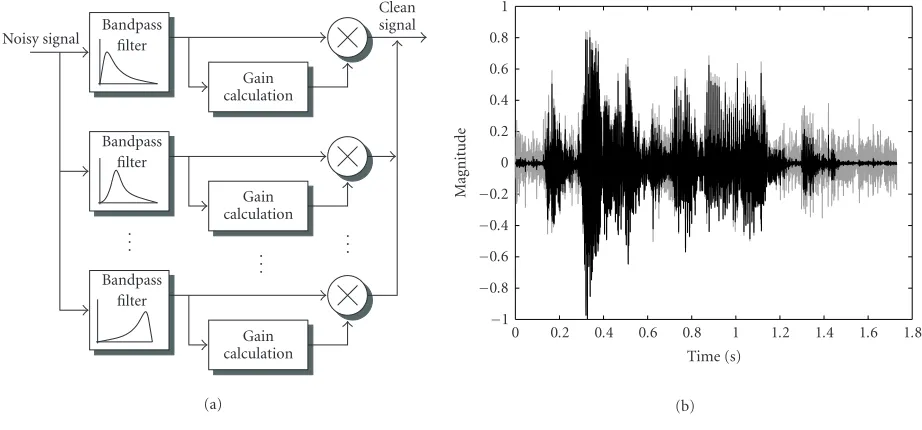
Figure6: Our continuous-time noise suppression system. (a) The overall structure of the system. The incoming noisy signal is divided into exponentially spaced frequency bands usingC4second-order sections. Next, the optimal gain (gain calculation block) for each band is
computed. If the band has sufficient estimated SNR, the signal passes through with maximal gain, otherwise the gain is reduced dependent upon the estimated SNR in that particular band. The resulting gain factor is multiplied with the bandlimited noisy signal to produce a bandlimited “clean” signal. Finally, the output of all of the bands is summed to reconstruct the signal with the noise components significantly reduced. (b) Experimental measurements of noise suppression in one frequency band. The light gray data is the subband noisy speech input signal; the black waveform is the corresponding subband output after the gain function has been applied. The noise-only portions of the signal have been significantly attenuated while a lesser attenuation is applied appropriately to the speech + noise portions.
technique for noise suppression in the continuous-time do-main. We are building a system that operates in real time and uses extremely low amounts of power. The result is a system that performs a function normally reserved for digital com-putation, freeing those resources for other operations in the digital domain.
3.2.1. Structure of suppression system
Figure 6a shows the structure of a continuous-time noise suppression system for real-time analog implementation. The goal is to design a real-time system that generates some optimal estimate of the actual signal from an additive mix-ture of signal and noise. We assume that the additive noise is stationary over a long time period relative to the short-term nonstationary patterns of normal speech. A filter bank sep-arates the noisy signal into 32 bands that are exponentially spaced in frequency, similar to the human auditory system for frequency domain processing.
After the incoming noisy signal has been bandlimited by the filter bank, a gain factor is calculated based on the the en-velopes of each observed subband signal and subband noise signal. The first step in the gain calculation algorithm is to estimate both the levels of the noisy signal and the noise (us-ing a minimum statistics approach). Because one cannot ac-curately determine the desired signal component of the in-coming signal, the noisy signal is accepted as a reasonable estimate. Currents that are representative of the noisy sig-nal level and the noise level are divided to create an estimate
for SNR. Within each frequency band, the noisy signal enve-lope is estimated using a peak detector. Based on the voltage output of the peak detector, the noise level is estimated us-ing a minimum detector operatus-ing at a slower rate than the peak detector. The currents representing the noisy signal and noise levels are input to a translinear division circuit, which outputs a current representing the estimated signal-to-noise ratio. A nonlinear function is applied to the SNR current to calculate a gain factor.
Finally, a gain factor is calculated and multiplied with the bandlimited signal to realize the noise suppression. The gain factor may be expressed as a function of the estimated SNR. Several different gain functions may be used but all of them have the general characteristics of low gain for low SNR and high gain (at or near unity) for high SNR, with vary-ing smoothvary-ing between these two regions. The output of the gain function is then multiplied with the original bandlim-ited signal. Finally, the bandlimbandlim-ited signals are summed to reconstruct the full-band signal estimate, with the additive noise components suppressed.
3.2.2. System results
Vin
Bandpass filter
Peak detector and log amplitude
FG multiply
W11 W12 W13 W14 W15 W1n
W21 W22 W23 W24 W25 W2n
Cu
rr
en
t
Dig
ital
Output
· · ·
· · ·
· · ·
· · ·
Figure7: Block diagram of a floating-gate system to perform cep-strum front-end computation for speech processing systems. The system contains 32 frequency taps that can be spaced arbitrarily by programming the corner frequencies for the bandpass filter banks. The peak detectors provide a power spectrum of the input signal for any given time slice.
desired portions relatively intact. Any noise or distortion cre-ated by the gain calculation circuits minimally affects the output signal because these circuits are not directly in the sig-nal path. While the bandpass filters and the multipliers will inject a certain amount of noise into each frequency band, this noise will be averaged out by the summation of the sig-nals at the output of the system.
3.3. Feature extraction for audio processing
This section discusses our current work on a continuous-time mel-frequency cepstrum encoding IC using analog circuits and floating-gate computational arrays (more detail is given in [6]). We also introduce biologically inspired audi-tory features that are similar to the standard mel-frequency cepstrum coefficients (MFCCs) but appear to be more robust to noise.
3.3.1. Continuous-time cepstrum
The mel-cepstrum is often computed as the first stage of a speech recognition system [22]. The mel-cepstrum, as used in digital signal processing (DSP), is based on a signal sam-pled in time and in frequency.Figure 7shows the block di-agram for the analog cepstrum which is an approximation to the mel-cepstrum. The output of each filter contains in-formation similar to the short-time Fourier transform and can likewise be assumed to represent the product of the ex-citation and vocal tract within that filter band. The primary difference here is that the DSP mel-cepstrum approximates the critical band log-frequency analysis of the human ear by combining DFT bands while the analog system actually per-forms a critical band-like analysis on the input signal. Thus, higher-frequency critical band energies are effectively com-puted using shorter basis functions than the lower-frequency bands [6]. This is more in agreement with analysis in the hu-man auditory system and is better suited to identifying tran-sients.
70 60 50 40 30 20 10 0
Column 0
0.1 0.2 0.3 0.4 0.5 0.6 0.7 0.8 0.9 1
Id
×10−8
Figure 8: Programmed differential weights to the floating-gate multiplier circuits (a single sine period).
The basic building block of the continuous-time cep-strum implementation begins with a continuous spectrum decomposition and amplitude detection, similar to a discrete fourier transform (DFT). The spectrum decomposition is done using differential C4 second-order section bandpass
filters [21]. The magnitude function (inside the log) is estimated using a peak detector rather than using the true magnitude of the complex spectrum. Finally, we compute a cosine transform on these results using a matrix transform based on arrays of floating-gate multiplier circuits.Figure 8
shows the 32 programmed weight values (difference between a positive and negative weight) for a single row of multipliers programmed to a sine function.
This cepstrum processor can act as the front end for larger digital or analog speech processing systems. Early data from a related project gives confidence that this approach will improve the state of the art at a given power-dissipation level [23].
3.3.1.1. Simulation results
The cepstral coefficients were extracted using a Matlab simu-lation of the analog cepstrum chip. A hidden Markov model-(HMM-)based recognizer was used to perform continu-ous word recognition on the TIDIGITS database. The tests yielded a 98.2% word accuracy, which is comparable to that obtained with standard MFCCs.
3.3.2. MFCC-like auditory features
This section discusses the extraction of biologically inspired features for the task of audio classification.
Input
BPF BPF BPF · · · BPF
g(·) g(·) g(·) · · · g(·)
+ + + +
− − − −
· · ·
HWR HWR HWR · · · HWR
LPF LPF LPF · · · LPF
Log Log Log · · · Log
DCT
Auditory features
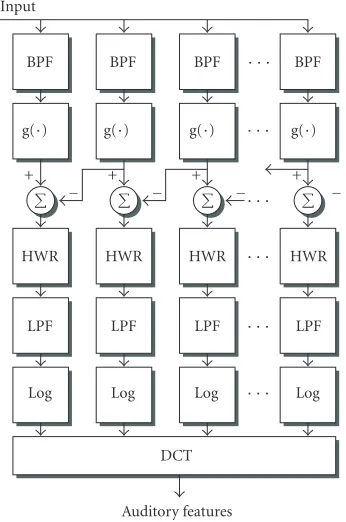
Figure9: The bandpass filtered version of the input is nonlinearly compressed. The differencing between lower and higher channels approximates a spatial derivative. The half-wave rectification fol-lowed by the smoothing filter picks out the peak. DCT is performed to decorrelate the signal.
comprised of a time derivative, a nonlinear compression, and a lowpass filter; and the reduction stage which consists of a spatial derivative, a spatial lowpass filter, a half-wave recti-fier, and a temporal integrator. The reduction stage models the lateral inhibition in the cochlear nucleus (CN) and also the inability of the CN neurons to respond to fast temporal changes.
When viewing the way the cochlea acts on signals of dif-ferent frequencies from an engineering perspective, it can be seen that the cochlea has bandpass frequency responses for each location. Ideally, one would have a bandpass filter with center frequency corresponding to the resonant frequency of every point along the cochlea—the cochlea has about 3000 inner hair cells acting as transduction points. In practice, 10– 20 filters per octave are considered an adequate approxima-tion.
The block diagram for extraction of MFCC-like audi-tory features is shown in Figure 9. The input speech signal is passed through the bandpass filter bank, the 40 dB/decade rolloff on the low frequency along with modeling the cochlear filter also provides a time differentiation of the input signal which models the inner hair cell coupling to the trav-eling wave. Each of the bandpass filters is built withC4SOS.
Following the bandpass filtering, each bandpassed signal is then nonlinearly compressed followed by a difference with the adjacent channels. The difference between channels is an approximation of the spatial derivative that models the lat-eral inhibition of the CN neurons. This is followed by
half-wave rectification and a smoothing filter. We then proceed to compute a cosine transform of the logarithm of the output of the smoothing filter.
3.3.3. Simulation results
A Matlab simulation of the above-described setup was used to extract the features. The new features were used for a four class audio classification problem to test their discrim-inant capabilities. The database used for the classification consisted of 4325 training files and 1124 testing files each of a duration of one second. The four classes considered were speech, music, noise, and animal sounds. A Gaussian mixture model (GMM) was used to perform the classifi-cation and four Gaussians were used for modeling each of the classes. A classification accuracy of 92.97% was achieved. Tests at different SNRs have shown these features to be robust to noise [26].
3.4. Continuous-time VQ
The following section discusses our current work on continuous-time vector quantization IC. Experimental data is presented from circuits fabricated on a 0.5µm n-well CMOS process available through MOSIS. In this section, we provide an overview of vector quantization (VQ), which is typically used in data compression and in classifying signals to symbols [27]. A VQ system will compute how faraway a particular input vector is from the desired target vectors, and pick the code vector that isclosestto the input vector. For VQ, some information is lost in the representation, but the goal is that it should be a sufficient representation for the problem at hand.
Figure 10shows the circuit and measured data from the VQ classifier array. Each cell in the array compares the value of that column’s input to the value it has memorized; the output current flows out of theVout node. This circuit is a
variation on the bump circuit [28], which compares the two inputs to this circuit; this cell returns a large current if the two values match (minimal difference). This system outputs a measure of the similarity; therefore, the outputs of all the elements can be added (by KCL) and the largest output is the vector with the maximum similarity. The sum of these current outputs is sent through a winner-take-all circuit that outputs theNlargest results, whereNcan be 1 or more [29]. We utilize floating gate elements [30] at the inputs to provide the ability to store and subtract offeach cell’s mean value.Figure 10bshows that the means in a VQ array can be programmed to an arbitrary level.
Dig
ital
output(s)
An
al
o
g
output(s)
W
inner
-tak
e-all
V1 V2 V3 Vn
. . .
. . .
. . .
. . .
Vadd
Vτ
Vtun,m Vtun,m
RAm RAm RAm RAm
V+3 V−3
Vout
Vd
Va,3 Va,4
(a)
1.5 1
0.5 0
−0.5
−1
−1.5
Differential input voltage (V) 0
1 2 3 4 5 6
Output
cur
rent
(nA)
Inject: negative input Inject: positive input
(b)
40 35 30 25 20 15 10 5 0
Time (s)
−2
−1.5
−1
−0.5 0 0.5 1
Output
vo
ltage
#
1
(V
)
Upgoing step Downgoing step
(c)
Figure10: Basic circuit, architecture, and measurements from the VQ circuit. (a) The core cell is built from a floating-gate bump circuit, which allows the target mean value to be stored and subtracted from the broadcast input signal. (b) Results from programming the VQ circuit. We see that output current (experimental measurements) of the middle leg of the bump circuit reaches a maximum at its center value, and falls offexponentially as one moves from that center value. This output current is summed together with the output from other bump circuits. We use the RAmsignal to select between adaptation or computation/programming along a given row; if only programming and computation are required, then the circuit can be significantly reduced. We reconfigure the VQ circuit so that it fits within the standard floating-gate programming architecture and algorithms [12]. We reset the floating-gate charge using electron tunneling, and program positive or negative offsets using hot-electron injection. If we inject the floating gate associated with the positive input terminal, then we increase the offset. If we inject the floating gate associated with the negative input terminal, then we decrease the offset. (c) The results of adapting the input signal mean. The common-mode feedback (CMFB) circuitry is switched in from the bottom of the array. We show experimental measurements showing the convergence of the floating-gate bump element with the CMFB circuitry. We show one drain voltage when connected to the CMFB circuitry; if the drain voltage reaches equilibrium between the operating rails, then the circuit has converged to the signal mean.
the array, and connect to the selected element for adapta-tion; typically we would only be adapting one element at a given time. This approach requires some circuit reconfigu-ration at the core cell; if only adaptation or programming would be used, then the circuit remains simpler than shown inFigure 10a.
4. COMPARATIVE ANALYSIS
Sarpeshkar [33] presents a good comparative study of digital and analog systems. Power and area gains in analog systems come primarily from the fact that one wire repsents many bits of information, but a digital system is re-stricted to one bit per wire. By using the device physics such as the Kirchoffcurrent laws, operations like 8-bit addition can be made very cheap, essentially using only one wire. In digital it would require an bit adder. Similarly an 8-bit multiply takes about 3000 transistors to implement in digital logic using static CMOS whereas in analog it can be implemented using 4–8 transistors. Since digital computa-tions use more number of devices, there is more wiring and computation overhead which in turn takes up more area and dissipates power.
The disadvantage of analog systems is that of noise. The noise in analog systems is essential due to thermal noise and in a cascade of components the thermal noise adds up. Additional compensation circuitry needs to be added to counter these offsets and these additional circuits can get expensive in terms of power and area. Typically for SNRs lower than 60 dB, analog computation is more ef-ficient compared to its digital implementation. CADSP is the optimal approach in that it allows us to harness the low power and smaller area of analog computations to per-form low signal-to-noise ratio (SNR) computations and thereby reducing the load on the digital processor that fol-lows.
MFCCs are the standard features used in state-of-the-art audio signal processing. MFCC computation by a dig-ital processor would involve as a first step, converting the incoming signal to a digital representation, computing the fast fourier transform (FFT), weighting the frequencies to group them on the mel-scale, taking a logarithm, and com-puting the discrete cosine transform (DCT). If we assume a sampling rate of 16 kHz and frame length for feature ex-traction as 20 msec with 50% overlap, the digital approach would take about 9×10⁵fixed-point operations per second.
On a DSP processor performing at 20 MIPS/mW, this would result in a power dissipation of 45µW. But in order to get about 10 bits of resolution in some of the frequency chan-nels, we would need a 16-bit A/D converter at the front end.
For the analog approach, we use a 32-channel bandpass filter bank with exponentially spaced corner frequencies for the frequency decomposition. The frequency decomposition is followed by a peak detector circuit and a log compres-sion. The cosine transform is performed by storing weights on the nodes of a floating gate multiplier. The filter bank and peak detector circuit consume about 1.5µW and 3µW, respectively. The log operation is essentially free in the ana-log implementation. The multiplier consumes about 30 nW of power. Since we used a bandpass filter upfront the band-width and resolution requirements of the A/D converters are reduced. We just need to use 32 10-bit A/D converters oper-ating at 100 Hz (or one converter operoper-ating at 3200 Hz) since we need to sample just one coefficient per frame. Assuming that the 16-bit and 10-bit A/D converters have to maintain
the same figure of merit defined by [34]
F=2RPfsamp
diss
, (1)
whereRis the resolution of the ADC in bits,fsampis the
sam-pling frequency, andPdissis the power dissipated. It is clear
that we have a reduction in power by a factor of approxi-mately 2×10³.
5. FUTURE WORK
By implementing the auditory processing in CADSP cir-cuitry, we achieve enough power and computational gain to start thinking about implementing algorithms and tech-niques hitherto restricted due to these constraints.
Biologically inspired feature extraction leads to a much richer feature space. MFCC-like auditory features are just the first step towards harnessing the strengths of biological representation of signals. Wang et al. [35] have shown that modelling the auditory cortex yields features that open up tremendous possibilities of future applications. This leads us to consider designing back-end systems that can fully ex-ploit this representation. Towards this goal we plan to de-velop HMM-like recognizers that are inspired by the den-dritic computations in biological systems, and we have made initial strides in this direction. An ambitious yet plausible aim would be to build an entire biologically inspired auto-matic speech recognition system on a CADSP platform.
6. CONCLUSION
In this paper, we introduced CADSP systems based on pro-grammable analog floating-gate circuits as a means for im-plementing audio perception on a chip. The CADSP system approach makes it possible to realize increasingly complex biological models of perception without paying a large price in power or size. System results for several different audio tasks and results of the building blocks of others were pre-sented to illustrate the potential of this approach. A rapid prototyping platform that is currently under development was also shown; this is an important part of designing fu-ture systems. By using the systems and design approach de-scribed, we hope to make complex machine perception on a chip possible.
ACKNOWLEDGMENT
This research was funded in part by HP Labs and grants from NSF.
REFERENCES
[2] P. Hasler and D. V. Anderson, “Cooperative analog-digital sig-nal processing,” inProc. IEEE Int. Conf. Acoustics, Speech, Sig-nal Processing (ICASSP ’02), vol. 4, pp. 3972–3975, Orlando, Fla, USA, May 2002.
[3] G. Frantz, “Digital signal processor trends,” IEEE Micro, vol. 20, no. 6, pp. 52–59, 2000.
[4] P. Hasler, P. Smith, R. Ellis, D. Graham, and D. V. Anderson, “Biologically inspired auditory sensing system interfaces on a chip,” inProc. IEEE Sensors Conference, vol. 1, pp. 669–674, Orlando, Fla, USA, June 2002, invited paper.
[5] R. Ellis, H. Yoo, D. Graham, P. Hasler, and D. V. Anderson, “A continuous-time speech enhancement front-end for micro-phone inputs,” inProc. IEEE Int. Symp. Circuits and Systems (ISCAS ’02), vol. 2, pp. 728–731, Phoenix-Scottsdale, Ariz, USA, May 2002.
[6] P. Smith, M. Kucic, R. Ellis, P. Hasler, and D. V. Anderson, “Mel-frequency cepstrum encoding in analog floating-gate circuitry,” inProc. IEEE Int. Symp. Circuits and Systems (IS-CAS ’02), vol. 4, pp. 671–674, Phoenix-Scottsdale, Ariz, USA, May 2002.
[7] P. Hasler, A. Bandyopadhyay, and D. V. Anderson, “High fill-factor imagers for neuromorphic processing enabled by floating-gate circuits,” EURASIP Journal on Applied Signal Processing, vol. 2003, no. 7, pp. 676–689, 2003.
[8] T. S. Hall, P. Hasler, and D. V. Anderson, “Field-programmable analog arrays: a floating-gate approach,” in Proc. 12th International Conference on Field Programmable Logic and Applications (FPL ’02), pp. 424–433, Montpellier, France, September 2002.
[9] R. Sarpeshkar, Efficient precise computation with noisy com-ponents: extrapolating from an electronic cochlea to the brain, Ph.D. thesis, California Institute of Technology, Pasadena, Calif, USA, 1997.
[10] L. Atlas and S. A. Shamma, “Joint acoustic and modulation frequency,” Eurasip Journal on Applied Signal Processing, vol. 2003, no. 7, pp. 668–675, 2003.
[11] P. Hasler and T. S. Lande, “Special issue on floating-gate de-vices, circuits, and systems,” IEEE Trans. Circuits Syst. II, vol. 48, no. 1, 2001.
[12] P. Smith, M. Kucic, and P. Hasler, “Accurate programming of analog floating-gate arrays,” inProc. IEEE Int. Symp. Cir-cuits and Systems (ISCAS ’02), vol. 5, pp. 489–492, Phoenix-Scottsdale, Ariz, USA, May 2002.
[13] K. F. E. Lee and P. G. Gulak, “A transconductor-based field-programmable analog array,” in Proc. IEEE International Solid-State Circuits (ISSCC ’95): Digest of Technical Papers, pp. 198–199, San Francisco, Calif, USA, February 1995.
[14] K. F. E. Lee and P. G. Gulak, “A CMOS field-programmable analog array,” inProc. IEEE International Solid-State Circuits (ISSCC ’95): Digest of Technical Papers, pp. 186–188, San Fran-cisco, Calif, USA, February 1991.
[15] S. T. Chang, B. R. Hayes-Gill, and C. J. Paul, “Multi-function block for a switched current field programmable analog ar-ray,” inProc. 39th Midwest Symposium on Circuits and Systems, Iowa State University, Ames, Iowa, USA, August 1996. [16] D. V. Anderson, C. Marcjan, D. Bersch, et al., “A field
pro-grammable analog array and its application,” inProc. IEEE Custom Integrated Circuits Conference (CICC ’97), pp. 555– 558, Santa Clara, Calif, USA, May 1997.
[17] Lattice Semiconductor Corporation, Hillsboro, Ore, USA, ispPAC Overview, September 1999.
[18] X. Quan, S. H. K. Embabi, and E. Sanchez-Sinencio, “A current-mode based field programmable analog array archi-tecture for signal processing applications,” inProc. IEEE
Cus-tom Integrated Circuits Conference (CICC ’98), pp. 277–280, Santa Clara, Calif, USA, May 1998.
[19] Fast Analog Solutions, Ltd., Oldham, UK, Totally reconfig-urable analog circuit (TRAC), March 1999, issue 2.
[20] M. Kucic, P. Hasler, J. Dugger, and D. V. Anderson, “Pro-grammable and adaptive analog filters using arrays of floating-gate circuits,” inProc. Conference on Advanced Re-search in VLSI (ARVLSI ’01), E. Brunvand and C. Myers, Eds., pp. 148–162, IEEE Computer Society, Salt Lake City, Utah, USA, March 2001.
[21] D. Graham and P. Hasler, “Capacitively-coupled current con-veyer second-order section for continuous-time bandpass fil-tering and cochlea modeling,” inProc. IEEE Int. Symp. Cir-cuits and Systems (ISCAS ’02), vol. 5, pp. 485–488, Phoenix-Scottsdale, Ariz, USA, May 2002.
[22] J. R. Deller, J. G. Proakis, and J. H. L. Hansen, Discrete-Time Processing of Speech Signals, Macmillan, Englewood Cliffs, NJ, USA, 1993.
[23] T. M. Massengill, D. M. Wilson, P. Hasler, and D. Graham, “Empirical comparison of analog and digital auditory pre-processing for automatic speech recognition,” inProc. IEEE Int. Symp. Circuits and Systems (ISCAS ’02), vol. 5, pp. 77–80, Phoenix-Scottsdale, Ariz, USA, May 2002.
[24] X. Yang, K. Wang, and S. Shamma, “Auditory representations of acoustic signals,”IEEE Trans. Inform. Theory, vol. 38, no. 2, pp. 824–839, 1992.
[25] K. Wang and S. Shamma, “Self-normalization and noise-robustness in early auditory representations,” IEEE Trans. Speech Audio Processing, vol. 2, no. 3, pp. 421–435, 1994. [26] S. Ravindran, D. V. Anderson, and M. Slaney,
“Low-power audio classification for ubiquitous sensor networks,” inProc. IEEE Int. Conf. Acoustics, Speech, Signal Processing (ICASSP ’04), vol. 4, pp. 337–340, Montreal, Canada, May 2004.
[27] J. Sch¨urmann, Ed., Pattern Classification: a Unified View of Statistical and Neural Approaches, John Wiley & Sons, New York, NY, USA, 1996.
[28] T. Delbruck, “Bump circuits for computing similarity and dissimilarity of analog voltages,” inProc. International Joint Conference on Neural Networks (IJCNN ’91), vol. 1, pp. 475– 479, Seattle, Wash, USA, July 1991.
[29] J. Lazzaro, S. Ryckebusch, M. A. Mahowald, and C. A. Mead, Advances in Neural Information Processing Systems 1, chap-ter Winner-take-all networks ofO(N) complexity, pp. 703– 711, Morgan Kaufman Publishers, San Mateo, Calif, USA, 1988.
[30] P. Hasler and T. S. Lande, “Overview of floating-gate devices, circuits, and systems,”IEEE Trans. Circuits Syst. II, vol. 48, no. 1, pp. 1–3, 2001.
[31] P. Hasler, P. Smith, C. Duffy, C. Gordon, J. Dugger, and D. V. Anderson, “A floating-gate vector-quantizer,” inProc. IEEE Midwest Circuits and Systems, Tulsa, Okla, USA, August 2002.
[32] P. Hasler, “Continuous-time feedback in floating-gate MOS circuits,”IEEE Trans. Circuits Syst. II, vol. 48, no. 1, pp. 56–64, 2001.
[33] R. Sarpeshkar, “Analog versus digital: extrapolating from elec-tronics to neurobiology,” Neural Computation, vol. 10, no. 7, pp. 1601–1638, 1998.
[34] R. H. Walden, “Analog-to-digital converter survey and analy-sis,”IEEE J. Select. Areas Commun., vol. 17, no. 4, pp. 539–550, 1999.
Sourabh Ravindranreceived the B.E. de-gree in electronics and communication en-gineering from Bangalore University, Ban-galore, India, in October 2000, and the M.S. degree in electrical and computer engineer-ing from the Georgia Institute of Technol-ogy (Georgia Tech.), Atlanta, Georgia, in August 2003. He is currently pursuing the Ph.D. degree at Georgia Tech. His research interests include audio classification,
audi-tory modelling, and speech recognition. He is a Student Member of IEEE.
Paul Smithreceived his B.S. degree in elec-trical engineering from the Illinois Insti-tute of Technology in December 1996. He received his M.S. degree from the Georgia Institute of Technology in December 1998, and his Ph.D. in electrical engineering from the Georgia Institute of Technology in Au-gust 2004. His research focus involves ana-log integrated circuits for speech process-ing and recognition applications. Paul is a
Member of Tau Beta Pi, a Member of Eta Kappa Nu, and a Member of the IEEE.
David Graham received the B.A. degree in natural science from Covenant College, Lookout Mountain, Georgia, in 2001. He also received both the B.S. and M.S. degrees in electrical engineering from the Georgia Institute of Technology, Atlanta, Georgia, in 2001 and 2003, respectively. He is currently pursuing the Ph.D. degree in electrical engi-neering at Georgia Tech. His research inter-ests include analog circuits for audio signal processing and silicon models of the human cochlea.
Varinthira Duangudom received her B.S. degree in electrical engineering from North Carolina State University, Raleigh, North Carolina, in 2002, and the M.S. degree in electrical and computer engineering from the Georgia Institute of Technology, At-lanta, Georgia, in 2004. She is currently pursuing the Ph.D. degree in electrical and computer engineering. Her research inter-ests are in auditory processing, including audio perception and biological modeling.
David V. Andersonwas born and raised in La Grande, Oregon. He received the B.S. de-gree in electrical engineering (magna cum laude) and the M.S. degree from Brigham Young University in August 1993 and April 1994, respectively, where he worked on the development of a digital hearing aid. He re-ceived the Ph.D. degree from the Georgia Institute of Technology (Georgia Tech), At-lanta, in March 1999. He is currently on
the faculty at Georgia Tech. His research interests include audi-tion and psychoacoustics, signal processing in the context of hu-man auditory characteristics, and the real-time application of such techniques. He is also actively involved in the development and
promotion of computer-enhanced education. Dr. Anderson is a Member of the Acoustical Society of America, Tau Beta Pi, and the American Society for Engineering Education.
Paul Hasleris an Associate Professor in the School of Electrical and Computer Engi-neering at the Georgia Institute of Tech-nology. Dr. Hasler received his M.S. and B.S.E. degree in electrical engineering from Arizona State University in 1991, and re-ceived his Ph.D. degree from the Califor-nia Institute of Technology (computation and neural systems) in 1997. His current research interests include low-power