of Strong Ground Motion
and Applications to Structural Response
Thesis by
Konstantinos Papadimitriou
In Partial Fulfillment
of the Requirements for the Degree of Doctor of Philosophy
California Institute of Technology Pasadena, California
1991
© 1990
Acknowledgments
I am deeply grateful to my advisor, Professor J.1. Beck, for his guidance and encouragement throughout the course of my research. His continuous availability and enthusiastic guidance are greatly appreciated.
I am sincerely grateful for the generous financial support provided to me by the California Institute of Technology, which made my studies here possible.
I would like to thank all my professors for the excellent education they offered me during my graduate studies. I also thank the people in Thomas who created a friendly environment, making my stay here a very pleasant experience.
My deepest thanks to Lambros Katafygiotis, Petros Koumoutsakos, and Roberto Camassa for the many memorable experiences we shared. The assistance of Suzette Martinez and Sharon Beckenbach with the typing of this thesis is greatly appreci-ated.
Abstract
This study addresses the problem of characterizing strong ground motion for the purpose of computing the dynamic response of structures to earthquakes. A new probabilistic ground motion model is proposed which can act as an interface between ground motion prediction studies and structural response studies. The model is capable of capturing, with at most nine parameters, all those features of the ground acceleration history which have an important influence on the dynamic response of linear and nonlinear structures, including the amplitude and frequency content nonstationarities of the shaking. Using a Bayesian probabilistic framework, a simple and effective statistical method is developed for extracting the "optimal" model from an actual accelerogram. The proposed ground motion model can be efficiently applied in simulations as well as analytical response and reliability studies of linear and inelastic structures.
The random response of linear and nonlinear oscillators subjected to the
Table of Contents
Acknowledgments Abstract . . . . Table of Contents
List of Tables and Figures Chapter 1: Introduction
1.1 Motivation and Objectives 1.2 Summary of this Study
111
IV .v
.X
. 1
1
3 Chapter 2: Modeling of Strong Ground Motion by Stochastic
Dif-ferential and Difference Equations . . . . 6 2.1 Introduction . . . 6 2.2 General Class of Strong Ground Motion Models 11
2.2.1 Continuous Model 12
2.2.2 Discrete Model . . 12
2.3 Subclasses of Strong Ground Motion Model 14
2.3.1 Stationary Stochastic Model . . 14
2.3.2 Piecewise Time-Invariant Model 17
2.3.3 Envelope-Modulated V/hite Noise Model 18 2.3.4 Piecewise Time-Invariant Frequency Content Model 19 2.4 Bayesian Methodology for Parameter Estimation . . . . 19 2.4.1 General AR(p) Model with Time-Varying Coefficients 20
2.4.2 Piecewise Time-Invariant Model 22
2.4.3 Envelope-Modulated White-Noise Model 23
2.4.4 Piecewise Time-Invariant Frequency Content Model 24 2.5 Structural Response and Ground Motion Model Adequacy 25
2.5.1 Nonlinear Hysteretic Model 25
2.5.2 Equation of Motion . . . . 26
2.5.3 Probabilistic Linear Elastic and Inelastic Response Spectra 28
2.6.1 Moving Time-Window Approach 30
2.6.2 Physical Interpretation of Time Variation of the Model Coe
f-ficients . . . 31 2.7 Modeling and Simulation of Earthquake Accelerograms 33
2.7.1 Modeling of the Intensity Using Various Models 34
2.7.2 Modeling of the Frequency Content Using PTIFC Models 35
2.7.3 Modeling of the Very Low Frequency Content 38
2.8 Conclusions
Chapter 3: Parsimonious Probabilistic Modeling of Strong
Ground Motion
3.1 Introduction . . . .
3.2 Stochastic Second-Order Differential Equations with Variable Coe f-ficients
3.2.1 Au to covariance Function
3.2.2 Evolutionary Power Spectral Density Function
3.2.3 Relation Between ACF and EPSD Function
3.3 Discrete Equation and Its Relation to the Continuous One
3.4 Parsimonious Ground Motion Model
40
64 64
65 65
68
69
69
71
3.4.1 Analysis and Simulation of Earthquake Accelerograms 74
3.4.2 Structural Response and Model Adequacy 75
3.5 Concluding Remarks . . . 76
Chapter 4: Transient Response Characteristics of Stochastically
Excited Linear and Nonlinear Systems . . . 89 4.1 Introduction . . . 89
4.2 Mathematical Formulation of the Response 91
4.2.1 Mean-Square Response 92
4.2.2 Covariance Response 93
4.2.3 Special Case: Modulated vVhite-Noise Excitation
4.3 Formulation for the Mean-Square Response of Linear Time Invariant
SDOF Oscillators
4.3.1 Mean-Square Displacement
93
4.3.2 Mean-Square Velocity . . . . 4.3.3 Mean-Square Absolute Acceleration 4.3.4 Displacement-Velocity Correlation
4.3.5 Similarities Between Transient and Stationary Mean-Square Response . . . .
4.3.6 Exact Solution for the Mean-Square Response
4.3.7 Exact Solution for the Covariance of the Response: Modu-lated "White-Noise Excitation
4.4 Approximation for the Mean-Square Response of a Linear
Time-96
97 97
97 98
99
Invariant SDOF Oscillator . . . " 99 4.4.1 Approximate First-Order Differential Equation for the
Mean-Square Displacement . . . . . 100 4.4.2 Accuracy of the Approximations using Modulated Whit
e-Noise Excitation . . . 101 4.5 Formulation for the Mean-Square Response of Nonlinear SDOF
Os-cillators . . . 105
4.5.1 Mean-Square Displacement 106
4.5.2 Mean-Square Velocity . . 107
4.5.3 Mean-Square Absolute Acceleration 107
4.5.4 Displacement-Velocity Correlation 108
4.5.5 Similarities Between Transient and Stationary Mean-Square Response . . . .. . . 108 4.6 Approximation of the Liapunov Matrix Equation for a Nonlinear
SDOF Oscillator 109
4.6.1 Covariance of the Response: Modulated White-Noise Excita-tion . . . 110 4.7 Approximation of the Forcing Integral Term of the Liapunov Matrix
Equation . . . 111 4.7.1 Broadband Excitation and Slowly-Varying Structural
Param-eters . . . 111
4.7.2 Lightly-Damped Oscillators 113
4.8.1 Modulated Filtered White-Noise Excitation 4.8.2 Filtered Modulated White-Noise Excitation
4.8.3 Stochastic Ground Motion Models
4.8.4 Accuracy of the Approximations Using the Proposed Stochas-114
116
116
tic Ground Motion Model . . . 120 4.8.5 Computational Aspects
4.9 Extension of the Approximations to Classically-Damped MDOF Lin-ear Systems
4.10 Conclusions
121
122 126
Chapter 5: Importance of Temporal Nonstationarity
In
theFre-quency Content of Ground Motion for Linear and N
on-linear Structural Models . . . 147 5.1 Introduction . . . 147
5.2 Description of EaJ-thquake Ground Motions 148
5.3 Linear SDOF Structural Model 149
5.4 Nonlinear SDOF Structural Model 152
5.4.1 Force-Deflection Relation 152
5.4.2 Equation of Motion Using the Equivalent Linearization
Method . . . . . 153 5.4.3 Characteristics of the Mean-Square Response; Moving
Reso-Chapter 6:
References
nance Effect Conclusions
Appendix A.I Solutions of Homogenous Second-Order Differential Equa-tion with Slowly-Varying Coefficients
Appendix A.2 Principal Matrix Solution . . . . .
Appendix A.3 Evolutionary Spectral Representation of a Stochastic Pro-154 170
173
179 181
cess . . . 182 Appendix B Relationships Between the Coefficients of Second-Order
Dis-crete and Continuous Equations 185
Appendix D Solution of the Second-Order Differential Equation Using the Two-Timing Method . . . 188 Appendix E Covariance Response of A Linear Oscillator Subjected to
Modulated White-Noise Excitation 191
Appendix F Complete Set of Equations for the Mean-Square
List of Tables and Figures
Figure 2.1. (a) Model I, (b) Model II, for ground acceleration.
Figure 2.2. Effect of n on the force-displacement curve [from Jayakumar, (1987)].
Figure 2.3. Hysteresis loop for periodic response of the structural model [from
Jayakumar, (1987)].
Figure 2.4. Force-displacement curves for arbitrary loading of the structural model
[from Jayakumar, (1987)].
Figure 2.5. Schematic diagram of a SDOF structure.
Figure 2.6. Acceleration time histories for the six accelerograms in Table 2.1.
Figure 2.7. Time variation of the frequency content of the accelerograms in Table
2.1, plotted in terms of the undamped frequency WI (solid), bandwidth
W1(1 (dashed-dotted) and damping ratio (1.
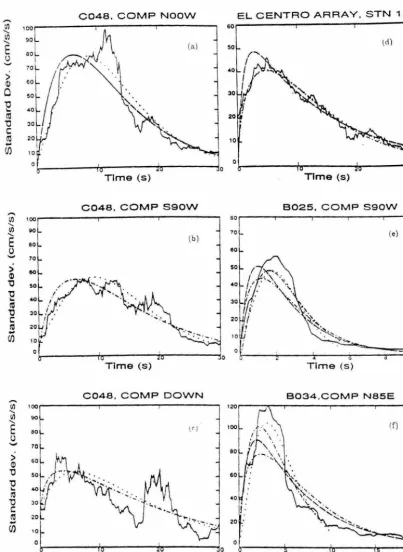
Figure 2.8. Comparison of the standard deviation computed for the accelerograms in Table 2.1 by the moving time-window approach (solid) and by the envelope-modulated white-noise model for the functions (2.1)
(dashed-dotted), (2.2) (dashed) and (2.58) (dotted).
Figure 2.9. The transformed series of stationary intensity for the NOOW component of the C048 record.
Figure 2.10. The NOOW component and one simulation for each optimal model of different subclasses. (a) "Target" accelerogram. (b) and (c) TIFC models with p=2 and p=4, respectively. (d) and (e) PTIFC models with p=2 and p=4, respectively.
compo-nent for each optimal model in Figure 2.10.
Figure 2.12. Comparison between the 5% damped response spectra of the "target" accelerogram (solid line), the mean response spectra (dashed-dotted
line) and the probabilistic response spectra (dashed lines which from
top to bottom correspond to p =0.99,0.90,0.50,0.10,0.01) computed for each optimal model in Figure 2.10. (a) and (b) correspond to
time-invariant frequency content models with p=2 and p=4, respectively.
(c) and (d) correspond to piecewise time-invariant models with p=2
and p=4, respectively.
Figure 2.13. Comparison between the 5% damped response spectra of the "target" accelerogram (solid line), the mean response spectra (dashed-dotted line) and the probabilistic response spectra (dashed lines which from top to bottom correspond to p =0.99,0.90, 0.50,0.10, 0.01) computed for the optimal PTIFC AR(2) model given in Table 2.2.
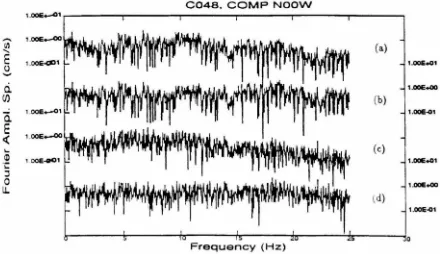
Figure 2.14. The Fourier transform of the "white-noise" samples in Figure 2.11.
Figure 2.15. Schematic diagram of the earthquake model, including Brune's source
model.
Figure 2.16. Power spectral density of the AR(p) model (dashed-dotted curved) and
the combined AR(p) and Brune's model (solid curve).
Figure 2.17. Comparison between the 5% damped acceleration response spectra
of the "target" accelerogram (solid line), the mean response spectra ( dashed-dotted line) and the probabilistic response spectra (dashed lines which from top to bottom correspond to p =0.99, 0.90, 0.50,
0.10,0.01) computed for optimal PTIFC AR(2) model in Figure 2.10,
including Brune's source model. (a) 0.04-20s period, (b) 0.1-2s period.
accelerogram (solid line), the mean response spectra (dashed -dot ted
line) and the probabilistic response spectra (dashed lines which from
top to bottom correspond to p =0.99, 0.90, 0.50, 0.10, 0.01) computed for optimal PTIFC AR(2) model in Figure 2.10, including Brune's
source model. (a) Velocity, (b) Displacement.
Figure 2.19. Comparison between the inelastic response spectra of the "target"
ac-celerogram (solid line), the mean response spectra (dashed-dotted line)
and the probabilistic response spectra (dashed lines which from top to
bottom correspond to p =0.99, 0.90, 0.50, 0.10, 0.01) computed for
optimal PTIFC AR(2) model in Figure 2.10, including Brune's source
model. Structural parameters n = 3, ry = 0.3 aJld ( = 0.05. (a) Acceleration, (b) Velocity.
Figure 2.20. Comparison between the inelastic response spectra of the "target"
ac-celerogram (solid line), the mean response spectra (dashed-dotted line)
and the probabilistic response spectra (dashed lines which from top to
bottom correspond to p =0.99, 0.90, 0.50, 0.10, 0.01) computed for optimal PTIFC AR(2) model in Figure 2.10, including Brune's source
model. Structural parameters n = 3, ry
=
0.3 and ( = 0.05. (a) Ductility, (b) Residual Ductility.Table 2.1. List of some representative accelerograms for assessmg stochastic
ground motion model.
Table 2.2. Various technical information about the accelerograms in Table 2.1 for
PTIFC modelling.
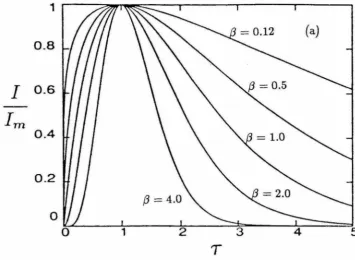
Figure 3.1. (a) Nondimensional time variation of the ground motion intensity for
different values of fl. (b) Relation between the nondimensional
dura-tion and
fl
for A = 10 and A = 20.band-width wg(g (dashed-dotted curves), damping ratio (g, and (b)
inten-sity [g obtained by the nine-parameter model (smooth curves) and the
moving time-window approach (other curves) for the C04S.1 record in
Table 2.1.
Figure 3.3. Comparison of (a) the C04S.1 accelerogram and (b), (c) two artificial
accelerograms.
Figure 3.4. Time variation of (a) undamped frequency Wg (solid curves),
band-width wg(g (dashed-dotted curves), damping ratio (g, and (b)
inten-sity [g obtained by the nine-parameter model (smooth curves) and the
moving time-window approach (other curves) for the El Centro Array,
Stn 12 record in Table 2.1.
Figure 3.5. Comparison of (a) the El Centro Array, Stn 12 accelerogram and (b),
( c) two artificial accelerograms.
Figure 3.6. Comparison of the exact (solid curve) and approximate (dashed-dotted
curve) autocorrelation function
Ryy(t, s)
of the stochastic processmod-eling the C04S.1 accelerogram.
Figure 3.7. The EPSD function plotted at different times (a) C04S.1, (b) El Centro
Array, Stn 12.
Figure 3.S. Comparison between the 5% response spectra of the C04S.1
accelero-gram (solid line), the mean response spectra (dashed-dotted line) and
the probabilistic response spectra ( dashed lines which from top to
bot-tom correspond to p =0.99, 0.90, 0.50, 0.10, 0.01) computed for the
nine-parameter optimal model.
Figure 3.9. Comparison between the inelastic response spectra of the C04S.1
ac-celerogram (solid line), the mean response spectra (dashed-dotted line)
bottom correspond to p =0.99,0.90,0.50,0.10,0.01) computed for the
nine-parameter optimal model. Structural parameters n
=
3, 1]=
0.3,and ( = 0.05.
Figure 4.1. N umber of cycles of oscillations needed for the oscillatory term to decay
to
n%
of its maximum value. n=l (solid curve), n=5 (dashed-dottedcurve), n= 1 0 (dot ted curve).
Figure 4.2. (a) Comparison between the nondimensiona.l exact (dashed curve) and
approximate (solid curve) mean-square displacement response of a
lin-ear SDOF oscillator subjected to a modulated (dashed-dotted curve)
white-noise excitation. 17 =
-¥o-
= 5.0.Figure 4.2. (b) Comparison between the nondimensional exact (dashed curve) and
approximate (solid curve) mean-square displacement response of a
lin-ear SDOF oscillator subjected to a modulated (dashed-dotted curve)
white-noise excitation. 17 = ~ = 2.0.
Figure 4.2. (c) Comparison between the nondimensional exact (dashed curve) and
approximate (solid curve) mean-square displacement response of a
lin-ear SDOF oscillator subjected to a modulated (dashed-dotted curve)
white-noise excitation. 1] =
-¥o-
= 1.0.Figure 4.2. (d) Comparison between the non dimensional exact (dashed curve) and
approximate (solid curve) mean-squa.re displacement response of a
lin-ear SDOF oscillator subjected to a modulated (dashed-dotted curve)
white-noise excitation. 1] = ~ = 0.5.
Figure 4.3. (a) Time variation of normalized mean-square displacement, C12, 1022,
and Ea for different damping ratios. (3 = 0.5, 1] = 5. Dotted curve
corresponds to the time variation of the input modulation.
and Ea for different damping ratios. (3
=
0.5, 'r/=
1. Dotted curve corresponds to the time variation of the input modulation.Figure 4.3. (c) Time variation of normalized mean-square displacement, E12, E22,
and Ea for different damping ratios. (3 = 4, 'r/ = 5. Dotted curve corresponds to the time variation of the input modulation.
Figure 4.3. (d) Time variation of normalized mean-square displacement, E12, E22, and Ea for different damping ratios. (3
=
4, 17=
1. Dotted curve corresponds to the time variation of the input modulation.Figure 4.4. Approximate nondimensional mean-square displacement (solid curves)
of the response of a linear SDOF oscillator subjected to a modulated (dashed-dotted curve) white-noise excitation.
Figure 4.5. Contour plots of the fractional error EL as defined III (4.112). The excitation is modeled by MODEL 1.
Figure 4.6. Contour plots of >'
(w
o)
as defined in (4.94). The excitation is modeledby MODEL 1.
Figure 4.7. Time variation of (a) the standard deviation and (b) the damped-frequency of the nine-parameter earthquake model fitted to the Orion
Blvd. recording.
Figure 4.8. Comparison between the exact (solid curve) and approximate (dashed curve) mean-square displacement response of a linear SDOF oscillator with 5% damping and Wo = 7,5,3, 1Hz. The excitation is the nine-parameter model shown in Figure 4.7.
Figure 4.9. Artificially designed time variation of the standard deviation and the damped-frequency of the nine-parameter excitation model.
curve) mean-square displacement response of a linear SDOF oscillator
with 5% damping and Wo = 7,5,3, 1Hz. The excitation is the
nine-parameter model shown in Figure 4.9.
Figure 4.11. Comparison between the exact (solid curve) and approximate
(dashed-curve) response of an equivalent linear SDOF oscillator. (a) STD of
the response (b) structural frequency
w(t).
Wo = 5Hz, (0 = 0.05.The excitation is the nine-parameter model shown in Figure 4.7 whose
damped frequency variation is repeated again in (b).
Figure 4.12. Comparison between the exact (solid curve) and approximate
(dashed-curve) response of an equivalent linear SDOF oscillator. (a) STD of
the response (b) structural frequency
w(
t).
Wo=
1Hz, (0=
0.05. The excitation is the nine-parameter model shown in Figure 4.7 whosedamped frequency variation is repeated again in (b).
Figure 4.13. Comparisons between the exact (solid curve), the proposed
approxi-mate (dashed curve), and Bucher's approximate (dashed-dotted curve)
solution for the covariance response of two modes i and j.
f3
= 0.5,(= 0.02.
Figure 4.14. Comparisons between the exact (solid curve), the proposed
approxi-mate (dashed curve), and Bucher's approximate (dashed-dotted curve)
solution for the covariance response of two modes i and j.
f3
= 0.5,( = 0.05, w = 1Hz.
Figure 5.1. Time variation of ( a) the standard deviation
.;q;rt5
and (b) thedomi-nant frequency w~(t) for the (TV) and the (TI) excitation models fitted to the Orion Blvd. record shown in Figure 2.1(a).
Figure 5.2. Nonstationary linear response characteristics computed for the (TV)
(solid curves) and for the (TI) excitation (dashed-dotted curves) for
Figure 5.3. Comparison of (a) the r.m.s. displacement responses and (b) the equiv-alent linear structural frequencies, for the (TV) (solid curve) and (TI) (dashed-dotted curve) excitation. Wo
=
1.5Hz, (=
0.05. Dashed curves correspond to the damped frequencies w~ of (TV) and (TI) ex-citations.Figure 5.4. Comparison of (a) the r.m.s. displacement responses and (b) the equiv-alent linear structural frequencies, for the (TV) (solid curve) and (TI) (dashed-dotted curve) excitation. Wo = 3.2Hz, ( = 0.05. Dashed curves correspond to the damped frequencies w~ of (TV) and (TI) ex-citations.
Figure 5.5. Comparison of (a) the r.m.s. displacement responses and (b) the equiv-alent linear structural frequencies, for the (TV) (solid curve) and (TI) (dashed-dotted curve) excitation. Wo
=
6Hz, (=
0.05. Dashed curves correspond to the damped frequencies w~ of (TV) and (TI) excitations.Figure 5.6. Softening elastic restoring force.
Figure 5.7. Comparison between the normalized EPSD functions computed by the (TV) (dashed curves) model at times 1, 4, 7, 10, 16, 22 seconds and the (TI) (solid curve) model for the Orion Blvd. recording.
Figure 5.S. Nonstationary nonlinear response characteristics computed for the (TV) excitation (solid curves) and the (TI) (dashed-dotted curves) excitations for varying initial structural frequencies. (0 = 0.05, Xy = 1/3.
Figure 5.10. Comparison between the response characteristics computed for the
(TV) (solid curves) and the (TI) (dashed-dotted curves) excitation.
(a) r.m.s. displacement of the response (b) equivalent linear structural
frequency. Wo
=
6Hz, (0=
0.05, Xy=
1/5. Dashed curves correspondto the damped frequencies w~ of (TV) and (TI) excitations.
Figure 5.11. Comparison between the response characteristics computed for the
(TV) (solid curves) and the (TI) (dashed-dotted curves) excitation.
( a) r.m.s. displacement of the response (b) equivalent linear structural
frequency. Wo = 4Hz, (0 = 0.05, Xy
=
1/3. Dashed curves correspondto the damped frequencies w~ of (TV) and (TI) excitations.
Figure 5.12. Comparison between the response characteristics computed for the
(TV) (solid curves) and the (TI) (dashed-dotted curves) excitation.
(a) r.m.s. displacement of the response (b) equivalent linear structural
frequency. Wo
=
3Hz, (0=
0.05, Xy = 1/3. Dashed curves correspondChapter 1
Introduction
1.1 Motivation and Objectives
In
earthquake-resistant design of major civil engineering projects, there aretwo major problems to be considered. One is predicting structural response to
earthquake shaking so that the proposed structure can be designed to respond satisfactorily. This problem is in the domain of the earthquake engineer. The other
problem is predicting the ground shaking that a structure may experience during its
lifetime. This problem may be considered the domain of the geologist and
strong-motion seismologist, although earthquake engineers and geotechnical engineers may
also get involved.
The earthquake engineer would like a description of the ground motion which
IS complete enough to reliably predict the corresponding dynamic response of a
structure. Peak ground acceleration alone is clearly too crude for this purpose.
A response spectrum provides a better description but it leads to difficulties, for
example, in predicting nonlinear response and in-structure equipment response (the
so-called "response of secondary systems"). Ideally, the earthquake engineer would
like the geologist and seismologist together to provide full time histories of possible
ground shaking and their probability of occurrence during the proposed lifetime of
the structure.
On the other hand, these scientists are limited by current theory and lack
of knowledge of subsurface properties, fault rupture recurrence intervals, and so
on, so that only a relatively simple description of the ground motion is possible.
predictions at very low frequencies, given two source parameters such as seismic
moment and corner frequency, but the "high"-frequency content (say over 1 Hz)
observed in accelerograms is generated at the source by local stress concentrations
at "asperities," a mechanism not well understood. Also, the propagation of these
frequencies is affected by variations in material properties which are uncertain on
the scale of the wave lengths involved. Thus, deterministic prediction of
high-frequency ground motion requires detailed knowledge of the state of the Earth and
the physical processes involved which is not usually available. One way to account
for the uncertainty in such knowledge is to employ a stochastic process which gives
a probabilistic description of the ground shaking.
One goal of this study is to develop a model to characterize ground shaking
which is complete enough for structural response studies and yet is simple enough
for ground motion prediction. Ideally, we would like a description of strong ground
motion which is independent of source and propagation models on the one hand and
of structural dynamics models on the other hand. The description would then form
a "fixed" interface through which ground motion prediction and structural response
prediction can be coupled, while still allowing independent developments in theory
and methodology in these two areas. Thus, we want to avoid expressing the ground
motion in such a way that it is dependent on a particular structural dynamics model.
If response spectra are used, for example, the earthquake engineer faces difficulties
in predicting the inelastic response of a structure, since what is given is the peak
response of a simple linear system. At the same time, if theoretical source models
and propagation models are used to describe the ground motion, these are likely
to be inadequate at "high" frequencies. A more complete description is preferrable
even if it does require complementing the theoretical models with an empirical
approach.
The first objective of this thesis IS to characterize strong ground motion 111 terms of a model in such a way that:
1) It captures with a small number of parameters the essential features of
the ground motion for the purpose of computing dynamic response, including the
a small number of parameters cannot give a complete description of the ground motion time history, a stochastic model is employed.
2) It is simple to use in processing existing accelerograms and estimating the most probable model that gives the "best" fit, in a statistical sense, to the acceler-ation data;
3) It is efficient to use in simplified analytical random vibration and reliability studies;
4) It is computationally efficient in generating artificial accelerograms for com-puting structural response using simulations;
5) The model parameters are physically meaningful so that they can be related to variables accounting for the earthquake source mechanism and propagation and local site effects in a seismic risk analysis.
The second objective of this thesis is to approximate the existing lengthy ex-pressions for the covariance of the nonstationary response of linear and equivalent linear systems (derived by applying the equivalent linearization method to nonlinear systems) in such a way that a) the approximations preserve the essential features of the response without significant loss of accuracy, and b) direct insight into the effect of the ground motion nonstationarities on the nonstationary structural response can be gained.
1.2 Summary of this Study
different earthquake events are studied by special subclasses of the general class of
models in order to assess the extent to which the class needs to be parameterized.
The adequacy of each subclass is judged by analyzing the residuals generated by
each optimal model, by comparing the target accelerogram and a sample of
simu-lated accelerograms, as well as by comparing the corresponding elastic and inelastic
response spectra. Brune's earthquake source model is incorporated in the model
to increase the accuracy of the spectral amplitudes at very low frequencies. The
correlation between the time variation of the model parameters and the different
wave groups present in strong motion accelerograms is also investigated.
In Chapter 3, a parsimonious probabilistic ground motion model is proposed
based on the findings reported in Chapter 2. The model is capable of capturing,
with at most nine parameters, all those features of the ground acceleration history
which have an important influence on the dynamic response of linear and nonlinear
structures, including the amplitude and frequency content nonstationarities of the
shaking. The model, which is a special case of the general class of models presented
in Chapter 2, is formulated in both continuous and discrete time by stochastic
second-order differential and difference equations, respectively. The coefficients of
both equations are treated as slowly-varying functions of time. Statistical
proper-ties of the stochastic processes generated by these equations are studied in detail,
and appropriate conversion relationships are developed to link the two formulations.
The proposed ground motion model can be efficiently applied in simulations as well
as analytical response and reliability studies of linear and nonlinear structures. The
Bayesian statistical method for estimating the model parameters is illustrated by
us-ing representative recorded "target" accelerograms. The applicability of the model
is checked by comparing the statistics of various linear elastic and inelastic response
parameters of a single-degree-of-freedom structure computed for the ground motion
model with the deterministic values of the same response parameters computed for
the "target" accelerogram.
In Chapter 4, random vibration analysis of both linear and nonlinear
(soften-ing) single-degree-of-freedom oscillators subjected to a stochastic excitation is
equiva-lent linearization method. A formulation is developed to approximate the original
computationally lengthy expressions for the covariance of the transient response of
the equivalent second-order linear oscillator by much simpler expressions. The
pro-posed approximation holds for a broad range of oscillator and excitation parameters.
In particular, it treats time-varying equivalent linear oscillators with any value of
the damping ratio, as well as excitations with time-varying amplitude and frequency
content. Classically-damped multi-degree-of-freedom linear systems are also
consid-ered and the original equation for the covariance response of two modes is
approxi-mated by a much simpler equation. The approximations reduce the computational
time involved in computing the response by more than an order of magnitude and
they preserve the essential features of the response without significant loss of
accu-racy. The results provide physically meaningful insight into the characteristics of
the nonstationary response to "earthquake-like" excitations.
Chapter 5 uses the ground motion model proposed in Chapter 3 and the
ap-proximate simplified expressions for the covariance response developed in Chapter
4 to provide insight into the effect of the ground motion nonstationarities on the
response of linear and nonlinear elastic structural models. A simple mathematical
analysis demonstrates the effects of softening of nonlinear structural models on their
response. It is found that the temporal nonstationarity in the frequency content of
the ground motion significantly influences the response of both linear and
nonlin-ear structures, and therefore it should not be neglected in the modeling of strong
ground motion.
Chapter 2
Modeling of Strong Ground Motion
by
Stochastic Differential and Difference Equations
2.1 Introduction
Earthquake accelerograms are obviously nonstationary time series. The
non-stationarity is manifested primarily in two different ways. First, the intensity of
the ground acceleration varies with time; after arrival of the first seismic waves, it
builds up to a maximum value over several seconds and then decreases gradually
until it vanishes into the background noise. Second, the frequency content varies
with time with a tendency to shift to lower frequencies as time increases. These
non-stationarities can be attributed partly to the different intensity, frequency
con-tent and arrival times of the P-wave, S-wave and surface-wave groups, and partly
due to the finite rupture-time and finite fault area.
The time-domain stochastic models that have been employed in the past to
represent one or both of the above non-stationary features have generally had one of
the following two types of structure.
In
Model I, shown in Figure 2.1(a), a stationarywhite-noise process is passed through a linear system in order to obtain the desired
correlation structure (or power spectral density) and the result is multiplied by a
deterministic envelope function so that the stationary filtered white noise gets the
desired time-dependent variance. In Model II, shown in Figure 2.1 (b), the action
of the linear system and the envelope function is reversed, so that stationary white
noise is multiplied by an envelope function to give non-stationary white noise, which
is then fed through a linear system, and the output represents an accelerogram.
Models I and II are also referred to as a "modulated stationary process" and a
system and the envelope function is chosen so that the output stochastic process
resembles certain prominent features observed in real accelerograms. The linear
system is usually assumed to be described in continuous or discrete time by a linear
differential or difference equation, respectively. These equations might have either
constant or time-varying coefficients.
Housner and Jennings (1964) have computed and analyzed the response spectra
of artificial accelerograms generated by ModelL In their work, the output of the
linear system corresponds to the absolute acceleration response of a
single-degree-of-freedom oscillator subjected to white-noise base excitation. The power spectral
density of the acceleration then has the form proposed by Kanai (1957) and Tajimi
(1960). This model was motivated by a simple representation of the dynamics of a
surface layer between the ground surface and the basement rock. In order to remove
the unrealistic nonzero components at the very low frequency, Clough and Penzien
(1975) included a high-pass filter into the low-pass Kanai-Tajimi filter.
The envelope function proposed by Housner and Jennings is composed of a
quadratic build-up phase, a constant phase, and an exponentially-decaying tail.
Based on a theoretical result, Saragoni and Hart (1974) proposed the envelope
function:
J(t) = atf3exp( -It)
0:::;
t:::;
To,
(2.1)whereas Shinozuka and Sato (1967) suggested the parametric form:
J(t) = a (exp(-;3t) - exp(-,t))
0:::;
t :::; To.
(2.2)In these expressions,
To
is the duration of the strong-motion record. The abovefunctions have simple parametric forms and were assumed to be representative of
the time variation of the amplitude, or intensity, of ground shaking, thereby
mod-elling the rate of build-up, rate of decay, maximum intensity and strong-motion
duration of the accelerograms. These authors employed continuous-time
formula-tions of the models and, with the exception of Saragoni and Hart, the models had
a stationary frequency content. The work of Saragoni and Hart (1974) divides each
accelerogram into three segments and models the frequency content of each
the abrupt change in the frequency content from segment to segment is not very satisfactory for simulating strong ground motion.
Recently seismologists have also become interested in the stochastic represen-tation of ground motion with stationary frequency content using simple versions of models I or II but relating the parameters of the model to theoretical models for source mechanisms and wave propagation (for example, Boore, 1983 and Safak, 1988).
Most recently, Yeh and Wen (1989) modeled the time variation of the frequency content by continuously changing the time scale of a stationary stochastic process to obtain a frequency modulated stochastic process. A frequency modulation function was used to relate the time-varying power spectrum to the original stationary pro-cess. Methods based on least-squares fit were proposed to separately estimate the frequency and the amplitude modulation of the model. The energy function and the cumulative zero-crossings corresponding to the amplitude and the frequency mod-ulation of the model were fitted to the expected energy function and cumulative zero-crossings of real accelerograms.
accel-eration time histories. Polhemus and Cakmak (1981) also used ARMA(2,1) and ARMA( 4,1) models for the linear system in Figure 2.1 ( a) and a polynomial ex pres-sion for the envelope function. A non-linear least squares procedure was applied to estimate the number of the polynomial terms needed as well as the values of the polynomial coefficients. Using the estim.ated time-dependent variance of the earthquake accelerogram, a "normalized" series was constructed and a stationary ARMA model was fitted to that series. The estimation of the ARMA parameters was done according to procedures discussed by Box and Jenkins (1976). Com-parisons between the response spectra of the original and simulated accelerograms showed good agreement for periods less than five seconds.
In
contrast to the work mentioned so far using ARMA models, which did not model the nonstationary frequency content observed in accelerograms, Jurkevics and Ulrych (1978) modeled the time-varying character of both the intensity and the frequency content using nonstationary AR(p) processes. The AR parameters were determined either by segmenting the record or by continuously updating the parameters in a time adaptive manner. To smooth out short-period variations, third degree polynomials were fitted to each of the parameters of a second-order model while Saragoni and Hart's envelope function was fitted to the white-noise variance. The procedure was successfully demonstrated for the Orion Boulevard recording of the 1971 San Fernando earthquake.In
a later study (1979), the same authors used their model to analyze 40 "rock-site" accelerograms obtained during intermediate-sized earthquakes in Southern California. The results of the analysis were used to estimate empirical relationships for the duration and attenuation of shaking amplitude with epicentral distance.conditions of the difference equations and the white-noise variances were the only unknown parameters to be estimated.
In summary, the existing ground motion models formulated in continuous time, with the exception of that developed by Yeh and "Ven (1989), fail to incorporate the time variation of the frequency content of the ground motion in a manner that is physically justified and is also efficient to use in both structural response simu-lations and random vibration analyses. The time variation of both the amplitude and the frequency content of the ground motion can be efficiently modeled in detail by employing nonparametric discrete models. However, these models can only be used to match existing accelerograms and generate artificial accelerograms having similar statistical properties with the "target" one. The lack of a small number of physically meaningful parameters in the model restrict their applicability and make them inappropriate to use in seismic risk studies and in predicting possible future ground motions from a given seismic environment. Although nonparametric discrete models generate artificial accelerograms in a computationally efficient way for use in structural response simulations, they cannot be used for simplified ana-lytical random vibration studies unless a simple continuous version of the model is available.
In this chapter, a general class of parametric stochastic models is proposed to investigate in detail and subsequently model the nonstationarities in both amplitude and frequency content observed in strong-motion accelerograms. A small number of SDOF (single-degree-of-freedom) oscillators acting in series and possibly time-varying replace the linear system in Figure 2.1(a) or (b). Each oscillator is described either in continuous time by a second-order differential equation or in discrete time by an AR(2) difference equation. The discrete-time formulation leads to a time-varying AR(p) model and provides a convenient algorithm for analyzing and sim-ulating accelerograms. For special subclasses of the general class of models, the discrete and the continuous model are linked by developing appropriate conversion relationships.
class needs to be parameterized. The new contributions III this chapter are as follows:
a) The development of a new simple and effective statistical method, based on a Bayesian probabilistic approach, to determine the "optimal" model, which is the most probable stochastic model, for a given subclass and a given "target" accelero-gram. Each optimal model is then used to judge the adequacy of the subclass of ground motion models by analyzing the residuals generated by each optimal model,
by comparing the target accelerogram and a sample of simulated accelerograms generated by the optimal model, as well as by comparing various linear elastic and inelastic response paramerers of a SDOF structure.
b) The incorporation of Brune's model (1970) in the stochastic formulation to improve the accuracy of the spectral amplitudes at very low frequencies;
c) The correlation of the time variation of the nonstationary features of the accelerograms with the time variation of the model parameters and the physical interpretation of such variations. Certain average trends concerning the time vari-ation of the model coefficients will be identified;
d) The study of the sensitivity of various response parameters to the details of the ground motion which are left "random" by the stochastic model.
The findings in this chapter will provide background for developing and jus-tifying the use of more parsimonious models in Chapter 3. The ultimate goal of these studies is to develop a simple and more efficient probabilistic representation of ground motion time histories.
2.2 General Class of Strong Ground Motion Models
-developed. The equivalence between the continuous and the discrete formulation
for specific subclasses of the general class of models is also derived by developing
appropriate conversion relationships.
2.2.1 Continuous Model
The mathematical form of the model has the continuous-time representation:
Lj(t,fiJ Yj (t)
=
Yj-l (t),
j=
1, ... , M,Yo (t)
=f
(t,ft)
e(t),
with the time-varying operator
Lj(t,fD
being defined by:(2.3)
(2.4)
where
y(t) _ YM(t)
,
ande
(t)
is a continuous Gaussian stochastic time series withproperties
E[
e
(t)]
=a
andE[e(t)
e
(T)]
=8(t -
T),
(2.5)usually referred to as a continuous stationary white-noise process. The symbol
E[ ]
denotes mathematical expectation. The coefficientsWj(t,ft)
,
(j(t
,
ft)
and themodulation function
f (
t,
ft.)
are deterministic. Their time-varying structure ispos-tulated depending on the application and, in general, it depends on a parameter
set
ft.
These time-varying coefficients control the time-variation of the amplitudeand the frequency content of the stochastic process y(
t).
Note that the set ofequa-tions (2.3) is equivalent to a continuous differential equation of order 2M, driven by
a modulated continuous white-noise process. Because of the linearity of equation
(2.3), the process
y(
t)
is a zero-mean Gaussian stochastic process. Therefore, theautocovariance function (ACF)
Ryy(tl
'
t2 ) defined as(2.6)
com pletely describes the probability structure of Y (
t
)
.
Consider values of the continuous stochastic process in Section 2.2.1 at
regu-lar time intervals
.6.t,
then a stochastic sequencey(k.6.t)
is obtained which can beap-proximately described by difference equations. Digitized earthquake accelerograms
are modeled as specific realizations of this discrete stochastic process. To introduce
a discrete model which approximates the sampled sequence, we first approximate
the dynamics of the second-order continuous equation by the second-order difference
equation:
Yk U) _ bU) l,k -(B)yU) k-l _ b(j) (B)y(j) 2,k - k-2 = cU) (B)yU-l) l,k - k-l , j =
1, ...
,M
(2.7)where
yij)
approximates the value of the processyj(t)
at timet
=k.6.t.
The forcingfunction
yiO)
of the discrete version of model (2.3) isyiO)
=
O"kO)
ek, where ek IS azero-mean, unit-variance Gaussian white-noise sequence with properties
E[ed
= 0 and(2.8)
It is easy to show that the output stochastic sequence {Yk}
{ViM)}
satisfies anAR model of order p =
2111,
given by the difference equation:P
Yk =
L
ai,kUl)
Yk-i+
O"kUD
ek, k = 1, ... ,N (2.9) i=lwhere ai,k(fl), i = 1, ... , p and O"k(fl) are in general time-varying coefficients which
depend on the parameter set fl. From the linearity of equations (2.9), the output
discrete process is also a zero-mean Gaussian process, completely defined by its
autocovariance function Rkl = E[YkY!]'
In
the next section, simplified subclasses of the general class of the model arestudied. The auto covariance functions will be used in the next section to study
the equivalence between continuous and discrete stochastic processes generated by
specific subclasses of the general class of ground motion models (2.3) and (2.7).
The coefficients of the discrete model are chosen such that the discrete and the
continuous stochastic processes have the same statistical properties, that is, the
same autocovariance functions. The resulting conversion relationships allow
inter-pretation of the coefficients of the discrete model in terms of the coefficients of the
to estimate the model parameters. The methodology is illustrated for specific sub-classes. Section 2.5 deals with the structural response to ground motions generated by the ground motion model. Numerical results for the analysis and the modeling of real earthquake accelerograms are presented in Sections 2.6 and 2.7.
2.3 Subclasses of Strong Ground Motion Model
Although a stationary model fails to describe the nonstationarities observed in accelerograms, its structure constitutes a basis for understanding the more compli-cated structure of the nonstationary model. Therefore, a mathematical description of the time-invariant linear system is first introduced, and it is then extended to include the time-variation of both the amplitude and frequency content which is observed in real accelerograms.
2.3.1 Stationary Stochastic Model
The stationary model is a special case of model (2.3) where both the oper-ators
Lj(t,£!.)
and the modulat.ion functionf(t,fJ..)
are time-invariant. The mathe-matical form of the stationary model has the continuous-time representation:L j Yj
(t)
=
Yj-dt),
j=
1, ... , A1,Yo
(t)
=f
e(t) ,
wit.h the time-invariant operator Lj being defined by:
d
2d
L j = dt2 +2(jWjdt +w;,
(2.10)
(2.11)
where
y(
t)
YM(t)
is a stationary stochastic process. In this case, the parameter set £!. includes the nat ural frequencies W j, the damping ratios (j, of each linear equationin (2.10) and the constant forcing term coefficient f. Because of the stationarity of
y(t),
its autocovariance function depends only on the time difference 7 =tl - t2,
that is,
Ryy (tl' t 2)
=Ryy (7).
For the case M = 1, the ACF (autocovariance function)
Ryy
of the output stationary processy( t)
has the simple closed form (Changet al.,
1982):f2
Ryy
(t)
=
3 (<p)
e
-
(IWlt
COS(W~t-
<P
1)
(2.12a)where
(2.12b)
Note that the ACF is a damped cosine wave, defined completely by the natural frequency and damping coefficient of the model, together with the power
P
of the input white-noise process.The sampled stationary stochastic sequence y(k6.t) can be approximated as in (2.7) by the set of the time-invariant second-order difference equations
Y(j) - b(j)y(j) - b(j)y(j) - c(j)y(j) k 1 k-l 2 k-2 - 1 l k-l' J'
=, ... ,
1 M (2.13)where
y~j)
approximates the value of the process yj(t) at time t = k6.t. Beck and Park (1984) show how to choose each second-order difference equation so that it constitutes the minimal-parameter discrete model that best fits the dynamics of the oscillator described by the second-order differential equation. The coefficientsb~j),
b~j)
andc~j)
are selected by imposing two conditions. The first condition enforces the free vibration solutions of the discrete and continuous second-order equation to be equal at each time tk = k6.t, which results in the relationships:bij) = 2exp(-wj(j6.t) cos (WjJl- (J6.t); if (j::; 1
bij) = 2exp(-wj(j6.t) cosh (WjJq -l6.t); if (j
2:
1b~j)
= -exp (-2wj(.i6.t)(2.14a)
(2.14b)
(2.14c)
For the second condition, the transfer function of the discrete equation is forced to optimally match the transfer function of the continuous one, in a least-squares sense, over the frequency band from DC to the Nyquist frequency 1/(26.t). This determines the optimum value of the coefficient c~l). The accuracy of the approx-imation deteriorates as the oscillator frequency approaches the Nyquist frequency, that is, as the number of time-steps per period decreases. For 10 time-steps per period, a very accurate discrete model is obtained for the oscillator.
Model (2.13) with forcing function
y~O)
= 0-(0) ek is the discrete verSIOn of model (2.10) for the stationary case. The value of 0-(0) is determined by enforcingoutput stochastic sequence
{Yd
order p =2M
of the type{yi
M )} satisfies a time-invariant AR model ofP
Yk =
2:=
aiYk-i+
(7ek,i=l
k = 1, ... ,N (2.15)
In the case M = 1, the discrete ACF of the stationary output sequence
{yd
takes the simple closed form (Chang et al., 1982):(2.16a)
where
and the variance (7~ has the form:
(2.16c)
The discrete autocovariance function is also a damped cosme wave, defined completely by the natural frequency and damping coefficient of the model and the variance of the discrete white-noise input process. Enforcing equality of the respec-tive variances in (2.16c) and in (2.12a)
(t
=
0) for the discrete and the continuous output processes, the relationship between (7 andf
is obtained in the form:1 - a2 (72
1
+
a2 (1 - a2/ - ai(2.17)
the two ACFs is very good. Note that in the case of M = 1 and for a white-noise forcing function, Nau et al. (1980) have shown that choosing an ARMA(2,1) model,
rather than an AR(2) model, gives an exact match between the discrete and the
continuous ACF at the points where the first is defined. The transfer function of the
ARMA(2, 1) model gives a slightly better fit to the typical strong-motion spectral
amplitudes at the very low frequencies where the AR(2) model has a theoretically
incorrect behavior. However, the frequency content of real accelerograms in this
range is contaminated by noise and so can lead to unreliable estimation. As it
will be seen later, Brune's source model (1970, 1971), which is based on physical
considerations, is employed to correct the very low frequency spectrum in this work.
2.3.2 Piecewise Time-Invariant Model
The discrete version of the stationary stochastic model is modified herein
to account in a piecewise manner for the time-variation of both the amplitude and
the frequency content observed in accelerograms. Mathematically, the piecewise
time-invariant (PTI) model is described by the difference equation:
P
Yk
=
L
ai,kYk-i+
CTkeki=1
(2.18)
where the coefficients of this equation and the variance of the white-noise input
sequence have the piecewise-constant representation:
L L
ai,k =
L
a~l)
R~l)
,
CTk =L
CT(1)R~l)
,
(2.19)1=1 1=1
The superscript
(l)
specifies a time segment of initial and final time tl-1 = N/_1Clt and t/ = N/Clt respectively, andR~l)
is a rectangular window given by(2.20) = 0 elsewhere.
The coefficients
a~l),
CT(l) are the unknown parameters of the model and togetherof the ground acceleration. However, the piecewise-constant representation of the coefficients ai,k accounts primarily for the time variation of the frequency content. On the other hand, the a(l) 's account primarily for the time variation ofthe intensity of the accelerogram. The piecewise time-invariant model will be utilized in Section 2.5 to explore in detail the nonstationarity of strong-motion accelerograms.
In the PTI model, the sequence
{Yd
within each segment and sufficiently far from the segment boundaries approaches stationarity. The correlation structure of the sequence during each segment is described by the expressions developed in the previous section for the discrete case or the equivalent continuous stationary process. The parameters in those expressions are replaced by the parametersa~l)
and a( /) corresponding to each segment I. Close to the boundaries of each segment, the process{Yk}
is not stationary since its correlation structure is influenced by the transient effect arising from the sudden change ofthe coefficients according to (2.19). The more the oscillators are da.mped, the smaller the nonstationary zone close to the boundaries that is influenced by the transient effect. In applications considered herein, the oscillators are heavily damped and also, for purposes concerning stable parameter estimation, the length of each segment is chosen to be much longer than the time-length of the transient zone. The stationary model is a special case of the PTI model for L=
1.2.3.3 Envelope-Modulated White Noise Model
The envelope-modulated white-noise (EMWN) model has the discrete form
k = 1, ... ,N. (2.21 )
2.3.4 Piecewise Time-Invariant Frequency Content Model
The Piecewise Time-Invariant Frequency Content (PTIFC) model has the
discrete time representation
(2.22)
I
where Yk' k = 1, ... , N is the PTI discrete process given in equation (2.18). The piecewise constant representation of the coefficients accounts for the time variation of the frequency content. The slowly-varying envelope function
h(fl),
which may assume the form (2.1), (2.2), or others, models in a continuous manner the variation of the intensity with time and it does not alter significantly the relative contributionof each spectral component to the output for each segment.
2.4 Bayesian Methodology for Parameter Estimation
In this section, a probabilistic methodology for estimating the model param-eters is presented. We use probability in the Bayesian sense of a multi-valued logic, so
p(a/c)
denotes a measure of the plausibility of the propositiona
given the information in proposition c. Bayes' theorem is a consequence of the axioms of probability logic:(
/b )
=p(b/a,c)p(a/c)
p
a ,cp(b/c).
(2.23)Bayes' theorem can be applied to data to extract information about the values of a parameter set of a model (Box and Tiao, 1973). To illustrate this, let M denote a given class of stochastic models characterized by a parameter set
fl
and let Jf.. denote a data sample to be characterized by the model. As we are uncertain what value offl
is appropriate before the data is examined, we treat the parameters as uncertain variables and use probabilities to quantify our uncertainties about their values. Applying Bayes' theorem for the parameter setfl
and the data Jf.., expression(2.23) takes the form:
(
;,)
_ p(Y/fl,.M)p(fl/kf)
P
fl/
Y,A1
-
( )
- p
Jf../M
(2.24)Relation (2.24) can be rewritten
(2.25)
where the form of the
p(Ji./fl.,
Jill) can be deduced from the structure of the assumed model, as will be seen later in some specific applications. The constant I\, is chosenso that it normalizes
p(fl./
Ji.
,
Jill) according to:1
p (fl./
u,
M)
dfl.
= 1 , (2.26)where
n
is the range of interest of the parameter setfl..
Relation (2.25), which gives the posterior probability distribution of the parameter setfl.,
indicates how the prior distribution offl.
is modified by the information from the sampleJi..
The most probable values ~ given the dataJi.
are those which maximizep (fl./U,
M)
overn.
These are used to give the most probable model in 111, which is taken to represent the observed process. This choice is clearly the most rational one if a single model in M is to be chosen, but it is also the correct choice asymptotically for large sample sizes in the sense that representing the whole class M by the most probable modelentails no loss of information when the class M is identifiable (Beck, 1990).
2.4.1 General AR(p) Model with Time-Varying Coefficients
Let
Mp
denote the nonstationary AR(p) modelP
Yk
=L
ai,k
(fl.) Yk-i
+
bk
(fl.) ek,
(2.27)i=l
where
ek
is a zero-mean, unit-variance Gaussian white-noise sequence andai,k(fl.),
bk(fl.),
i = 1, .. .,p
are in general time-varying coefficients which depend on the parameter setfl..
Let alsoJi.N
==
[Yl,
Y2, ... ,Ynl be an observed sequence of the process of interest, then using Bayes' theorem for the sets of variablesJi.N
andfl.,
the posterior probability distribution of the model parameters is:(2.28)
probability distribution of the sequence Yk given the parameter values takes the form:
N
P (Y..Nlfl, Mp)
=
P (YN, ... ,yJ/fl, Mp)=
II
P (Yk/Yk-l, ... ,Yk-p,fl, Mp) . (2.29)k=l
Since each ek is a unit Gaussian random variable, the p(yk!Yk-l, ... ,Yk-p, fl, Mp)
is also Gaussian, given by:
P(Yk
I
Yk-"
...
,
Yk-p,li, Mp)
=VZ;;~'(!1)
exp [ -2bi\!1)
(Y
k -~
a;
,
.(§)
Y
k -;)
']
(2.30)
It is assumed that the p(fl/ !vIp) is a locally non-informative prior distribution for the parameter set fl, which means that all values of the parameters over a large range are considered equally plausible a priori (Box and Tiao, 1973). Mathematica.lly, it is
assumed that p(fl/Mp) is constant over a large but finite range of interest
n.
Usingthis assumption and (2.28), (2.29), and (2.30), the posterior proba.bility distribution
of the parameters given the data
Ji.. N
and the modelll/[p, takes the form:(2.31 )
Expression (2.31) gives the updated joint probability distribution of the param-eter set fl, given the data sequence
Ji..N
and the class of models A1p. The mostprobable value
Q
of the model Mp is obtained by maximizing relation (2.31) and it defines the "optimal" AR(p) model to represent the given sample accelerogramJi..N.
Defining a more convenient functionFUD
,
such that(2.32)
the optimization problem is converted to a. nonlinear minimization of the objective
function F(fl).
Expression (2.32) is the general formula for obtaining the most probable
the coefficients ai,k and bk. The above method is simple and it is developed fully in the time domain utilizing the acceleration data directly in its digitized form. Un-like frequency-domain methods which are applicable only to stationary cases, the present time-domain method a) is applicable to the estimation of the nonstationary features of accelerograms, b) it can directly incorporate smooth parametric varia-tions of the model parameters and c) it simultaneously treats the amplitude and the frequency content nonstationarities. Next, we specialize expression (2.32) for specific subclasses of the general class of models.
2.4.2 Piecewise Time-Invariant Model
Recall that the coefficients of the piecewise time-invariant model have the representation (2.19), so after algebraic manipulations, the posterior probability distribution of the parameter set fl takes the form:
L
P(fl/}LN,Mp) =
IIp(l)
(f!..(I)/}LN,Mp) (2.33) [=1where
fl(l) =
(a~l),
...
,a1i)
,(j(l») ,c(l)(j(N~-NI-l)
exp [2 [-(:)],'f
(Yk -ta~l)Yk-i)2l
(j k=N1_1 +1 z=l
(2.34)
Expression (2.33) implies that the parameter subsets fl(l) corresponding to different segments are statistically independent. Thus, the most probable values are obtained by maximizing each
p(!l([)
/}L, A!fp) independently.For simplicity, introduce for each I the set
{y~l)
,
i = 1, ... ,N(l)} such that for allI:
~(l) . _ 1 N(l)
YNI-l-p+i=Yi ' z- , ... , (2.35)
where N(l) = N[ - N1- 1 . Then using (2.34), the corresponding objective function
F(l)(!l(l»)
can be rewritten more conveniently as:F(l)(ftY»)
= In c+
N In (j+
2!2
(Q -
i)T
(Q -
i)
where
Y2
11..=
(
Yp+l ) Yp+2
y~+]J
,
YN-l+p YN-2+p
YN
(2.37a)
(2.37b)
(2.37c)
We have dropped the superscript I in equations (2.36) and (2.37) for clarity. For
this case, the minimization of (2.36) results in a closed form expression for the most
probable values of the model parameters in the form
~(l)
=
(Q~l),
a-(I)), whereQ~l)
isgiven by (2.37a) and a-(l) is given by:
[
ah(
I)]2
=
N(l) 1(
11..
h
(l)
-
~h
(l»)T(
11..
h(
l)
-
~h
(l»)
(2.38)2.4.3 Envelope-Modulated White-Noise Model
For the envelope-modulated white-noise model defined by (2.21), the
objec-tive function
F(ft)
takes the form:N 1 N 2
FUD
=In
c+
Lin
!k
(ft)
+
2
L
j!j(B)'
k=l k=l k
-(2.39)
The condition that is satisfied at the minimum of F(fl.) , is:
(2.40)
where ~ is the value at which the minimum is attained and
Bi
is the i-th parameterof the envelope function
!k(ft).
ForBi
=
cr, the scaling parameter for the envelopes(2.1) or (2.2), condition (2.40) gives
( )
2 N
1
L
YkN K=l
!k
(~)
= 1.Therefore using the proposed methodology, the most probable envelope function
jk
=fk(ft)
is chosen so that the process{Yk/
jk,
k
= 1, ... ,N
}
has unit samplevariance. In general, the optimum value
ft
cannot be determined analytically but must be calculated numerically using a minimization algorithm.2.4.4 Piecewise Time-Invariant Frequency Content Model
The procedure which estimates the parameters of a piecewise time-invariant frequency content (PTIFC) model given an accelerogram is divided into three steps.
Step
1. The envelope-modulated white-noise model is utilized to model the intensity of an accelerogram in a prescribed interval[to,
tIl
,
and the most probable envelopej(t)
is estimated by minimizing (2.39). In this case,j(t)
is a prescribed continuous-time measure of the standard deviation of the process (equations(2.1)
or
(2.2),
for example) with the optimal estimates of the parameters.Step
2. A time series with constant intensity is obtained by dividing the original accelerogram by the estimate of its time-varying standard deviationjk,
according tok = 1, ... ,N. (2.42)
Step
3. The "optimal" model with frequency content which is either time-invariant or piecewise time-invariant is obtained using the transformed constant-variance serieshh
,
k
= 1, ... ,N}
as described in Section 2.4.2. For parameter estimation purposes, the length of each segment in the piecewise time-invariant case must be chosen:a. short enough so that the predominant frequency of the modeled segment re-mains almost constant over its length and
b. long enough so that the estimation procedure is capable of reliably determining the information about the frequency content of the segment.
nsid-ered with an inadequate model (for example, the number of segments L was not
sufficient to model an accelerogram with significant time-varying frequency con-tent), led to erroneous results for the most probable envelope function. In addition,
the three-step procedure is computationally efficient for the piecewise time-invariant
model. In this case, the most probable model is obtained explicitly by the formu-las (2.37a) and (2.38) and by an additional numerical minimization of the nonlin-ear three-parameter function
![Figure 2.2. Effect of n on the force-displacement curve [from Jayakumar, (1987)].](https://thumb-us.123doks.com/thumbv2/123dok_us/1121024.1141211/63.558.95.482.104.429/figure-effect-n-force-displacement-curve-jayakumar.webp)
![Figure 2.3. Hysteresis loop for periodic response of the structural model [from Jayakumar, (1987)]](https://thumb-us.123doks.com/thumbv2/123dok_us/1121024.1141211/64.558.143.439.129.401/figure-hysteresis-loop-periodic-response-structural-model-jayakumar.webp)
![Figure 2.4. Force-displacement curves for arbitrary loading of the structural model [from Jayaku-mar, (1987)]](https://thumb-us.123doks.com/thumbv2/123dok_us/1121024.1141211/65.561.174.383.112.621/figure-force-displacement-curves-arbitrary-loading-structural-jayaku.webp)