Enhanced Evolution
Thesis by
Fabien Nicaise
In Partial Fulfillment of the Requirements for the Degree of
Doctor of Philosophy
California Institute of Technology Pasadena, California
2008
c
2008
Organic life beneath the shoreless waves
Was born and nurs’d in ocean’s pearly caves;
First forms minute, unseen by spheric glass,
Move on the mud, or pierce the watery mass;
These, as successive generations bloom,
New powers acquire and larger limbs assume;
Whence countless groups of vegetation spring,
And breathing realms of fin and feet and wing.
- Erasmus Darwin, Grandfather of Charles Darwin The Temple of Nature 1802 [28]
To err is human, but to really foul things up you need a
com-puter
- Paul Ehrlich
Why kick the man downstream who can’t put the parts
to-gether because the parts really weren’t designed properly?
Acknowledgements
There are a many people that I need to thank for their help and support over the last few years. First and foremost is my advisor, Professor Erik K. Antonsson. He is the kind of advisors most graduate students dream about, letting you plot your own course and make your mistakes while making sure that you actually make progress towards graduation.
Second, I’d like to acknowledge and thank the rest of my committee, Chris Adami, Ken Pickar, and Joel Burdick, for their knowledge, insight, and guidance. I’d like to single out Chris Adami who was almost a co-advisor at times.
Abstract
Engineering design is a complex problem on generating and evaluating a variety of options. In traditional methods, this typically involves evaluating up to a dozen different point de-signs. The limit on the process is the amount of time to generate, refine, and evaluate the various concepts. Using a computer helps to speed up the process, but human involvement still remains the weakest link.
The natural extension of this process is to continually and rapid generate, refine, and evaluate concepts entirely automatically. Evolutionary Algorithms provide such a method, by emulating natural evolution. The computer maintains a population point design, each of which is represented by a gene string that is allowed to change (mutate) and combine with other genes (crossover). At each generation, every individual is modified then evaluated and the improved solutions proceed to the next generation.
Contents
Acknowledgements iv
Abstract v
1 Introduction 1
1.1 Background . . . 1
1.2 Motivation . . . 4
1.3 Thesis Contributions . . . 5
1.4 Chapter Overview . . . 6
2 Engineering Design 8 2.1 Introduction . . . 8
2.2 Design in Engineering . . . 9
2.2.1 Engineering Design . . . 10
2.2.2 Conceptual Design . . . 12
2.3 Problems of Interest . . . 14
2.4 Evolutionary Methods . . . 15
2.4.1 Key element of EAs . . . 17
2.4.1.2 Mutation . . . 20
2.4.1.3 Reproduction . . . 20
2.4.1.4 Other aspects . . . 22
2.4.2 Common Variations on EAs . . . 24
2.4.2.1 Genetic Algorithms . . . 24
2.4.2.2 Genetic Programming . . . 24
2.4.2.3 Evolutionary Programming . . . 25
2.4.2.4 Evolution Strategy . . . 25
2.4.2.5 Classifier System . . . 25
2.4.2.6 Summary on EAs . . . 26
2.4.3 EAs in Structural Design . . . 27
2.5 Other Design Methods . . . 28
2.5.1 Simulated Annealing . . . 29
2.5.2 Ant Colony Optimization . . . 31
2.5.3 Agent Based Design . . . 33
2.6 Perceived Deficiencies . . . 34
2.6.1 Lack of Modularity . . . 35
2.6.2 Emergence . . . 35
2.6.3 Topology Changes . . . 36
2.6.4 Expansion . . . 37
2.7 Summary . . . 37
3.1 Introduction . . . 38
3.2 Evolution . . . 39
3.3 The Code . . . 40
3.4 Development . . . 41
3.5 Artificial Biology . . . 41
3.6 Artificial Structural Growth . . . 41
3.6.1 Basic Necessities of an Encoding Scheme . . . 43
3.6.2 Examples Generative Encodings . . . 44
3.7 Conclusions . . . 45
4 Computing Environment 47 4.1 Introduction . . . 47
4.2 Goal of a Growth Model . . . 48
4.3 Artificial Growth . . . 49
4.3.1 Environment and Chemistry . . . 49
4.3.2 Nodes (Cells) . . . 52
4.3.3 Links . . . 53
4.4 Genetic Code1 . . . 54
4.4.1 Conditional Statements and Regulation . . . 55
4.4.2 Expressive Statements and Truss Development . . . 58
4.4.2.1 Proto-link Development . . . 58
4.4.2.2 Link Development . . . 59
4.4.2.3 Other Expressive Statements . . . 60
4.4.3 Simulation in Action . . . 60
4.5 Examples . . . 61
4.5.1 Self-limiting Growth . . . 61
4.5.2 Small Truss . . . 61
4.5.3 Large Truss . . . 62
4.5.4 Diversity . . . 62
4.6 Completeness . . . 64
4.6.1 Conditional . . . 64
4.6.2 Expressive . . . 65
4.7 Performance Criteria . . . 67
4.7.1 Mass . . . 67
4.7.2 Strength and Stiffness . . . 68
4.7.2.1 Strength specific details . . . 70
4.7.2.2 Stiffness specific details . . . 70
4.7.3 Geometric Constraints . . . 71
4.7.4 Robustness . . . 72
4.7.5 Other measures . . . 73
4.8 Genetic Algorithms . . . 74
4.8.1 Variation Operators . . . 74
4.8.1.1 Mutation . . . 74
4.8.1.2 Crossover . . . 77
4.8.3 Selection . . . 84
4.8.4 Parallel Algorithm . . . 86
4.9 Summary . . . 89
5 Results 91 5.1 Introduction . . . 91
5.2 Hand Coded Examples . . . 92
5.2.1 The simplest structure possible . . . 92
5.2.2 A more complicated example . . . 93
5.2.3 Topology change . . . 94
5.3 Evolved Examples . . . 95
5.4 Summary . . . 95
6 Conclusions 97 6.1 Summary . . . 97
6.2 Future Work . . . 98
A Structural Evaluation Validation 103 A.1 Method . . . 103
A.2 Validation . . . 114
A.2.1 Test Problem 1 . . . 115
A.2.2 Test Problem 2 . . . 118
C Source Code 126
C.1 Acknowledgements . . . 126
C.2 Code Listing . . . 127
C.2.1 Environment Class . . . 128
C.2.2 Phenotype Class . . . 128
C.2.3 Genetic Operations . . . 128
C.2.4 Parallel Client-Server Code . . . 128
D Defense Slides 134
Glossary 159
Index 163
List of Tables
4.1 Conditional statements with veto power . . . 55
4.2 Evaluative conditional statements . . . 56
4.3 Expressive statements . . . 58
A.1 Selected material properties . . . 114
A.2 Definition of the pyramid test case. . . 115
A.3 List of nodal displacement comparisons for the pyramid test problem. . . 116
A.4 List of element stress comparisons for the pyramid test problem. . . 117
A.5 List of natural frequency comparisons for pyramid test problem. . . 117
A.6 Definition of the crane test case. . . 120
A.7 List of nodal displacement comparisons for the crane test problem. . . 120
A.8 List of element stress comparisons for the crane test problem. . . 121
List of Figures
1.1 Overview of the engineer’s job. . . 2
2.1 The engineering design process. Adapted from [69] . . . 11
2.2 The conceptual design process. Adapted from [69] . . . 12
2.3 An early conceptual layout of the MSL descent stage. . . 14
2.4 . . . 16
2.5 Examples of crossover . . . 21
2.6 Diagram of basic evolution, modified with artificial constructs to make an evolutionary algorithm. [60] . . . 22
2.7 Example of a base structure. . . 27
2.8 Sample of FEM type encoding . . . 28
4.1 Simple example of self-stopping growth. . . 62
4.2 Small Truss. . . 63
4.3 Large Truss example. . . 63
4.4 Example of Diversity. . . 64
4.5 Modified Evolutionary Algorithm with growth and development . . . 75
4.6 Flowchart of mutation options. . . 76
4.8 Example of a preference function . . . 80
4.9 The client server architecture of the parallel EA. . . 86
5.1 Starting position for simple growth example. . . 92
5.2 Movie sequence of simple growth example. . . 93
5.3 Starting position for the pyramid growth example. . . 93
5.4 Movie sequence of pyramid growth example. . . 94
5.5 Starting position for the node spawning growth example. . . 94
5.6 Movie sequence of node spawning growth example. . . 95
A.1 Configuration of the pyramid test case. . . 115
A.2 NASTRAN calculated displacements to the pyramid test problem. . . 116
A.3 NASTRAN calculated stress to the pyramid test problem. . . 117
A.4 Configuration of the crane test case. . . 118
A.5 NASTRAN calculated displacements to the crane test problem. . . 119
Listings
4.1 Client pseudo-code. . . 87
4.2 Server pseudo-code. . . 87
4.3 Pseudo-code for Send Genome. . . 88
4.4 Pseudo-code for Receive Genome. . . 89
4.5 Pseudo-code for Send Fitness. . . 89
4.6 Pseudo-code for Receive Fitness. . . 90
5.1 Genome writen for the simple growth case. . . 93
5.2 Genome writen for the pyramid growth case. . . 94
5.3 Genome writen for the spawning growth case. . . 96
B.1 Configuration file for controlling growth. . . 122
B.2 Configuration file for controlling evolution. . . 123
B.3 Configuration file for controlling growth.(cont.) . . . 124
B.4 Configuration file for display post-processor. . . 125
C.1 Receive fitness on the server side. . . 128
C.2 Send fitness on the client side. . . 129
C.3 Receive the genome on the client side. . . 130
Chapter 1
Introduction
From the war of nature, from famine and death, the most
ex-alted object which we are capable of conceiving, namely, the
production of the higher animals, directly follows. There is
grandeur in this view of life, with its several powers, having
been breathed into a few forms or into one; and that, whilst
this planet has gone cycling on according to the fixed law of
gravity, from so simple a beginning endless forms most
beau-tiful and most wonderful have been, and are being, evolved.
– Charles Darwin (1809-1882), Origin of Species. [27]
1.1
Background
Physical
artifact Model Function
Modeling Analysis Manufacturing Design
Figure 1.1: Overview of the engineer’s job.
thought: “it’s easy, you’ll figure it out” and “either you have it or you don’t.” This is clearly an exageration, as there is a wide spectrum in between, but not unrealistic. Even Richard Feyman lays out his training in mechanical engineering design [40]:
You look in the Boston Gear catalogue, and select those gears that are in the middle of the list. The ones at the high end have so many teeth they’re hard to make. If they could make gears with even finer teeth, they’d have made the list go even higher. The gears athe low end of the list have so few teeth they break easy. So the best design uses gears from the middle of the list.
There must be a better way than this!
For certain, a creative person has an advantage here, but they are also fraught with biases from past experiences. While those are good, as they develop engineering judgment, a bad experience for the wrong reasons can often color future decisions inappropriately. This is one of the places where automated design tools become useful. They can quickly and efficiently explore the design space, which is frequently much larger than a designer can properly explore, and identify viable candidate solutions. Those candidates in hand, the designer can then confidently do the analyses and trade studies that they have been trained for.
If they are so useful, where are these tools? The reality is that synthesis is a rather complicated task for a computer as well. In fact, almost all such tools aren’t really sythesis tools at all but rather search tools, exploring the design space at a much faster rate than human designers. Where as a designer may have time for only five to ten candidates, some of the leading computerized search tools can consider millions of candidates in a similar time frame.
These direct encodings however have met with little success, as will be discussed in Chapter 2. They are too rigidly defined and do not respond well to the variation operators imposed by the algorithms. They also do not scale well when the scope of the problem is changed, for example if the structure requires thermal information, it can take a long rewrite of the genome and the details of the algorithm.
This thesis will propose an alternative. Instead of using Direct Encoding and represent-ing the structure directly, this work uses concepts from nature to represent instructions for building the structure, a concept calledIndirect Encoding.
1.2
Motivation
The conceptual design phase of any engineering task is an incredible time when ideas seem limitless and possible. Nothing has been done before on this new concept and engineers are free to guide it how they will. This is the ‘clean slate’ time on a project.
It is also a time during which decisions will be made that determine the future success (or failure) of designs. Coincidentally, it is also the time at which the least is known about the design and what things are likely to work. Mistakes, or more likely faulty assumptions, made during conceptual design may not be detected for weeks, months, or even years on larger projects. These errors can also be very costly to repair as they may require starting the process over at conceptual design again.
Because of this, it is critical to get a broad exploration of the design space. Humans, while very creative, are very poor at exploring the design space for a variety of reasons:
• A tendency to like and defend ‘your ideas’, despite the training not to do so
• The size of the design space may be too large for one person to explore
• The design space may be too complex to efficiently sub-allocate to various persons
• Multiple competing factors, and the lack of knowledge about which factors to
con-sider make comparison of alternatives difficult
• There is never enough time to look at all of the options
Formal methods [11] provide a mechanism for working around some of these issue. One popular method is the use of Evolutionary Algorithms: a technique based on Dar-winian evolution and applied to engineering artifacts shows much promise and has been used in many fields. However, in the area of structural and mechanism design, it has met with only limited success.
If the success that has been obtained using Evolutionary Algorithms could be applied to problems of structural design or further to configuration design, there is a potential for saving much time, money, effort, and aggravation.
1.3
Thesis Contributions
This thesis is focused on the creation and implementation of a new encoding scheme for synthesizing discrete structures with Evolutionary Algorithms. There were two major steps in this undertaking:
• Develop an evolutionary framework to evolve
At the time this work got started, all Evolutionary Algorithms used a Direct Encod-ingscheme. This is especially true of mechanical design, where the long history of Finite Element Methods (FEM) provides a ready-made solution to encoding. But this does not lead to a very evolvable solution. Instead, we return to the natural inspirations that started Evolutionary Algorithms and use a more natural growth. Now the gene represents instruc-tions on building an individual. To demonstrate the capablities of this technique, several examples were hand coded to show the growth capablity.
The second important contribution of this thesis is the generation of a framework to evolve the rule sets developed in the first step. This involves creating the mutation and crossover operators for the new genome definition. It also requires defining and implement-ing an evaluation technique. Initially, this was done usimplement-ing Nastran, a commercial analysis package, but that prooved too costly and took too much time to run so a custom analysis solution was implemented. Again, to demonstrate the capabilities, several example cases were run through the evolutionary process to generate candidate solutions.
1.4
Chapter Overview
Chapter 2 will begin by framing the discussion with a background of mechanical design and the methods in use in mechanical design. Special attention will be paid to Evolution Algorithms in their varied forms, as well as what are the preceived deficiencies of these methods as currently used.
at play in the natural world, as they relate to evolution. Part of this will be examining how the nature of DNA and the fact that it does not directly represent organism but rather stores a set of blueprints on how to build the individual. This chapter will discuss how biological growth occurs and begin to lay out a method that will simulated in subsequent chapters.
Chapter 4 will utilize the concepts of Chapter 3 to create a new encoding scheme,
indirect encoding, for use in the types of problems outlined in Chapter 2. This chapter will also discuss the specific implementation of Evolutionary Algorithms used in this work.
Chapter 5 will utilize the method outlined in Chapter 4 to present some examples using the method and compares it with traditional methods.
Chapter 2
Engineering Design
We try to solve the problem by rushing through the design
process so that enough time is left at the end of the project
to uncover the errors that were made because we rushed
throught the design process. [66]
– Glenford Myers (originally found in McConnell)
2.1
Introduction
Engineering Design, as opposed to design or industrial design, is focused an the itera-tive application of analysis and calculation in order to meet a prescribed set of require-ments [76]. This does not necessarily imply any more rigor or formalism in the process, though it probably should.
Auto-mated methods in design optimization and synthesis will be examined as they relate to the work that will be presented in later chapters. Then, the perceived deficiencies with these methods will be discussed.
This chapter will also examine, briefly, some of the competing methods that were not used directly but do provide interesting background. These are other computational opti-mization and/or synthesis tools that could be useful in future endouvors. There will be brief justification, if not very rigorously, for why these were not used.
Finally, emerging methods in engineering design in general and in Evolutionary Algo-rithms will be examined. These provide some insights into ways to approach the solution we seek and will provide some context for the next chapters.
2.2
Design in Engineering
Design. It is such a simple word and such a simple concept: create something that currently isn’t. And, yet ask ten people about design, and you are likely to get ten different answers. Maybe even eleven different answers.
In his book, Petroski [71] relates a story about an architect, a psychologist, and an engineer having a discussion about design (not the set-up for a joke). In the discussion, the architect argues for aesthetics, the psychologist argues for ease of use, and the engineer just wants it to work. The reality is that all three are correct, design must involve all three of these aspects. In fact it must involve many more aspects as well: cost, political considerations, legal aspects, and so much more.
task. The subtitle to Petroski’s book is: “Why there is no perfect design,”to which he gives the short answer to just a few pages into the book:
All design involves choice, and the choices often have to be made to satisfy competing constraints.
Before a choice can be made however, there needs to be choices from which to choose. It is these choices, and more specifically, where they come from that is of interest in this thesis. This is the art, science, and practice of synthesis.
2.2.1
Engineering Design
Scott [76] tells us that“Engineering design distinguishes itself from other field of design by its use of calculation and analysis.” To return to the example from above, it is difficult to imagine a computational definition of aesthetics for architect to study or measure of intuitivenes for the psychologist, even if some quantification can be done through polls or such devices.
The distinction is, of course, not so clear. Ertas [37] ask in his first chapter if design is art or science. He states that intuition is an important aspect of engineering design. He proposes that the “intuition of a well qualified designer” is key to the process. But this is not very satisfying, even if true. According to Ertas, one has to design to be a good designer, which means that at some point, there are less good designers doing design work so they can become good designers, in an apprenticeship role; a less than desirable situation in the relatively rigorous world of engineering (though unavoidable).
Solution Preliminary layout
Definitive Layout
Documentation Start
Specification
Concept Clarify the task
Elaborate the specification
Identify essential problems Establish function structures Search for solution principles Evaluate against performance criteria
Develop preliminary layout Select best preliminary layouts
Optimize and complete form designs Prepare preliminary documents
Finalize details
Complete all documentation
Upgrade and improve
Specification
Concept
Abstract to identify the essential problems Establish function structures
Search for solution principles
Combine principles to fulfill overall function Select suitable combinations
Evaluate concept variants against technical criteria
Synthesis
Figure 2.2: The conceptual design process. Adapted from [69]
models, heuristic models, and Agent-based models. Of these, it is the formal methods that are the most relevant to this thesis.
Many have proposed formal methods to assist in the process of design, to ensure that the best designs can be promulgated, even for less experienced designers [11, 81, 69]. As Scott [76] points out, the advantage of formal methods is that they allow for codification and computation. Which, in turn, means that they have the possibility of automation. Because of this key advatage, formal methods form the basis of this thesis.
2.2.2
Conceptual Design
known about it. The process is so involved that some are even applying chaos theory to study it[12].
Pahl and Beitz [69] gives a a very concise definition for the process:
Conceptual design is that part of the design process in which, by the identifi-cation of the essential problems through abstraction, by the establishment of function structures and by the search for appropriate solution principles and their combinaiton, the basic solution path is laid down through the elaboration of a solution concept.
That is quite a mouthful, but accurate. In other words, the conceptual design is that part of the design where the basic features of a candidate solution. This is a very iterative process where one concept will be generated, studied, and evaluated based on its merrits.
Figure 2.3: An early conceptual layout of the structure for the Mars Science Laboratory Descent Stage. Courtesy of JPL.
2.3
Problems of Interest
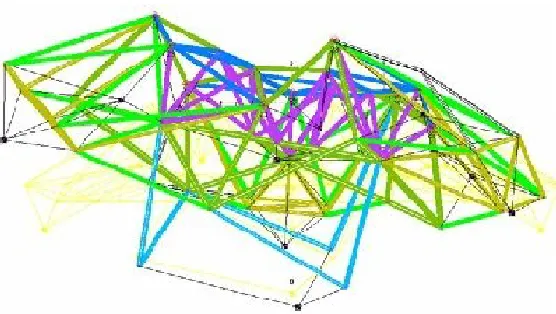
In order to make this a realistic thesis, some effort must be made to limit the scope of the task. The type of artifact of interest is the mechanical structure. More specifically, the discrete structure, also known as a truss structure. A sample of such a structure is shown in Figure 2.3
There are many reasons that such a choice was made. The first is that it has to be made. The breadth of design, even structural design is simply too large for the focus of one project. Trusses were selected because of their relative simplicity. They are easy to conceptualize, easy to imagine, and relatively easy to analyze; though they remain just as complicated to design. Truses lend themselves to quick and robust analysis methods that are ideal for an evolutionary framework. On the other hand, as was learned from the project, the discrete nature of trusses presents some unique challenges to the growth process.
be spent in the last chapter describing reasonably simple extensions that could be made with relatively small effort, such as continuous structures or mechanisms. It is in fact a goal of this work that it should be relatively simple to expand, since this is one of the deficiencies with exist Evolution Algorithms (as will be shown shortly).
Lastly, problems of interest here are ones that are too large for a single designer to handle, but too complex and interdependent to subdivide among several engineers. The goal is not to replace the designer but give them more tools with which to accomplish difficult design tasks put to them. That being said, it is worth pointing out that most of the examples in this thesis are small, simple structures so that the principles can be understood.
2.4
Evolutionary Methods
Evolutionary Algorithms (EA) are a computational search and optimization tool based on the natural process of evolution. It is a broad term that encompasses several other methods and algorithms. After discussing the general character of Evolutionary Algorithms, we will then turn to some of the major algorithms that are encompassed by the umbrella term.
Figure 2.4: D
2.4.1
Key element of EAs
As mentioned previously, the three key aspects of Evolutionary Algorithms are Selection, Mutation, and Reproduction. This section will examine those three aspects in detail and then will briefly discuss the small modifications that are required to to transition from the natural world to the artificial silicon world (which has been termedin silicoto contrast with
in vivofor live nature andin vitrofor a specimen in a controlled lab1).
2.4.1.1 Generational Selection
Selection, in short is the basic means by which an individual is selected from the population to pass its genetic material on to the next generation. The natural version will be discussed in more detail in Chapter 3. For now, we’ll simply say that the fitest individual survives; this could be the fastest, tallest, strongest, or simply the most attractive individual.
In silico, there are many more options available, as well as many more pitfalls. First, we need to define what makes one individual “better” than another, using the proper language: what makes one organism fitter than another. This is typically done by what is called a fitness function. This is some performance metric on the individual. The nature of this function is as diverse as the applications. In structural mechanical engineering, we typically evaluate for stress level, natural frequency, and mass. Additionally, we could also evaluate based on raw material cost, manufacturing cost, reliablity, or a myriad of other domain specific factors. The final trick in defining these fitness functions is aggregating all of the performance metrics into a single metric to describe the individual. There are a few common aggregation functions:
Maximum Exactly as it sounds, take the maximum individual score to be the aggregate score. This usually requires some non-dimensionallization of the various perfor-mance variables.
Minimum Like maximum, but using the minimum score.
Sum Add all of the scores together to form an aggregate score. Again, non-dimensionalizing the performance variables tends to improve results. Could be a weighted sum or an average, as they are essentially the same.
Rms The root sum of squares method
Product Multiply all of the factors together to get the aggregate score.
Method of Imprecision(MoI) A fuzzy method of aggregating disparate engineering
infor-mation using designer preferences [77].
These methods all have benefits and drawbacks. The advantage of the first is that it is fast, but tends to let one parameter compensate for the others too much. For example, even if the structure is perfectly stiff, if it weighs ten times more than the earth, it is not realistic. Likewise, the minimum has the problem that it does not reward an individual fast enough for making a little progress in one area.
good choice for design work, that separates the parameter scaling and the relative weight-ing, as well as the degree of compensation. More on this method will be provided in Chapter 4, where the algorithm implemented will be discussed in detail.
Having calculated the fitness score, there needs to be a method for selecting which individuals go to the next generation. This is the heart ofselection. Again, while there are many methods available, these are the most popular:
Steady State Every parent produces one offspring and that offspring replaces the parent in
the population. This is probably the simplest concept and the easiest to understand, but can be difficult if sexual reproduction (crossover) is used.
Elitism The best individual is carried to the next population. This could also be the best
n individuals, where n can range up to the population size. If n is less than the population size, then one of the other methods would need to be used to select the remaining slots.
Roulette A non-uniform random selection in which the odds of an individual being
se-lected is proportional to its fitness. This method can occasionally run into problems if the population has very high or very low fitness individuals as they will skew the odds and will tend to lead towards pre-mature conversion.
Tournament Two (or more) individuals are selected at random. The better one goes to the
next generation and the others do not.
Rank Selection Like Roulette selection, but the odds are determined by the individual’s
Again, there are benefits and drawbacks to all of these methods. The basic idea is to balance passing good individuals to the next generation with converging too fast to a local maximum by not including enough diversity in the next generation. Again, more details on this will be presented in Chapter 4 as the algorithm is implemented.
2.4.1.2 Mutation
Mutation is the basic element of change in Evolutionary Methods, as well as in nature. A mutation is said to occur when a gene, or a portion of a gene, spontaneously changes in quality. This may or may not acutally produce an effect on phenotype, depending on where the mutation occurs.
Specific implementations of genomes all require somewhat different mutation opera-tors. However, they all do share a couple of traits. The first kind of mutation is generally applicable: duplication, where whole sections of the genome over. The second is point mutations. These operate on a single aspect of the genome randomly changing it to another value.
2.4.1.3 Reproduction
Crossover is the process by which two (or potentially more) individuals combine to form a new individual (offspring). The details of crossover are even more dependent on encoding scheme (genome) than mutation is.
Parent 1 —1.2 5.6— Parent 2 —3.4 7.8— (a) Blend —2.3 6.7— (b) Mix —1.2 7.8—
Figure 2.5: Examples of cross over. (a) Blend crossover, where each allele in the child is the mean of the parents’ allele. (b) Mix crossover, where whole alleles are taken from each parent and passed directly to the child.
the positions on the genome has to be meaningful. If the positions of alleles on the genome is random, then it is unlikely that the blend crossover scheme would work.
The other type of crossover is the mixing crossover. In this case, alleles are taken as whole statements and passed unchanged to the offspring. In this case, position on the genome is less important, as the allele is transfered directly.
Having had this discussion about parents coming together to produce offspring, brings to mind a question: how are the parents chosen to produce each offspring. As expected, there are a variety of options:
Random Generate a uniform random number for each parent. Though, not the best idea,
because Generational Selection is used to decide what individual lives to the next generation, this may not be a bad thing.
Rank Using an exponential random number, select the parent based on their rank in a list sorted by fitness. Once an individual has been used, it can either be put back into the population, to mate again, or be removed to give more chance to the others.
Direct Parents are assigned in sequential order based on fitness. (The best and second best
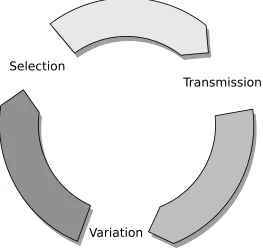
Figure 2.6: Diagram of basic evolution, modified with artificial constructs to make an evolutionary algorithm. [60]
2.4.1.4 Other aspects
As can be expected, when evolution is moved from the natural world to the computer, there are aspects that are special to the computational enviroment. These are initiallization, evaluation, and termination.
initiallize a population in order to proceed. One popular method of initiallizing a population is to seed it with a known valid individual. This gives the evolutionary process a solid start, but may put it too close to a local maximum that it cannot escape. On the other hand, the process could be started with a purely random set of genomes. This would give a broader start, but would cause many generations to be used simply to come up with a feasible solution.
Much mention has been made so far about the fitness of an individual, but so far no mention of where it comes from. In nature, it is clearly the ability to survive, but in-silico, it becomes a little more complicated. To get a fitness for an individual, it must beevaluated
for desired performance. These fitness functions are as diverse as the applications and can be anything quantifiable. There are aspects to this function that can help or hinder evolution, but in principle there are no limits to what can be evaluated.
The last issue to be addressed is termination. When should the evolutionary process be stopped. This is one area where nature will be of no use. To the best availbale knowledge, nature never stops evolving, it simply continues to find smaller niches to take advantage of or changes the target as the environment changes. In the design world however, there must be a point where the process stops and the product is built. The simple answer is that the designer stops when all of their desires (preferences) have been satisfied.
until satisfied.
2.4.2
Common Variations on EAs
As might be expected, there are many variations on this basic concept of using natural evolution as a basis for improving designs in engineering. Some are natural extensions of others, some where developed by two different groups in tandem, and some simply developed from a different point of view. In this section, we will examine a selection of the common algorithms that have been developed in the basic framework of Evolutionary Algorithms and how the fit in with the work under consideration.
2.4.2.1 Genetic Algorithms
Genetic Algorithms (GA) were an attempt to make a generic, application independent al-gorithm, in which the genome would be a fixed length binary genome. In this scheme, the mutation operator and crossover operator were trivial implementations of the random bit-flip and the random single point crossover, respectively. In reality, most implemen-tation used real value encoding, and many even extended the method to variable length genome [61].
2.4.2.2 Genetic Programming
to be evaluated for fitness. This means that this technique is often found in attempts to design software. One interesting point that separates most GP from other Evolutionary Alogirithms is that GP tends to only use crossover, there is generally no point mutation operator.
2.4.2.3 Evolutionary Programming
Evolutionary Programming (EP) was first described by Fogel [42] consisted of a very basic algorithm of population size N, that was augmented to size 2N by adding the children of mutation then selecting theN best for the next generation. The encoding for EPs generally resembled GA encoding, in that it was a direct representation of parameters from the solu-tion. Although capable of both sexual and asexual reproduction, most success with EPs was derived from purely asexual recombination, most likely due to the encoding scheme [52]. The population size and mutation strength varied widely accross a variety of test problems.
2.4.2.4 Evolution Strategy
Evolution Strategies (ES) are a class of Evolutionary Algorithms that maintain a population of1individual. The lone parent then createsmnew offspring. Of the augmented population of (1 +m), the single best individual is chosen to survive to the next generation. These were originally applied to a sequence of several parameters in an optimiziation application.
2.4.2.5 Classifier System
capable of sensing its environment and then reacting appropriately. THis is actually a strong precursor to the current work, except that it appears to have very strong difficulties in actually working.
2.4.2.6 Summary on EAs
As can be seen in the previous few sections there are many types of Evolutionary Algo-rithms. The reality is that they are all very similar in their methods. There is no sharp line to distinguish them from each other. In fact, as can be seen reading the above sections, there is a very blurry line between them, sometimes to the point that they are virtually indistingishable.
For this reason, this thesis will not try to fit into one of the other classes. As has been done by others [52], the methods used in this thesis will be refered to as an Evolutionary Algorithm, and not further refine the definiton. For the current purpose, these are the characteristics of an Evolutionary Algorithm:
Population A set of candidate solutions shall be maintained that consists of at least one solution
Encoding the candidate solutions shall be encoded in some method to allow the other elements to proceed. This can be a sequential or non-sequential set of values (binary, integer, floating point, or even character).
500 N
Figure 2.7: Sample of a base structure in two dimensions, where every possible solution is included in the structure and the genome encodes which links are turned on or off.
EvaluationThe candidate solutions shall be challenged to meet a performance goal and ranked among other solutions as to how well it performed.
Selectionthe candidate solutions shall be challenged to remain in the population based on its fitness.
2.4.3
EAs in Structural Design
Evolutionary Algorithms have been a popular technique to apply to structural design syn-thesis problems because of their inherent lack of designer bias and potential for quality output.
The first major encoding scheme used in structural synthesis is the base structure. In this encoding scheme, the genome is a set of real values, indicating the cross-sectional area of elements in a pre-defined, over-constrained structure, such as in Figure 2.4.3. If the area drops below a certain threshhold, that element is removed for that individual. In that sense, every possible solution already exists, waiting for evolution to scape away the excess.
Node 1
(0.0,0.0)
Node 3
(0.5,1.0)
Node 2
(1.5,0.0)
Node 4
(2.0,2.0)
Genome: [0.0 0.0][1.5 0.0][0.5 1.0][2.0 2.0] [1 3A1][2 3A2][3 4A3][2 4A4]
Figure 2.8: Sample of FEM type encoding, in two dimensions (brackets added for clarity). The first gene of the genome represents the coordinates of the nodes and the second gene the connectivity between them.
FEM encoding. In this encoding, illustrated in Figure 2.4.3, uses the commonly used rep-resentation of a truss for Finite Element Modelling. In this scheme, the genome is divided into two parts. The first part is the node data and contains a listing of the position of the nodes. The second part is the element data and contains the two end points of the element along with section properties (in the example, only crossectional area is tracked.)
** discuss examples from the lit
2.5
Other Design Methods
In addition to briefly describing their functionality and uses, I will also compare them to the ideas suggested in this thesis and why they are not compelling or useful to the perceived needs.
For the purposes of this document, we ignore the more traditional optimization meth-ods, such as newton-rhapson(some examples are [83, 70, 23]) or hill-climbing (examples are [51, 33]) algorithms. These methods all require a relatively smooth, continuous search space. In addition, they all need to have a fixed complexity to have any hope of success. Both of these requirements are contrary to conceptual design in mechanical or structural engineering. There is noa-prioriknowledge on the scale of complexity of the system under consideration. By that very fact, the continuity is violated as adding a new set of parameters is an inherently discontinuous operation.
Instead, we will focus on the more potent techniques for searching large spaces. Most of these are also stochastic techniques, like Evolutionary Algorithms, but operate on a fundamentally different principal.
2.5.1
Simulated Annealing
Simulated Annealing (SA) is another class of stochastic search algorithms. Originally pro-posed by Kirkpatric et. al. [56] and Cerny [21] simmultaneously in the mid 1980’s, is based on the the ideas of metallurgical annealing, where the atomic crystalline structure of mate-rials is altered, and generally improved, by application of a heat treatment involving high temperatures and followed by a slow cooling to working temperatures.
suc-cessively evaluating candidate solutions and then disturbing, or mutating them. In the case of Simulated Annealing, only one individual is considered at any given time step. If this individual is better than the previously stored state, it is adopted as the the new stored state. If the candidate individual is not as good os the stored state, then it is usually thrown out, although there is a small probability that it will be kept any way. This last part is the critical step. It allows the algorithm to escape from a local minimum, which we have already discussed is a critical ability for any algorithm that traverses complex, discontinu-ous, multi-modal performance lanscapes. It is also from this last operation that the method get’s its name: the probability is controlled by atemperatureparameter that monotonically decreases to zero over a optimization run, as it would in mettalurgical annealing. In some-ways, Simulated annealing can be considered as a Genetic Algorithm with a population of one (though some careful choices in parameters will have to made in order for this to be true in the strictest sense).
Finally, to discuss the relative merrits of Genetic Algorithms versus Simulated Aneal-ing. This is a topic that has been broached before, mostly from a computer science point of view rather than an engineering point of view, however the results should still be applica-ble. Lahtinen et. al. [58] and Manikas et. al. [65] both tried to take some sample problems and run them through both algorithms. Both had mixed results. Manikas found that one of their three test problems were the same results and the other two were marginally better while Lahtinen found that the Simulated annealing performed marginally better. In short, there is no clear winner.
For our purposes here, we disregarded Simmulated Annealing for several reasons. First, for mostly historical reasons, we had experience with Evolutionary Algorithms and it did not make sense to switch at that time. Further, the Evolutionary Algorithms are implic-itly parallel, which was a very attractive feature. While Simulated Annealing can be made parallel, it is a more complex operation due to the serial nature of the algorithm. Finally, the idea that germinated in our musings on improving the design search process was bi-ologically based, and it appears as more creadible to have the biological basis applied to Evolutionary Algorithms. As a closing thought on this section, there is no reason that the work that will be presented here cannot be used to extend Simmulated Annealing, it is sim-ply a more tenous connection to use the biological extensions that will be demonstrated to extend a crystalline based method.
2.5.2
Ant Colony Optimization
for optimizing systems; particularly, he used it to find shortest paths through graph struc-tures. ACO, as it is commonly refered to, another biologically inspired method for search-ing through a large domain, in a similar fashion to the way ants forage for food. They start out randomly searching their domain, trying to find any source of food (valid solutions) in their area. As they find useful sources of food, they lay down pheromone tracks on their trip back to the colony. Other ants are then more likely to find that pheromone trail and follow it to the food and back to the colony.
There are two keys to making ACO work (as in real ants). First, the ants are governed by probability. If they find a pheromone trail, they may or may not follow it. Even when on the trail, they may or may not stay on it. This allows for further exploration of the space and helps keep ACO out of local optimums. The second key is that pheromone trails evaporate. This allows old, useless tracks to disappear and prevents ants from following useless, lower optimality tracks. The other benefit to evaporation, is that it provides a selection pressure (the shamelessly borrow a term from Evolutionary Algorithms). Because the tracks will evaporate, the ones that last the longest will be the ones that get traversed the fastest, i.e. the shortest paths. After searching in this way for some time, all the ants will eventually follow the same path, giving a termination condition, as the optimum has been found.
that have been examined with ACOs: circuit design [4], Web usage and data mining [5], evolutionary tree reconstruction [10], DNA sequencing [14], and many, many more [31].
So finally, the question is why did we not use this method to further our design syn-thesis work. The short answer is that ACO is very good at optimizing graph traversing whereas we are trying to generate the graph. The distinction is not trivial. ACOs are good, as already mentioned, at finding the shortest path through a graph of cities (travelling sales-man). There is no analog to this in structural design. It might be akin to finding the most stressed load path in a given structure. While this might be a useful measure to use in the design process, it does not directly generate a better structure. The few examples in the literature that use ACOs to design structures [78, 16] only optimize the section properties of an existing structure. Applying this model to synthesis, is, again, not trivial. The simple method is to allow the optimization to make a null section, i.e. no connection. This essen-tially brings us back to the base structure method that was discussed above and clearly not a desirable condition.
2.5.3
Agent Based Design
Agent Based Design, often called Intelligent Agent Design (IA), is technique for providing one or more agents, bits of software with some intelligence, with a method for creating more complex systems. The basis is that they form the basis of complexity theory, where each little bit is simple and easy, but the whole creates complex interactions that were not originally expected.
agent based design has been used to create wasp nests from simple rules of the type that real wasps might use. It robot control, they have found widespread use [41, 79, 45]. One attractive aspect using agent based design in control is the ability to assign certain agents to be ‘advocates’ for certain behaviors or task while a master agent acts as the arbiter. They have also been tried on problems of interest to mechanical engineering as well [18, 17].
And finally to discuss why these were not used. The principal reason is that they require intelligence to be programmed into the agents. In practice, these are typicaly heuristic engineering rules. These are the same types of rules that engineers themselves follow. While this is one level of abstraction and can be useful in day to day work for reducing work load, especially on repetitive tasks, it is not the purpose of this project. We seek to use the computer to search for and generate non-obvious solutions. Ideally, solutions that an engineer would not come up with on their own. This, by definition, requires working in a purer space than that already defined by the engineering community.
Finally, it is worth noting that in many ways, as the work will show, that we have made use of many of the techniques in IA to make our work function. The agents are purely artificial and very basic, but each one acts on its own, independent of the others around it. It will be shown to be almost a corruption of IA.
2.6
Perceived Deficiencies
base structure ** add example. More than this though, the strict direct encoding leads to four fundamental problems: lack of modularity, lack of emergence, inability to affect significant topological changes, and complex extension. Each of these will now be looked at.
2.6.1
Lack of Modularity
The standard encoding for Evolutionary Algorithms uses a direct encoding, the genome to represent the phenotype. It may be in code, such as binary or some other abstraction, but it is still an exact representation of the genome. Much the way that the word ‘genome’ could be protected by spies by coding it into ‘fdmnld’ (by using the letter immediatly before the one intended), it is still a direct representation of the word.
The poses a problem for enabling modularity. Exactly repeating a block of structure, does not help the structure in any way, and in fact violates the laws of nature (one piece of matter cannot occupy the same space as another). In the case of the base structure, the idea of a module becomes even more arcane. There is no concept of a module when you are turning on and off a given set of links.
2.6.2
Emergence
scheme reduces exploration of the search space.
2.6.3
Topology Changes
A further problem with the direct encoding method of Evolutionary Algorithms is the diffi-culty placed on the mutation parameter to affect a topological change. The actions required to make a topological change are:
1. create a new node.
2. create three new links to that node.
3. make sure the node is in a feasible location.
4. make sure the other three end point of the link connect to different nodes.
Assuming a 0.001 mutation rate (each parameter has a 0.001:1 chance of being mutated in each generation), the odds of just adding the four necessary items (steps 1 and 2 above) is
10−12. These are staggering odds, even by evolutionary standards. And the last two steps have not even been accounted for yet.
2.6.4
Expansion
Another issue, is that any time an EA wants to be expanded in scope, it essentially needs a complete, or nearly complete re-write of the genome encoding. The reason for this is that the genome was conceived specifically for the purpose, adding new elements changes the way mutation is applied as, for example, thermal parameters may not mutate the same way that structural parameters. Likewise, crossover will need to be redifined to account for the fact that it cannot add structural data where thermal data is expected, or vice-versa. This problem would be even worse if one tried to incorporate complete non-mechanical properties, such as electronics or fluidics.
2.7
Summary
This chapter has taken a broad look at the field of engineering design and the various methods available to assist the engineer in doing their job. Many of the problems with those tools were identified and examined for potential remedy with the new method proposed later in this thesis.
In order to make the task more feasible, the scope of study was also restricted to discrete mechanical structures (Trusses). They are conceptually a simple idea and the analysis of them is fairly straightforward, even though the task of designing them properly remains as difficult as any in engineering design.
Chapter 3
Biological Inspirations
We do not arbitrarily give laws to the intellect or to other
things, but as faithful scribes we receive and copy them from
the revealed voice of Nature.
– Sir Francis Bacon [53]
3.1
Introduction
Having looked at the deficiencies with artificial evolution in the last chapter, attention will now turn to finding a way to improve the situation. In order to do this, the natural world will be examined in further details. Some effort will be expended on understanding how and why evolution works in the natural world.
This will lead us into a discussion of the encoding scheme used by nature (DNA). This will involve a discussion of development in biology, as a single cell grows and develops into a large, multi-cellular creature.
scheme for artificial structural design synthesis should look like.
3.2
Evolution
Evolution is the improvement of a genetic line by the accumulation of beneficial changes,
i.e., mutations when one base (A, C, G, or T) is replaced by another. There are many reasons that such a change may occur. It is important to realize that the fitness evaluation in nature is always done at the fully grown individual level. The actual code does not play an important role in the evaluation of fitness other than creating the individual to be evaluated.
The fact that the code does not directly represent a distinct structure creates some in-teresting properties. A point mutation of a single base could cause no change at all in the case where it simply encodes the same amino acid, but in a different way. Similarly a sin-gle point mutation can also cause drastic changes: when a mutation causes the protein that activates the ‘eye’ gene gets mutated away, the eye may never grow. While a seemingly inconsequential detail, this could actually be a critical mechanism. In most cases, we want mutations to change little, in order to keep individuals alive. However, to achieve signif-icant exploration of the design space, a single point mutation has to have the capacity to create large change.
been little change in what the DNA code contains, but rather the changes have been made to how cell development is regulated.
3.3
The Code
The first step to understanding how evolution works in nature is to understand the code. This overview begins with the most basic structures and proceeds to more complex struc-tures.
Deoxyribonucleic Acid (DNA) contains a backbone, made essentially of sugar, that supports an assortment of bases, which provide the information encoded in the molecule. The four bases that make up DNA provide all the information for the growth, development, and regulation of the organism whose growth processes it encodes. These four bases: Ade-nine (A), Cytosine (C), GuaAde-nine (G), Thiamine (T) are grouped in sets of three in an ordered list. Each of these groups translates into one of 20 different amino acids. However, simple combinatorics indicates that there are 48 possible sets of 3 bases. Clearly, these are not unique translations. As described in [46], some different code combinations actually are interpreted the same amino acid. One major reason for this is to protect the code. Some mutations, while changing the actual code, do not change the interpretation.
3.4
Development
The primary purpose of the proteins is to ‘act’ in the cell. These ’actions’ can take many forms. The proteins play roles in allowing other chemicals to pass into and out of the cell, and also serve as catalysts in many cell functions.
Additionally, the proteins perform a signaling function, both inside and outside of the cell. Outside the cell, they communicate their existence and needs to surrounding cells. Within the cell, they cause the cell to have an identity.
The final purpose of the proteins is cell regulation. Some proteins can cause certain portions of the the DNA to not be read. This represses certain functions or activates others. This causes cells to act in different fashions. Cells with the ‘eye’ protein, activate certain portions of the DNA to be read, causing structures like irises and retinas to be made. Simi-larly, those areas are turned off in cells that contain the ‘liver’ protein while those areas that cause those cells to produce the enzymes to break down alcohol are activated. [19]
3.5
Artificial Biology
This is not the first work to try to emulate natural processes. This section wil briefly look at several examples that were drawn from, at least in part.
3.6
Artificial Structural Growth
changes occur quite readily: for example, the in the evolution of structures, the location of a node might be mutated fromx = 3.231mto x = 3.522m. However, large changes in a single point mutation are more difficult, as discussed in Section??. The mutation of adding a node is a much more difficult task, as not only does the mutation have to add the node, it must also determine the correct connections to make a valid structure.
The approach to this problem for truss-like structures is to develop a set of rules that can ‘act’ on the truss. These could be rules such asgrow a new connection towards node X
orstrengthen the connection to node Y. The details of implementing this approach are not clear at this time and certainly not proven.
The development would also need the ability to sense it’s environment using condi-tional statements. This would create some differentiated cells that react to certain stimuli differently from other cells. One cell may be a ’growth’ cell that attempts to connect across gaps in the structure, while other cells may be ’receptor’ cells that signal that a connection is needed.
There may also be certain additional benefits to an indirect, rule based encoding over a traditional encoding. One possibility is that this approach may produce greater robustness. Many biological systems can overcome many otherwise crippling defects to still produce viable individuals, such as the starfish, which can regenerate entire arms that are cut off during the growth process. Another possibility is that good code sequences will be appli-cable to multiple tasks. Because of the code itself would be responsive to the environment in which it is placed, a well evolved yet generic code could provide a good seed solution to most problems of interest.
structures. For example a GA might use statements like ‘There is a link between nodesi
andj’. GP would instead use a statement like ‘Connect nodesiandj by a link’ However, there are two major differences between GP and the approach outlined here:
1. Use local rules, not global rules. This would be akin to creating multi-cellular or-ganisms, rather than a large single cell. Each portion of the structure (or generalized artifact) should act independently of distant portions of the structure. It should, how-ever, respond to its local environment, both of the structure and the external stimuli, using the signaling properties of the simulated proteins.
2. Move away from psuedo-assembly instructionsand instead use growth-based encod-ing that responds to the local environment, includencod-ing sensencod-ing the conditions in the environment and taking appropriate actions.
3.6.1
Basic Necessities of an Encoding Scheme
Any encoding scheme has to adhere to a few basic rules to work properly. Kicinger [55] summarizes perfectly a few basic rules originally laid out by Gen and Cheng [3].
Non-redundancy Each genotype should represent only one phenotype to ensure there is no ambiguity in phenotype.
Completeness Any point in the phenotypic design space must be representable by some genome. If not, portions of the candidate solutions may be excluded.
Lamarckian property The alleles of a genome must have the same meaning/action, re-gardless of where it appears. Gen and Cheng argue that this is a requirement for inheritability.
Causality The scale of the effect on the phenotype, should be proportional to the scale of the change on the genotype. Gen and Cheng refer to this as continuity.
3.6.2
Examples Generative Encodings
While the work presented here is novel, there have been a few similar types of work pre-sented. Some of them were used an inspiration on the direction to take the work and several of them have shown up in the literature more recently, as this work was wrapping up, and need to be mentioned for completeness.
There are also a few interesting examples of using LegoTMbricks to represent the de-sign [43, 72]. These two methods use an assembly sequence of LegoTMbricks to represent the final phenotype. While not strictly a generative method of the style desired, this is a great leap forward from the standard direct encoding.
There are also a few examples that evolve generative representations, but apply them to design types of problems. The first is an example of using the ideas of cell division to mesh a part for FEM analysis [75]. In this example demonstrates the ability of a small set of instructions to create a quality mesh after some evolution. In this case, the mesh is applied to an existing artifact and is not used to design the part. Another example is the use of genetic regulatory networks for controlling robots. Kumar [?] shows one such example, where the genome is a list of reactions that occur based on input stimulus proteins generated by the sensors. The results in case end up a genome that represents a coding scheme to control their robot, but the genome still represents the controller directly, it does not create a new contoller topology for use in the robot.
Finally, there are some genetic network systems that have not been applied to evolution. The best example of this is work by Nagpal et. al. [68]. In this work, the authors use 2-D shapes (circles) to act as cells that can only communicate with their immediate neighbors. While this work did not evolve their genomes, they did observe some of the key goals of using representative systems: the ability to represent complex structures with simple rules and robustness to a variety of external stimuli.
3.7
Conclusions
Chapter 4
Computing Environment
The bad news is that, in our opinion, we will never find the
philosopher’s stone. We will never find a process that allows
us to design software in a perfectly rational way. The good
news is that we can fake it.
– David Parnas and Paul Clements [66]
4.1
Introduction
The Chapter 2 described the percieved deficiencies with a broad range of Evolutionary Algorithms as used in structural design synthesis. Most of these stem from the fact that a traditional, directly encoded genome does not provide a suitable mechanism for tolerating mutation and crossover operations.
This chapter will take ideas from biology and apply them to the perceived deficiencies of artificial Evolutionary Algorithms in an effort to improve their performance and useful-ness. As an introduction, the chapter will start with a general discussion of what is expected in a growth model and how it should look and behave.
After that, we will discuss the artificial environment that is created in-silico, a virtual incubator of sorts for the structures to develop in. Then the genome that makes the structure actually grow will be described. We’ll provide a few simple examples of the growth to demonstrate the feasibility and potential of the model. We will also present a brief proof to demonstrate that the genome model has the ability to span the entire design space. Finally, we will discuss the details of the Evolutionary Algorithm used to evolve these genomes.
4.2
Goal of a Growth Model
What we seek is a model similar to the one outlined in [8]. The simulation grows a final phenotype that cannot be divined simply by inspection of the genotype. One of the keys to generating is to realize that the model will create a multi-cellular organism.
Astor and Adami [8] outlined four principals of molecular and evolutionary biology. They are listed here with the explanation from Adami and Astor along with comments on why they are considered important for furthering EC tasks:
Coding: The model should encode structures in such a way that evolutionary principals can be applied. Clearly, this is the heart of the matter and the motivation for this task.
control the review the actions and decide that something looks ‘wrong’ and should be fixed.
Locality: each cell must act autonomously and be determined only by its genetic code and the state of its local environment. This removes the idea of cells being able to query the ‘master control’ during growth. Cells are allowed only to look at what they are doing in their local neighborhood in which to decide their actions.
Heterogeneity: The model must have the ability to describe different, heterogeneous cells in the same network. This is akin to having bone cells in the body and muscles cells. They serve different purposes and without either one, the body does not function.
The goal of this model goal of such a system to remove the designers influence over the design process. ECs that have implemented ‘fixes’ to improve exploration or convergence rate tend to simply transfer designer bias at a different level. This method makes the struc-ture independent of the designer. Also, by making the cells develop their own strucstruc-tures, they will be able to re-use the same coding to create similar structures, providing some level of modularity.
4.3
Artificial Growth
4.3.1
Environment and Chemistry
are able to sense gravity, but are not affected by it. i.e. the do not fall while unsupported. (Note: This is not the case during evaluation, only during the growth portion.)
In this world, proteins secreted by the cells (Nodes) provide for all the intercellular communication. These proteins are allowed to diffuse through the artificial world using a simplified diffusion model. Rather than trying to solve the partial differential equation directly, either analytically or numerically, this one is done by a simple model. Each ‘in-jection’ of proteins is modeled by it’s own decaying gaussian pulse:
pij =C0
exp
K1((x−x0)2+(y−y0)2+(z−z0)2) t−t0
K2(t−t0)
(4.1)
for every sourcej and every proteini. (x, y, z)is the location in question and(x0, y0, z0) is the location where the protein was added with original concentrationC0. K1andK2are parameters used to define the spacial and temporal decay of the concentration of proteins. These should be tweaked to improve performance, depending on the scale of the task.
Then the global effect is found by summing all the individual contributions:
pi(x, y, z)|t = N X
j=0
pij(x, y, z) t (4.2)
for every proteini.
contribution of one source is:
∇pij = 2K1
expK1((x−x0)2+(y−y0)2+(z−z0)2) t−t0
K2(t−t0)
(x−xo)
(y−yo)
(z−zo) (4.3)
= 2K1pij
(x−xo)
(y−yo)
(z−zo) (4.4)
Then, using the linearity of the gradient operation, the global effect is found by sum-ming all of the individual components:
∇pi(x, y, z)|t = N X
j=0
∇pij(x, y, z) t (4.5)
where all variables are as defined above.
At each time step of the growth process, all of the concentrations and gradients are updated based on what happened during the last iteration of the processing. All of the cells are constantly producing their own proteins and creating a dynamic environment.
As more complicated designs are considered (such as with obstacles) it would be worth-while to consider a more accurate model that actually tracked real diffusion.
gradient.
Internal Proteins are constrained to remain inside the cell. While they do not diffuse across the space, they do decay, so if the cell does not produce more, it will eventually disappear. Since internal proteins do not diffuse across space, they cannot be inter-cellular communicators; however, they do further specialize certain cell functions as well as serve as intra-cellular communicators, providing information from one gene to the next.
4.3.2
Nodes (Cells)
The heart of the system is the node. These are the synthetic analog of the biological cell. Each node acts independent of the others and without direct knowledge of the actions of others. It does however remain able to sense another cell’s actions using the diffusabe proteins described above. At each time step, the cell executes it’s genetic code and acts based on it’s local environment. This is analogous to how a cell in your body works. There are a variety of different types of nodes, which will be described separately. Nodes come in three basic varieties.
Base nodes serve as the grounding point for any truss structure. In order to have a variety of behaviors, base nodes are further subdivided in categories by an integer. These are often fixed in space by the designer, and therefore, gene rules that instruct the node to move are often disregarded.
Field nodes make up anything that is left. Any new node that is created in the course of running the code is automatically a field node. Field nodes, like the other nodes, can also be differentiated using an integer identifier. These nodes are free to move around the design space freely.
Connections between nodes are established bylinks. These have all the basic properties expected from a standard mechanical truss: cross-sectional area, material, and moments of area.
While they are

![Figure 2.1: The engineering design process. Adapted from [69]](https://thumb-us.123doks.com/thumbv2/123dok_us/1117746.1141017/27.612.217.431.179.584/figure-engineering-design-process-adapted.webp)
![Figure 2.2: The conceptual design process. Adapted from [69]](https://thumb-us.123doks.com/thumbv2/123dok_us/1117746.1141017/28.612.181.390.52.327/figure-the-conceptual-design-process-adapted-from.webp)