Volume 2006, Article ID 38989, Pages1–12 DOI 10.1155/ASP/2006/38989
Blind Mobile Positioning in Urban Environment
Based on Ray-Tracing Analysis
Shohei Kikuchi,1Akira Sano,1and Hiroyuki Tsuji2
1School of Integrated Design Engineering, Faculty of Science and Technology, Keio University, 3-14-1 Hiyoshi Kohoku-ku,
Yokohama, Kanagawa 223-8522, Japan
2Wireless Communications Department, National Institute of Information and Communications Technology (NICT),
3-4 Hikarino-Oka, Yokosuka, Kanagawa 239-0847, Japan
Received 1 June 2005; Revised 27 October 2005; Accepted 13 January 2006
A novel scheme is described for determining the position of an unknown mobile terminal without any prior information of transmitted signals, keeping in mind, for example, radiowave surveillance. The proposed positioning algorithm is performed by using a single base station with an array of sensors in multipath environments. It works by combining the spatial characteristics estimated from data measurement and ray-tracing (RT) analysis with highly accurate, three-dimensional terrain data. It uses two spatial parameters in particular that characterize propagation environments in which there are spatially spreading signals due to local scattering: the angle of arrival and the degree of scattering related to the angular spread of the received signals. The use of RT analysis enables site-specific positioning using only a single base station. Furthermore, our approach is a so-calledblindestimator, that is, it requires no prior information about the mobile terminal such as the signal waveform. Testing of the scheme in a city of high density showed that it could achieve 30 m position-determination accuracy more than 70% of the time even under non-line-of-sight conditions.
Copyright © 2006 Hindawi Publishing Corporation. All rights reserved.
1. INTRODUCTION
Interest in determining the position of wireless terminals has been growing rapidly for a number of wireless applica-tions, such as location-based services, navigation, and secu-rity. In the United States, for example, the Federal Communi-cations Commission (FCC) requires wireless carriers imple-menting enhanced 911 (E-911) service to provide estimates of a caller’s location within a given accuracy, for instance, wireless E-911 callers have to be located within 50 m of their actual location at least 67% of the time [1–3]. In Japan, there is a need to determine the locations of illegal wireless ter-minals on vehicles that are interfering with wireless commu-nication systems [4]. Position determination is also needed for radiowave surveillance. The most widely used position-determination scheme is the global positioning system (GPS) [5]. Although it can be used to determine the locations of things highly accurately, existing handsets have to be modi-fied to function as a GPS receiver, and it does not work un-less the mobile terminal has a line-of-sight (LOS) path to the satellites [2]. Thus, it is not applicable to the detection of a nonsubscriber such as the radiowave surveillance.
In a few decades, the use of array antennas is receiv-ing much attention through the efficient use of information
carried in the spatial dimension [1,6]. More and more mo-bile positioning schemes using array antenna employed at a high base station have been investigated as the number of cellular handset subscribers increases. Until now, a number of conventional position-determination methods have been based on trilateration, which combines the received signal strength (RSS), time-of-arrival (TOA), time-delay-of-arrival (TDOA), and/or angle-of-arrival (AOA) of signals received at three receivers, for example, see [7–10]. This approach also depends on there being an LOS path between each receiver and transmitter, which is difficult to observe in urban envi-ronments since a non-LOS (NLOS) condition significantly degrades positioning accuracy. Although some NLOS miti-gation strategies can partly improve accuracy by exploitinga prioriknowledge or using a sensor network to a certain ex-tent [11,12], the propagation characteristics greatly depend on the measurement area and the location of the transmitters and receivers.
area, and the estimated location is obtained by minimizing the Euclidean distance between a sample signal vector and the location fingerprints in the database. This site-specific technique is especially popular in indoor location systems such as existing wireless local area network (WLAN) infras-tructure [14]. The straightforward extension to outdoor po-sitioning in general cellular systems is unrealistic considering an immense amount of time and effort to make a database [16]. Furthermore, the dynamic nature of the outdoor radio environments makes fingerprint methods infeasible. Instead of the database made from measurement data, a model-based approach is promising for outdoor positioning, for example, the use of ray-tracing (RT) analysis that the radiowave prop-agation in a testing area is virtually simulated by modeling three-dimensional (3D) terrain data and propagation laws. Ahonen and Eskelinen virtually predicted the site-specific fingerprints of a testing area by using the RT analysis, and compared RSSs of received signals with those of the RT anal-ysis results obtained at 7 base stations (a serving cell and 6 strongest neighbors) [13]. Basically, however, the use of the RSSs is not adequate to the applications such as surveillance of illegal wireless terminals and emergency calls from non-subscribers, since the RSS estimation needs prior informa-tion of transmitted signals [10]. Furthermore, using fewer base stations is important from the economic standpoint. Although a positioning algorithm with a single base station employing sensors of array was proposed [17], it utilized the temporal information of impinging signals that also require prior knowledge of transmitted signals [9,18].
This work presents a novel positioning method for use in multipath environments, which has three important features as follows.
(i) It uses a “blind algorithm,” that is, it needs no prior information about the transmitted signal, such as its signal waveform.
(ii) It is site-specific in that it takes the propagation envi-ronment into consideration by using RT analysis, and pinpoints the location of a terminal using only a single base station.
(iii) It exploits the characteristics of radiowave propagation in urban environments considering a local scattering model.
The algorithm consists of two steps. First, the parameters characterizing the locations in the testing area (defined later) are experimentally estimated from received signals. Second, the RT simulations are virtually conducted for calculating the parameters corresponding to those in the measurement data analysis, and the estimated location is determined by matching with the experimentally estimated parameters. The preliminary calculation of the RT analysis reduces the com-putational load; however, note that the use of the RT anal-ysis makes a difference from the conventional fingerprint methods in that the fingerprint does not always have to be stored in advance. Furthermore, one of the notable features of the proposed algorithm is to give a blind algorithm in or-der to meet more variable requirements of positioning issues such as surveillance of illegal wireless terminals as mentioned
Scattering circle
Base station
Mobile station
Local scatterers
Figure1: Conceptual diagram of local scattering.
above. The estimation of only spatial parameters realizes the blind algorithm, while temporal parameter estimation needs prior information of signal waveform [18]. Those us-ing codivision multiple access (CDMA), like those de-scribed by Caffery and St¨uber [7], are also considerable for future communication systems, and the proposed position-ing algorithm can be applied to the narrowband CDMA sys-tems, for example, IS-95 [19], if code information for dis-preading is known in advance. Another feature is to model the received signal based on a local scattering model that as-sumes scattering only in the vicinity of a mobile or some re-flectors, for example, see [20,21]. This signal model is suit-able for the propagation environments of urban areas with a high base station and a low mobile terminal. Then in ad-dition to AOAs of the received signals, this work introduces a new spatial parameter indicating the degree of scattering (DOS) related to the angular spread under the assumption of the local scattering model, like in Figures 1 and2. The two parameters of AOA and DOS are used for pinpointing the location without any information of transmitted signal waveform. The DOS is related to a parameter derived from the first-order approximation of received signal model [20], and the theoretical performance of the DOS will be also de-rived in this paper. The matching of these two parameters dramatically mitigates the computational burden, compared to the case that angular profile between−π/2< θ < π/2 itself is used for matching [22]. Furthermore, RT analysis [23] us-ing highly accurate, 3D terrain data realizes site-specific posi-tioning using only a single base station. Note that the RT an-alyzer follows the fundamental property of radiowave prop-agation, for example, geometrical optics (GO) and uniform theory of diffraction (UTD) [24].
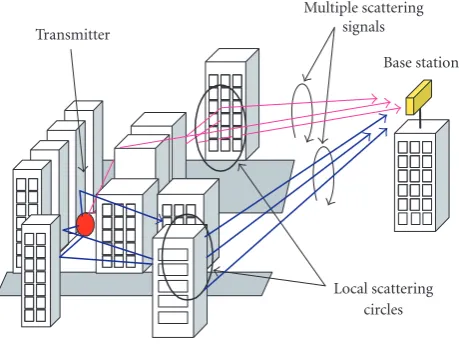
Transmitter
Base station Multiple scattering
signals
Local scattering circles
Figure2: Local scattering on reflectors.
the AOA and DOS in the experimental data analysis and the theoretical behavior of the DOS are described inSection 3.
Section 4mentions the fundamental property of the RT anal-ysis and how to exploit the parameters corresponding to the AOA and DOS from the RT analysis result. The parameter estimation results obtained through experimental data anal-ysis and the positioning accuracy of the proposed algorithm are discussed inSection 5. We conclude inSection 6with a brief summary.
2. CONCEPT OF PROPOSED
POSITION-DETERMINATION SCHEME
2.1. Local scattering model and parameters characterizing terminal location
Suppose that a transmitter in a general cellular system is located in low positions outdoors and its scattered signals, which deteriorate as a result of multipath propagation, are measured at a receiver mounted on top of a building. If the receiver is much higher than the transmitters, a local scatter-ing model, like the one described by Aszt´ely and Ottersten [20], that considers reflections and scattering in the vicinity of each transmitter is an appropriate model of the received signals. In such a model, spatially spread signals are observed at the receiver, as illustrated inFigure 1. However, in prac-tical situations, especially under NLOS conditions between the transmitter and receiver, which is the case dealt with throughout this paper, the spread signals are usually mea-sured after propagating along several routes, as illustrated in
Figure 2. As a result, the received signal is expressed as the summation of several local scatterers on some reflections. For example, if there is an LOS between a transmitter and a re-ceiver, the transmitter lies along the AOAs of the direct paths to multiple base stations. If there is no LOS, the locations of terminals cannot always be identified by using the AOA esti-mates, making the position-determination more difficult.
Our proposed positioning method, using a single array of sensors, uses two particular spatial parameters, the AOA and
DOS, to determine the location of a terminal. These param-eters represent the path characteristics, which depend on the propagation environment between the transmitter and re-ceiver. The signals can be discriminated using the DOSs, even if their AOAs are the same. Estimation of these two parame-ters and the relationship between the angular spread and the bit error rate (BER) are described elsewhere [25,26].
2.2. Positioning method using ray-tracing analysis
The AOA and DOS estimated from the received signals are not sufficient for determining the location of a mobile termi-nal with a single base station, since the location of the mo-bile is not always determined by such trilateration because of an NLOS condition and/or multipath propagation. We also have to use RT analysis. Using an RT simulator, we can vir-tually analyze the radiowave propagation using the given ter-rain data and some propagation parameters such as coeffi -cients of reflection and diffraction. Since the rendering of ge-ographical information has been attracting much attention, this technology should become widely used in a variety of applications in the near future. This work thus uses the RT analysis with highly accurate 3D terrain data around the test-ing area to estimate the location of a terminal, by compartest-ing with the results of the two spatial parameters from both ex-perimental and RT analyses. In the RT analysis, these param-eters can be calculated from all the rays between a transmitter and receiver as shown inFigure 3. In addition, the estimated AOAs and DOSs are virtually measured at all outdoor loca-tions (e.g., every 10 m). The calculated AOAs and DOSs in the RT analysis are used for estimating the location of the terminal. Letθk andηk,k = 1,. . .,K, denote, respectively, the estimated AOA and DOS of thekth scatterer obtained in the experimental analysis. Similarly, let θk(RT)(X,Y) and η(RT)k (X,Y),k = 1,. . .,K, be, respectively, the estimates in
the RT analysis, where (X,Y) indicates the Cartesian coor-dinate of the pseudotransmitters inside the testing areaD. Note thatKis the number of scatterers inFigure 2, not that of the total rays. We estimate the location of a terminal using a cost function:
F(X,Y)=
K
k=1
(1−ν)θk −θk(RT)(X,Y) 2
+νηk −ηk(RT)(X,Y) 21/2
,
(1)
whereθkis the radian measure, and 0≤ν≤1 is a weighting factor that indicates the ratio between the correlation of the AOAs and DOSs. The (X,Y) minimizing this cost function is taken as the estimated position. That is,
X,Y =arg min
X,Y⊆DF(X,Y), (2)
Tx
Rx
Figure3: 3D terrain data around testing area and RT analysis. A number of rays from a transmitter (Tx) reach a receiver (Rx) via different reflections and diffractions.
problem to be avoided, to pinpoint the locations of mobile terminals using only a single receiver even under NLOS con-ditions.
Remark 1. This work deals with the position determination of one mobile terminal using a single base station. If the number of users is more than one, then the total number of scatterers isKT = I
i=1Ki, whereI denotes the number of transmitted sources, and Ki is the number of scatterers generated from theith source. In order to determine the po-sition of the mobiles, we need the identification of{Ki}I
i=1 and the association, that is, which transmitted source thekth scatterer belongs to. This problem is called “source associa-tion.” As one idea to solve the problem, Yan and Fan pro-posed an algorithm for categorizing the distinct KT AOAs intoIgroups in the case that theith group includesKi coher-ent signals [27]. Note that the total number of scatterersKT
has to meet the conditionM > KT, whereMis the number of sensors of array. SupposeI =1 andKT =K1=K through-out this paper.
3. DATA MODEL AND PARAMETER ESTIMATION
This section describes the received signal model for multi-path environments, like the one illustrated inFigure 2, based on the local scattering model. We also mention the estima-tion of the AOA and DOS, and statistically derive the physical properties of the DOS.
3.1. Signal model considering local scattering
The received signal model is expressed as the summation of multiple local scatterers [25, 26, 28]. We assume that the transmitter is stationary during observation and that the time dispersion introduced by the multipath propaga-tion is small compared to the reciprocal of the bandwidth of the transmitted signals. AnM-element uniform linear array (ULA) is used as the base station; it is mounted on top of a high building. A flat Rayleigh fading narrowband channel is considered. The received signal consists ofKscatterers; the number depends on the physical propagation phenomena,
such as reflection and diffraction:
x(t)=
K
k=1 Lk
l=0
βklaθk+θkl st−τkl +n(t) (3)
≈
K
k=1 Lk
l=0
αklaθk+θkl sk(t) +n(t), (4)
whereLkandβklare the total number of rays associated with thekth scatterer and complex amplitude of thelth ray in the
kth scatterer, respectively.sk(t) is the signal of thekth scat-terer, andn(t) is an additive white Gaussian noise (AWGN) vector. We assume that the array response vector is perfectly known from calibration. Themth factor ofa(θk) is expressed asam(θk)=exp{j2πdsinθk/λ}for ULAs. The quantitiesθk
andθk+θkl represent the nominal AOA of thekth scatterer and the arrival angle of thelth ray in thekth scatterer, respec-tively. This means that|βk0|is sufficiently large compared to
|βkl|under the condition that thekth scatterer includes a di-rect path, while|βk0|is at almost the same level as|βkl|if the scatterer results from reflections. Note that this model covers both LOS and NLOS conditions. Assuming narrowband sig-nals, the time delay of the scattered signals is included in the phase shift [20]. Thus, given the definitionssk(t)=s(t−τk0) andΔτkl=τkl−τk0, we obtain (4) from (3) using an approx-imation:
st−τkl ≈sk(t) exp−j2π fcΔτkl ,
αkl=βklexp−j2π fcΔτkl , k=1,. . .,K. (5)
3.2. Scattering parameter
3.2.1. Definition
It is impossible to identify all the unknown parameters in (4) since the number of scattered signals,Lk, is too large and un-countable. Therefore, a number of statistical approaches to deal with the scattering model have been so far proposed. For instance, the standard deviation of the distributed rays is estimated by the weighted subspace fitting [21], which re-quires heavy computational load. On the other hand, assum-ing that the rays are independent and identically distributed with phases uniformly distributed over [0, 2π], and that the number of rays is sufficiently large, the central limit theorem may be used to approximate the elements of the spatial signa-ture as complex Gaussian random variables. Thus, (4) can be approximated using a first-order Taylor expansion under the assumption that the angular spread is small, that is,|θkl | →0 [20,21]:
x(t)≈
K
k=1 Lk
l=0
αklaθk +θkl dθk sk(t) +n(t)
=
K
k=1
γkaθk +φkdθk sk(t) +n(t)
=
K
k=1
aθk +ρkdθk sk(t) +n(t),
Measurement data analysis
(Section 3)
3D data around testing area
Ray-tracing analysis (Section 4)
Estimated location
(X,Y) x(t)
(X,Y) F(X,Y)
θ,η
θ(RT)(X,Y)
η(RT)(X,Y)
Figure4: Diagram of proposed positioning algorithm.
whered(θ)=∂a(θ)/∂θ, and
γk=
Lk
l=0
αkl, φk=
Lk
l=0
αklθkl. (7)
Including γk in sk(t) as the complex amplitude, we define
ρk = φk/γk andsk(t) = γksk(t). Due to the definitions of
γkandφkof (7), the identification of the number of the rays in a scattererLkis unnecessary. The model is then consistent with flat Rayleigh fading since the magnitude of each element of the spatial signature has a Rayleigh distribution. There are three unknown parameters in (6),θk,ρk, andsk(t);ρk has been discussed elsewhere [20,25]. Actually, however,ρk tem-porally fluctuates as a result of multipath fading in practical situations. Thus, we define a new parameter called the “de-gree of scattering (DOS)” using the expectations of the abso-lute values ofφkandγkas
ηk=Eφk
Eγk, (8)
where E{·}denotes the expectation. This parameter ηk is theoretically relevant to the angular spread of thekth scat-terer, and the detailed behavior of the parameter is discussed inSection 3.2.3. The DOS can be estimated without any prior information such as signal waveform, and the identification of both AOA and DOS is appropriate forfingerprintto deter-mine the location under the assumption of the local scatter-ing model.
3.2.2. Parameter estimation method
To estimate the AOAs and DOSs, we assume that the number of scatterersK is correctly estimated in advance. Although eigenvalue-based nonparametric source number detection methods such as the Akaike information criterion (AIC) and minimum description length (MDL) criterion are commonly used [29], they does not work well in the presence of angular spread. Recently, robust source number estimators have been described elsewhere, for example, [30], based on the gener-alized maximum-likelihood-ratio test principles, that work well even for slightly scattered signals. TheKnominal AOAs are estimated from correlated sources by an AOA localizer based on TLS-ESPRIT [31] with a spatial smoothing [32],
under the assumption that the angular distribution for a scat-terer is symmetrical. The DOSs are obtained using the least-squares (LSs) method:
sk(t),ρk=arg min sk(t),ρk
J(t), (9)
whereJ(t) is the cost function used to estimatesk(t) andρk,
J(t)=x(t)−
K
k=1
aθk +ρkdθk sk(t) 2
. (10)
TheKsets of DOS are recursively calculated using only the x(t) of the received signals as follows.
Step 1. Obtainθk,k=1,. . .,K.
Step 2. InitializeK-column vector,ρ(0) =
[0,. . ., 0]T, where
ρ(i)
denotes theith iteration ofρ=[ρ1,. . .,ρK ]T.
Step 3. Calculate ML estimatesk(t):
s(t)=VHV −1VHx(t), (11)
where
V=
K
k=1
aθk +ρkdθk , s(t)=s1(t),. . .,sK(t)
T
.
(12)
Step 4. Estimateρkusing an LS approach that minimizes the following cost function:
J2=E
x(t)−x(t)2, (13)
where
x(t)=
K
k=1
aθk +ρkdθk sk(t)=ASe +DSρ,
A=aθ1 ,. . .,aθK , D=dθ1 ,. . .,dθK ,
S=Diags1(t),. . .,sK(t)
,
ρ=ρ1,. . .,ρK T
,
e=[1,. . ., 1]T.
Diag{·}is a diagonal matrix whose diagonal elements are
{·}. Thus, the cost function (13) can be reobtained as
J2=EASe+DSρ−x(t)
2
=EDSρ−z2, (15)
wherez=x(t)−ASe .
Step 5. Repeat Steps4and5untilρconverges.
Step 6. Derive|γk|under the conditionE{sk(t)s∗k(t)} =1:
Esk(t)s∗k(t)
=Eγksk(t)s∗k(t)γk∗
=γk2. (16)
Step 7. Calculateφk = |γk||ρk|.
Step 8. Repeat the above steps for every time slot (includ-ing enough samples). Determine expectations E{|γk|} and
E{|φk|}by temporal averaging, and obtainηk from (8).
3.2.3. Theoretical behavior of scattering parameter
The theoretical performance of the proposed parameterηkis considered to clarify its physical meaning. The resultant for-mulations are applied to the RT analysis. First, the theoretical behavior of the expectationsE{|γk|}andE{|φk|}are derived for LOS and NLOS conditions, respectively.
From (16), |γk| means the amplitude envelope of the signal received at the base station, and it varies based on Nakagami-Rice fading, which has a probability density func-tion (pdf) that follows the Ricean distribufunc-tion. Note that Nakagami-Rice fading includes Rayleigh fading as a special case. Since the phase of αkl changes randomly during ob-servation, the expected values and variances of{αkl}and
{αkl}can be expressed, respectively, as
EαRe
=EαIm
=0,
VarαRe
=Eα2 Re
=αkl
2
2 , Var
αIm
=VarαRe
, (17)
where [·]Reand [·]Imdenote, respectively, the real and imag-inary parts, and Var{·}is the variance. LetA2k/2 andμ2k = Lk·Var{αRe} =Lk·Var{αIm}be, respectively, the power of the main wave and scattered waves. The Ricean factor is de-fined as the ratio between their powers [24]:
Kk= A2k
2μ2 k
. (18)
Basically, the propagation scenarios can be classified into LOS and NLOS conditions depending on Ricean factorKk. We consider the performance of the DOS in both cases. Since
|γk|follows the Ricean distribution, the expectationE{|γk|}
is
Eγk=
π
2μkexp
−Kk M
3 2; 1;Kk
, (19)
where M(·) denotes Kummer’s confluent hypergeometric function [33]. The detailed derivation of (19) is given in the
appendix. WhenKk1, the pdf of|γk|is an approximately Gaussian distribution since the scattered component orthog-onal to the main wave can be neglected. The expected value of|γk|can be approximated as
Eγk≈Ak. (20)
On the other hand, without a high-powered main wave, that is, under NLOS conditions, the level of the scattered waves is almost the same as that of the main wave. Thus, we define
μ2
k =A2k/2 +μ2kas the total wave power including the main
wave. Since the pdf of|γk|is approximated by a Rayleigh dis-tribution, the expected value of|γk|can be then expressed as
Eγk≈
π 2μ k= π 2 A2 k
2 +μ 2 k= π 2μk
Kk+ 1. (21)
Next, the behavior ofφkis considered. From (7), the real and imaginary parts ofφkare, respectively,
φRe,k= Lk
l=1
αRe,k,lθkl , φIm,k= Lk
l=1
αIm,k,lθkl , (22)
whereθk0=0 without loss of generality. Under the assump-tion thatθkl andαkl have no correlation, the pdfs of both
φRe,k andφIm,k can be approximated as Gaussian
distribu-tions. The expectations ofφRe,kandφIm,k are given,
respec-tively, as
EφRe,k
=0, EφIm,k
=0. (23) Thus, their variances are, respectively,
VarφRe
=LkEθ2Eα2 Re
=μ2 kσθ2k,
VarφIm
=LkEθ2Eα2 Im
=μ2 kσθ2k,
(24)
whereσθkdenotes the standard deviation of the angular dis-tribution, the so-called angular spread [21]. Since the dis-tributions of φRe andφIm are Gaussian, the pdf of |φ| =
φ2
Re+φ2Imfollows the Rayleigh distribution. From (24), the expected value of|φk|is
Eφk=
π
2μkσθk. (25)
As shown by (8), the DOS is defined as the ratio between
E{|γk|}andE{|φk|}. Under the conditionKk 1, that is, an LOS condition, we derive the parameterηLOS,kusing (20)
and (25):
ηLOS,k= E
φk
Eγk≈ π 2 μkσθk Ak = π 4 σθk
Kk, (26)
whereηLOS,kis proportional toσθkand inversely proportional toKk. Furthermore, when the level of the main wave is al-most the same as that of the scattered waves, which occurs mainly under NLOS conditions, ηNLOS,k is given from (21)
and (25):
ηNLOS,k= E
φk
Eγk ≈ σθk
whereηNLOS,k is proportional toσθk, and inversely propor-tional to Kk+ 1. Equations (26) and (27) mean that the DOSηkdepends on the Ricean factorKkand angular spread
σθkof each AOA. This means the larger the DOS is, the more widely the impingingkth signal is distributed, and vice versa. Thus, the DOS is an efficient criterion for describing the de-gree of scattering.
4. RAY-TRACING ANALYSIS
Section 2described the basic procedure of the proposed po-sitioning method. In our scheme, the AOAs and DOSs ob-tained by practical data analysis are compared with those by RT analysis using the cost function of (1). This section de-scribes how the parameters are calculated in the RT analysis. We use highly accurate, 3D terrain data for the experimen-tal area. The data is collected for approximately 20 layers per material including the conditions of the dielectric properties regarding the materials of reflectors and the 3D coordinates obtained within a height accuracy of±25 cm. The RT analy-sis follows propagation rules such as the GO and UTD [24], and enables us to determine the position of terminals accu-rately using site-specific information for the measurement area.
In the analysis, the receiver is virtually located in the same place as in the experiment described in the next section, and the waves propagate following the geometric laws of ra-diowave propagation. We use theray-launching method[23] for our RT simulator as it is more tractable and computa-tionally reasonable than the other commonly used approach, that is, the imaging method. The ray-launching method ra-diates a ray at every angle Δθ from a transmitter, and the path is traced through reflection, transmission, and diff rac-tion points, while the imaging method traces a ray reflec-tion and transmission route connecting a transmission point with a reception point by obtaining an imaging point against a reflection surface. Thus, the implementation of the imag-ing method is unrealistic as the terrain data become huge. As a result of the RT analysis, an angular profile can be ob-tained like that shown inFigure 5, which indicates the valid-ity of modeling the received signal using the local scattering model. From the profile, a scatterer is defined as a signal clus-ter including a nominal ray above 30 dB and rays 10 degrees around when the least signal level that the receiver detects is set at 0 dB. Therefore,Figure 5can be regarded as a case ofK =2. The angular spread of each scatterer is calculated using the second-order statistics:
σθ(RT)k =
1
Lk Lk
l=1
θkl(RT) −θ¯k(RT)
2
·P
(RT) kl ¯
Pk(RT)
, (28)
where ¯θk(RT)and ¯P (RT)
k are, respectively, the nominal AOA and
its power, θ(RT)kl andPkl(RT) are the AOAs and powers of the scattered waves, respectively, andLk is the total number of both nominal and scattered waves. The theoretical behavior of the DOS derived above says that the DOS depends on the standard deviation of the scattered signals and the Ricean
50 40 30 20 10 0
−10
−20
−30
−40
−50
Angle (deg) 0
10 20 30 40 50
DO
A
sp
ec
tru
m
(d
B
) 1st scatterer 2nd scatterer
Additive noise
Figure5: Example of angular profile by RT analysis (K =2). It is shown that some rays are launched from the Tx and reflected on the reflector. At the end of the process, a fewer number of rays may be received at the Rx.
factor. Thus, the DOS is also derived from those parame-ters even in the RT analysis. The Ricean factor is given by
Kk(RT) = P¯ (RT) k /2
Lk
l=1Pkl(RT) since it is the ratio between the powers of the main and scattered waves. Using (26), (27), and (28), we can obtain the DOS under LOS conditions by
η(RT)LOS,k=
π
4
σk(RT)
Kk(RT)
, (29)
and under NLOS conditions by
ηNLOS,(RT) k=
σk(RT)
Kk(RT)+ 1
. (30)
Note that determining whether the mobile terminal is at an LOS or NLOS location is obvious in the RT simulations. We can thus obtainK(RT),θ(RT)
k , andη (RT)
k for all points in the 3D
terrain and use for pinpointing the location of terminals, in combination with the results of the experimental data analy-sis.
5. EXPERIMENTAL DATA ANALYSIS AND POSITION-DETERMINATION ACCURACY
We now consider the application of the parameter estima-tion method described above to experimental data measured using array antennas. The accuracy of the proposed position-determination algorithm based on experimental data analy-sis is also discussed.
5.1. Experimental conditions
Rx
Tx1
Tx2 Tx3
Tx4 Tx5
Tx6
0( de
gree )
Figure6: Map around testing area.
Table1: Angle, distance, and transmitted power regarding each Tx.
LOS NLOS
Tx1 Tx2 Tx3 Tx4 Tx5 Tx6
Angle (deg) −15.7 10.6 0 −6.5 22.9 54.8 Distance (m) 215 200 100 300 200 210
Power (dBm) 0 10 0 30 20 30
2.335 GHz carrier frequency. Figure 6shows a map of the testing area, and Table 1 summarizes the angles, distances, and signal powers of the transmitters, which were 1.5 m high. The transmitters (Tx1-6) were stationary; three of them (Tx1 to Tx3) were at LOS positions, while the others (Tx4 to Tx6) were at NLOS positions. The transmitted signal was formed byπ/4-shift QPSK modulation. We took 1900 snapshots at a sample rate of 2 MHz, which meant that the observation time was only 10−3second. The other specifications and the experimental system are described elsewhere [34]. The data was collected at the base station. Note that the analysis was done for one terminal at a time.
5.2. Experimental analysis
The AOAs and DOSs were estimated by using the proce-dure described inSection 3.2.2. Tables 2and3 summarize the AOAs and DOSs estimated under LOS and NLOS condi-tions, respectively. We analyzed 1900 sample signals, divided into 19 groups, and calculatedE{|γk|}andE{|φk|}by aver-aging the estimates for those 19 periods to estimate the DOS,
ηk.
The previous numerical simulations [26] showed that the DOS was correlated with the BER of beamformed signals,
which meant that the DOS indicated the degree of scattering. This is supported by the results shown in Tables2and3. The DOS of a direct path was much smaller than that of reflected ones since the definition of the DOS in (26) and (27) says that the DOS is smaller as the Ricean factor is larger. Thus, since both AOA and DOS are appropriate parameters for de-scribing the characteristics of each scatterer, we use them as the key to obtain the locations of terminals.
5.3. Positioning method and its accuracy
We estimated the location of terminals using the results of the field testing and RT analysis by the method described in
Section 2. First, using the RT simulator, pseudotransmitters were positioned at 10 m intervals within about 500 m×500 m on the map inFigure 6and the AOAs and DOSs were esti-mated for each one. Note that the DOSs were obtained sepa-rately for the LOS and NLOS transmitter positions since the DOSs in the RT analysis behave differently in (29) and (30). The results were matched with the experimental analysis re-sults by using the cost function of (1) with the weighting fac-torν=0.5.
Table2: Parameter estimation results using actual data in LOS conditions.
Tx no. Tx1 Tx2 Tx3
Path no. Path1 Path2 Path1 Path2 Path3 Path1 Path2 Path3
DOA (deg) −15.7 45.7 −24.6 10.3 17.5 −38.8 0.0 40.5
DOS 0.0102 0.2942 0.0912 0.0535 0.5013 0.1492 0.0116 0.2239
Table3: Parameter estimation results using actual data in NLOS conditions.
Tx no. Tx4 Tx5 Tx6
Path no. Path1 Path2 Path3 Path1 Path2 Path1 Path2 Path3
DOA (deg) −18.2 12.5 44.8 −29.0 15.1 −40.1 3.1 49.4
DOS 0.0368 0.1674 0.0812 0.0952 0.0715 0.6824 0.1328 0.3972
5.4. Weighting factor and positioning accuracy
To prove the effectiveness of introducing DOS, the position-ing accuracy was evaluated at different values of the weight-ing factorνin (1).Figure 6shows the relationship between the probability of accuracy within 20 m and the weighting factor. The results confirm that introducing DOS, which re-flects the propagation characteristics, dramatically improved position-determination accuracy. Although the optimization of the weighting factor is quite difficult since it depends on the transmitter location, the results show that the accuracy was approximately 15% to 40% better when both AOA and DOS were used than when only AOA was used.
6. CONCLUSION
We have described the novel method for determining the po-sition of a wireless terminal; it uses a single array antenna and is suitable for use in multipath environments. It makes use of two spatial parameters, the angle of arrival and the de-gree of scattering, which reflect the path characteristics be-cause they depend on the propagation environment between the transmitter and the receiver. These parameters are used in combination with the results of ray-tracing analysis with highly accurate 3D terrain data. The key features of our algo-rithm are that it is “blind,” which needs no prior information about the transmitted signal such as signal waveform, keep-ing in mind the application of unknown source detection for radiowave surveillance. Furthermore, it is based on a local scattering model considering scattering in the vicinity of a mobile or some reflectors. We achieved a site-specific scheme with only a single base station by introducing the ray-tracing analysis.
Field testing showed that the proposed method was suffi -ciently accurate to meet the Federal Communications Com-mission requirements for mobile terminal position deter-mination and that it outperformed other positioning al-gorithms, although the experimental area was only about 500 m×500 m. This site-specific method can be used in other
locations if only experimental data and 3D terrain data are available.
APPENDIX
The expectation of|γk|in (19) is derived as follows. First we definer= |γk|, and the pdfp(r) follows the Ricean distribu-tion:
p(r)= r
μ2k
exp
−r2+A
2 k
2μ2k
I0
Akr μ2k
, (A.1)
whereμk=Lk·Var{αRe} =Lk·Var{αIm}, andI0(·) is a zero-order Bessel function of the first kind [33]. The expectation ofris expressed as an integral in terms ofr:
E{r}=
∞
0 r·p
(r)dr=
∞
0 r2 μ2 k
exp
−r2+A2k
2μ2 k
I0
Akr μ2
k dr.
(A.2)
This equation can be modified with the following mathemat-ical formulae using a Gamma function and the Kummer’s confluent hypergeometric function [33], respectively:
∞
0 x
ξ−1exp−
a2x2 Iυ(bx)dx
= Γ
(ξ+υ)/2bυ
2υ+1aξ+υΓ(υ+ 1)·M
ξ+υ
2 ;υ+ 1;
b2 4a2
,
M(c;d;z)=
∞
k=0 (c)k
(d)k zk k! =1 +
c d
z
1!+
c(c+ 1)
d(d+ 1)
z2 2!
+ c(c+ 1)(c+ 2)
d(d+ 1)(d+ 2)
z3 3! +· · ·,
(A.3)
whereΓ(x) is the Gamma function,M(c;d;z) is the Kum-mer’s confluent hypergeometric function, and we define
(x)n=Γ(Γx+n)
Table4: Positioning accuracy in LOS conditions: “Num.” denotes the number of successful estimations within each accuracy up to 200 trials, and “Prob.” is cumulative probability of correct positioning.
Positioning Tx1 Tx2 Tx3
accuracy Num. Prob. Num. Prob. Num. Prob.
Within 10 m 158 79.0% 123 61.5% 181 90.5%
Within 20 m 40 89.0% 49 86.0% 19 100%
Within 30 m 2 100% 28 100% 0 100%
Table5: Positioning accuracy in NLOS conditions: “Num.” denotes the number of successful estimations within each accuracy up to 200 trials, and “Prob.” is cumulative probability of correct positioning.
Positioning Tx4 Tx5 Tx6
accuracy Num. Prob. Num. Prob. Num. Prob.
Within 10 m 63 31.5% 82 41.0% 19 9.5%
Within 20 m 68 65.0% 77 79.5% 72 45.5%
Within 30 m 36 83.5% 22 90.5% 56 73.5%
1 0.8 0.6 0.4 0.2 0
Weighting factorν 20
40 60 80 100
P
robabilit
y
(%)
Tx1 Tx2 Tx3
(a)
1 0.8 0.6 0.4 0.2 0
Weighting factorν 20
40 60 80 100
P
robabilit
y
(%)
Tx4 Tx5 Tx6
(b)
Figure 7: Positioning accuracy within 20 m in case of changing weighting factorν: (a) the result of detecting Tx1 to 3 located at LOS positions, while (b) shows the detection probability of Tx4 to 6 at NLOS positions.
Substitutingx=r,ξ=3,υ=0,a=1/(√2μk), andb=Ak/ μ2
kinto (A.3), we obtain (19) from (A.2) as
Eγk=
π
2μkexp
− A
2 k
2μ2k M
3 2; 1;
A2 k
2μ2k
. (A.5)
REFERENCES
[1] T. S. Rappaport, J. H. Reed, and B. D. Woerner, “Position loca-tion using wireless communicaloca-tions on highways of the futur,” IEEE Communications Magazine, vol. 34, no. 10, pp. 33–41, 1996.
[2] J. H. Reed, K. J. Krizman, B. D. Woerner, and T. S. Rappaport, “An overview of the challenges and progress in meeting the E-911 requirement for location service,”IEEE Communications Magazine, vol. 36, no. 4, pp. 30–37, 1998.
[3] S. Tekinay, E. Chao, and R. Richton, “Performance bench-marking for wireless location systems,”IEEE Communications Magazine, vol. 36, no. 4, pp. 72–76, 1998.
[4] http://www.tele.soumu.go.jp/e/monitoring/index.htm. [5] C. Drane, M. Macnaughtan, and C. Scott, “Positioning GSM
telephones,”IEEE Communications Magazine, vol. 36, no. 4, pp. 46–54, 1998.
[6] S. U. Pillai,Array Signal Processing, Springer, New York, NY, USA, 1989.
[7] J. J. Caffery Jr. and G. L. St¨uber, “Subscriber location in CDMA cellular networks,”IEEE Transactions on Vehicular Technology, vol. 47, no. 2, pp. 406–416, 1998.
[8] Y. T. Chan and K. C. Ho, “A simple and efficient estimator for hyperbolic location,”IEEE Transactions on Signal Processing, vol. 42, no. 8, pp. 1905–1915, 1994.
[9] I. Jami, M. Ali, and R. F. Ormondroyd, “Comparison of meth-ods of locating and tracking cellular mobiles,” inProceedings of IEE Colloquium on Novel Methods of Location and Tracking of Cellular Mobiles and Their System Applications, vol. 99/046, pp. 1/1–6/1, London, UK, May 1999.
Transactions on Vehicular Technology, vol. 52, no. 6, pp. 1508– 1518, 2003.
[11] L. Cong and W. Zhuang, “Non-line-of-sight error mitigation in mobile location,”IEEE Transactions on Wireless Communi-cations, vol. 4, no. 2, pp. 560–573, 2005.
[12] R. J. Kozick and B. M. Sadler, “Source localization with dis-tributed sensor arrays and partial spatial coherence,” IEEE Transactions on Signal Processing, vol. 52, no. 3, pp. 601–616, 2004.
[13] S. Ahonen and P. Eskelinen, “Mobile terminal location for UMTS,” IEEE Aerospace and Electronic Systems Magazine, vol. 18, no. 2, pp. 23–27, 2003.
[14] K. Kaemarungsi and P. Krishnamurthy, “Modeling of indoor positioning systems based on location fingerprinting,” in Pro-ceedings of the 23th Annual Joint Conference of the IEEE Com-puter and Communications Societies (INFOCOM ’04), vol. 2, pp. 1012–1022, Hong Kong, March 2004.
[15] C. Nerguizian, C. Despins, and S. Aff`es, “Geolocation in mines with an impulse response fingerprinting technique and neu-ral networks,” inProccedings of IEEE 60th Vehicular Technol-ogy Conference (VTC ’04), vol. 5, pp. 3589–3594, Los Angeles, Calif, USA, September 2004.
[16] C. M. Takenga, K. R. Anne, K. Kyamakya, and J. C. Ched-jou, “Comparison of gradient descent method, Kalman filter-ing and decoupled Kalman in trainfilter-ing neural networks used for fingerprint-based positioning,” inProccedings of IEEE 60th Vehicular Technology Conference (VTC ’04), vol. 6, pp. 4146– 4150, Los Angeles, Calif, USA, September 2004.
[17] M. Porretta, P. Nepa, F. Giannetti, et al., “A novel single base station location technique for microcellular wireless networks: description and validation by a deterministic propagation model,”IEEE Transactions on Vehicular Technology, vol. 53, no. 5, pp. 1502–1514, 2004.
[18] M. C. Vanderveen, A.-J. van der Veen, and A. Paulraj, “Esti-mation of multipath parameters in wireless communications,” IEEE Transactions on Signal Processing, vol. 46, no. 3, pp. 682– 690, 1998.
[19] D. N. Knisely, S. Kumar, S. Laha, and S. Nanda, “Evolution of wireless data services: IS-95 to cdma2000,”IEEE Communica-tions Magazine, vol. 36, no. 10, pp. 140–149, 1998.
[20] D. Aszt´ely and B. Ottersten, “The effects of local scattering on direction of arrival estimation with MUSIC,”IEEE Transac-tions on Signal Processing, vol. 47, no. 12, pp. 3220–3234, 1999. [21] T. Trump and B. Ottersten, “Estimation of nominal direction of arrival and angular spread using an array of sensors,”Signal Processing, vol. 50, no. 1-2, pp. 57–69, 1996.
[22] M. Wax and O. Hilsenrath, “Signature matching for location determination in wireless communication systems,” US patent no. 6,112,095.
[23] M. C. Lawton and J. P. McGeehan, “The application of a de-terministic ray launching algorithm for the prediction of ra-dio channel characteristics in small-cell environments,”IEEE Transactions on Vehicular Technology, vol. 43, no. 4, pp. 955– 969, 1994.
[24] M. P. M. Hall, L. W. Barclay, and M. T. Hewitt,Propagation of Radiowaves, The Institution of Electrical Engineers, London, UK, 1996.
[25] H. Tsuji, K. Yamada, and H. Ogawa, “A new approach to array beamforming using local scattering modeling,” inProccedings of IEEE 54th Vehicular Technology Conference (VTC ’01), vol. 3, pp. 1284–1288, Atlantic City, NJ, USA, October 2001. [26] K. Yamada and H. Tsuji, “Using a model of scattering in a
low-intersymbol-interference channel for array beamforming,” in
Proceedings of the 11th European Signal Processing Conference (EUSIPCO ’02), Toulouse, France, September 2002.
[27] H. Yan and H. H. Fan, “On source association of DOA esti-mation under multipath propagation,”IEEE Signal Processing Letters, vol. 12, no. 10, pp. 717–720, 2005.
[28] S. Kikuchi, H. Tsuji, R. Miura, and A. Sano, “Mobile local-ization using local scattering model in multipath environ-ments,” inProccedings of IEEE 60th Vehicular Technology Con-ference (VTC ’04), vol. 1, pp. 339–343, Los Angeles, Calif, USA, September 2004.
[29] M. Wax and T. Kailath, “Detection of signals by information theoretic criteria,”IEEE Transactions on Acoustics, Speech, and Signal Processing, vol. 33, no. 2, pp. 387–392, 1985.
[30] Y. Abramovich, N. K. Spencer, and A. Y. Gorokhov, “Bounds on maximum likelihood ratio—part II: application to antenna array detection—estimation with imperfect wavefront coher-ence,”IEEE Transactions on Signal Processing, vol. 53, no. 6, pp. 2046–2058, 2005.
[31] S. Shahbazpanahi, S. Valaee, and M. H. Bastani, “Distributed source localization using ESPRIT algorithm,”IEEE Transac-tions on Signal Processing, vol. 49, no. 10, pp. 2169–2178, 2001. [32] T.-J. Shan, M. Wax, and T. Kailath, “On spatial smoothing for direction-of-arrival estimation of coherent signals,”IEEE Transactions on Acoustics, Speech, and Signal Processing, vol. 33, no. 4, pp. 806–811, 1985.
[33] Z. X. Wang and D. R. Guo,Special Functions, World Scientific, Hackensack, NJ, USA, 1989.
[34] A. Kanazawa, H. Tsuji, H. Ogawa, Y. Nakagawa, and T. Fuka-gawa, “An experimental study of DOA estimation in multipath environment using an adaptive array antenna equipment,” in Proceedings of the Asia-Pacific Microwave Conference, pp. 804– 807, Sydney, Australia, December 2000.
Shohei Kikuchireceived the B.E., M.E., and Ph.D. degrees in System Design Engineering from Keio University, Japan, in 2002, 2003, and 2006, respectively. Since April 2006, he has been working for Toshiba Corpora-tion. His research interests are in array sig-nal processing and its applications for mo-bile communication systems. He received a Young Researcher’s Encouragement Award from IEEE VTS Japan in 2003. He is a Mem-ber of IEEE, IEICE, and SICE.
Akira Sano received the B.E., M.E., and Ph.D. degrees in mathematical engineering and information physics from The Univer-sity of Tokyo, in 1966, 1968, and 1971, re-spectively. He is currently a Professor De-partment of System Design Engineering, Keio University. He was a Visiting Research Fellow at the University of Salford, Salford, UK, from 1977 to 1978. His research inter-ests include adaptive modeling and design
Control Applications and served as Chair of IFAC Technical Com-mittee on Modeling and Control of Environmental Systems from 1996 to 2001. He has also been Vice Chair of IFAC Technical Com-mittee on Adaptive Control and Learning since 1999 and has been Chair of the IFAC Technical Committee on Adaptive and Learning Systems since 2002.
Hiroyuki Tsujireceived the B.E., M.E., and Ph.D. degrees from Keio University in 1987, 1989, and 1992, respectively. Since 1992, he has been working in the National Institute of Information and Communications Tech-nology (NICT), Independent Administra-tive Institution, Japan. In 1999, he was a Vis-iting Researcher at University of Minnesota. His research interests are in array signal pro-cessing, particularly as applied to