Volume 2007, Article ID 59535,11pages doi:10.1155/2007/59535
Research Article
Motion Segmentation and Retrieval for 3D Video Based on
Modified Shape Distribution
Toshihiko Yamasaki and Kiyoharu Aizawa
Department of Information and Communication Engineering, Graduate School of Information Science and Technology, The University of Tokyo, Engineering Building No. 2, 7-3-1 Hongo, Bunkyo-ku, Tokyo 113-8656, Japan
Received 31 January 2006; Accepted 14 October 2006
Recommended by Tsuhan Chen
A similar motion search and retrieval system for 3D video are presented based on a modified shape distribution algorithm. 3D video is a sequence of 3D models made for a real-world object. In the present work, three fundamental functions for efficient retrieval have been developed: feature extraction, motion segmentation, and similarity evaluation. Stable-shape feature represen-tation of 3D models has been realized by a modified shape distribution algorithm. Motion segmenrepresen-tation has been conducted by analyzing the degree of motion using the extracted feature vectors. Then, similar motion retrieval has been achieved employing the dynamic programming algorithm in the feature vector space. The experimental results using 3D video sequences of dances have demonstrated very promising results for motion segmentation and retrieval.
Copyright © 2007 T. Yamasaki and K. Aizawa. This is an open access article distributed under the Creative Commons Attribution License, which permits unrestricted use, distribution, and reproduction in any medium, provided the original work is properly cited.
1. INTRODUCTION
Dynamic three-dimensional (3D) modeling of real-world objects using multiple cameras has been an active research area in recent years [1–5]. Since such sequential 3D mod-els, which we call 3D video, are generated employing a lot of cameras and represented as 3D polygon mesh, realistic rep-resentation of dynamic 3D objects is obtained. Namely, the objects’ appearance such as shape and color and their tem-poral change are captured in 3D video. Therefore, they are different from conventional 3D computer graphics and 3D motion capture data. Similar to 2D video, 3D video consists of consecutive sequences of 3D models (frames). Each frame contains three kinds of data such as coordinates of vertices, connection, and color.
So far, researches of 3D video have been mainly focused on its acquisition methods, and they are in their infancy. Therefore, most of the research topics in 3D video were cap-ture systems [1–5] and compression [6,7]. As the amount of 3D video data increases, the development of efficient and effective segmentation and retrieval systems is being desired for managing the database.
Related works can be found in so-called 3D “motion cap-ture” data aiming at motion segmentation [8–12] and re-trieval [13–15]. This is because structural features such as
motion of joints and other feature points are easily located and tracked in motion capture data.
For motion segmentation, Shiratori et al. analyzed lo-cal minima in motion [8]. The idea of searching local min-ima in kinematic parameters was also employed in [9]. Some other approaches were proposed based on motion estima-tion error using singular value decomposiestima-tion (SVD) [10] and least square fitting [11]. In addition, model-based ap-proaches were also reported using hidden Markov model (HMM) [12] and Gaussian mixture model (GMM) [10].
Regarding content-based retrieval for motion capture data, the main target of previous works [13–15] was fast and effective processing because accurate feature localization and tracking was already taken for granted as discussed above. For instance, an image-based user interface using a self-organizing map was developed in [13]. In [14], motion data of the entire skeleton were decomposed as the direct sum of individual to reduce the dimension of the feature space. Reference [15] proposed qualitative and geometric features opposed to quantitative and numerical features used in pre-vious approaches to avoid dynamic time warping matching, which is computationally expensive.
with optical or magnetic markers. On the other hand, fea-ture tracking is difficult for 3D video because neither mark-ers nor sensors are attached to the usmark-ers. In addition, each frame of 3D video is generated independently regardless of its neighboring frames [1–5] due to the nonrigid nature of human body and clothes. This results in unregularized num-ber of vertices and topology, making the tracking problem more difficult.
Therefore, the number of 3D video segmentation algo-rithms reported so far is quite limited [16–18]. In [16], a his-togram of distance among vertices on 3D mesh model and three fixed reference points were generated for each frame, and segmentation was done when the distance between his-tograms of successive frames crossed threshold values. And, more efficient histogram generation method based on spher-ical coordinate system was developed in [17]. The problem in these two approaches is that they strongly relied on “suitable” thresholding, which was defined only by empirical study (try and error) for each sequence. In [16,17], proper threshold setting was left unsolved.
With regard to 3D video retrieval, there are no related works yet except for the one we have developed [19]. How-ever, the development of efficient tools for exploiting a large-scale database of 3D video would become a very important issue in the near future.
The purpose of this work is to develop a motion segmen-tation and retrieval system for 3D video of dances based on our previous works [18,19]. To the best of our knowledge, this work is the first contribution to such a problem. We have developed three key components such as feature extraction, motion segmentation, and similarity evaluation among 3D video clips.
In particular, proper shape feature extraction from each 3D video frame and analysis of its temporal change are ex-tra important tasks as compared to motion capture data segmentation and retrieval. Therefore, we have introduced a modified shape distribution algorithm we have devel-oped in [18] to stably extract shape features from 3D models.
Segmentation is an important preprocessing to divide the whole 3D video data into small but meaningful and manageable clips. The segmented clips are handled as min-imum units for computational efficiency. Then, a segmen-tation technique based on motion has been developed [18]. Because motion speed and direction of feature points are difficult to track, the degree of motion is calculated in the feature vector space of the modified shape distribution. The segmentation is achieved by searching local minima in the degree of motion accompanied with a simple verification process.
In retrieving, an example of 3D video clip is given to the system as a query. After extracting the feature vectors from the query data, the similarity to each candidate clip is computed employing dynamic programming (DP) matching [20,21].
In our experiments, five 3D video sequences of three different kinds of dances were utilized. In the experiments of segmentation, high-accuracy precision and recall rates of
Figure1: Example frame of our 3D video data. Each frame is de-scribed in a VRML format and consists of coordinates of vertices, their connection, and color.
92% and 87%, respectively, have been achieved. In addi-tion, the system has also demonstrated very encouraging re-sults by retrieving a large portion of the desired and related clips.
The remainder of the paper is organized as follows. In Section 2, detailed data description of 3D video is given. In Section 3, the modified shape distribution algorithm is de-scribed for stable shape feature extraction. Then, the algo-rithm for motion segmentation using the extracted feature vectors is explained inSection 4.Section 5describes the al-gorithm for similar motion retrieval based on DP matching. Section 6 demonstrates the experimental results and con-cluding remarks are given inSection 7.
2. DATA DESCRIPTION
The 3D video data in the present work were obtained em-ploying the system developed in [4]. They were generated from multiple view images taken with 22 synchronous cam-eras. The 3D object modeling is based on the combination of volume intersection and stereo matching [4].
0 200 400 600 800 1000 Bin number (0-1023)
0 200 400 600 800 1000 1200 1400 1600 1800 2000
Fre
q
u
en
cy
Figure2: Thirty histograms for the same 3D model (shown on the upper side) using the original shape distribution [24]. Generated histograms have some deviation even for the same 3D model.
3. SHAPE FEATURE EXTRACTION: MODIFIED SHAPE DISTRIBUTION
With regard to feature extraction from 3D models, a num-ber of techniques have been developed aiming at static 3D model retrieval [23]. Among the feature extraction algo-rithms, shape distribution [24] is known as one of the most effective methods. In the original shape distribution algo-rithm [24], a number of points (e.g., 1024) were randomly sampled among the vertices of the 3D model surface and dis-tance between all possible combinations of points was calcu-lated. Then, a histogram of distance distribution was gener-ated as a feature vector to express the shape characteristics of a 3D model. The shape distribution algorithm has a virtue of robustness to objects’ rotation, translation, and so on.
However, histograms using the original shape distribu-tion cannot be generated stably because of the random sam-pling of the 3D surface.Figure 2shows 30 histograms gen-erated for the same 3D model selected from our 3D video. The histograms were generated by randomly sampling 1024 vertices and setting the number of bins of the histogram as 1024 (dividing the range between maximum and minimum values in distance into 1024). It is observed that the shapes of the histograms fluctuate and sometimes a totally different histogram is obtained. In [24], deviation in the histograms was not so significant because rough shape feature extraction was pursued for similar shape retrieval of static 3D models. On the other hand, in our case, it is required to clarify a slight shape difference among frames in 3D video.
Therefore, we have modified the original shape distribu-tion algorithm for more stability. Since vertices are mostly uniform on the surface in our 3D models, they are firstly clustered into 1024 groups based on their 3D spatial distri-bution employing vector quantization as shown inFigure 3. The centers of mass of the clusters are used as representa-tive points for distance histogram generation. Although such
Figure3: Concept of modified shape distribution. Vertices of 3D model are firstly clustered into 1024 groups by vector quantization in order to scatter representative vertices uniformly on 3D model surface.
clustering process is computationally expensive, it needs to be carried out only once in generating the histograms (fea-ture vectors), and all the processings that follow are based on the extracted feature vectors. Therefore, the computational cost for clustering can be neglected. As a result, representa-tive points are distributed uniformly and generation of sta-ble histograms has been made possista-ble. In our algorithm, the number of bins is set to 1024. After obtaining histograms, smoothing (moving average) is applied to them to remove noise by taking the average of the values in 2+2 bins as
shown in (1),
b¼
i =bi
2+bi 1+bi+bi+1+bi+2
5 , (1)
wherebirepresents theith element of the histogram andb¼
i is that after the smoothing process. By using modified shape distribution, identical histograms can always be obtained for the same 3D model.
4. MOTION SEGMENTATION
In motion segmentation, for dance sequences in particular, motion speed is an important factor. When a person changes motion type or motion direction, the motion speed becomes small temporarily. More importantly, motion is paused for a moment to make the dance look lively. Such moments can be regarded as segmentation points.
data of degree of motion goes thorough a further smoothing filter.
In [8], the extracted local minima in motion speed were verified whether they were truly segmentation boundaries or not by thresholding. This verification process is important to make the system robust to noise. The local minimum values should be lower than a predefined threshold value and the local maximum values between the local minima should be higher than another threshold. In this respect, threshold op-timization depending on input data was still required in [8]. In our scheme, local minima are regarded as segmentation boundaries when the two local maxima on both sides of the local minimum value (Dlmin) are greater than 1.01Dlmin.
Since the verification is relative, it is robust to data variation and no empirical decision is required.
5. MATCHING BETWEEN MOTION CLIPS
In this paper, example-based queries are employed. A clip from a certain 3D video is given as a query and similar mo-tion is searched from the other clips in the database. The per-formers in the query and the candidate clips do not necessar-ily have to be the same due to the robust shape feature repre-sentation by the modified shape distribution. However, since the shape distribution algorithm extracts the global shape feature, it is not eligible for searching motion clips with to-tally different types of clothes. For instance, a motion clip with casual cloth and that with Japanese kimonowould be regarded as totally different motion sequences.
DP matching [20,21] is utilized to calculate the similar-ity between the query and candidate clips. DP matching is a well-known matching method between time-inconsistent se-quences, which has been successfully used in speech [25,26], computer vision [27], and so forth.
A 3D video sequence in a database (Y) is assumed to be divided into segments properly in advance according to Section 4. Assume that the feature vector sequences of the query (Q) and theith clip inY,Y(i), are denoted as follows:
Q=q1,q2,. . .,qs,. . .,ql
,
Y(i)=y(i) 1 ,y
(i) 2 ,. . .,y
(i) t ,. . .,y(mi)
,
(2)
whereqsand yt(i)are the feature vectors of thesth and tth frames inQandY(i), respectively. Besides,landmrepresent the number of frames inQandY(i).
Let us defined(s,t) as the Euclidean distance betweenqs andy(ti)as in (3),
d(s,t)=qs yt(i). (3)
Then, the dissimilarity (D) between the sequencesQandY(i) is calculated as
DQ,Y(i)= cost(l,m)
l2+m2, (4)
Table1: Summary of 3D video utilized in experiments. Sequence #1 and sequences #2-1 #2-3 are Japanese traditional dances called
bon-odoriand sequence #3 is a Japanese warmup dance. Sequences #2-1 #2-3 are identical but are performed by different persons.
Sequence # 1 # 2-1 # 2-2 # 2-3 # 3 Number of frames 173 613 612 616 1,981 Number of vertices (average) 83 k 17 k 17 k 17 k 17 k Number of patches (average) 168 k 34 k 34 k 34 k 34 k Resolution 5 mm 10 mm 10 mm 10 mm 10 mm
Frame rate 10 frames/s
where the cost function cost(s,t) is defined as in the following equation:
cost(s,t)
=
⎧ ⎪ ⎪ ⎪ ⎪ ⎪ ⎨ ⎪ ⎪ ⎪ ⎪ ⎪ ⎩
d(1, 1) forl=m=1, d(s,t) + mincost(s,t 1),
cost(s 1,t),
cost(s 1,t 1) otherwise. (5)
Here, symbols of Q and Y(i) are omitted in d(s,t) and cost(l,m) for simplicity. Since the cost is a function of the sequence lengths, cost(l,m) is normalized by(l2+m2). The lower theDis, the more similar the sequences are.
6. EXPERIMENTAL RESULTS
In our experiments, five 3D video sequences generated by the system developed in [4] were utilized. The parameters of the data are summarized in Table 1. Sequences #1 and #2-1#2-3 are Japanese traditional dances calledBon Odori
and sequence #3 is a Japanese warming-up dance. Sequences #2-1#2-3 are identical but performed by different persons.
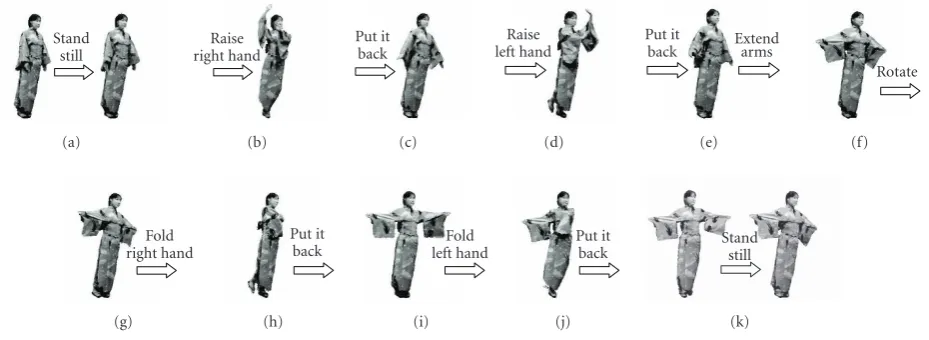
The frame rate was 10 frames/s. For the detailed content of 3D video, please see Figure 4for sequence #1 andFigure 7 for #2-1. In sequences #2-1#2-3, the motion sequence in
Figure 7is repeated approximately three times.
6.1. Motion segmentation
In the experiment, the motion of “standing still” in the first tens of frames of each sequence was extracted manu-ally in advance and neglected in the processing. Even when the dancer in 3D video is standing still, human body sways slightly, in which it is difficult to define segmentation bound-aries.
Figure 4 demonstrates the subjective segmentation re-sults for sequence #1 by eight volunteers. They were asked to define motion boundaries without any instruction or others’ segmentation results. In this experiment, when four (50%) or more subjects voted for the same points, the segmenta-tion boundaries were defined. The results were used for eval-uation. For sequences #2-1#2-3 and #3, the segmentation
boundaries were defined by the authors.
Stand still
(a)
Raise right hand
(b)
Put it back
(c)
Raise left hand
(d)
Put it
back Extendarms
(e)
Rotate
(f)
Fold right hand
(g)
Put it back
(h)
Fold left hand
(i)
Put it back
(j)
Stand still
(k)
Figure4: Subjective segmentation results for sequence #1 by eight volunteers.
0 50 100 150 200
Frame number 0
200 400 600 800 1000
D
is
ta
n
ce
b
et
w
ee
n
su
cce
si
ve
fr
ames
(A.U
.)
(a) (b) (c) (d) (e) (f) (g) (h) (i) (j) (k)
Segmentation boundaries defined subjectively by eight volunteers Results of the system
Figure5: Comparison of subjectively defined segmentation points and results of our system for sequence #1. Dotted arrows from (a) to (k) represent the segmentation boundaries defined subjectively by eight volunteers. Solid arrows are the results of our system.
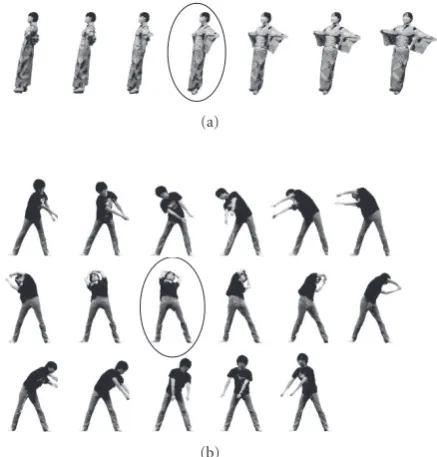
between histograms of successive frames. The dotted ar-rows from (a) to (k) represent the subjectively defined segmentation points shown in Figure 4. The solid arrows are the results of our system. There was only one over-segmentation. In addition, no miss-segmentation was de-tected. The over-segmentation between (f) and (g) was due to the fact that the pivoting foot was changed while the dancer was rotating and motion speed decreased temporarily (seeFigure 9(a)).
As other examples, segmentation results for sequences #2-1#2-3 are shown inFigure 6. The meanings of arrows are
different from those inFigure 5. Solid arrows represent over-segmented points, and dotted arrows are miss-over-segmented points. The other local minima points coincided with au-thors’ definition of segmentation boundaries. It is observed that the distances between the feature vectors of successive frames for sequences #2-1#2-3 are larger than those for
se-quence #1. This is because the dancer in sese-quence #1 wears kimonoand motion in feet is not sensed very much.
The first 14 segmentation points (approximately, out of the 210 frames) obtained from sequence #2-1 are shown in Figure 7. It is observed that the 3D video sequence is di-vided into small but meaningful segments. There was only one over-segmentation, which is shown with the cross, and no miss-segmentation for the period. The precision and re-call rates for sequence #2-1 were 95% and 93%, respectively (seeTable 2for more details).
0 100 200 300 400 500 600 700 Frame number 0 500 1000 1500 2000 D is ta n ce b et w ee n su cce si ve fr ames (A.U .) Oversegmentation Miss-segmentation (a)
0 100 200 300 400 500 600 700
Frame number 0 500 1000 1500 2000 D is ta n ce b et w ee n su cce si ve fr ames (A.U .) Oversegmentation Miss-segmentation (b)
0 100 200 300 400 500 600 700
Frame number 0 500 1000 1500 2000 D is ta n ce b et w ee n su cce si ve fr ames (A.U .) Oversegmentation Miss-segmentation (c)
Figure6: Segmentation results for sequences #2-1 #2-3: (a) #2-1, (b) #2-2, (c) #2-3. The meanings of arrows are different from Figure 5. Solid arrows represent oversegmented points, and dotted arrows are miss-segmented points. The other local minima points coincided with authors’ definition of segmentation boundaries.
Stand still
Clap hands twice
Clap hands
once big circleDraw a
Draw a big circle Twist to right Twist to left Twist to right Twist to left Jump three steps Jump three steps Stoop down Jump and spread hands
Figure 7: First 14 segmentation points of sequence #2-1. Image with cross-stands for oversegmentation.
Distance between succesive frames
Sum of dist. of the target frames with 1+1
frames
Sum of dist. of the target frames with 2+2
frames
Sum of dist. of the target frames with 3+3
frames 0 60 70 80 90 100 P recision and re call Recall Precision
Figure8: Precision and recall rates when the number of neighbor-ing frames involved in calculation of degree of motion was changed. Sequence #2-1 was used.
Table2: Performance summary of motion segmentation.
Sequence # 1 # 2-1 # 2-2 # 2-3 # 3 Total A: number of relevant
records retrieved 11 40 42 34 124 251
B: number of irrelevant
records retrieved 1 2 3 6 11 23
C: number of relevant
records not retrieved 0 3 3 8 25 39 Precision: A/(A+B) 92 95 93 80 92 92 Recall: A/(A+C) 100 93 93 85 83 87
to neglecting small or quick motion. Our 3D video was cap-tured at 10 frames/s. In such a low-frame rate case, calculat-ing the distance between only the successive frames yields the best performance.
Table 2 summarizes the motion segmentation perfor-mance. The numbers of segmentation boundaries for #2-1
(a)
(b)
Figure9: Examples of oversegmentation: (a) when changing pivot-ing foot; (b) when drawpivot-ing a big circle by arms. Detected overseg-mentation points are shown with circles.
mistakes. There are only a few miss- and over-segmentations per minute. Since sequence #3 contains more complicated motion than the others, which is hard to detect, the number of miss-segmentations is larger than the other sequences.
Most of the miss-segmentations were caused because the dancer did not pause properly even when the motion type changed. On the other hand, over-segmentation arose when the motion speed was decreased for motion transitions such as changing pivoting foot (Figure 9(a)) and changing the motion direction without changing the meaning of motion (Figure 9(b)). To resolve the problem, high-level motion ob-servation may be needed.
6.2. Similar motion retrieval
In similar motion search, motion clips which are obtained by segmenting the sequences are handled as minimum units for computational efficiency. To demonstrate the retrieval performance itself, the miss- and over-segmentations in our motion segmentation results were corrected manually in ad-vance. The motion definitions of the segmented clips af-ter the correction in sequences #2-1 and #2-2 are shown in Table 3.
Figure 10demonstrates the matrix representing the sim-ilarity evaluation score among clips in sequences #2-1 and #2-2. The brighter the color is, the more similar the two clips are. Although the dancers are different in sequences #2-1 and #2-2, it is observed that similar clips yield larger similarity score (smaller dissimilarity scoreDin (4)), showing the fea-sibility of our modified shape distribution-based retrieval.
Figure 11shows an example of similar motion retrieval results. A motion clip of “drawing a big circle by hands (clip
2-1(41) 2-1(31) 2-1(21) 2-1(11) 2-1(1)
Sequenc
e
#2-1
2-2(1) 2-2(11) 2-2(21) 2-2(31) 2-2(41) Sequence #2-2
Figure10: Matrix representing results of similarity evaluation be-tween sequences #2-1 and #2-2. The whiter the color is, the more similar the two clips are.
#2-2(4))” in sequence #2-2 was used as a query and simi-lar motion was searched from clips in sequence #2-1. Fig-ures11(b)–11(g)demonstrate the top six most similar clips retrieved from sequence #2-1. It is demonstrated that sim-ilar motion is successfully retrieved even though the num-bers of frames and posture of the 3D models are inconsis-tent with those in the query. In this case, all the relevant clips are retrieved. It has been confirmed that our retrieval system performs quite well for other queries.
Table 4summarizes the retrieval performance using se-quences #2-1#2-3. In the experiment, each clip from
se-quences shown in the column was used as a query. And the clips from the sequences shown in the row were used as can-didates. The query itself was not included in cancan-didates. The performance was evaluated by the method employed in [24]. The “first tier” inTable 4(a) demonstrates the averaged per-centage of the correctly retrieved clips in the topkhighest similarity score clips, wherek is the number of the ground truth of similar motion clips defined by the authors. An ideal matching would give no false positives and would return a score of 100%. The “second tier” inTable 4(b) gives the same type of result, but for the top 2khighest similarity score
clips. The “nearest neighbor” in Table 4(c) shows the per-centage of the test in which the retrieved clip with the highest score was correct. It is demonstrated that 56%85% of
sim-ilar motion clips are included in the first tier and more than 80% (82%98%) of clips are correctly retrieved in the
sec-ond tier. Besides, accuracy of nearest neighbor is 57%98%.
Table3: Motion definitions of clips after the correction: (a) sequence #2-1; (b) sequence #2-2.
Clip ID Frames Motion type
2-1(1) 0–55 Stand still
2-1(2) 56–71 Clap hands twice
2-1(3) 72–82 Clap hands once
2-1(4) 83–99 Draw a big circle
2-1(5) 100–117 Draw a big circle
2-1(6) 118–127 Twist to right
2-1(7) 128–136 Twist to left
2-1(8) 137–146 Twist to right
2-1(9) 147–155 Twist to left
2-1(10) 156–177 Jump three steps
2-1(11) 178–192 Jump three steps
2-1(12) 193–204 Stoop down
2-1(13) 205–203 Jump and spread hands
2-1(14) 204–224 Clap hands twice
2-1(15) 225–234 Clap hands once
2-1(16) 235–250 Draw a big circle
2-1(17) 251–269 Draw a big circle
2-1(18) 270–280 Twist to right
2-1(19) 281–287 Twist to left
2-1(20) 288–300 Twist to right
2-1(21) 301–306 Twist to left
2-1(22) 307–325 Jump three steps
2-1(23) 326–347 Jump three steps
2-1(24) 348–355 Stoop down
2-1(25) 356–366 Jump and spread hands
2-1(26) 367–374 Clap hands twice
2-1(27) 375–387 Clap hands once
2-1(28) 388–403 Draw a big circle
2-1(29) 404–421 Draw a big circle
2-1(30) 422–433 Twist to right
2-1(31) 433–441 Twist to left
2-1(32) 442–451 Twist to right
2-1(33) 452–460 Twist to left
2-1(34) 460–480 Jump three steps
2-1(35) 481–501 Jump three steps
2-1(36) 502–518 Jump and spread hands
2-1(37) 519–527 Clap hands twice
2-1(38) 528–537 Clap hands once
2-1(39) 538–546 Twist to right
2-1(40) 547–556 Twist to left
2-1(41) 557–563 Twist to right
2-1(42) 564–575 Twist to left
2-1(43) 576–607 Stop in the middle of jumping
2-1(44) 608–612 Stand still
(a)
Clip ID Frames Motion type 2-2(1) 0–44 Stand still
2-2(2) 45–61 Clap hands twice
2-2(3) 62–71 Clap hands once
2-2(4) 72–89 Draw a big circle
2-2(5) 90–107 Draw a big circle
2-2(6) 108–119 Twist to right
2-2(7) 120–128 Twist to left
2-2(8) 129–135 Twist to right
2-2(9) 136–145 Twist to left
2-2(10) 146–166 Jump three steps
2-2(11) 167–181 Jump three steps
2-2(12) 182–191 Stoop down
2-2(13) 192–203 Jump and spread hands
2-2(14) 204–214 Clap hands twice
2-2(15) 215–224 Clap hands once
2-2(16) 225–242 Draw a big circle
2-2(17) 243–260 Draw a big circle
2-2(18) 261–270 Twist to right
2-2(19) 271–280 Twist to left
2-2(20) 281–286 Twist to right
2-2(21) 287–311 Twist to left
2-2(22) 312–320 Undefined motion (mistake)
2-2(23) 321–332 Jump three steps
2-2(24) 333–344 Jump three steps
2-2(25) 345–356 Stoop down
2-2(26) 357–366 Jump and spread hands
2-2(27) 367–372 Clap hands twice
2-2(28) 373–392 Clap hands once
2-2(29) 393–412 Draw a big circle
2-2(30) 413–423 Draw a big circle
2-2(31) 424–430 Twist to right
2-2(32) 431–439 Twist to left
2-2(33) 440–448 Twist to right
2-2(34) 449–470 Twist to left
2-2(35) 471–488 Jump three steps
2-2(36) 489–499 Jump three steps
2-2(37) 500–508 Stoop down
2-2(38) 509–518 Jump and spread hands
2-2(39) 519–529 Clap hands twice
2-2(40) 530–544 Clap hands once
2-2(41) 545–556 Draw a big circle
2-2(42) 557–565 Twist to right
2-2(43) 566–572 Twist to left
2-2(44) 573–586 Twist to right
2-2(45) 587–601 Twist to left
2-2(46) 602–612 Stop in the middle of drawing a big circle
(a) (b)
(c) (d)
(e) (f)
(g)
Figure11: Experimental results for 3D video retrieval using motion of “drawing a big circle by hands”: (a) query clip from sequence #2-2 (clip #2-2(4)); (b) the most similar clip in sequence #2-1 (clip #2-1(4)); (c) the second most similar clip (clip #2-1(28)); (d) the third most
similar clip (clip #2-1(5)); (e) the fourth most similar clip (clip #2-1(16)); (f) the fifth most similar clip (clip #2-1(29)); (g) the sixth most
Table4: Retrieval performance: (a) first tier, (b) second tier, (c) nearest neighbor. Query clip was generated from the sequence in the column and the clips from the sequences shown in the row were used as candidates. The query itself was not included in the candi-date clips.
# 2-1 # 2-2 # 2-3
# 2-1 80% (298/372) 63% (252/397) 70% (292/420) # 2-2 62% (247/394) 63% (220/350) 63% (259/414) # 2-3 57% (242/421) 56% (232/414) 85% (346/408)
(a)
# 2-1 # 2-2 # 2-3
# 2-1 98% (366/372) 84% (335/397) 90% (378/420) # 2-2 85% (335/394) 82% (287/350) 87% (360/414) # 2-3 89% (374/421) 94% (390/414) 96% (392/408)
(b)
# 2-1 # 2-2 # 2-3 # 2-1 98% (40/41) 76% (31/41) 90% (36/40) # 2-2 57% (24/42) 62% (26/42) 62% (26/42) # 2-3 67% (28/42) 69% (29/42) 90% (36/40)
(c)
Some false positives were detected due to the fact that the shape distribution is designed for extracting global shape fea-tures. Therefore, extracted sequential feature vectors tend to be affected by various factors such as difference in motion trajectories and physiques or clothes of the dancers. To en-hance the retrieval performance, higher-level motion analy-sis is needed.
7. CONCLUSIONS
3D video, which is generated using multiple view images taken with a lot of cameras, is attracting a lot of attention as a new multimedia technology. In this paper, key technolo-gies for 3D video retrieval such as feature extraction, mo-tion segmentamo-tion, and similarity evaluamo-tion have been de-veloped. The development of these technologies for 3D video is much more challenging than those for motion capture data because localization and tracking of feature points are very difficult in 3D video. The modified shape distribution algo-rithm has been employed for stable feature representation of 3D models. Segmentation has been conducted analyzing the degree of motion calculated in the feature vector space. The proposed segmentation algorithm does not require any predefined threshold values in verification process and re-lies only on relative comparison, thus realizing robustness to data variation. The similar motion retrieval has been realized by DP matching using the feature vectors. We have demon-strated effective segmentation with the precision and recall rates of 92% and 87% on average, respectively. In addition, reasonable retrieval results have been demonstrated by ex-periments.
ACKNOWLEDGMENT
This work is supported by the Ministry of Education, Cul-ture, Sports, Science and Technology of Japan under the
“Development of Fundamental Software Technologies for Digital Archives” Project.
REFERENCES
[1] T. Kanade, P. Rander, and P. J. Narayanan, “Virtualized reality: constructing virtual worlds from real scenes,”IEEE Multime-dia, vol. 4, no. 1, pp. 34–47, 1997.
[2] S. Wurmlin, E. Lamboray, O. G. Staadt, and M. H. Gross, “3D video recorder,” inProceedings of the 10th Pacific Conference on Computer Graphics and Applications, pp. 325–334, Beijing, China, October 2002.
[3] T. Matsuyama, X. Wu, T. Takai, and T. Wada, “Real-time dy-namic 3-D object shape reconstruction and high-fidelity tex-ture mapping for 3-D video,”IEEE Transactions on Circuits and Systems for Video Technology, vol. 14, no. 3, pp. 357–369, 2004. [4] K. Tomiyama, Y. Orihara, M. Katayama, and Y. Iwadate, “Algorithm for dynamic 3D object generation from multi-viewpoint images,” inThree-Dimensional TV, Video, and Dis-play III, vol. 5599 ofProceedings of SPIE, pp. 153–161, Phila-delphia, Pa, USA, October 2004.
[5] Y. Ito and H. Saito, “Free-viewpoint image synthesis from multiple-view images taken with uncalibrated moving cam-eras,” inProceedings of IEEE International Conference on Image Processing (ICIP ’05), vol. 3, pp. 29–32, Genova, Italy, Septem-ber 2005.
[6] H. Habe, Y. Katsura, and T. Matsuyama, “Skin-off: representa-tion and compression scheme for 3D video,” inProceedings of Picture Coding Symposium (PCS ’04), pp. 301–306, San Fran-cisco, Calif, USA, December 2004.
[7] K. M¨uller, A. Smolic, M. Kautzner, P. Eisert, and T. Wiegand, “Predictive compression of dynamic 3D meshes,” in Proceed-ings of IEEE International Conference on Image Processing (ICIP ’05), vol. 1, pp. 621–624, Genova, Italy, September 2005. [8] T. Shiratori, A. Nakazawa, and K. Ikeuchi, “Rhythmic
mo-tion analysis using momo-tion capture and musical informamo-tion,” inProceedings of IEEE International Conference on Multisen-sor Fusion and Integration for Intelligent Systems (MFI ’03), pp. 89–92, Tokyo, Japan, July-August 2003.
[9] K. Kahol, P. Tripathi, and S. Panchanathan, “Automated ges-ture segmentation from dance sequences,” inProceedings of the 6th IEEE International Conference on Automatic Face and Ges-ture Recognition, pp. 883–888, Seoul, Korea, May 2004. [10] J. Barbiˇc, A. Safonova, J.-Y. Pan, C. Faloutsos, J. K. Hodgins,
and N. S. Pollard, “Segmenting motion capture data into dis-tinct behaviors,” inProceedings of Graphics Interface (GI ’04), pp. 185–194, London, UK, May 2004.
[11] C. Lu and N. J. Ferrier, “Repetitive motion analysis: segmen-tation and event classification,”IEEE Transactions on Pattern Analysis and Machine Intelligence, vol. 26, no. 2, pp. 258–263, 2004.
[12] W. Takano and Y. Nakamura, “Segmentation of human behav-ior patterns based on the probabilistic correlation,” in Proceed-ings of the 19th Annual Conference of the Japanese Society for Artificial Intelligence (JSAI ’05), Kitakyushu, Japan, June 2005, 3F1-01.
[13] Y. Sakamoto, S. Kuriyama, and T. Kaneko, “Motion map: image-based retrieval and segmentation of motion data,” in
Proceedings of ACM SIGGRAPH/Eurographics Symposium on Computer Animation, pp. 259–266, Grenoble, France, August 2004.
of Visual Communication and Image Representation, vol. 15, no. 3, pp. 446–466, 2004.
[15] M. M¨uller, T. R¨oder, and M. Clausen, “Efficient content-based retrieval of motion capture data,” inProceedings of ACM SIG-GRAPH, pp. 677–685, Vienna, Austria, 2005.
[16] J. Xu, T. Yamasaki, and K. Aizawa, “3D video segmentation using point distance histograms,” inProceedings of IEEE Inter-national Conference on Image Processing (ICIP ’05), vol. 1, pp. 701–704, Genova, Italy, September 2005.
[17] J. Xu, T. Yamasaki, and K. Aizawa, “Effective 3D video seg-mentation based on feature vectors using spherical coordinate system,” inMeeting on Image Recognition and Understanding (MIRU ’05), pp. 136–143, Hyogo, Japan, July 2005.
[18] T. Yamasaki and K. Aizawa, “Motion segmentation of 3D video using modified shape distribution,” in Proceedings of IEEE International Conference on Multimedia & Expo (ICME ’06), Toronto, Ontario, Canada, July 2006.
[19] T. Yamasaki and K. Aizawa, “Similar motion retrieval of 3D video based on modified shape distribution,” inProceedings of IEEE International Conference on Image Processing (ICIP ’06), Atlanta, Ga, USA, October 2006.
[20] R. Bellman and S. Dreyfus, Applied Dynamic Programming, Princeton University Press, Princeton, NJ, USA, 1962. [21] D. P. Bertsekas,Dynamic Programming and Optimal Control
(Volume One), Athena Scientific, Belmont, Mass, USA, 1995. [22] T. Matsuyama, X. Wu, T. Takai, and S. Nobuhara, “Real-time
3D shape reconstruction, dynamic 3D mesh deformation, and high fidelity visualization for 3D video,”Computer Vision and Image Understanding, vol. 96, no. 3, pp. 393–434, 2004. [23] J. W. H. Tangelder and R. C. Veltkamp, “A survey of content
based 3D shape retrieval methods,” inProceedings of Interna-tional Conference on Shape Modeling and Applications (SMI ’04), pp. 145–156, Genova, Italy, June 2004.
[24] R. Osada, T. Funkhouser, B. Chazelle, and D. Dobkin, “Shape distributions,”ACM Transactions on Graphics, vol. 21, no. 4, pp. 807–832, 2002.
[25] H. J. Ney and S. Ortmanns, “Dynamic programming search for continuous speech recognition,” IEEE Signal Processing Magazine, vol. 16, no. 5, pp. 64–83, 1999.
[26] H. Ney and S. Ortmanns, “Progress in dynamic programming search for LVCSR,”Proceedings of the IEEE, vol. 88, no. 8, pp. 1224–1240, 2000.
[27] A. A. Amini, T. E. Weymouth, and R. C. Jain, “Using dy-namic programming for solving variational problems in vi-sion,”IEEE Transactions on Pattern Analysis and Machine In-telligence, vol. 12, no. 9, pp. 855–867, 1990.
Toshihiko Yamasakiwas born in Japan in 1976. He received the B.S. degree in elec-tronic engineering, the M.S. degree in infor-mation and communication engineering, and the Ph.D. degree from The University of Tokyo in 1999, 2001, and 2004, respectively. From April 2004 to October 2006, he was an Assistant Professor at Department of tier Informatics, Graduate School of Fron-tier Sciences, The University of Tokyo. Since
October 2006, he has been an Assistant Professor at Department of Information and Communication Engineering, Graduate School of Information Science and Technology, The University of Tokyo. His current research interests include dynamic 3D mesh process-ing, wearable media, and analog VLSI design. He is a Member of IEEE, ACM, and so on.
Kiyoharu Aizawa received the B.E., the M.E., and the Dr.E. degrees in electrical en-gineering all from the University of Tokyo, in 1983, 1985, 1988, respectively. He is cur-rently a Professor at the Department of In-formation and Communication Engineer-ing of the University of Tokyo. He was a Visiting Assistant Professor at University of Illinois from 1990 to 1992. His current re-search interests are in image coding, image