R E V I E W
Open Access
Greedy sparse decompositions: a comparative
study
Przemyslaw Dymarski
1*, Nicolas Moreau
2and Gaël Richard
2Abstract
The purpose of this article is to present a comparative study of sparse greedy algorithms that were separately introduced in speech and audio research communities. It is particularly shown that the Matching Pursuit (MP) family of algorithms (MP, OMP, and OOMP) are equivalent to multi-stage gain-shape vector quantization algorithms previously designed for speech signals coding. These algorithms are comparatively evaluated and their merits in terms of trade-off between complexity and performances are discussed. This article is completed by the introduction of the novel methods that take their inspiration from this unified view and recent study in audio sparse decomposition.
Keywords:greedy sparse decomposition, matching pursuit, orthogonal matching pursuit, speech and audio coding
1 Introduction
Sparse signal decomposition and models are used in a large number of signal processing applications, such as, speech and audio compression, denoising, source separation, or automatic indexing. Many approaches aim at decomposing the signal on a set of constituent ele-ments (that are termed atoms, basis or simply dictionary elements), to obtain an exact representation of the sig-nal, or in most cases an approximative but parsimonious representation. For a given observation vector x of dimension N and a dictionary F of dimensionN ×L, the objective of such decompositions is to find a vector gof dimension Lwhich satisfies F g=x. In most cases, we haveL≫Nwhicha priorileads to an infinite num-ber of solutions. In many applications, we are however interested in finding an approximate solution which would lead to a vector gwith the smallest numberKof non-zero components. The representation is either exact (when gis solution ofF g =x) or approximate (when g is solution of F g ≈ x). It is furthermore termed as sparse representation whenK≪N.
The sparsest representation is then obtained by find-ing gÎ ℝL that minimizes ||x−Fg||22 under the
constraint ||g||0 ≤Kor, using the dual formulation, by findinggÎ ℝLthat minimizes ||g||0 under the constraint ||x−Fg||22≤ε.
An extensive literature exists on these iterative decom-positions since this problem has received a strong inter-est from several research communities. In the domain of audio (music) and image compression, a number of greedy algorithms are based on the founding paper of Mallat and Zhang [1], where the Matching Pursuit (MP) algorithm is presented. Indeed, this article has inspired several authors who proposed various extensions of the basic MP algorithm including: the Orthogonal Matching Pursuit (OMP) algorithm [2], the Optimized Orthogonal Matching Pursuit (OOMP) algorithm [3], or more recently the Gradient Pursuit (GP) [4], the Complemen-tary Matching Pursuit (CMP), and the Orthogonal Com-plementary Matching Pursuit (OCMP) algorithms [5,6]. Concurrently, this decomposition problem is also heavily studied by statisticians, even though the problem is often formulated in a slightly different manner by repla-cing the L0 norm used in the constraint by a L1 norm (see for example, the Basis Pursuit (BP) algorithm of Chen et al. [7]). Similarly, an abundant literature exists in this domain in particular linked to the two classical algorithms Least Angle Regression (LARS) [8] and the Least Absolute Selection and Shrinkage Operator [9].
* Correspondence: [email protected] 1
Institute of Telecommunications, Warsaw University of Technology, Warsaw, Poland
Full list of author information is available at the end of the article
However, sparse decompositions also received a strong interest from the speech coding community in the eigh-ties although a different terminology was used.
The primary aim of this article is to provide a com-parative study of the greedy“MP”algorithms. The intro-duced formalism allows to highlight the main differences between some of the most popular algo-rithms. It is particularly shown in this article that the MP-based algorithms (MP, OMP, and OOMP) are equivalent to previously known multi-stage gain-shape vector quantization approaches [10]. We also provide a detailed comparison between these algorithms in terms of complexity and performance. In the light of this study, we then introduce a new family of algorithms based on the cyclic minimization concept [11] and the recent Cyclic Matching Pursuit (CyMP) [12]. It is shown that these new proposals outperform previous algo-rithms such as OOMP and OCMP.
This article is organized as follows. In Section 2, we introduce the main notations used in this article. In Sec-tion 3, a brief historical view of speech coding is pro-posed as an introduction to the presentation of classical algorithms. It is shown that the basic iterative algorithm used in speech coding is equivalent to the MP algo-rithm. The advantage of using an orthogonalization technique for the dictionaryFis further discussed and it is shown that it is equivalent to a QR factorization of the dictionary. In Section 4, we extend the previous ana-lysis to recent algorithms (conjugate gradient, CMP) and highlight their strong analogy with the previous algo-rithms. The comparative evaluation is provided in Sec-tion 5 on synthetic signals of small dimension (N= 40), typical for code excited linear predictive (CELP) coders. Section 6 is then dedicated to the presentation of the two novel algorithms called herein CyRMGS and CyOOCMP. Finally, we suggest some conclusions and perspectives in Section 7.
2 Notations
In this article, we adopt the following notations. All vec-torsxare column vectors wherexiis theith component.
A matrixF ÎℝN × Lis composed of Lcolumn vectors such as F = [f1 ··· fL] or alternatively ofNL elements denoted fkj, wherek(resp.j) specifies the row (resp. col-umn) index. An intermediate vector x obtained at the kth iteration of an algorithm is denoted asxk. The scalar
product of the two real valued vectors is expressed by <x,y>=xty. The L
pnorm is written as ||·||pand by
con-vention ||·|| corresponds to the Euclidean norm (L2). Finally, the orthogonal projection ofxonyis the vector ay that satisfies <x - ay, y >= 0, which brings a =<x, y>/||y||2
.
3 Overview of classical algorithms 3.1 CELP speech coding
Most modern speech codecs are based on the principle of CELP coding [13]. They exploit a simple source/filter model of speech production, where the source corre-sponds to the vibration of the vocal cords or/and to a noise produced at a constriction of the vocal tract, and the filter corresponds to the vocal/nasal tracts. Based on the quasi-stationary property of speech, the filter coeffi-cients are estimated by linear prediction and regularly updated (20 ms corresponds to a typical value). Since the beginning of the seventies and the “LPC-10” codec [14], numerous approaches were proposed to effectively represent the source.
In the multi-pulse excitation model proposed in [15], the source was represented ase(n) =Kk=1gkδ(n−nk),
where δ(n) is the Kronecker symbol. The positionnk
and gain gkof each pulse were obtained by minimizing
||x− ˆx||2, where x is the observation vector and xˆ is obtained by predictive filtering (filterH(z)) of the excita-tion signal e(n). Note that this minimization was per-formed iteratively, that is for one pulse at a time. This idea was further developed by other authors [16,17] and generalized by [18] using vector quantization (a field of intensive research in the late seventies [19]). The basic idea consisted in proposing a potential candidate for the excitation, i.e. one (or several) vector(s) was(were) cho-sen in a pre-defined dictionary with appropriate gain(s) (see Figure 1).
The dictionary of excitation signals may have a form of an identity matrix (in which nonzero elements corre-spond to pulse positions), it may also contain Gaussian sequences or ternary signals (in order to reduce compu-tational cost of filtering operation). Ternary signals are also used in ACELP coders [20], but it must be stressed that the ACELP model uses only one common gain for all the pulses. Thus, it is not relevant to the sparse approximation methods, which demand a separate gain
6 ?
x
H(z)
Min x−xˆ2
6 6
g j
ˆ
x
N-1 0
0 L-1
- -j
j
for each vector selected from the dictionary. However, in any CELP coder, there is an excitation signal diction-ary and a filtered dictiondiction-ary, obtained by passing the excitation vectors (columns of a matrix representing the excitation signal dictionary) through the linear predictive filter H(z). The filtered dictionary F = {f1,..., fL} is updated every 10-30 ms. The dictionary vectors and gains are chosen to minimize the norm of the error vec-tor. The CELP coding scheme can then be seen as an operation of the multi-stage shape-gain vector quantiza-tion on a regularly updated (filtered) dicquantiza-tionary.
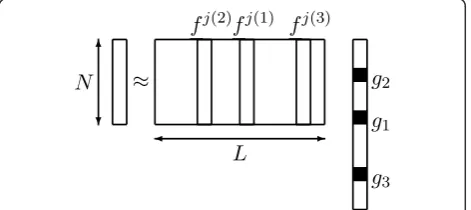
LetFbe this filtered dictionary (not shown in Figure 1). It is then possible to summarize the CELP main principle as follows: given a dictionaryFcomposed ofL vectorsfj, j= 1, ···, Lof dimension Nand a vectorx of dimensionN, we aim at extracting from the dictionary a matrixAcomposed ofKvectors amongstLand at find-ing a vectorgof dimensionKwhich minimizes
||x−−Ag −||
2=||x
−−
K
k=1
gkf−j(k)||2=||x−− ˆx−||2.
This is exactly the same problem as the one presented in introduction.a This problem, which is identical to multi-stage gain-shape vector quantization [10], is illu-strated in Figure 2.
Typical values for the different parameters greatly vary depending on the application. For example, in speech coding [20] (and especially for low bit rate) a highly redundant dictionary (L≫N) is used and coupled with high sparsity (Kvery small).bIn music signals coding, it is common to consider much larger dictionaries and to select a much larger number of dictionary elements (or atoms). For example, in the scheme proposed in [21], based on an union of MDCTs, the observed vector x represents several seconds of the music signal sampled at 44.1 kHz and typical values could beN >105,L >106, andK≈103.
3.2 Standard iterative algorithm
If the indices j(1) ···j(K) are known (e.g., the matrixA), then the solution is easily obtained following a least
square minimization strategy [22]. Let ˆx be the best approximate of x, e.g. the orthogonal projection ofxon the subspace spanned by the column vectors ofA verify-ing:
<x−Ag, fj(k)>= 0 fork= 1· · ·K
The solution is then given by
g= (AtA)−1Atx (1)
whenAis composed of Klinearly independent vectors which guarantees the invertibility of the Gram matrix AtA.
The main problem is then to obtain the best set of indicesj(1) ··· j(K), or in other words to find the set of indices that minimizes||x− ˆx||2or that maximizes
||ˆx||2=xˆtˆ
x=gtAtAg=xtA(AtA)−1Atx (2)
since we have||x− ˆx||2= ||x||2− ||ˆx||2if g is chosen according to Equation 1.
This best set of indices can be obtained by an exhaus-tive search in the dictionaryF(e.g., the optimal solution exists) but in practice the complexity burdens impose to follow a greedy strategy.
The main principle is then to select one vector (dic-tionary element or atom) at a time, iteratively. This leads to the so-called Standard Iterative algorithm [16,23]. At thekth iteration, the contribution of thek- 1 vectors (atoms) previously selected is subtracted fromx
ek=x−
k−1
i=1
gifj(i),
and a new indexj(k) and a new gaingkverifying
j(k) = arg max
j
<fj,ek>2
<fj,fj>andgk
<fj(k),ek>
<fj(k),fj(k)>
are determined. Let
aj=<fj
, fj>= ||fj||2be the vector (atom) energy, βj
1=<f−
j
,x−>be the crosscorrelation betweenfjand xthenβkj =<fj, ek>the crosscorrelation betweenfj and the error (or residual)ekat stepk,
rkj =<f −
j
,f −
j(k)>the updated crosscorrelation.
By noticing that
βj
k+1=<f
j
, ek−g
kfj(k)>=βk−gkrkj
one obtains the Standard Iterative algorithm, but called herein as the MP (cf. Appendix). Indeed, although 6
? -
g
1g
3g
2f
j(1)f
j(3)f
j(2)≈
N
L
it is not mentioned in [1], this standard iterative scheme is strictly equivalent to the MP algorithm.
To reduce the sub-optimality of this algorithm, two common methodologies can be followed. The first approach is to recompute all gains at the end of the minimization procedure (this method will constitute the reference MP method chosen for the comparative eva-luation section). A second approach consists in recom-puting the gains at each step by applying Equation 1 knowing j(1) ···j(k), i.e., matrixA. Initially proposed in [16] for multi-pulse excitation, it is equivalent to an orthogonal projection ofxon the subspace spanned by fj(1)
··· fj(k), and therefore, equivalent to the OMP later proposed in [2].
3.3 Locally optimal algorithms 3.3.1 Principle
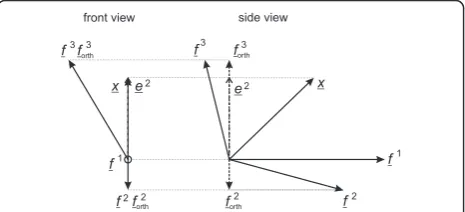
A third direction to reduce the sub-optimality of the standard algorithm aims at directly finding the subspace which minimizes the error norm. At step k, the sub-space of dimension k - 1 previously determined and spanned byfj(1)···fj(k-1) is extended by the vectorfj(k), which maximizes the projection norm ofxon all possible subspaces of dimensionkspanned byfj(1)···fj(k-1)fj. As illustrated in Figure 3, the solution obtained by this algorithm may be better than the other solution obtained by the previous OMP algorithm.
This algorithm produces a set of locally optimal indices, since at each step, the best vector is added to the existing subspace (but obviously, it is not globally optimal due to its greedy process). An efficient mean to implement this algorithm consists in orthogonalizing the dictionary F at each step krelatively to the k - 1 chosen vectors.
This idea was already suggested in [17], and then later developed in [24,25] for multi-pulse excitation, and
formalized in a more general framework in [26,23]. This framework is recalled below and it is shown as to how it encompasses the later proposed OOMP algorithm [3].
3.3.2 Gram-Schmidt decomposition and QR factorization
Orthogonalizing a vector fj with respect to vector q (supposed herein of unit norm) consists in subtracting fromfjits contribution in the direction ofq. This can be written:
fj
orth=f
j−<
fj, q>q=fj−qqtfj= (I −qqt)fj.
More precisely, if k- 1 successive orthogonalizations are performed relatively to the k- 1 vectorsq1 · · ·qk-1 which form an orthonormal basis, one obtains for step k:
fj
orth(k)=f
j
orth(k−1)−<f
j
orth(k−1), q
k−1>qk−1
= [I −qk−1(qk−1)t]fj
orth(k−1)
Then, maximizing the projection norm of x on the subspace spanned by fj(1)
1 f
j(2)
orth(2)· · ·f
j(k−1)
orth(k−1)f
j
orth(k) is
done by choosing the vector maximizing(βkj)2αjkwith
αj
k=<f
j
orth(k), f
j
orth(k)>
and
βj
k=<f
j
orth(k), x− ˆx
k−1>
=<fj
orth(k), x>
In fact, this algorithm, presented as a Gram-Schmidt decomposition with a partial QR factorization of the matrix f, is equivalent to the OOMP algorithm [3]. This is referred herein as the OOMP algorithm (see Appendix).
The QR factorization can be shown as follows. Ifrkj is the component of fj on the unit norm vector qk, one obtains:
fj
orth(k + 1)=f
j
orth(k + 1)−r
j
kq
k=fj−
k
i=1
rijqi
fj=rj1q1+· · ·+rjkqk+fj
orth(k + 1)
rkj =<fj,qk>=<fj
orth(k)+
k−1
i=1
rjiqi,qk>
rjk=<fj
orth(k),q
k>
For the sake of clarity and without loss of generality, let us suppose that thekth selected vector corresponds to thekth column of matrixF(note that this can always be obtained by column wise permutation), then, the fol-lowing relation exists between the original (F) and the
Figure 3Comparison of the OMP and the locally optimal algorithm: letx,f1,f2lie on the same plane, butf3stem out of this plane. At the first step both algorithms choosef1(min angle withx) and calculate the error vectore2. At the second step the OMP algorithm choosesf3because∡(e2,f3)<∡(e2,f2). The locally optimal algorithm makes the optimal choicef2sincee2andf2
orthogonalized (Forth(k+1)) dictionaries
F= [q1· · ·qkfk+1
orth(k + 1)· · ·f
L
orth(k + 1)]× ⎡ ⎢ ⎢ ⎢ ⎢ ⎢ ⎢ ⎣ r1
1r12· · · ·r1L
0r2
2r32· · · ·rL2
..
.. .. ... ... ... ... ..
.. .. ...rk k· · ·rLk
0· · · ·0IL−k
⎤ ⎥ ⎥ ⎥ ⎥ ⎥ ⎥ ⎦ .
where the orthogonalized dictionaryForth(k+1)is given by
Forth(k + 1)= [0· · ·0fkorth(k + 1)+1 · · ·fLorth(k + 1)]
due to the orthogonalization step of vector fj(k)
orth(k)by qk.
This readily corresponds to the Gram-Schmidt decomposition of the first k columns of the matrix F extended by the remainingL-kvectors (referred as the modified Gram-Schmidt (MGS) algorithm by [22]).
3.3.3 Recursive MGS algorithm
A significant reduction of complexity is possible by noti-cing that it is not necessary to explicitly compute the orthogonalized dictionary. Indeed, thanks to orthogonal-ity properties, it is sufficient to update the energies αkj and cross-correlationsβkj as follows:
αj
k= ||f
j
orth(k)|| 2
= ||fj
orth(k - 1)|| 2− 2rj
k−1<f
j
orth(k - 1), q
k−1>
+ (rkj−1)2||qk−1||2
=αkj−1−(rjk−1)2
βj k=<f
j
orth(k), x>=<f j
orth(k - 1), x>−r j k−1<q
k−1, x>
βj k=β
j k−1−r
j k−1
βj(k−1) k−1
αj(k−1) k−1
.
A recursive update of the energies and crosscorrela-tions is possible as soon as the crosscorrelation rjkis known at each step. The crosscorrelations can also be obtained recursively with
rkj = [<f
j,fj(k)>−k−1
i=1 r
j(k)
i <f
j,qi>]
αj(k)
k
= [<f
j
,fj(k)>−ik=1−1rji(k)rij]
αj(k)
k
The gainsg¯1· · · ¯gKcan be directly obtained. Indeed, it
can be seen that the scalar
<qk−1, x>=βj(k−1)
k−1 /
αj(k−1)
k−1 corresponds to the com-ponent ofx (or gain) on the (k- 1)thvector of the cur-rent orthonormal basis, that is, the gain g¯k−1. The gains
which correspond to the non-orthogonalized vectors can simply be obtained as:
q1· · ·qK
⎡⎢ ⎣ ¯ g1 .. . ¯ gK ⎤ ⎥ ⎦=
fj(1)· · ·fj(K)
⎡⎢ ⎣ g1 .. . gK ⎤ ⎥ ⎦
=q1· · ·qKR
⎡ ⎢ ⎣ g1 .. . gK ⎤ ⎥ ⎦ with R= ⎡ ⎢ ⎢ ⎢ ⎢ ⎣
rj1(1)r j(2) 1 · · · r
j(K) 1
0 r2j(2)· · · r j(K) 2
..
. . .. ... ... 0 · · · 0 rjK(K)
⎤ ⎥ ⎥ ⎥ ⎥ ⎦
which is an already computed matrix since it corre-sponds to a subset of the matrix R of size K × L obtained by QR factorization of matrixF. This algorithm will be further referenced herein as RMGS and was ori-ginally published in [23].
4 Other recent algorithms 4.1 GP algorithm
This algorithm is presented in detail in [4]. Therefore, the aim of this section is to provide an alternate view and to show that the GP algorithm is similar to the standard iterative algorithm for the search of indexj(k) at stepk, and then corresponds to a direct application of the conjugate gradient method [22] to obtain the gain gkand error ek. To that aim, we will first recall some
basic properties of the conjugate gradient algorithm. We will highlight how the GP algorithm is based on the conjugate gradient method and finally show that this algorithm is exactly equivalent to the OMP algorithm.c
4.1.1 Conjugate gradient
The conjugate gradient is a classical method for solving problems that are expressed byAg=x, where Ais aN× N symmetric, positive-definite square matrix. It is an iterative method that provides the solutiong* = A-1xin Niterations by searching the vectorgwhich minimizes
Φ(g) = 1 2g
tAg−xtg. (3)
Let ek-1 =x- Agk-1be the error at stepkand note that ek-1
gk-1
. The basic gradient method consists in finding at each step the positive constantckwhich minimizesF(gk
-1
+ckek-1). In order to obtain the optimal solution inN
iterations, the Conjugate Gradient algorithm consists of minimizing F(g), using all successive directions q1 · · · qN. The search for the directionsqkis based on the
A-conjugate principle.d
It is shown in [22] that the best directionqkat stepk is the closest one to the gradient ek-1 that verifies the conjugate constraint (that is,ek-1from which its contri-bution onqk-1using the scalar product <u, Av> is sub-tracted):
qk=ek−1− <e
k−1,Aqk−1>
<qk−1,Aqk−1>q
k−1
. (4)
The results can be extended to anyN ×Lmatrix A, noting that the two systems Ag=x and AtAg=Atxhave the same solution ing. However, for the sake of clarity, we will distinguish in the following the errorek=x-Agk and the errore˜k=Atx−AtAgk.
4.1.2 Conjugate gradient for parsimonious representations
Let us recall that the main problem tackled in this arti-cle consists in finding a vectorg withKnon-zero com-ponents that minimizes ||x- Fg||2
knowingxandF. The vectorgthat minimizes the following cost function
1
2||x−Fg||
2= 1
2||x||
2− (Ftx)tg+ 1
2gF
tFg
verifiesFtx=FtFg. The solution can then be obtained, thanks to the conjugate gradient algorithm (see Equa-tion 3). Below, we further describe the essential steps of the algorithm presented in [4].
LetAk= [fj(1)· · ·fj(k)] be the dictionary at stepk. Fork = 1, once the indexj(1) is selected (e.g. A1is fixed), we look for the scalar
g1= arg min
g
1 2||x−A
1g||2= arg min
g Φ(g)
where
Φ(g) =−((A1)tx)tg + 1 2g(A
1)tA1g
The gradient writes
∇Φ(g) =−[(A1)tx − (A1)tA1g] =−˜e0(g)
The first direction is then chosen asq1=˜e0
(0). Fork= 2, knowingA2, we look for the bi-dimensional vectorg
g2= arg min
g Φ(g) = arg ming [−((A
2)tx)tg + 1
2g
t(A2)tA2g]
The gradient now writes
∇Φ(g) =−[(A2)tx−(A2)tA2g] =−˜e1(g)
As described in the previous section, we now choose the directionq2 which is the closest one to the gradient ˜
e1(g1), which satisfies the conjugation constraint (e.g.,e˜1 from which its contribution onq1 using the scalar pro-duct< u, (A2)tA2v> is subtracted):
q2=˜e1<e˜
1
, (A2)tA2q1>
<q1, (A2)tA2q1>q 1.
At step k, Equation 4 does not hold directly since in this case the vectorg is of increasing dimension which does not directly guarantee the orthogonality of the vec-torsq1· · ·qk. We then must write:
qk=e˜k−1−
k−1
i=1
<˜ek−1(Ak)tAkqi>
<qi, (Ak)tAkqi> q
i. (5)
This is referenced as GP in this article. At first, it is the standard iterative algorithm (described in Section 3.2), and then it is a conjugate gradient algorithm pre-sented in the previous section, where the matrixAwas replaced by the Akand where the vector qkwas modi-fied according to Equation 5. Therefore, this algorithm is equivalent to the OMP algorithm.
4.2 CMP algorithms
The CMP algorithm and its orthogonalized version (OCMP) [5,6] are rather straightforward variants of the standard algorithms. They exploit the following prop-erty: if the vector g (again of dimensionL in this sec-tion) is the minimal norm solution of the underdetermined system Fg= x, then it is also a solu-tion of the equasolu-tion system
Ft(FFt)−1Fg=Ft(FFt)−1x
if inFthere areNlinearly independent vectors. Then, a new family of algorithms can be obtained by simply applying one of the previous algorithms to this new sys-tem of equations Fg=y with F=Ft(FFt)-1Fand y=Ft (FFt
)-1x. All these algorithms necessitate the computa-tion ofaj = <jj, jj>, bj= <jj,y> andrjk=< φj,φj(k)>. It is easily shown that if
C= [c1· · ·cL] = (FFt)−1F
then, one obtains a j =<cj, fj >, b j =<cj, xj > and
rjk=<cj, fj(k)>.
iterative algorithm except for the initial calculation of the matrix C which requires the inversion of a sym-metric matrix of size N× N. Thus, in this article the simulation results for the OOCMP will be obtained with the RMGS algorithm with the modified formulas foraj, b j, and
rjk as shown above. The OCMP algorithm, requiring the computation of the L× LmatrixF =Ft (FFt)-1F
is not retained for the comparative evaluation since it is of greater computational load and lower sig-nal-to-noise (SNR) than OOCMP.
4.3 Methods based on the minimization of theL1 norm
It must be underlined that an exhaustive comparison of L1 norm minimization methods is beyond the scope of this article and the BP algorithm is selected here as a representative example.
Because of the NP complexity of the problem,
min||x−Fg||22, ||g||0=K
it is often preferred to minimize theL1 norm instead of theL0 norm. Generally, the algorithms used to solve the modified problem are not greedy and special mea-sures should be taken to obtain a gain vector having exactly Knonzero components (i.e., ||g||0 =K). Some algorithms, however, allow to control the degree of spar-sity of the final solution–namely the LARS algorithms [8]. In these methods, the codebook vectorsfj(k)are con-secutively appended to the base. In thekth iteration, the vectorfj(k)having the minimum angle with the current errorek-1is selected. The algorithm may be stopped ifK different vectors are in the base. This greedy formula-tion does not lead to the optimal soluformula-tion and better results may be obtained using, e.g., linear programming techniques. However, it is not straightforward in such approaches to control the degree of sparsity ||g||0. For example, the solution of the problem [9,27]
min{λ||g||1+||x−Fg||22} (6)
will exhibit a different degree of sparsity depending on the value of the parameter l. In practice, it is then necessary to run several simulations with different para-meter values to find a solution with exactly Knon-zero components. This further increases the computational cost of the already complexL1 norm approaches. The L1 norm minimization may be iteratively re-weighted to obtain better results. Despite the increase of complexity, this approach is very promising [28].
5 Comparative evaluation 5.1 Simulations
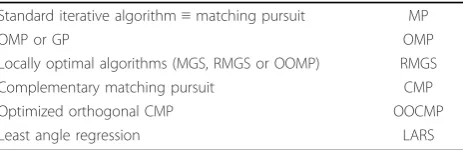
We propose in this section a comparative evaluation of all greedy algorithms listed in Table 1.
For the sake of coherence, other algorithms based on L1 minimization (such as the solution of the problem (6)) are not included in this comparative evaluation, since they are not strictly greedy (in terms of constantly growingL0). They will be compared with the other non-greedy algorithms (see Section 6).
We recall that the three algorithms, MGS, RMGS, and OOMP are equivalent except on computation load. We therefore only use for the performance evaluation the least complex algorithm RMGS. Similarly, for the OMP and GP, we will only use the least complex OMP algo-rithm. For MP, the three previously described variants (standard, with orthogonal projection and optimized with iterative dictionary orthogonalization) are evalu-ated. For CMP, only two variants are tested, i.e., the standard one and the OOCMP (RMGS-based imple-mentation). The LARS algorithm is implemented in its simplest, stepwise form [8]. Gains are recalculated after the computation of the indices of the codebook vectors.
To highlight specific trends and to obtain reproducible results, the evaluation is conducted on synthetic data. Synthetic signals are widely used for comparison and testing of sparse approximation algorithms. Dictionaries usually consist of Gaussian vectors [6,29,30], and in some cases with a constraint of uniform distribution on the unit sphere [4]. This more or less uniform distribu-tion of the vectors on the unit sphere is not necessarily adequate in particular for speech and audio signals where strong correlations exist. Therefore, we have also tested the sparse approximation algorithms on corre-lated data to simulate conditions which are characteris-tic to speech and audio applications.
The dictionaryFis then composed ofL= 128 vectors of dimension N= 40. The experiments will consider two types of dictionaries: a dictionary with uncorrelated elements (realization of a white noise process) and a dictionary with correlated elements [realizations of a second order AutoRegressive (AR) random process]. These correlated elements are obtained; thanks to the filterH(z):
H(z) = 1
1−2ρcos(ϕ)z−1+ρ2z−2
withr= 0.9 and=π/4.
Table 1 Tested algorithms and corresponding acronyms
Standard iterative algorithm≡matching pursuit MP
OMP or GP OMP
Locally optimal algorithms (MGS, RMGS or OOMP) RMGS
Complementary matching pursuit CMP
Optimized orthogonal CMP OOCMP
The observation vector xis also a realization of one of the two processes mentioned above. For all algorithms, the gains are systematically recomputed at the end of the iterative process (e.g., when all indices are obtained). The results are provided as SNR ratio for different values of K. For each value ofKand for each algorithm, M= 1000 random draws of Fandxare performed. The SNR is computed by
SNR=
M
i=1||x(i)||2
M
i=1||x(i)− ˆx(i)||2
.
As in [4], the different algorithms are also evaluated on their capability to retrieve the exact elements that were used to generate the signal ("exact recovery performance”).
Finally, overall complexity figures are given for all algorithms.
5.2 Results
5.2.1 Signal-to-noise ratio
The results in terms of SNR (in dB) are given in Figure 4 both for the case of a dictionary of uncorrelated (left) and correlated elements (right). Note that in both cases, the observation vectorx is also a realization of the cor-responding random process, but it is not a linear combi-nation of the dictionary vectors.
Figure 5 illustrates the performances of the different algorithms in the case where the observation vectorxis also a realization of the selected random process but this time it is a linear combination of P= 10 dictionary vectors. Note that at each try, the indices of theseP vec-tors and the coefficients of the linear combination are randomly chosen.
5.2.2 Exact recovery performance
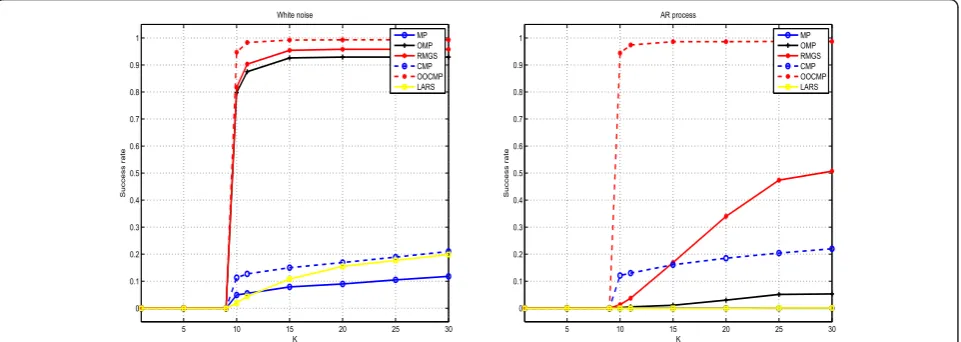
Finally, Figure 6 gives the success rate as a function of K, that is, the relative number of times that all the
correct vectors involved in the linear combination are retrieved (which will be called exact recovery).
It can be noticed that the success rate never reaches 1. This is not surprising since in some cases the coeffi-cients of the linear combination may be very small (due to the random draw of these coefficients in these experi-ments) which makes the detection very challenging.
5.2.3 Complexity
The aim of the section is to provide overall complexity figures for the raw algorithms studied in this article, that is, without including the complexity reduction tech-niques based on structured dictionaries.
These figures, given in Table 2 are obtained by only counting the multiplication/additions operations linked to the scalar product computation and by only retaining the dominant termse(more detailed complexity figures are provided for some algorithms in Appendix).
The results are also displayed in Figure 7 for all algo-rithms and different values ofK. In this figure, the com-plexity figures of OOMP (or MGS) and GP are also provided and it can be seen, as expected, that their com-plexity is much higher than RMGS and OMP, while they share exactly the same SNR performances.
5.3 Discussion
As exemplified in the results provided above, the tested algorithms exhibit significant differences in terms of complexity and performances. However, they are some-times based on different trade-off between these two characteristics. The MP algorithm is clearly the less complex algorithm but it does not always lead to the poorest performances. At the cost of slight increasing complexity due to the gain update at each step, the OMP algorithm shows a clear gain in terms of perfor-mance. The three algorithms (OOMP, MGS, and RMGS) allow to reach higher performances (compared to OMP) in nearly all cases, but these algorithms are
5 10 15 20 25 30
0 10 20 30 40 50 60 70 80
K
SNR [db]
White noise MP
OMP RMGS CMP OOCMP LARS
5 10 15 20 25 30
0 10 20 30 40 50 60 70 80
K
SNR [db]
AR process MP
OMP RMGS CMP OOCMP LARS
not at all equivalent in terms of complexity. Indeed, due to the fact that the updated dictionary does not need to be explicitly computed in RMGS, this method has nearly the same complexity as the standard iterative (or MP) algorithm including for high values ofK.
The complementary algorithms are clearly more com-plex. It can be noticed that the CMP algorithm has a complexity curve (see Figure 7) that is shifted upwards compared with the MP’s curve, leading to a dramatic (relative) increase for small values of K. This is due to the fact that in this algorithm an initial processing is needed (it is necessary to determine the matrixC- see Section 4.2). However, for all applications where numer-ous observations are processed from a single dictionary, this initial processing is only needed once which makes this approach quite attractive. Indeed, these algorithms obtain significantly improved results in terms of SNR and in particular OOCMP outperforms RMGS in all but
one case. In fact, as depicted in Figure 4, RMGS still obtained better results when the signals were correlated and also in the case where K << N which are desired properties in many applications.
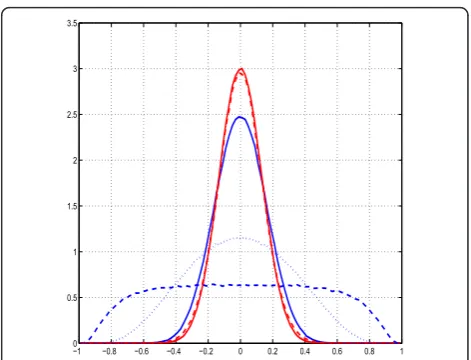
The algorithms CMP and OOCMP are particularly effective when the observation vectorxis a linear combi-nation of dictionary elements, and especially, when the dictionary elements are correlated. These algorithms can, almost surely, find the exact combination of vectors (con-trary to the other algorithms). This can be explained by the fact that the crosscorrelation properties of the normal-ized dictionary vectors (angles between vectors) are not the same forFandF. This is illustrated in Figure 8, where the histograms of the cosines of the angles between the dictionary elements are provided for different values of the parameterrof the AR(2) random process. Indeed, the angle between the elements of the dictionaryF are all close toπ/2, or in other words they are, for a vast majority,
5 10 15 20 25 30
0 10 20 30 40 50 60 70 80
K
SNR [db]
White noise MP
OMP RMGS CMP OOCMP LARS
5 10 15 20 25 30
0 10 20 30 40 50 60 70 80
K
SNR [db]
AR process MP
OMP RMGS CMP OOCMP LARS
Figure 5SNR (in dB) for different values ofKwhen the observation signalxis a linear combination ofP= 10 dictionary vectors in the uncorrelated case (left) and correlated case (right).
5 10 15 20 25 30
0 0.1 0.2 0.3 0.4 0.5 0.6 0.7 0.8 0.9 1
K
Success rate
White noise
MP OMP RMGS CMP OOCMP LARS
5 10 15 20 25 30
0 0.1 0.2 0.3 0.4 0.5 0.6 0.7 0.8 0.9 1
K
Success rate
AR process
MP OMP RMGS CMP OOCMP LARS
nearly orthogonal whatever the value ofrbe. This prop-erty is even stronger when theFmatrix is obtained with realizations of white noise (r= 0).
This is a particularly interesting property. In fact, when the vector xis a linear combination of P vectors of the dictionaryF, then the vectory is a linear combi-nation ofP vectors of the dictionary F, and the quasi-orthogonality of the vectors ofF allows to favor the choice of good vectors (the others being orthogonal to y). In CMP, OCMP, and OOCMP, the first selected vec-tors are not necessarily minimizing the norm ||Fg- x||, which explains why these methods are poorly perform-ing for a low numberKof vectors. Note that the opera-tionF=CtFcan be interpreted as a preconditioning of matrixF[31], as also observed in [6].
Finally, it can be observed that the GP algorithm exhi-bits a higher complexity than OMP in its standard ver-sion but can reach lower complexity by some approximations (see [4]).
It should also be noted, that the simple, stepwise implementation of the LARS algorithm yields compar-able SNR values to the MP algorithm, at a rather high computational load. It then seems particularly important
to use more elaborated approaches based on the L1 minimization. In the next section, we will evaluate in particular a method based on the study of [32].
6 Toward improved performances 6.1 Improving the decomposition
Most of the algorithms described in the previous sec-tions are based upon Ksteps iterative or greedy process, in which, at stepk, a new vector is appended to a sub-space defined at stepk- 1. In this way, aK-dimensional subspace is progressively created.
Such greedy algorithms may be far from optimality and this explains the interest for better algorithms (i.e., algorithms that would lead to a better subspace), even if they are at the cost of increased computational com-plexity. For example, in the ITU G.729 speech coder, four vectors are selected in the four nested loops [20]. It is not a full-search algorithm (there are 217 combina-tions of four vectors in this coder), because the inner-most loop is skipped in inner-most cases. It is, however, much more complex than the algorithms described in the pre-vious sections. The Backward OOMP algorithm intro-duced by Andrle et al. [33] is a less complex solution than the nested loop approach. The main idea of this algorithm is to find aK’ > Kdimensional subspace (by using the OOMP algorithm) and to iteratively reduce the dimension of the subspace until the targeted dimen-sionKis reached. The criterion used for the dimension reduction is the norm of the orthogonal projection of the vectorxon the subspace of reduced dimension.
In some applications, the temporary increase of the subspace dimension is not convenient or even not possi-ble (e.g., ACELP [20]). In such cases, optimization of the subspace of dimensionK may be performed using the Table 2 Overall complexity in number of multiplications/
additions per algorithm (approximated)
MP (K+ 1)NL+K2N
OMP (K+ 1)NL+K2(3N/2 +K2/12) RMGS (K+ 1)NL+K2L/2
CMP (K+ 1)NL+K2N+N2(2L+N/3) OCMP NL(2N+L) +K(KL+L2+KN) OOCMP 4KNL+N3/3 + 2N2L
LARS variable, depending on the number of steps
OOMP 4KNL
GP (K+ 1)NL+K2(10N+K2)/4
5 10 15 20 25 30
0 0.2 0.4 0.6 0.8 1 1.2 1.4 1.6 1.8 2
K
Number of mult/add [Mflops]
MP OMP RMGS CMP OCMP OOCMP OOMP GP
Figure 7 Complexity figures (number of multiplications/ additions in Mflops for different values ofK).
−1 −0.8 −0.6 −0.4 −0.2 0 0.2 0.4 0.6 0.8 1 0
0.5 1 1.5 2 2.5 3 3.5
cyclic minimization concept [11]. Cyclic minimizers are frequently employed to solve the following problem:
min θ1,...,θK
V(θ1, . . ., θK)
where Vis a function to be minimized and θ1,...,θK are scalars or vectors. As presented in [11], cyclic mini-mization consists in performing, fori= 1,...,K, the mini-mization with respect to one variable:
¯
θi= arg min θi
V(θ1, . . ., θi, . . ., θK)
and substituting the new valueθ¯ifor the previous one:
¯
θi→θi. The process can be iterated as many times as
desired.
In [12], the cyclic minimization is employed to find the signal model consisting of complex sinusoids. In the augmentation step, a new sinusoid is added (according to the MP approach in frequency domain), and then in the optimization step the parameters of the previously found sinusoids are consecutively revised. This approach, termed as CyMP by the authors, has been extended to the time-frequency dictionaries (consisting of Gabor atoms and Dirac spikes) and to OMP algo-rithms [34].
Our idea is to combine the cyclic minimization approach with the locally optimal greedy algorithms like RMGS and OOCMP to improve the subspace generated by these algorithms.
Recently some other non-greedy algorithms have been proposed, which also tend to improve the subspace, namely the COSAMP [35] and the Subspace Pursuit (SP) [29]. These algorithms enable, in the same iteration, to reject some of the basis vectors and to introduce new candidate vectors. Greedy algorithms also exist, namely the Stagewise Orthogonal Matching Pursuit (StOMP) [36] and the Regularized Orthogonal Matching Pursuit (ROMP) [30], in which, a series of vectors is selected in the same iteration. It has been shown that the non-greedy SP outperforms the non-greedy ROMP [29]. This motivates our choice only to include the non-greedy COSAMP and SP algorithms in our study.
The COSAMP algorithm starts with the iteration indexk= 0, the codebook F, the error vectore=x, and theL-dimensional gain vectorgk = 0. Number of non-zero gains in the output gain vector should be equal to K. Each iteration consists of the following steps:
-k=k+ 1,
- Crosscorrelation computation:b=Fte.
- Search for the 2K indices of the largest crosscorrelations:
Ω= supp2K(b).
- Merging of the new and previous indices:T =Ω ∪ suppK(gk-1).
- Selection of the codebook vectors corresponding to the indicesT: A=FT.
- Calculation of the corresponding gains (least squares):gT= (AtA)-1Atx(the remaining gains are set to
zero).
- PruninggTto obtainKnonzero gains of maximum
absolute values:gk.
- Update of the error vector:e=x-Fgk.
- Stop if ||e||2 <ε1or ||gk-gk-1|| <ε2 ork=kmax.
Note that, in COSAMP, 2K new indices are merged withKold ones, while the SP algorithm merges Kold andKnew indices. This constitutes the main difference between the two algorithms. For the sake of fair com-parison, the stopping condition has been modified and unified for both algorithms.
6.2 Combining algorithms
We propose in this section a new family of algorithms which, like the CyMP, consist of an augmentation phase and an optimization phase. In our approach, the aug-mentation phase is performed using one of the greedy algorithms described in previous sections, yielding the initialK-dimensional subspace. The cyclic optimization phase consists in substituting new vectors for the pre-viously chosen ones, without modification of the sub-space dimension K. The K vectors spanning the subspace are consecutively tested by removing them from the subspace. Each time aK- 1 -dimensional sub-space is created. A substitution takes place, if one of the L-Kcodebook vectors, appended to thisK- 1 -dimen-sional subspace, forms a better K-dimensional subspace than the previous one. The criterion is, naturally, the approximation error, i.e.,||x− ˆx||. In this way a“ wander-ing subspace” is created: a K-dimensional subspace evolves in the N-dimensional space, trying to approach the vector xbeing modeled. Generic scheme of the pro-posed algorithms may be described as follows:
1.The augmentation phase:Creation of a K-dimen-sional initial subspace, using one of the locally optimal greedy algorithms.
2.The cyclic optimization phase:
(a)Outer loop: testing of codebook vectorsfj(i), i= 1,...,K, spanning theK-dimensional subspace. In the i-th iteration vectorfj(i)
is temporarily removed from the subspace.
3. Stop if there are no substitutions in the outer loop (i.e., in the whole cycle).
In the augmentation phase, any greedy algorithm may be used, but, due to the local convergence of the cyclic optimization algorithm, a good initial subspace yields a better final result and reduces the computational cost. Therefore, the OOMP (RMGS algorithm) and OOCMP were considered and the proposed algorithms will be referred below as CyOOMP or CyRMGS and CyOOCMP. In the cyclic optimization phase, the imple-mentation of the operations in both loops is always based on the RMGS (OOMP) algorithm (no matter which algorithm has been used in the augmentation phase). In the outer loop the K- 1 steps of the RMGS algorithm are performed, using already known vector indices. In the inner loop, the Kth step of the RMGS algorithm is made, yielding the index of the best vector belonging to the orthogonalized codebook. Thus, in the inner loop, it may be either one substitution (if the vec-tor fl calculated using the RMGS algorithm is better than the vectorfj(i)temporarily removed from the sub-space) or no substitution.
If the initial subspace is good (e.g., created by the OOCMP algorithm), then, in most cases, there are no substitutions at all (the outer loop operations are per-formed only once). If the initial subspace is poor (e.g., randomly chosen), the outer loop operations are per-formed many times and the algorithm becomes compu-tationally complex. Moreover, this algorithm stops in some suboptimal subspace (it is not equivalent to the full search algorithm), and it is therefore, important to start from a good initial subspace. The final subspace is, in any case, not worse than the initial one and the algo-rithm may be stopped at any time.
In [34], the cyclic optimization is performed at each stage of the greedy algorithm (i.e., the augmentation
steps and cyclic optimization steps are interlaced). This yields a more complex algorithm, but which possesses a higher probability of finding a better subspace.
The proposed algorithms are compared with the other non-greedy procedures: COSAMP, SP, andL1 minimiza-tion. The last algorithm is based on minimization of (6), using the BP procedure available in [32]. Ten trials are performed with different values of the parameter l. These values are logarithmically distributed within a range depending on the demanded degree of sparsityK. At the end of each trial, pruning is performed, to select K codebook vectors having the maximum gains. The gains are recomputed according to the least squares criterion.
6.3 Results
The performance results are shown in Figure 9 in terms of SNR (in dB) for different values ofK, when the dic-tionary elements are realizations of the white noise pro-cess (left) or AR(2) random propro-cess (right).
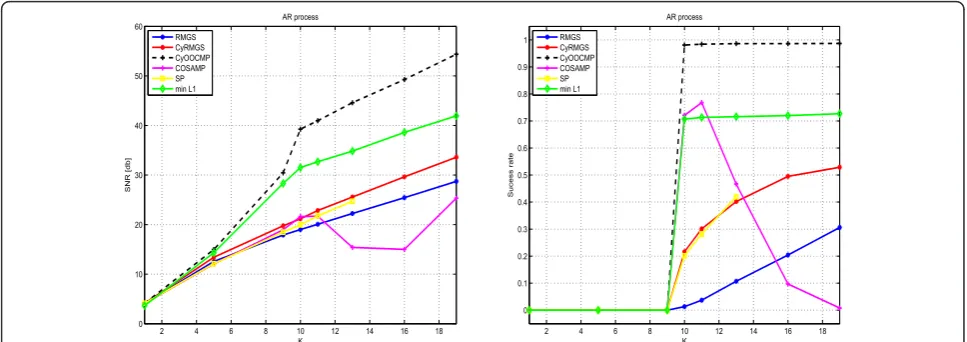
It can be observed that since RMGS and OOCMP are already quite efficient for uncorrelated signal, the gain in performance for CyRMGS and CyOOCMP are only significant for correlated signals. We then discuss below only the results obtained for the correlated case. Figure 10 (left) provides the SNRs in the case where the vector x is a linear combination ofP = 10 dictionary vectors and the success rate to retrieve the exact vectors (right).
The SNR are clearly improved for both the algorithms compared with their initial core algorithm in all tested cases. A typical gain of 5 dB is obtained for CyRMGS (compared to RMGS). This cyclic substitution technique also significantly improves the initially poor results of OOCMP for small values of K. One can also notice that a typical gain of 10 dB is observed for the simulations, where x is a linear combination ofP = 10 dictionary
2 4 6 8 10 12 14 16 18
0 2 4 6 8 10 12 14 16 18 20
K
SNR [db]
White noise RMGS
CyRMGS CyOOCMP COSAMP SP min L1
2 4 6 8 10 12 14 16 18
0 5 10 15 20 25 30
K
SNR [db]
AR process RMGS
CyRMGS CyOOCMP COSAMP SP min L1
vectors for correlated signals (see Figure 10 (left)). Finally, the exact recovery performances are also improved as compared with for both the core algo-rithms (RMGS and OOCMP).
L1 minimization (BP algorithm) performs nearly as good as the Cyclic OOMP, but is more complex in practice due to the necessity of running several trials with different values for the parameterl.
SP outperforms COSAMP, but both methods yield lower SNR as compared with the cyclic implementa-tions. Moreover, COSAMP and SP do not guarantee monotonic decrease of the error. Indeed, in practice, they often reach a local minimum and yield the same result in consecutive iterations, which stops the proce-dure. In some other situations they may exhibit oscilla-tory behaviors, repeating the same sequence of solutions. In that case, the iterative procedure is only stopped afterkmax iterations which, for typical value of kmax = 100, considerably increases the average compu-tational load. Detection of the oscillations should diminish the computational complexity of these two algorithms.
Nevertheless, the main drawback of these new algo-rithms is undoubtedly the significant increase in com-plexity. One may indeed observe that the complexity figures displayed in Figure 11 are of order one in magni-tude and higher than those displayed in Figure 7.
7 Conclusion
The common ground of all the methods discussed in this article is the iterative procedure to greedily compute a basis of vectorsq1· · ·qK which are
- simplyfj(1) · · · fj(K)in MP, OMP, CMP, and LARS algorithms,
- orthogonal in OOMP, MGS, and RMGS (explicit computation for the first two algorithms and only impli-cit for RMGS),
- A-conjugate in GP algorithm.
It was shown in particular in this article that some methods often referred as different techniques in the lit-erature are equivalent. The merit of the different meth-ods was studied in terms of complexity and performances and it is clear that some approaches rea-lize a better trade-off between these two facets. As an example, the RMGS provides substantial gain in perfor-mance to the standard MP algorithm with only a very minor complexity increase. Its main interest is indeed the use of a dictionary that is iteratively orthogonalized, but without explicitly building that dictionary. On the
2 4 6 8 10 12 14 16 18
0 10 20 30 40 50 60
K
SNR [db]
AR process RMGS
CyRMGS CyOOCMP COSAMP SP min L1
2 4 6 8 10 12 14 16 18
0 0.1 0.2 0.3 0.4 0.5 0.6 0.7 0.8 0.9 1
K
Sucess rate
AR process RMGS
CyRMGS CyOOCMP COSAMP SP min L1
Figure 10SNR (in dB) for different values ofKwhen the observation signalxis a linear combination ofP= 10 dictionary vectors for correlated signals (left) and the exact recovery performances (right).
2 4 6 8 10 12 14 16 18 20
0 2 4 6 8 10 12 14 16 18 20
K
Number of mult/add [Mflops]
RMGS CyRMGS CyOOCMP COSAMP SP
other end, for application where complexity is not a major issue, CMP-based algorithms represent an excel-lent choice, and especially the newly introduced CyOOCMP.
The cyclic algorithms are compared with the other non-greedy procedures, i.e., COSAMP, SP, and L1 mini-mization. The proposed cyclic complementary OOMP successfully competes with these algorithms in solving the sparse and non-sparse problems of small dimension (encountered, e.g., in CELP speech coders).
Although it is not discussed in this article, it is inter-esting to note that the efficiency of an algorithm may be dependent on how the dictionaryFis built. As noted, in the introduction, the dictionary may have an analytic expression (e.g., when Fis an union of several trans-forms at different scales). But F can also be built by machine learning approaches (such as means [10], K-SVD [37], or other clustering strategy [38]).
Finally, a recent and different paradigm was intro-duced, the compressive sampling [39]. Based on solid grounds, it clearly opens the path for different approaches that should permit better performances with possibly smaller dictionary sizes.
Appendix
The algorithmic description of the main algorithms dis-cussed in the article along with the more precise com-plexity figures is presented in this section. Note that all implementations are directly available on line at http:// www. telecom-paristech.fr/~ grichard/EURASIP_Mor-eau2011/.
Algorithm 1 Standard Iterative algorithm (MP) forj= 1 toLdo
aj=<fj, fj>
βj
1=<f
j
, x> end for
fork= 1 toKdo j(k) = arg maxj(βkj/
√ αj)2
gk=βkj(k)/αj(k)
forj= 1 toL(ifk < K)do rkj =<fj, fj(k)>
βj
k+1=β
j
k−gkr
j k
end for end for
Option : recompute all gains A= [fj(1)
· · ·fj(K)] g= (AtA)-1Atx
Complexity:(K+ 1)NL+a(K), wherea(K)≈ K3/3 is the cost of final gains calculation
Algorithm 2 Optimized Orthogonalized MP (OOMP) forj= 1 toLdo
αj
1=<f
j
, fj>
βj
1=<fj, x>
fj
orth(1)=f
j
end for
fork= 1 toKdo
j(k) = arg maxj(β j
k/
αj
k)2
qk=−fj(k) orth(k)/
αj(k)
k
forj= 1 toL(ifk<K)do fj
orth(k + 1)= [I−q
k(qk)t]fj
orth(k) αj
k+1=<f
j
orth(k + 1), f
j
orth(k + 1)> βj
k+1=<f
j
orth(k + 1), x>
end for end for
A= [fj(1)
· · ·fj(K)] g= (AtA)-1Atx
Complexity:(K+ 1)NL+ 3(K- 1)NL+a(K)
Algorithm 3 Recursive modified Gram-Schmidt forj= 1 toLdo
αj
1=<f
j
, fj>
βj
1=<f
j
, x> end for
fork= 1 toKdo
j(k) = arg maxj(βkj/
αj
k)2
¯
gk=βkj(k)/
αj(k)
k
forj= 1 toL(ifk < K)do
rkj = [<fj, fj(k)>−ki=1−1rij(k)rji]/
αj(k)
k
αj
k+1=α
j
k−(r
j
k)2
βj
k+1=β
j
k− ¯gkr
j k
end for
end forgK=g¯K/
αj(K)
K
fork=K- 1 to 1do
gk= (g¯k−
K
i=k+1r
j(i)
k gi)/
αj(k)
k
end for
Complexity:(K+ 1)NL+ (K- 1)L(1 +K/2)
Algorithm 4 Gradient pursuit forj= 1 toLdo
aj=<fj
,fj> βj
1=<f
j
end for
e0 =x g0
= 0
fork= 1 toKdo j(k) = arg maxj(βkj/
√ αj)2 Ak= [fj(1)· · ·fj(k)] Bk= (Ak
)tAk ˜
e= (Ak)tek−1
ifk= 1then qk=e˜ else
a =<˜e, Bkqk−1>/<qk−1, Bkqk−1>
qk=e˜−ki=1−1aqk−1 end if
ck=<qk,e˜>/<qk, Bkqk>
gk=gk-1 +ckqk
ek=x-Akgk
forj= 1 toL(ifk < K)do βj
k+1=<f
j
, ek>
end for end for
Complexity:(K+ 1)NL+Kk=1[3Nk+ 2k2+k3] +α(K)
Endnotes
a
Note though that the vectorgis now of dimensionK instead ofL, the indicesj(1) · · ·j(K) point to dictionary vectors (columns ofF) corresponding to non-zero gains. bK
= 2 or 3,L= 512 or 1024,N= 40 for a sampling rate of 8kHz are typical values found in speech coding schemes.cSeveral alternatives of this algorithm are also proposed in [4], and in particular the“approximate con-jugate gradient pursuit”(ACGP) which exhibits a signifi-cantly lower complexity. However, in this article all figures and discussion will only consider the primary GP algorithm.dTwo vectorsuandvareA-conjugate, if they are orthogonal with respect to the scalar productutAv. e
The overall complexity figures were obtained by consid-ering the following approximation for smalli values: K
k=1ki≈Ki+1
iand by only keeping dominant terms considering thatK≪N. Practical simulations showed that the approximation error with these approximative figures was less than 10% compared to the exact figures
Abbreviations
BP: basis pursuit; CELP: code excited linear predictive; CMP: complementary matching pursuit; CyMP: cyclic matching pursuit; GP: gradient pursuit; LARS: least angle regression; MP: matching pursuit; OCMP: orthogonal
complementary matching pursuit; OMP: orthogonal matching pursuit; OOMP: optimized orthogonal matching pursuit.
Acknowledgements
The authors would like to warmly thank Prof. Laurent Daudet for his detailed and constructive comments on an earlier version of this manuscript.
Author details
1Institute of Telecommunications, Warsaw University of Technology, Warsaw, Poland2Institut Telecom, Telecom ParisTech, CNRS-LTCI, Paris, France
Competing interests
The authors declare that they have no competing interests.
Received: 16 February 2011 Accepted: 3 August 2011 Published: 3 August 2011
References
1. S Mallat, Z Zhang, Matching pursuits with time-frequency dictionaries. IEEE Trans. Signal Process.41(12), 3397–3415 (1993). doi:10.1109/78.258082 2. Y Pati, R Rezaifar, P Krishnaprasad, Orthogonal matching pursuit: recursive
function approximation with applications to wavelet decomposition, in
Proceedings of the 27th Asilomar Conference on Signals, Systems and Computers(1993)
3. L Rebollo-Neira, D Lowe, Optimized orthogonal matching pursuit approach. IEEE Signal Process. Lett.9, 137–140 (2002). doi:10.1109/LSP.2002.1001652 4. T Blumensath, M Davies, Gradient pursuits. IEEE Trans. Signal Process.56(6),
2370–2382 (2008)
5. G Rath, C Guillemot, Sparse approximation with an orthogonal complementary matching pursuit algorithm, inProceedings of the International Conference on Acoustics, Speech, and Signal Processing, 3325–3328 (2009)
6. G Rath, A Sahoo, A comparative study of some greedy pursuit algorithms for sparse approximation, inEusipco(2009)
7. S Chen, D Donoho, M Saunders, Atomic decomposition by basis pursuit. SIAM Rev.43(1), 129–159 (2001). doi:10.1137/S003614450037906X 8. B Efron, T Hastie, I Johnstone, R Tibshirani, Least angle regression. Ann. Stat.
32(2), 407–499 (2004). doi:10.1214/009053604000000067
9. R Tibshirani, Regression shrinkage and selection via the lasso. J. R. Stat. Soc.
58(1), 267–288 (1996)
10. A Gersho, R Gray, Vector Quantization and Signal Compression. Kluwer Academic Publishers (1992)
11. P Stoica, Y Selen, Cyclic minimizers, majorization techniques, and the expectation-maximization algorithm: a refresher. IEEE Signal Process. Mag.
21(1), 112–114 (2004). doi:10.1109/MSP.2004.1267055
12. M Christensen, S Jensen, The cyclic matching pursuit and its application to audio modeling and coding, inRec. Asilomar Conf. Signals Systems and Computers(2007)
13. N Moreau, Tools for Signal Compression. ISTE Wiley (2011)
14. T Tremain, The government standard linear predictive coding algorithm: LPC-10. Speech Technology Magazine.1, 40–49 (1982)
15. B Atal, J Remde, A new model of LPC excitation for producing natural-sounding speech at low bit rates, inProceedings of the International Conference on Acoustics, Speech, and Signal Processing, 614–617 (1982) 16. M Berouti, H Garten, P Kabal, P Mermelstein, Efficient computation and
encoding of the multi-pulse excitation for LPC, inProceedings of the International Conference on Acoustics, Speech, and Signal Processing, 10.1.1–10.1.4 (1984)
17. P Kroon, E Deprettere, Experimental evaluation of different approaches to the multi-pulse coder, inProceedings of the International Conference on Acoustics, Speech, and Signal Processing, 10.4.1–10.4.4 (1984)
18. M Schroeder, B Atal, Code-excited linear prediction (CELP): high-quality speech at very low bit rates, inProceedings of the International Conference on Acoustics, Speech, and Signal Processing, 937–940 (1985)
19. Y Linde, A Buzo, R Gray, An algorithm for vector quantizer design. IEEE Trans. Commun.COM-28, 84–95 (1980)
20. R Salami, C Laflamme, J Adoul, A Kataoka, S Hayashi, C Lamblin, D Massaloux, S Proust, P Kroon, Y Shoham, Design and description of CS-ACELP: a toll quality 8 kb/s speech coder. IEEE Trans. Speech Audio Process.
6(2), 116–130 (1998). doi:10.1109/89.661471
21. E Ravelli, G Richard, L Daudet, Union of MDCT bases for audio coding. IEEE Trans. Speech, Audio Lang. Process.16(8), 1361–1372 (2008)
22. G Golub, C Van Loan, Matrix Computations (Johns Hopkins University Press, 1983) (second edition 1989, third edition 1996)
24. S Singhal, Reducing computation in optimal amplitude multipulse coders, inProceedings of the International Conference on Acoustics, Speech, and Signal Processing, 2363–2366 (1986)
25. S Singhal, B Atal, Amplitude optimization and pitch prediction in multipulse coders. IEEE Trans. Acoust. Speech Signal Process.37(3), 317–327 (1989). doi:10.1109/29.21700
26. N Moreau, P Dymarski, Mixed excitation CELP coder, inProceedings of the European Conference on Speech Communication and Technology, 322–325 (1989)
27. D Giacobello, MG Christensen, MN Murthi, SH Jensen, M Moonen, Retrieving sparse patterns using a compressed sensing framework: applications to speech coding based on sparse linear prediction. IEEE Signal Process. Lett.17(1), 103–106 (2010)
28. D Giacobello, MG Christensen, MN Murthi, SH Jensen, M Moonen, Enhancing sparsity in linear prediction of speech by iteratively reweighted 1-norm minimization, inProceedings of the Internatinoal Conference on Acoustics, Speech, and Signal Processing, 4650–4653 (2010)
29. W Dai, O Milenkovic, Subspace pursuit for compressive sensing signal reconstruction. IEEE Trans. Inf. Theory,55(5), 2230–2249 (2009) 30. D Needell, R Vershynin, Signal recovery from incomplete and inaccurate
measurements via regularized orthogonal matching pursuit. IEEE J. Sel. Topics Signal Process.4(2), 310–316 (2010)
31. K Schnass, P Vandergheynst, Dictionary preconditioning for greedy algorithms. IEEE Trans. Signal Process.56(5), 1994–2002 (2008) 32. G Peyre, Toolbox Sparsity–Sparsity-Based Signal Processing Related
Functions. Matlab Central. (2007)
33. M Andrle, L Rebollo-Neira, E Sagianos, Backward-optimized orthogonal matching pursuit approach. IEEE Signal Process. Lett.11(9), 705–708 (2004). doi:10.1109/LSP.2004.833503
34. B Sturm, M Christensen, Cyclic matching pursuit with multiscale time-frequency dictionaries, inRec. Asilomar Conference on Signals Systems and Computers(2010)
35. D Needell, JA Tropp, Cosamp: iterative signal recovery from incomplete and inaccurate samples. Appl. Comput. Harmonic Anal.26(3), 301–321 (2008) 36. D Donoho, Y Tsaig, I Drori, J Starck, Sparse solution of underdetermined
linear equations by stagewise orthogonal matching pursuit, vol. 2. Technical Report, Department of Statistics, Stanford University (2006)
37. M Aharon, M Elad, A Bruckstein, K-SVD: an algorithm for designing overcomplete dictionaries for sparse representation. IEEE Trans. Signal Process.54(11), 4311–4322 (2006)
38. P Leveau, E Vincent, G Richard, L Daudet, Instrument-specific harmonic atoms for mid-level music representation. IEEE Trans. Speech Audio Lang. Process.16(1), 116–128 (2008)
39. E Candès, M Wakin, An introduction to compressive sampling. IEEE Signal Process. Mag.56(6), 21–30 (2008)
doi:10.1186/1687-6180-2011-34
Cite this article as:Dymarskiet al.:Greedy sparse decompositions: a comparative study.EURASIP Journal on Advances in Signal Processing2011
2011:34.
Submit your manuscript to a
journal and benefi t from:
7Convenient online submission
7Rigorous peer review
7Immediate publication on acceptance
7Open access: articles freely available online
7High visibility within the fi eld
7Retaining the copyright to your article