
by Donald Olson
England
FOR
DUMmIES
‰3
RD EDITION
Plan your trip
with
For Dummies
Covering the most popular destinations in North America and Europe,
For Dummies travel guides are the ultimate user-friendly trip planners.
Available wherever books are sold or go to www.dummies.com
And book it with
our online partner,
Frommers.com
⻬
Book airfare, hotels and packages
⻬
Find the hottest deals
⻬
Get breaking travel news
⻬
Enter to win vacations
⻬
Share trip photos and stories
⻬
And much more
Available wherever books are sold.
Go to www.dummies.com or call 1-877-762-2974 to order direct.
The fun and easy wa
y
™to travel!
U.S.A.
Also available:
Alaska For Dummies Arizona For Dummies Boston For Dummies California For Dummies Chicago For Dummies Colorado & the Rockies For Dummies
Florida For Dummies Los Angeles & Disneyland For Dummies
Maui For Dummies National Parks of the American West For Dummies
New Orleans For Dummies New York City For Dummies San Francisco For Dummies Seattle & the Olympic Peninsula For Dummies Washington, D.C. For Dummies
RV Vacations For Dummies Walt Disney World & Orlando For Dummies
EUROPE
Also available:
England For Dummies Europe For Dummies Germany For Dummies Ireland For Dummies London For Dummies
Paris For Dummies Scotland For Dummies Spain For Dummies
OTHER DESTINATIONS
Also available:
Bahamas For Dummies Cancun & the Yucatan For Dummies Costa Rica For Dummies Mexico’s Beach Resorts For Dummies
Montreal & Quebec City For Dummies
Vancouver & Victoria For Dummies
by Donald Olson
England
FOR
DUMmIES
‰3
RD EDITION
England For Dummies®
, 3rd Edition
Published by
Wiley Publishing, Inc.
111 River St.
Hoboken, NJ 07030-5774
www.wiley.com
Copyright © 2006 by Wiley Publishing, Inc., Indianapolis, Indiana Published simultaneously in Canada
No part of this publication may be reproduced, stored in a retrieval system, or transmitted in any form or by any means, electronic, mechanical, photocopying, recording, scanning, or otherwise, except as permit-ted under Sections 107 or 108 of the 1976 Unipermit-ted States Copyright Act, without either the prior written permission of the Publisher, or authorization through payment of the appropriate per-copy fee to the Copyright Clearance Center, 222 Rosewood Drive, Danvers, MA 01923, 978-750-8400, fax 978-646-8600. Requests to the Publisher for permission should be addressed to the Legal Department, Wiley Publishing, Inc., 10475 Crosspoint Blvd., Indianapolis, IN 46256, 317-572-3447, fax 317-572-4355, or online at
http://www.wiley.com/go/permissions.
Trademarks: Wiley, the Wiley Publishing logo, For Dummies, the Dummies Man logo, A Reference for the Rest of Us!, The Dummies Way, Dummies Daily, The Fun and Easy Way, Dummies.com and related trade dress are trademarks or registered trademarks of John Wiley & Sons, Inc., and/or its affiliates in the United States and other countries, and may not be used without written permission. Frommer’s is a trade-mark or registered tradetrade-mark of Arthur Frommer. Used under license. All other tradetrade-marks are the prop-erty of their respective owners. Wiley Publishing, Inc., is not associated with any product or vendor mentioned in this book.
LIMIT OF LIABILITY/DISCLAIMER OF WARRANTY: THE PUBLISHER AND THE AUTHOR MAKE NO REP-RESENTATIONS OR WARRANTIES WITH RESPECT TO THE ACCURACY OR COMPLETENESS OF THE CONTENTS OF THIS WORK AND SPECIFICALLY DISCLAIM ALL WARRANTIES, INCLUDING WITHOUT LIMITATION WARRANTIES OF FITNESS FOR A PARTICULAR PURPOSE. NO WARRANTY MAY BE CRE-ATED OR EXTENDED BY SALES OR PROMOTIONAL MATERIALS. THE ADVICE AND STRATEGIES CON-TAINED HEREIN MAY NOT BE SUITABLE FOR EVERY SITUATION. THIS WORK IS SOLD WITH THE UNDERSTANDING THAT THE PUBLISHER IS NOT ENGAGED IN RENDERING LEGAL, ACCOUNTING, OR OTHER PROFESSIONAL SERVICES. IF PROFESSIONAL ASSISTANCE IS REQUIRED, THE SERVICES OF A COMPETENT PROFESSIONAL PERSON SHOULD BE SOUGHT. NEITHER THE PUBLISHER NOR THE AUTHOR SHALL BE LIABLE FOR DAMAGES ARISING HEREFROM. THE FACT THAT AN ORGANIZATION OR WEBSITE IS REFERRED TO IN THIS WORK AS A CITATION AND/OR A POTENTIAL SOURCE OF FUR-THER INFORMATION DOES NOT MEAN THAT THE AUTHOR OR THE PUBLISHER ENDORSES THE INFORMATION THE ORGANIZATION OR WEB SITE MAY PROVIDE OR RECOMMENDATIONS IT MAY MAKE. FURTHER, READERS SHOULD BE AWARE THAT INTERNET WEB SITES LISTED IN THIS WORK MAY HAVE CHANGED OR DISAPPEARED BETWEEN WHEN THIS WORK WAS WRITTEN AND WHEN IT IS READ. PLEASE BE ADVISED THAT TRAVEL INFORMATION IS SUBJECT TO CHANGE AT ANY TIME AND THIS IS ESPECIALLY TRUE OF PRICES. WE THEREFORE SUGGEST THAT READERS WRITE OR CALL AHEAD FOR CONFIRMATION WHEN MAKING TRAVEL PLANS. THE AUTHOR AND THE PUBLISHER CANNOT BE HELD RESPONSIBLE FOR THE EXPERIENCES OF READERS WHILE TRAVELING.
For general information on our other products and services, please contact our Customer Care Department within the U.S. at 800-762-2974, outside the U.S. at 317-572-3993, or fax 317-572-4002. For technical support, please visit www.wiley.com/techsupport.
Wiley also publishes its books in a variety of electronic formats. Some content that appears in print may not be available in electronic books.
Library of Congress Control Number: 2005937359 ISBN-13: 978-0-471-74871-7
ISBN-10: 0-471-74871-4
Manufactured in the United States of America 10 9 8 7 6 5 4 3 2 1
About the Author
Donald Olson is a novelist, playwright, and travel writer. His newest novel, Confessions of a Pregnant Princess, was published in 2005 under the pen name Swan Adamson. An earlier Swan Adamson novel, My Three Husbands, has been translated into French and published in several European countries. Donald Olson’s novel The Confessions of Aubrey Beardsley, was published in the United Kingdom by Bantam Press, and his play, Beardsley,
was produced in London. His travel stories have appeared in the
New York Times, Travel + Leisure, Sunset, National Geographic
books, and many other publications. England For Dummies, 1st Edition won a 2002 Lowell Thomas Travel Writing Award for best guidebook. His other guidebooks London For Dummies, Best Day Trips from London, Irreverent London, Germany For Dummies, and
Frommer’s Vancouver & Victoriaare all published by Wiley Publishing, Inc. London is one of Donald’s favorite cities, and England is one of his favorite countries.
Dedication
This book is dedicated to all those Londoners who showed the world in July 2005 that they are stronger than any terrorists.
Author’s Acknowledgments
Editorial
Editors:Naomi Black,
Christine Ryan, Project Editors; M. Faunette Johnston, Production Editor; and Jennifer Moore, Development Editor Copy Editor: Laura Miller Cartographer: Andrew Murphy Senior Photo Editor: Richard Fox Cover Photos: Front cover:©
Steve Bidler/eStock Photo; Dorset: Shaftesbury: family walking on Gold Hill, thatched cottages beyond
Back cover: © Nick Bodle/ Alamy Images; Cumbria: Derwent Water scenic Cartoons: Rich Tennant
(www.the5thwave.com)
Composition Services
Project Coordinator: Jennifer Theriot Layout and Graphics: Carl Byers,
Lauren Goddard, Denny Hager, Joyce Haughey, Barbara Moore, Heather Ryan, Julie Trippetti Proofreaders: Laura Albert,
Leeann Harney, TECHBOOKS Production Services
Indexer: TECHBOOKS Production Services
Publishing and Editorial for Consumer Dummies
Diane Graves Steele, Vice President and Publisher, Consumer Dummies Joyce Pepple, Acquisitions Director, Consumer Dummies
Kristin A. Cocks, Product Development Director, Consumer Dummies Michael Spring, Vice President and Publisher, Travel
Kelly Regan,Editorial Director, Travel Publishing for Technology Dummies
Andy Cummings,Vice President and Publisher, Dummies Technology/General User
Composition Services
Gerry Fahey,Vice President of Production Services Debbie Stailey,Director of Composition Services
Publisher’s Acknowledgments
We’re proud of this book; please send us your comments through our Dummies online registration form located at www.dummies.com/register/.
Contents at a Glance
Introduction ...1
Part I: Introducing England...7
Chapter 1: Discovering the Best of England ...9
Chapter 2: Digging Deeper into England ...15
Chapter 3: Deciding When and Where to Go ...24
Chapter 4: Following an Itinerary: Five Great Options ...41
Part II: Planning Your Trip to England ...55
Chapter 5: Managing Your Money ...57
Chapter 6: Getting to England...69
Chapter 7: Getting Around England ...77
Chapter 8: Booking Your Accommodations ...87
Chapter 9: Catering to Special Needs or Interests ...95
Chapter 10: Taking Care of the Remaining Details ...103
Part III: London and Environs ...113
Chapter 11: Settling Into London ...115
Chapter 12: Exploring London ...158
Chapter 13: Day-tripping from London ...201
Part IV: The Southeast ...221
Chapter 14: Kent and Sussex ...223
Chapter 15: Kent’s Best Castles, Stately Homes, and Gardens ...247
Part V: The West Country ...259
Chapter 16: Hampshire and Wiltshire: Old Wessex and New Sarum ...261
Chapter 17: Devon: Moors, Tors, and Sandy Shores ...274
Chapter 18: Cornwall: Saints, Salts, Sea, and Sun...292
Part VI: England’s Heartland...309
Chapter 19: Stratford-upon-Avon and Warwick Castle ...311
Chapter 20: Bath and the Best of the Cotswolds ...325
Part VII: Way Up North ...349
Chapter 21: Yorkshire ...351
Chapter 22: The Lake District ...377
Part VIII: The Part of Tens...399
Chapter 23: Ten Writers and the Places They Lived ...401
Chapter 25: Ten (Or So) Great English Churches...409
Chapter 26: Ten Important Royals — Past and Present ...413
Appendix: Quick Concierge...422
Maps at a Glance
The Regions in Brief ...25
London’s Neighborhoods ...122
London’s Top Hotels ...132
London’s Top Restaurants...144
London’s Top Attractions ...160
British Museum...163
St. Paul’s Cathedral...171
Tower of London...173
Westminster Abbey ...175
West End Shopping...186
London’s Clubs, Pubs, and Bars ...194
Day Trips from London ...202
Cambridge ...203
Oxford ...215
The Southeast ...224
Canterbury ...227
Rye ...231
Brighton ...239
Kent’s Castles, Stately Homes, and Gardens...248
Hampshire and Wiltshire ...262
Winchester ...264
Salisbury ...269
Devon ...275
Exeter ...276
Dartmoor National Park...282
Cornwall...293
England’s Heartland ...312
Stratford-upon-Avon ...314
Bath ...327
Yorkshire ...352
York ...353
York Minster ...363
The Lake District ...378
Table of Contents
Introduction ...1
About This Book...1
Conventions Used in This Book ...2
Foolish Assumptions ...3
How This Book Is Organized...3
Part I: Introducing England...4
Part II: Planning Your Trip to England...4
Part III: London and Environs...4
Part IV: The Southeast...4
Part V: The West Country ...4
Part VI: England’s Heartland ...5
Part VII: Way Up North ...5
Part VIII: The Part of Tens...5
Icons Used in This Book...6
Where to Go from Here...6
Part I: Introducing England ...7
Chapter 1: Discovering the Best of England ...9
The Best of Legendary London ...9
The Best Cities, Towns, and Villages ...10
The Best Castles, Palaces, and Stately Homes ...11
The Best Cathedrals and Churches ...11
The Best Historic Places ...12
The Best Gardens ...13
The Best Romantic Landscapes ...13
The Best Shopping ...14
Chapter 2: Digging Deeper into England ...15
The Main Events: A Brief History of England ...15
Building Blocks: An Overview of English Architecture ....18
Dining English Style from Traditional to Modern ...20
Visiting the Local Pub...20
Background Check: Finding England in Books and Movies...21
Books...22
Movies ...23
Chapter 3: Deciding When and Where to Go ...24
Going Everywhere You Want to Be ...24
Exploring Southeast England: Canterbury,
castles, and historic towns ...26
Sightseeing at Stonehenge and in the West Country: Hampshire, Wiltshire, Devon, and Cornwall...27
Discovering England’s heartland: Stratford-upon-Avon, the Cotswolds, and Bath ...28
Heading north: Yorkshire and the Lake District ...28
Scheduling Your Time...29
Revealing the Secrets of the Seasons ...30
Traveling during high and low seasons ...30
Watching those unpredictable skies ...31
Blooming in spring...32
Shining (and raining) in summer ...32
Glowing in autumn...33
Welcoming in winter ...34
Perusing a Calendar of Events...35
January...35
February...35
March ...36
April ...36
May ...36
June...37
July...38
August ...38
September...39
October ...39
November ...39
December...40
Chapter 4: Following an Itinerary:
Five Great Options...41
Seeing England’s Highlights in One Week ...42
Touring the Best of England in Two Weeks...45
Discovering England with Kids...47
Strolling through England’s Greenery: An Itinerary for Garden Lovers ...49
Visiting England’s Past: An Itinerary for History Buffs ....51
Part II: Planning Your Trip to England...55
Chapter 5: Managing Your Money ...57
Planning Your Budget ...57
Lodging...57
Transportation ...58
Dining ...59
England For Dummies, 3rd Edition
Sightseeing...59
Shopping and nightlife ...60
Cutting Costs — But Not the Fun ...62
Handling Money ...63
Using ATMs and carrying cash...64
Charging ahead with credit cards...64
Toting traveler’s checks...65
Dealing with a lost or stolen wallet ...66
Taking Taxes into Account...67
Tipping Like You Mean It...68
Chapter 6: Getting to England...69
Finding Out Who Flies Where ...69
Getting the Best Deal on Your Airfare ...70
Working with Consolidators ...71
Booking your flight online ...71
Arriving by Other Means...72
Taking the train ...72
Riding a ferry or hovercraft...73
Joining an Escorted Tour ...73
Choosing a Package Tour ...75
Locating package tours ...75
Checking out airline and hotel packages ...76
Chapter 7: Getting Around England ...77
Weighing the Options: Train or Car? ...77
Riding the Rails...77
Buying your train ticket ...78
Negotiating the rail system...78
Getting to know London’s train stations ...79
Saving with BritRail passes...80
Hopping a Coach: Bus Travel ...81
Driving on the Left, Passing on the Right: Car Travel ...81
Renting a car in London — or not ...82
Renting a car in England ...83
Hitting the road: Motorways, dual carriageways, and roundabouts...84
Following the rules of the road ...85
Coping with emergencies on the road ...85
Filling up the tank ...86
Chapter 8: Booking Your Accommodations ...87
Finding the Right Place for You ...88
Understanding the pros and cons of B&Bs ...88
Exploring hotel choices ...89
Finding the Best Room at the Best Rate...92
Surfing the Web for Hotel Deals ...93
Reserving the Best Room...94
Chapter 9: Catering to Special Needs or Interests...95
Traveling with the Brood: Advice for Families ...95
Locating family-friendly accommodations and restaurants ...96
Hiring a baby-sitter in England...97
Making Age Work for You: Tips for Seniors ...97
Accessing England: Information for Travelers with Disabilities ...98
Considering the benefits of escorted tours...100
Dealing with access issues ...100
Following the Rainbow: Resources for Gay and Lesbian Travelers...101
Chapter 10: Taking Care of the Remaining Details...103
Getting a Passport...103
Applying for a U.S. passport...103
Applying for other passports ...104
Entering England with your passport ...105
Dealing with a (gulp) lost passport ...105
Playing It Safe with Travel and Medical Insurance ...105
Staying Healthy When You Travel...106
Staying Connected by Cellphone ...107
Accessing the Internet Away From Home ...109
Keeping Up with Airline Security ...111
Part III: London and Environs ...113
Chapter 11: Settling into London...115
Getting There ...115
Flying to London ...115
Taking the train ...119
Orienting Yourself in London ...119
Introducing the Neighborhoods...120
The City of London ...120
West End ...121
West London...124
The South Bank ...126
Finding Information After You Arrive ...126
Getting Around London...127
By Underground (subway) ...127
By bus...129
By taxi...130
On foot...130
England For Dummies, 3rd Edition
Staying in Style ...131
The top hotels ...134
Runner-up accommodations ...141
Dining Out ...143
Neighborhoods for ethnic eats ...143
Strategies for budget dining ...143
The top restaurants...146
Treating Yourself to a Tea ...155
Casual tearooms and patisseries ...155
Elegant spots for high tea ...156
Chapter 12: Exploring London ...158
Discovering the Top Attractions ...158
Finding More Cool Things to See and Do ...175
Seeing London by Guided Tour ...181
Bus tours...181
Boat tours ...182
An amphibious tour...183
Walking tours...183
Following an Itinerary...184
Shopping in London...184
When to shop and how to find deals...184
Where to shop and what to buy...185
Living It Up After Dark ...190
Finding out what’s happening ...190
Getting tickets ...190
Raising the curtain on performing arts and music...190
Checking out the club and bar scenes ...192
Fast Facts: London ...197
Chapter 13: Day-tripping from London ...201
Cambridge: Medieval Colleges on the River Cam ...201
Getting to Cambridge ...201
Finding information and taking a tour ...204
Getting around Cambridge ...204
Exploring the best of Cambridge ...204
Finding more to see and do in Cambridge...207
Dining in Cambridge ...208
Greenwich: The Center of Time and Space...209
Getting to Greenwich...209
Finding information and taking a tour ...209
Exploring Greenwich ...210
Dining in Greenwich ...211
Hampton Court Palace: Henry VIII’s Riverside Estate....211
Getting to Hampton Court ...211
Exploring Hampton Court...212
Royal Botanic Gardens (Kew Gardens):
Royal Pleasure Grounds ...212
Getting to Kew Gardens ...213
Exploring Kew Gardens...213
Oxford: Town and Gown...213
Getting to Oxford ...214
Finding information and taking a tour ...214
Exploring the best of Oxford ...214
Finding more to see and do in Oxford...216
Dining in Oxford ...217
Blenheim Palace: Ancestral Home of the Churchills ...218
Getting to Blenheim Palace ...218
Exploring Blenheim Palace ...218
Windsor Castle: Official Royal Residence ...219
Getting to Windsor Castle...220
Exploring Windsor Castle ...220
Part IV: The Southeast ...221
Chapter 14: Kent and Sussex ...223
Canterbury: Tales from the Great Cathedral ...224
Getting to Canterbury ...225
Finding information and taking a tour ...225
Staying in or near Canterbury...225
Dining in or near Canterbury ...226
Exploring Canterbury...228
Rye: Smugglers, Mermaids, and Writers ...229
Getting to Rye...230
Finding information ...230
Taking a tour of Rye...231
Staying in Rye ...232
Dining in Rye ...233
Exploring Rye ...234
Battle: 1066 and All That ...236
Getting to Battle ...236
Finding information ...236
Dining in Battle...237
Exploring the Battle of Hastings Abbey and Battlefield ...238
Brighton: Fun Beside the Seaside ...238
Getting to Brighton ...239
Finding information ...240
Getting around Brighton ...240
Staying in or near Brighton...240
Dining in Brighton...242
England For Dummies, 3rd Edition
Exploring Brighton...243
Shopping in Brighton...245
Stepping out in Brighton, night or day...245
Chapter 15: Kent’s Best Castles,
Stately Homes, and Gardens...247
Knole: A Room for Every Day of the Year ...248
Getting to Knole ...249
Exploring Knole...249
Hever Castle: Anne Boleyn Slept Here...250
Getting to Hever Castle ...250
Exploring Hever Castle...251
Chartwell: The Private Life of a Famous Prime Minister...252
Getting to Chartwell ...252
Exploring Chartwell House ...252
Leeds Castle: Castle of Queens, Queen of Castles ...253
Getting to Leeds Castle ...253
Exploring Leeds Castle...253
Sissinghurst Castle Garden: Romance amongst the Roses ...254
Getting to Sissinghurst Castle Garden ...255
Exploring Sissinghurst Castle Garden ...255
Dover Castle: Towers and Tunnels ...256
Getting to Dover Castle ...256
Exploring Dover Castle...256
Part V: The West Country ...259
Chapter 16: Hampshire and Wiltshire:
Old Wessex and New Sarum ...261
Winchester: King Alfred Meets Jane Austen ...263
Getting to Winchester ...263
Finding information and taking a tour of Winchester ...263
Staying in Winchester...264
Finding lunch or a spot of tea ...264
Exploring Winchester and the surrounding area ...265
Salisbury: High-Spire Act...268
Getting to Salisbury ...268
Finding information on Salisbury ...268
Staying in or near Salisbury ...269
Dining in Salisbury...270
Exploring Salisbury and the surrounding area ...271
Stonehenge: Visiting the Standing Stones...272
Getting to Stonehenge ...272
Exploring Stonehenge ...273
Chapter 17: Devon: Moors, Tors,
and Sandy Shores ...274
Exeter: Sea Captains and Silversmiths ...275
Getting to Exeter ...276
Finding information and taking a tour ...277
Staying in Exeter ...277
Dining in Exeter...278
Exploring Exeter...279
Shopping for Exeter silver ...280
Dartmoor National Park: Back to Nature ...281
Getting to the park...281
Finding information ...281
Taking a tour of the park...283
Staying in Dartmoor National Park...283
Dining in Dartmoor National Park ...284
Exploring in and around Dartmoor National Park ...285
Torquay: Relaxing on the English Riviera ...286
Getting to Torquay...287
Getting around and touring Torquay ...287
Finding information ...287
Staying and dining in Torquay ...287
Exploring Torquay ...288
Plymouth: Where the Pilgrims Set Sail ...289
Getting to Plymouth ...289
Taking a cruise in Plymouth ...289
Finding information ...289
Locating a spot for lunch or tea...290
Exploring Plymouth ...290
Chapter 18: Cornwall: Saints, Salts, Sea, and Sun...292
Penzance: As in “The Pirates of . . .” ...294
Getting to Penzance...294
Finding information and taking a tour of Penzance...295
Staying in Penzance ...295
Dining in Penzance ...296
Exploring in and around Penzance...298
The Penwith Peninsula: A Driving Tour from Penzance to Land’s End ...300
Stop #1: Newlyn...300
Stop #2: Mousehole ...301
England For Dummies, 3rd Edition
Stop #3: The Minack Theatre ...301 Stop #4: Land’s End ...302 St. Ives: Artists’ Haven by the Sea...302 Getting to St. Ives ...302 Finding information about St. Ives...303 Staying in St. Ives ...303 Dining in St. Ives...304 Exploring St. Ives ...304 Finding more to see near St. Ives ...305 Fowey and the Saint’s Way: River Town
and Holy Track ...306 Cotehele, Eden Project, and Lanhydrock:
Three Great Cornish Gardens ...307 Cotehele ...307 Eden Project ...308 Lanhydrock...308
Part VI: England’s Heartland ...309
Chapter 19: Stratford-upon-Avon
and Warwick Castle...311
Stratford-upon-Avon: In the Bard’s Footsteps ...311 Getting to Stratford-upon-Avon...312 Finding information about
Stratford-upon-Avon ...313 Getting around and touring
Stratford-upon-Avon ...313 Staying in Stratford-upon-Avon ...313 Dining in Stratford-upon-Avon...315 Exploring the best of Stratford-upon-Avon...317 Finding more to see and do in
Stratford-upon-Avon ...320 Seeing a play in Stratford-upon-Avon ...321 Shopping in Stratford-upon-Avon ...321 Warwick Castle: Warlords and Ladies ...321 Getting to Warwick ...322 Dining at Warwick Castle ...322 Exploring Warwick Castle ...322 Finding more to see and do in Warwick...324
Chapter 20: Bath and the Best of the Cotswolds ...325
Bath: Hot Mineral Springs and
Cool Georgian Splendor...326 Getting to Bath ...326 Finding information and taking a tour of Bath ...328 Exchanging money and locating ATMs ...328
Staying in and around Bath ...329 Dining in Bath ...330 Exploring Bath...332 Cheltenham: A Little Bath ...334 Getting to Cheltenham ...335 Traveling among the local villages ...335 Finding information and taking a tour
of Cheltenham ...335 Staying in Cheltenham ...335 Dining in Cheltenham ...336 Exploring Cheltenham...337 Shopping in Cheltenham...338 Bourton-on-the-Water: Bridges on the Windrush ...338 Getting to Bourton-on-the-Water ...338 Stopping for a spot of tea in
Bourton-on-the-Water ...339 Exploring Bourton-on-the-Water ...339 Upper Slaughter and Lower Slaughter:
Quiet and Atmospheric ...340 Broadway: Village Shopping ...340 Getting to Broadway...340 Finding information about Broadway ...341 Staying in Broadway ...341 Stopping for a spot of tea in Broadway...341 Exploring Broadway and vicinity...341 Chipping Campden: Picture Perfect ...342 Getting to Chipping Campden ...342 Staying and dining in Chipping Campden...342 Exploring Chipping Campden ...344 Cirencester: Market Town with a Roman Past ...344 Getting to Cirencester ...344 Finding information about Cirencester...344 Staying in Cirencester ...344 Dining in Cirencester ...345 Exploring Cirencester...346 Shopping in Cirencester...347
Part VII: Way Up North ...349
Chapter 21: Yorkshire...351
York: Ancient Walls and Snickelways ...352 Getting to York ...353 Renting a car or calling a taxi...354 Finding information about York ...354 Exchanging money and locating ATMs ...354
England For Dummies, 3rd Edition
Taking a tour in York ...355 Staying in York...356 Dining in York ...357 Exploring York...359 Shopping in York...364 Stepping out at night in York...364 Day-tripping from York: Castle Howard
and Eden Camp ...365 Scarborough: Cliffs and Arcades...366 Getting to Scarborough...367 Getting around Scarborough ...367 Finding information and taking a tour of
Scarborough ...367 Staying in Scarborough ...367 Dining in Scarborough...369 Exploring Scarborough ...369 Seeing the performing arts in Scarborough ...372 Yorkshire’s Two National Parks: Moors and Dales ...372 North York Moors National Park ...372 Yorkshire Dales National Park...374 Haworth: On the Trail of the Brontës ...375 Getting to Haworth ...375 Finding information and taking a tour
of Haworth ...375 Dining in Haworth...376 Exploring Haworth...376
Chapter 22: The Lake District ...377
The Lake District: Natural Beauty
and Literary Treasures ...379 Getting to the Lake District ...379 Getting around the Lake District...380 Taking a tour of the Lake District ...380 Lake Windermere: The Largest Lake in England ...381
Finding information and exchanging money
near Lake Windermere ...381 Touring by boat or foot...381 Staying near Lake Windermere ...382 Dining near Lake Windermere...383 Exploring around Lake Windermere...385 Grasmere: Wordsworth Territory ...387 Finding information about Grasmere ...387 Touring on foot...387 Staying in and around Grasmere...388 Dining in Grasmere ...389 Exploring in and around Grasmere...390
Keswick: Lakeland Central ...392 Getting to Keswick ...392 Finding information and exchanging money
at Keswick ...392 Staying in or near Keswick ...392 Dining in Keswick...394 Exploring in and around Keswick ...395 Shopping in Keswick ...397 Discovering Keswick’s performing arts ...397
Part VIII: The Part of Tens...399
Chapter 23: Ten Writers and
the Places They Lived ...401
Jane Austen...401 Charlotte, Emily, and Anne Brontë...402 Charles Dickens...402 Henry James (and E. F. Benson)...403 Beatrix Potter ...403 Vita Sackville-West ...403 William Shakespeare...404 William Wordsworth ...404
Chapter 24: Ten Great English Gardens ...405
Castle Howard ...405 Chelsea Physic Garden ...406 Eden Project...406 Hever Castle...406 Hidcote Manor...407 Kew Gardens ...407 Lanhydrock ...407 Sissinghurst Castle Garden ...407 Stourhead ...408 Warwick Castle ...408
Chapter 25: Ten (Or So) Great English Churches...409
Canterbury Cathedral: Pilgrim Central ...409 Exeter Cathedral: A Medieval Sculpture Gallery...410 King’s College Chapel: Unparalleled Lightness ...410 St. Martin-in-the-Fields: West End Landmark...410 St. Paul’s Cathedral: Wren’s Crowning Achievement...411 Salisbury Cathedral: High in the Sky ...411 Westminster Abbey: England’s Crowning Glory ...411 Winchester Cathedral: Saxon Power Base ...412 York Minster: England’s Largest Gothic Church ...412
England For Dummies, 3rd Edition
Chapter 26: Ten Important Royals —
Past and Present ...413
Queen Boudicca (A.D. 30?–60):
Braveheart of the Britons...413 Alfred the Great (849–899): A Warrior and a Scholar ...414 William the Conqueror (1028–1087): Winner Takes All ...415 Henry II (1133–1189): Family Plots...416 Henry VIII (1491–1547): Take My Wife — Please! ...416 Elizabeth I (1533–1603): Heart and Stomach of a King...417 George III (1738–1820): “My Lords and Peacocks . . .”....418 George IV (1762–1830): A Dandy King for the Regency...419 Queen Victoria (1819–1901): Mother of Monarchs ...420 Queen Elizabeth II (1926– ): Monarchy Amid Media...421
Appendix: Quick Concierge ...422
Toll-Free Numbers and Web Sites ...427 Major airlines serving England ...427 Major car-rental agencies operating in England ...428 Major hotel chains in England...428 Where to Get More Information ...429 Locating tourist offices ...429 Surfing the Net...430
Index ...433
Introduction
S
o you’re going to England. Great! But what parts of England do you want to visit? The country stretches from the English Channel in the south to the Scottish border in the north, and from Wales and the Irish Sea in the west to the North Sea in the east. England isn’t a huge country — you can drive its length in a day — but sightseeing possibilities pack the interior.I have a hunch that London is on your itinerary, but what other cities, regions, or specific attractions do you want to see? The walled city of York? Stratford-upon-Avon, the birthplace of William Shakespeare? Are you interested in nightclubbing at a seaside resort, like Brighton, or strolling through an elegant 18th-century spa town, like Bath? Are there specific landscapes you want to see, such as the Yorkshire moors or the cliffs of Cornwall? What castles, cathedrals, and stately homes do you want to visit? And how about other historic sites? Do you want to visit Roman ruins, spend all day in the Tower of London, or walk around the field where the Normans and the Saxons fought the Battle of Hastings in 1066? England promises so much to see, do, and enjoy that you may find planning a trip here a real challenge.
But don’t worry, lucky traveler — in this book, I help you assemble your perfect itinerary from England’s sightseeing riches. With a bit of plan-ning and some useful information under your belt, you may find taking that trip to England easy.
About This Book
This book serves as a selective guide to England. By definition, England is the southern part of Great Britain, excluding Wales. Wales and Scotland, although part of the United Kingdom of Great Britain and Northern Ireland, don’t appear in this book.
My goal throughout this book is to give you a good selection of the coun-try’s highlights, which means I exclude places that other, more exhaus-tive guidebooks routinely include. Birmingham, Manchester, and Bristol are important cities, but from the perspective of a first-time visitor to England, they don’t have much to offer. England has so much worth seeing that you don’t need to waste your time with the second-rate, the overrated, or the boring.
Please be advised that travel information can change at any time — this is especially true of prices. I suggest that you write or call ahead for con-firmation when making your travel plans. The author, editors, and pub-lisher can’t be held responsible for readers’ experiences while traveling. Your safety is important, however, so I encourage you to stay alert and be aware of your surroundings. Keep a close eye on cameras, purses, and wallets, all favorite targets of thieves and pickpockets.
Conventions Used in This Book
I recently tried to extract some information from a guidebook and felt that I needed training in hieroglyphics to interpret all the different sym-bols. I’m happy to report that user-friendly England For Dummiesisn’t like that. I keep the symbols and abbreviations to a minimum.
I do use the following credit card abbreviations to indicate which cards hotels, restaurants, and attractions accept
AE: (American Express)
DC: (Diners Club)
MC: (MasterCard)
V: (Visa)
All local, U.K. telephone numbers in this book begin with a zero, fol-lowed by a city or area code. A slash divides the zero and city or area code from the local number. For information about calling U.K. numbers from either within or outside the United Kingdom, see the Appendix.
I divide the hotels into two categories: my personal favorites and those that don’t quite make my preferred list but still get my hearty seal of approval. Don’t be shy about considering these runner-up accommoda-tions if you can’t get a room at one of my favorites or if your preferences differ from mine — the amenities that the runners-up offer and the serv-ices they provide make all these accommodations good choserv-ices to con-sider as you determine where to rest your head at night.
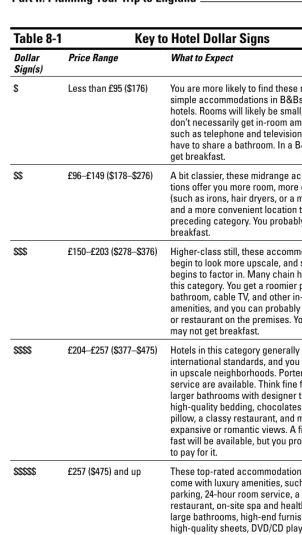
I also include some general pricing information to help you as you decide where to unpack your bags or dine on the local cuisine. In addi-tion to giving you exact prices, I use a system of dollar signs ($) to show a range of costs for hotels or restaurants. The dollar signs for hotels cor-respond to rack rates (nondiscounted, standard rates) and reflect a hotel’s low to high rates for a double room. For restaurants, the dollar signs denote the averagecost of dinner for one person, including appe-tizer, main course, dessert, one nonalcoholic drink, tax, and tip (usually 10 percent, unless the bill already includes a service charge). The scale for hotels goes up to five $ signs; the priciest restaurants get four $ signs. Check out the following table to decipher the dollar signs:
Cost Hotel Restaurant
$ $175 and under $25 and under
$ $ $176–$275 $26–$40
$ $ $ $276–$375 $41–$60
$ $ $ $ $376–$475 $61 and up
$ $ $ $ $ $476 and up
I always give prices in this book first in British pounds sterling (£), fol-lowed by U.S. dollars ($) rounded off to the nearest dollar over $10 and to the nearest nickel under $10. Although the exchange rate fluctuates daily, this book uses £1 = $1.85.
For those hotels, restaurants, and attractions that I plot on a map, the listing information gives you a page reference to the map. If a hotel, restaurant, or attraction falls outside the city limits or in an out-of-the-way area, this book may not include it on a map.
Foolish Assumptions
As I wrote this book, I made some assumptions about you, dear reader, and your needs as a traveler. Here’s what I assumed about you:
⻬You may be an experienced traveler who hasn’t had much time to explore England and wants expert advice on how to maximize your time and enjoy a hassle-free trip.
⻬You may be an inexperienced traveler looking for guidance when determining whether to take a trip to England and how to plan for it.
⻬You’re not looking for a book that provides all the information avail-able about England or that lists every hotel, restaurant, or attrac-tion. Instead, you’re looking for a book that focuses on the places that can give you the best or most original experience in England.
If you fit any of these criteria, England For Dummies, 3rd Edition, gives you the information that you’re looking for!
How This Book Is Organized
I break this book down into eight parts. The first two parts deal with trip planning and organization. They provide information, advice, and sug-gestions that can help you map out a wonderful vacation. I devote the other parts of the book to London and specific regions of the country. For each region, I list the best towns and cities to visit, with hotel and restaurant choices, and the top attractions, including castles, stately homes, and gardens.
Part I: Introducing England
This first part introduces England and gives you some excellent reasons for going there. This section gives you an overview of the best England has to offer and helps you get the big picture. These chapters provide background information on the history, architecture, and dining scene in England; recommend books and movies to enhance your trip; help you to decide when to visit and what to see; and provide sample one- and two-week itineraries.
Part II: Planning Your Trip to England
This part helps take some of the wrinkles out of the trip-planning stage. I give you sound advice on planning a realistic budget and talk about your options for airlines and airfares, how package tours can save you big bucks, and what kinds of guided tours you can join. This part helps you to decide what form of transportation (train, bus, or rental car) to use to get around the country, and it explains what kind of accommodations you can expect for your money. I provide tips for England-bound travel-ers with special needs and interests: families, seniors, traveltravel-ers with dis-abilities, and gay and lesbian travelers. I also deal with some pretrip loose ends, from passports to medical insurance.
Part III: London and Environs
All you need to know about England’s greatest city makes up this part. You find detailed information on London’s airports and thumbnail descriptions of the city’s diverse neighborhoods. Also, I help you get around like a Londoner on the Underground, on the bus, or in a taxi. You can find a list of London’s best hotels and an appetizing survey of London’s best restaurants. I cover the top attractions in and around this exciting city, plus shopping and nightlife. Making side trips from London is easy, and I provide details on several possible destinations:
Greenwich, Hampton Court Palace, Kew Gardens, Windsor Castle, Oxford, Blenheim Palace, and Cambridge.
Part IV: The Southeast
In this part, I outline the highlights of Kent and Sussex, counties close to London that border the English Channel. I also recommend overnight destinations, such as Canterbury, with its ancient cathedral; the swinging seaside resort of Brighton; and the cobblestoned town of Rye. I devote a chapter to Kent’s greatest castles, stately homes, and gardens — including Knole, Hever Castle, Sissinghurst Castle Gardens, Dover Castle, and Leeds Castle.
Part V: The West Country
This part explores the West Country counties of Hampshire, Wiltshire, Devon, and Cornwall. Winchester is Hampshire’s most historic city. Neighboring Wiltshire is the home of Salisbury, with its towering
cathedral, and that great prehistoric monument Stonehenge. In Devon, you find the unique moorland landscape of Dartmoor National Park; Torquay, a laid-back seaside resort; and Plymouth, where the Pilgrims set sail for the New World. Vacationers often flock to mysterious Cornwall, which includes Land’s End in England’s southwesternmost corner, with its colorful seaside towns, such as Penzance and St. Ives.
Part VI: England’s Heartland
I devote this part to central England. You may know Stratford-upon-Avon in Warwickshire as the home of William Shakespeare, and nearby Warwick Castle is one of the country’s most popular attractions. Such an amazing collection of 18th-century buildings fills beautiful Bath that UNESCO (United Nations Educational, Scientific, and Cultural Organization) desig-nated the city a World Heritage Site. The Cotswolds region, with its picture-perfect villages built of honey-colored stone, is one of England’s premier touring destinations. Cheltenham and Cirencester make good bases for exploring the Cotswolds.
Part VII: Way Up North
Yorkshire and the Lake District are highly scenic areas close to England’s northern border with Scotland. York is one of the most beautiful and his-toric cities in the North; Scarborough is a Yorkshire resort town on the North Sea; and amazing Castle Howard lies between them. North York Moors National Park and the Yorkshire Dales National Park protect Yorkshire’s distinctive landscape of heather-covered moors, gentle dales, and rugged coastline. The Lake District, in Cumbria, is a spectacu-larly beautiful region of mountains and lakes, all within Lake District National Park. You can stay on Lake Windermere, England’s largest lake, or in nearby Grasmere or Keswick.
Part VIII: The Part of Tens
The Part of Tens allows me to focus a little more attention on the extra-special places and sights I want you to know about. My “tens” include ten famous writers and how you can visit where they lived and worked, ten great English gardens, ten magnificent churches and cathedrals, and ten famous royals and the events that characterized their reign.
You can also find two other elements in this book. Near the back, I include an A-to-Z appendix—your Quick Concierge — containing plenty of handy information, such as how the telephone system works and what numbers to call in an emergency. You also find a list of toll-free tele-phone numbers and Web sites for airlines, car-rental agencies, and hotel chains serving England, plus Web sites where you can find additional information on specific cities or areas. Finally, I include a tear-out Cheat Sheet that can help you with unfamiliar British words.
Icons Used in This Book
In this book’s margins, you can find six different icons: little pictures that clue you in on some important trip-planning matters and a few things that are just for fun.
This icon points out my report on the most newsworthy scandals — I mean stories — about people and places. I throw in these tidbits about English personalities and places just for the fun of it.
I’m not cheap, but I love to save money, and I suspect you do, too. Keep an eye out for the Bargain Alert icon as you seek out money-saving tips and/or great deals.
Best of the Best highlights the best the destination has to offer in all cat-egories: hotels, restaurants, attractions, activities, shopping, and nightlife.
Watch for the Heads Up icon to identify annoying or potentially danger-ous situations such as tourist traps, unsafe neighborhoods, budgetary ripoffs, and other things to beware.
Look to the Kid Friendly icon for attractions, hotels, restaurants, and activities that welcome children or people traveling with kids.
Find out useful advice on things to do and ways to schedule your time when you see the Tip icon.
Where to Go from Here
To England, of course! How you use this book is up to you. You can start from the beginning and read straight through, or you can start anywhere in between and extract information as you want or need it. Throughout the book, I hope you think of me as your guide or companion on this journey to England. However you use the book, I want you to have a great time.
Part I
In this part . . .
T
his part helps to get you going. If you’ve never been to England, you need advice and information to start plan-ning your trip. And if you’ve been to England before, you may want to refresh your knowledge and look for some new places to visit.Chapter 1 gives you a brief overview that fills you in on the best England has to offer, from the edge-of-your-seat excitement of London to the sleepy splendor of ancient villages. I give you a round-up of the greatest gardens, the coolest castles, the stateliest of stately homes, the most historically charis-matic towns and cities, the most beautiful churches and cathedrals, and the most romantic landscapes.
Chapter 2 digs deeper into the culture and history of England in a way that can only add to your enjoyment of what you see and experience once you’re there. I give you a brief outline of the main events in English history, right up to the latest royal scandals. I cover the dining and drinking scene, from haute restaurants to historic pubs where you can enjoy a pint of ale with the locals. I outline England’s main architectural trends. And, finally, I recommend some books and movies that you may want to check out.
Chapter 3 offers more specific information to help you plan when and where you want to go. I present a general overview of the main areas I cover in the book and include a calendar of events and a description of the seasons.
Chapter 1
Discovering the Best
of England
In This Chapter
䊳Discovering London and England’s most fascinating towns and villages
䊳Exploring England’s unrivaled collection of castles, palaces, cathedrals, and churches
䊳Experiencing the great historic landmarks of England
䊳Enjoying glorious gardens and the English countryside
䊳Going shopping in London and beyond
E
ngland claims a special place in the hearts and minds of many people. English speakers (and readers) in the United States, Canada, Australia, and New Zealand often feel a kinship with the land of their mother tongue. England shares many cultural ties and hundreds of place names with those countries. So for some people, a trip to England is like going home. The country’s great age, and the sheer weight of its history, can induce a sense of awe and wonder. England is a land of ancient cities, royal palaces, massive cathedrals, and legendary sites. You can see the layers of its long history everywhere you look. And travelers can enjoy the country in so many different ways. Mighty castles, stately homes, glorious gardens, and picturesque villages enhance the country-side’s natural beauty. The cooking is unique, and so is the English pub.This chapter gives you as an at-a-glance reference to the absolute best — the best of the best — that England has to offer. In the categories that I outline, you can find some of the things that make traveling in England so much fun and so endlessly fascinating. I discuss each of these places in detail later in this book; you can find them in their indicated chapters, marked with a Best of the Best icon.
The Best of Legendary London
⻬London is where you can visit truly world-class museums. The British Museum,the National Gallery,the Tate Modern,the Tate Britain,the Victoria & Albert Museum,and the Natural History Museum— to name the best known — display a mind-boggling array of artwork and unique treasures.
⻬The Tower of London, Westminster Abbey,and Buckingham Palace are just three of the famous historic places you can visit. Hyde Park, Kensington Gardens, Green Park,and St. James’s Parkform a vast network of green space shared by Londoners and visitors to the capital of the United Kingdom.
⻬London’s dining sceneis phenomenal, and the entertainment choices— theater, music, dance, opera, film — are almost limitless. The shopping opportunitiesare endless, too.
The Best Cities, Towns, and Villages
England isn’t that large, so you can base yourself in London and take day trips to many historic cities and towns in other parts of the country. Or you can make them part of an itinerary that showcases the country’s best cities:
⻬One of the most elegant of English cities is the former spa town of Bath,with its amazing Georgian crescents(row houses built in a long curving line) and 18th-century architecture. See Chapter 20. ⻬Oxfordand Cambridgeare famous university towns where
centuries-old colleges cluster around quadrangles. See Chapter 13. ⻬For some laid-back fun beside the seaside, you can visit Brighton,
on the south coast, or head up north to Scarborough,on the North Sea in Yorkshire. Cornwallhas several picturesque towns, many of them former fishing villages with colorful histories of smuggling and pirates: Penzance is the largest, but you also find St. Ives,an artists’ colony with a beautiful beach; Mousehole;and Fowey.See Chapters 14, 21, and 18 respectively.
⻬Rye,in Sussex, is one of the best-preserved and most attractive towns in England, full of Elizabethan homes and buildings. See Chapter 14.
⻬York,two hours north of London by train, is still surrounded by its medieval walls; has narrow, medieval lanes; and is home to York Minster, one of the largest churches in the world. See Chapter 21. ⻬The scenic Cotswoldsregion is dotted with charming, honey-colored
stone villages — Broadway, Bourton-on-the-Water, Chipping Campden,and Cirencester— that all grew rich on wool during the Middle Ages. See Chapter 20.
⻬In theLake District,a scenically splendid area in northwest England, you find picturesque villages, such as Grasmere,and lakeside towns, such as Keswick,in stunning countryside. See Chapter 22.
The Best Castles, Palaces, and Stately Homes
Step into one of England’s castles, palaces, or stately homes, and all you can do is marvel at the way people used to live. Somepeople, I should say, because these enormous estates belonged to an elite minority with royal connections or private fortunes. Usually set amid spectacular grounds, these places are treasure troves of history and art, packed with rare paintings and beautiful furniture.⻬In London, you can visit Buckingham Palace,the queen’s official residence, and Kensington Palace,once the home of Princess Diana. Henry VIII’s Hampton Court Palaceis a short train ride from London, as is 900-year-old Windsor Castle,another official resi-dence of Queen Elizabeth II. See Chapter 12 for more on Buckingham and Kensington palaces; see Chapter 13 for more on Hampton Court Palace and Windsor Castle.
⻬Knole,which has 365 rooms (some with their original 17th-century furnishings), and moated Hever Castle,birthplace of Anne Boleyn, are just two of the many castles and stately homes you can visit in Kent. See Chapter 15.
⻬One of the most dramatically sited castles in England is St. Michael’s Mount,on its own rocky island in Mount’s Bay, Penzance. Castle Drogo, in nearby Dartmoor National Park, is the last private castle to be built in England (it was completed in 1930). See Chapters 18 and 17, respectively.
⻬Blenheim Palace,near Oxford, was the palatial childhood home of Winston Churchill, who later moved to Chartwell,a house in Kent that is filled with Churchill memorabilia. See Chapters 13 and 15, respectively.
⻬Farther north, just a few miles from Stratford-upon-Avon, is mighty Warwick Castle,surrounded by thick stone walls and towers. The wax artisans at Madame Tussauds have “peopled” the castle with its former owners and some of their famous guests. See Chapter 19. ⻬Castle Howard,in Yorkshire, is one of the most beautiful stately
homes in England, an enormous domed wonder set amidst land-scaped grounds with classically inspired buildings. See Chapter 21.
The Best Cathedrals and Churches
England’s mighty cathedrals, still in use 800 years and more after they were built, dominate the heart of England’s cities. Their stupendous size
never fails to impress, and some of their architectural details are stun-ning. I include several of my favorite cathedrals and churches in this book:
⻬English monarchs have been crowned in London’s Westminster Abbeysince the time of William the Conqueror. St. Paul’s Cathedral is the masterpiece of Sir Christopher Wren, who rebuilt London after the Great Fire of 1666. See Chapter 12.
⻬Chaucer’s pilgrims in The Canterbury Taleswere headed toward Canterbury Cathedral,and tourists still flock there in droves. See Chapter 14.
⻬The west front of Exeter Cathedralis remarkable for its rows of sculptured saints and kings, the largest surviving array of 14th-century sculpture in England. See Chapter 17.
⻬Massive York Minster,the largest Gothic building in northern Europe, contains more medieval stained glass than any other cathe-dral in England. See Chapter 21.
The Best Historic Places
England markets its history big time, and with good reason: Its history stretches back some 2,000 years, to a time when Latin-speaking Roman soldiers built forts, roads, and temples from Kent to Northumberland. But England was inhabited for thousands of years before the Romans arrived. No soap opera can beat the stories associated with England’s most famous historic sites. The great historical landmarks of England stir the imagination because they’ve witnessed so much — from glorious triumphs to bloody tragedies.
⻬When you visit the Tower of London,you can walk on a piece of ground where the great dramas and terrors of a turbulent kingdom were played out, where Elizabeth I was held captive while still a princess, and where Sir Thomas More and Anne Boleyn were beheaded. See Chapter 12.
⻬In southern England, at a place called Battle,you can walk around the battlefield where in 1066 William of Normandy defeated Harold, the Saxon king of England. The battle changed the course of English history. See Chapter 14.
⻬Long-vanished peoples erected mysterious monuments that still fill the country. The most famous is Stonehenge,a massive stone circle on the plains of Wiltshire. In Cornwall,you can visit other tantalizing prehistoric sites, including Chysauster,the remains of an Iron Age village. In northern England, up in the Lake District, Castlerigg Stone Circle,near Keswick, is another enigmatic reminder of early human presence in England. See Chapters 16, 18, and 22, respectively.
Part I: Introducing England
The Best Gardens
In England, gardening has been raised to an art form. Chalk it up to a temperate climate (especially in the southeast and southwest) that can support all kinds of rare and exotic plant species, including azaleas and rhododendrons. I include several great English gardens in this book because gardens are a growing (pardon the pun) interest for visitors from around the globe. The gardens usually surround a stately home or castle that you can also visit.
⻬Perhaps the most famous garden in England is at Sissinghurst Castle, in Kent. The plantings there, and at equally beautiful Hidcote Manor, in Gloucestershire, form living “rooms” of shape, color, scent, and texture. See Chapters 15 and 20.
⻬Stourhead,in Wiltshire, was laid out in 1741 and is one of the oldest landscape gardens in England. See Chapter 16.
⻬In Cornwall, Cotehele,and Lanhydrockare estates known for their superb riverside gardens. Cornwall is also the site of England’s newest garden, a massive world-environment learning center called the Eden Project.See Chapter 18.
⻬You can find immaculately landscaped grounds, where every shrub and blade of grass is clipped to perfection, at Hever Castle,in Kent; Warwick Castle,near Stratford-upon-Avon; and Castle Howard,up north in Yorkshire. See Chapters 15, 19, and 21, respectively. ⻬Closer to London, you find historic gardens at Hampton Court
Palaceand the Royal Botanic Gardens at Kew. See Chapter 13.
The Best Romantic Landscapes
England has been settled for thousands of years, and truly wild places are rare in this densely populated country where 46,382,000 people inhabit 50,357 square miles of land. Yet travelers always comment on the countryside’s beauty, a domesticated blend of farms, enclosed fields, and small villages that seem to snooze under a blanket of history. The way humans have interacted with the environment for thousands of years — leaving behind grand monuments, such as Stonehenge, humble country churches, thatched cottages, and hedgerows — contributes to the enduring charm of the English countryside. Many visitors respond to the sense of human continuity evoked by the following landscapes:
⻬If you explore Cornwall,you encounter rocky coastal headlands, windswept moors, and Celtic crosses left by Irish missionaries 14 centuries ago. See Chapter 18.
⻬Touring the Cotswolds,you see picturesque villages of honey-colored stone that date back to the Middle Ages interspersed with lightly forested valleys and high open fields where sheep graze as they’ve done for a thousand years. See Chapter 20.
⻬Luckily, the country’s wildest and most unique landscapes are pro-tected as national parks, limiting commercial development and opening the countryside to walkers, thus preserving the regions’ essential character. Places like Dartmoor National Parkin Devon, North York Moorsand Yorkshire Dalesnational parks in Yorkshire, and Lake District National Parkin semi-remote Cumbria are all great places for you to experience the most romantic landscapes of England. See Chapters 17, 21, and 22, respectively.
The Best Shopping
Londonis one of the world’s greatest shopping cities, and my credit cards aren’t doing all the talking. From mighty Harrods to the superchic boutiques of Bond Street, from the 200-year-old shops on Jermyn Street to the wonderland of bookstores on Charing Cross Road, London offers a seemingly endless array of goods and goodies. Custom-made shirts, hand-tooled leather shoes, high-quality woolens — in London, you can still find such things. You can hunt for an old engraving, paw through bric-a-brac at an outdoor market stall, or wander through the London silver vaults in your quest for a Georgian soup ladle. See Chapter 12.
Nowhere else in the country can match London’s abundance of shop-ping opportunities. Outside the capital, however, small shops and one-of-a-kind places draw the shopper’s eye:
⻬Antiquarian bookstores abound in Cambridgeand Oxford. See Chapter 13.
⻬Exeteris a good place to look for silver. See Chapter 17. ⻬The Cotswolds has more antique stores than anywhere else in
England. See Chapter 20.
⻬Many areas of the country feature locally made handicrafts. Look for pottery in Devon, Cornwall,and the Lake District. See Chapters 17, 18, and 22, respectively.
You may also stumble across some treasure at a rural car-boot (trunk) sale or jumble sale. At these informal sales in school or church buildings or in parking lots, you can buy secondhand odds and ends. And of course, every major historic attraction in England — from Sissinghurst Castle Garden in Kent to Castle Howard in Yorkshire — has a gift shop.
Chapter 2
Digging Deeper
into England
In This Chapter
䊳Running through the main events in England’s history
䊳Building your architecture appreciation
䊳Diving into English food and beer
䊳Discovering books and movies about England
T
his chapter helps you find out more about England and deepens your experience of the country. I distill the essence of England’s complicated and tumultuous past so you can get a clear, quick sense of the major eras. Then I highlight the main architectural trends, whet your appetite with a primer on English food and drink, and recommend some excellent books and movies about England.The Main Events: A Brief History of England
England’s history is an inexhaustible subject. Huge tomes have been written on individual monarchs, colorful personalities, architectural styles, and historical eras. But in this section, I’m going to be as brief as a bikini and give you a history of England that covers only the bare essentials:⻬Prehistory:Beginning about 5,000 years ago, a Neolithic civilization was cutting and hauling megaton slabs of stone over dozens of miles and erecting them in elaborate geometric configurations. Stonehenge is the most famous example of their work. (See Chapter 16 for details on Stonehenge.)
⻬The Romans arrive:When the Romans conquered England in
the country — most notably in Bath. (See Chapter 20 for more on Bath.)
⻬Northern invaders:With the Roman Empire’s breakup in A.D. 410, Jutes, Angles, and Saxons from northern Europe invaded England and formed small kingdoms. For the next 600 years or so, the Anglo-Saxon kingdoms fought off Viking raiders. In the north, Eboracum, a Roman settlement, became Jorvik, a Viking city, and eventually York (See Chapter 21 for more on York.)
⻬William the Conqueror:The next major transitional period in England started in 1066, when William of Normandy fought and killed Harold, the Anglo-Saxon king of England, at the Battle of Hastings (the site of today’s town of Battle, which you can read about in Chapter 14). William and his French nobles took over the land and built castles — Windsor Castle (see Chapter 13) and the Tower of London (see Chapter 12) are two examples — and cathe-drals that still stand today. Every monarch up to the present day claims descent from William the Conqueror.
⻬Magna Carta:King John, a Plantagenet, signed the Magna Carta in 1215, granting more rights to the nobles. What about the common man and woman? As serfs and vassals in a closed, hierarchical, class-ridden society, their lot wasn’t an easy one. Geoffrey Chaucer (1342–1400) was the first writer to give us some recognizable portraits of folks who lived during the medieval period, in The Canterbury Tales.(For more on Canterbury, see Chapter 14.) ⻬Hundred Years’ War:At home and abroad, war and bloodshed tore
England apart for more than 300 years. The Hundred Years’ War between France and England began in 1337. During this same period, in the War of the Roses, the Houses of York and Lancaster fought for the right of succession to the English crown.
⻬Tudor and Elizabethan England:Henry VIII, the Tudor king famous for taking six wives, brought about the next great shift in what had been Catholic England. In 1534, he dissolved all the monasteries and became head of the Church of England. His daughter, Elizabeth I, ruled during a period of relative peace, power, and prosperity. The Elizabethan period was England’s Golden Age, the time when Shakespeare’s plays were being performed at the Globe Theatre in London.
⻬Civil war:In 1603, James VI of Scotland became King James I of England, uniting the crowns of England and Scotland. But conflicts between monarchs and nobles were endless. Charles I, seeking absolute power, dissolved Parliament in 1629. He was beheaded in 1649 after Oliver Cromwell led a bitter civil war between Royalists and Parliamentarians. Cromwell’s armies destroyed churches and royalist strongholds throughout the country. Cromwell was ele-vated to Lord Protectorate of the Realm, but by 1660 a new king, Charles II, was on the throne. This time, however, his powers were limited.
⻬Fire and plague: London, which had been growing steadily, was devastated by two back-to-back catastrophes: the Great Plague of 1665 and the Great Fire of 1666.
⻬The Victorian Empire:England reached its zenith of power and prestige during the reign of Victoria (1837–1901), who ruled over an empire so vast that “the sun never set” on it. The Industrial Revolution spawned another major change during this period, moving England away from its agrarian past and into a mechanized future. Charles Dickens and other social reformers exposed the wretched working conditions in Victorian England, where children as young as 6 had to labor in mines and factories. The late Victorian age was the time of Sherlock Holmes, a fictional detective created by Arthur Conan Doyle, and Jack the Ripper, a real-life serial killer who terrorized London’s West End.
⻬England in the World Wars:England suffered terrible losses during World War I (1914–1918) but emerged victorious. During World War II, from the fall of France in 1940 until the United States entered the war in 1941, England stood alone against Hitler. Winston Churchill was the country’s prime minister during the war years. With strictly rationed food, mandatory blackouts, and terrible bombing raids that destroyed cities and killed tens of thousands of civilians, life in wartime England had a profound effect on its citi-zens. Shortages continued for many years afterward.
⻬The welfare state:Another major societal shift occurred in 1945 when the Labour Party began to dismantle the empire and intro-duced the welfare state. Under the National Health System, every citizen in the United Kingdom can receive free health care (the quality of that care is another story). It wasn’t until Margaret Thatcher and the Tory Party came into power during the 1980s that England began privatizing formerly state-run agencies, such as the railroad (with what some say are disastrous results). ⻬Queen Elizabeth II:Queen Elizabeth II ascended the throne in
1952. The fairy-tale wedding of her son Prince Charles to Lady Diana Spencer was the last high point for the House of Windsor. Charles and Diana’s subsequent divorce seemed to unleash a flood-gate of royal scandals, with the result that the popularity of the British monarchy is at an all-time low. In 2002, the queen celebrated her 50th anniversary on the throne. But the queen is no longer the richest woman in England: J. K. Rowling, the author of the Harry Potter books, now holds that title.
⻬New Labour:In 2001, Tony Blair was elected to a second term as prime minister, and New Labour, with its centrist approach, was firmly in control of the government. However, in the 2005 elections, the party lost one-third of its seats as voters expressed their dis-content with Blair’s continuing support of the war in Iraq. ⻬Terrorist bombings:In July 2005, a day after exultant Londoners
learned that their city would host the 2012 Olympics, terrorists
detonated bombs in the London Underground and on a double-decker bus, killing 54 people and wounding hundreds more. Londoners stood together and carried on, showing the world that they would not be cowed by acts of violence.
Building Blocks: An Overview
of English Architecture
You can determine the period in which a building was constructed (or reconstructed) by its architectural and decorative details. In a country like England, where the age of buildings can span a thousand-year period (a few Anglo-Saxon churches are even older than that), many different styles evolved. The architectural periods are often named for the monarch or royal family reigning at the time. You can enhance your enjoyment of England’s abundance of historic buildings if you know a few key features of the different styles. The following list is a brief primer in English architectural history, from Norman to Victorian times:
Part I: Introducing England
18
Recent royal events
⻬Norman(1066–1189): Round arches, barrel vaults, and highly deco-rated archways characterize this period’s Romanesque style. ⻬Early English Gothic(1189–1272): The squat, bulky buildings of the
Norman period gave way to the taller, lighter buildings constructed in this style.
⻬Decorated Gothic(1272–1377): Buildings in this style have large windows, tracery(ornamental work with branching lines), and heavily decorated gables and arches.
⻬Perpendicular Gothic(1377–1483): Large buttresses(exterior side supports) allowed churches to have larger windows than ever before. Tracery was more elaborate than in previous Gothic build-ings; the four-centered arch appeared; and architects perfected fan vaulting(a decorative form of vaulting in which the structural ribs spread upward and outward along the ceiling like the rays of a fan). ⻬Tudor(1485–1553): During this period, buildings evolved from
Gothic to Renaissance styles. Large houses and palaces were built with a new material: brick. England has many half-timbered Tudor and Elizabethan domestic and commercial buildings. This method of construction used brick and plaster between visible wooden timbers.
⻬Elizabethan(1553–1603): The Renaissance brought a revival of classical features, such as columns, cornices(prominent rooflines with brackets and other details), and pediments(a decorative trian-gular feature over doorways and windows). The many large houses and palaces of this period were built in an E or H shape and con-tained long galleries, grand staircases, and carved chimneys. ⻬Jacobean(1603–1625): In England, Inigo Jones adopted the
sym-metrical, classically inspired Palladian style that arrived from Italy, but he used it in a freer and more fanciful way. Buildings in this style incorporate elements from ancient Greek and Roman architec-ture. Columns and pilasters, round-arch arcades, and flat roofs with openwork parapets became common.
⻬Stuart(1625–1688): Elegant classical features, such as columns, cornices, and pediments, are typical of this period, in which Sir Christopher Wren was the preeminent architect.
⻬Queen Anne(1689–1714): Buildings from the English baroque period mix heavy ornamentation with classical simplicity.
⻬Georgian and Regency(1714–1830): During these periods, elegant terraced houses were built; many examples survive in Brighton and Bath. Form and proportion were important elements; interior deco-ration inspired by Chinese motifs became fashionable.
⻬Victorian(1830–1901): A whole range of antique styles emerged — everything from Gothic and Greek Revival to pseudo-Egyptian and Elizabethan. Hundreds of English churches were renovated during the Victorian era.
Figure

Outline
Related documents