Jun-ichiro itojun Hagino
Linacre House, Jordan Hill, Oxford OX2 8DP, UK
Copyright © 2004, Elsevier Inc. All rights reserved.
No part of this publication may be reproduced, stored in a retrieval system, or transmitted in
any form or by any means, electronic, mechanical, photocopying, recording, or otherwise,
without the prior written permission of the publisher.
Permissions may be sought directly from Elsevier’s Science & Technology Rights
Department in Oxford, UK: phone: (+44) 1865 843830, fax: (+44) 1865 853333, e-mail:
[email protected]. You may also complete your request on-line via the Elsevier
homepage (http://elsevier.com), by selecting “Customer Support” and then “Obtaining
Permissions.”
Recognizing the importance of preserving what has been written, Elsevier prints its books on
acid-free paper whenever possible.
Library of Congress Cataloging-in-Publication Data
British Library Cataloguing-in-Publication Data
A catalogue record for this book is available from the British Library.
ISBN: 1-55558-
318-0
For information on all Elsevier Digital Press publications visit our Web site at
www.books.elsevier.com
Preface
vii
About This Book
ix
Write Portable Application Programs
ix
Be Security Conscious When Writing Programs
ix
Terminology and Portability
x
1
Introduction
1
1.1
A History of IPv6 and Its Key Features
1
1.2
Transition from IPv4-Only Internet to IPv4/v6 Dual Stack Internet
4
1.3
UNIX Socket Programming
6
1.4
IPv6 Architecture from a Programmer’s Point of View
10
2
IPv6 Socket Programming
13
2.1
AF_INET6: The Address Family for IPv6
13
2.2
Why Programs Need to Be Address-Family Independent?
14
2.3
Guidelines to Address-Family Independent Socket Programming
17
3
Porting Applications to Support IPv6
27
3.1
Making Existing Applications IPv6 Ready
27
3.2
Finding Where to Rewrite, Reorganizing Code
27
3.3
Rewriting Client Applications
29
4
Tips in IPv6 Programming
49
4.1
Parsing a IPv6 Address out of String
49
4.2
Issues with “:” As a Separator
49
4.3
Issues with an IPv4 Mapped Address
50
4.4
bind(2) Ordering and Conflicts
51
4.5
How IPv4 Traffic Gets Routed to Sockets
52
4.6
Portability across Systems
52
4.7
RFCs 2292/3542, Advanced API
54
4.8
Platform Support Status
54
5
A Practical Example
59
5.1
Server Program Example—popa3d
59
5.2
Further Extensions
62
5.3
Client Program Example—nail
62
A
Coming updates to IPv6 APIs
81
B
RFC2553 “Basic Socket Interface Extensions for IPv6"
83
C
RFC3493 “Basic Socket Interface Extensions for IPv6”
125
D
RFC2292 “Advanced Sockets API for IPv6"
165
E
RFC3542 “Advanced Sockets Application Program Interface (API) for IPv6" 233
F
IPv4-Mapped Address API Considered Harmful
311
G
IPv4-Mapped Addresses on the Wire Considered Harmful
317
H
Possible Abuse Against IPv6 Transition Technologies
323
I
An Extension of format for IPv6 Scoped Addresses
333
J
Protocol Independence Using the Sockets API
345
Here in Japan, it looks like the Internet is deployed everywhere. Not a day will go by
without hearing the word Internet. However, many people do not know that we are
very close to reaching the theoretical limit of IPv4. The theoretical limit for the
number of IPv4 nodes is only 4 billion—much fewer than the world’s population.
People in trains and cars send email on their cellphones using small numeric
key-pads. Most of these devices are not connected to the real Internet—these cellphones do
not speak the Internet Protocol. They use proprietary protocols to deliver emails to the
gateway, and the gateway relays the emails to the Internet. Cellular operators are now
trying to make cellphones a real VoIP device (instead of “email only” device) to avoid
the costs of operating proprietary phone switches/devices/gateways and to use
inexpen-sive IP routers.
There are a lot of areas where the Internet and the Internet Protocol have to be
deployed. For instance, we need to enable every vehicle to be connected to the IP
network in order to exchange information about traffic congestion. There are plans to
interconnect every consumer device to the Internet, so that vendors can collect
infor-mation from the machines (such as statistics), as well as provide various value-added
services.
Also, we need to deploy IP to every country in the world, including highly
popu-lated areas such as China, India, and Africa, so that everyone has equal opportunity to
access the information on the Internet.
The IPv6 effort was started in 1992, in the INET92 conference held in Kobe,
Japan. Since then, we have been making a huge amount of effort to help the transition
happen. Fortunately, it seems that the interest in IPv6 has reached the critical mass,
and the transition to IPv6 is now a reality. Many ISPs in Japan are offering commercial
IPv6 connectivity services, numerous vendors are shipping IPv6-enabled operating
systems, and many IPv6-enabled products are coming. If you are not ready yet, you
need to hurry up.
The transition to IPv6 requires an upgrade of router software and host operating
systems, as well as application software. This book focuses on how you can modify
your network application software, based on the socket API, to support IPv6. When
you write a network application program, you will want the program to be
IPv6-capable, so that it will work just fine on the IPv6 network, as well as the IPv4 network.
After going through this book, you will be able to make your programs IPv6-ready. It
will also help you port your IPv4-capable application to become IPv6-capable at the
same time.
In this book, we advocate address-family independent socket layer programming
for IPv6 transition. By following the instructions in the book, your code will become
independent from the address family (such as AF_INET or AF_INET6). This is the
best way to support IPv6 in your program, compared with other approaches (such as
hardcoding AF_INET6 into the program).
I would like to thank the editor for the Japanese edition of the book, Ms. Eiko
Akashima, and translator for the Japanese edition of the book, Ms. Ayako Ogawa (the
original manuscript of the book is in English, even though it was first published
in Japan). On the technical side, I would like to thank Mr. Craig Metz, who generously
permitted us to include his paper on address-family independent programming, as well
as the members of the WIDE/KAME project, who have made a lot of useful
sugges-tions to the content of the book.
Jun-ichiro itojun Hagino
This book tries to outline how to write an IPv6-capable application on a UNIX socket
API, or how to update your IPv4 application to be IPv6-capable. The book tries to
show portable and secure ways to achieve these goals.
Write Portable Application Programs
There are a large number of platforms that support socket API for network
program-ming. When you write an application on top of socket API, you will want to see your
program work on as many platforms as possible. Therefore, portability is an important
factor in application programming. As many of you already know, there are many
UNIX-like operating systems, as well as non-UNIX operating systems that implement
socket APIs. For instance, Windows XP does implement socket API; Mac OS X uses
BSD UNIX as the base operating system and provides socket API to the users (Apple
normally recommends the use of Apple APIs). So the book tries to recommend
port-able ways of writing IPv6-capport-able programs.
Be Security Conscious When Writing Programs
unfortunately, there are some IPv6 APIs that are inherently insecure, so the book tries
to avoid (and discourage) the use of such APIs.
This book does not try to cover every aspect of IPv6 technology—the book
con-strains itself to the IPv6-capable programming on top of socket API. There are
numerous reading materials on IPv6 technology, so readers are encouraged to read
them before starting to work on this book.
Also, the book assumes a certain level of expertise in socket API programming.
The book does not try to explain every aspect of socket API programming; please read
the material listed in the References for an introductory description to socket API.
Terminology and Portability
This section describes notations and terminologies used in this book. Here we also
dis-cuss porting issues of examples when you are using operating systems that are not
4.4BSD variants.
Terminology
System calls and system library functions are usually denoted by UNIX manpage
chap-ters: socket(2) or printf(3).
“Nodes” means any IP devices. “Routers” are any nodes that forward packets for
others. “Hosts” are nodes that are not routers (however, in this book, we don’t really
need to make distinctions between them).
Portability of Examples
The examples in the book compile and run on latest *BSD releases. I tried to make the
examples as correct as possible.
If you are planning to use the examples on other platforms, here are some tweaks
dependent on OS implementations.
Solaris, Linux, Windows XP
struct sockaddr has no sa_len member. Therefore, it is not possible to get the size of a
given sockaddr when the caller of the function passed a pointer to a sockaddr. The only
ways to work around this problem are:
struct sockaddr *sa; int salen;
foo(sa, salen)
2. To have a switch statement to determine length of sockaddr. With this
approach, however, the application will not be able to support sockaddrs with
unknown address family.
struct sockaddr *sa; int salen;
switch (sa->sa_family) { case AF_INET:
salen = sizeof(sockaddr_in); break;
case AF_INET6:
salen = sizeof(struct sockaddr_in6); break
default:
fprintf(stderr, “not supported\n”); exit(1);
/*NOTREACHED*/ }
Missing Type for Variables
In some cases, your platform may not have the type declaration used in this book. In
such cases, use the following:
■
If socklen_t is not defined—such as older *BSD releases:
Use unsigned int instead.
■
If in_port_t is not present:
Use u_int16_t.
■
If u_int8_t, u_int16_t, and u_int32_t are not found:
1
Introduction
1.1
A History of IPv6 and Its Key Features
In 1992, the IETF (http://www.ietf.org/) became aware of a global shortage of IPv4
addresses and technical obstacles in deploying new protocols due to limitations
imposed by IPv4. An IPng (IP next generation) effort was started to solve these issues.
The discussion is outlined in several RFCs, starting with RFC 1550. After a large
amount of discussion, in 1995, IPv6 (IP version 6) was picked as the final IPng
pro-posal. The IPv6 base specification is specified in RFC 1883 and revised in RFC 2460.
In a single sentence, IPv6 is a reengineering effort against IP technology. Key
fea-tures are as follows.
1.1.1
Larger IP Address Space
IPv4 uses only 2^32 bits for IP address space, which allows only (theoretically) 4
bil-lion nodes to be identified on the Internet. Four bilbil-lion may look like a large number;
however, it is less than the world’s population. Moreover, due to the allocation
(in)effi-ciency, it is not possible to use up all 4 billion addresses.
1.1.2
Deploy More Recent Technologies
After IPv4 was specified 20 years ago, we saw many technical improvements in
net-working. IPv6 covers a number of those improvements in its base specification,
allowing people to assume that these features are available everywhere, anytime. Recent
technologies include, but are not limited to, the following:
■
Autoconfiguration
—With IPv4, DHCP is optional. A novice user can get into
trouble if visiting an offsite without a DHCP server. With IPv6, the stateless
host autoconfiguration mechanism is mandatory. This is much simpler to use
and manage than IPv4 DHCP. RFC 2462 has the specification for it.
■Security
—With IPv4, IPsec is optional and you need to ask the peer if it
sup-ports IPsec. With IPv6, IPsec support is mandatory. By mandating IPsec, we
can assume that you can secure your IP communication whenever you talk to
IPv6 peers.
■
Friendly to traffic engineering technologies
—IPv6 was designed to allow better
support for traffic engineering such as diffserv
1or RSVP
2. We do not have
sin-gle standard for traffic engineering yet; so the IPv6 base specification reserves a
24-bit space in the header field for those technologies and is able to adapt to
coming standards better than IPv4.
■
Multicast
—Multicast support is mandatory in IPv6; it was optional in IPv4.
The IPv6 base specifications extensively use multicast on the directly connected
link. It is still questionable how widely we will be able to deploy multicast (such
as nationwide multicast infrastructure), though.
■
Better support for ad hoc networking
—Scoped addresses allow better support for
ad hoc (or “zeroconf”) networking. IPv6 supports anycast addresses, which can
also contribute to service discoveries.
1.1.3
A Cure to Routing Table Growth
The IPv4 backbone routing table size has been a big headache to ISPs and backbone
operators. The IPv6 addressing specification restricts the number of backbone routing
entries by advocating route aggregation. With the current IPv6 addressing
specifica-tion, we will see only 8,192 routes in the default-free zone.
1. diffserv: short for “differentiated services.” It is an IETF standard that classifies packets into a couple of classes and performs rough bandwidth/priority control.
1.1.4
Simplified Header Structures
IPv6 has simpler packet header structures than IPv4. It will allow vendors to
imple-ment hardware acceleration for IPv6 routers easier.
1.1.5
Allows Flexible Protocol Extensions
IPv6 allows more flexible protocol extensions than IPv4 by introducing a protocol
header chain. Even though IPv6 allows flexible protocol extensions, IPv6 does not
impose overhead to intermediate routers. It is achieved by splitting headers into two
flavors: the headers intermediate routers need to examine and the headers the final
des-tination will examine. This also eases hardware acceleration for IPv6 routers.
1.1.6
Smooth Transition from IPv4
There were a number of transition considerations made during the IPv6 discussions.
Also, there is a large number of transition mechanisms available. You can pick the most
suitable one for your network during the transition period.
1.1.7
Follows the Key Design Principles of IPv4
IPv4 was a very successful design, as proven by the large-scale global deployment. IPv6
is a new version of IP, and it follows many of the design features that made IPv4 very
successful. This will also allow smooth transition from IPv4 to IPv6.
1.1.8
And More
There are number of good books available about IPv6. Be sure to check these if you are
interested.
Protocol Header Chain
IPv6 defines a protocol header chain, which is a way to concatenate extension
headers repeatedly after the IPv6 base header. With IPv4, the IPv4 header is
adja-cent to the final header (like TCP). With IPv6, the protocol header chain allows
various extension headers to be put between the IPv6 base header and the final
header.
IPv6 header
Next Header = Routing
Routing header
Next Header = Fragment
Fragment header
Next Header = TCP
Fragment of TCP
1.2
Transition from IPv4-Only Internet to IPv4/v6 Dual
Stack Internet
Today, most of the nodes on the Internet use IPv4. We will need to gradually
intro-duce IPv6 to the Internet and hopefully make all nodes on the Internet IPv6-capable.
To do this, the IETF has carefully designed IPv6 migration to be seamless. This is
achieved by the following two key technologies:
■
Dual stack
■Tunneling
With these technologies, we can transition to IPv6 even though IPv4 and IPv6 are
not compatible (IPv4-only devices and IPv6-only devices cannot talk with each other
directly). We will go into the details soon.
It is expected that we will have a long period of IPv4/v6 dual stack Internet, due to
the wide deployment of IPv4 devices. For instance, some of the existing devices, such
as IPv4-capable game machines, may not be able to be upgraded to IPv6.
Therefore, in this book, we would like to focus on the issues regarding the
transi-tion from IPv4-only Internet to IPv4/v6 dual stack Internet and the changes in socket
API programming.
1.2.1
Dual stack
At least in the early stage of IPv6 deployment, IPv6-capable nodes are assumed to be
IPv4-capable. They are called “IPv4/v6 dual stack nodes” or “dual stack nodes.” Dual
stack nodes will use IPv4 to communicate with IPv4 nodes, and use IPv6 to
com-municate with IPv6 nodes. It is just like a bilingual person—he or she will use English
when talking to people in the States, and will use Japanese when talking to Japanese
people.
The determination of protocol version is automatic, based on available DNS
records. Because this is based on DNS, and normal users would use fully qualified
domain name (FQDN) in email addresses and URLs, the transition from IPv4 to
IPv6 is invisible to normal users. For instance, assume that we have a dual stack
node, and we are to access http://www.example.com/. A dual stack node will behave as
follows:
www.example.com. IN A 10.1.1.1
■
If www.example.com resolves to an IPv6 address, connect to the IPv6 address.
www.example.com. IN AAAA 3ffe:501:ffff::1234■
If www.example.com resolves to multiple IPv4/v6 addresses, IPv6 addresses
will be tried first, and then IPv4 addresses will be tried. For example, with the
following DNS records, we will try connecting to 3ffe:501:ffff::1234, then
3ffe:501:ffff::5678, and finally 10.1.1.1.
www.example.com. IN AAAA 3ffe:501:ffff::1234 www.example.com. IN AAAA 3ffe:501:ffff::5678 www.example.com. IN A 10.1.1.1
Since we assume that IPv6 nodes will be able to use IPv4 as well, the Internet will
be filled with IPv4/v6 dual stack nodes in the near future, and the use of IPv6 will
become dominant.
1.2.2
Tunneling
Even when we have IPv4/v6 dual stack nodes at two locations (e.g., home and office),
it may be possible that the intermediate network (ISPs) are not IPv6-ready yet. To
circumvent this situation, RFC 2893 defines ways to encapsulate an IPv6 packet into
an IPv4 packet. The encapsulated packet will travel IPv4 Internet with no trouble,
and then decapsulate at the other end. We call this technology “IPv6-over-IPv4
tunneling.”
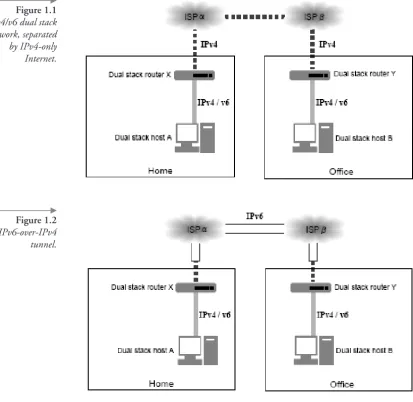
For example, imagine the following situation (see Figure 1.1):
■We have two networks: home and office.
■
We have an IPv4/v6 dual stack host and router at both locations.
■However, we have IPv4-only connectivity to the upstream ISP.
In this case, we can configure an IPv6-over-IPv4 tunnel between X and Y. An IPv6
packet from A to B will be routed as follows (see Figure 1.2):
■
The IPv6 packet will be transmitted from A to X, as is.
■X will encapsulate the packet into an IPv4 packet.
■The IPv4 packet will travel the IPv4 Internet, to Y.
From a programmer’s point of view, tunneling is transparent: It can be viewed as a
simple IPv6 point-to-point link. Therefore, when writing IPv6-capable programs, you
can ignore tunneling.
1.3
UNIX Socket Programming
This section briefly describes how UNIX systems abstract network accesses via socket
interface. If you are familiar with UNIX sockets, you can skip this section. Also, the
Figure 1.1
IPv4/v6 dual stack
network, separated
by IPv4-only
Internet.
Figure 1.2
section does not try to be complete—for the complete description, you may want to
check the reading material listed in the References.
With only a few exceptions, UNIX operating systems abstract system resources as
files. For instance, the hard disk device is abstracted as a file such as /dev/rwd0c. Even
physical memory on the machine is abstracted as a file, /dev/mem. You can open(2),
read(2), write(2), or close(2) files, and files already opened by a process are identified
by an integer file descriptor.
int fd; /* file descriptor */ char buf[128];
fd = open(“/tmp/foo”, O_RDONLY, 0); if (fd < 0) {
perror(“open”); exit(1); /*NOTREACHED*/ }
if (read(fd, buf, sizeof(buf)) < 0) { perror(“read”);
exit(1); /*NOTREACHED*/ }
close(fd); exit(0);
Accesses to the network are also abstracted as special kinds of files, called sockets.
Sockets are created by a socket(2) system call. Sockets are a special kind of file
descrip-tor, so they are represented as an integer and can be terminated by using close(2). On a
socket(2) call, you need to identify the following three parameters:
■
Protocol family
—AF_INET identifies IPv4.
■
Type of socket
—SOCK_STREAM means connetion-oriented socket model.
SOCK_DGRAM means datagram-oriented socket model.
■
Protocol type
—such as IPPROTO_TCP or IPPROTO_UDP.
For the Internet protocol, there are two kinds of sockets: connection-oriented
and connectionless sockets. Connection-oriented sockets abstract TCP connections, and
connectionless sockets abstract communication over UDP. Type of socket and protocol
type has to be consistent; SOCK_STREAM has to be used with IPPROTO_TCP.
int s; /* socket */
/*
* AF_INET: protocol family for IPv4 * SOCK_STREAM: connection-oriented socket * IPPROTO_TCP: use TCP on top of IPv4 */
s = socket(AF_INET, SOCK_STREAM, IPPROTO_TCP); if (s < 0) {
perror(“socket”); exit(1); /*NOTREACHED*/
}
close(s);
While read(2) or write(2) is possible for sockets, we normally need to supply more
information, such as peer’s address, to get the data stream to reach the peer. There are
additional system calls specifically provided for sockets, such as sendmsg(2), sendto(3),
recvmsg(2), and recvfrom(3).
Since we need to identify the peer when accessing the network, we need to denote
it either by:
■
Using connect(2) to make the socket a connected socket. The peer’s address
will be kept in the system, and you can use read(2) or write(2) after connect(2).
■Using sendto(3) or sendmsg(2) to denote the peer every time you transmit data
to the socket.
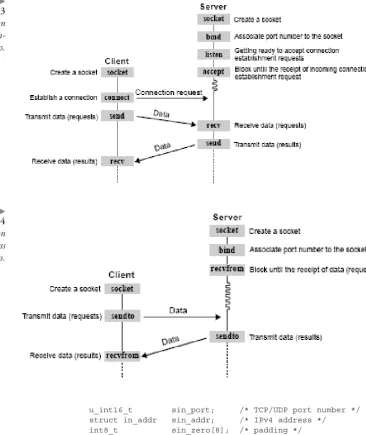
For connection-oriented (TCP) sockets, there are two sides: client side, which
makes active connection, and server side, which awaits connection from the client
passively. connect(2) is mandatory for the client side. bind(2), listen(2), and accept(2)
are mandatory for the server side. (See Figure 1.3.)
For connectionless (UDP) sockets, connect(2) is not mandatory. To receive traffic
from other peers, bind(2) is mandatory. (See Figure 1.4.)
To denote TCP/UDP endpoints, IP address and port number are necessary. To
carry the endpoint information, we use a C structure called “sockaddr” (short for
“socket addresses”). sockaddr for IPv4 is defined in the following code segment. Fields
that appear on wire (sin_port and sin_addr) are in network byte order; other fields are
in host byte order.
/*
* Note: the definition is based on 4.4BSD socket API. * Linux/Solaris has no sin_len field.
*/
struct sockaddr_in {
u_int16_t sin_port; /* TCP/UDP port number */ struct in_addr sin_addr; /* IPv4 address */
int8_t sin_zero[8]; /* padding */
};
Normally, users will denote the peer’s address either as a host name (e.g.,
www.example.org) or as a numeric string representation (e.g., 10.2.3.4). Mapping
between host names and IP addresses is registered in theDNS database, and there are
APIs to query the DNS database, such as gethostbyname(3) or gethostbyaddr(3).
There are also functions to convert IP address in numeric string representation
Figure 1.3
Communication
over
connection-oriented sockets.
Figure 1.4
into binary representation, such as struct in_addr (inet_pton(3)) and vice versa
(inet_ntop(3)).
1.4
IPv6 Architecture from a Programmer’s
Point of View
From a programer’s point of view, IPv4 and IPv6 are almost exactly the same; we have
an IP address (size differs: 32 bit and 128 bit) to identify nodes (actually network
inter-faces) and a TCP/UDP port number to identify services on the node.
There are several points that programmers need to know:
■
In both cases, users normally will use DNS names, rather than IP addresses, to
identify the peer. For instance, users use http://www.example.com/ rather than
http://10.2.3.4/.
■
IPv4 addresses are presented as decimals separated by dots, such as 10.2.3.4.
IPv6 addresses are presented as hexadecimals separated by colons, such as
3ffe:501:ffff:0:0:0:0:1. Two continuous colons can be used to mean
continu-ous zeros—for example, 3ffe:501:ffff:0:0:0:0:1 is equal to 3ffe:501:ffff::1.
■To avoid ambiguity with the separator for the port number, the numeric IPv6
address in a URL has to be wrapped with a square bracket: http://
[3ffe:501:ffff::1]:80/. Again, however, users won’t, and shouldn’t need to, use a
numeric IPv6 address in URLs. DNS names should be used instead.
■
In IPv4, we used variable-length subnet masks, such as /24 (netmask
0xffffff00), /28 (0xfffffff0), or /29 (0xfffffff8). Variable-length subnet mask
was introduced to reduce IPv4 address space use; however, it has certain
draw-backs: It limits how many devices you can connect to your subnet, and you will
need to change subnet mask, or renumber the subnet, when the number of
devices goes too high. In IPv6, we always use /64 as the subnet mask. Therefore,
it is guaranteed that up to 2
64devices can be connected to a given subnet. (See
Figures 1.5 and 1.6.)
■
In IPv4, a node normally has a single IPv4 address associated with it. In IPv6, it
is normal to have multiple IP addresses onto a single node. More specifically,
IPv6 addresses are assigned to interfaces, not to nodes. An interface can have
multiple IPv6 addresses.
into multicast, and broadcast is no longer needed. For instance, to transmit a
packet to all nodes on a specific broadcast medium, we use an IPv6 link-local
all-nodes multicast address, which is ff02::1. IPv6 introduces anycast as a new
communication model, which is one-to-one communication, where the
desti-nation node can be chosen from multiple nodes based on “closeness” from the
source.
■
In IPv4, with a private address as the only exception, unicast addresses are
glob-ally unique. In IPv6, there are scoped IPv6 addresses, namely, link-local IPv6
addresses. These addresses are defined to be unique across a given link.
Link-local address is under the fe80::/10 prefix range. Since uniqueness of a
link-Cannot accommodate more nodes on subnet B
Figure 1.5
Variable-length
subnet mask in
IPv4. If we try to
connect more nodes
to subnet B on the
diagram’s left side,
we have to
renumber subnet
B’s network address
to 10.1.2.16/28 to
accommodate
them.
Each IPv6 subnet can accommodate 2^64 nodes
Figure 1.6
local address is limited in a certain link (such as Ethernet segment), you can see
the same link-local address used in multiple places.
Note:
There was another kind of scoped address, site-local address, defined in the
speci-fication. However, it is soon to be deprecated so you do not need to worry about it.
2
IPv6 Socket Programming
2.1
AF_INET6: The Address Family for IPv6
As we have seen in Chapter 1, on the socket API we use a constant AF_INET to
iden-tify IPv4 sockets. Also, to ideniden-tify IPv4 peers on the socket we have used C structure,
called sockaddr_in.
To handle IPv6 on the socket API, we use a constant called AF_INET6. The
expression is as follows:
s = socket(AF_INET, SOCK_STREAM, IPPROTO_TCP);
This could be rewritten as:
s = socket(AF_INET6, SOCK_STREAM, IPPROTO_TCP);
to initialize an IPv6 socket into variable s.
The following code shows the definition of sockaddr_in and sockaddr_in6:
Definition of sockaddr_in:struct sockaddr_in {
u_int8_t sin_len; /* length of sockaddr */ u_int8_t sin_family; /* address family */ u_int16_t sin_port; /* TCP/UDP port number */ struct in_addr sin_addr; /* IPv4 address */ int8_t sin_zero[8]; /* padding */ };
Definition of sockaddr_in6: struct sockaddr_in6 {
u_int8_t sin6_len; /* length of this struct (socklen_t) */ u_int8_t sin6_family; /* AF_INET6 (sa_family_t) */
u_int32_t sin6_flowinfo; /* IP6 flow information */ struct in6_addr sin6_addr; /* IP6 address*/ u_int32_t sin6_scope_id; /* scope zone index*/ };
To identify IPv6 peers on the socket API, we use a C structure called
sockaddr_in6. For instance, to issue operations such as connect(2) on a socket created
with AF_INET6 specified, we use sockaddr_in6.
Compared with sockaddr_in, sockaddr_in6 adds two fields: sin6_flowinfo and
sin6_scope_id. Standardization of sin6_flowinfo is not finished yet; therefore, this
book does not go into its details. We discuss sin6_scope_id in detail later in the book.
2.2
Why Programs Need to Be
Address-Family Independent?
In this book we advocate address-family independent socket layer programming for
IPv6 transition. By following the instructions in the book, your code will become
inde-pendent from the address family (such as AF_INET or AF_INET6).
Here are several reasons for taking this direction:
■
To support the IPv4/v6 dual stack environment, programs must be able to
han-dle both IPv4 and IPv6 properly. If you hardcode AF_INET or AF_INET6
into your programs, your program ends up not working properly in the
IPv4/v6 dual stack environment.
■
We would like to avoid rewriting network applications when a new protocol
becomes available. It includes both the IP layer (as with IPv7—there are
currently no plans, but we don’t know about the future) as well as the
trans-port/session layer (similar to using SCTP instead of TCP). For instance, in
some systems, it could be possible that your program becomes capable of
sup-porting AppleTalk by using address-family independent APIs.
■
We have enough tools for address-family independent programming, such as
sockaddr_storage, getaddrinfo(3), and getnameinfo(3).
■
If you hardcode address family into your program, your program will not
func-tion if the operating system kernel does not support the address family. With a
program independent of address family, you can ship a single source/binary for
any operating system kernel configuration.
■
APIs such as gethostbyname2(3) do not provide support for scoped IPv6
addresses.
Program 2.1 presents a program that hardcodes IPv4 assumptions. Bold portions
depend on IPv4 or on IPv4 API assumptions.
Other reading material may recommend to just replace AF_INET into
AF_INET6 and sockaddr_in into sockaddr_in6, as in Program 2.2. However, the
approach has multiple drawbacks.
First, with gethostbyname2(3), you can only connect to IPv6 destinations, not
IPv4 destinations. In an IPv4/v6 dual stack environment, FQDN can be resolved into
multiple IPv4 addresses as well as multiple IPv6 addresses. Clients should try to
con-tact all of them, not just the IPv6 ones.
Second, IPv6 supports scoped IPv6 addresses, as discussed earlier. With the use of
gethostbyname2(3), we cannot handle scoped IPv6 addresses, since
gethostby-name2(3) does not return scope identification.
Third, by hardcoding AF_INET6 the code will work only on IPv6-enabled
ker-nels, since a kernel without IPv6 support does not usually have AF_INET6 socket
support. If you want to ship a single binary that works correctly on IPv4-only,
IPv6-only, and IPv4/v6 dual stack kernel without recompilation, address-family
independ-ence is needed.
Fourth, the code is not future-proven. In the future, when a new protocol comes
up, we would like to avoid rewriting exising applications. IPv6 transition is costly, so
we would like to solve other problems together with the IPv6 transition; therefore, let
us make sure we won’t need to upgrade our networking code ever again.
Finally, from our experience, by writing applications in an address-family
inde-pendent manner, you can maintain higher portability and stability of your
applications. Therefore, this book does not recommend hardcoding AF_INET6.
Program 2.1
Original program, which is IPv4-only.
/*
* original code */
struct sockaddr_in sin;
socklen_t salen; struct hostent *hp;
/* open the socket */
s= socket(AF_INET, SOCK_STREAM, IPPROTO_TCP); if (s < 0) {
exit(1); /*NOTREACHED*/ }
/* DNS name lookup */
hp = gethostbyname(hostname); if (!hp) {
fprintf(stderr, “host not found\n”);
exit(1); /*NOTREACHED*/ }
if (hp->h_length != sizeof(sin.sin_addr)) {
fprintf(stderr, “invalid address size\n”); exit(1);
/*NOTREACHED*/ }
memset(&sin, 0, sizeof(sin)); sin.sin_family = AF_INET;
salen = sin.sin_len = sizeof(struct sockaddr_in);
memcpy(&sin.sin_addr, hp->h_addr, sizeof(sin.sin_addr)); sin.sin_port = htons(80);
/* connect to the peer */
if (connect(s, (struct sockaddr *)&sin, salen) 0) { perror(“connect”);
exit(1); }
Program 2.2
Program rewritten to support IPv6 with AF_INET6 hardcoded—THIS
METHOD IS NOT RECOMMENDED
/*
* AF_INET6 code - the book recommend AGAINST rewriting applications * like this.
*/
struct sockaddr_in6 sin6; socklen_t salen;
struct hostent *hp;
/* open the socket - IPv6 only, no IPv4 support */ s = socket(AF_INET6, SOCK_STREAM, IPPROTO_TCP); if (s < 0) {
perror(“socket”); exit(1);
/*NOTREACHED*/ }
/* DNS name lookup - does not support scope ID */ hp = gethostbyname2(hostname, AF_INET6);
if (!hp) {
fprintf(stderr, “host not found\n”); exit(1);
if (hp->h_length != sizeof(sin6.sin6_addr)) { fprintf(stderr, “invalid address size\n”); exit(1);
/*NOTREACHED*/ }
memset(&sin6, 0, sizeof(sin6)); sin6.sin6_family = AF_INET6;
salen = sin6.sin6_len = sizeof(struct sockaddr_in6);
memcpy(&sin6.sin6_addr, hp->h_addr, sizeof(sin6.sin6_addr)); sin6.sin6_port = htons(80);
/* connect to the peer */
if (connect(s, (struct sockaddr *)&sin6, salen) 0) { perror(“connect”);
exit(1); }
2.3
Guidelines to Address-Family Independent
Socket Programming
So, how can we make our program address-family independent? This section
enumer-ates important tips to be followed to achieve this goal.
2.3.1
Using sockaddrs for address representation
To support IPv4/v6 dual stack from your program, you first need to be able to handle
IPv4 and IPv6 addresses in your program.
Traditionally, IPv4-only programs used struct in_addr to hold IPv4 addresses.
However, since the structure does not contain an identification of address family, the
data is not self-contained.
/*
* this example is IPv4-only, and we cannot identify address family * from the data itself. foo() cannot distinguish the address * family of the given address.
* inet_addr(3) is not recommended due to the lack of failure handling. */
extern void foo(void *); struct in_addr in;
if (inet_aton(“127.0.0.1", &in) != 1) {
fprintf(stderr, “could not translate address\n”); exit(1);
}
foo(&in);
programmer’s point of view it is not apparent that the variable in is holding an IPv4
address.
/* THIS IS A VERY BAD PRACTICE */ extern void foo(int);
int in;
in = htonl(0x7f000001); /* 127.0.0.1 */ foo(in);
To handle IPv4 and IPv6 addresses, it is suggested you use sockaddrs, such as
sockaddr_in or sockaddr_in6, always. With sockaddrs, the data contains the
identifi-cation of address family, so we can pass around the address data and know which
address family it belongs to.
When passing pointers around, use struct sockaddr *, and let the called function
handle it.
extern int foo(struct sockaddr *);
int
main(argc, argv) int argc; char **argv; {
struct sockaddr_in sin;
/* setup sin */
foo((struct sockaddr *)&sin); }
int foo(sa)
struct sockaddr *sa; {
switch (sa->sa_family) { case AF_INET:
case AF_INET6:
/* do something */ return 0;
default:
return -1; /*not supported*/
When you need to reserve room for a sockaddr (as for recvfrom(2)), use struct
sockaddr_storage. It is specified that struct sockaddr_storage is big enough for any
kind of sockaddrs.
sockaddr_in6 is larger than sockaddr; therefore, if there is a possibility to hold
sockaddr_in6 into a memory region, it is not sufficient to use sockaddr to reserve
memory space.
void
foo(s, buf, siz) int s; char *buf; size_t siz; {
struct sockaddr_storage ss; socklen_t sslen;
sslen = sizeof(ss);
recvfrom(s, buf, siz, (struct sockaddr *)&ss, &sslen); }
There is another important reason for using sockaddr. Due to the scoped IPv6
addresses, the IPv6 address (128 bits) does not uniquely identify the peer.
In Figure 2.1, from node B, we can see two nodes with fe80::1: one on Ethernet
segment 1, another on Ethernet segment 2. To communicate with node A or node C,
node B has to disambiguate between them with a link-local address—specifying a
128-bit address is not enough—you need to specify the scope identification (in link-local
case, specifying the outgoing interface is enough). sockaddr_in6 has a member named
sin6_scope_id to disambiguate destinations between multiple scope zones.
String representation of a scoped IPv6 address is augmented with scope identifier
after % sign, such as fe80::1%ether1. Scope identification string (ether1 part) is
implementation-dependent. getaddrinfo(3) will translate the string into a sin6_
scope_id value.
Figure 2.1
In other words, even though sin_addr (or struct in_addr) identifies the IPv4 peer
uniquely enough, sin6_addr (or struct in6_addr) alone is not sufficient to identify an
IPv6 peer. We always have to specify sockaddr_in6 to identify an IPv6 peer.
2.3.2
Translating Text Representation into sockaddrs
To get sockaddrs from a given string host name (either FQDN or numeric), we have
been using gethostbyname(3), inet_aton(3), and inet_pton(3). We also used
get-servbyname(3) and strtoul(3)
1to grab a port number.
/*
* NOTE: in FQDN case, foo() gets the first address on the DNS database. * it is not a good practice - we should try to use all of them
*/
const struct sockaddr * foo(hostname, servname)
const char *hostname; const char *servname; {
struct hostent *hp; struct servent *sp;
static struct sockaddr_in sin; char *ep;
unsigned long ul;
/* initialize sockaddr_in */ memset(&sin, 0, sizeof(sin)) ; sin.sin_family = AF_INET;
/* the following line is not needed for Linux/Solaris */ sin.sin_len = sizeof(struct sockaddr_in);
/* get the address portion */ hp = gethostbyname(hostname); if (hp) {
if (sizeof(sin.sin_addr) != hp->h_length) {
fprintf(stderr, “unexpected address length\n”); exit(1);
/*NOTREACHED*/ }
memcpy(sin.sin_addr, hp->h_addr, sizeof(sin.sin_addr)); } else {
if (inet_pton(AF_INET, hostname, &sin.sin_addr) != 1) { fprintf(stderr, “%s: invalid hostname\n”); exit(1);
/*NOTREACHED*/ }
/* get the port number portion */ sp = getservbyname(servname, “tcp”); if (sp)
sin.sin_port = sp->s_port; else {
errno = 0; ep = NULL;
ul = strtoul(servname, &ep, 10);
if (servname[0] == ’\0’ || errno != 0 || !ep || *ep != ’\0’ || ul > 0xffff) {
fprintf(stderr, “%s: invalid servname\n”); exit(1);
/*NOTREACHED*/ }
sin.sin_port = htons(ul & 0xffff); }
return (const struct sockaddr *)&sin; }
As you can see, the operation is cumbersome; programmers have to cope with
FQDN case and numeric case separately. The strtoul(3) portion is very hard to get
right. Moreover, gethostbyname(3) is not thread safe. And finally, this example does
not support IPv6 at all; the code only supports IPv4.
So, we switch to the getaddrinfo(3) function. getaddrinfo(3) will translate FQDN
and numeric representation of host name and will also deal with port name/number.
getaddrinfo(3) also fills in arguments to be passed to socket(2) and bind(2) calls and
makes our program more data-driven (rather than hardcoded logic). Of course,
getad-drinfo(3) deals with IPv6 addresses. The definition of getadgetad-drinfo(3) is presented in
RFC 2553, section 6.4.
The previous example can be rewritten as follows. As you can see, it is much
sim-pler and has no IPv4 dependency.
/*
* NOTE: in FQDN case, foo() gets the first address on the DNS * database. it is not a good practice - we should try to use all of * them
*/
const struct sockaddr * foo(hostname, servname)
const char *hostname; const char *servname; {
struct addrinfo hints, *res; static struct sockaddr_storage ss; int error;
hints.ai_socktype = SOCK_STREAM;
error = getaddrinfo(hostname, servname, &hints, &res); if (error) {
fprintf(stderr, “%s/%s: %s\n”, hostname, servname, gai_strerror(error));
exit(1); /*NOTREACHED*/ }
if (res->ai_addrlen sizeof(ss)) {
fprintf(stderr, “sockaddr too large\n”); exit(1);
/*NOTREACHED*/ }
memcpy(&ss, res->ai_addr, res-ai_addrlen);
freeaddrinfo(res);
return (const struct sockaddr *)&ss; }
getaddrinfo(3) is very flexible and has a number of modes of operation. For
instance, if you want to avoid DNS lookup, you can specify AI_NUMERICHOST
in hints.ai_flags, as follows. With AI_NUMERICHOST, getaddrinfo(3) will accept
numeric representation only.
memset(&hints, 0, sizeof(hints)); hints.ai_socktype = SOCK_STREAM; hints.ai_flags = AI_NUMERICHOST;
error = getaddrinfo(hostname, servname, &hints, &res);
getaddrinfo(3) normally returns addresses suitable to be used by the client side of
TCP connection. If the NULL is passed as the host name, it will return struct addrinfo,
corresponding to loopback addresses (127.0.0.1 and ::1).
/* the result (res) will have 127.0.0.1 and ::1 */ memset(&hints, 0, sizeof(hints));
hints.ai_socktype = SOCK_STREAM;
error = getaddrinfo(NULL, servname, &hints, &res);
By specifying AI_PASSIVE, we can make getaddrinfo(3) return wildcard address
(0.0.0.0 and ::) instead, so that we can use the returned value for opening listening
sockets for the server side of the TCP connection.
/* the result (res) will have 0.0.0.0 and :: */ memset(&hints, 0, sizeof(hints));
hints.ai_socktype = SOCK_STREAM; hints.ai_flags = AI_PASSIVE;
getaddrinfo(3) handles IPv6 address strings with scope identification, so
program-mers do not need to do anything special to handle scope identification.
2.3.3
Translating Binary Address Representation into Text
For printing binary address representation, we have been using functions such as
inet_ntoa(3) or inet_ntop(3). When an FQDN (reverse lookup) is desired, we used
gethostbyaddr(3).
struct in_addr in;
/* not thread safe */
printf(“address: %s\n”, inet_ntoa(in));
struct in_addr in;
char hbuf[INET_ADDRSTRLEN];
/* thread safe */
if (inet_ntop(AF_INET, &in, buf, sizeof(buf)) != 1) { fprintf(stderr, “could not translate address\n”); exit(1);
/*NOTREACHED*/ }
printf(“address: %s\n”, hbuf);
struct in_addr in; struct hostent *hp;
/* DNS reverse lookup - not thread safe */ hp = gethostbyaddr(&in, sizeof(in)), AF_INET); if (!hp) {
fprintf(stderr, “could not reverse-lookup address\n”); exit(1);
/*NOTREACHED*/ }
printf(“FQDN: %s\n”, hp->h_name);
For port number, we used to access sin_port directly and used getservbyport(3) to
translate the port number into string representation (such as ftp for port 21).
struct sockaddr_in sin; struct servent *sp;
sp = getservbyport(sin.sin_port, “tcp”); if (sp)
printf(“port: %s\n”, sp->s_name); else
With our new approach, we will always use getnameinfo(3) and pass a pointer to
sockaddr to it. getnameinfo(3) is very flexible and supports both numeric address
rep-resentation as well as FQDN reprep-resentation (with reverse address lookup). Also,
getnameinfo(3) can translate port number into string at the same time. getnameinfo(3)
supports both IPv4 and IPv6, and you do not need to distinguish between the two
cases. The last argument would control the behavior of getnameinfo(3). The definition
of getnameinfo(3) is in RFC 2553, section 6.5.
struct sockaddr *sa;
/* salen could be sa-sa_len with 4.4BSD-based systems */ char hbuf[NI_MAXHOST]; sbuf [NI_MAXSERV];
int error;
/* get numeric representation */
error = getnameinfo(sa, salen, hbuf, sizeof(hbuf), NI_NUMERICHOST | NI_NUMERICSERV);
if(error) {
fprintf(stderr, “error: exit(1);
/*NOTREACHED*/ }
printf("addr: %s port: %s\n", hbuf, sbuf)
/*
* get FQDN representation when possible * if not, get numeric representation */
error = getnameinfo(sa, salen, hbuf, sizeof(hbuf), 0);
if (error) {
fprintf(stderr, “error: %s\n”, gai_strerror(error)); exit(1);
/*NOTREACHED*/ }
printf(“addr: %s port: %s\n", hbuf, sbuf);
/* must get FQDN representation, or raise error */
error = getnameinfo(sa, salen, hbuf, sizeof(hbuf), NULL, 0, NI_NAMEREQD);
if (error) {
fprintf(stderr, “error: %s\n”, gai_strerror(error)); exit(1);
/*NOTREACHED*/ }
printf(“FQDN: %s\n”, hbuf);
2.3.4
APIs We Should No Longer Use
Now, we have decided to use sockaddr as our address representation. Therefore, we
should not use any of the APIs that take struct in_addr or struct in6_addr, such as the
following:
inet_addr,
inet_aton,
inet_lnaof,
inet_makeaddr,
inet_netof,
inet_network,
inet_ntoa,
inet_ntop,
inet_pton,
gethostbyname,
gethostbyname2,
gethostbyaddr,
getservbyname,
getservbyport
We should never pass around struct in_addr (address) or u_int16_t/in_port_t
(port number) alone. Data structures should be self-descriptive; otherwise, the caller
would have trouble identifying if the address is for IPv4 or IPv6. By passing around
sockaddrs, we can be sure that the caller knows which address family to use, since the
address family is available in sa_family member.
The following code fragment will damage us in the future, when we need to
sup-port other address families; we should not write code such as this.
struct sockaddr *sa;
/*
* you cannot support other address families with this code */
switch (sa->sa_family) { case AF_INET:
port = ntohs(((struct sockaddr_in *)sa)->sin_port); break;
case AF_INET6:
port = ntohs(((struct sockaddr_in6 *)sa)->sin6_port); break;
default:
fprintf(stderr, “unsupported address family\n”); exit(1);
/*NOTREACHED*/ }
We should use something like the following code instead. It is a bit cumbersome,
but it will make your code future-proven.
struct sockaddr *sa;
socklen_t salen; /* sa-sa_len on 4.4BSD systems */ char sbuf[NI_MAXSERV];
char *ep;
/*
* use getnameinfo(3) to grab the port number from the sockaddr, * and make the program address family independent
*/
error = getnameinfo(sa, salen, NULL, 0, sbuf, sizeof(sbuf), NI_NUMERICSERV);
if (error) {
fprintf(stderr, “invalid port\n”); exit (1) ;
/*NOTREACHED*/ }
errno = 0; ep = NULL;
ul = strtoul(sbuf, &ep, 10);
if (sbuf[0] == ’\0’ || errno !=0 || !ep || *ep != ’\0’ || ul>0xffff) { fprintf(stderr, “invalid port\n”);
exit (1) ; /*NOTREACHED*/ }
3
Porting Applications to Support IPv6
3.1
Making Existing Applications IPv6 Ready
Now, we have leanrned how to program IPv6-capable applications with socket-based
API—making it address-family independent by using getaddrinfo and getnameinfo.
In this section we will discuss how to rewrite existing applications to be address-family
independent. The key thing is to identify where to rewrite, and then to reorganize code
to be address-family independent.
3.2
Finding Where to Rewrite, Reorganizing Code
To find out where to rewrite, you will need to find IPv4-dependent function calls, as
well as IPv4-dependent data types.
% grep gethostby *.c *.h % grep inet_aton *.c *.h % grep sockaddr_in *.c *.h % grep in_addr *.c *.h
Unfortunately, if the application is incorrectly written and passes around 32-bit
binary representation of IPv4 address in int or u_int32_t, we won’t find any use for
in_addr but will still need to identify which variable holds IPv4 addresses.
If socket API calls are made from a single *.c file, it is easy to port. Otherwise, you
will need to check how IPv4-dependent data is passed around, and fix all of them to be
independent of protocol family. In some cases, IPv4-dependent data types are used in
struct definitions and/or function prototypes. In such cases, we need to reorganize the
code to be address-family independent.
/*
* The data structure is IPv4-dependent */
struct foo {
struct sockaddr_in dst; };
/*
* The function prototype is IPv4-dependent */
struct foo * setaddr(in)
struct in_addr in; {
struct foo *foo;
foo = malloc(sizeof(*foo)); if (!foo)
return NULL;
memset(foo, 0, sizeof(*foo));
foo->dst.sin_family = AF_INET;
/* Linux/Solaris does not need the following line */ foo->dst.sin_len = sizeof(struct sockaddr_in); foo->dst.sin_addr = in;
return foo; }
Changes to struct definition are easier; you need either to change everything to
struct sockaddr_storage or have a struct addrinfo *, if you need to handle multiple
addresses. Changes to function prototype are much more difficult. In some cases, it is
okay to pass around struct sockaddr *. In other cases, it is wiser to pass around struct
addrinfo *, if you need to handle multiple addresses. Or, it may be easier to pass around
string representation (const char *
)
and change where the name resolution is made (i.e.,
call to getaddrinfo(3)).
After the rewrite, without multiple address support, the code fragment should be
as follows:
/*
* The data structure is address family independent */
struct foo {
struct sockaddr_storage dst; };
/*
* The function prototype is address family independent.
*/
struct foo * setaddr(sa, salen)
struct sockaddr *sin; socklen_t salen; {
struct foo *foo;
if (salen > sizeof(foo->dst)) return NULL;
foo = malloc(sizeof(*foo)); if (!foo)
return NULL;
memset(foo, 0, sizeof(*foo));
memcpy(&foo->dst, sa, salen); return foo;
}
In any case, be careful not to introduce memory leaks due to changes from scalar
type passing (e.g., struct in_addr) to pointer passing (e.g., struct addrinfo *).
If you are shipping binaries to others, your code has shared library dependencies; if
you are using 32-bit binary representation in files such as databases, you have to be
careful making changes. We may end up breaking binary backward compatibility due
to struct definition changes. For instance, the IPv6 patch for Apache Webserver 1.3
series changes internal struct definition to hold sockaddr_storage, instead of struct
in_addr. The structures are part of the Apache module API, so third-party Apache
modules touched these structures. Therefore, the IPv6 patch for Apache makes it
incompatible (in source-code level, not just binary level) with third-party modules.
The IPv6 patch to Apache 1.3 can be found at ftp://ftp.kame.net/pub/kame/misc/ or
http://www.ipng.nl/.
3.3
Rewriting Client Applications
A typical TCP client application is illustrated in Program 3.1. The sample program
supports IPv4 only.
The program takes two arguments, host and port, and connects to the specified
port on the specified host and grabs traffic from the peer. For instance, if
test.exam-ple.org is running chargen service, you can connect to the service by the following
command line.
The program can take the numeric port number as the third argument.
% ./test test.example.org 19If you want to test this on your machine, open the chargen service on your
inetd.conf and send the HUP signal to inetd so that it would re-read inetd.conf.
% sudo vi /etc/inetd.conf ... enable chargen service
% grep chargen /etc/inetd.conf ... check the content of inetd.conf chargen stream tcp nowait nobody internal
chargen stream tcp6 nowait nobody internal #chargen dgram udp wait nobody internal #chargen dgram udp6 wait nobody internal % ps auxww |grep inetd
root 260 0.0 0.2 84 756 ?? Ss 5:22PM 0:00.01 /usr/sbin/inetd -l % sudo kill -HUP 260 ... make inetd(8) re-read inetd.conf % netstat -an |grep 19
tcp 0 0 *.19 *.* LISTEN
tcp6 0 0 *.19 *.* LISTEN
Note:
The chargen service could be abused by malicious parties to chew up the
band-width of your Internet connectivity. Therefore, care must be taken when your test
target machine is connected to the Internet (such as filtering connection to chargen
port from outside at the router).
One of the defects in the previous sample program was that the program does not
try to connect to all available destination addresses when the specified host name
resolves to multiple IP addresses. Program 3.2 tries to connect to all addresses resolved,
and uses the first one that accepts the connection.
In the sample program, there are a lot of IPv4 dependencies hardcoded in the
program, as follows:
■
struct sockaddr_in is used
■
hbuf is sized INET_ADDRSTRLEN, which is the maximum string length for
an IPv4 address
■
gethostbyname(3) is used
■
socket(2) call uses hardcoded AF_INET
The bold portion of Program 3.2 shows the IPv4 dependencies. We need to get
rid of these dependencies by using getaddrinfo(3), as presented in the previous
section.
The result of the rewrite is presented in Program 3.3.
Notice that the code to handle port name/number is simplified, because
getaddrinfo(3) will handle both string and numeric cases for you. Also, the
socket(2)–connect(2) loop is greatly simplified, because it is now data-driven (instead
of based on hardcoded logic). socket is opened and closed multiple times, based on the
address resolution result from getaddrinfo(3). There are no IPv4/IPv6 dependencies in
the program—in fact, the program will continue to work even if we have some other
protocol to support. For instance, glibc (in the past), as well as the NRL IPv6 stack,
returned AF_UNIX sockaddrs as a result of getaddrinfo(3).
3.4
Rewriting Server Applications
There are two major ways to run server on a UNIX system: via inetd(8) or as a
stand-alone program.
To provide a service to both IPv4 and IPv6 clients, we need to open two listening
sockets: one for AF_INET and one for AF_INET6. There are several ways to achieve
this:
11. Make the application IPv6-capable. Configure inetd(8) to invoke the
applica-tion on both the AF_INET and AF_INET6 connecapplica-tions.
2. Run an application that handles multiple listening sockets. This can be
achieved by using select(2) or poll(2).
3. Run two instances of the application: one for AF_INET and another for
AF_INET6.
In the first and second cases, we will be able to avoid hardcoding address family
into the application. In the last case, an additional command-line option is necessary
for switching listening sockets between AF_INET and AF_INET6. Hence, the
appli-cation will not be address-family independent. I recommend following either the first
or second item.
3.4.1
Rewriting Applications Invoked via inetd(8)
A typical TCP server application invoked via inetd(8) is presented in Program 3.4. The
program gets invoked by inetd(8) and transmits “hello <
addr
>\n” to the client.
inetd.conf(5) has to be configured as follows:
test stream tcp nowait nobody /tmp/test test
Program 3.4 supports IPv4 only.
To make applications invoked via inetd(8), we just need to remove IPv4
depend-ency from the program. Program 3.5 shows the address-family independent variant of
Program 3.4.
inetd.conf(5) has to be configured as follows, so that we can accept connections
from the IPv4 client as well as the IPv6 client:
test stream tcp nowait nobody /tmp/test test test stream tcp6 nowait nobody /tmp/test test
3.4.2
Handle Multiple Sockets in a single Application
A typical TCP server application that listens to a socket by itself is illustrated in
Pro-gram 3.6. The proPro-gram takes one argument for port, listens to the specified port, and
transmits “hello <
addr
>\n” to the client. The sample program supports IPv4 only.
To handle multiple sockets in single application, we need to use select(2); we can’t
just use blocking accept(2) to wait for a connection. If we use accept(2) for a certain
socket, the operation will block until an incoming connection reaches the socket; we
cannot handle other sockets until then. By using getaddrinfo(3) with AI_PASSIVE
flag, we will be able to get all the addresses to which we should listen.
Program 3.7 illustrates an address-family independent application that listens to
multiple sockets. The application takes a single command-line argument as a port, and
listens to all wildcard addresses returned by getaddrinfo(3) on the specified port.
Nor-mally, the application will listen to AF_INET and AF_INET6 wildcard addresses
(0.0.0.0 and ::).
The following code segment shows the behavior of the system when we invoke the
sample program:
% ./test 9999 ... start the application listen to :: 9999
% netstat -an | grep 9999 ... see on which port the application is listening
tcp 0 0 *.9999 *.* LISTEN tcp6 0 0 *.9999 *.* LISTEN
The use of select(2) is not specific to IPv6 support. A program that deals with
mul-tiple sockets (or file descriptors, I should say) must use either select(2) or poll(2).
3.4.3
Running Multiple Applications for Multiple Protocol
Family Support
If, due to some constraints, the use of select(2) or poll(2) is not possible, you can run
two instances of applications—one for AF_INET socket and another for AF_INET6
—to serve both IPv4 and IPv6 peers. Program 3.8 shows an application that listens to
either the AF_INET wildcard address or the AF_INET6 wildcard address, based on
the command-line argument.
% ./test -6 9999 ... run the application on AF_INET6 socket listen to :: 9999
^Z
% netstat -an | grep 9999
tcp6 0 0 *.9999 *.* LISTEN
% ./test -4 9999 ... run another instance of the application on AF_INET socket
listen to 0.0.0.0 9999 Z
% netstat -an | grep 9999
tcp 0 0 *.9999 *.* LISTEN
tcp6 0 0 *.9999 *.* LISTEN
3.4.4
The Use of IPV6_V6ONLY
In the previous examples, we used setsockopt(IPPROTO_IVP6, IPV6_V6ONLY)
right after opening an AF_INET6 socket. This is necessary for security reasons.
In RFC 2553, it is specified that an AF_INET6 socket can accept IPv4 traffic as
well, using a special form of address IPv6 called “IPv4 mapped address.” If you run
getpeername(2) on such an AF_INET6 socket, it would return an IPv6 address
(sockaddr_in6) ::ffff:x.y.z.u, when the real peer is x.y.z.u (sockaddr_in). Due to the
way the current standard documents are written, the behavior is a source of security
concern. We will discuss this topic further in the next chapter.
plat-forms without IPV6_V6ONLY support, we cannot protect the program from the
security issue. The IPV6_V6ONLY socket option is introduced in 2553bis, which is
an updated version of RFC 2553.
Program 3.1
client-gethostby.c: TCP client example—connect to a server specified by
host/port and receive traffic from the server.
/*
* client by gethostby* (IPv4 only)
* by Jun-ichiro itojun Hagino. in public domain. */ #include <sys/types.h> #include <sys/socket.h> #include <netinet/in.h> #include <netdb.h> #include <stdio.h> #include <errno.h> #include <unistd.h> #include <string.h> #include <stdlib.h> #include <arpa/inet.h>
int main __P((int, char **));
int
main(argc, argv) int argc; char **argv; {
struct hostent *hp; struct servent *sp; unsigned long lport; u_int16_t port; char *ep;
struct sockaddr_in dst; int dstlen; ssize_t l; int s;
char hbuf[INET_ADDRSTRLEN]; char buf[1024];
/* check the number of arguments */ if (argc != 3) {
fprintf(stderr, “usage: test host port\n”); exit(1); /*NOTREACHED*/
}
/* resolve host name into binary */ hp = gethostbyname(argv[1]); if (!hp) {
/*NOTREACHED*/ }
if (hp->h_length != sizeof(dst.sin_addr)) {
fprintf(stderr, “%s: unexpected address length\n”, argv[1]); exit(1);
/*NOTREACHED*/ }
/* resolve port number into binary */ sp = getservbyname(argv[2], “tcp”); if (sp) {
port = sp-s_port & 0xffff; } else {
ep = NULL; errno = 0;
lport = strtoul(argv[2], &ep, 10); if (!*argv[2] || errno || !ep || *ep) {
fprintf(stderr, “%s: no such service\n”, argv[2]); exit(1);
/*NOTREACHED*/ }
if (lport & ~0xffff) {
fprintf(stderr, “%s: out of range\n”, argv[2]); exit(1);
/*NOTREACHED*/ }
port = htons(lport & 0xffff); }
endservent();
/* try the first address only */ memset(&dst, 0, sizeof(dst)); dst.sin_family = AF_INET;
/* linux/Solaris does not need the following line */ dst.sin_len = sizeof(struct sockaddr_in);
memcpy(&dst.sin_addr, hp->h_addr, sizeof(dst.sin_addr)); dst.sin_port = port;
dstlen = sizeof(struct sockaddr_in);
s= socket(AF_INET, SOCK_STREAM, IPPROTO_TCP); if (s < 0) {
perror(“socket”); exit(1);
/*NOTREACHED*/ }
inet_ntop(AF_INET, hp->h_addr, hbuf, sizeof(hbuf));
fprintf(stderr, “trying %s port %u\n”, hbuf, ntohs(port));
if (connect(s, (struct sockaddr *)&dst, dstlen) < 0) { perror(“connect”);
while ((l = read(s, buf, sizeof(buf))) > 0) write(STDOUT_FILENO, buf, l); close(s); exit(0);
/*NOTREACHED*/ }
Program 3.2
client-gethostby-multiaddr.c: Updated program to connect to all the
addresses returned by DNS address resolution, instead of the first one returned.
/*
* client by gethostby*, multiple address support (IPv4 only) * by Jun-ichiro itojun Hagino. in public domain. */
#include <sys/types.h> #include <sys/socket.h> #include <netinet/in.h> #include <netdb.h> #include <stdio.h> #include <errno.h> #include <unistd.h> #include <string.h> #include <stdlib.h> #include <arpa/inet.h>
int main __P((int, char **));
int
main(argc, argv) int argc; char **argv; {
struct hostent *hp; struct servent *sp; unsigned long lport; u_int16_t port; char *ep;
struct sockaddr_in dst; int dstlen; ssize_t l; int s;
char hbuf[INET_ADDRSTRLEN]; char buf[1024];
char **ap;
/* check the number of arguments */ if (argc != 3) {
fprintf(stderr, “usage: test host port\n”); exit(1);
/*NOTREACHED*/ }
if (!hp) {
fprintf(stderr, “%s: %s\n”, argv[1], hstrerror(h_errno)); exit(1);
/*NOTREACHED*/ }
if (hp->h_length != sizeof(dst.sin_addr)) {
fprintf(stderr, “%s: unexpected address length\n”, argv[1]); exit(1);
/*NOTREACHED*/ }
/* resolve port number into binary */ sp = getservbyname(argv[2], “tcp”); if (sp) {
port = sp->s_port & 0xffff; } else {
ep = NULL; errno = 0;
lport = strtoul(argv[2], &ep, 10); if (!*argv[2] || errno || !ep || *ep) {
fprintf(stderr, “%s: no such service\n”, argv[2]); exit(1);
/*NOTREACHED*/ }
if (lport & ~0xffff) {
fprintf(stderr, “%s: out of range\n”, argv[2]); exit(1);
/*NOTREACHED*/ }
port = htons(lport & 0xffff); }
endservent();
s = socket(AF_INET, SOCK_STREAM, IPPROTO_TCP); if (s < 0) {
perror(“socket”); exit(1);
/*NOTREACHED*/ }
/* try all the addresses until connection goes successful */ for (ap = hp->h_addr_list; *ap; ap++) {
inet_ntop(AF_INET, *ap, hbuf, sizeof(hbuf));
fprintf(stderr, “trying %s port %u\n”, hbuf, ntohs(port));
memset(&dst, 0, sizeof(dst)); dst.sin_family = AF_INET;
/* linux/Solaris does not need the following line */ dst.sin_len = sizeof(struct sockaddr_in);
memcpy(&dst.sin_addr, hp->h_addr, sizeof(dst.sin_addr)); dst.sin_port = port;
if (connect(s, (struct sockaddr *)&dst, dstlen) < 0) continue;
while ((l = read(s, buf, sizeof(buf))) > 0) write(STDOUT_FILENO, buf, l); close(s); exit(0);
/*NOTREACHED*/ }
fprintf(stderr, “test: no destination to connect to\n”); exit(1);
/*NOTREACHED*/
}
Program 3.3
client-getaddrinfo.c: Make the program address-family independent.
/*
* client by getaddrinfo (multi-protocol support) * by Jun-ichiro itojun Hagino. in public domain. */ #include <sys/types.h> #include <sys/socket.h> #include <netinet.h> #include <netdb.h> #include <stdio.h> #include <errno.h> #include <unistd.h> #include <string.h>
int main __P((int, char **));
int
main(argc, argv) int argc; char **argv; {
struct addrinfo hints, *res, *res0; ssize_t l;
int s;
char hbuf[NI_MAXHOST], sbuf[NI_MAXSERV]; char buf[1024];
int error;
/* check the number of arguments */ if (argc != 3) {
fprintf(stderr, �