Revisiting the Case for Explicit Syntactic Information in Language Models
Ariya Rastrow, Sanjeev Khudanpur, Mark Dredze Human Language Technology Center of Excellence,
Center for Language and Speech Processing, Johns Hopkins University Baltimore, MD USA
{ariya,khudanpur,mdredze}@jhu.edu
Abstract
Statistical language models used in deployed systems for speech recognition, machine translation and other human language
tech-nologies are almost exclusivelyn-gram
mod-els. They are regarded aslinguistically na¨ıve, but estimating them from any amount of text,
large or small, is straightforward.
Further-more, they have doggedly matched or out-performed numerous competing proposals for
syntactically well-motivatedmodels. This
un-usual resilience ofn-grams, as well as their
weaknesses, are examined here. It is
demon-strated thatn-grams are good word-predictors,
even linguistically speaking, in a large major-ity of word-positions, and it is suggested that
to improve over n-grams, one must explore
syntax-aware (or other) language models that
focus on positions wheren-grams are weak.
1 Introduction
Language models (LM) are crucial components in tasks that require the generation of coherent natu-ral language text, such as automatic speech recog-nition (ASR) and machine translation (MT). Most language models rely on simple n-gram statistics and a wide range of smoothing and backoff tech-niques (Chen and Goodman, 1998). State-of-the-art ASR systems use(n−1)-gram equivalence classi-fication for the language model (which result in an
n-gram language model).
While simple and efficient, it is widely believed that limiting the context to only the (n−1)most recent words ignores the structure of language, and several statistical frameworks have been proposed
to incorporate the “syntactic structure of language back into language modeling.” Yet despite consider-able effort on including longer-dependency features, such as syntax (Chelba and Jelinek, 2000; Khudan-pur and Wu, 2000; Collins et al., 2005; Emami and Jelinek, 2005; Kuo et al., 2009; Filimonov and Harper, 2009),n-gram language models remain the dominant technique in automatic speech recognition and machine translation (MT) systems.
While intuition suggests syntax is important, the continued dominance of n-gram models could in-dicate otherwise. While no one would dispute that syntax informs word choice, perhaps sufficient in-formation aggregated across a large corpus is avail-able in the local context forn-gram models to per-form well even without syntax. To clearly demon-strate the utility of syntactic information and the de-ficiency ofn-gram models, we empirically show that
n-gram LMs lose significant predictive power in po-sitions where the syntactic relation spans beyond the
n-gram context. This clearly shows a performance gap inn-gram LMs that could be bridged by syntax.
As a candidate syntactic LM we consider the Structured Language Model (SLM) (Chelba and Je-linek, 2000), one of the first successful attempts to build a statistical language model based on syntac-tic information. The SLM assigns a joint probabil-ity P(W, T) to every word sequenceW and every possible binary parse tree T, where T’s terminals are words W with part-of-speech (POS) tags, and its internal nodes comprise non-terminal labels and lexical “heads” of phrases. Other approaches in-clude using the exposed headwords in a maximum-entropy based LM (Khudanpur and Wu, 2000),
ing exposed headwords from full-sentence parse tree in a neural network based LM (Kuo et al., 2009), and the use of syntactic features in discriminative training (Rastrow et al., 2011). We show that the long-dependencies modeled by SLM, significantly improves the predictive power of the LM, specially in positions where the syntactic relation is beyond the reach of regularn-gram models.
2 Weaknesses ofn-gram LMs
Consider the following sentence, which demon-strates why the(n−1)-gram equivalence classifica-tion of history inn-gram language models may be insufficient:
<s> i asked the vice president for
his endorsement </s>
In ann-gram LM, the wordforwould be modeled based on a3-gram or4-gram history, such as<vice
president> or <the vice president>.
Given thesyntacticrelation between the preposition
for and the verb asked (which together make a compound verb), the strongest evidence in the his-tory (and hence the best classification of the hishis-tory) for word for should be<asked president>, which is beyond the 4-gram LM. Clearly, the syntactic relation between a word position and the corresponding words in the history spans beyond the limited(n−1)-gram equivalence classification of the history.
This is but one of many examples used for moti-vatingsyntactic features(Chelba and Jelinek, 2000; Kuo et al., 2009) in language modeling. How-ever, it is legitimate to ask if this deficiency could be overcome through sufficient data, that is, accu-rate statistics could somehow be gathered for then -grams even without including syntactic information. We empirically show that(n−1)-gram equivalence classification of history is not adequate to predict these cases. Specifically, n-gram LMs lose predic-tive power in the positions where theheadword rela-tion, exposed by the syntactic structure, goes beyond
(n−1)previous words (in the history.)
We postulate the following three hypotheses:
Hypothesis 1 There is a substantial difference in
the predictive power of n-gram LMs at positions within a sentence where syntactic dependencies reach further back than then-gram context versus
positions where syntactic dependencies are local.
Hypothesis 2 This difference does not diminish by
increasing training data by an order of magnitude.
Hypothesis 3 LMs that specifically target positions
with syntactically distant dependencies will comple-ment or improve over n-gram LMs for these posi-tions.
In the following section (Section 3), we present a set of experiments to support the hypotheses 1 and 2. Section 4 introduces a SLM which uses dependency structures followed by experiments in Section 5.
3 Experimental Evidence
In this section, we explain our experimental evi-dence for supporting the hypotheses stated above. First, Section 3.1 presents our experimental design where we use a statistical constituent parser to iden-tify two types of word positions in a test data, namely positions where the headword syntactic re-lation spans beyond recent words in the history and positions where the headword syntactic relation is within the n-gram window. The performance of an n-gram LM is measured on both types of posi-tions to show substantial difference in the predictive power of the LM in those positions. Section 3.3 de-scribes the results and analysis of our experiments which supports our hypotheses.
Throughout the rest of the paper, we refer to a position where the headword syntactic relation reaches further back than the n-gram context as a syntactically-distantposition and other type of posi-tions is referred to as asyntactically-localposition.
3.1 Design
Our experimental design is based on the idea of comparing the performance of n-gram LMs for syntactically-distantvs.syntactically-local. To this end, we first parse each sentence in the test set us-ing a constituent parser, as illustrated by the exam-ple in Figure 1. For each wordwi in each sentence, we then check if the “syntactic heads” of the preced-ing constituents in the parse ofw1, w2,· · ·, wi−1are
!"!#$%&'!!!!!()&!*"+&!,-&$"'&.(!!!!!!/0-!!!!!!!)"$!&.'0-$&1&.(!
232! 42!
5!
67!
62!
89! 442! 442! 42!
:4! 232;! 44! 442! 22!
#$%&'! #$%&'!
/0-!
&.'0-$&1&.(! ,-&$"'&.(!
[image:3.612.77.294.58.178.2]"!
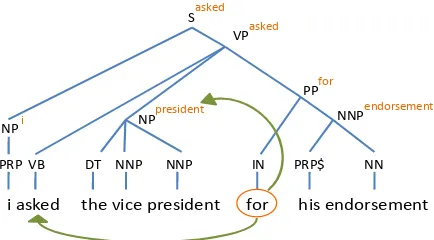
Figure 1: Example of asyntactically distant position in
a sentence: the exposed headwords precedingfor are
h.w−2 =askedandh.w−1 =president, while the
two preceding words are wi−2 = vice and wi−1 =
president.
as follows,
M={j|positions s.th.w−1, h.w−2 =wj−1, wj−2}
N ={j|positions s.th.w−1, h.w−2 6=wj−1, wj−2}
Here,h−1 andh−2 correspond, respectively, to the
two previousexposed headwordsat positioni, based on the syntactic structure. Therefore, M corre-sponds to the positions in the test data for which two previousexposed headsmatch exactly the two previ-ous words. Whereas,N corresponds to the position where at least on of theexposed headsis further back in the history than the two previous words, possibly both.
To extract the exposed headwords at each posi-tion, we use a constituent parser to obtain the syn-tactic structure of a sentence followed byheadword percolationprocedure to get the headwords of cor-responding syntactic phrases in the parse tree. The following method, described in (Kuo et al., 2009), is then used to extract exposed headwords from the history of position i from the full-sentence parse trees:
1. Start at the leaf corresponding to the word posi-tion (wi) and the leaf corresponding to the pre-vious context word (wi−1).
2. From each leaf, go up the tree until the two paths meet at the lowest common ancestor (LCA).
3. Cut the link between the LCA and the child that is along the path from the context wordwi−1.
The head word of the the LCA child, the one that is cut, is chosen as previous exposed head-wordh.w−1.
These steps may be illustrated using the parse tree shown in Figure 1. Let us show the procedure for our example from Section 2. Figure 1 shows the cor-responding parse tree of our example. Considering word positionwi=forandwi−1=presidentand
applying the above procedure, the LCA is the node
VPasked. Now, by cutting the link fromVPaskedto NPpresident the word president is obtained as
the first exposed headword (h.w−1).
After the first previous exposed headword has been extracted, the second exposed headword also can be obtained using the same procedure, with the constraint that the node corresponding the sec-ond headword is different from the first (Kuo et al., 2009). More precisely,
1. setk= 2
2. Apply the above headword extraction method betweenwiandwi−k.
3. if the extracted headword has previously been chosen, setk=k+ 1and go to step(2).
4. Otherwise, return the headword ash.w−2.
Continuing with the example of Figure 1, after
president is chosen as h.w−1, asked is
cho-sen ash.w−2 of position forby applying the
pro-cedure above. Therefore, in this example the po-sition corresponding to word for belongs to the set N as the two extracted exposed headwords
(asked,president) are different from the two
previous context words (vice,president). After identifying setsN andMin our test data, we measure perplexity of n-gram LMs on N, M
andN ∪ Mseparately. That is,
PPLN ∪M = exp
"
−
P
i∈N ∪Mlogp(wi|Wii−−1n+1)
|N ∪ M|
#
PPLN = exp
"
−X
i∈N
logp(wi|Wii−−1n+1)
|N |
#
PPLM = exp
"
−X
i∈M
logp(wi|Wii−−1n+1)
|M|
#
where p(wi|wi−1wi−2· · ·wi−n+1) is the
condi-tional probability calculated by an n-gram LM at position i and|.| is the size (in number of words) of the corresponding portion of the test.
In addition, to show the performance of n-gram LMs as a function of training data size, we train different n-gram LMs on 10%,20%,· · ·,100% of a large corpus of text and report the PPL numbers us-ing each trained LM with different trainus-ing data size. For all sizes less than 100%, we select 10 random subset of the training corpus of the required size, and report the average perplexity of 10n-gram models. This will enable us to observe the improvement of then-gram LMs on as we increase the training data size. The idea is to test the hypothesis that not only is there significant gap between predictive power of then-gram LMs on setsN andM, but also that this difference does not diminish by adding more train-ing data. In other words, we want to show that the problem is not due to lack of robust estimation of the model parameters but due to the fact that the in-cluded features in the model (n-grams) are not in-formativeenough for the positionsN.
3.2 Setup
The n-gram LMs are built on 400M words from various Broadcast News (BN) data sources includ-ing (Chen et al., 2006): 1996 CSR Hub4 Language Model data, EARS BN03 closed captions, GALE Phase 2 Distillation GNG Evaluation Supplemen-tal Multilingual data, Hub4 acoustic model training scripts (corresponding to the 300 Hrs), TDT4 closed captions, TDT4 newswire, GALE Broadcast Con-versations, and GALE Broadcast News. All the LMs are trained using modified Kneser-Ney smoothing. To build the LMs, we sample from each source and build a source specific LM on the sampled data. The final LMs are then built by interpolating those LMs. Also, we do not apply any pruning to the trained LMs, a step that is often necessary for speech recog-nition but not so for perplexity measurement. The test set consists of the NIST rt04 evaluation data set, dev04f evaluation set, and rt03 evaluation set. The test data includes about70Kwords.
We use the parser of (Huang and Harper, 2009), which achieves state-of-the-art performance on broadcast news data, to identify the word poisons that belong toN andM, as was described in
Sec-tion 3.1. The parser is trained on the Broadcast News treebank from Ontonotes (Weischedel et al., 2008) and the WSJ Penn Treebank (Marcus et al., 1993) along with self-training on 1996 Hub4 CSR (Garo-folo et al., 1996) utterances.
3.3 Analysis
We found that |N ∪M||N | ≈ 0.25 in our test data. In other words, two previous exposed headwords go beyond 2-gram history for about 25% of the test data.
!"# $%# $"# &%# &"# '%%#
'%# (%# )%# *%# "%# +%# !%# $%# &%# '%%#
,-./0
1-#2
23
#45
6#
78/9:9:;#</=/#>9?-#456#
@AB# @# B#
(a)
!"# $%# $"# &%# &"# '%# '"# (%%#
(%# )%# *%# +%# "%# !%# $%# &%# '%# (%%#
,-./0
1-#2
23
#45
6#
78/9:9:;#</=/#>9?-#456#
@AB# @# B#
[image:4.612.315.537.217.472.2](b)
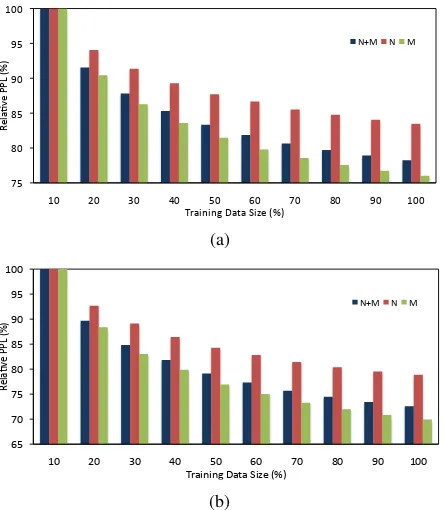
Figure 2: Reduction in perplexity with increasing training data size on the entire test setN+M, on itssyntactically localsubsetM, and thesyntactically distant subsetN. The figure shows relative perplexity instead of absolute perplexity — 100% being the perplexity for the smallest training set size — so that (a)3-gram and (b)4-gram LMs may be directly compared.
We train 3-gram and 4-gram LMs on
10%,20%,· · ·,100% of the BN training data, where each 10% increase corresponds to about
40M words of training text data. Figure 2 shows reduction in perplexity with increasing training data size on the entire test setN+M, on itssyntactically localsubsetM, and thesyntactically distantsubset
Position Training Data Size
in 40M words 400M words
Test Set 3-gram 4-gram 3-gram 4-gram
M 166 153 126 107
N 228 217 191 171
N +M 183 170 143 123
P P LN
[image:5.612.73.298.54.156.2]P P LM 138% 142% 151% 161%
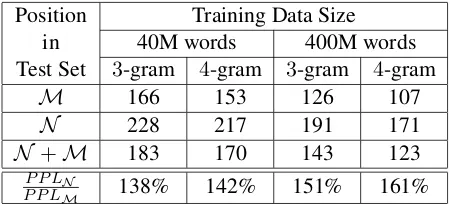
Table 1: Perplexity of3-gram and4-gram LMs on
syntac-tically local(M) andsyntactically distant(N) positions in the test set for different training data sizes, showing the sustained higher perplexity in distant v/s local positions.
perplexity for the smallest training set size — so the rate of improvement for 3-grams and 4-gram LMs can be compared. As can be seen from Figure 2, there is a substantial gap between the improvement rate of perplexity in syntactically distant positions compared to that in syntactically local positions (with 400M woods of training data, this gap is about
10% for both 3-gram and 4-gram LMs). In other words, increasing the training data size has much more effect on improving the predictive power of the model for the positions included inM. Also, by comparing Figure 2(a) to 2(b) one can observe that the gap is not overcome by increasing the context length (using4-gram features).
Also, to better illustrate the performance of then -gram LMs for different portions of our test data, we report the absolute values of PPL results in Table 1. It can be seen that there exits a significant difference between perplexity of sets N and M and that the difference gets larger as we increase the training data size.
4 Dependency Language Models
To overcome the lack of predictive power ofn-gram LMs in syntactically-distant positions, we use the SLM framework to build a long-span LM. Our hope is to show not only that long range syntactic depen-dencies improve overn-gram features, but also that the improvement is largely due to better predictive power in the syntactically distant positionsN.
Syntactic information may be encoded in terms of headwords and headtags of phrases, which may be extracted from a syntactic analysis of a sen-tence (Chelba and Jelinek, 2000; Kuo et al., 2009),
such as a dependency structure. A dependency in a sentence holds between adependent(ormodifier) word and ahead(orgovernor) word: the dependent dependson the head. These relations are encoded in adependency tree(Figure 3), a directed graph where each edge (arc) encodes a head-dependent relation.
The specific parser used to obtain the syntactic structure is not important to our investigation. What is crucial, however, is that the parser proceeds left-to-right, and only hypothesized structures based on
w1, . . . , wi−1are used by the SLM to predictwi.
Similarly, the specific features used by the parser are also not important: more noteworthy is that the SLM uses (h.w−3, h.w−2, h.w−1) and their POS
tags to predict wi. The question is whether this yields lower perplexity than predicting wi from
(wi−3, wi−2, wi−1).
For the sake of completeness, we next describe the parser and SLM in some detail, but either may be skipped without loss of continuity.
The Parser: We use the shift-reduce
incremen-tal dependency parser of (Sagae and Tsujii, 2007), which constructs a tree from a transition sequence governed by a maximum-entropy classifier. Shift-reduce parsing places input words into a queue Q
and partially built structures are organized by a stack
S. Shift and reduce actions consume the queue and build the output parse on the stack. The classi-fier g assigns probabilities to each action, and the probability of a statepg(π) can be computed as the product of the probabilities of a sequence of ac-tions that resulted in the state. The parser therefore provides (multiple) syntactic analyses of the history
w1, . . . , wi−1at each word positionwi.
The Dependency Language Model: Parser states
at position wi, called history-states, are denoted
Π−i = {π−0i, π−1i· · ·, π Ki
−i}, where Ki is the total number of such states. GivenΠ−i, the probability assignment forwi is given by
p(wi|W−i) =
|Π−i|
X
j=1
pwi|f(πj−i)
pg(π−ji|W−i) (1)
where, W−i is the word history w1, . . . , wi−1 for
wi, π−ji is the jth history-state of position i,
step action stack queue
i asked the vice president ...
-0
asked the vice president ... shift
1 i
the vice president for ... shift
2 i asked
the vice president for ... left-reduce
3 asked
i
for his endorsement ... shift
6 asked the vice president i
for his endorsement ... left-reduce
7 asked the president i vice
<s> i asked the vice president for his endorsement
Thursday, March 29, 12
for his endorsement ... left-reduce
8 asked president
i the vice
for his endorsement ... right-reduce
9 asked
i
vice the
president
Thursday, March 29, 12
step action stack queue
i asked the vice president ...
-0
asked the vice president ... shift
1 i
the vice president for ... shift
2 i asked
the vice president for ... left-reduce
3 asked
i
for his endorsement ... shift
6 asked the vice president i
for his endorsement ... left-reduce
7 asked the president i vice
<s> i asked the vice president for his endorsement
Thursday, March 29, 12
[image:6.612.73.299.56.192.2]Tuesday, April 3, 12
Figure 3: Actions of a shift-reduce parser to produce
the dependency structure (up to the wordpresident)
shown above.
the parser, andf(πj−i)denotes an equivalence clas-sification of the parser history-state, capturing fea-tures fromπ−jithat are useful for predictingwi.
We restrictf(π)to be based on only the heads of the partial trees{s0s1 · · · }in the stack. For
exam-ple, in Figure 3, one possible parser state for pre-dicting the wordforis the entire stack shown after step 8, but we restrict f(·) to depend only on the headwordsasked/VBandpresident/NNP.
Given a choice of f(·), the parameters of the modelp(wi|f(π−ji))are estimated to maximize the log-likelihood of the training data T using the Baum-Welch algorithm (Baum, 1972), and the re-sulting estimate is denotedpML(wi|f(πj−i)).
The estimate pML(w|f(·)) must be smoothed to
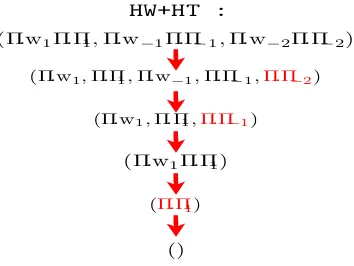
handle unseen events, which we do using the method of Jelinek and Mercer (1980). We use a fine-to-coarse hierarchy of features of the history-state as illustrated in Figure 4. With
fM(π−i) → fM−1(π−i) → . . . → f1(π−i)
denoting the set of M increasingly coarser equiv-alence classifications of the history-state π−i,
we linearly interpolate the higher order esti-matespML w|fm(π−i)
with lower order estimates
pML w|fm−1(π−i)
as
pJM(wi|fm(π−i))
= λfmpML(wi|fm(π−i))
+(1−λfm)pJM(wi|fm−1(π−i)),
for 1 ≤ m ≤ M, where the 0-th order model
pJM(wi|f0(π−i))is a uniform distribution.
HW+HT :
(h.w0h.t0,h.w 1h.t 1,h.w 2h.t 2)
(h.w0h.t0)
()
(h.w0,h.t0,h.w 1,h.t 1,h.t 2)
(h.w0,h.t0,h.t 1)
(h.t0)
[image:6.612.338.515.63.196.2]Saturday, April 14, 12
Figure 4: The hierarchal scheme of fine-to-coarse con-texts used for Jelinek-Mercer smoothing in the SLM.
The coefficientsλfm(π−i)are estimated on a
held-out set using the bucketing algorithm suggested by Bahl (1983), which ties λfm(π−i)’s based on the
count offm(π−i)’s in the training data. We use the expected count of the features from the last iteration of EM training, since theπ−iare latent states.
We perform the bucketing algorithm for each level
f1, f2,· · ·, fM of equivalence classification sepa-rately, and estimate the bucketed λc(fm) using the
Baum-Welch algorithm (Baum, 1972) to maximize the likelihood of held out data, where the word prob-ability assignment in Eq. 1 is replaced with:
p(wi|W−i) =
|Πi|
X
j=1
pJM
wi|fM(π−ji)
pg(π−ji|W−i).
The hierarchy shown in Figure 4 is used1for obtain-ing a smooth estimatepJM(·|·)at each level.
5 SLM Experiments
We train a dependency SLM for two different tasks, namelyBroadcast News(BN) andWall Street Jour-nal (WSJ). Unlike Section 3.2, where we swept through multiple training sets of multiple sizes,
training the SLM is computationally intensive. Yet, useful insights may be gained from the40M word case. So we choose the source of textmost suitable for each task, and proceed as follows.
5.1 Setup
The following summarizes the setup for each task:
• BN setup : EARS BN03 corpus, which has
about 42M words serves as our training text. We also use rt04 (45Kwords) as our evaluation data. Finally, to interpolate our structured lan-guage models with the baseline4-gram model, we use rt03+dev04f (about40Kwords) data sets to serve as our development set. The vocabulary we use in BN experiments has about84Kwords.
• WSJsetup: The training text consists of about
37M words. We use eval92+eval93 (10K
words) as our evaluation set and dev93 (9K
words) serves as our development set for inter-polating SLMs with the baseline4-gram model.
In both cases, we sample about20Ksentences from the training text (we exclude them from training data) to serve as our heldout data for applying the bucketing algorithm and estimating λ’s. To apply the dependency parser, all the data sets are first converted to Treebank-style tokenization and POS-tagged using the tagger of (Tsuruoka et al., 2011)2. Both the POS-tagger and the shift-reduce depen-dency parser are trained on the Broadcast News tree-bank from Ontonotes (Weischedel et al., 2008) and the WSJ Penn Treebank (after converting them to dependency trees) which consists of about1.2M to-kens. Finally, we train a modified kneser-ney4-gram LM on the tokenized training text to serve as our baseline LM, for both experiments.
5.2 Results and Analysis
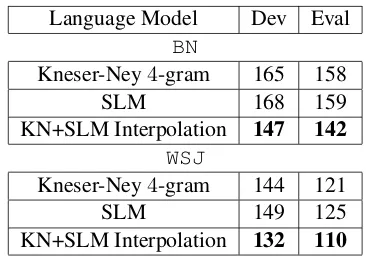
Table 2 shows the perplexity results forBNandWSJ
experiments, respectively. It is evident that the 4 -gram baseline forBNis stronger than the40M case of Table 1. Yet, the interpolated SLM significantly improves over the4-gram LM, as it does forWSJ.
2
To make sure we have a proper LM, the POS-tagger and dependency parser only use features from history to tag a word position and produce the dependency structure. All lookahead features used in (Tsuruoka et al., 2011) and (Sagae and Tsujii,
Language Model Dev Eval
BN
Kneser-Ney4-gram 165 158
SLM 168 159
KN+SLM Interpolation 147 142
WSJ
Kneser-Ney4-gram 144 121
SLM 149 125
[image:7.612.334.517.52.180.2]KN+SLM Interpolation 132 110
Table 2: Test set perplexities for different LMs on theBN
andWSJtasks.
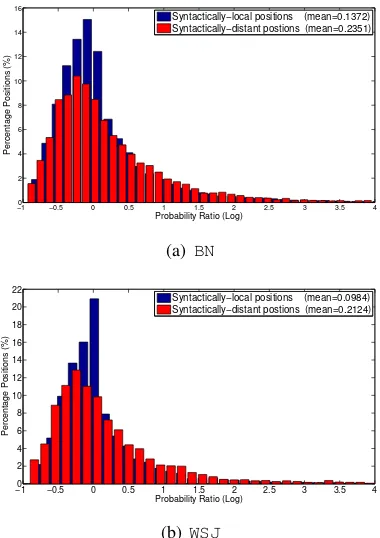
Also, to show that, in fact, the syntactic depen-dencies modeled through the SLM parameterization is enhancing predictive power of the LM in the prob-lematic regions, i.e. syntactically-distantpositions, we calculate the following (log) probability ratio for each position in the test data,
logpKN+SLM(wi|W−i)
pKN(wi|W−i)
, (2)
where pKN+SLM is the word probability
assign-ment of the interpolated SLM at each position, and
pKN(wi)is the probability assigned by the baseline
4-gram model. The quantity above measures the im-provement (or degradation) gained as a result of us-ing the SLM parameterization3.
Figures 5(a) and 5(b) illustrate the histogram of the above probability ratio for all the word positions in evaluation data ofBNandWSJtasks, respectively. In these figures the histograms for syntactically-distantandsyntactically-localare shown separately to measure the effect of the SLM for either of the position types. It can be observed in the figures that for both tasks the percentage of positions with
logpKN+SLM(wi|W−i)
pKN(wi|W−i) around zero is much higher for
syntactically-local(blue bars) than the syntactically-distant (red bars). To confirm this, we calculate the averagelogpKN+SLM(wi|W−i)
pKN(wi|W−i) —this is the
aver-age log-likelihood improvement, which is directly
2007) are excluded. 3
IflogpKN+SLM(wi|W−i)
pKN(wi|W−i) is greater than zero, then the SLM
−1 −0.5 0 0.5 1 1.5 2 2.5 3 3.5 4 0
2 4 6 8 10 12 14 16
Probability Ratio (Log)
Percentage Positions (%)
Syntactically−local positions (mean=0.1372) Syntactically−distant postions (mean=0.2351)
(a)BN
−10 −0.5 0 0.5 1 1.5 2 2.5 3 3.5 4 2
4 6 8 10 12 14 16 18 20 22
Probability Ratio (Log)
Percentage Positions (%)
Syntactically−local positions (mean=0.0984) Syntactically−distant postions (mean=0.2124)
[image:8.612.321.532.53.218.2](b) WSJ
Figure 5: Probability ratio histogram of SLM to 4-gram
model for (a)BNtask (b)WSJtask.
related to perplexity improvement— for each posi-tion type in the figures.
Table 3, reports the perplexity performance of each LM (baseline 4-gram, SLM and interpolated SLM) on different positions of the evaluation data forBNandWSJ tasks. As it can be observed from this table, the use of long-span dependencies in the SLM partially fills the gap between the performance of the baseline4-gram LM onsyntactically-distant positionsN versussyntactically-localpositionsM. In addition, it can be seen that the SLM by itself fills the gap substantially, however, due to its under-lying parameterization which is based on Jelinek-Mercer smoothing it has a worse performance on regularsyntactically-localpositions (which account for the majority of the positions) compared to the Kneser-Ney smoothed LM4. Therefore, to improve the overall performance, the interpolated SLM takes advantage of both the better modeling performance of Kneser-Ney forsyntactically-localpositions and
4This is merely due to the superior modeling power and better smoothing of the Kneser-Ney LM (Chen and Goodman, 1998).
Test Set 4-gram SLM 4-gram + SLM
Position BN
M 146 152 132
N 201 182 171
N +M 158 159 142
P P LN
P P LM 138% 120% 129% WSJ
M 114 120 105
N 152 141 131
N +M 121 125 110
P P LN
[image:8.612.90.280.60.329.2]P P LM 133% 117% 125%
Table 3: Perplexity on theBNandWSJevaluation sets for
the4-gram LM, SLM and their interpolation. The SLM
has lower perplexity than the4-gram insyntactically
dis-tantpositionsN, and has a smaller discrepancy P P LN
P P LM between preplexity on the distant and local predictions,
complementing the4-gram model.
the better features included in the SLM for improv-ing predictive power on syntactically-distant posi-tions.
6 Conclusion
The results of Table 1 and Figure 2 suggest that predicting the next word is about 50% more diffi-cult when its syntactic dependence on the history reaches beyond n-gram range. They also suggest that this difficulty does not diminish with increas-ing trainincreas-ing data size. If anythincreas-ing, the relative diffi-culty of word positions with nonlocal dependencies relative to those with local dependencies appears to increase with increasing training data and n-gram order. Finally, it appears that language models that exploit long-distance syntactic dependencies explic-itly at positions where then-gram is least effective are beneficial as complementary models.
Tables 2 and 3 demonstrates that a particular, recently-proposed SLM with such properties im-proves a4-gram LM trained on a large corpus.
Acknowledgments
References
LR Bahl. 1983. A maximum likelihood approach to
continuous speech recognition. IEEE Transactions
on Pattern Analysis and Machine Inteligence (PAMI), 5(2):179–190.
L. E. Baum. 1972. An equality and associated maxi-mization technique in statistical estimation for
proba-bilistic functions of Markov processes. Inequalities,
3:1–8.
C. Chelba and F. Jelinek. 2000. Structured
lan-guage modeling. Computer Speech and Language,
14(4):283–332.
SF Chen and J Goodman. 1998. An empirical study of smoothing techniques for language modeling. Techni-cal report, Computer Science Group, Harvard Univer-sity.
S. Chen, B. Kingsbury, L. Mangu, D. Povey, G. Saon, H. Soltau, and G. Zweig. 2006. Advances in speech transcription at IBM under the DARPA EARS
pro-gram. IEEE Transactions on Audio, Speech and
Lan-guage Processing, pages 1596–1608.
M Collins, B Roark, and M Saraclar. 2005. Discrimina-tive syntactic language modeling for speech recogni-tion. InACL.
Ahmad Emami and Frederick Jelinek. 2005. A
Neu-ral Syntactic Language Model. Machine learning,
60:195–227.
Denis Filimonov and Mary Harper. 2009. A joint
language model with fine-grain syntactic tags. In
EMNLP.
John Garofolo, Jonathan Fiscus, William Fisher, and
David Pallett, 1996. CSR-IV HUB4. Linguistic Data
Consortium, Philadelphia.
Zhongqiang Huang and Mary Harper. 2009.
Self-Training PCFG grammars with latent annotations
across languages. InEMNLP.
Frederick Jelinek and Robert L. Mercer. 1980. Inter-polated estimation of Markov source parameters from
sparse data. InProceedings of the Workshop on
Pat-tern Recognition in Practice, pages 381–397.
S. Khudanpur and J. Wu. 2000. Maximum entropy tech-niques for exploiting syntactic, semantic and
colloca-tional dependencies in language modeling. Computer
Speech and Language, pages 355–372.
H. K. J. Kuo, L. Mangu, A. Emami, I. Zitouni, and L. Young-Suk. 2009. Syntactic features for Arabic
speech recognition. InProc. ASRU.
M.P. Marcus, M.A. Marcinkiewicz, and B. Santorini.
1993. Building a large annotated corpus of
En-glish: The Penn Treebank. Computational Linguistics,
19(2):330.
Ariya Rastrow, Mark Dredze, and Sanjeev Khudanpur.
2011. Efficient discrimnative training of long-span
language models. In IEEE Workshop on Automatic
Speech Recognition and Understanding (ASRU).
K. Sagae and J. Tsujii. 2007. Dependency parsing
and domain adaptation with LR models and parser
en-sembles. InProc. EMNLP-CoNLL, volume 7, pages
1044–1050.
Yoshimasa Tsuruoka, Yusuke Miyao, and Jun’ichi
Kazama. 2011. Learning with Lookahead :
Can History-Based Models Rival Globally Optimized
Models ? InProc. CoNLL, number June, pages 238–
246.
Ralph Weischedel, Sameer Pradhan, Lance Ramshaw, Martha Palmer, Nianwen Xue, Mitchell Marcus, Ann Taylor, Craig Greenberg, Eduard Hovy, Robert Belvin,
and Ann Houston, 2008.OntoNotes Release 2.0.
Lin-guistic Data Consortium, Philadelphia.
Imed Zitouni. 2007. Backoff hierarchical class
n-gram language models: effectiveness to model unseen
events in speech recognition. Computer Speech &