INHERITANCE IN TOMATOES'
E. W. LINDSTRORI Iowa State College, Anies, Iowa
Received February 6, 192.5
TABLE OF CONTENTS
PAGE
. . . 305
Genetic relations. . . 307
Stature and skin structure.-Dd P p factors. . . 307
Stature and flesh color,-Dd Rr factors.. . . 309
Stature and skin color,-Dd Yy factors.. . . 309
Flesh color and skin color,-Rr Yy factors.. . . 310
Flesh color and skin structure,-Rr P p factors. . . 312
Skin color and skin structure,--Yy P p factors. . . 313
Tests for differential fertilization or pollen-tube growth. . . 314
Linkage groups in the tomato.. . . 315
SUMMARY . . . 316 LITERATURE CITED. . . . 31 7
INTRODUCTION
I n connection with my experimental work on size inheritance in the tomato (Lycopersicum escu1entum)I have accumulated considerable genetic data on fruit characteristics and stature of plant. As these observations have an important bearing on the linkage situation in this species, it seems advisable to report them, especially since critical data have not yet been published. Because the tomato is so well adapted for a study of size inheritance it becomes imperative that the heredity of the simpler qualitative characters of this plant be thoroughly understood before the more complex problems of quantitative inheritance are attacked.
The varieties of tomatoes that I chose for work with size possessed qualitative characters, which may be described as follows :
Flesh color: Red
(R)
dominant over yellow ( r ) . GeneR
governs the formation of red needle-shaped crystals occurring within the cells of the mature fruit, while r produces the yellow granular color bodies. DUGGAR(1913) has named the red pigment produced by
R,
lycopersicin, replacing 'Paper No. 5 , Department of Genetics, IOWA STATE COLLEGE, Ames, Iowa. Mr. W. A. CARVER, graduate student in genetics, assisted in making the pollinations and in recording field notes.the term lycopin previously used by SCHUXCK (1903) and W I L L S T ~ T T E R and ESCHER (1910).
Skin color: Yellow ( Y ) dominant over colorless ( y ) . Gene Y produces a distinct, yellow pigment suffused throughout the cell walls of the epi- dermis of the fruit, whereas its allelomorph, y , produces a transparent or colorless condition in these epidermal walls.
Skin structure: Smooth (P) dominant over “peach”
( p ) .
Gene P is responsible for the ordinary smooth, shiny texture of the epidermis of the fruit. Such fruits also lack an appreciable amount of pubescence. Genep
gives a distinct pubescence on the mature fruit. The general structure of the epidermis is also changed so as to give a dull appearance to the fruit. The effect of these genes is perhaps analogous to the situation found in the nectarine and peach-tree fruits.Stature: Tall (D) dominant over dwarf i d ) . I n addition to the greater length of Flant, the D factor produces a less-wrinkled type of leaf than does
the d factor. The foliage of a dwarf plant is distinctly rugose and is much darker green in color than is the standard type.
The inheritance of each of the four pairs of characters may be explained on a single-factor basis. They are relatively easy of classification. The dominance in each case is practically complete. Notes have been taken on other characteristics, such as foliage color (dark and light green) and type of leaf, but the classification was found rather uncertain, and for this reason these characters have not been included.
Commercial varieties of tomatoes inbred one year were used as the source of material. The following is a list of such varieties together with their abbreviations and genetic formulae with respect to the four charac- teristics noted above:
Variety
Ked Cherry (RC) Bonny Best (BB) New Globe (NG)
Ponderosa (P) Yellow Cherry (YC)
Yellow Plum (YPl) Yellow Peach (UP) Red Peach (RP) Golden Beauty (GB)
Dwarf Giant (DG)
Condi/ution
R R I’F PP D D
R R PE’ PP DD
RR yy PP DD
RR y y PP DD
r r Y Y PP D D
rr Y Y PP DD
rr yy PP D D
IZR y y PP D D
rr y? PP D D X R YE’ PP dd
These varieties have been crossed, with the necessary precautions
INHERITANCE I N TOMATOES 307
Earlier investigations have shown that three of the four pairs of genetic factors controlling the above characteristics may be interpreted as in- volving a simple, monohybrid situation (CRAIG 1907; GILBERT 1912; HALSTED 1905;
HEDRICK
and BOOTH 1907). Apparently but little critical data have been published concerning the inheritance of the “peach” type of fruit (PRICE and DRINKARD 1908), but this characterI
find to be asimple recessive to the smooth or non-pubescent type, characteristic of most of the commercial varieties..
A s far as I have been able to ascertain, the linkage relations, of these factors have nat been investigated to any extent. JONES (1917) has listed a few cases of linked inheritance in the tomato, from data reported b y other investigators, but in these linkages one of the characters involved has been of a quantitative nature, the mode of heredity of which is still unknown.
GENETIC RELATIONS
Stature and skin structure,-Dd Pp factors
Complete linkage exists between the Dd (tallness versus dwarfness) and the P p (smooth versus peach skin) pairs of factors. This
I
observed clearly in the F2 generation of the cross Dwarf Giant (dd P P ) XYellow Peach(DD
p p ) .
Seed from the F1 generation, which was tall in stature and bore smooth or non-pubescent ,fruit, gave in the F2 the following distribution among a total of 209 plants: ‘101 tall smooth : 56 tall peach : 52 dwarf smooth : 0 dwarf peach. No double-recessive pIants (ddp p )
appeared. Afew of the dwarf F2 plants were tested in the FS generation and all bred true to the smooth type of fruit as well as t o dwarfness, indicating that the dwarf-peach combination does not appear a t
Such data obviously are characteristic of complete linkage. The approxi- mation to the 2 : 1 : 1 ratio typical of such a situation is ‘extremely
In one later F3 progeny from an open-pollinated dwarf smooth Fz plant, two distinct peach (pubescent) dwarfs appeared among five plants. On the complete-linkage hypothesis these could scarcely have occurred by pollen contamination, since the mother plants were presumably homozygous dP.dP. The only obvious explanation is that of mutation from d P . d P to dP.dp in the F2 plant, whereby the peach type would appear in Fa as a recessive segregate. That such mutations of pubescence occur is not uncommon, especially in the case of the nectarine and the peach-tree fruits. I have also observed in the tomato that in FZ and Fa generations ihvolving the smooth and peach types, considerable variation in the degree of pubescence occurs. I n some cases I have seen in the same fruit-cluster of an F2or F3 peach type, a relatively smooth fruit a t
maturity. Some of these variations are now being investigated.
The quadruple recessive type, rryyppdd, which I have just developed from the plants noted above, has been crossed with the tetrahybrid condition, Rr Y y P p D d , and should give some critical data on the P-D linkage.
close, the deviations from the calculated proportion of 10.5 : 52 : 52 being only 4 : 4 : 0, respectively.
An interesting verification of the complete-linkage theory was afforded by some F3 seedling progeny tests. Ten F, progenies from tall-peach
type F2 plants all bred true for the tall character. Of ten F3 progenies
grown from tall-smooth type
Fz
plants, none bred true for tallness, all segregated for dwarfs. I n other words, one can predict which of the F,progenies, arising from the dominant tall Fz plants, will breed true for tallness by the type of skin structure of the mother plants. The F, pro- genies from dwarf-smooth F2 plants, ten in number, all bred true for dwarfness. These facts are in full accord with the expectation if D and
P
are considered as being completely linked in inheritance.
This situation is perhaps known in the commercial world, since there are no dwarf varieties recorded with “peach” skin. GROTH (1910) noted this phenomenon in the days before genetic linkages were understood.
I n a n y case of complete linkage it becomes of interest to speculate whether the situation really is one in which two different pairs of genetic factors are actually correlated in inheritance because they are borne on the same chromosome, or whether there is fundamentally only one pair of factors with a third allelomorph concerned. On the basis of complete linkage, the following three genotypes only are expected in the F2 genera- tion :
1 Dp
.
Dp,-tall peach 2 Dp.
0 , - t a l l smooth1 d P
.
dP,---dwarf smoothThis situation accounts for the experimental facts very well.
INHERITANCE I N TOMATOES 309
reason for any physiological incompatibility between dwarfness and the peach type of fruit.
Accordingly, complete linkage of two different factor pairs seems t o present the simpler and more reasonable explanation of the inheritance of these characters.
Stature and $esh color,-Dd R r factors
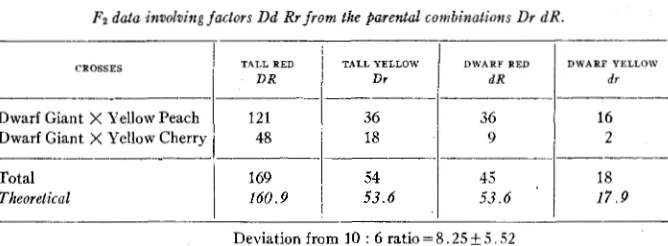
These factors are inherited independently of each other. The F2 data
of the crosses, Dwarf Giant (dd RR) XYellow Peach ( D D r r ) , and Dwarf Giant X Yellow Cherry ( D D r r ) , demonstrating this, have been arranged in table 1. There is not sufficient deviation from the 9 : 3 : 3 : 1 ratio in
TABLE 1
FZ data knvoloing factors Dd Rr from the parental combinations Dr dR.
CROSSES
Dwarf Giant X Yellow Peach Dwarf Giant X Yellow Cherry
Total Theoretical
TALL RED TALL YELLOW
D R
121
2 9
18 48
16 36
36
__________________
169 54
17.9 53.6
160.9
I
53.618
45 ,
Deviation from 10 : 6 ratio = 8.25 5.52
these hybrid generations to justify any suspicion of linkage. When the parental classes (Dr and dR) are grouped against the non-parental classes
(187 : 99) the conclusion that D and R are independently inherited be- comes obvious, since the deviation from the 10 : 6 ratio in this case is only about 1.5 times as large as the probable error.
Stature and skin color,-Dd Y y factors
Dwarfness is also inherited independently of skin color. Proof for this is afforded by the F, generation of the cross, Dwarf Giant (dd Y Y ) X
Yellow Peach ( D D y y ) . From a total of 209 F P plants the following results were obtained:
123 tall yellow-skin ( D Y ) : 34 tall colorless-skin ( D y ) : 37 dwarf yellow- skin ( d Y ) : 15 dwarf colorless-skin ( d y ) .
The theoretical expectancy on a 9 : 3 : 3 : 1 basis is 118 : 39 : 39 : 13. Obviously, the agreement is so close that factors D and Y must be inde- pendently inherited.
310 E. K . LINDSTROM
Flesh color and skin color,-Rr Y y factors
These factors are responsible for the actual color of the tomato fruit (HURST 1906). Their four different combinations produce the following well-known colors:
R Y , orange red (due to red flesh showing through yellow skin) Ry, red (the pink or purple of commerce)
r Y , dark yellow r y , pale yellow
I have experienced no real difficulty in classifying mature tomato fruit colors on this basis, despite the fact that occasionally a yellow-fleshed fruit will show a faint red blush at the distal end.
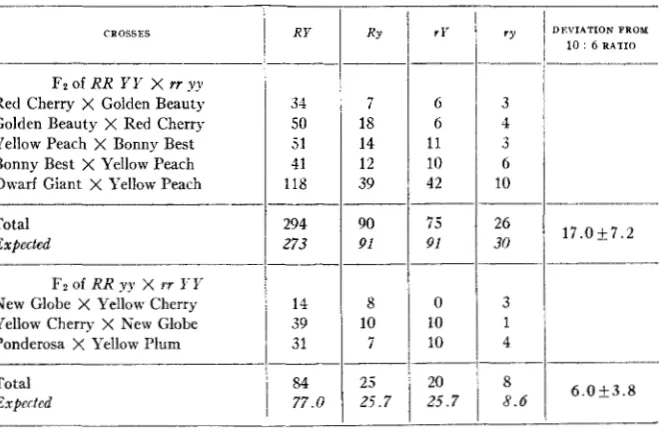
Data from Fz and backcross generations involving both the "coupling" and "repulsion" phases of linkage are available and have been arranged in tables 2 and 3 .
TABLE 2
Fruit color in FP gentrutions id s a r i o m tomato c r o s e s involwing j e s h and skitt colors.
CROSSES RY
""
F2 of RR Y Y X rr yy
___ "
Red Cherry X Golden Beauty 34 7
Golden Beauty X Red Cherry 50 18 Yellow Peach X Bonny Best 51 14 Bonny Best X Yellow Peach 41 12
Dwarf Giant X Yellow Peach 118 39
Total 294 90
Expected 273 91
-____-
"
FI of RR yy X W I-Ii
_ _ _ _ _ _ _
New Glohe X Yellow Cherry 14 8 Yellow Cherry X New Glohe 39 10
Ponderosa X Yellow Plum 31 7
Total
1
84 25Expertcd
l 77.0 25.7
r Y
6
6 11
10
42
75
91
0 10 10
20
25.7
___- ry DEVIATION FROM
10 : 6 RATIO
3
4
3 6
10
30
26
17 . 0 + 7 . 2
~ . _ ^ _ _
-3
1
4
8
8.6 6 . 0 k 3 . 8
-
I n table 2 , which gives the F2 generations of five different crosses, there
is a n approximation to a dihybrid distribution with independent inheri-
tance. Where R and Y were contributed by the same parent, there resulted 294 orange-red : 90 red : 75 yellow : 26 pale yellow, when 273 : 91 : 91 : 30,
INHERITANCE I N TOMATOES 311
deviates from the 10 : 6 ratio of independent inheritance by 1 7 individuals, a deviation which is 2.4 times larger than its probable error, and might suggest linked inheritance. However, the excess of red-fleshed fruits is responsible in some measure for the large deviation.
Where
R
and y were contributed by the same parent the F2 distribution was 84 : 25 : 20 : 8, when 77 : 26 : 26 : 9, approximately, were to be expected. This gives 92 non-parental and 45 parental combinations where 86 and 51, respectively, are to be expected. I n this case the deviation of 6 is in the wrong direction to indicate any linkage.TABLE 3
Fruit color in backcross generations of varimls tomato crosses involvingjlesh and skin colors.
CROSSE5*
Coupling phase (RY X r y )
F1 (RC X GB) X YP F1 (GB X RC) X YP YP X F1 (GB X RC) F1 (GB X RC) X GB GB X F1 (GB X RC) F1 (YP X BB) X YP YP X F1 (YP X BB) F1 (YP X BB) X GB
F1 (BB X UP) X YP YP X F1 (BB X UP)
" ___"___
Total Expected -
Repulsion phase ( R y X r V )
"
FI (NG X YC) X YP F1 (NG X YC) X GB
F1 (YC X NG) X YP F1 (YC X NG) X GB
" Total Expedea - " " " " -
R P
-~
21 9 13 9 11 9 9 7 12 12 112 98 7 4 12 12 35 32 RY 9 13 13 3 9 9 1 1 9 8 9 93 98 14 5 14 5 38 321' r>*
______
5 8 1 1 11 9 6 618 12 13 19
6 4 9 9 6 8 8 10 9
93 94
98 98
___-
___-
7
7 6
5 8 2 9 12
30 26
32 32
" CROSSING PERCENT
OVER
I___-
4 7 . 4 k 1 . 7
4 7 . 3 k 3 . 0
* Abbreviations in Roman capital letters are variety names, RC being Red Cherry, etc.
The backcross generations of the same crosses, listed in table 3, offer some indications of a very loose linkage between
R
and Y . Both the ((coup- ling" and '(repulsion" phases of the situation show this. I n one case thereis 47.4f 1.7 percent and in the other 47.3 f3.0 percent crossing over. When, however, these crossover percentages are compared with their
probable errors, the deviations from 50 percent crossing over, characteristic of independent inheritance, fall within the, limits of error for inheritance upon an independent basis. T o test the actuality of such a loose linkage, much larger numbers are necessary. Undoubtedly, many investigators
have such data on hand and it is hoped that they will report them in the near future. I n view of the absence of linkage in one of the Fz generations, however, i t is reasonable to suppose that factors R and Y will be found to be inherited independently of each other.
Flesh color and s k i n structure,--Kr
Pp
fuctorsThe "peach" type of skin. which is completely linked with stature of plant, is apparently due to the effect of a single recessive gene, and this factor seems to be inherited independently of red and yellow flesh color governed by the Rr factor pair. Data supporting this conclusion are pro- vided by Fz and backcross generations of the crosses shown in tables 4 and S.
7' 2 B 1.E 1
F 2 dola i t ~ v o l o i t ~ g f ~ r t o r s Rr Pp, the parental c.ombimtious bci77g RI' u17d r p .
Ikviation from 10 : 6 ratio = 13.0 * 6 . 2
I A B L E 7 * .
1 " "
-
Crossing-over percentage = 51.4 i 2 .S
, I n table 4 the F2 generations derived from the crosses, Bonny Best X
Yellow Peach and Dwarf Giant X Yellow Peach, both crosses involving
INHERITANCE IN TOMATOES 313
9 : 3 : 3 : 1 ratio of independent inheritance. The parental classes total 210 and the non-parental 147, where 223 and 134, respectively, are to be expected. This shows a deviation of 13, which is only 2.1 times as large as its probable error.
The backcross data of the Bonny Best X Yellow Peach cross appearing in table 5 show conclusively that no linkage is present. I n this case the crossover percentage is calculated as 51.4k2.5 percent, indicating in- dependent inheritance between
R
and P. Such independent inheritance must follow, of course, sinceP
and D are completely linked, and D andl?
have been shown in a preceding section to be independent.
S k i n color and skin structure,-Yy P p factors
The "peach" characteristic is also transmitted independently of the skin-color factor pair,
Y y .
Here again F2 and backcross data from the same crosses are available as shown in tables 6 and 7. Both of these dis- tributions are, without doubt, in excellent agreement with the Fz, 9 : 3 : 3 : 1, and the backcross, 1 : 1 : 1 : 1, ratios. Accordingly, the genes Y andP
TABLE 6
Fe data involving Y y Pp factors, the parental combinations being E'P and y p .
CROSSES SMOOTH
Bonny Best X Yellow Peach 85 28 23 12
Dwarf Giant X Yellow Peach 118
Expected
I
20125 59
70 203
Total
13 36
42
67 67 22
" -
~
_
_
-Deviation from 10 : 6 ratio = 5.0 k 6 . 2 TABLE 7
Backcross data involving F y P p factors, the parental combinations being I'P and yp.
Y P
F1 (BB X UP) X YP
l
2120
YP X F1 (BB X UP) 23
17 24 28
23 23
CROSSES Y P YP TP
""
_____
"""_
- "" ""Total
L
Expected
40 47
48
I
44.75 44.75 44.75 44.75Crossing-over percentage = 5 3 . 1 2 . S
314 E. W. LINDSTROM
are not linked. This cross is a verification of the independent inheritance between
Y
and D, a situation which must follow ifD
andP
are completely linked.TESTS FOR DIFFERENTIAL FERTILIZATION OR POLLEN-TUBE GROWTH
A
fairly large series of backcrosses, made reciprocally, afford some information on whether or not there is in the tomato differential fertiliza- tion or pollen-tube growth. My data on this point involve the flesh colors,TABLE 8
L'wxtnury rf backcross data f c r comparison rf reciprcral backcrosses testing di.flrrcntiol .ferlili:tl/ion or tollen-tnbe gromth involving the genes Rr, Y y and Pp.
BACKCBOSSHS
" F1 as 0 parent
(YC X BB) X YC (YC X BB) X YP (GB X RC) X YC (RC X GB) X YP (GB X RC) X YP (GB X RC) X GB (UP X BB) X YP (BB X YP) X YP (UP X BB) X GB (NG X YC) X YP (YC X NG) X YP (YC X NG) X GB (NG X YC) X GB
Total observed
Expected
Percent observed
F, as c?' parent YC X (YC X BB) YC X (GB X RC)
YP X (GB X RC) GB X (GB X RC) YP X (UP X BB) YI' X (BB X UP) Total observed Expected Percent observed
-
R r
49 46
25 15
23 37
30 14
22 18
12 18
18 32
20 20
16 12
21 19
26 13
17 13
9 11
288 268
278 278
51 .S 48.2
-
38 30 30 30
26 14
20 10 20 30 21 19
l ss 133
144 144 53.8 46.2
I. 3'
26 18 19 21
18 12
28 22
21 19 13 15
14 26
20 19
18 12
13 7
190 171
180.5 180.5
52.6 47.4
21 19
15 15
21 29
23 l 7
80 80
80 80
50
.o
50.0P P
30 20
1 ~5 2 5
45 45
45 35
50.0 50.0
24 25
22 18
46 43
44.5 44.5 51.7 48.3
R
andv,
the skin colors, Y and y, and the skin-structure genes,P
andp .
INHERITANCE I N TOMATOES 315
f
is used as the pistillate parent with results when it is used as a staminate parent, it is possible to detect any excess of one character over another (see table S).With respect to the flesh color genes, Rr, it may be seen in table 8 that there is an excess of red-fruited plants in both series of backcrosses. When the ITI is used as the pollen parent there is 2.0 percent more red fruits
than when it is used as the ovule parent. This suggests that the pollen- tubes bearing the
R
gene are somewhat more effective in fertilization than those carrying the yellowr
factor. However, the deviation (1 1.0k
5.7) in this case is only twice as large as the probable error? and accordingly affords no indisputable proof of such differential action.With none of the other factors is there any significant difference in the two series of backcrosses. The numbers involved are somewhat meager, and reliance could not be placed on them save where unusually large differences existed.
LINKAGE GROUPS IN THE TOMATO
Heretofore, no critical data have been reported on genetic linkage in the tomato. It is true that
HEDRICK
and BOOTH (1907) suggested a corre- lation between fruit shape (pyriform) and theDd
factor pair, and JONES(1917) concurs in this idea. As far as
I
am aware, however, no one has yet proven that fruit shape in tomatoes can be resolved into simple genetic factors. My experience is that the heredity of fruit shape is relatively complex, and has as yet not been analyzed into its component parts. T o compute a crossing-over percentage for such a linkage is accordingly some- what premature.The same criticism applies to the linkage first reported by PRICE and
DRINKARD
(1908) and listed by JONES (1917), involving foliage color andnumber of locules in the fruit. Despite the frequent assertions or implica- tions that locule number is dependent upon a single pair of genes, I venture to suggest that this is not the case. I n my work, a t least, there are several different factors concerned. Because of the partial dominance of the two- loculed condition and the resulting skew curve in the F2 generation, there is a temptation to interpret this quantitative data on a single-factor basis. As far as I know no critical F3 tests have ever been reported to substantiate the claim of a one-factor basis for locule number.
CRANE (1915) reports a similar situation with respect to a correlation involving quantitative characters. He suggests that a linkage exists be- tween general fruit shape (not-pyriform) and certain types of inflorescence.
His data are meager, however, and he does not stress this relation, nor to my knowledge has it been followed up.
I n 1924, I reported a case in which the Yy pair of factors was apparently linked with a certain major factor for total size or weight of fruit. Since then I have verified this report with other crosses and have evidence to prove that this is a legitimate genetic linkage and not a physiological correlation. The size factors involved in this linkage are a partially
dominant factor for small size that is characteristic of the Cherry type of fruit, contrasted with a factor for large size contributed by the Golden Beauty variety. The Y gene is not necessarily linked with all size factors, but rather with certain ones characteristic of definite, pure varieties. I n fact, I have crosses in which the Yy factors are most certainly not linked with size factors brought in by some of the larger-fruited sorts. I n some of these crosses the RY factors show a decided linkage with size factors. Data on these linkages are forthcoming in a later publication.
If we dismiss temporarily these cases of linkage, because a t least some of the characters involved are as yet too complex to actually isolate the quantitative gene concerned, we are forced to the conclusion that linkage groups in the tomato are as yet rare. The complete linkage existing be- tween the Dd and Pp factors seems to be a legitimate case.
Accordingly, i t is worth recording that the following genetic factors in the tomato form the basis for three different linkage groups:
Group 1. Dd and Pp
Group 2. Rr Group 3. Yy
All the necessary tests have been made to demonstrate the truth of this situation with the exception of a rare possibility that K and Y are loosely linked. When we consider that the tomato has been reported as possessing twelve pairs of chromosomes i t is not surprising, of course, that more linkages have not been discovered.
SUMMART
1. Complete linkage exists between the Dd pair of genes controlling growth habit (tall versus dwarf) and the Pp pair responsible for skin structure (smooth versus “peach” type of fruit).
2. Genes Rr involved in flesh color (red versus yellow) are inherited independently of both Dd and P p .
3. The factors Yycontrolling skin color are undeniablyindependent of
INHERITANCE I N TOMATOES 317
4. These series of interrelations permit the establishment of three 5. Backcross data afforded some evidence of a slight differential provisional linkage groups in the tomato.
fertilization or pollen-tube growth involving the genes
R
and r .LITERATURE CITED
CRAIG, A. G., 1907 Mendel’s law applied to tomato breeding. Proc. Soc. Hort. Sci. 5: 24-27. CRANE, M. B., 1915 Heredity of types of inflorescence and fruits in tomato. Jour. Genetics DUGGAR, B. M., 1913 Lycopersicin, the red pigment of the tomato. Washington Univ. Studies GROTH, B. H. A., 1910 Structure of tomato skins. New Jersey Agric. Exp. Sta. Bull. 228. pp.
GILBERT, A. W., 1912 A Mendelian study of tomatoes. Proc. Amer. Breeders Assn. 7: 169-188.
HALSTED, B. D., 1905 Report of the botanist. New Jersey Agric. Exp. Sta. Rept. 1905: 423-525.
HEDRICK, U. P., and BOOTE, N. O., 1907 Mendelian characters in tomatoes. Proc. Soc. Hort. HIJRST, C. C., 1906 Mendelian characters in plants and animals. Rep. Third International
JONES, D. F., 1917 Linkage in Lycopersicum. Amer. Nat. 51: 608-621.
LINDSTROM, E. W., 1924 A genetic linkage between size and color factors in the tomato. Science
PRICE, H. L., and DRINKARD, A. W., 1908 Inheritance in tomato hybrids. Virginia Agric. SCHUNCK, C. A., 1903 The xanthophyll group of yellow coloring matters. Proc. Roy. Soc. WILLSTATTER, R., and ESCHER, H. H., 1910 uber der Farbstoff der Tomate. Zeit. f. physiol.
5: 1-11.
1: 22-45.
1-22.
Sci. 5: 19-24.
Conference on Genetics. pp. 114129.
N.S. 60: 182-183.
Exp. Sta. Bull. 177. pp. 17-53.
London 72: 165-176.
Chemie. 64: 47-61.