Speed Control of Single Phase Induction Motor
Using Infrared Receiver Module
Souvik Kumar Dolui
1, Dr.Soumitra Kumar Mandal
2M.Tech Student, Dept. of Electrical Engineering, NITTTR, Kolkata, Salt Lake City, India
Professor, Dept. of Electrical Engineering, NITTTR, Kolkata, Salt Lake City, India
ABSTRACT:In this paper the design and implementation of speed control of a single phase induction motor through infrared receiver module is presented. The proposed speed control method enables the user to operate an induction motor remotely. In this scheme any button on the remote can be used for the speed control of the induction motor. Whenever any push button switch of remote controller is pressed on the remote control, the infrared light emitting diode transmits the signal to the regulator‟s infrared sensor. Subsequently, this signal was decoded by the decoder and the firing angle of ac voltage controller can be controlled. Hence the induction motor operates at the reference speed in accordance with the action commanded by the remote controller.
KEYWORDS:IR decoder, AVR Microcontroller, Control, Display.
I.INTRODUCTION
Today, electronics are widely used in home appliances such as the motor speed regulation of a washing machine, the control of a vacuum cleaner, the light dimming of a lamp and the heating in a coffee vendor machine etc. This provision increases rapidly because appliances require enhanced features, easy to build and modify as electronics based solutions become cheaper and more sophisticated. With the evolution of VLSI technology, the microcontrollers replace analog controllers and discrete solutions are available in low cost applications. The design and development of a variable-speed controllerof AC motor drives, employing CPLD device is reported in [1]. The control of induction motor drives is a quite complex task. Usually the vector control algorithm is used to control induction motor. In vector control scheme, the rotor speed and the position of the magnetic flux inside the motor during the speed control process are required [2]. The measuring, modelling, and decoupling of saturation-induced saliencies in carrier signal injection based sensor less control is reported in [3]. AC drive system in conveyor applications can be very challenging. This scheme is suitable for a medium voltage AC drive system where electrical power can besupplied through a common AC Bus [4]. Stator flux estimation may be used to control the electromagnetic torque of the induction motor during soft starting. The inherent problems related to pure integration of the back electromagnetic force. To estimate the stator flux are minimized using the low pass filter [5]. A speed-estimation method may be used for controlling the induction-motor drive and it operates based on a special current-control scheme called integral sliding-mode current control. Classic current control for the induction motor drive is done by regulating the d-q synchronous reference frame currents using PI controllers with or without a decoupling compensator[6]. In this paper, the design and development of speed control of a single phase induction motor through infrared receiver module is presented. The proposed method enables the user to operate an induction motor remotely.
II.PROPOSED SPEED CONTROL SCHEME
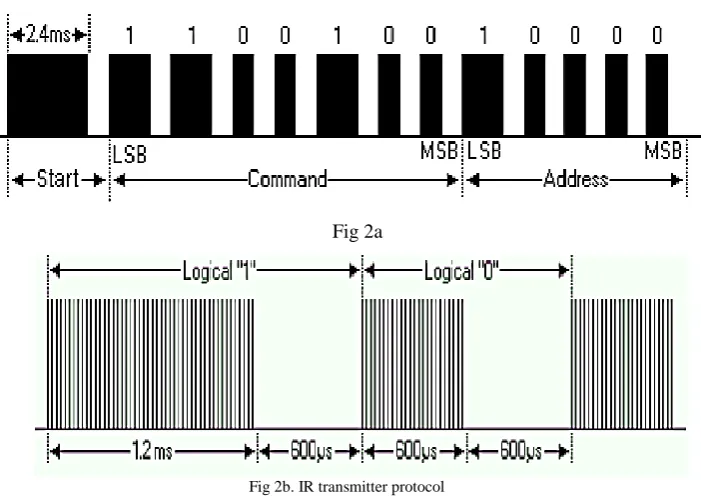
In proposed speed control system, sony IR remote is used and it operates based on 12-bit SIRC protocol as illustrated in Figure 2a. The code starts with a header of 2.4ms followed by 7-bit command and 5-bit device address in which least significant bits (LSB) are transmitted first. Subsequently, thecommands are repeated after 45ms as long as the switch is ON and the remote control is held down. The address and commands are exist for logical ones and zeros. A space of 600μs or 1T and a pulse of 1200μs or 2T form are used to represent logical one. A logical zero is formed by a space of 600μs and the pulse of 600μsis shown in Figure 2b. Usually, thezero crossing detectors generate pulses for each zero crossing of the input ac signal. After that these pulses are fed to the microcontroller interrupt pin through the opto -coupler. The opto - coupler is used for the isolation of the high voltage ac to the low voltage dc supply at the microcontroller side. The microcontroller was interrupted at each zero crossing which triggers the triac as per requirement.
Fig 1. Block diagram of speed control of IM
Fig 2a
Fig 2b. IR transmitter protocol
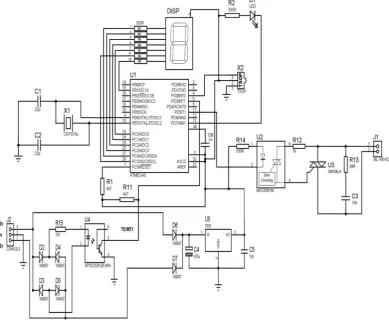
proposed system. This makes the AVR microcontroller a better choice for such embedded systems. This microcontroller uses calibrated 8 MHz internal RC oscillator. TSOP- 1740 receiver module is used to receive the IR signal from the transmitter. This sensor module demodulates the received IR signal that is compatible to the microcontroller. Microcontroller decodes the demodulated frame from the sensor module to corresponding command and address data byte. This decoded data bytes are then used to take an actual control decision. In the present system, in order to increase or decreasethe output ac voltage, the function keys „volume +‟ and „volume -‟ on IR remote transmitter are used respectively and to ON-OFF ac mains switch „power‟ function key is used.
Fig 3. Circuit diagram of proposed speed control system
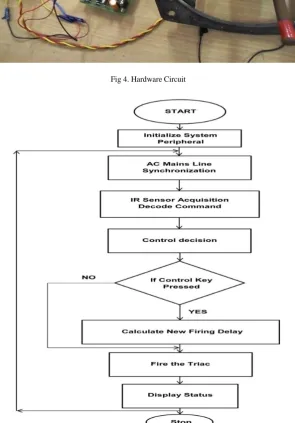
Fig 4. Hardware Circuit
IV.EXPERIMENTAL RESULTS
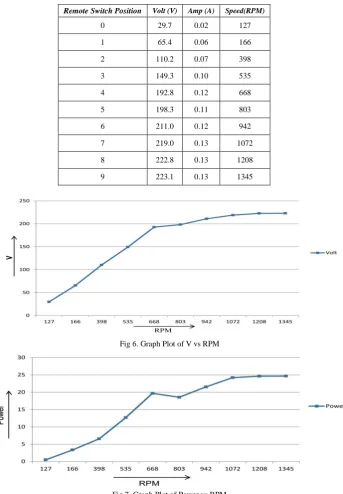
The concept of speed control of ac motors which are used in home appliances can be implemented using the proposed method. It can control the speed of induction motor effectively. The experimental results are illustrated in Table I. Relationship between speed vs voltage and speed vs Power are depicted in Figure 6 and Figure 7 respectively.
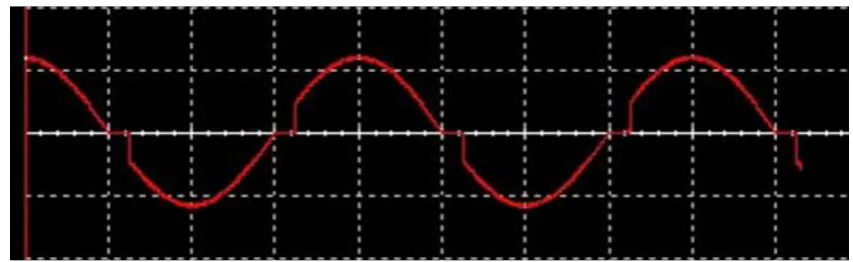
Figure 8 and Figure 9 show the Output voltage across induction motor at remote switch position 2 and 9 respectively.
TABLE I : EXPERIMENTAL RESULTS
Remote Switch Position Volt (V) Amp (A) Speed(RPM)
0 29.7 0.02 127
1 65.4 0.06 166
2 110.2 0.07 398
3 149.3 0.10 535
4 192.8 0.12 668
5 198.3 0.11 803
6 211.0 0.12 942
7 219.0 0.13 1072
8 222.8 0.13 1208
9 223.1 0.13 1345
Fig 6. Graph Plot of V vs RPM
Fig 8.Output voltage across induction motor at =85
Fig 9.Output voltage across induction motor at =30
V. CONCLUSION
The proposed speed control system of single phase induction motor using inferred receiver module has been designed and implemented. The developed system has been tested and the experimental results are reported in this paper. The proposed speed to operate induction motor remotely. This variable speed drive with variable voltage control provides low-cost solutions for light commercial and consumer applications.
REFERENCES
[1] Ming-Fa Tsai, Hsien-Chang Chen, “Design and implementation of a CPLD-based SVPWM ASIC for variable-speed control of AC motor drives” Published in: Power Electronics and Drive Systems, 2001. Proceedings., 2001 4th IEEE International Conference on (Volume:1 ) Page(s): 322 -
328 l.1.
[2] Kusch, R., Naunin, D., “Position-sensorless smooth torque control of a squirrel cage synchronous reluctance motor” Published in: Industrial Technology, 2003 IEEE International Conference on (Volume:1 ) Page(s): 560 - 565 Vol.1.
[3] Zargari, N., Seggewiss, G., Turton, R., Rizzo, S. “Multiple medium voltage AC drives fed from a common AC bus for single or multi motor conveyor applications” Published in: Power Electronics and Applications, 2005 European Conference on Page(s): 9 pp. - P.9.
[4] Briz, F., Degner, M.W., Diez, A., Lorenz, R.D. “Measuring, modeling and decoupling of saturation-induced saliencies in carrier signal injection- based sensorless AC drives” Published in: Industry Applications Conference, 2000. Conference Record of the 2000 IEEE (Volume :3 ) Page(s):
1842- 1849 vol.3.
[5] Vaclavek, P., Blaha, P, “Speed Estimation Scheme for Small AC Induction Machine Sensorless Control” Published in:Industrial Electronics Society, 2007. IECON 2007. 33rd Annual Conference of the IEEE Page(s): 986 – 991.
[6] Nied, A., de Oliveira, J., de Campos, R.F., Dias, R.P., “Soft Starting of Induction Motor with Torque Control” Published in: Industry Applications Society Annual Meeting, 2008. IAS '08. IEEE Page(s): 1 – 6.