INVESTIGATION HIGHLIGHTED ARTICLE
Inference of the Properties of the Recombination
Process from Whole Bacterial Genomes
M. Azim Ansari* and Xavier Didelot†,1 *Department of Statistics, University of Oxford, Oxford OX1 3TG, United Kingdom, and†Department of Infectious Disease Epidemiology, Imperial College London, London W2 1PG, United Kingdom
ABSTRACTPatterns of linkage disequilibrium, homoplasy, and incompatibility are difficult to interpret because they depend on several
factors, including the recombination process and the population structure. Here we introduce a novel model-based framework to infer recombination properties from such summary statistics in bacterial genomes. The underlying model is sequentially Markovian so that data can be simulated very efficiently, and we use approximate Bayesian computation techniques to infer parameters. As this does not require us to calculate the likelihood function, the model can be easily extended to investigate less probed aspects of recombination. In particular, we extend our model to account for the bias in the recombination process whereby closely related bacteria recombine more often with one another. We show that this model provides a goodfit to a data set ofBacillus cereusgenomes and estimate several recombination properties, including the rate of bias in recombination. All the methods described in this article are implemented in a software package that is freely available for download athttp://code.google.com/p/clonalorigin/.
B
ACTERIA are organisms that reproduce clonally, but they occasionally exchange fragments of DNA with one another. This process can lead to two outcomes, nonhomologous and homologous recombination (Vos 2009). Nonhomologous re-combination occurs when a novel segment of DNA from the donor cell is inserted into the genome of the recipient cell. On the other hand, homologous recombination happens when the DNA from the donor cell replaces its homologous counterpart in the genome of the recipient cell. In this study we are concerned only with the “core”genome of regions present in all sampled genomes (Medini et al. 2008), and therefore only homologous recombination is relevant. Foreign DNA can be taken up by the recipient cell through one of three mechanisms: conjugation (transfer of DNA from one cell to another when they are in physical contact), transduction (bacteriophage-mediated DNA transfer), or transformation (uptake of DNA from the environment by the recipient cell) (Thomas and Nielsen 2005). In homologous recombination,the recipient cell then replaces the homologous section of its DNA with the foreign DNA segment.
A first concept that has helped researchers to appreciate the role of recombination in bacteria is linkage disequilibrium (LD) or the nonrandom association of alleles at different loci (Maynard Smith et al.1993). LD between a pair of sites is expected to decrease as more and more recombination events affect exclusively one or the other site, so that LD is a function of the distance between pairs of sites. In bacteria on average LD decreases down to a plateau level when pairs of sites are considered that are farther and farther away from each other on the genome, and this is often represented graphically (e.g., Namouchiet al.2012; Takunoet al.2012). Another impor-tant concept is homoplasy, which is said to occur when given a known tree, a site could not have arisen without either recombination or repeat mutation (Maynard Smith and Smith 1998; Maynard Smith 1999). The probability of a site being homoplasic increases with the number of recombina-tion events affecting the site. For this reason, homoplasy is commonly used as an indicator of the prevalence of recom-bination (e.g., Nübelet al.2008; Harriset al.2010). A related notion is incompatibility between pairs of sites [also known as the four-gamete test (G4)], which occurs when two sites can-not be explained by a shared phylogenetic tree without either recombination or repeat mutation (Hudson and Kaplan 1985; Maynard Smith 1999). Incompatibility between pairs of sites Copyright © 2014 by the Genetics Society of America
doi: 10.1534/genetics.113.157172
Manuscript received September 3, 2013; accepted for publication October 22, 2013; published Early Online October 23, 2013.
Available freely online through the author-supported open access option. Supporting information is available online athttp://www.genetics.org/lookup/suppl/ doi:10.1534/genetics.113.157172/-/DC1.
1Corresponding author: Department of Infectious Disease Epidemiology, Imperial
is often used to identify recombination events (e.g., Takuno
et al.2012; Yaharaet al.2012).
Recombination plays a key role in shaping the patterns of all these summary statistics, but they are also crucially af-fected by other factors, which makes them difficult to interpret. This includes the population structure underlying the relationships between the individuals under study (McVean et al.2002; Wakeley and Lessard 2003), and this effect is likely to be especially important in bacteria because of their clonal mode of reproduction. Another factor likely to be important in bacterial population genetics is biased recombina-tion, which we define in contrast to free recombination where all individuals in the population are equally likely to recombine. There are many factors contributing to recombination being biased rather than free. Laboratory experiments have shown that the recombination process is homology dependent so that it tends to happen more often between individuals that are less diverged (Roberts and Cohan 1993; Zawadzki et al. 1995; Majewskiet al.2000; Majewski 2001). Furthermore, the geo-graphical and ecological structures observed in many bacterial populations imply a greater opportunity of recombination for pairs of cells that are closely related (Feil and Spratt 2001; Majewski 2001; Cohan 2002; Didelot and Maiden 2010). Purifying selection may also effectively prevent recombination between distantly related bacteria. All these effects would clearly be hard to disentangle, and here we group them all under the single concept of biased recombination. The strength of this bias is an important factor to take into account to understand recombination in bacteria. In particular, this determines how often recombination happens within the di-versity of the population under study rather than from other sources. Such recombination events from external sources would strongly affect LD, but have little or no effect on ho-moplasy and G4 since they introduce what is in effect new polymorphism from the viewpoint of the studied population. Here we introduce a new statistical framework for in-ferring the recombination parameters, including the rate of bias in recombination, from a sample of bacterial genomes. Our starting point is an evolutionary model of free recombi-nation that describes the ancestral recombirecombi-nation process given the clonal relationships in the sample. We show how this can easily be extended to allow recombination to be biased. We describe how data can be efficiently simulated under the model, which is crucial to allow the use of approximate Bayesian computation (ABC) techniques (Pritchard et al.
1999; Beaumontet al.2002) to estimate parameters. We use informative summary statistics about the recombination pro-cess such as LD, homoplasy, and G4 to infer parameters. Applications are presented on simulated data sets as well as on a real data set ofBacillus cereusgenomes.
Model and Methods
Free recombination model
The process of homologous recombination in bacteria is asymmetric in terms of the genetic contributions made by
donor and recipient cells, since typically a small segment of DNA from the donor in the order of a few hundreds or thousands of nucleotides in length is incorporated into the genome of the recipient that is much longer (Didelot and Maiden 2010). This asymmetry contrasts with the well-studied mechanism of crossing over in eukaryotic sexual reproduction where the two parents contribute equally. Consequently, it is possible to consider the (potentially empty) set of genomic sites that have not been affected by recombination since a sample of isolates evolved from a common ancestor, and the ancestral relationships between the isolates at these sites is called the clonal genealogy (Guttman 1997). Alternatively, the clonal ge-nealogy of a set of isolates can be defined as the ancestral tree obtained by tracing the ancestry of the isolates back in time and following the ancestral line of the recipient cell (rather than the donor cell) whenever a recombination event occurred.
The coalescent model with gene conversion describes the ancestry of a bacterial sample subject to homologous re-combination (Wiuf 2000; Wiuf and Hein 2000; McVeanet al.
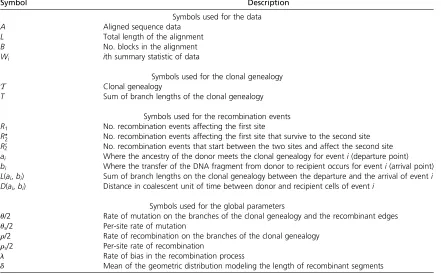
2002; Didelot et al.2009b). A useful approximation of this process is the ClonalOrigin model (Didelotet al.2010), where given the clonal genealogy the recombinant lines of ancestry are assumed to be independent of each other. This means that given the clonal genealogy the recombinant lines of ancestry are not allowed to recombine and are allowed to coalesce only with the clonal genealogy. Consequently, the clonal and recombination processes can be separated. Here, however, we exploit another property of this model, namely the fact that it has a simple Markovian structure along the genome, similar to that of the sequentially Markov coalescent in ap-proximating the crossing-over ancestral recombination graph (McVean and Cardin 2005; Marjoram and Wall 2006). Given the clonal genealogy this allows for the simulation of pairs of sites at a given physical distance from each other on the genome. As both LD and G4 are defined for pairs of sites, we use this Markovian property of the model to simulate these summary statistics in a computationally efficient man-ner. A formal description of this model follows, and the math-ematical symbols used are summarized in Table 1.
In the ClonalOrigin model (Didelot et al.2010), recombi-nation events are independent of one another given the clonal genealogy and the total number of recombination events R
given the total branch length of the clonal genealogyTand the population recombination rateris Poisson distributed:
PðR¼rjr;TÞ ¼ðrT= 2Þ
r
e2ðrT=2Þ
r! : (1)
Each recombination eventihas four properties: the depar-ture point on the clonal genealogyaiwhere the ancestry of the donor cell meets the clonal genealogy, the arrival point on the clonal genealogybiwhere the recombination occurs, the site on the chromosome where recombination starts xi, and the site on the chromosome where recombination ends
events have the same arrival points, but different departure points on the clonal genealogy.
The arrival points bi are uniformly distributed on the clonal genealogy as recombination happens at a constant rate on the branches of the clonal genealogy. A recombinant edge reconnects with the clonal genealogy at a rate equal to the number of ancestors in the clonal genealogy as in the standard coalescent model (Kingman 1982). Thusai condi-tional on biis distributed as
Pðai jbi;T Þ ¼e2Lðai;biÞ; (2)
whereT is the clonal genealogy and L(ai,bi) is the sum of branch lengths on the clonal genealogy between the time of
ai and bi. In addition we assume that the recombination events are uniformly distributed along the observed sequences and that their length is geometrically distributed with meand.
Extending the model to include biased recombination
We extend the ClonalOrigin model to incorporate the bias in recombination and modify Equation 2 such that a recombi-nant edge coalesces with the clonal genealogy at a rate that depends on both the number of ancestors in the clonal genealogy and the amount of evolutionary distance between donor and recipient cells. Therefore we propose the follow-ing distribution forai,
Pðai jbi;T Þ}e2Lðai;biÞ3e2lDðai;biÞ; (3)
where D(ai, bi) is the evolutionary distance in coalescent unit of time between the donor and recipient cells for
recombinationiandlis the strength of the recombination bias. Free recombination is nested in this model, as setting l= 0 results in Equation 2. For values of lgreater than zero, we have that the probability of recombination decreases with the evolutionary distance between donor and recipient. Figure 1 shows the relationship between
D(ai,bi) andL(ai,bi) for three recombination events with the same arrival points, but three different departure points on the clonal genealogy. Under a free recombina-tion model, the three recombinarecombina-tion events would have the same probability because the sums of branch lengths of clonal genealogy between the arrival and departure points on the clonal genealogy are the same. However, the amount of evolutionary distance between the donor and recipient cells increases from recombination events 1 to 2 to 3. Thus in the model of biased recombination described by Equation 3 with l . 0, the probability of event 1 is more than that of event 2, which is more than that of event 3.
Simulating pairs of sites
The sequentially Markovian property of our model allows us to simulate pairs of sites at a given physical distance from each other given the clonal genealogy. The simulation is done in three steps. First, we simulate recombination events affecting thefirst site and their properties. In the second step, we simulate recombination events affecting the second site. This includes some of the recombination events from thefirst site that are long enough to affect the second site and some new recombinations initiated between the two sites. In the
Table 1 List of symbols
Symbol Description
Symbols used for the data
A Aligned sequence data
L Total length of the alignment
B No. blocks in the alignment
Wi ith summary statistic of data
Symbols used for the clonal genealogy
T Clonal genealogy
T Sum of branch lengths of the clonal genealogy
Symbols used for the recombination events
R1 No. recombination events affecting thefirst site
R⋆2 No. recombination events affecting thefirst site that survive to the second site
R92 No. recombination events that start between the two sites and affect the second site
ai Where the ancestry of the donor meets the clonal genealogy for eventi(departure point)
bi Where the transfer of the DNA fragment from donor to recipient occurs for eventi(arrival point)
L(ai,bi) Sum of branch lengths on the clonal genealogy between the departure and the arrival of eventi
D(ai,bi) Distance in coalescent unit of time between donor and recipient cells of eventi
Symbols used for the global parameters
u/2 Rate of mutation on the branches of the clonal genealogy and the recombinant edges
us/2 Per-site rate of mutation
r/2 Rate of recombination on the branches of the clonal genealogy
rs/2 Per-site rate of recombination
l Rate of bias in the recombination process
third step the local trees for the two sites are computed and mutations are added.
The sequence data are made of B independent blocks with total lengthL and subject to mutation and recombi-nation at population rates uandr, respectively. A recom-bination event may start before a block and be long enough to affect the beginning of a block, so that the probability of observing the recombination start at the be-ginning of a block is dtimes greater than within a block (Didelot and Falush 2007). There areBsites at the begin-ning of blocks and L2Bsites within blocks; thus the re-combination rate per site is defined as rs=r/(dB+L2
B), and since mutation affects any site with equal proba-bility, the mutation rate per site isus=u/L(Didelotet al. 2010).
Given the clonal genealogyT, recombination rate per site rs, mean length of recombination tractd, the rate of bias in recombinationl, the physical distance between the two sites on the chromosome k, and the mutation rate per site us, a pair of sites is simulated as follows:
Step 1: Simulate recombination events for thefirst site. a. We assume that recombinations start between nucleo-tides and that they are at least 1 nucleotide long. As the lengths of recombination events are geometrically distrib-uted with meand, the rate at which a site inucleotides before thefirst site initiates a recombination that survives to thefirst site is
rs
23
12d21i:
Summing over all sites before thefirst site, we get the expected rate of recombination affecting thefirst site:
XN
i¼0
rs
2
12d21i¼rs 2
XN
i¼0
12d21i¼rs 2d:
Therefore the number R1of recombination events affecting thefirst site is Poisson distributed:
R1j T;rs;d Poisson
rsdT
2
: (4)
b. For each recombination eventi, the arrival point on the clonal genealogy bi is uniformly distributed and the de-parture point ai is drawn from Equation 3. To simulate from Equation 3, we use rejection sampling where the proposal distribution is Equation 2 and the simulated ai is accepted with probabilitye2lDðai;biÞ:
Step 2: Simulate recombination events for the second site. Two types of recombination events can affect the second site. Some events affecting the first site may have survived to the second site and new recombinations could have started between the two sites and have survived to the second site. a. As the length of recombination events is geometrically distributed, the probability of a recombination that is af-fecting thefirst site to have survived to the second site is
PðSurvivalÞ ¼12d21k:
Thus the number of recombination eventsR⋆2from thefirst site that survive to the second site is binomially distributed:
R⋆2 Binomial
R1;
12d21k
: (5)
b. The number of recombination events R29 that start be-tween the two sites and that affect the second site is distributed as
Figure 1 Illustration of the recombination model. Consider three recombination events arriving at points
b1=b2=b3and departing from pointsa1,a2, anda3 on the clonal genealogy. In the ClonalOrigin model (free recombination, Equation 2) these three departure points are equally likely because the sums of branch lengths between the times of eachbiandaiare equal:
R92T;rs;d9 Poisson rsd
9T
2
!
;
where d9¼X k21
i¼0
12d21i:
(6)
This is because there are onlykpositions between the two sites where recombination could have started.
c. For each of the R29recombination events affecting the second but not the first site, the departure and arrival points on the clonal genealogy are simulated as detailed in step 1.
Step 3: For both sites, extract the local trees backward in time (from tips to root), given the clonal genealogy and the recombination events. Mutations are then simulated on these local trees as follows.
a. The numberMjof mutations affecting the local tree at sitejis distributed as
Mj jTj;us Poisson
usTj 2
; (7)
whereTjis the total branch length of the local tree at sitej. b. We are interested in simulating polymorphic sites and Equation 7 only for plausible values ofusandTjleads to many nonpolymorphic sites. To remedy this problem, we use an importance sampling strategy (Fearnhead 2007). A local tree is in the target distribution if Equation 7 leads to at least one mutation on that local tree. The proposal distribution is made of all local trees simulated by steps 1 and 2. Therefore the importance sampling weight is
wj¼PPðLocalðLocal tree tree j isj is in in the the proposal target distribution distributionÞÞ ¼PðMj.0Þ
1 ¼12P
Mj¼0
¼12e2ðusTj=2Þ:
(8)
The simulated local trees are importance sampled using the weights from Equation 8, and the number of mutations on the local tree is simulated from the truncated Poisson with one or more mutations.
c. Mutations are uniformly distributed on the local trees. For simplicity we use the Jukes–Cantor model where all mutations are equally likely, but any mutation model could be used (Whelanet al.2001).
Inference using whole genomes
Whole genomes can be compared using Mauve that detects and aligns the conserved genomic regions in the presence of rearrangements (Darling et al. 2004, 2010). Given a core alignmentAof whole bacterial genomes and the clonal ge-nealogy T [estimated, for example, using ClonalFrame
(Didelot and Falush 2007)], we want to infer the posterior density of the model parametersP(rs,d,l,us|A,T). How-ever, due to the complexity of the model, the likelihood function is intractable and therefore we cannot use standard approaches such as a Markov chain Monte Carlo (MCMC). One solution would be to use data augmentation techni-ques as in Didelot et al.(2010). Instead here we use ABC (Pritchard et al. 1999; Beaumont et al.2002), where the likelihood does not have to be computed, but simulation from the model has to be efficient. In effect, the likelihood is approximated through a distance metric on a set of in-formative summary statistics between the simulated and ob-served data. There are several implementations of the ABC algorithm (reviewed in Beaumont 2010; Csilléryet al.2010) and we have implemented and tested both ABC-MCMC (Marjoram et al. 2003) and ABC-SMC (Sequential Monte Carlo; Beaumont et al. 2009) approaches. The results pre-sented used a parallel ABC-MCMC implementation where given the current chain state uj,n statesu19;. . .;un9are pro-posed independently and for each one data x19;. . .;xn9 are simulated in parallel (wherenis the number of cores avail-able). The proposed states and their simulated data are ex-amined sequentially in the ABC-MCMC algorithm. For each rejected proposed state, the MCMC stays atuj. If a proposed state ui9is accepted, then the remaining proposed states u9iþ1;. . .;un9are discarded. If all proposed states are rejected, then the MCMC has stayed atujfornstates and the process is repeated with a proposal ofnnew states. This paralleliza-tion scheme is similar to that of prefetching, which was de-veloped for MCMC with known likelihood (Brockwell 2006).
Summary statistics and distance metric
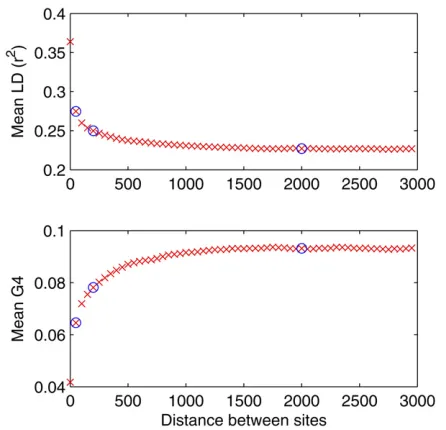
Since one of the parameters we need to infer is the mutation rateus, we included in the summary statistics the proportion of segregating sites Sthat is highly informative about this parameter (Watterson 1975). To calculateSfrom the simu-lated data, Equation 8 was used, which gives the probability that a simulated site is polymorphic. The most widely used summary statistics that are informative about the recombi-nation process are LD, homoplasy, and incompatibility be-tween pairs of sites (meaning for biallelic sites, all four possible haplotypes are present, G4). To measure LD, r2 was used, which quantifies the amount of association be-tween a pair of biallelic sites (Hill and Robertson 1968). Asr2and G4 are distance dependent, for empirical data sets, we plot the mean ofr2and G4 against distance between the sites. Figure 2 shows an example for a sample of 13B. cereus
these would not affect the variation in LD at different dis-tances. To account for this, and since we are here interested in recombination, we used the differences in LD as summary statistics,i.e., LD1002LD2000and LD1002LD200. We also included as a summary statistic the proportion of homopla-sic sites relative to the clonal genealogy and a new variable that we called clade homoplasy, which is calculated as fol-lows: Given a clonal genealogy, it is divided into its two largest clades and for biallelic sites if both alleles are present in both clades, we say that the site is clade homoplasic. We introduce this new summary statistic as an indicator of the amount of recombination between the clades, which will be informative about the rate of bias in the recombination process.
In total, we therefore use eight summary statistics: the proportion of segregating sites, two distance-based differ-ences in LD, three distance-based values of G4, one value for homoplasy, and one value for clade homoplasy. These summary statistics are compared between the observed and simulated data sets, using a metric equal to the sum of the squared normalized distances,
distx9;x¼X
i
Wi
x92WiðxÞ WiðxÞ
!2
; (9)
wherex9is the simulated data,xis the observed data, and
Wiis theith summary statistic of the data.
Monte Carlo estimation of r/m
An important quantity in bacterial population genetics is the ratior/mof rates at which nucleotides are substituted due to recombination and mutation (Guttman and Dykhuizen 1994; Vos and Didelot 2009). In our model this is equal to
r m¼ð
Recombination rate per siteÞ3Pðsubstitution jrecombinationÞ ðMutation rate per siteÞ
¼rsd3Pðsubstitution jrecombinationÞ
us :
(10)
Given a recombination on the clonal genealogy, the proba-bility of a substitution being introduced due to the re-combination event at the site is given by
Pðsubstitution jrecombinationÞ us
2EðDÞ; (11)
WhereE(D) is the expected distance between the donor and recipient cells in a coalescent unit of time given a recombi-nation event. Therefore for a given set of parameters, the probability of substitution given a recombination event is estimated using Equation 11 by simulating many recombi-nation events on the clonal genealogy and computing the average distance between donors and recipients. Equation 10 is then used to estimater/m. This Monte Carlo procedure is applied for each value of the parameters in the posterior sample to obtain a sample from the posterior distribution of
r/m.
Results
Relationship between parameters and summary statistics
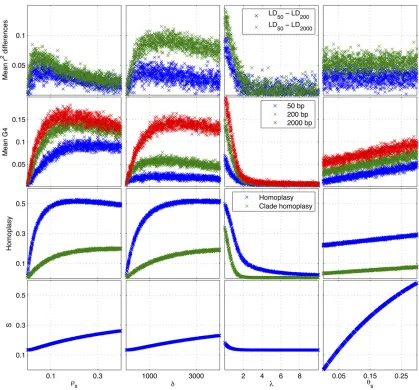
We used simulated data to investigate the relationship between the model parameters and the summary statistics. A clonal genealogy with 15 taxa was simulated under the coalescent model (Supporting Information,Figure S1) and the parametersrs= 0.02,d= 300,l= 1.2, andus= 0.05 were used, which represent reasonable values for a real bac-terial population (Fraseret al.2007; Didelotet al.2010). We then changed one parameter at a time in the intervalsrs2 [0, 0.4], d 2 [0, 4000], l 2 [0, 10], us 2 [0, 0.3] and simulated the summary statistics to see how they varied with the parameters. For each parameter value, we simu-lated 2000 pairs of sites distant from each other by 50, 200, and 2000 bp.
Figure 3 shows how the summary statistics change with the model parameters.rs,d, andlhave a large influence on
r2, G4, and homoplasies and a relatively small effect on the proportion of segregating sitesS. On the other handushas little impact on r2, G4, and homoplasies, but it has a large influence onS. In the absence of recombination (rs= 0) the differences in meanr2are zero, which indicatesr2is inde-pendent of distance between pairs of sites. Asrs increases, the differences in meanr2increase to a maximum, beyond which, asrsincreases, the differences in meanr2decrease and for very high values ofrs, the differences approach zero, which indicatesr2again becomes independent of distances between pairs of sites. Increasing rsincreases homoplasies and G4 up to a maximum beyond which the mean G4 and homoplasy slightly decrease.dhas a similar but nonidentical
effect onr2, G4, and homoplasies. However,lhas the op-posite effect onr2, G4, and homoplasies. This is because asl increases, the effect of the recombination decreases as the donor cells tend to have a smaller evolutionary distance relative to the recipient cells and therefore local trees be-come more and more similar to the clonal genealogy. For extremely high values of lthis results in no differences in mean r2, no homoplasies, and zero incompatible pairs of sites (G4), which is similar to those observed in the absence of recombination. us has the largest influence on the pro-portion of segregating sites S, but rs,d, andlalso slightly affect it. This is because as the number of recombination events increases, the probability that a recombination edge reattaches itself higher up the clonal genealogy increases and that would increase the total branch length of local trees relative to the clonal genealogy.
It is important to note that the clonal genealogy has a large impact on the observed patterns of LD and homoplasy. To illustrate this, we performed the same sensi-tivity analysis as above but using a different clonal genealogy
(Figure S2). The resulting relationships between model
parameters and summary statistics are shown in Figure S3. These relations are quantitatively the same as described above based on Figure 3, but the exact values differ significantly. It is therefore essential to account for the clonal genealogy as we do here to correctly interpret the values of the summary sta-tistics. Having done this, there are strong relationships be-tween model parameters and the summary statistics (Figure 3), which means that inference via ABC on the basis of these statistics should provide good statistical power to infer param-eter values.
Application to simulated data sets
We first applied our inference methodology to a data set simulated under our model. Fifteen genomes of length 1,000,000 bp were simulated, based on the clonal genealogy shown in Figure S4, and using the following parameters: rs= 0.02,d= 300,l= 1.2, andus= 0.05.Figure S5shows the LD and G4 plots for this data set. The LD r2for these simulated data were (0.1970, 0.1605, 0.1339) for pairs of sites distant by (50, 200, 2000) bp, respectively. The propor-tions of G4 were (0.0242, 0.0613, 0.1002) for pairs of sites distant by the same respective amounts. The proportions of homoplasic and clade homoplasic sites were, respectively, (0.3067, 0.0931). Finally, the proportion of segregating sites wasS= 0.1235.
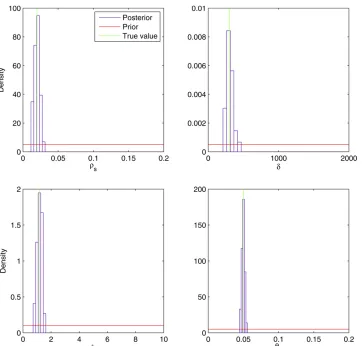
We chose uniform priors for all model parameters in the following ranges:rs2[0, 0.2],d2[0, 2000], l2[0, 10], and us 2 [0, 0.2]. We ran a parallel ABC-MCMC chain of 300,000 iterations with the ABC threshold e = 0.015 and the proposal density tuned so that the acceptance rate was 0.4%. The histograms in Figure 4 show the marginal distri-bution of posterior samples for each of the four parameters. The posterior distribution of the recombination rate per site rs had a mean of 0.020 with a 95% credibility interval (CI) = 0.012–0.028. The posterior of the mean recombination
tract length dhad a mean of 309 with CI = 226–449. The posterior of the rate of bias of recombinationlhad a mean of 1.18 with CI = 0.81–1.47. The posterior of the mutation rate us had a mean of 0.050 with CI = 0.046–0.054. For each of the four parameters, the true value that was used for simulation was well within the 95% credibility interval and in each case close to the mean of the posterior distribu-tion. Furthermore, Figure 4 shows that the posterior distri-butions are much tighter than the prior distridistri-butions for each of the four parameters. This means that the summary statistics upon which inference is based carry significant in-formation about the underlying values of the parameters, as had previously been suggested by the correlations between parameters and summary statistics in simulated data sets (Figure 3).
Running this inference procedure on a cluster of 12 Intel 3.33-GHz cores took 70 hr. The computing time of the inference procedure depends on the range of parameters being inferred as higher values of rs andd lead to slower simulations. As the inference procedure is time consuming, testing our model on hundreds of simulated data sets is not possible and we tested our algorithm on 11 additional sim-ulated data sets with a range of parameters. We limited our parameter ranges to biologically meaningful values. The pa-rameter ranges used arers= [0, 0.07],d= [0, 1000],l= [0, 2], andus= [0.02, 0.08]. We used the clonal genealogy
ofFigure S4and used different parameter values to simulate
11 data sets, each made of 15 whole genomes of 1,000,000 bp. We then used our method to infer the parameter values for each of the 11 data sets.Figure S6andFigure S7show the marginal posterior density for each of the 11 data sets. For values of rs ordequal to zero, there are no recombi-nation events. In such cases eitherrsanddcan be close to zero while the other parameter andlcan change freely. In addition, extremely high values ofllead to patterns sim-ilar to those of the scenario without recombination. Such instances are easily recognized as LD and G4 plots are straight lines and therefore could be excluded from further analysis. For all other reasonable values ofrs,d,l, andus, the posterior ranges are much tighter than the prior ranges. This shows that our inference method works as expected and that inference is possible for a wide range of parameter values.
To assess the effect of inferring the clonal genealogy incorrectly, we performed two additional simulations. Given the clonal genealogy of Figure S4, the distance matrix li,j was computed between all pairs of leaves. A modified dis-tance matrix was then computed by replacing eachli,jwith a uniform draw from the interval [0.75li,j, 1.25li,j], and a modified tree was computed using Unweighted Pair Group Method with Arithmetic Mean (UPGMA) on the modified distance matrix. The two resulting genealogies are shown
inFigure S8, and these differ from the true clonal genealogy
ofFigure S4in both tree topology and branch lengths. These
Figure S9, indicating that that our model and inference pro-cedure are robust to slight misspecification of the clonal genealogy. In both cases the true parameters used for simu-lation of data are well within the 95% credible interval of the posterior densities.
Application to B. cereus
We applied our method to estimate recombination proper-ties based on a core alignment of 13 whole genomes of B. cereus, including the first genome from this species to be fully sequenced (Ivanova et al. 2003). These are the same data as previously analyzed by Didelot et al. (2010), thus allowing comparisons between the two analyses to be drawn. This previous analysis was performed using the ClonalOrigin model, which does not account for the bias in recombination. Nevertheless, the posterior distribution of recombination events contained a clear excess of recom-bination between close relatives (cf. Figure 5 of Didelotet al.
2010).
Figure S10 shows the clonal genealogy of the data that
was estimated by Didelot et al.(2010), using ClonalFrame (Didelot and Falush 2007). A unique tree topology with little uncertainty in the branch lengths was reconstructed. Figure 2 shows the LD and G4 plots for this data set. Three points on the plots were selected to be used as summary statistics, with distance between the pairs of sites at 50, 200, and 2000 bp. The mean r2 and G4 for pairs of sites at these distances were, respectively, (0.2738, 0.2493, 0.2270) and (0.0679, 0.0808, 0.0932); the proportion of segregating sites in this data set was S = 0.174; and the proportions of homoplasic and clade homoplasic sites were, respectively, 0.29 and 0.15.
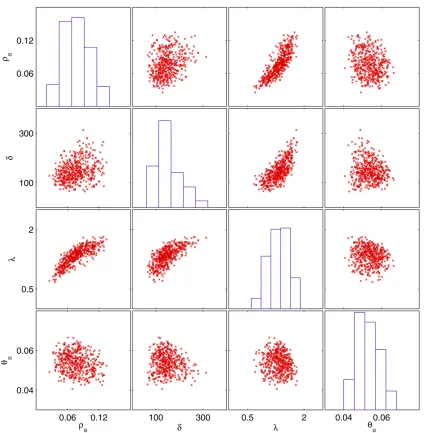
We chose uniform priors for all model parameters in the rangesrs2[0, 0.2],d2[0, 2000],l2[0, 4], andus2[0, 0.2]. Several independent ABC-MCMC chains were run with similar results. The histograms on Figure 5 show the mar-ginal posterior densities for the estimated parameters. The posterior mean for the recombination raterswas 0.077 with
CI = 0.036–0.127. The posterior mean of the recombination tract lengthdwas 152 bp with CI = 74–279. The posterior mean of the rate of bias in recombinationlwas estimated to be 1.32 with CI = 0.812–1.788. The posterior mean of the mutation rateuswas 0.0528 with CI = 0.0437–0.0640. The estimates ofusanddwere in agreement with previous esti-mates [median ofus = 0.0438 andd = 236 (Didelotet al. 2010)]. However, this previous analysis estimated that re-combination was significantly less frequent [rs = 0.017 (Didelot et al.2010)]. In this previous study, the recombi-nation rate was probably underestimated as a result of not accounting for the bias in recombination. In a model with biased recombination, a larger fraction of recombination events are between close relatives and therefore have little effect and would tend to go undetected by methods that do not account for it. The relative impact of recombination to mutation r/m (Guttman and Dykhuizen 1994; Vos and Didelot 2009) was estimated using Equations 10 and 11.
r/mhad a mean of 3.4 with CI = 1.6–6.7 (Figure S11). This is slightly higher than the previous estimate from Clonal-Frame [mean ofr/m= 2.41 (Didelotet al.2010)].
The posterior distributions of the four model parameters were significantly correlated as shown by the scatter plots in Figure 5.ushad moderate levels of negative correlation withrs (Pearson’s linear correlation coefficient,r=20.26,P= 1.33
10216),d(r=20.12,P= 2.531024), andl(r=20.16,P= 3.5 31027). The strongest associations, however, were the positive correlation of rs with l (r = 0.83, P = 2.0 3 102253) andd withl (r= 0.75,P= 1.3 3102178).rs and d were also slightly correlated (r= 0.34,P= 3.2310229). Since higher values of ltranslate into a higher bias in re-combination (where rere-combination occurs between more similar isolates) and therefore a smaller effect of recombi-nation, it is logical that there is to some extent a trade-off between smaller rs and lon one hand (meaning less re-combination with more effect per rere-combination) and higherrsandlon the other hand (meaning more recombi-nation with less effect per recombirecombi-nation). Likewise, higher values of dindicate larger recombination events and there-fore a higher effect per event, which explains the trade-off betweenlandd.
To test thefit of our model with biased recombination to the observed data, we considered the posterior predictive distribution of three additional summary statistics,i.e., their distribution when parameters are drawn from the posterior sample (Gelmanet al.1996). These summary statistics had not been used in inference, but were similar in principle to the clade homoplasy statistic previously defined. TheB. cereus
clonal genealogy was divided into four distinct clades. One of these clades had a single member, which was ignored. We
measured the amount of clade homoplasy between the other three clades and used them as posterior predictive summary statistics. This Bayesian model criticism approach has been used in several previous ABC studies (Thornton and Andolfatto 2006; Morelliet al.2010). We found that the observed values of the three summary statistics were contained within the boundaries of the posterior predictive distributions (Figure S12). Our model with biased recombination is therefore able to reproduce the observed summary statistics and represents a goodfit to the data.
Comparison with experimental studies
Several experimental studies have demonstrated a log-linear relationship between sequence divergence and frequency of recombination (Roberts and Cohan 1993; Zawadzki et al.
1995; Vuli´cet al.1997; Majewskiet al.2000). These results
are summarized in Figure 1A of Fraseret al.(2007), which shows that different bacterial species have a similar log-linear relationship, with a coefficient of20. To compare our results on biased recombination to these previous exper-imental studies, we need to compute the relative rate of recombination between two isolates as a function of their homology. Since this equates to considering recombination between two cells living at the same time, the first part of Equation 3 is equal to one and the probability of recombi-nation is proportional to exp(2lD), whereDis the distance between the donor and the recipient cells in a coalescent unit of time. The expected amount of sequence divergence per site p between two genomes separated by a branch of length Disp =usD/2, which implies thatD = 2p/us, and therefore we obtain that the rate of recombination between two cells is proportional to exp(22lp/us). The frequency of
recombination has therefore a log-linear relationship with sequence divergence in our biased recombination model, with a coefficient (measured on a log of base 10 as in pre-vious studies) of 2l/(usln(10)). In the case of theB. cereus
application above, this coefficient had a mean of 22.1 with CI = 12.5–32.0. Our estimate for the rate of bias in recom-bination is therefore slightly higher than the rate of homology
dependency of recombination that was found in previous experimental studies.
Discussion
Linkage disequilibrium, G4, and homoplasy are often interpreted informally as evidence of recombination. We have introduced aflexible statistical framework to interpret the values of these statistics calculated from whole bacterial genomes. Our underlying model is based on an approxima-tion to the coalescent with gene conversion (Didelot et al.
2010), which has the advantage of being sequentially Markovian along the genomes. This allows us to simulate patterns of LD and G4 through sampling of many pairs of sites at given distances, which takes only a small fraction of the computational power that would be needed to simulate large segments of DNA. Approximate Bayesian computation (Pritchard et al. 1999; Beaumontet al.2002) was used to perform inference under this bacterial population genomic model. This approach offers great flexibility to implement extensions of the model like the one we presented in Equa-tion 3 to account for the biased recombinaEqua-tion, simply by modifying the way simulation is performed without the need to compute a new likelihood function. We applied our method to simulated data sets and a real data set con-sisting of 13 whole genomes of B. cereus. We showed that these data contain evidence that the recombination process depends on the evolutionary distance between donors and recipients and measured the strength of this relationship. Our model is robust to slight misspecification of the clonal genealogy, but gross inaccuracies would lead to misleading results.
Evidence for a higher rate of recombination within than between the three major clades of B. cereuswas first pre-sented using multilocus sequence typing data, by searching for the most likely origin of ClonalFrame recombination seg-ments (Didelotet al.2009a). This approach was also applied to genomic data fromSalmonella enterica, and more recom-bination was found withinfive lineages than between them (Didelotet al.2011). However, this method is not very pow-erful, because ClonalFrame does not look for potential donors of the recombination events and therefore is better able to detect recombination coming from farther away (Didelot and Falush 2007). A better approach is the one implemented in ClonalOrigin (Didelot et al. 2010), where the source of recombined fragments is inferred jointly with the recombination events rather than relying on a postpro-cessing step. By comparison of the number of recombination events observed between pairs of branches and expected under the prior model, recombination was found to happen more often between members of the same B. cereusclades (Didelot et al. 2010). Similar results have been obtained using the same technique in other organisms, such as Sulfo-lobus islandicus(Cadillo-Quirozet al.2012) andEscherichia coli (Didelot et al. 2012). However, this is still not fully satisfactory from a statistical point of view, since the analysis
is done using a prior model where recombination does not depend on evolutionary distance, which is proved to be in-correct by the posterior distribution of events. For this rea-son, this approach does not allow us to estimate the strength of bias in recombination, since the posterior depends on both the prior (where this parameter is zero) and the ob-served data (which contain evidence that this parameter is nonzero). The best statistical approach is therefore the one we presented here, where the model explicitly incorporates this important parameter, so that we can use Bayesian sta-tistics to formally estimate its value.
We estimated the coefficient for the log-linear relation-ship between recombination rate and the effective sequence divergence to be22 inB. cereus. This is slightly higher than previous estimates based on laboratory experiments, which were20 (Fraseret al.2007). This higher coefficient could be due to the fact that laboratory experiments measure the rate of recombination between two bacteria only when they are brought into contact, whereas there are factors in na-ture, such as geographical or ecological structuring of the population, that would increase the sexual isolation be-tween distantly related bacteria (Majewski 2001; Didelot and Maiden 2010). Yet this coefficient is far lower than the value of 300 predicted by population genetics models to be required for recombination to be on one hand a strong cohesive force between highly homologous bacteria and on the other hand very rare between diverged bacteria, thus resulting in clusters of diversity that could be considered to represent separate species (Falush et al. 2006; Hanage
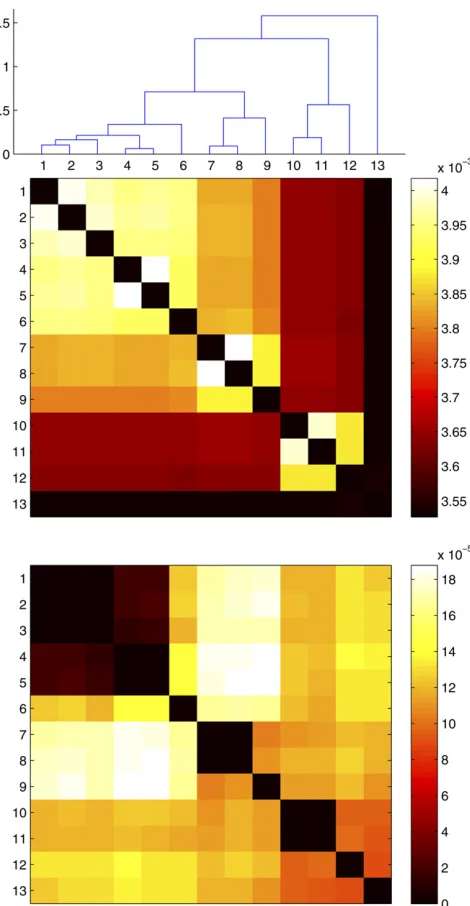
et al.2006; Fraseret al.2007, 2009; Achtman and Wagner 2008). To test this hypothesis further, we used a Monte Carlo simulation to see the effect of the next evolutionary events likely to happen to any one of theB. cereusgenomes in our data set. We found that for all except the most closely related pairs of genomes, future recombination events would result in convergence,i.e., a reduction of the genetic distance (Figure 6, bottom). However, we also found that mutation would increase the genetic distance between any pair of genomes at a much higher rate than recombination would reduce it (Figure 6, top). We therefore conclude that all pairs of genomes are likely to diverge in the near future, since the convergence effect of recombination will not be sufficient to compensate for the divergence effect of muta-tion. Convergence via recombination is likely to be restricted to rare situations where strong selective or ecological factors are involved, such as found in the convergence ofS. enterica
serovars Typhi and Paratyphi A (Didelotet al.2007) or the convergence of Campylobacter jejuni and coli (Sheppard
et al.2008).
Acknowledgments
We thank Rory Bowden, Alison Etheridge, Richard Everitt, Daniel Falush, Simon Myers, and Daniel Wilson for useful ideas and helpful discussions. We also thank two anonymous reviewers whose comments improved an earlier version of this
manuscript. M. Azim Ansari received a scholarship from the Life Sciences Interface Doctoral Training Centre, which is funded by the Engineering and Physical Sciences Research Council. This study was partly funded by the UK Clinical Research Collaboration (UKCRC) Modernising Medical Microbiology Consortium, which is supported by the Wellcome Trust (grant 087646/Z/08/Z), and by the Medical Research Council, the Biotechnology and Biological Sciences Research Council, and the National Institute for Health Research on behalf of the Department of Health (grant G0800778).
Literature Cited
Achtman, M., and M. Wagner, 2008 Microbial diversity and the genetic nature of microbial species. Nat. Rev. Microbiol. 6: 431– 440.
Beaumont, M. A., 2010 Approximate Bayesian computation in evolution and ecology. Annu. Rev. Ecol. Evol. Syst. 41: 379–406. Beaumont, M. A., W. Zhang, and D. J. Balding, 2002 Approximate Bayesian computation in population genetics. Genetics 162: 2025–2035.
Beaumont, M. A., J. M. Cornuet, J. M. Marin, and C. P. Robert, 2009 Adaptive approximate Bayesian computation. Biome-trika 96: 983–990.
Brockwell, A. E., 2006 Parallel Markov chain Monte Carlo simu-lation by pre-fetching. J. Comput. Graph. Stat. 15: 246–261. Cadillo-Quiroz, H., X. Didelot, N. L. Held, A. Herrera, A. Darling
et al., 2012 Patterns of geneflow define species of thermo-philic Archaea. PLoS Biol. 10: e1001265.
Cohan, F. M., 2002 Sexual isolation and speciation in bacteria. Genetica 116: 359–370.
Csilléry, K., M. G. B. Blum, O. E. Gaggiotti, and O. François, 2010 Approximate Bayesian Computation (ABC) in practice. Trends Ecol. Evol. 25: 410–418.
Darling, A. C. E., B. Mau, F. R. Blattner, and N. T. Perna, 2004 Mauve: multiple alignment of conserved genomic se-quence with rearrangements. Genome Res. 14: 1394–1403. Darling, A. E., B. Mau, and N. T. Perna, 2010 progressiveMauve:
multiple genome alignment with gene gain, loss and rearrange-ment. PLoS ONE 5: e11147.
Didelot, X., and D. Falush, 2007 Inference of bacterial microevo-lution using multilocus sequence data. Genetics 175: 1251– 1266.
Didelot, X., and M. C. J. Maiden, 2010 Impact of recombination on bacterial evolution. Trends Microbiol. 18: 315–322. Didelot, X., M. Achtman, J. Parkhill, N. R. Thomson, and D. Falush,
2007 A bimodal pattern of relatedness between the Salmo-nella Paratyphi A and Typhi genomes: Convergence or diver-gence by homologous recombination? Genome Res. 17: 61–68. Didelot, X., M. Barker, D. Falush, and F. G. Priest, 2009a Evolution of pathogenicity in the Bacillus cereus group. Syst. Appl. Microbiol. 32: 81–90.
Didelot, X., D. Lawson, and D. Falush, 2009b SimMLST: simula-tion of multi-locus sequence typing data under a neutral model. Bioinformatics 25: 1442–1444.
Didelot, X., D. Lawson, A. Darling, and D. Falush, 2010 Inference of homologous recombination in bacteria using whole-genome sequences. Genetics 186: 1435–1449.
Didelot, X., R. Bowden, T. Street, T. Golubchik, C. Spenceret al., 2011 Recombination and population structure in Salmonella enterica. PLoS Genet. 7: e1002191.
Falush, D., M. Stephens, and J. K. Pritchard, 2003 Inference of population structure using multilocus genotype data: linked loci and correlated allele frequencies. Genetics 164: 1567–1587. Falush, D., M. Torpdahl, X. Didelot, D. F. Conrad, D. J. Wilsonet al.,
2006 Mismatch induced speciation in Salmonella: model and data. Philos. Trans. R. Soc. Lond. B Biol. Sci. 361: 2045–2053. Fearnhead, P., 2007 Computational methods for complex sto-chastic systems: a review of some alternatives to MCMC. Stat. Comput. 18: 151–171.
Feil, E. J., and B. G. Spratt, 2001 Recombination and the popula-tion structures of bacterial pathogens. Annu. Rev. Microbiol. 55: 561–590.
Fraser, C., W. P. Hanage, and B. G. Spratt, 2007 Recombination and the nature of bacterial speciation. Science 315: 476–480. Fraser, C., E. J. Alm, M. F. Polz, B. G. Spratt, and W. P. Hanage,
2009 The bacterial species challenge: making sense of genetic and ecological diversity. Science 323: 741–746.
Gelman, A., X.-L. Meng, and H. Stern, 1996 Posterior predictive assessment of modelfitness via realized discrepancies. Stat. Sin. 6: 733–759.
Guttman, D., and D. Dykhuizen, 1994 Clonal divergence in Es-cherichia coli as a result of recombination, not mutation. Sci-ence 266: 1380–1383.
Guttman, D. S., 1997 Recombination and clonality in natural pop-ulations of Escherichia coli. Trends Ecol. Evol. 12: 16–22. Hanage, W. P., B. G. Spratt, K. M. E. Turner, and C. Fraser,
2006 Modelling bacterial speciation. Philos. Trans. R. Soc. Lond. B Biol. Sci. 361: 2039–2044.
Harris, S. R., E. J. Feil, M. T. G. Holden, M. A. Quail, E. K. Nickerson et al., 2010 Evolution of MRSA during hospital transmission and intercontinental spread. Science 327: 469–474.
Hill, W. G., and A. Robertson, 1968 Linkage disequilibrium in finite populations. Theor. Appl. Genet. 38: 226–231.
Hudson, R. R., and N. L. Kaplan, 1985 Statistical properties of the number of recombination events in the history of a sample of DNA sequences. Genetics 111: 147–164.
Ivanova, N., A. Sorokin, I. Anderson, N. Galleron, B. Candelon et al., 2003 Genome sequence of Bacillus cereus and compar-ative analysis with Bacillus anthracis. Nature 423: 87–91. Kingman, J. F. C., 1982 The coalescent. Stoch. Proc. Appl. 13:
235–248.
Majewski, J., 2001 Sexual isolation in bacteria. FEMS Microbiol. Lett. 199: 161–169.
Majewski, J., P. Zawadzki, P. Pickerill, F. M. Cohan, and C. G. Dowson, 2000 Barriers to genetic exchange between bacterial species: Streptococcus pneumoniae transformation. J. Bacteriol. 182: 1016–1023.
Marjoram, P., and J. D. Wall, 2006 Fast“coalescent”simulation. BMC Genet. 7: 16.
Marjoram, P., J. Molitor, V. Plagnol, and S. Tavare, 2003 Markov chain Monte Carlo without likelihoods. Proc. Natl. Acad. Sci. USA 100: 15324–15328.
Maynard Smith, J., 1999 The detection and measurement of re-combination from sequence data. Genetics 153: 1021–1027. Maynard Smith, J., and N. H. Smith, 1998 Detecting
recombina-tion from gene trees. Mol. Biol. Evol. 15: 590–599.
Maynard Smith, J., N. H. Smith, M. O’Rourke, and B. G. Spratt, 1993 How clonal are bacteria? Proc. Natl. Acad. Sci. USA 90: 4384–4388.
McVean, G., P. Awadalla, and P. Fearnhead, 2002 A coalescent-based method for detecting and estimating recombination from gene sequences. Genetics 160: 1231–1241.
McVean, G. A. T., and N. J. Cardin, 2005 Approximating the co-alescent with recombination. Philos. Trans. R. Soc. Lond. B Biol. Sci. 360: 1387–1393.
Medini, D., D. Serruto, J. Parkhill, D. A. Relman, C. Donatiet al., 2008 Microbiology in the post-genomic era. Nat. Rev. Micro-biol. 6: 419–430.
Morelli, G., X. Didelot, B. Kusecek, S. Schwarz, C. Bahlawaneet al., 2010 Microevolution of Helicobacter pylori during prolonged infection of single hosts and within families. PLoS Genet. 6: e1001036.
Namouchi, A., X. Didelot, U. Schöck, B. Gicquel, and E. P. C. Rocha, 2012 After the bottleneck: genome-wide diversification of the Mycobacterium tuberculosis complex by mutation, recombina-tion, and natural selection. Genome Res. 22: 721–734. Nübel, U., P. Roumagnac, M. Feldkamp, J.-H. Song, K. S. Koet al.,
2008 Frequent emergence and limited geographic dispersal of methicillin-resistant Staphylococcus aureus. Proc. Natl. Acad. Sci. USA 105: 14130–14135.
Pritchard, J. K., M. T. Seielstad, A. Perez-Lezaun, and M. W. Feldman, 1999 Population growth of human Y chromosomes: a study of Y chromosome microsatellites. Mol. Biol. Evol. 16: 1791–1798. Roberts, M. S., and F. M. Cohan, 1993 The effect of DNA
se-quence divergence on sexual isolation in Bacillus. Genetics 134: 401–408.
Sheppard, S. K., N. D. McCarthy, D. Falush, and M. C. J. Maiden, 2008 Convergence of Campylobacter species: implications for bacterial evolution. Science 320: 237–239.
Takuno, S., T. Kado, R. P. Sugino, L. Nakhleh, and H. Innan, 2012 Population genomics in bacteria: a case study of Staph-ylococcus aureus. Mol. Biol. Evol. 29: 797–809.
Thomas, C. M., and K. M. Nielsen, 2005 Mechanisms of, and barriers to, horizontal gene transfer between bacteria. Nat. Rev. Microbiol. 3: 711–721.
Thornton, K., and P. Andolfatto, 2006 Approximate Bayesian in-ference reveals evidence for a recent, severe bottleneck in a Netherlands population ofDrosophila melanogaster. Genetics 172: 1607–1619.
Vos, M., 2009 Why do bacteria engage in homologous recombi-nation? Trends Microbiol. 17: 226–232.
Vos, M., and X. Didelot, 2009 A comparison of homologous re-combination rates in bacteria and archaea. ISME J. 3: 199–208. Vuli´c, M., F. Dionisio, F. Taddei, and M. Radman, 1997 Molecular keys to speciation: DNA polymorphism and the control of ge-netic exchange in enterobacteria. Proc. Natl. Acad. Sci. USA 94: 9763–9767.
Wakeley, J., and S. Lessard, 2003 Theory of the effects of popu-lation structure and sampling on patterns of linkage disequilib-rium applied to genomic data from humans. Genetics 164: 1043–1053.
Watterson, G. A., 1975 On the number of segregating sites in genetical models without recombination. Theor. Popul. Biol. 7: 256–276.
Whelan, S., P. Liò, and N. Goldman, 2001 Molecular phyloge-netics: state-of-the-art methods for looking into the past. Trends Genet. 17: 262–272.
Wiuf, C., 2000 A coalescence approach to gene conversion. Theor. Popul. Biol. 57: 357–367.
Wiuf, C., and J. Hein, 2000 The coalescent with gene conversion. Genetics 155: 451–462.
Yahara, K., M. Kawai, Y. Furuta, N. Takahashi, N. Handa et al., 2012 Genome-wide survey of mutual homologous recombina-tion in a highly sexual bacterial species. Genome Biol. Evol. 4: 628–640.
Zawadzki, P., M. S. Roberts, and F. M. Cohan, 1995 The log-linear relationship between sexual isolation and sequence divergence in Bacillus transformation is robust. Genetics 140: 917–932.
GENETICS
Supporting Information http://www.genetics.org/lookup/suppl/doi:10.1534/genetics.113.157172/-/DC1
Inference of the Properties of the Recombination Process
from Whole Bacterial Genomes
M. Azim Ansari and Xavier Didelot
0.2
0.2
0.05 0.15 0.25
θs
2 4 6 8
λ
1000 3000
δ
0.1 0.3
0.1 0.3 0.5
ρs
S
0.1 0.3 0.5
Homoplasy
0.05 0.1 0.15
Mean G4
0.05 0.1
Mean r
2 differences
LD
50− LD200 LD
50− LD2000
50 bp 200 bp 2000 bp
Homoplasy Clade homoplasy
Figure S3.
Relationship between the summary statistics and model parameters when
0.2
Figure S4.
Clonal genealogy simulated under the coalescent and used for the
0
500
1000
1500
2000
2500
3000
0.1
0.15
0.2
0.25
Mean LD (r
2
)
0
500
1000
1500
2000
2500
3000
0
0.05
0.1
0.15
0.2
Mean G4
Distance between sites
0 0.1 0.2 0
20 40
Density
0 1000 2000
0 2 4x 10
−3
0 5 10
0 0.2 0.4
0 0.1 0.2
0 50 100
0 0.1 0.2
0 100 200
Density
0 1000 2000
0 2 4x 10
−3
0 5 10
0 0.5 1
0 0.1 0.2
0 50 100
0 0.1 0.2
0 100 200
Density
0 1000 2000
0 0.005 0.01
0 5 10
0 0.5 1
0 0.1 0.2
0 50 100
0 0.1 0.2
0 100 200
Density
0 1000 2000
0 2 4x 10
−3
0 5 10
0 1 2
0 0.1 0.2
0 100 200
0 0.1 0.2
0 50
ρs
Density
0 1000 2000
0 0.005 0.01
δ
0 5 10
0 0.5
λ
0 0.1 0.2
0 50 100
θs
Figure S6.
Posterior marginal densities for five simulated data sets on a range of
0 0.1 0.2 0
100 200
Density
0 1000 2000
0 0.005 0.01
0 5 10
0 5 10
0 0.1 0.2
0 100 200
0 0.1 0.2
0 50 100
Density
0 1000 2000
0 0.005 0.01
0 5 10
0 2 4
0 0.1 0.2
0 200 400
0 0.1 0.2
0 50 100
Density
0 1000 2000
0 0.005 0.01
0 5 10
0 1 2
0 0.1 0.2
0 100 200
0 0.1 0.2
0 50 100
Density
0 1000 2000
0 2 4x 10
−3
0 5 10
0 2 4
0 0.1 0.2
0 50 100
0 0.1 0.2
0 20 40
Density
0 1000 2000
0 2 4x 10
−3
0 5 10
0 2 4
0 0.1 0.2
0 50 100
0 0.1 0.2
0 20 40
ρs
Density
0 1000 2000
0 0.005 0.01
δ
0 5 10
0 1 2
λ
0 0.1 0.2
0 50 100
θs
Figure S7.
Posterior marginal densities for six simulated data sets on a range of
0.2
0.2
0 0.05 0.1 0.15 0.2 0
20 40 60 80 100
ρs
Density
Posterior incorrect CG1 Posterior incorrect CG2 Posterior correct CG Prior
True value
0 1000 2000
0 0.002 0.004 0.006 0.008 0.01
δ
0 2 4 6 8 10
0 0.5 1 1.5 2 2.5
λ
Density
0 0.05 0.1 0.15 0.2
0 50 100 150 200
θs
Figure S9.
Comparison of posterior marginal density obtained using the correct, and
0
5
10
0
0.1
0.2
0.3
0.4
r/m
Density
0 0.1 0.2 0
5 10 15 20 25
Clade homoplasy 1
0 0.1 0.2
0 10 20 30 40 50 60
Clade homoplasy 2
0 0.1 0.2
0 10 20 30 40 50 60 70
Clade homoplasy 3