Detection and Localization of Multiple
Spoofing Attackers in Wireless Networks
Divya
Dept. of CSE, RVCE / VTU, Karnataka, India
ABSTRACT: Spottingassaults effectively injury the networks performance and straightforward to launch by several equipments accessible in market. The regular security technique to talk concerning spottingassaults is usually to use crypto graphical authentication. Thoughthe node identification are often tested through crypto graphical authentication. within the current work, a physical house coupled to every node, onerous to redact, and not extremely dependent on cryptography is utilized as groundto uncoverspotting strike, deciding the quantity of stoners once the severalantagonists pretending sort of a same node identity and locatingseveralantagonists. house interdependency of received portents power genetic coming back from cordless nodes are often accustomed discover the spotting issues then the condition to decide the quantity of opponents as a multi-phase recognition downside has developed. Cluster-based mechanisms unit of measurement developed to look for the number of assaulters. When the required knowledge is available, we have an option of victimization Support Vector Machines (SVM) approach to increase the accuracy and responsibleness to decide the number of opponents. Additionallyconstitutional detection and localization program is developed which will simply locate the location of several assaulters.
KEYWORDS: cordless network security, cryptography, spotting assail, spatial correlation
1. FOREWORD
The cordless transmission medium, antagonists will oversee any transmissions. In varied forms of assaults, identity based mostly spotting assaults square measure particularly easy to fire and should origin critical harm to network practicality. In 802.11 systems it's mere for a good assaulter to assemblevaluable mac address data throughout passive watching associate degreed afterward reform its mac address just by issue an ipconfig dictate to cover whereas additional device. In revenge of existing 802.11 security technologies together with Wired Equivalent Privacy (WEP), Wi-Fi Protected Access (WPA), or may be 802. 11(WPA2), several of those manner will solely guard informationframes a good assaulter will still spot management or management frames to cause important harm on networks. IDS cross-check the wired and conductor network from the inside and report or security alarm in keeping with however they examine the network traffic they're going to see. They frequently screen for access soak up to associate degree account the network and square measure ready, during a few cases, try to evaluations within the security controls known for the access purpose with pre-defined company security criteria and either reset or maybe shutdown any non-conforming AP's they notice. The variations between positioning IDS devices on each wired and wireless networks may be an important one as giant business networks is round the world. IDS systems will yet determine and alert to the incidence of black-market mac addresses on the networks. this may become a useful aid in investigating hackers.
II. LITERATURE SURVEY
Typically cryptologic authentication mechanism had been accustomed discover spoofing assaults. In [5] the cryptologic techniques area unit used for safe communications in connected and cordless systems. truly any cryptologic ways in which is helpful if it’s essential supervising is powerful. Essential supervising is additionally a cardinal side for cover in mobile accidental networks. Present paper suggests a safe and effective key management (SEKM) structure for mobile random systems. SEKM has Associate in Nursing open public key infrastructure (PKI) and applies a concealed posting theme and victimization multi-cast server teams. Providing safe and sound communications area unit the complications in mobile accidental networks as a results of cryptography for the secure communication.
[6]In this approach offer attention to Associate in nursing administration drawback IEEE 802.11 Wireless LANs suffers by. IEEE 802.11featured with permanent keys shared just by all stations that offers restricted key management options. This scenario makes tough to totally revoke access from antecedently approved host. A amount is absolutely revoked principally as a result of it will not relate with the network gain access to purpose, and a lot of notably, once it will merely not listen and decipher traffic created by varied alternative hosts on the conductor local area network is reduced just in case the keys expire quick quite enough.
[10]This paper displays a most recent entirely endorsement, alluded to as a TESLA testament which will be used by insufficient hubs to perform element confirmation. Our system verifies approaching hubs, keeps up trust connections all through topology changes through scholarly degree temperate play subject, and gives information birthplace confirmation to locator information. Further, this structure relegates verification undertakings to hubs on their technique assets and asset plentiful access focuses movement advanced marks and keeping up a large portion of the security parameters. Perceiving ambushes territory unit most firmly identified with USA. Faria and Cheriton [3] arranged the occupation of coordinating guidelines of sign prints for perceiving location. Sheng et al. [7] shapely the RSS readings utilizing a mathematician blend model. Building RSS profiles for perceiving identification. Probes steady testbed demonstrate that this strategy is capable against reception apparatus assorted qualities and altogether beats existing methodologies.
[16] Shows the key furthest reaches of limitation abuse signal quality in indoor situations. Signal quality methodologies unit of estimation alluring as an aftereffect of their wide pertinent to remote identifier organizes and don't need extra restriction equipment. [18] Helps in precisely acquiring the position of cell phones is huge to abnormal state applications. In indoor situations, restriction approaches abuse RF-based unique mark coordinating could be a lively examination territory, accordingly it'll reuse this correspondence base, conjointly as prune the sign instability to acknowledge higher area exactness. All through this paper they give a hypothetical investigation of the confinement execution once abuse unique finger impression coordinating plans.
III. PROJECT METHODOLOGY
1) detection the presence of recognizing assaulters
2) verify the number of assaulters once severalantagonists masquerading constant node identity 3) Localizing severalantagonists and eliminate them
3.1 Innovation / Contribution to the field
IV. SYSTEM MODEL
There are several ways to predict the assaults performed by the hackers. Where in the below figure Fig.1 demonstrates the procedure of attacking. Firstly the hacker finds node or target host on which the attack should be performed. So that once the selection of target host is made, then corresponding host is been found on which the target host has a trust relationship. Then the trusted host is disabled so that the target sequence number can be sampled and hencethe trust host is impersonated. Once this is done, depending on the address the authorized connection is made. And Connection is successful and hacker executes the require commands and obtain the required information.
Below figure depicts the architecture of our proposed model. In the fig.2 nodes used by the users are identified by the hackers or assaulters to hack the information communicating between the users or to harm the target system. First and foremost the spotting attack is detected using cryptographic methods, amount of assaulters are determined using cluster based mechanism and assaulters are located using IDOL.
Fig.2Architecture of proposed model
V. ALGORITHMS
Within GADE model Partitioning AroundMedoids cluster analysis methodology is employed to work out the recognizing assaultersand then SILENCE mechanism is employed to determine the quantity of assaulters.
Support Vector Machines-Based Mechanism(SVM):To improve the efficiency of finding the number of assaultersSVM method is added. This method is used to divide the number of assaulters in to different classes. The costiveness of using SVM is that it will mix the intermediate results from totally different data point strategies to create a model supported coaching knowledge to accurately predict the quantity of assaulters.
In order to evaluate the generality of IDOL for localizing antagonists, chosen a group of representative localization algorithms ranging from nearest neighbor matching in signal house (RADAR ), to probability-based(Area-Basedlikelihood ), and to multiliteration (Bayesian Networks) .
RADAR-Gridded: The radio detection and ranging-Gridded formula is a scene-matching localization formula extended from radiolocation Gridded uses associate interpolated signal map, that is made up of a bunch of averaged RSS readings with notable (x, y ) locations. Given Associate in Nursing determined RSS reading with Associate in Nursing unknown location, radiolocation returns the x,y of the highest neighbor among the signal map to the one to localize, wherever "nearest" is printed as a result of the geometrician distance of RSS points in Associate in Nursing N-dimensional signal space, where N is that the range of landmarks.
follows a distribution with mean as a result of the mean of RSS reading vector s. ABP then computes the prospect of the wireless device being at each tile Li, with i = 1...L, on the bottom exploitation
Bayes’ rule:
Given that the wireless node ought to be at specifically one tile satisfying ∑L i=1 P(Li|s) = one, ABP normalizes the possibility and returns the foremost likely tiles/grids up to its confidence .
Bayesian Networks (BN): BN localization is also a multiliteration rule that encodes the signal-to-distance propagation model into the Bayesian Graphical Model for localization. Figure 2 shows the essential Bayesian Network used for our study. The vertices X and Y represent location; the vertex si is that the RSS reading from the ith landmark; and so the vertex Di represents the mathematician distance between matters such by X and Y and so the ith landmark.The value of si follows an indication propagation modelsi = b0i+b1i logDi, where b0i, b square measure the parameters specific to the ith landmark the house Di= (X−xi) + (Y−yi) inturn depends on matters (X, Y ) of the measured signal and additionally the coordinates (x,yi) of the ith landmark. The network models noise and outliers by modeling the as a distribution around the above propagation model, with variance ɽi: si~N(b0i+ b1ilogDi, ɽi).Through Markov chain Monte Carlo (MCMC)simulation, BN returns the sampling distribution of the realizable location of X and Y as a result of the localization result.
Fig 3. Bayesian network in proposed model
Support Vector Machines-Based Mechanism (SVM):To enhance the performance of finding the amount of assaultersSVM method is added. This method is used to divide the number of assaulters in to different classes. The costiveness of using SVM is that, it will combine the intermediate outcomes from totally distinct data point strategies to create a framework supported coaching knowledge to exactly count the quantity of assaulters.
VI. OUTCOMES AND VENTILATIONS
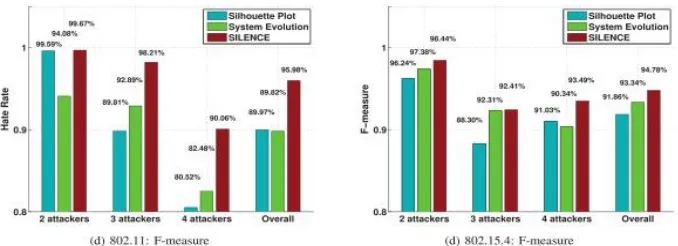
Shown in Fig.4 the performance efficiency is more by using SILENCE mechanism. The proposed approach is successful in finding the presence and deciding the number of assaulters. Validation is done on 2 testbeds through each an 802.11network (Wi-Fi)and an 802.15.4 (ZigBee) network in 2 real edifice habitats. Validated result is shown in table 1. It istend to found that the proposed mechanisms area highly effective in detective work.Alsoanalyzedthat the presence of assaults with detection rates over 90% and crucial the quantity of antagonistsachieving over 90% hit rates and exactitude at the same time once mistreatment SILENCE and SVM-based mechanism is employed. Further, supported the quantity of assaulters determined by our mechanisms, the proposed system can find the presence and decide the amount of assaulters at different transmitting powers.
Table 1: Outcomes
Number of Assaulters 2 3 4 802.11 network, Hit Rate 99.96% 99.07% 94.83% 802.11 network, Precision 99.10% 95.65% 99.92% 802.11 network, F-measure 99.52% 97.33% 97.31% 802.15.4 network, Hit Rate 99.99% 96.49% 92.41% 802.15.4 network, Precision 97.44% 92.86% 99.99% 802.15.4 network, F-measure 98.70% 94.64% 96.06% SVM: Hit Rate, Precision, and F-Measure of Deciding the Amount of Assaulters
VI. CONCLUSION
This paper includes the new approaches with different methodologies to determine the assaulters’ presence and to decide the amount of attackers who are causing harm to the system resources are functionality of the system. Previously available methods are scanned and advanced techniques are added to the existing methods to improve the efficiency of the aim in the current paper. Practical tests have been made and proved to get the high performance and great results, thus proving the effective utilization of available technical environment according to the user need.
VII. ACKNOWLEDGEMENTS
I deeply express my sincere gratitude to Dr. K. N. Subramanya, Principal, R.V.C.E, Dr. Shobha G, Head of Department, Computer Science & Engineering, R.V.C.E, my guide Dr. Nagaraj G. S, Professor, Department of CSE, R.V.C.E for their valuable guidance and support for this project.
References
[1] J. Bellardo and S. Savage, “802.11 Denial-of-Service Assaults: Real Vulnerabilities and Practical Solutions,” Proc. USENIX Security Symp., pp. 15-28, 2003.
[2] F. Ferreri, M. Bernaschi, and L. Valcamonici, “Access Points Vulnerabilities to Dos Assaults in 802.11 Networks,” Proc. IEEE Wireless Comm. and Networking Conf., 2004.
[3] D. Faria and D. Cheriton, “Detecting Identity-Based Assaults in Wireless Networks Using Signal prints,” Proc. ACM Workshop Wireless Security (WiSe), Sept. 2006.
[4] Q. Li and W. Trappe, “Relationship-Based Detection of Spotting Related Anomalous Traffic in Ad Hoc Networks,” Proc. Ann. IEEE Comm. Soc. on IEEE and Sensor and Ad Hoc Comm. and Networks (SECON), 2006.
[5] B. Wu, J. Wu, E. Fernandez, and S. Magliveras, “Secure and Efficient Key Management in Mobile Ad Hoc Networks,” Proc. IEEE Int’l Parallel and Distributed Processing Symp. (IPDPS), 2005.
[6] A. Wool, “Lightweight Key Management for IEEE 802.11 Wireless LansWith Key Refresh and Host Revocation,” ACM/Springer Wireless Networks, vol. 11, no. 6, pp. 677-686, 2005.
[7] Y. Sheng, K. Tan, G. Chen, D. Kotz, and A. Campbell, “Detecting 802.11 MAC Layer Spotting Using Received Signal Strength,” Proc. IEEE INFOCOM, Apr. 2008.
[9] Y. Chen, W. Trappe, and R.P. Martin, “Detecting and Localizing Wireless SpottingAssaults,” Proc. Ann. IEEE Comm. Soc. Conf. Sensor, Mesh and Ad Hoc Comm. and Networks (SECON), May 2007.
[10] M. Bohge and W. Trappe, “An Authentication Framework for Hierarchical Ad Hoc Sensor Networks,” Proc. ACM Workshop Wireless Security (WiSe), pp. 79-87, 2003.
[11] L. Xiao, L.J. Greenstein, N.B. Mandayam, and W. Trappe, “Fingerprints in the Ether: Using the Physical Layer for Wireless Authentication,” Proc. IEEE Int’l Conf. Comm. (ICC), pp. 4646-4651, June 2007.
[12] V. Brik, S. Banerjee, M. Gruteser, and S. Oh, “Wireless Device Identification with Radiometric Signatures,” Proc. 14th ACM Int Conf. Mobile Computing and Networking, pp. 116-127, 2008.
[13] F. Guo and T. Chiueh, “Sequence Number-Based MAC Address Spoof Detection,” Proc. Eighth Int’l Conf.Recent Advances in Intrusion Detection, pp. 309-329, 2006.
[14] L. Sang and A. Arora, “Spatial Signatures for Lightweight Security in Wireless Sensor Networks,” Proc. IEEE INFOCOM, pp. 21372145, 2008.
[15] P. Bahl and V.N. Padmanabhan, “RADAR: An in-Building RF- Based User Location and Tracking System,” Proc. IEEE INFOCOM, 2000.
[16] E. Elnahrawy, X. Li, and R.P. Martin, “The Limits of Localization Using Signal Strength: A Comparative Study,” Proc. IEEE Int’l Conf. Sensor and Ad Hoc Comm. and Networks (SECON), Oct. 2004.
[17] Y. Chen, J. Francisco, W. Trappe, and R.P. Martin, “A Practical Approach to Landmark Deployment for Indoor Localization,” Proc. IEEE Int’l Conf. Sensor and Ad Hoc Comm. and Networks (SECON), Sept. 2006.
[18] J. Yang and Y. Chen, “A Theoretical Analysis of Wireless Localization Using RF-Based Fingerprint Matching,” Proc. Fourth Int’l Workshop System Management Techniques, Processes, and Services (SMTPS), Apr. 2008.
[19] P. Enge and P. Misra, Global Positioning System: Signals, Measurements and Performance. Ganga-Jamuna Press, 2001.