ABSTRACT
KONIREDDYGARI, SREEKANTH. Measuring and Improving TLB Performance for Linux GUI Applications. (Under the direction of Dr. Edward Gehringer and Dr. William Cohen).
Modern GUI applications rely on a large number of dynamically linked shared libraries to
reduce the applications' memory footprint and to avoid recompilation when newer versions
of the shared libraries become available. However, each shared library needs separate
memory pages, and the pages are laid out in virtual memory in essentially random fashion.
This leads to increased conflict misses in the translation lookaside buffer (TLB) and
diminishes the application's performance. Previous work has measured TLB performance
using standard benchmarks, which consist of applications with statically-linked libraries.
Statically-linked programs tend to use fewer libraries, and don't require separate pages for
each library; hence they place much less stress on the TLB.
We added a TLB simulator to Valgrind, a Linux binary instrumentation tool, and
used Dogtail, a testing framework for GUI applications, to measure TLB behavior for
several dynamically linked GUI applications: the document-viewing application Evince, the
word processor Abiword, the image viewer Gthumb, and the calculator Gcalctool. Analysis
of TLB miss data from the Valgrind instrumentation showed that some shared library pages
repeatedly conflicted with pages from other shared libraries for TLB entries. Moving just a
single highly-contended shared library to a different place in the virtual address space
reduced TLB conflict misses up to 14.7%. Average reductions across applications were
call-graph information. Results demonstrated greater improvement in miss ratios for
Measuring and Improving TLB Performance for
Linux GUI Applications
by
Sreekanth Konireddygari
A thesis submitted to the Graduate Faculty of North Carolina State University
in partial fulfillment of the requirements for the Degree of
Master of Science
Computer Science
Raleigh, North Carolina
2008
APPROVED BY:
_________________________ ________________________
BIOGRAPHY
Sreekanth Konireddygari is currently a graduate student in the Department of Computer
Science, North Carolina State University. He earned his Bachelor’s degree in Electronics
and Communication Engineering from Karnatak University, India. Sreekanth is currently
employed with IBM Corporation, RTP, NC, where he develops cross-platform software for
ACKNOWLEDGMENTS
I would like to express my sincere gratitude to my advisors Dr. Edward Gehringer and Dr.
William Cohen for giving me an opportunity to pursue this study, and for their guidance
throughout the whole journey of this thesis work. I would like to thank Dr. Matthias
Stallmann for agreeing to serve on the committee, and for his guidance on
graph-partitioning techniques.
I would like to extend my sincere appreciation to my manager at work, Ed Rabenda, for his
encouragement and support all along.
I am grateful to my wife and my family for their inspiration. Without their unflagging
TABLE OF CONTENTS
LIST OF TABLES………. v
LIST OF FIGURES………... vi
1 Introduction... 1
1.1 Related Work ... 2
2 Simulations and Benchmarks... 4
2.1 TLB Simulator ... 4
2.2 Simulator Design Assumptions ... 4
2.3 Design of the Simulator ... 5
2.4 Simulation Environment ... 6
2.5 Workload... 6
2.5.1 Working Set ... 7
2.6 Simulator TLB Configurations ... 8
3 Methodolgy ... 10
3.1 Layout of Shared Libraries in a Process's Virtual Address Space ... 10
3.1.1 Prelink ─ A Method to Modify the Shared Library Layout ... 10
3.2 Single-library Relocation Based on TLB-set Eviction Patterns ... 11
3.2.1 TLB-Set Contention Analysis with Page Eviction History ... 13
3.2.2 Eviction Graph Generation and Analysis ... 14
3.3 Relocation Based on Application Call Graph ... 15
3.3.1 TLB-Set Allocation and Library Relocation Algorithm... 16
4 Results... 19
4.1 Results from Single-library Relocation with Eviction Pattern Methodology... 19
4.2 Results from Call-Graph Methodology ... 28
4.3 Different workloads ... 32
4.4 Performance ... 33
5 Conclusions... 36
5.1 Future Work ... 37
LIST OF TABLES
Table 2.1: Number of instruction and data (4KB) pages mapped and touched in the process
address space of the benchmarks ... 8
Table 4.1: The default and the new base virtual addresses of the libraries for the 512-entry TLB simulation benchmarks... 23
Table 4.2: The default and new base virtual addresses of the libraries for the split 128-entry instruction TLB simulation ... 23
Table 4.3: Performance figures for the unfied 512-entry, 4-way TLB ... 26
Table 4.4: Performance figures for the unified 256-entry, 4-way TLB... 26
Table 4.5: Performance figures for 128-entry, 4-way I-TLB ... 26
Table 4.6: Performance figures for 128-entry, 4-way D-TLB... 26
Table 4.7: Performance figures for 64-entry, 4-way I-TLB ... 26
Table 4.8: Performance figures for 64-entry, 4-way D-TLB... 27
Table 4.9: Performance figures for the unified 512-entry, 4-way TLB... 29
Table 4.10: Performance figures for the unified 256-entry, 4-way TLB... 30
Table 4.11: Performance figures for 128-entry, 4-way I-TLB ... 30
Table 4.12: Performance figures for 128-entry, 4-way D-TLB... 30
Table 4.13: Performance figures for 64-entry, 4-way I-TLB ... 30
Table 4.14: Performance figures for 64-entry, 4-way D-TLB... 31
Table 4.15: Performance figures with a different workload for Evince with unified 512-entry, 4-way TLB... 33
LIST OF FIGURES
Figure 3.1: An example illustrating the single-library relocation methodology... 12
Figure 3.2: Steps involved in the single-library relocation strategy ... 13
Figure 3.3: A sample eviction graph illustrating contention in set 24 ... 15
Figure 3.4: Sample output of the Valgrind simulator listing TLB page interactions ... 16
Figure 4.1: Distribution of misses among TLB sets from Evince with unified 512-entry, 4-way TLB simulation before the shared library layout modification... 19
Figure 4.2: Distribution of misses among TLB sets from Abiword with unified 256-entry, 4-way TLB simulation before the shared library layout modification... 20
Figure 4.3: Distribution of misses among TLB sets from Gthumb with 64-entry, 4-way split data TLB simulation before the shared library layout modification... 21
Figure 4.4: Eviction graph for Evince with unified 512-entry, 4-way TLB simulation ... 22
Figure 4.5: Difference in TLB misses across sets before and after the modification of the layout for Evince with unified 512-entry, 4-way TLB ... 24
Figure 4.6: Differences (after and before relocation) in TLB misses across sets sorted in descending order for Evince 512-entry unified TLB. Each vertical bar represents a set. ... 24
Figure 4.7: Coefficient of variance of misses across TLB sets for Evince before and after 25 Figure 4.8: Miss rates for the unfied 512-entry TLB... 27
Figure 4.9: Miss rated for the unified 256-entry TLB ... 27
Figure 4.10: Miss rates for 128-entry I-TLB ... 27
Figure 4.11: Miss rates for 128-entry D-TLB... 27
Figure 4.12: Miss rates for 64-entry I-TLB ... 28
Figure 4.13: Miss rates for 64-entry D-TLB... 28
Figure 4.14: Differences (after and before relocation) in TLB misses across sets sorted in descending order for Evince with 128-entry I-TLB. Each vertical bar represents a set. ... 29
Figure 4.15: Miss rates for 128-entry I-TLB ... 31
Figure 4.16: Miss rates for 128-entry D-TLB... 31
Figure 4.17: Miss rates for 64-entry I-TLB ... 31
Figure 4.18: Miss rates for 64-entry D-TLB... 31
Figure 4.19: Miss rates for the unified 512-entry TLB... 32
1 Introduction
A translation lookaside buffer (TLB) is present on all modern microprocessors to
maintain a cache of recently used virtual-to-physical address translations. The reach, or
coverage, of a TLB is the amount of physical memory that the processor can access without
suffering an expensive TLB miss, and is computed as the product of number of entries
contained in the TLB by the amount of memory mapped by each entry. Due to space and
lookup time constraints, the coverage of the TLB has not scaled as rapidly as the
virtual-memory address spaces of application programs. This has become a significant
performance bottleneck affecting the overall performance of the system.
The run-time instruction and data reference patterns of an application can have a
significant bearing on the TLB performance. Like traditional caches, TLBs can suffer from
lack of temporal and spatial locality. For example, for a graphics application accessing
pixels in a column, each pixel might be on a separate page of memory; thus, accessing the
column would cause frequent TLB misses. Likewise, graphical user interfaces (GUIs) often
use dozens of shared libraries. Each shared library is a separate unit; separate units are
linked into separate pages. Thus, functions in separate libraries that call each other will
always be on separate pages, increasing the number of pages in the working set and
increasing the probability of TLB misses.
TLB performance can be an issue for GUI applications. We modeled typical TLB
configurations while simulating representative GUI applications. Some sets in the
TLB misses per set suggested that performance could be improved by relocating (changing
the virtual address of) the shared library with the page causing the high number of misses.
Moving shared libraries with the highly contended pages yielded modest improvements in
the TLB miss rates for the applications examined. Call-graph analysis of the applications
used in the study also revealed that function calls among pages mapped into same TLB sets
showed higher levels of evictions. The contention observed within these sets suggested that
TLB performance can be improved by distributing frequently called pages among different
sets. We studied two software-oriented shared-library relocation methodologies to improve
TLB performance on existing CPU architectures.
1.1 Related Work
Most previous TLB studies used SPEC benchmarks with little consideration of how many
shared libraries they used, or how the libraries were laid out in the process's virtual address
space. These studies primarily used non-GUI applications with smaller application working
sets. Chen et al. [1] studied the performance of various TLB configurations with
applications such as gcc, magic, and ld, which had an average text segment size of about
200KB (50 pages, 4KB each). This is significantly smaller than the working-set size of
most modern GUI applications. In this study, all applications have instruction regions of at
least 81MB (20,380 pages, 4KB each). This is representative of GUI application programs
in modern computing environments, and is at least an order of magnitude larger than the
demands placed on the TLB by the instruction stream. While the instruction stream might
have a negligible impact on the TLB in smaller applications, the instruction TLB could
become a performance bottleneck for the execution of applications with large working-set
size, such as Abiword, one of the benchmarks used in this study.
Talluri et al [11] propose increasing the size of the TLB entries to improve the TLB
performance of superpages with less operating system support. However, the increased
TLB area can lead to increased access times. Kandiraju et al [5] also propose significant
changes to TLB hardware to implement prefetching techniques. As the CPUs are becoming
increasingly complex, the space constraints may neither allow for such an increase in TLB
sizes nor for a complex TLB circuitry.
On-the-fly superpage construction approach was proposed by Romer et al [9]. The
methodology describes methods to detect when and where a superpage should be
constructed based on TLB miss behavior gathered at runtime. However, the implementation
2 Simulations and Benchmarks
To better understand the contention within TLB sets, a TLB simulator was developed.
Since TLB performance improvements cannot be computed using formulas, simulations
were conducted with benchmarks that represent commonly-performed tasks.
2.1 TLB Simulator
A TLB simulator was developed and integrated into the Cachegrind component of the
Valgrind suite [7], a Linux binary instrumentation tool. This simulator is capable of running
GUI programs on Linux without modifying the executable. Several simplifying
assumptions were made in the simulator; they are discussed in the Section 2.2. Section 2.3
describes the simulator internals.
2.2 Simulator Design Assumptions
The simulator was designed to execute in a single-process environment; TLB misses that
might occur due to process context switches are not considered. In most IA-32 CPU
implementations, the TLB is flushed whenever there is a context switch (Moshe Bar [12]),
which results in additional compulsory TLB misses. These compulsory misses will not
increase the number of other (capacity and conflict) misses. Our hypothesis is that if
TLB-set contention is detected and reduced when the process is being executed, overall TLB
performance for all processes is also improved. Moreover, the rising number of processor
core, and hence the frequency of context switches. In addition, TLB flushes due to context
switches can be avoided by extending the index of the TLB to include the process ID or the
domain ID (Ulrich Drepper [12]).
TLBs often have multiple levels. A miss in one level is passed on to the next-level
TLB. We did not simulate multi-level TLBs, since misses at one level that are satisfied in a
lower-level TLB cost a lot less than a miss that goes all the way to the page table in main
memory. Thus, the cost is dominated by the global TLB miss rate. We assume that the
TLBs we simulated are last-level TLBs before the page table. These misses are relatively
expensive due to a chain of read accesses needed to fill the new TLB entry.
2.3 Design of the Simulator
Valgrind uses dynamic binary instrumentation, which eliminates the need to modify or
recompile the applications used in our simulation studies. The core of the Valgrind suite
provides a synthetic CPU on which instrumented instructions are executed. The simulated
TLB configuration is given as a command-line argument to the simulator. The TLB
simulator is invoked by the Valgrind core whenever the simulated application references its
instructions or data. The Valgrind core supplies the following information to the TLB
simulator:
• Type of access (instruction or data)
• Virtual address of the referenced instruction or data
LRU replacement is simulated. During the simulation, the TLB simulator maintains various
dynamically tracks and records eviction patterns in each set, and dumps this data to a file
for further analysis. These eviction-history tables allow us to determine which sets
experience heavy contention. The TLB simulator translates the virtual address to a physical
address, which is forwarded to the cache simulator of the Valgrind suite.
2.4 Simulation Environment
The simulations were done on a workstation with a 32-bit Intel Core Duo processor hosting
a Linux Fedora core 6 operating system.
2.5 Workload
The following GUI-based Linux applications were used as benchmarks for this study:
Evince, Abiword, Gthumb and Gcalctool. These applications were chosen because they
possess the following characteristics:
• represent commonly-performed tasks
• depend on a number of dynamically-linked libraries
• have built-in accessibility features needed to automate the workload generation
process
The GUI automation tool dogtail [3] was used to generate consistent workloads across
multiple runs. Dogtail scripts were generated to automate the following user tasks for each
of the applications:
• Evince: Open a 32KB PDF document and print it to a file in the current directory,
• Abiword: Type 15 sentences, format the paragraph to make it right aligned, save the
file in the current folder, and then close the application.
• Gthumb: Open a folder that contains an image. The size of the image file is 8 KB. In
browser mode, select the thumbnail image and view it in an image window, then
close the application.
• Gcalctool: Enter the decimal number 45 and multiply this by the decimal number 3.
Divide the result by the decimal number 7. Enter the decimal number 6, delete it
using the backspace key, enter the decimal number 9, and subtract this from the
result. Add .03 to the result. Compute the final result and quit the application.
2.5.1 Working Set
These applications mapped 82MB to 190MB of instruction pages and 31MB to 89MB of
data pages (Table 2.1) into their address space, and touched at least 3179 instruction and
data pages. This means that the address space was at least 57 times as large as the reach of
the largest (512-entry) TLB, and the number of pages touched was at least six times its
Table 2.1: Number of instruction and data (4KB) pages mapped and touched in the process
address space of the benchmarks
Pages Mapped Pages Touched
Instruction Data Instruction Data
Evince 20,380 9,507 1922 3933
Abiword 21,541 7,815 2110 3743
Gthumb 47,490 22,137 1804 3322
Gcalctool 19,630 20,659 1291 1888
2.6 Simulator TLB Configurations
The page size simulated for all TLB configurations is 4 KB, which is a standard page size
supported by Linux on IA-32 systems. The following four TLB configurations, representing
a broad spectrum of TLB configurations on CPUs from different CPU vendors, were
simulated:
• Unified 512-entry, 4 KB page, 4-way set-associative TLB (2 MB reach),
• Unified 256-entry, 4 KB page, 4-way set-associative TLB (1 MB reach)
• Separate instruction and data TLBs, each 128-entry, 4 KB page, 4-way set
associative (512 KB reach for instruction pages and 512 KB reach for data pages)
• Separate instruction and data TLBs, each 64-entry, 4 KB page, 4-way set associative
(256 KB reach for instruction pages and 256 KB reach for data pages)
The TLB configurations simulated in this study closely relate to those on some of the
AMD K8: L2, unified 512-entry, 4-way set associative
Intel P4: L1, I-TLB and D-TLB 64-entry
3 Methodolgy
We used two approaches to relocating shared libraries: (1) Relocation of a single library
experiencing high contention and (2) relocation of many libraries, based on the application
call graph. This chapter describes these two methodologies. The following section describes
the technique used by Linux to layout the shared libraries in a process address space.
3.1 Layout of Shared Libraries in a Process's Virtual Address
Space
When an application is being loaded for execution, the dynamic linker is responsible for
resolving dependencies, and mapping and loading the shared libraries into the process
address space. While doing so, it does not take into account the reference patterns of the
application nor the performance implications for the TLB. Instead, the loader attempts to
minimize the load time. This speedup is accomplished through prelinking, as discussed in
the following section.
3.1.1 Prelink
─
A Method to Modify the Shared Library Layout
The prelink program on the Linux operating system is intended to save load time by
performing relocations in advance. It resolves dependencies prior to loading the libraries. It
scans all dependent libraries, assigns a unique slot in the virtual address space to each
library, and relinks the shared library with that base address. The dynamic linker, during the
load process, maps the prelinked library into the allocated virtual memory address range,
the help of the dynamic linker, resolves all relocations in the object files against dependent
libraries, and stores the relocations in shared library object files. In our study, we prelinked
all applications prior to the simulations to keep the shared library layout consistent across
different data-collection runs. This allowed us to modify the virtual-address slot of a single
library whose pages were contending heavily with other pages in a TLB set in a particular
TLB configuration. The prelink utility provides a “relink-only” (-r) option, which allowed
the location of a shared library to be changed in the object files without affecting
virtual-address slots of other shared libraries. Based on the process virtual-address map, an empty slot was
chosen so that the page descriptor would fall in the desired TLB set. The shared library was
moved there using the relink option. The simulations were rerun after relinking libraries for
each of the TLB configurations.
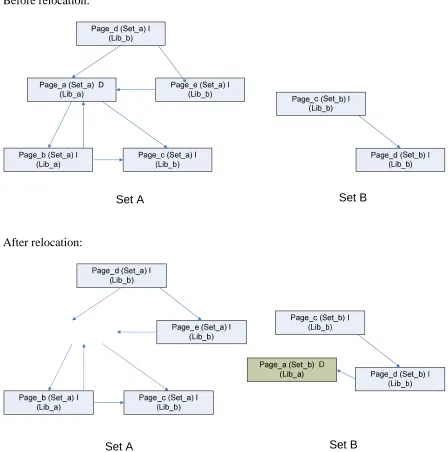
3.2 Single-library Relocation Based on TLB-set Eviction Patterns
The objective of this methodology is to move the most heavily-contending page from a set
with most evictions to a set with fewer evictions in order to reduce TLB misses. Figure 3.1
illustrates a sample relocation of a page from Set A to Set B. The pages are denoted by
circles, and the transitions in the figure denote the contention between the pages. Section
3.2.2 provides a more in-depth description of the graphs that were used in this study to
analyze the contention between the pages in a set. The dotted lines in Figure 3.1 after
relocation indicate the reduction in the number of evictions in Set A.
The single-library relocation study involves the following steps (see Figure 3.2): collection
of the simulation data to detect the TLB sets with the highest number of conflict misses,
Before relocation:
After relocation:
Figure 3.1: An example illustrating the single-library relocation methodology
Page_a (Set_a) D (Lib_a)
Page_b (Set_a) I (Lib_a)
Page_c (Set_a) I (Lib_b) Page_d (Set_a) I
(Lib_b)
Page_e (Set_a) I (Lib_b)
Set A Set B
modification of the layout of the shared library by relocating a single library, and manually,
collection of the simulation data after the modification. The method described in Section
3.1.1 was used to modify the layout by changing the base virtual address of the shared
library in the Linux operating system.
Figure 3.2: Steps involved in the single-library relocation strategy
3.2.1 TLB-Set Contention Analysis with Page Eviction History
To analyze the eviction patterns and study TLB-set contention among libraries, the TLB
simulator generates an eviction-history table that contains the following information in
tabular format:
• referenced page (victimizer) that is causing a TLB access, and is being loaded into
one of the TLB sets,
• the page that is being evicted (victim) from the TLB,
• the number of times the victmizer page evicted the victim page,
• the types of the victimizer and victim page (instruction or data),
• the TLB set number,
• the names of the files to which each victimizer and victim page belongs,
• number of times data or instructions referenced in the victimizer page
3.2.2 Eviction Graph Generation and Analysis
To study the contention for TLB sets by pages from shared libraries, eviction graphs were
generated from the eviction history tables. Each set is represented by an eviction graph, and
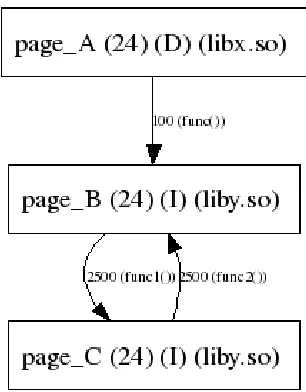
each node within the graph represents a page. A sample eviction graph used for contention
analysis is illustrated in Figure 3.3. The edges represent transitions showing which page is
replaced in the TLB. The transition from page A to page B indicates that (the victim) page A
is being replaced by (the victimizer) page B. A label on the transition denotes the number of
times the victim page has been evicted by the victimizer page. Nodes with less than 500
transitions (incoming edges) are not generated in the eviction graph for the 512-entry and
256-entry TLB configurations; for 128-entry and 64-entry TLB simulations, the
corresponding thresholds are 1000 and 3000 evictions page, respectively. The sample
eviction graph in Figure 3.3 illustrates the contention between three pages: page A, page B
and page C. A is replaced by B 100 times because of the reference to the routine func() on
B. Similarly, B and C replace each other 2500 times. After doing the analysis, we relocate
the base virtual address of the library, so that that the most highly-contending page from
Figure 3.3: A sample eviction graph illustrating contention in set 24
3.3 Relocation Based on Application Call Graph
Another approach to reducing TLB contention involves relocation of shared libraries based
on the call-graph information. Call-graph information was collected by the instrumentation
tool Callgrind, a sub-component of the tool Valgrind. The objective of this strategy is to
distribute the frequently called (referenced) pages among different sets. This tends to
improve TLB performance by minimizing conflicts within TLB sets. The algorithm keeps
track of the (dynamic) number of calls to pages in each set of the TLB. The most frequently
called page of a library is assigned to the set having the least total calls thus far. This results
in the library being assigned to a specific location in the virtual address space. Linked lists
representing callee-caller relationships are constructed to lay out the libraries in the
3.3.1 TLB-Set Allocation and Library Relocation Algorithm
The TLB-set allocation and relocation algorithm uses the callgraph data captured by
running the application with the default layout of the shared libraries. The call-graph output
generated by Callgrind lists the caller page for each of the callee (virtual) pages. In the
sample call-graph output shown in Figure 3.4, the last entry denoted with a “*” is the callee
page (28C6) and the entries above it (26AB, 2EE7, C9F etc.) denoted by “<” are its caller
pages. The number to the left of “<” is the number of instruction references, and to its
immediate right is the caller page number. The number in the parentheses is the number of
times the function in the caller page called the function in the callee page.
86, 141 < 2EEA (2101x) [/usr/lib/libORBIT-2.so.0.1.0] 105,493 < 2EF0 (2573x) [/usr/lib/libORBIT-2.so.0.1.0] 340,628 < 2E28 (8308x) [/usr/lib/libbonobo-2.so.0.0.0]
784 < E (16x) [/usr/lib/gtk-2.0/2.10.0/engines/libclearlooks.so] 111,233 < AF4 (4734x) [/lib/libc-2.5.so]
11,016 < C9F (347x) [/usr/lib/libxml2.so.2.6.27] 86,141 < 2EE7 (2101x) [/usr/lib/libORBIT-2.so.0.1.0] 720,903 < 26AB (17583x) [/lib/libgobject-2.0.so.0.1200.9] 114,845,705 * 28C6 [/lib/libpthread-2.5.so]
Figure 3.4: Sample output of the Valgrind simulator listing TLB page interactions
The algorithm consists of two phases: initialization, and distribution of callee pages among
sets. The initialization phase does the following:
• The call-graph data file generated by Callgrind is processed, and a linked list of all
callee pages is constructed.
• For each callee page, a linked list of caller pages is constructed. The caller and the
callee pages are represented by data structures with the following: page address,
• The callee page list is sorted in decreasing order of reference counts; this places the
callee page with most references at the top of the list.
• An n-entry pseudo-TLB, represented by a linked list, is constructed, where n is the
number of sets. Each set is represented by a data structure which contains the
following: set number, list of callee pages mapped into this set, and reference count
(the sum of reference counts of all callee pages mapped into the set).
• Each set in the pseudo-TLB comprises a list of library pages mapped into that set.
Each library page is represented by a data structure which consists of the following:
name of the shared library mapped into that set, a list of callee pages of the shared
library mapped into that set.
The callee-page distribution phase of the algorithm consists of the following steps:
• The page at the front of the callee page list (the page with highest reference count)
is picked for relocation.
• If the library that owns the callee page is already relocated, the next callee page
from the list is picked.
• The TLB set with the lowest reference count is picked from the list that represents
the pseudo-TLB.
• To minimize TLB replacements, the callee page is placed in a set other than the set
that its callers lie in. So for each candidate set, the callee-page's caller list is
traversed to check whether any of the calling pages lie in the candidate set. If it is
lowest reference count. This check is performed iteratively until a set is picked
from the pseudo-TLB, and the callee page is mapped into that set. The callee page
is added to the library page list of the pseudo-TLB set to indicate that the page has
been mapped into that set.
• Based on the selected TLB set, a new starting address for the callee page's library is
calculated.
• If the library whose page has just been relocated has any other pages, they are
mapped to virtual addresses contiguous with the just-relocated page. The reference
counts of the sets into which the callee pages are mapped are updated.
• These steps are repeated starting with the next callee page in the sorted callee-page
4 Results
This chapter presents results from simulations before and after shared-library relocation,
using the two methodologies explained in chapter 3.
4.1 Results from Single-library Relocation with Eviction Pattern
Methodology
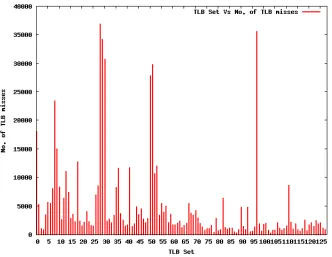
The graphs in Figure 4.1, Figure 4.2, and Figure 4.3 illustrate the distribution of misses
across sets for Evince with unified 512-entry TLB, Abiword with unified 256-entry TLB
and Gthumb with 64-entry split instruction TLB simulation runs, respectively, using the
default layout of the shared libraries in their address spaces.
The peaks in the graph show that the contention among a few sets is significantly higher
than for other sets. This suggests that if the pages with repeated conflicts in high-contention
sets are moved to other sets with relatively fewer conflicts, a reduction in the total number
of conflict misses might be achieved.
Figure 4.3: Distribution of misses among TLB sets from Gthumb with 64-entry, 4-way split data TLB simulation before the shared library layout modification
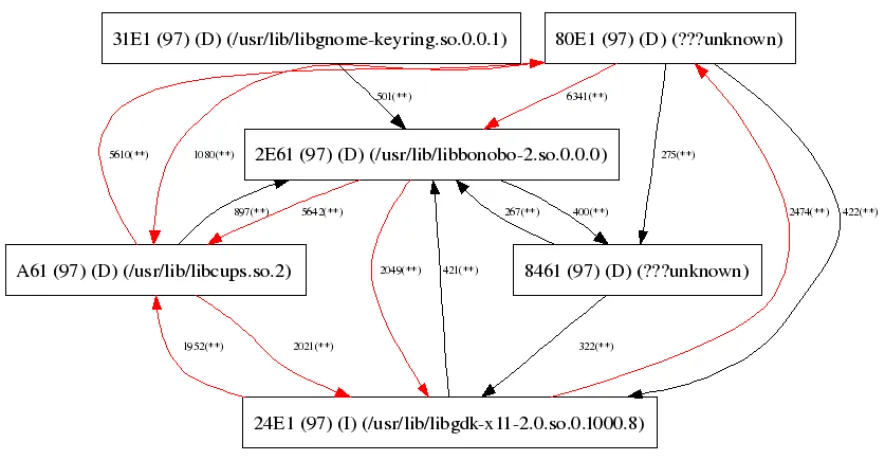
The eviction graph shown in Figure 4.4 illustrates the contention in set 97 (the set with the
maximum number of misses) among pages from different libraries for Evince in the
512-entry TLB simulation run. It is clear from the graph that page 0x2E61 from the shared
library libbonobo-2.so.0.0.0 is involved with many TLB evictions in the high-contention set
97; the page is either being brought into the set, frequently replacing other pages; or is
being evicted frequently by other pages, as indicated by the edges. The virtual base address
of this shared library was modified so that the page is mapped into a different TLB set. The
library was moved to virtual address 0x12C000, which was previously unoccupied in the
process address space. This change in virtual address ensures that the page with maximum
Figure 4.4: Eviction graph for Evince with unified 512-entry, 4-way TLB simulation
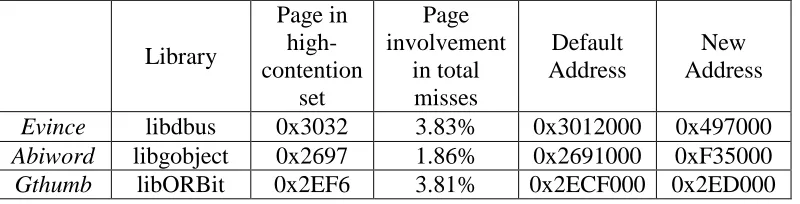
Table 4.1 lists the libraries that have been modified for the 512-entry TLB simulations. The
column “Page in high-contention set” lists the single page in each library causing the
maximum number of evictions in the highly-contended set before the layout modification.
The column “Page involvement in total misses” lists the percentage of the total number of
misses for which the page (listed in the column “Page in high-contention set”) from the
library is either fetched into the TLB or evicted from the TLB. The libraries listed in
column “Library” of the table were picked for layout modification because their most
highly-contending page is involved in about 2.6% (on average) of the total number of
misses in the respective benchmark. The libraries that have been modified for the 128-entry
instruction TLB simulation are listed in Table 4.2. Figure 4.5 displays the difference in the
shared library libbonobo-2.so.0.0.0 for Evince with 512-entry TLB simulation. The
negative peaks show the reduction in the number of misses after the
Table 4.1: The default and the new base virtual addresses of the libraries for the 512-entry TLB simulation benchmarks
Library Page in high-contention set Page involvement in total misses Default Address New Address
Evince libbonobo 0x2E61 2.87% 0x2E05000 0x12C000
Abiword libgdk 0x24B7 2.13% 0x24A3000 0x11C000
Gthumb libORBit 0x2F1D 2.78% 0x2ECF000 0x2ED000
Table 4.2: The default and new base virtual addresses of the libraries for the split 128-entry instruction TLB simulation
Library Page in high-contention set Page involvement in total misses Default Address New Address
Evince libdbus 0x3032 3.83% 0x3012000 0x497000
Abiword libgobject 0x2697 1.86% 0x2691000 0xF35000
Gthumb libORBit 0x2EF6 3.81% 0x2ECF000 0x2ED000
modification of the layout. Set 97, which was one of the heavily contended sets in Figure
4.5, shows a negative peak indicating less contention after the modification. Figure 4.6
illustrates the differences in TLB misses across sets sorted in descending order. It can be
observed that the shaded area below the axis is larger than the shaded area above which
indicates that there is a net decrease in the number of TLB misses after relocation.
Figure 4.7 presents the coefficient of variance values for the misses across all sets
variance indicates that replacements are more evenly spread among the sets, which means
Figure 4.5: Difference in TLB misses across sets before and after the modification of the layout for Evince with unified 512-entry, 4-way TLB
Figure 4.7: Coefficient of variance of misses across TLB sets for Evince before and after
the base address modification
less thrashing in heavily contended TLB sets. This also suggests that the peaks (of misses)
seen in some of the sets before the layout modification in Figure 4.1 have been reduced.
Table 4.3, Table 4.4, Table 4.5, Table 4.6, Table 4.7 and Table 4.8 present the total number
of TLB accesses and misses for the benchmarks before and after the shared library layout
modification. It can be observed that misses are reduced after layout modification, except
for a slight increase in the number of misses for Abiword with split 128-entry and 64-entry
data TLB simulations. However, instruction-TLB misses for these two simulations have
decreased. The corresponding miss rates for all simulated TLB configurations before and
after the layout modification are presented in Figure 4.8, Figure 4.9, Figure 4.10, Figure
4.11, Figure 4.12, and Figure 4.13. These figures illustrate that the miss rates have
entry and 64-entry D-TLB simulations as shown in Figure 4.11 and Figure 4.13.
Table 4.3: Performance figures for the unfied 512-entry, 4-way TLB
TLB Accesses TLB Misses
Before After Before After
Evince 2,440,825,239 2,453,775,228 609,102 552,421 Abiword 6,998,081,655 6,990,273,929 3,109,707 2,852,774
GThumb 1,957,182,463 1,958,059 493,741 468,913
Table 4.4: Performance figures for the unified 256-entry, 4-way TLB
TLB Accesses TLB Misses
Before After Before After
Evince 2,432,596,581 2,457,165,965 3,366,102 2,872,029 Abiword 6,977,572,797 6,957,123,472 11,966,085 11,337,441 GThumb 1,958,149,042 1,957,018,016 2,026,559 1,984,695
Table 4.5: Performance figures for 128-entry, 4-way I-TLB
TLB Accesses TLB Misses
Before After Before After
Evince 1,566,255,316 1,575,622,195 1,167,461 1,088,987 Abiword 4,330,240,432 4,305,221,408 6,895,394 6,550,586 GThumb 1,253,874,020 1,255,493,913 791,188 787,931
Table 4.6: Performance figures for 128-entry, 4-way D-TLB
TLB Accesses TLB Misses
Before After Before After
Evince 890,978,634 895,263,366 2,251,358 2,009,389 Abiword 2,646,306,273 2,629,314,357 4,907,404 4,964,352 GThumb 702,923,236 703,660,666 1,517,735 1,498,081
Table 4.7: Performance figures for 64-entry, 4-way I-TLB
TLB Accesses TLB Misses
Before After Before After
Table 4.8: Performance figures for 64-entry, 4-way D-TLB
TLB Accesses TLB Misses
Before After Before After
Evince 888,170,929 896,415,162 5,277,293 5,030,958 Abiword 2,649,817,917 2,652,221,532 11,496,889 12,364,948 GThumb 702,651,903 703,799,087 3,643,586 3,619,820
Figure 4.8: Miss rates for the unfied 512-entry TLB
Figure 4.9: Miss rated for the unified 256-entry TLB
Figure 4.12: Miss rates for 64-entry I-TLB Figure 4.13: Miss rates for 64-entry D-TLB
4.2 Results from Call-Graph Methodology
Table 4.9, Table 4.10, Table 4.11, Table 4.12, Table 4.13 and Table 4.14 present TLB
performance figures before and after shared library relocation using the call-graph
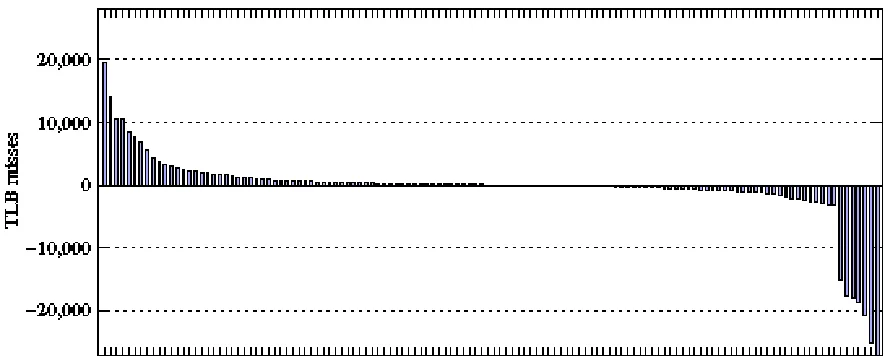
technique of Section 3.3. Figure 4.14 illustrates the differences in TLB misses after and
before the relocation sorted in descending order for Evince with 128-entry I-TLB. It can be
observed that there are more number of sets with greater magnitude below the axis
(negative) indicating a net decrease in the number of TLB misses. The miss ratios for the
128-entry and 64-entry split TLB simulations (in Figure 4.15 and Figure 4.17) indicate that
a significant reduction in miss ratios was achieved for the instruction TLBs after the
relocation. However, the data-TLB results for the split 128-entry and 64-entry TLBs are
mixed, as shown in Figure 4.16 and Figure 4.18. Let's consider why this might be. Each
library contains both instruction and data pages, which are moved as a single unit. Using
the call graph allowed us to minimize conflicts between instruction pages, resulting in
other page descriptors in the data TLB, or with instruction pages in a unified TLB. Thus,
the unified TLBs also demonstrate mixed results, as shown in Figure 4.19 and Figure 4.20.
Figure 4.14: Differences (after and before relocation) in TLB misses across sets sorted in descending order for Evince with 128-entry I-TLB. Each vertical bar represents a set.
Analysis of eviction graphs from the unified TLBs indicated less contention
between the instruction pages within sets. However, this was offset by increased contention
between data and instruction pages, resulting in higher miss ratios for some sets. Some data
pages are called anonymous pages because they do not map back to files. The data pages
that conflicted with the instruction pages were usually from anonymous regions of the
shared library. The use of superpages (very large pages) for the anonymous data regions
might be able to reduce conflicts.
Table 4.9: Performance figures for the unified 512-entry, 4-way TLB
TLB Accesses TLB Misses
Before After Before After
Table 4.10: Performance figures for the unified 256-entry, 4-way TLB
TLB Accesses TLB Misses
Before After Before After
Evince 2,432,596,581 2,466,145,691 3,366,102 2,462,219 Abiword 6,977,572,797 6,927,738,289 11,966,085 12,440,600 GThumb 1,958,149,042 1,957,960,886 2,026,559 1,885,401 Gcalctool 10,291,653,021 10,310,440,397 8,183,581 10,821,483
Table 4.11: Performance figures for 128-entry, 4-way I-TLB
TLB Accesses TLB Misses
Before After Before After
Evince 1,566,255,316 1,568,440,670 1,167,461 1,028,631 Abiword 4,330,240,432 4,265,969,510 6,895,394 6,440,247 GThumb 1,253,874,020 1,256,111,153 791,188 718,884 Gcalctool 6,434,091,484 6,477,231,581 5,081,368 4,665,743
Table 4.12: Performance figures for 128-entry, 4-way D-TLB
TLB Accesses TLB Misses
Before After Before After
Evince 890,978,634 907,951,938 2,251,358 1,995,101 Abiword 2,646,306,273 2,607,129,388 4,907,404 5,180,330 GThumb 702,923,236 704,228,286 1,517,735 1,458,420 Gcalctool 3,849,406,916 3,826,300,213 5,018,408 4,980,255
Table 4.13: Performance figures for 64-entry, 4-way I-TLB
TLB Accesses TLB Misses
Before After Before After
Table 4.14: Performance figures for 64-entry, 4-way D-TLB
TLB Accesses TLB Misses
Before After Before After
Evince 888,170,929 902,118,785 5,277,293 5,222,082 Abiword 2,649,817,917 2,631,807,307 11,496,889 12,566,841 GThumb 702,651,903 703,719,931 3,643,586 3,866,747 Gcalctool 3,856,304,970 3,860,823,018 18,592,604 16,367,273
Figure 4.15: Miss rates for 128-entry I-TLB Figure 4.16: Miss rates for 128-entry D-TLB
Figure 4.19: Miss rates for the unified 512-entry TLB
Figure 4.20: Miss rates for the unified 256-entry TLB
4.3 Different workloads
Analysis of eviction graphs from the unified TLBs indicated less contention
between the instruction pages within sets. However, this was offset by increased contention
between data and instruction pages, resulting in higher miss ratios for some sets. Some data
pages are called anonymous pages because they do not map back to files. The data pages
that conflicted with the instruction pages were usually from anonymous regions of the
shared library. The use of super pages (very large pages) for the anonymous data regions
might be able to reduce conflicts.
As we have seen, the call-graph methodology is based on changing the layout of
instruction pages only. By contrast, the eviction pattern methodology takes into account
conflicts between data and instruction pages into account. However, it does this by tracking
the TLB evictions during a single run of the program. Thus the question arises, Will a
relocation based on the performance of a single run of the system produce an improvement
for a different run, e.g., with a different set of inputs? Fortunately, improvements made to
To evaluate the impact of the modified shared library across different workloads, we
studied TLB behavior with a workload that was different from the one used in initial
data-collection runs. The benchmark Evince with unified 512-entry TLB was re-simulated with
the following workload:
• Open a PDF document
• Zoom in three times
• Zoom out one time
• Perform best-fit operation
• Save the file in the current folder
• Quit the application
Data was collected before and after layout modification. The library and the new load
address of the shared library libbonobo-2.so.0.0.0 was kept consistent with the initial
workload. It can be observed from the results presented in Table 4.15 that there is a decline
in the TLB miss ratio by 4.9%.
Table 4.15: Performance figures with a different workload for Evince with unified 512-entry, 4-way TLB
TLB Accesses TLB Misses
Before After Before After
Evince 6,208,255,627 5,998,949,296 828,097 761,396
4.4 Performance
TLB misses have been shown to be relatively expensive. Values between 350 [4] and 2000
accesses to main memory that cannot be performed in parallel. From Table 4.10, the
number of TLB accesses before relocation for Evince with the unified 256-entry TLB are
2,432,596,581 and number of misses before relocation are 3,366,102. For a miss ratio of
0.00138 and 375 cycle TLB miss cost, the contribution to CPI for TLB misses before
relocation is 0.51. For a miss ratio of 0.00099 (2,466,145,691 accesses and 2,462,219
misses) after relocation using the call-graph method, the contribution to CPI for TLB
misses is 0.37. For a high-performance processor which has a CPI around 1 this reduction
would be a significant performance improvement.
Table 4.16 presents TLB miss contributions to CPI before and after relocation using
the call-graph method. Unsurprisingly, the largest TLB, 512 entries unified has the lowest
CPI cost for TLB misses, a contribution of 0.17 or less to the CPI. For the smallest TLB
split 64 entries for instructions and 64 entries for data the CPI contribution was 0.96 CPI or
more. These experiments indicate there is a significant performance improvement in the
TLB for the GUI applications. The area required for increasing the TLB size may be a
better investment than using it for cache memory. Table 4.16 shows improvements for the
instruction TLBs using the call-graph method, but increased data TLB misses for Abiword
Table 4.16: Miss cost in terms of CPI before and after relocation of shared libraries with the call-graph method.
Note: The cost for each TLB miss is assumed to be 375 cycles. ‘B’ stands for miss cost before relocation and ‘A’ stands for miss cost after relocation.
64i 64d 128i 128d 256u 512u
B A B A B A B A B A B A
5 Conclusions
This study investigated the impact of shared libraries on the TLB. Our benchmark results
indicate that it is possible to improve on the random layout of shared libraries to produce a
lower TLB miss rate. Simulations of various TLB configurations show reductions in
average TLB miss rates of 7.5% for unified TLBs by moving one shared library per
application based on page-eviction patterns. A different relocation strategy based on the call
graph, rather than page evictions, which relocated multiple shared libraries demonstrated
significant reductions in the miss ratios of up to 27.8%, with the highest average miss-rate
reduction, 9.6%, seen for I-TLBs. Thus, the eviction-pattern strategy worked best for
unified TLBs, because it takes into account conflicts between and data pages. The
call-graph methodology, which considers only conflicts between instruction pages, works better
for split TLBs, such as those found on most modern processors. (The AMD Athlons have
split L1 TLBs and unified L2 TLBs.) However, a methodology based on eviction patterns
will be more sensitive to changes in input than will a method based on call graphs. Our
experiments show that the eviction-pattern strategy also produced improvements for
different input patterns, but the improvements are smaller than for the inputs on which the
relocation was based. In summary, it is possible to produce significant savings in expensive
TLB misses by changing the layout of shared libraries in the virtual address space. In the
future, these strategies could be automated by using performance-monitoring hardware to
5.1 Future Work
The data collected for this study shows that there are significant variations in the number of
misses encountered by individual sets in the TLB mechanism and reductions in the TLB
miss rates are possible through changes in the virtual memory layout of the shared libaries.
However, for production machines, it is not practical to use a heavy weight instrumentation
such as Valgrind and make manual changes to the layout of the shared libraries. Many
processors have performance-monitoring hardware. This hardware could be used to collect
information about which memory locations are causing TLB misses while the program is
running normally. The performance-monitoring hardware could also be used to collect
dynamic call-graph information. This information could be used for automated layout
similar to the techniques developed by Pettis and Hansen [8] for function layout. Manually
relocating one library to reduce the number of conflicts is not practical for applications with
many libraries. The use of call-graph data to relocate libraries is an attempt to automate the
relocation process. In Linux distributions such as Fedora, the prelink command runs on a
regular basis to handle any new libraries loaded on the machine. Changing the prelink
mechanism to use the data collected from the performance monitoring hardware and could
reduce TLB conflicts.
In the eviction graphs used for the single-library relocation strategy, the number of
nodes and transitions are hard coded with a preset threshold. These graphs can be generated
with a set percentage of the total weighted values of edges coming in and out of the nodes
To minimize the conflicts among data pages as seen with call-graph relocation
6 References
[1] J. Bradley Chen, Anita Borg, Norman P. Jouppi. A Simulation-based study of TLB Performance. In Proc. of the 19th Annual Symposium on Computer Architecture, pages 114-123, May 1992.
[2] David Cortesi, Origin 2000 and Onyx2 Performance Tuning and Optimization Guide. Document Number 007-3430-003, Silicon Graphics Inc.. 2001. http://techpubs.sgi.com/
[3] Len DiMaggio. Automated GUI testing with Dogtail. In Red Hat Magazine, June 2006. http://www.redhat.com/magazine/020jun06/features/dogtail/
[4] Ulrich Drepper. Memory part 2: CPU caches. In Linux Weekly News, October 2007. http://lwn.net/Articles/252125/
[5] Gokul B. Kandiraju and Anand Sivasubramaniam. Going the distance for TLB prefetching: An appliction-driven study. In Proc. of the 29th annual international symposium on Computer architecture, pages 195-206, May 2002.
[6] Yousef A. Khalidi, Madhusudhan Talluri, Micheal N. Nelson, Dock Williams. Virtual Memory Support for Multiple Page Sizes. In Proc. of the 4th Workshop on Workstation
Operating Systems, pages 104-109, Oct. 1993.
[7] Nicholas Nethercote. Dynamic Binary Analysis and Instrumentation. PhD Dissertation, University of Cambridge, November 2004.
[8] Karl Pettis and Robert C. Hansen. Profile Guided Code Positioning In Proc. of the
SIGPLAN '90 Conference on Programming Language Design and Implementation, pages
16-27. June 1990.
[9] Theodore H. Romer,Wayne H. Ohlrich, Anna R. Karlin. Reducing TLB and Memory Overhead Using Online Superpage Promotion. In Proc. of the 22nd annual international
symposium on Computer architecture, pages 176-187, 1995.
[10] Mark Swanson, Leigh Stoller, and John Carter. Increasing TLB reach using superpages backed by shadow memory. In Proc. of the 25th annual international symposium on
Computer architecture, pages 204-213, July 1998.
[11] Madhusudhan Talluri and Mark D.Hill. Surpassing the TLB Performance of superpages with Less Operating System Support. In Proc. of the 6th Symposium on
[12] Ulrich Drepper. The Cost of Virtualization. ACM Queue, Vol 5, No. 7. http://www.acmqueue.com/modules.php?name=Content&pa=showpage&pid=524