ISSN(Online): 2320-9801
ISSN (Print): 2320-9798
International Journal of Innovative Research in Computer
and Communication Engineering
(An ISO 3297: 2007 Certified Organization)
Vol. 3, Issue 2, February 2015
Optimized Turbo Decoder Technique For
High Performance LTE In Wireless
Communication
Sangeetha V, Lalithambigai M
PG Scholar, VLSI Design, Sri Shakthi Institute of Engineering and Technology, Coimbatore, India Assistant Professor, Dept. of ECE., Sri Shakthi Institute of Engineering and Technology, Coimbatore, India
ABSTRACT : Turbo Decoder plays a significant role in today’s 4G networks. This work focuses on Encoding and Decoding process by using Turbo Decoding techniques. The Maximum A Posteriori (MAP) probability decoders, which are intrinsic building-blocks of parallel turbo decoders. The Logarithmic –Bahl –Cocke–Jelinek–Raviv (LBCJR) algorithm used in MAP decoders, It presents with an ungrouped backward recursion technique for the computation of backward state metrics. Unlike the conventional decoder architectures, this technique can be extensively pipelined and retimed to achieve higher clock frequency. Additionally, the state metric normalization technique employed in the design of an Add-Compare-Select-Unit (ACSU) has reduced critical path delay of decoder architecture.
KEYWORDS: ACSU, CE, LBCJR algorithm, LTE, MAP, Trellis Graph, Turbo Decoder.
I. INTRODUCTION
LTE, an abbreviation for Long-Term Evolution, commonly marketed as 4G LTE, is a standard for wireless communication of high-speed data for mobile phones and data terminals. It is based on the GSM/EDGE and UMTS/HSPA network technologies, increasing the capacity and speed using a different radio interface together with core network improvements. The standard is developed by the 3GPP (3rd Generation Partnership Project).
LTE is the natural upgrade path for carriers with both GSM/UMTS networks and CDMA2000 networ ks. The different LTE frequencies and bands used in different countries will mean that only multi-band phones will be able to use LTE in all countries where it is supported.
Although marketed as a 4G wireless service, LTE (as specified in the 3GPP Release 8 and 9 document series) does not satisfy the technical requirements the 3GPP consortium has adopted for its new standard generation, and which were originally set forth by the ITU-R organization in its IMT-Advanced specification. However, due to marketing pressures and the significant advancements that WiMAX, HSPA+ and LTE bring to the original 3G technologies, ITU later decided that LTE together with the aforementioned technologies can be called 4G technologies. The LTE Advanced standard formally satisfies the ITU-R requirements to be considered IMT-Advanced. To differentiate LTE Advanced and WiMAX - Advanced from current 4G technologies
ISSN(Online): 2320-9801
ISSN (Print): 2320-9798
International Journal of Innovative Research in Computer
and Communication Engineering
(An ISO 3297: 2007 Certified Organization)
Vol. 3, Issue 2, February 2015
3GPP-LTE-Advanced standard has appeared with the aid of powerful technique like carrier aggregation. This standard supports a peak data rate of 1 Gbps specified by the International –Telecommunication –Union -Radio communication -Sector (ITUR) for the International -Mobile Telecommunications -Advanced (IMT-A), which is also referred as fourth-generation (4G) [3]. Eventually, enhanced use of multi-antenna techniques and support for relay nodes in the LTE-Advanced air-interface have made its new releases capable of supporting peak data rate(s) of 3 Gbps milestone. For reliable and error- free communication in these recent standards, turbo code has been extensively used because it delivers near-optimal bit-error-rate (BER) performance [5]. However, the iterative nature of turbo decoding imposes adverse effect which defers turbo decoder from achieving high-throughput benchmarks of the latest wireless communication standards. On the other hand, extensive research on the parallel architectures of turbo decoder has shown its promising capability to achieve higher throughput, albeit, at the cost of large silicon-area [6].Parallel turbo decoder contains multiple Maximum A Posteriori (MAP) probability decoders, contention-free interleavers, memories and interconnecting networks. Maximum achievable throughput of such P radix 2 decoder with radix- MAP decoders for a block length of N and a sliding window size of M is given as
= × ×
2 × ×
× /
( + 2) × + map+ +
(1)
where Z = N/M, F is a maximum operating clock frequency, represents a number of decoding iterations , is a pipeline delay for accessing data from memories to MAP decoders, is a pipeline delay for writing extrinsic information to memories, and is a decoding delay of MAP decoder [7]. This expression suggests that the achievable throughput of parallel turbo decoder has dominant dependencies on number of MAP decoders, operating clock frequency and number of decoding iterations. Thereby, valuable contributions have been reported to improve these factors. An implementation of parallel turbo decoder which uses retimed and unified radix 2 MAP decoders, for Mobile WiMAX (Worldwide-Interoperability- for-Microwave-Access) and 3GPP - LTE standards, is presented in [8]. Similarly, parallel architecture of turbo decoder with contention-free interleaver is designed for higher throughput applications. For 3GPP-LTE standard, reconfigurable and parallel architecture of turbo decoder with a novel multistage interconnecting network. Recently, a peak data rate of 3GPP-LTE standard has been achieved by parallel turbo decoder. Subsequently, a processing schedule for the parallel turbo decoder has been proposed to achieve 100% operating efficiency, high throughput parallel turbo decoder based on the algebraic-geometric properties of Quadratic-Permutation-Polynomial (QPP) interleaver has been proposed. An architecture incorporating a stack of 16 MAP decoders with an optimized state -metric initialization scheme for low decoder latency and high throughput. Another contribution which includes a very high throughput parallel turbo decoder for LTE-Advanced base station. Recently, a novel hybrid decoder-architecture of turbo Low-Density-Parity-Check (LDPC) codes for multiple wireless communication standards. Based on the comprehensive overview of recent standards for wireless communication, primary motive of our research is to conceive an architecture of turbo decoder for high throughput application. We have focused on an improvement of maximum clock frequency (F) which eventually improves an achievable throughput of parallel turbo decoder from (1). So far, no work has reported parallel turbo decoder that can achieve higher throughput beyond 3Gbpsmilestone targeted for the future releases of 3GPP-LTE-Advanced.
1) We propose a modified MAP-decoder architecture based on a new ungrouped backward recursion scheme for the sliding window technique of the Logarithmic- Bahl–Cocke–Jelinek–Raviv (LBCJR) algorithm and a new state metric normalization technique. The suggested techniques have made provisions for retiming and deep-pipelining in the architectures of the State-Metric-Computation-Unit (SMCU) and MAP decoder, respectively, to speed up the decoding process.
2) As a proof of concept, an implementation in 90nm CMOS technology is carried out for the parallel turbo decoder with 8 radix-2 MAP-decoders which are integrated with memories via pipelined interconnecting networks based on contention-free QPP interleavers. It is capable of decoding 188 different block lengths ranging from 40 to 6144 with a code-rate of 1/3 and achieves more than the peak data rate of 3GPP-LTE. We have also carried out synthesis-study and postlayout simulation of a parallel turbo decoder with 64 radix-2 MAP decoders that can achieve the milestone throughput of 3GPP-LTE-Advanced.
ISSN(Online): 2320-9801
ISSN (Print): 2320-9798
International Journal of Innovative Research in Computer
and Communication Engineering
(An ISO 3297: 2007 Certified Organization)
Vol. 3, Issue 2, February 2015
II. TRANSMITTERANDRECEIVER
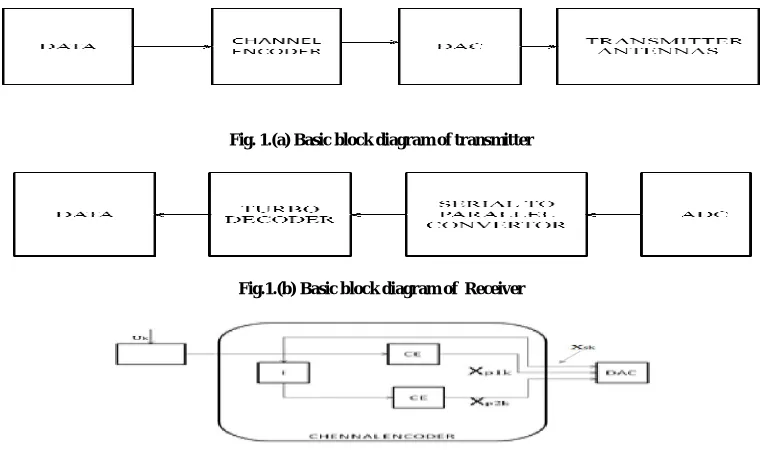
Transmitter and receiver sections of a wireless gadget which supports 3GPP-LTE/LTE-Advanced standards. Fig. 1(a). shows transmitter block. Each of these sections has three major parts:
digital-baseband module,
analog-RF module
multiple-input-multiple-output (MIMO) antennas
In Fig 1(c). shows digital- baseband module of transmitter, sequence of information bits ∀ = {1,2,3 … … } is processed by various submodules and is fed to the channel encoder. It generates a systematic bit , parity bits and for each information bit using convolutional-encoders (CEs) and I (QPP- interleaver). These encoded bits are further processed by remaining submodules; finally, the transmitted digital data from baseband are converted into quadrature and inphase analog signals by a digital-analog-converter (DAC). Analog signals, those are fed to the multiple analog-RF modules, are up-converted to a RF frequency, amplified, band passed and transmitted via MIMO antennas which transform RF signals into electromagnetic waves for the transmission through wireless channel. At the receiver, Fig 1(b) shows RF signals provided by multiple antennas to analog-RF modules are band-pass filtered to extract signals of the desired band, then they are low-noise-amplified and down- converted into baseband signals.
Fig. 1.(a) Basic block diagram of transmitter
Fig.1.(b) Basic block diagram of Receiver
Fig.1.(c) Tx- Digital-Baseband Module
Subsequently, these signals are sampled by Analog-Digital-Converter (ADC) of the digital-baseband module, where various submodules process such samples and are fed to the soft-demodulator. It generates a priori logarithmic-likelihood-ratios (LLRs) , and for the transmitted systematic and parity bits, respectively, , and
are fed to turbo decoder via serial-parallel converter. Turbo decoders work on graph based approach and are parallel concatenation of MAP decoders, as shown in Fig. 1(a). Basically, the MAP decoder uses BCJR algorithm to process input a priori LLRs and then determine the values of a posteriori LLRs for the transmitted bits. Extrinsic informationvalues are computed as
= + ,( )− (2)
ISSN(Online): 2320-9801
ISSN (Print): 2320-9798
International Journal of Innovative Research in Computer
and Communication Engineering
(An ISO 3297: 2007 Certified Organization)
Vol. 3, Issue 2, February 2015
where ,( ) and ,( ) are a posteriori LLRs from MAP decoders; and are de-interleaved and
interleaved values, respectively, of the extrinsic information. As shown in Fig.1(a), the values of extrinsic information are iteratively processed by MAP decoders to achieve near-optimal BER performance. Finally, a posteriori LLR values, those are generated by turbo decoder, are processed by rest of the baseband submodules. Ultimately, a sequence of decoded bits is ∀ obtained, as shown in Fig. 1(a). On the other hand, conventional BCJR algorithm for MAP decoding includes mathematically complex computations. It delivers near-optimal error-rate performance at the cost of huge memory and computationally intense VLSI (very-large-scale-integration) architecture, which imposes large decoding delay. These shortcomings have made this algorithm inappropriate for practical implementation.
Logarithmic transformations of miscellaneous mathematical equations involved in BCJR algorithm have scaled down the computational complexity as well as simplified its architecture from an implementation perspective, and such procedure is referred as logarithmic-BCJR (LBCJR) algorithm. Furthermore, huge memory requirement and large decoding delay can be controlled by employing sliding window technique for LBCJR algorithm. This is a trellis-graph based decoding process in which N stages are used for determining a posteriori LLRs
( ) ∀ = {1,2,3 … … }
where each stage comprises of trellis states. LBCJR algorithm traverses forward and backward of this graph to compute forward ∝ ( ) as well as backward ( ) state metrics, respectively, for each trellis state such that k ε N and i ε . As shown in Fig. 1(c), for states and , forward and backward state metrics during their respective traces are computed as
∝ ( ) = ( ) + , , ( ) + ,
( ) = ( ) + , , ( ) + ,
(4)
respectively, where a logarithmic approximation which simplifies mathematical computations of BCJR algorithm. Based on max-log-MAP approximation, this function operates as ( , ) = max( , ) Similarly, log-MAP approximation computes as ( , ) = max( , ) + ln( , ) + 1 + / /
.
III.PROPOSED TECHNIQUES
A. Modified Sliding Window Approach:
This approach for LBCJR algorithm is based on an ungrouped backward recursion technique. Unlike the conventional SW-LBCJR algorithm, this technique performs backward recursion for each trellis stage, independently, for the computation of backward state metrics. For a sliding window size of M, such an ungrouped backward recursion for kth stage begins from (K+M-1)th stage in the trellis graph. Each of these backward recursions is initiated with logarithmic-equiprobable values assigned to all the backward state metrics of (K+M-1)th trellis stage as
( ) = ln 1 ∀j∈N (5)
Simultaneously, the branch metrics are computed for successive trellis stages and are used for determining the statemetric values using (2). After computing N backward state metrics of th trellis stage by an ungrouped backward recursion, all the forward state metrics of (k - 1)th trellis stage are computed. It is to be noted that the forward recursion starts with an initialization at k=0 such that
( ) = 0 ∀i = 0 and ( )− ∞ ∀i≠0 (6)
ISSN(Online): 2320-9801
ISSN (Print): 2320-9798
International Journal of Innovative Research in Computer
and Communication Engineering
(An ISO 3297: 2007 Certified Organization)
Vol. 3, Issue 2, February 2015
{ } . Similarly, such successive process of second ungroupedbackward recursion (u=2) is carried out to compute aneffective-set of { } for k=2 trellis stage, as shown inFig.2(a).
Fig. 2. (a) Illustration of ungrouped backward recursions in a trellis graph of four states. (b) Scheduling of the modified sliding window approach for LBCJR algorithm.
In this suggested-approach, time-scheduling of various operations to be performed for the computation of successive a posteriori LLRs is schematically presented in Fig. 2(b). Thisscheduling is illustrated for M=4, where the trellis stages andtime intervals are plotted along y-axis and x-axis respectively. An ungrouped backward recursions begin from the time interval to ts because the branch metrics required for these recursions are available from this interval onward. Thereby, referring Fig. 2(b), operations performed from this interval onward are systematically explained as follows.
• : A first ungrouped backward recursion (denoted by u=1 ) begins with the computation of { } which uses the initialized backward state metrics from trellis stage. Since, this backward recursion is performed to computean effective-set of backward state metrics for k=1, it is started from (k+M-1)=4th trellis stage.
• : A consecutive-set { } is computed for the continuation of first ungrouped backward recursion. Simultaneously, a second ungrouped backward recursion starts from the initialized trellis stage k=5 with the computation of a new-set { } .
• : First ungrouped backward recursion ends in this interval with the computation of effective-set { } for k-1 trellis stage. In parallel, second ungrouped backward recursion continues with the computation of consecutive- set
{ } . Similarly, a new-set { } is computed and it marks the start of third ungrouped backward recursion. Initialization of all the forward state metrics of set is also carried out.
• : An effective-set { } is obtained with the termination of second ungrouped backward recursion and a consecutive-set { } is computed for an ongoing third ungrouped backward recursion. Simultaneously, fourth ungrouped backward recursion begins with the computation of a new-set { } . Using an initialized set , a set of forward state metrics is determined. A posteriori LLR value ( ) of the trellis stage is computed using forward, backward and branch metrics from the sets , and { } respectively.
• : From this interval onward, similar pattern of operations are carried out for each time-interval B. State Metric Normalization Technique:
Magnitudes of forward and backward state metrics grow as recursions proceed in the trellis graph. Overflow may occur without normalization, if the data widths of these metrics are finite. There are two commonly used state metric normalization techniques:
subtractive
modulo normalization
ISSN(Online): 2320-9801
ISSN (Print): 2320-9798
International Journal of Innovative Research in Computer
and Communication Engineering
(An ISO 3297: 2007 Certified Organization)
Vol. 3, Issue 2, February 2015
The normalization technique suggested in our work is focused to achieve high-speed performance of turbo decoder from an implementation perspective. Assume that s and s states at (k-1)th stage as well as s and s states at (k+1)th stage are associated with s state at kth stage in a trellis graph.
Fig.3. (a) ACSU for modulo normalization technique. (b) An ACSU for suggested normalization technique. (c) An ACSU for subtractive normalization technique. (d) Part of a trellis graph with = showing (k-1)th and kth trellis stages and metrics involved in the computation of forward state metric at trellis state.
IV.DECODERARCHITECTUREANDSCHEDULING
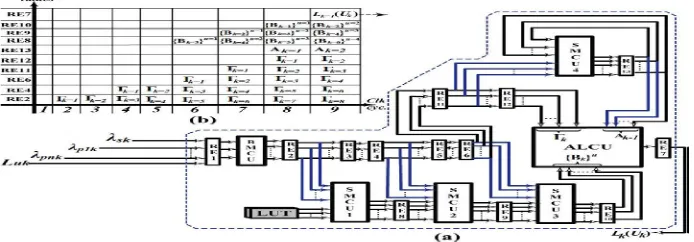
We next present the MAP-decoder architecture and its scheduling based on the proposed techniques. Detail discussion on the design of high-speed MAP decoder, and its implementation trade-offs, are carried out. Furthermore, parallel architecture of turbo decoder and QPP interleaver used in this work are presented.
Fig. 4. (a) High-level architecture of the proposed MAP decoder, based on modified sliding window technique, for M= 4. (b) Launched values of state and branch metric sets as well as a posteriori LLRs by different registers of MAP decoder in successive clock cycles.
A. Parallel Turbo-Decoder Architecture
With an objective of designing a high-throughput parallel turbo decoder that meets the benchmark data-rate of 3GPP specification [3], we have used a stack of MAP decoders with multiple memories and interconnecting-networks (ICNWs). Parallel turbo decoder achieves higher throughput as it simultaneously processes N/P input a priori LLRs in each time instant and reduces the decoding delay of every half-iteration [6].
For 188 different block lengths of 3GPP -LTE/ LTE- Advanced, one of the parallel configuration P, such that
Pε{1,2,4,8,32,64}, can be used for turbo decoding [3]. In this work, a parallel configuration of has been used for a code- rate of 1/3, as shown in Fig. 5(a).
It can be seen that the input a priori LLRs, and are channeled into three different banks of memories. Each bank comprises of eight memories (MEM1 to MEM8) and a priori LLRs and a maximum value of N=6144, these banks store 126 kB of data. These stored apriori LLR values are fetched in each half-iteration and are fed to the stack of 8 MAP decoders. As shown in Fig. 5(a), memory-bank for is connected with 8 MAP decoders via ICNW. Multiplexed LLR values from memory-banks of and are also fed to these MAP decoders. It is to be noted that the ICNW is used for an interleaving phase while turbo decoding.
ISSN(Online): 2320-9801
ISSN (Print): 2320-9798
International Journal of Innovative Research in Computer
and Communication Engineering
(An ISO 3297: 2007 Certified Organization)
Vol. 3, Issue 2, February 2015
pseudorandom addresses of quadratic-permutation- polynomial (QPP) interleaver based on
∏( ) = {( × × ) + ( × × ) + (2 × × × × ) + ( × ) + ( × )}
Fig.5.(a) Parallel turbo decoder architecture with 8 MAP decoders.
Fig.5.(b) Pipelined ICNW (interconnecting-network) based on Batcher network (vertical dashed lines indicate the orientation of register delays for pipelining).
Where i={1,2,3 … … . . }, = , and = {1,2,3 … … . . } for AGU0 to AGU7 respectively [10]. Similarly, and are the interleaving factors whose values are determined by the turbo block length of 3GPP standards [3].
Addresses generated by AGUs are fed to the network of master-circuits, denoted by “M” in Fig. 5(b), which generate select signals for the network of slave-circuits, denoted by “S.” Data-outputs from the memory-bank are fed to slave network and are routed to 8 MAP decoders. Stack of MAP decoders and memories MEX1 to MEX8, for storing extrinsic information, are linked with ICNW. For the eight-bit quantized extrinsic information, 48 kB of memory is used in the decoder architecture. During the first half-iteration, the input a priori LLR values and are sequentially fetched from memory-banks and are fed to 8 MAP decoders. Then, the extrinsic information produced by these MAP decoders is stored sequentially. Thereafter, these values are fetched and pseudorandomly routed to MAP decoders using ICNW and are used as a priori-probability values for the second half-iteration. Simultaneously, soft values are fed pseudorandomly via ICNW and the multiplexed values are fed to the MAP decoders to generate a posteriori LLRs ( ). This completes one full-iteration of parallel turbo decoding. Similarly, further iterations can be carried out by generating the extrinsic information and repeating the above procedure.
V. SIMULATION RESULTS
Fig.6 Output waveform for Encoder
ISSN(Online): 2320-9801
ISSN (Print): 2320-9798
International Journal of Innovative Research in Computer
and Communication Engineering
(An ISO 3297: 2007 Certified Organization)
Vol. 3, Issue 2, February 2015
Fig.7 Output waveform for Decoder
The fig.7. shows the output waveform for Decoder. Based upon the techniques like Modulo normalization, Subtractive normalization and Trellis graph the 8 bit input will be proceed in BMCU and SMCU blocks to provide the decoded output.
VI.CONCLUSION AND FUTURE WORK
In this paper highlights the concept of modified sliding window approach and state metric normalization technique which resulted in a highly pipelined architecture of parallel turbo decoder. These techniques have specifically shortened the critical path delay and improved the operating clock frequency that has eventually aided the parallel turbo decoder to achieve higher throughput. Power issue of this design was mitigated using fine grain clock gating technique during the implementation phase. Similarly, large design-area of the decoder can be taken care by scaling down the technology. An implementation of 8 parallel turbo decoder with radix-2 MAP decoders has achieved a maximum throughput which is suitable for 3GPP-LTE-Advanced as per its specification.In future, Optimized Adder structure will be added to the network, to optimize the area, delay and power in Long Term Evolution- Advancements(LTE-A). This will be achieve by combining decoder and encoder blocks.
REFERENCES
1 Belfanti .S, Roth .C, Gautschi .M, Benkeser .C, and Huang .Q, “A 1 Gbps LTE-advanced turbo-decoder ASIC in 65 nm CMOS,” in Proc.
Symp. VLSI Circuits (VLSIC), 2013.
2 Condo .C, Martina .M, and Masera.G, “VLSI implementation of a multi-mode turbo/LDPC decoder architecture,” IEEE Trans. Circuits,
Jun. 2013.
3 Dobkin.R, M. Peleg, and R. Ginosar, “Parallel VLSI architecture for MAP turbo decoder,” in Proc. IEEE Int. Symp. Personal, Indoor
MobileRadio Commun., 2002.
4 Lin .C, Chen .C, and Wu .A, “Area-efficient scalable MAP processor design for high -throughput multi -standard convolutional
turbo decoding,” IEEE Trans. Very Large Scale Integr. (VLSI) Syst., Feb. 2011.
5 Studer .C, Benkeser .C, Belfanti.S, and Q. Huang, “Design and implementation of a parallel turbo-decoder ASIC for 3GPP-LTE,” IEEE
J. Solid-State Circuits, Jan. 2011.
6 T. Ilnseher, F. Kienle, C. Weis, and N. Wehn, “A 2.15 GBit/s turbo code decoder for LTE advanced base station applications,” in Proc.
Int. Symp. Turbo Codes and Iterative Information Processing (ISTC),2012.
7 Wong C.C, M.-W. Lai, C.-C. Lin, H.-C. Chang, and C.-Y. Lee, “Turbo decoder using contention-free interleaver and parallel
architecture,” IEEE J. Solid-State Circuits, vol. 45, no. 2, pp. 422–432, Feb. 2010.
BIOGRAPHY
Sangeetha V did her Bachelor of Engineering in Electronics and Communication Engineering at Sri subramanya College of Engineering and Technology, Palani and doing Masters of Engineering in VLSI Design at Sri Shakthi Institute of Engineering and Technology, Coimbatore,India. .Her research interests are Wireless Networks and VLSI Design.
Lalithambigai M, Assistant Professor working in the Department of Electronics and Communication Engineering at Sri Shakthi Institute of Engineering and Technology, Coimbatore, India. She received her Master of Engineering (ME) degree in 2014 from Sona College of Technology, Salem, India. Her research interests are in VLSI Design and Communication.