ISSN(Online): 2320-9801
ISSN (Print): 2320-9798
I
nternational
J
ournal of
I
nnovative
R
esearch in
C
omputer
and
C
ommunication
E
ngineering
(An ISO 3297: 2007 Certified Organization)
Vol. 3, Issue 8, August 2015
An Efficient Underwater Image Enhancement
Using Color Constancy Deskewing Algorithm
R.SwarnaLakshmi1, B. Loganathan2
M.Phil Research Scholar, Govt Arts Science College, Coimbatore, India1
Associate Professor, Govt Arts Science College, Coimbatore, India2
ABSTRACT: The objective of image enhancement is to recover the perception of information in underwater images for human viewers, or to provide recovered input for other automated image processing techniques. In underwater conditions, the image clarities are corrupted by light inclusion and diffusion. This causes one colour to dominate the image. In order to enhance the observation of underwater images, we proposed an approach based on color constancy algorithms. The objective of this proposed method is twofold (i) Feature Extraction and (ii) color constancy algorithm. Firstly, to capture the image characteristics, the Feature parameterization (e.g. grain size and contrast) and the optimized constancy mapping is extended to incorporate the statistical nature of images. The proposed algorithms are tested on synthetic images as well as real images.
KEYWORDS: Underwater imaging, RGB, Color illumination, Color Features
I. INTRODUCTION
Underwater (UW) imaging has been receiving considerable attention in the last few decades. A driving force behind advances in UW technologies has been the need to improve image quality. Underwater images can suffer from different types of degradations including color loss, noise due to floating particles, low contrast, skewing and blurring [1]. In this paper, the primary aim is to restore scenes captured through a dynamic refractive medium. Even though visibility is limited to few tens of meters inside water, imaging through dynamic water surface is important for coral reef monitoring, examining the contamination of shallow waters, mapping the distribution of vegetation and seabed sediments etc. [2]. These capabilities find applications in commercial fishing zones as well as in boat safety. Thus, it is essential to develop image restoration schemes that can address the challenges that arise when imaging through flowing water.
For the last few years, a flourishing movement has been started towards the direction of the improvement of image processing techniques and methods [1]. Very little research has been carried out to process underwater images. The existing research shows that underwater images raise new challenges and impose significant problems due to light absorption and scattering effects of the light and inherent structure less environment.
The primarily focus on restoring a UW scene affected by skew and motion blur when imaged through a dynamic refractive medium. The phenomenon of skew is due to the wavy nature of water, as different light rays experience different amounts of refraction at the water surface. This space-varying refraction that occurs on the water surface results in non-rigid deformation of the scene when captured on the image plane. Several methods exist that primarily aim to restore skewed scenes.
II. RELATED WORK
ISSN(Online): 2320-9801
ISSN (Print): 2320-9798
I
nternational
J
ournal of
I
nnovative
R
esearch in
C
omputer
and
C
ommunication
E
ngineering
(An ISO 3297: 2007 Certified Organization)
Vol. 3, Issue 8, August 2015
of surface slopes at the instant of observation has been proposed and approbated. In [4] presented the appearance of a pattern behind a transparent, moving object is distorted by refraction at the moving object's surface. An algorithm for reconstructing the surface shape of a non-rigid transparent object, such as water, from the apparent motion of the observed pattern is described. In [5] authors explained simultaneously estimate the shape of the water surface and recover the planar underwater scene without using any calibration patterns, image priors, multiple viewpoints or active illumination. The key idea is to build a compact spatial distortion model of the water surface using the wave equation. In [6] Authors had modified the algorithm to recover a geometrically correct image of an object or scene from a set of images distorted by the wave motion of a water surface. Under mild conditions where the wavy surface normal’s weakly satisfy a Gaussian distribution, to demonstrate that the geometric distortion can be removed and a corrected image can be recovered. The method is based on higher-order spectra analysis-in particular, the bispectrum, similar to its use in astronomical speckle imaging. In adapting this technique to imaging through or over a moving water surface, special care must be taken, and specifically tailored techniques. In [7] authors proposed a novel algorithm is proposed to predict "lucky" regions in a sequence of long-range camera images affected by atmospheric turbulence. Our new approach is to employ bi-coherence as a measure of quality to determine lucky regions or good quality image patches from a recorded sequence of anisplanatic images. The better-quality image regions are selected according to the magnitude of the average value of the bi-coherence of each region.
III.PROPOSED ALGORITHM
The underwater image enhancement is a new method to give the solution for image restoration as well as image enhancement. In this paper, underwater images are acting as blue tone and green tone. The overview of the proposed work is shown in Fig.1.
Fig.1: Proposed System Workflow
A. Image Feature Extraction:
An underwater image is a combination of Red, Green and Blue colors. In feature extraction process, the each
individual (RGB) colors are extracted into 3 matrices, each one representing color features. The RGB color extracted
ISSN(Online): 2320-9801
ISSN (Print): 2320-9798
I
nternational
J
ournal of
I
nnovative
R
esearch in
C
omputer
and
C
ommunication
E
ngineering
(An ISO 3297: 2007 Certified Organization)
Vol. 3, Issue 8, August 2015
uniform illumination, blurring, and low contrast and diminished colors, because the light is exponentially attenuated as it travels in the water. To improve the performance of feature extraction, the 3 types of pre-processing techniques for underwater images: (1) Color Correction (2) Color Normalization and (3) Image Enhancement.
The three techniques are arranging in order, next to each other creating a 3 dimensional m x n by 3 matrixes.
Three color planes namely Red, Green and Blue are separated.
For each color plane row mean and variance are calculated.
The averages of all image dimensions are calculated for each color plane (R, G and B).
The features of all 3 planes are combined to form a feature vector. Once the feature vectors are generated for
all images in the database, they are stored in a feature data set.
B. Estimating the Light Source Of Illumination:
The light source of illumination are based on shorten statements such as restricted gamuts feature (partial number of colors which can be observed under a specific illuminant), the allocation of underwater colors that are present in an image (e.g. white patch, grey-world etc.) and the set of possible light indexes. The Collection of underwater images is taken under the different light source that is used to estimate the color source. The dimensions should be Px3, where P is the number of data points and 3 is the number of color channels.
To estimation the image color of the light source to compute the canonical range’s for the light illumination type (i.e., pixels, Edges and Gradient). For accurate performance, the canonical range must be learned using images that are a representative set of real-world surfaces. Also, all images that are used to learn the canonical range must be images that are illuminated by the same light source. A correlation between the image illumination allocation of an underwater scene and the irradiance at a texture point in the scene. To take illumination from all directions into account, let us consider an infinite patch of the extended light source, of an image size.
The Grey-World algorithm is based on the Grey-World assumption, i.e. the average reflectance in a scene under a neutral light source is achromatic. In these two algorithms are proven to be important instantiations of the Minkowski-norm:
𝐿𝑐 = 𝑓𝑐 𝑝
𝑥 𝑑𝑒𝑥
1
𝑝 eq. (1)
Where c = {R, G, B} and k is a multiplicative constant chosen such that the illuminant color, e = (eR, eG, eB)T , has
unit length.
C. Under Water Image Enhancement:
The underwater endearment methods make total concept of the image structure process, and without a priori knowledge of the environment is needed. They are usually simpler and faster than the image restoration techniques. The enhancement algorithm of image white patch describes the texture pixels in points of maximal reflectance of RGB bands. The color constancy methods in that the green patch continues to appear green, the white patch continues to appear white, and all the remaining patches continue to have their original colors. The Shades-of-Grey algorithm is one the method is selected it considerably improves performance with respect to Grey-World (another uncalibrated algorithm such as Grey-edge25 could also have been used). The image Edge reflection, which assumes that the average edge difference in the scene is achromatic. The method is based on the observation that the distribution of color derivatives exhibits the largest variation in the light source direction.
IV.SIMULATION RESULTS
ISSN(Online): 2320-9801
ISSN (Print): 2320-9798
I
nternational
J
ournal of
I
nnovative
R
esearch in
C
omputer
and
C
ommunication
E
ngineering
(An ISO 3297: 2007 Certified Organization)
Vol. 3, Issue 8, August 2015
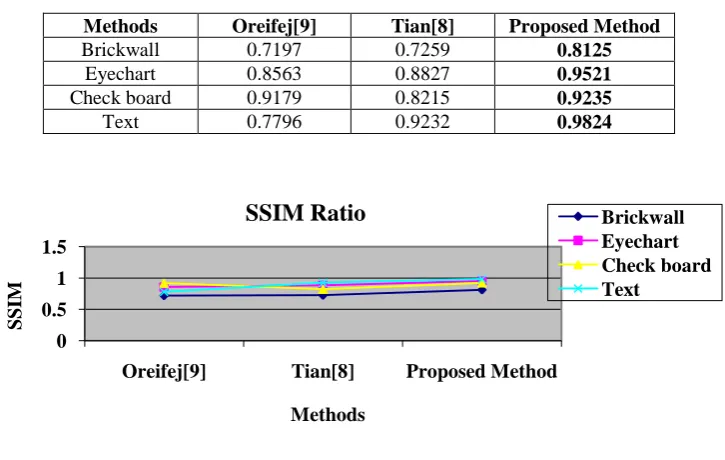
SSIM for our method along with comparisons. It is clearly evident that our method outperforms existing methods both qualitatively and quantitatively. The effect of curvature of the water waves on the performance of the proposed method is discussed in detail in the supplementary material.
Table I: Comparison with State-Of-The-Art methods For Peak Signal Noise Ratio (PSNR)
Methods Oreifej[9] Tian[8] Proposed Method
Brickwall 21.0315 22.4240 25.6
Eyechart 19.4327 21.4142 26.44
Check board 22.0372 19.2969 29.36
Text 13.9449 15.0205 23.45
Table II: Comparison with State-Of-The-Art methods For Structural Similarity Index Measure (SSIM)
Methods Oreifej[9] Tian[8] Proposed Method
Brickwall 0.7197 0.7259 0.8125
Eyechart 0.8563 0.8827 0.9521
Check board 0.9179 0.8215 0.9235
Text 0.7796 0.9232 0.9824
V. CONCLUSION AND FUTURE WORK
The proposed system of underwater image enhancement algorithm both on light illumination and shades colour models to enhance underwater images. In order to demonstrate the usefulness of our approach, we have developed an interactive software tool to be used for underwater image enhancement. First of all, it performs contrast stretching on RGB colour model. Secondly, it performs saturation and intensity stretching on weibull histogram colour model. The advantage of applying two stretching models is that it helps to equalize the colour contrast in the images and also
0 20 40
Oreifej[9] Tian[8] Proposed Method
PSNR
(d
B
)
Methods
PSNR Ratio
Brickwall
Eyechart
0 0.5 1 1.5
Oreifej[9] Tian[8] Proposed Method
SS
IM
Methods
SSIM Ratio
Brickwall
ISSN(Online): 2320-9801
ISSN (Print): 2320-9798
I
nternational
J
ournal of
I
nnovative
R
esearch in
C
omputer
and
C
ommunication
E
ngineering
(An ISO 3297: 2007 Certified Organization)
Vol. 3, Issue 8, August 2015
addresses the problem of lighting. By applying the proposed approach, we have produced promising results. The quality of the images is statistically illustrated through the histograms. Our future work will include further evaluation of remote sensing underwater images the proposed approach.
REFERENCES
1. M. Chambah, A. Renouf, D. Semani, P. Courtellemont A. Rizzi, “Underwater colour constancy: enhancement of automatic live fish recognition” 2004, In Electronic Imaging.
2. R. Schettini and S. Corchs, “Underwater image processing: State of the art of restoration and image enhancement methods,” EURASIP J. Adv. Signal Process., vol. 2010, Jan. 2010, Art. ID 14.
3. D. G. Turlaev and L. S. Dolin, “On observing underwater objects through a wavy water surface: A new algorithm for image correction and laboratory experiment,” Izvestiya, Atmosph. Ocean. Phys., vol. 49, no. 3, pp. 339–345, 2013.
4. H. Murase, “Surface shape reconstruction of a nonrigid transport objectusing refraction and motion,” IEEE Trans. Pattern Anal. Mach. Intell., vol. 14, no. 10, pp. 1045–1052, Oct. 1992.
5. A. A. Efros, V. Isler, J. Shi, and M. Visontai, “Seeing through water,” in Proc. Adv. Neural Inf. Process. Syst., 2004, pp. 393–400. 6. Z. Wen, A. Lambert, D. Fraser, and H. Li, “Bispectral analysis and recovery of images distorted by a moving water surface,” Appl. Opt.,
vol. 49, no. 33, pp. 6376–6384, 2010.
7. Z. Wen, D. Fraser, and A. Lambert, “Bicoherence: A new lucky region technique in anisoplanatic image restoration,” Appl. Opt., vol. 48, no. 32, pp. 6111–6119, 2009.
8. Y. Tian and S. G. Narasimhan, “Seeing through water: Image restoration using model-based tracking,” in Proc. IEEE 12th Int. Conf. Comput. Vis., Sep./Oct. 2009, pp. 2303–2310.