Sentiment Analysis and Opinion Mining using
Machine Learning Techniques
Janardhana D R, Manjunath Mulimani
Assistant Professors, Dept. of ISE., Sahyadri College of Engineering and Management, Mangaluru, Karnataka, India
ABSTRACT: Analysis of sentiments or opinions is a leading method for text message analysis and this gives the best
results on opinions or sentiments by extracting and analyzing opinion oriented text, recognising positive and negative opinions, and quantifying how positive and negative entities are regarded. Opinions are the key power of human operations. We make the decision based on the feedback of others. It’s not only true for individuals it’s also true for organizations. The main objective of this study is to build the model and contemplate the opinions associated with the huge volume of movie review data. Movie reviews with labelled opinion as positive represented by 1 and negative represented by 0. Here, trained the machine with 25,000 labelled movie review data using machine learning algorithms like Random Forest, Naive Bayes, and SVM. Once, Machine trained it will forecast the opinion associated with unlabeled test data more precisely. This model helpful to discover the customer opinion associated with the unstructured movie review data in digital format on web. The model is completely based on the NLP, Text Analysis, Machine Learning and Statistics.
KEYWORDS: Radom Forest,Naive Bayes,SVM(support vector machine),NLP(Natural Language Process)
I. INTRODUCTION
Opinion mining is also called as Sentiment analysis, is the field of study that uses people’s thoughts, belief, assessments, ratings, perspective, and feelings towards substances such as products, services, corporations, individuals, complications, occasions, topics, and their credits. Sentiment analysis mainly focuses on opinions which express positive or negative emotions. All human activities is based on Opinions and Opinions are the key values of human operations. When we want to take a resolution, we want to know others emotions. In the real business world, an organization always wants to find customer or public reviews about their products and services.. When corporations or a business companies requires public or consumer opinions, they conduct surveys, opinion polls, and market survey.
Acquiring public and consumer opinions has long been a huge business itself for marketing, public relations, and political propagandize companies. Each consumer also want to know the opinions of current users of a product before purchasing it, and others like in case of government elections public wants to collect opinions about political candidates before going to decision on voting Today’s social media (e.g., reviews, deliberation forums, records, micro-blogs, Twitter, comments, and postings in social network sites) is having proliferate growth on the Web, individuals and corporations are increasingly utilizing the content of these media for decision formations. Nowadays, if one wants to buy a consumer product, he/she will consult their friends and family for opinions because there are many user reviews and analysis in public forums on the Web about the product.
Nowadays for an organization, conducting surveys, opinion polls, and market survey is not at all needed to make that in to public opinions cluster because there is a profusion of such information’s publicly available. however, identifying and analysing opinion sites on the web and refining the information contained in them remains an awesome task because of the escalation of diverse sites. Each site typically contains an immense compendium of opinion text that is not always possible to decode in long blogs and blog postings. the average individual peruser will have hurdle in recognising the admissible sites for separating and encapsulating the opinions in them. so in order to overcome from this programmed sentiment analysis systems are needed
A. Different Levels of Analysis
positive or negative thoughts about the product. This task is commonly known as document-level sentiment classification.
Sentence level: In Sentence level, task goes to the take decision and determines whether each sentence conveyed a positive, negative, or neutral opinion. Neutral usually means no thoughts. Sentence level is intently matched to emotional classification and peculiar sentences (called objective sentences) that express real information and conveys anomalous views and opinions.
Entity and Aspect level: Aspect and entity level is not performing actually on the people likes and dislikes. This level performs like a fine tuner analysis. This aspect level also called as featured level. This always performs on the emotions (positive and negative) which are present at the each opinion.
Instead of looking at language constructs (report-log, segment text, sentences, clauses or phrases),
B. Different Types of Opinions
Regular opinion: A regular opinion is frequently referred to simple opinion type and it has two main sub-types,
Direct opinion: A direct opinion mention to thoughts expressed straight away on an entity or an entity aspect, e.g., “The image quality is awesome.”
Indirect opinion: An Unintended opinion is an opinion that is conveyed indirectly on an entity or aspect of an entity based on its outcome on some other entities. This sub-type frequently occurs in the medical territory. For example, the sentence “After getting new laptop, my operating system not working properly” describes an undesirable effect of the laptop on “operating system”, which indirectly gives a negative opinion or sentiment to the laptop. In this case, the entity is the laptop and the aspect is the effect on operating system.
Comparative opinion: A comparative opinion conveys a relation of homogeneous or variations between two or more entities and/or a preference of the opinion holder based on some apportion characteristics of the entities. For example, the sentences, “Pepsi tastes better than Maza” and “Pepsi tastes the best” express two relative opinions.
C. Data crawling
Data Crawling refers to the operation of dealing with datasets of enormous compendium, for which tools called crawlers (spiders or bots) are used to crawl into the deepest of web pages and converge data. This resemble of information extraction is predominantly used in the web and hence the name Web Crawlers. The crawling agents/tools are designed to be competent of reaching the maximum depth of a website and crawl the data constantly from each level. This ability of a crawler plays an vital role in the creation of real-time datasets. The basic web crawling process is outlined inFig.1
Fig: 1 A Basic web crawling process
If the requirement is to gather a particular type of data for a specific duration, then the crawler follows a scheduled execution, so that the data collection is systematic and at regular intervals of time
.
D. Data Pre-Processing
inconsistencies like missing values. Once the data is cleaned, dissimilar forms or presentation of data can be combined jointly which forms the integration step during pre-processing
E. Supervised Classification
Supervised classification is nothing but choosing proper class label for a given input. In basic classification, each input is considered as a fragmented from all other inputs, and the set of labels should be priory defined. Some examples of classification tasks are:
• Determining whether an email is spam or not.
• Identifying what the topic of a news article is, from a fixed list of topic like “sports," "technology," and "politics." The basic classification task has a number of attractive variants. For example, in multi-class classification, each case taken with multiple labels; the set of labels is not priory defined that is in case of open classification and in sequence classification, list of inputs are arranged mutually
Supervised classifier is built based on the training corpus containing the correct label for each input. The structure used by supervised classification is shown in below fig 2
Fig: 2 Frameworks for Supervised Classification
In the process of supervised classifier, the feature extractor extracts the words those comprise either positive or negative sentiment. Then, Machine learning algorithms classify precisely and allocate the label as positive for positive sentiments and negative for negative sentiments. Once machine trained with huge compendium of data, then it will envisage precisely test data based on their knowledge. During prediction, the feature extractor can be used to convert unidentified inputs to feature sets. These inputs sets are then forwarding to the model, which generates expected labels.
II. RELATED WORK
Because of popularity of social media, field of Big Data is hot topic in today scenario. Data stored in the form of reviews, blogs, comments etc..., sentiment analysis and opinion mining became interesting field of research. A complete overview of sentiment analysis is presented by Pang and Lee in 2008. According to the survey Pang and Lee mentioned various methodology of opinion mining on opinion oriented data. Only few of the researchers in opinion mining considered micro blogs, web data, e business web reviews like Amazon, flipkart. W. Wang and Y.Zhou, 2009 explains about e -business websites using popularity of internet. Yang et. al., constructed corpus using web-blogs, Corpus contains emotion icons represents users’ mood. The researchers used SVM for sentence level sentiment analysis. J.Read, 2005 used emoticons such as “;-)” and ;-(“ for development of training set for sentiment classification. For this, researcher collected text contains emoticons from various newsgroups. Dataset classified as “positive” and “negative” samples. SVM and Naive Bayes had given up to 70% accuracy on this test data. In (Go et al., 2009), used Twitter to collect training data and then perform sentiment analysis on constructed corpora with “positive”, “negative” emoticons. The author obtained 81% accuracy using Naive Bayes Classifier. But he got less performance on three classes “negative”, “positive” and “neutral”.
III.DATA AND METHODOLOGY
The unique 25,000 reviews are labeled trained set using for analysis. In addition to this 50,000 reviews are unclassified labeled data set are present
A. File Description
(i) Labelled Train Data: The labelled trained data set contains 25,000 rows containing an id, sentiment, and text for each review.
(ii) Test Data: Here the test data is nothing but test set. Task is to predict the sentiment based on each reviews
Fig: 3 Samples of Labelled Train Data
Fig: 4 Samples of Test Data
B. Data Pre-Processing
Data pre-processing steps as follows:
(i) Read tab delimited csv file LabeledTrainData.csv into python. (ii) Remove html tags using python package Beautiful Soup (iii) Remove numbers, punctuations, stop words.
(iv) Convert reviews into lower case letters and words also called tokens using nltk
C. Data Fields
(i) ID: Each row in the review contain an unique identification number
(ii) Sentiment; for each sentiments in the review assigning binary numbers like 1 for positive reviews and 0 for negative reviews
Fig.5: Sample Raw Review before processing Fig 6: Sample processed review
D. FEATURE SELECTION FROM BAG OF WORDS
Feature selection by definition is the process of selecting a subset of attributes or features during model construction. Generally, a dataset may consist of many attributes, all of which may not have significant contributions or in other words, may not be as informative as the others. Hence, it is sensible to choose only a handful of features from the set of available features. Different approaches can be adopted for feature selection. Large set of vocabulary for IMDB data set generated by Bag of Words using feature extraction module from scikit-learn. Bag of words holds the set of features selected from Labelled Train Data.
Fig.7: Features from Bag of Words
E. Classification Algorithms used for Analysis
Based on feature selection three prominent classifiers used for review classification as positive and negative . (i) Random Forest
(ii) Naive Bayes
(iii) Support Vector machine
Train the machine using above 3 classifiers with feature selected from Bag of words. For each algorithm need to evaluate accuracy on trained data, predicted sentiment on test Data, Number of positive reviews and negative reviews and time taken by each classifier.
(i) Support Vector Machines
Support Vector Regression (SVR). The relevant concepts associated with the technique are discussed below. Consider the following figure, where ’x’ and ’o’ denote the two different classes of training examples, separated by a separating hyper plane known as the decision boundary. Figure 3 represents a binary classification problem mentioned above.
Fig.8: A simple linear classifier for binary classification
The following notation is adopted for the remainder of this discussion, y {−1, 1} denotes the class labels hw, b(x) = g (wT x + b) represents the classifier, where g(z) = 1 if z ≥ 0 and g(z) = −1 otherwise. The parameter b can be treated as the intercept term, and the vector w is associated with the input feature vector.
(ii) Naive Bayes Classifier
A Language Model is a statistical approach of modelling the words from a text by means of a probability distribution. The model assigns probabilities to the sequence of words. This approach is commonly used in a wide range of domains which include Information Retrieval, Speech Recognition, Parts-of-speech tagging and more. A Language Model is very similar in terms of approach to the Naive Bayes classifier that it behaves essentially as an extension of a Naive Bayes classifier. Generally, a Naive Bayes classifier is known for its simplicity and efficiency and this happens to be the reason why Naive Bayes is commonly used in Text Analytics, despite the presence of many other NLP approaches using k-Nearest Neighbour algorithm or Support Vector Machines. Language Models build on these traits of a Naive Bayes classifier and makes further improvements. In text classification, a document is tokenized into an unordered collection of words,
Where each word is treated as a token. A Naive Bayes classifier associates a probability measure to each token (word) that appears in the document. This estimation forms the basis for the construction of a Language Model. The model may vary from a simple bag of words model to what is known as an n-gram model. A bag of words model is a simple, unordered representation of words in a text. The frequency of occurrence of each word is used as a feature for training a classifier. However, when considers the occurrence of previous words in the text, the model is said to be n-gram. In addition, the approach employs smoothing techniques to tackle the problem of zero probability. A Naive Bayes classifier employs Laplace smoothing to assign non-zero probabilities to unseen words as well. Smoothing is defined as follows: Consider, a set of observations following multinomial distribution:
X = (x1, ..., xd) from N trials, and parameter vector θ = (θ1, ..., θd) The smoothened version of the estimator is given by θi^ = xi+α / N+αd ,(i = 1, .., d) where α > 0 is the smoothing parameter.
In text classification, the Naive Bayes classifier is founded on the assumption of independence of words/tokens given the category/class. Given a document d and a predefined set of classes {..., ci , ...}. The Naive Bayes classifier starts off with the calculation of the posterior probability associated with the document that it belongs to a particular class ci , using Bayes rule. P(ci |d) = P(d|ci)P(ci) /P(d).
(iii) Random Forest
tree learning concept is very close to meet the requirements for data mining aspects. Because tree learning method or decision tree is never changing process under any circumstances of scaling and transformation features values and also this is very robust in nature to insert any irregular features produces identifiable models and those are rarely accurate in nature.
In certain examples, tree grows very deep to learn highly irregular patterns like those out of the training set data. Because those data has low inclination and very high variation. Random forest is the way of aggregating the multiple deep decision trees, on trained different parts of the training sets with the aim of reducing the variations. This can be archived by small inclination and small loss in interoperability but in general it boosts the performance of final model.
IV.SIMULATION RESULTS
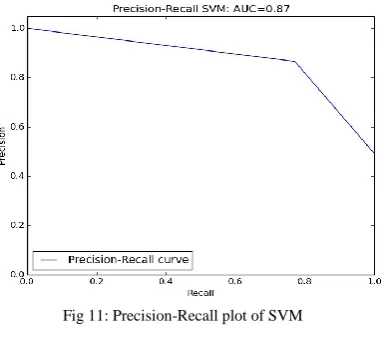
The simulation performed with three different machine learning techniques gives the best accuracy and the prediction rates on the revived data to select best opinion on product, organization etc. Here using random forest, naive bayes and support vector machines. Figure 9 gives result on random forest, figure 10 gives on Naive bayes and figure 11 gives on support vector machine.
A. Random Forest Classifier
Number of Positive Reviews: 12222 Number of Negative Reviews: 12778 Mean Accuracy on Trained Data: 0.91
Time Taken by Random Forest for prediction: 513.60 seconds Accuracy on Test Data:0.88
Confusion Matrix: [4290 791] [839 4080]
Precision= number of accurate positives / (sum of accurate positives and false positives) = 0.83 Recall= number of accurate positives / (the sum of accurate positives and false negatives) = 0.82
B. Naive Bayes
Number of Positive Reviews: 12020 Number of Negative Reviews: 12980 Mean Accuracy on Trained Data: 0.94
Time Taken by Naive Bayes for prediction: 47.31 seconds Accuracy on Test Data: 0.89
Confusion Matrix: [4357 724] [756 4163]
Precision= number of accurate positives / (sum of accurate positives and false positives) =0.85 Recall= number of accurate positives / (the sum of accurate positives and false negatives) = 0.84
C. Support Vector Machine
Number of Positive Reviews: 12020 Number of Negative Reviews: 12980 Mean Accuracy on Trained Data: 0.96
Time Taken by SVM for prediction: 50.44 seconds Accuracy on Test Data: 0.87
Confusion Matrix: [4495 586] [1128 3791]
Fig.9 Precision-Recall plot of Random Forest Fig 10: Precision-Recall plot of Naive Bayes
Fig 11: Precision-Recall plot of SVM
V. CONCLUSION
Analysis of sentiments is a multidiscipline area that covers NLP, text mining and machine learning. This technique can be used for different purposes like analysing blogs, news paper article data, social networks data, and movies reviews data. Here, Sentiment Analysis used for analysing opinions either positive or negative associated with the IMDB movie review data. Machine is trained over 25,000 labelled movie review data using different algorithms in machine learning such as Random Forest, Naive Bayes, and Support Vector Machine (SVM). Once, Machine trained it will predict the opinion associated with unlabelled test data accurately. This model helpful for to identifying the customer opinion associated with the unstructured movie review data in digital format on web. Also model gives most appropriate accuracy, Precision, and recall on the test Data. The model is completely based on the NLP, Text Analysis, Machine Learning and Statistics.
REFERENCES
1. Parkhe, V.; Biswas, B. "Aspect Based Sentiment Analysis of Movie Reviews: Finding the Polarity Directing Aspects", Soft Computing and Machine Intelligence (ISCMI), 2014
2. Tayal, D.K.; Yadav, S.; Gupta, K.; Rajput, B.; Kumari, K. "Polarity detection of sarcastic political tweets", Computing for Sustainable Global Development (INDIACom), 2014
3. Khurana, S.; Relan, M.; Singh, V.K. "A text analytics-based approach to compute coverage, readability and comprehensibility of eBooks", Contemporary Computing (IC3), 2013
4. Sheibani, A.A. "Opinion mining and opinion spam: A literature review focusing on product reviews", Telecommunications (IST), 2012 Sixth International Symposium
6. K. Khan, B. B. Baharudin, a. Khan, and F. e-Malik, "Mining opinion from text documents: A survey" 2009 3rd IEEE International Conference on Digital Ecosystems and Technologies
7. Bing Liu. Sentiment Analysis and Opinion Mining, Morgan & Claypool Publishers, May 2012.