ISSN(Online): 2319-8753 ISSN (Print): 2347-6710
I
nternational
J
ournal of
I
nnovative
R
esearch in
S
cience,
E
ngineering and
T
echnology
(A High Impact Factor, Monthly, Peer Reviewed Journal)
Visit: www.ijirset.com Vol. 8, Issue 7, July 2019
Assessment of Business Educators Competency
Level in Teaching Business Administration and
Communication Segments of Office Technology
and Management Courses in Selected Polytechnics
in North-East Nigeria
Nnaji Florence Oluchi
1, Hauwa Bawa Pyiki
2Department of Office Technology and Management, School of General Studies and Management Technology, Federal
Polytechnic Bali, Taraba State Nigeria
ABSTRACT: The study assessed business educators’ competency level in teaching business administration and communication segments of Office Technology and Management courses in selected Polytechnics in Northeast Nigeria. Two research questions and two null hypotheses guided the study. Survey design was adopted for the study. The population of the study was 889 which comprised of 49 lecturers and 840 students. The entire population of lecturers and a sample of 262 students which was drawn using Taro Yamane formula constituted a sample size of 311 which was studied. Aself-structured questionnaire titled BECLTQ on a 4 point rating scale validated by two experts and a reliability test which yielded a coefficient of stability of 0.89 was used to collect data for the study. Mean and standard deviation were used to answer the research questions while t-test was used to test the null hypotheses at 0.05 level of significance. The findings of the study revealed that business educators are very competent in teaching the Business Administration and Communication courses. It was recommended amongst others that business educators should always make their teaching functional by imparting the necessary competencies to students so that graduates of OTM will meet up withthe requirements of the employers of labour.
KEYWORDS: Assessment, Competency, Educator, Office Technology and Management
I. INTRODUCTION
ISSN(Online): 2319-8753 ISSN (Print): 2347-6710
I
nternational
J
ournal of
I
nnovative
R
esearch in
S
cience,
E
ngineering and
T
echnology
(A High Impact Factor, Monthly, Peer Reviewed Journal)
Visit: www.ijirset.com Vol. 8, Issue 7, July 2019
necessary and vital competencies needed at any point. It is necessary that business education teachers are competent with what to be taught to students and that business education teachers require instructional planning competency to effectively plan activities to be taught to the students (Dambo, Enyekit and Enyekit 2018). The level of achievement of objectives of any lesson depends so much on the teacher’s ability to strategically plan instruction to effectively transfer knowledge (Nwachukwu, 2005).
Communication is the life blood of any business organization. It is the most important channel to achieve any organizational goal. Office managers are expected to have a high level of communication ability and this is achievable through the business educators’ efficient communication competence. The graduates of OTM are to work in the public offices as employees or employers of labour. The success of these graduates in any business office is dependent on their ability to communicate effectively with their customers/clients. Business administration has to do with written or spoken communication and the planning, organizing and coordinating of the day-to-day business activities. These communication and administrative competency transferred to learner during teaching and learning process go a long way to establish the learners after graduation. Office managers/secretaries are the first contact the organization has with the outside world because any customer/persons visiting the organization must come in contact with the secretary first. It is the secretary that answers all the customers’ questions concerning the organization. It is also the secretary that directs the customer to the boss, to different departments/units where his problems will be solved. It therefore, means that if the communication and administrative competence of the office manager is efficiently displayed the customer will have good impression of the organization, if not the secretary will ruin the organization because of incompetency. Business educators’ competency therefore, is a sine qua non in the training of Office Technology and Management students if they will worth their professional calling because competencies are conceptualized in such a way as something that people actually do and can be observed.
II. STATEMENT OF THE PROBLEM
Students graduate from educational environments into the outer society where they are expected to display an array of knowledge learnt in the school. OTM business educators are to use multiple competencies to make the learners relevant after graduation. Federal Government of Nigeria (2004) National Policy on Education emphasized the need for functional education that is, an education that is relevant to the need of the society, oriented and based on acquisition of appropriate skills and competencies. Communication is the life wire of every organization and business administration is an important tool in organizational effectiveness. The teacher is at the corner stone of every educational foundation. This means that no educational policy can be effective without adequate preparation of teacher who is going to implement the policy (Baba, Victor-Igwe, and Baba 2015). Business educators’ competence is at the center of the learner’s effectiveness. However, it has been observed that most of the OTM graduates are performing below the expectation of employers and that most of the graduates are idle. These proves to be a concern to both educational managers and employers. It is against this backdrop that the paper assessed business educators’ competency level in teaching business administration and communication segments of office Technology and Management courses in selected Polytechnics in Northeast Nigeria.
III. PURPOSE OF THE STUDY
The major purpose of the study is the Assessment of Business Educators Competency Level in Teaching Business Administration and Communication Segments of Office Technology and Management courses in selected Polytechnics in Northeast Nigeria. Specifically, the study sought to:
1. Determine Business Educators Competency Level in Teaching Business Administration Segments of Office Technology and Management courses in selected Polytechnics in Northeast Nigeria.
ISSN(Online): 2319-8753 ISSN (Print): 2347-6710
I
nternational
J
ournal of
I
nnovative
R
esearch in
S
cience,
E
ngineering and
T
echnology
(A High Impact Factor, Monthly, Peer Reviewed Journal)
Visit: www.ijirset.com Vol. 8, Issue 7, July 2019
IV. RESEARCH QUESTIONS
The following research questions were raised to guide the study:
1. What are Business Educators’ Competency Level in Teaching Business Administration Segments of Office Technology and Management courses in selected Polytechnics in Northeast Nigeria?
2. What are Business Educators’ Competency Level in Teaching Communication Segments of Office Technology and Management courses in selected Polytechnics in Northeast Nigeria?
V. RESEARCH HYPOTHESES
The following null hypotheses were formulated and tested at 0.05 level of significance.
1. There is no significant difference in the mean responses of lecturers and students on Business Educators’ Competency Level in Teaching Business Administration Segments of Office Technology and Management courses in selected Polytechnics in Northeast Nigeria
2. There is no significant difference in the mean responses of lecturers and students on Business Educators’ Competency Level in Teaching communication Segments of Office Technology and Management courses in selected Polytechnics in Northeast Nigeria
VI. REVIEW OF RELATED LITERATURE
Theoretical Underpinning
Edward Thorndike and Skinners theories are useful for this study. In 1898, Edward Thorndike introduced a theory of learning that emphasized the role of experience in the strengthening and weakening of stimulus-response connections; this perspective is sometimes referred to as connectionism. We can sum up Thorndike’s law of effect as follows; responses to a situation that are followed by satisfaction are strengthened; responses that are followed by discomfort are weakened. According to Thorndike, learning consists of trial-and-error behaviour and gradual stamping in” of some behaviours and “stamping out” of others. More especially, rewarded responses increase, and punished responses diminish and disappear. Thorndike’s original law of effect implied that reward and punishment have opposite but equal effects on behaviour. One strengthens and the other weakens. Practice is important from a behaviourist perspective, people are more likely to learn when they have a chance to behave for instance, when they can talk, write, experiment, or demonstrate. Ideally, then, students should be active respondents throughout the learning process, rather than supply passive recipients of whatever information or skill is being taught. Business educators should be competent to stimulate the interest of student with love and patience and use different pedagogical methods such as interactive approach to help students learn. Every business educator should possess the competency of perseverance in making sure students learn. The cat tried several times to come out of the puzzle box with trial and error method the cat was able to learn how to come out of the box. The learning process is based on objectively observable changes in behaviuor. Behaviourist theory define learning simply as the acquisition of a new behavior or change in behaviuor (Richard, 2012, and Akpomi 2018). Changes in behaviour are observed, and used as indicators as to what is happening inside the learner’s mind. Learning involves the recognition of experiences, either by attaining new insights or changing old ones. (Akpomi 2018).
ISSN(Online): 2319-8753 ISSN (Print): 2347-6710
I
nternational
J
ournal of
I
nnovative
R
esearch in
S
cience,
E
ngineering and
T
echnology
(A High Impact Factor, Monthly, Peer Reviewed Journal)
Visit: www.ijirset.com Vol. 8, Issue 7, July 2019
end, they have a good understanding of the logic of the arguments that are formulated in class. It is the deep approach that learners use at the long run to perform duties in the business office during the real world of work. It calls for recollection of competencies, knowledge and skills learnt from the school. The business educator should impart knowledge with such competencies that will aid the learner interact with contents and display skills learnt in school effectively in the work place.
Skinner’s theory of reinforcement is also important to every business educator. They should be conversant with the different types of positive and negative reinforcement in order to apply them in teaching business administration and communication courses so that students will properly maintain the right behaviour. Business educators’ competency to give attention, approval, praise, and appreciation are powerful classroom reinforcements (Burnett, 2001, Mckerchar and Thompson, 2004). Reinforcement must not be delayed as it is more effective when it is done immediately (Mueller, Edwards, and Trahant, 2003). Business educators’ competence should be able to allow proper reinforcement for different student’s behaviour in learning. Values, attitudes and desire which lead to effective, embodied human action in the world, in a particular domain is very important (Deakin, 2008). Knowledge of school curricula, class management, methodologies, education theories and assessment are important (Hammond and Bransford, 2005).
VII. CONCEPT OF COMPETENCE
Competence describes what an academic staff should be able to know and do in professional practice. It refers to a state or quality of being able and fit (Jimoh, 2014). The term competence has been used to refer to the meaning expressed as standards of performance (Hoffmann, 1999). Competencies are sets of behaviors that are instrumental in the delivery of desired results or outcomes (Bartram, Robertson, and Callinan 2002). Competency is based on performance of identified task, high level of competency are acknowledged by the result of evaluation of skills, knowledge and attitude (Iwu, 2005). Competencies are the knowledge, skills and behaviours that enable an employee to meet the established performance criteria (Ojukwu, and Ojukwu 2002). Business educators should enhance their competencies through professional development. This is highly required for improving educational effectiveness and performance and for sustaining business educators’ commitment and job satisfaction. Competences are dependent on sound frameworks of knowledge, supported by meta-cognitive skills and management strategies for swift retrieval and use (Feiman, 2008).
Communication competence is a major characteristics of effective teacher and therefore, must be acquired. It takes good and efficient communication competence to make teaching and learning achievable (Akarahu, 2011). Teaching practices and resources going virtual, the need for effective communication between students and educators increase significantly. It is important for educators to be able to communicate with students using multiple communication channels (Baba, Ameh and Ezeahurukwe 2018). Communication competence is a skill that every business educator must possess because it makes teaching and learning meaningful.
VIII. CONCEPT OF ASSESSMENT
ISSN(Online): 2319-8753 ISSN (Print): 2347-6710
I
nternational
J
ournal of
I
nnovative
R
esearch in
S
cience,
E
ngineering and
T
echnology
(A High Impact Factor, Monthly, Peer Reviewed Journal)
Visit: www.ijirset.com Vol. 8, Issue 7, July 2019
business education courses who give the recipients relevant skills and knowledge that are useful to them and the society.
IX. CONCEPT OF OFFICE TECHNOLOGY AND MANAGEMENT
Office technology and management programme provides students with in-depth administrative office preparation to meet the demands and challenges in the business environment. Through the programme students can obtain marketable skills applicable to various careers and industries (Ukaike, 2018). It is current nomenclature of secretarial studies The changes were widely accepted with a lot of interest by the various institutions and students offering secretarial studies programme (Okoro,and Asogwa, 2012). OTM is a programme designed to equip students with vocational skills in OTM and socio-psychological work skills for employment in various fields of endeavor (NBTE, 2004). The new Office Technology and Management programme incorporates the following six components in its design, Office Application, Office Technology, Business and Administrative Management, Numeric component, General Studies and Students Industrial Work Experience Scheme (SIWES) (Fadare, 2015). The design of the OTM components appears to be responsive to a global initiative that is, an objective that portends new academic direction in favour of the modern business office which is highly technological in nature (Okoro, 2008). This branch of education involves teaching students the fundamentals, theories and processes of business. OTM refers to the controlling, effective handling and maintenance of the technologies in an office environment for the achievement of the administrative goals of the organization. It is provided for comprehensive understanding of the world of work as well as the development of competencies related to various elements of the world of work for sustainable industrial development (Ehirheme, 2004). Business educators’ competence refers primarily to their ability to integrate OTM courses knowledge into pedagogical practice because business education is education for and about training in business skills, competencies required for use in business offices, clerical occupations and that which gives occupational identity (Nnaji, 2014). Office Technology and Management is a programme of study designed to develop skills, abilities, understanding, attitudes, work habits and appreciation encompassing knowledge and information needed by individuals to enter and progress in employment (public or self-employment) on a useful and productive basis (Nnaji and Ibe, 2014). Business education which OTM is a branch is a formidable force that equips individuals with appropriate skills, knowledge, abilities and competencies that will enable them to be self-employed and self-reliant which will lead to sustainable economic development (Etonyeaku, 2013). Business education is a programme of instruction which consists of two parts; office education which is a vocational education programme for office career leading to employability and advancement in office occupation and general business education which is a programme meant to provide students with information and competencies which are needed by all in managing personal business affairs and in using the services of business world (Osuala, 2004,Ekpenyong, 2010).
Office technology and management, is education for secretary ship which includes the training necessary to develop secretarial skills. These skills include human relation skills, communication skill, administrative skill, skills to operate various office automations. All these skills prepare a person for the secretarial functions and a good secretary must possess them. Those who successfully graduate from this programme of study always have job opportunities.
X. CONCEPT OF TEACHING
ISSN(Online): 2319-8753 ISSN (Print): 2347-6710
I
nternational
J
ournal of
I
nnovative
R
esearch in
S
cience,
E
ngineering and
T
echnology
(A High Impact Factor, Monthly, Peer Reviewed Journal)
Visit: www.ijirset.com Vol. 8, Issue 7, July 2019
students behaviour changing as a result of teaching and learning. Teaching and learning is an act whereby the teacher imparts or transfers knowledge, behavior, skills, values or preferences to a learner and the learner acquires or modifies what is taught and learnt to a potential change in synthesizing information, depth of the knowledge, attitude or behaviuor relative to the type and range of experience. Teaching and learning works hand in hand as teaching is a complex, multifaceted activity, often requiring instructors to juggle multiple tasks and goals simultaneously and flexibly. Learning on the other hand is a process, not a product, in which the learner plays a crucial role to make learning more effective (Vipene and Akpomi 2009). Teaching is an educational term frequently used to mean the act of imparting knowledge to the learner. Teaching and learning is very important because what is taught to the learner builds the life and behaviour of the learner. The business educators competency is necessary because no educator can teach above the level of his knowledge/understanding.
XI. COMPETENCIES NEEDED IN THE TEACHING OF COMMUNICATION AND BUSINESS ADMINISTRATION COURSES
Communication competencies needed by business educators are people communication skill, business communication skill technical English skill, listening skill, writing skill, reading, conference participation skills, answering questions skill, conversational skills, oral persuasions skills, speaking skills listening skills, ability to ask the right questions, telephone receptionist skills, meeting skills and politeness in conversation (Agboola and Ademiluyi 2011). Competencies required of business educators in teaching business administration courses include ability to teach introduction to business, business law, office administration and management, planning skill, organizing skill, directing skill, controlling skill, motivating skill, staffing skill, office management skill, understanding of business law, principles of economics, class room management, ability to provide enthusiasm and carrying every student along while teaching, ability to select instructional material, use of variety of cognitive level strategies, ability to give clear directions and explanations and provide appropriate learning experiences and so on (Mmeremikwu-fiac and Onwukwe 2011).
XII. METHOD
The survey research design was adopted for the study. A survey research design is one in which a group of people or items are studied by collecting and analyzing data from only a few people or items considered to be representative of the entire group (Nworgu, 2015). A descriptive survey design is one which involves the assessment of public opinion using collection of detailed description of existing phenomena with the intent of using the data to justify current condition and practices or to make better plans for improving phenomena (Nwachukwu and Husayn 2013). When a survey centers on individuals and their opinions, beliefs, motivation, behaviour and when questionnaire is involved in collecting data the descriptive survey research method is the most appropriate (Anyakoha, 2009 and Osuala, 2000). The survey design was therefore, suitable for this study, since the study seeks to document and describe what exists or the present status of existence or absence of what is investigated. The area of the study is Adamawa, Bauchi and Taraba. The population for the study was 889 lecturers and students in the polytechnics offering OTM programme in the area of the study. The first group was made of up 49 lecturers while the second group comprised of 840 students. The total population of lecturers were used since it was a manageable size to handle. The Taro Yamane method for finite population to calculate sample size Utoware and Kren-Ikidi (2014) was used to draw the students’ sample of 262. Therefore, the total sample for this study was 311. The instrument for data collection was an 18-item structured questionnaire developed by the researchers. The instrument was titled “Business Educators’ Competency Level in Teaching Questionnaire” (BECLTQ). The questionnaire items were measured using 4-Point Rating Scale weighted as Very Competent (VC) 4points, Competent (C) 3 points, Moderately Competent (MC) 2 points, and Not Competent (NC) 1 point. The instrument was validated by two experts.
ISSN(Online): 2319-8753 ISSN (Print): 2347-6710
I
nternational
J
ournal of
I
nnovative
R
esearch in
S
cience,
E
ngineering and
T
echnology
(A High Impact Factor, Monthly, Peer Reviewed Journal)
Visit: www.ijirset.com Vol. 8, Issue 7, July 2019
coefficient is high and positive, therefore, the instrument was adjudged reliable and suitable for the study. The questionnaires were administered by the researchers and research assistants. A total of 311 copies of questionnaires were produced and administered to the respondents. 301 were returned and out of this number 295 (98%) questionnaires were properly filled and this was used for the analysis. The data generated from the two research questions were analysed using Mean and Standard Deviation while t- test was used to test the null hypotheses at 0.05 level of significance. Any item having a mean score of 2.50 and above was regarded as agreed while any mean score below 2.50 was regarded as disagreed. For the hypotheses if the calculated value is equal or greater than the critical t-value, the hypothesis was rejected that is, there is a significant difference. Similarly, if the calculated t-value is less than the critical t-value; the hypothesis was not rejected that is there is no significant difference.
XIII. PRESENTATION AND ANALYSIS AND ANALYSIS OF DATA
Research Question 1:What are business educators’ competency level in teaching business administration segments of
Office Technology and Management courses in selected Polytechnics in Northeast of Nigeria?
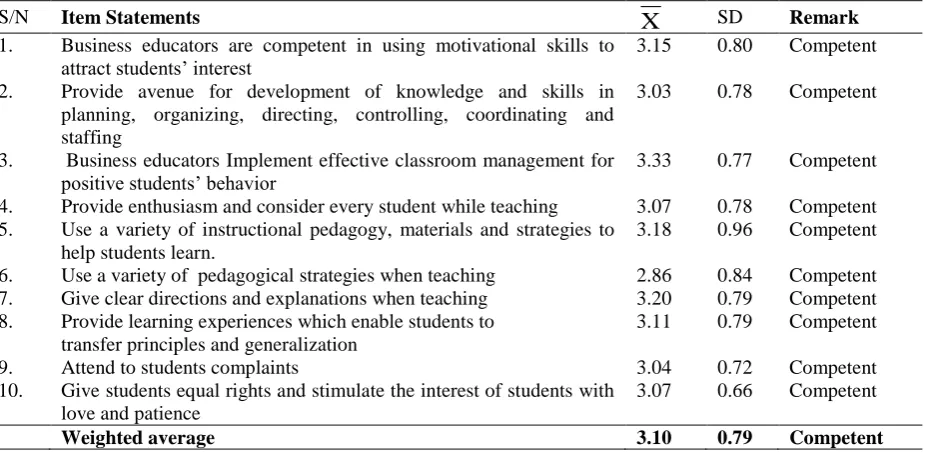
Table 1: Mean and standard deviation of responses on business educators’ competency level in teaching business administration courses
S/N Item Statements
X
SD Remark1. Business educators are competent in using motivational skills to attract students’ interest
3.15 0.80 Competent
2. Provide avenue for development of knowledge and skills in planning, organizing, directing, controlling, coordinating and staffing
3.03 0.78 Competent
3. Business educators Implement effective classroom management for positive students’ behavior
3.33 0.77 Competent
4. Provide enthusiasm and consider every student while teaching 3.07 0.78 Competent
5. Use a variety of instructional pedagogy, materials and strategies to help students learn.
3.18 0.96 Competent
6. Use a variety of pedagogical strategies when teaching 2.86 0.84 Competent
7. Give clear directions and explanations when teaching 3.20 0.79 Competent
8. Provide learning experiences which enable students to transfer principles and generalization
3.11 0.79 Competent
9. Attend to students complaints 3.04 0.72 Competent
10. Give students equal rights and stimulate the interest of students with love and patience
3.07 0.66 Competent
Weighted average 3.10 0.79 Competent
Source: Field Survey, 2018
Analysis of data in table 1 showed that the respondents indicated competent for all the item constructs with mean ranges from 2.86 to 3.33. The table showed that the respondents unanimously indicated competent for all the constructs as the mean is far above the fixed mean of 2.50. All the 10 items has standard deviation ranging from 0.66 to 0.96, which means the responses are clustered around their respective mean. This implied that business educators are very competent in teaching business administration courses in Polytechnics in Northeast. This was supported by a mean score of 3.10 and a standard deviation of 0.79 (mean = 3.10, SD = 0.79).
Research Question 2:What are Business Educators’ Competency Level in Teaching Communication Segments of
ISSN(Online): 2319-8753 ISSN (Print): 2347-6710
I
nternational
J
ournal of
I
nnovative
R
esearch in
S
cience,
E
ngineering and
T
echnology
(A High Impact Factor, Monthly, Peer Reviewed Journal)
Visit: www.ijirset.com Vol. 8, Issue 7, July 2019
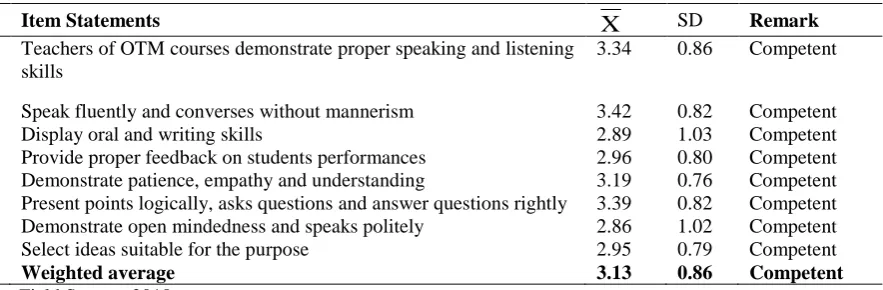
Table 2: Mean and standard deviation of responses on business educators’ competency level in teaching communication courses
S/N Item Statements
X
SD Remark1. Teachers of OTM courses demonstrate proper speaking and listening skills
3.34 0.86 Competent
2. Speak fluently and converses without mannerism 3.42 0.82 Competent
3. Display oral and writing skills 2.89 1.03 Competent
4. Provide proper feedback on students performances 2.96 0.80 Competent
5. Demonstrate patience, empathy and understanding 3.19 0.76 Competent
6. Present points logically, asks questions and answer questions rightly 3.39 0.82 Competent
7. Demonstrate open mindedness and speaks politely 2.86 1.02 Competent
8. Select ideas suitable for the purpose 2.95 0.79 Competent
Weighted average 3.13 0.86 Competent
Source: Field Survey, 2018
Analysis of data in table 2 showed that the respondents indicated competent for all the item constructs with mean ranges from 2.86 to 3.42. The table showed that the respondents unanimously indicated competent for all the constructs as the mean is far above the fixed mean of 2.50. All the 8 items have standard deviation ranging from 0.76 to 1.03. The standard deviations are very low, which means the responses are clustered around their respective mean. This implied that business educators are very competent in teaching communication courses in Polytechnics in Northeast. This was supported by a mean score of 3.13 and a standard deviation of 0.86 (mean = 3.13, SD = 0.86).
XIV. HYPOTHESES TESTING
H01: There is no significant difference in the mean responses of lecturers and students on Business Educators’ Competency Level in Teaching Business Administration Segments of Office Technology and Management courses in selected Polytechnics in Northeast Nigeria
Table 3: Summary of t-test of the difference between the mean responses of lecturers and students on the business educators’ competency level in teaching business administration courses
Group N Mean SD t-cal Df p-value Decision
Lecturers 49 3.70 0.10
9.877 293 0.000 Rejected
Students 246 3.00 0.46
Source: Field survey, 2018 P<0.05
Table 3 shows that there are 49 lecturers and 246 students. The lecturers had mean and standard deviation of 3.70 and 0.10, respectively while students had mean and standard deviation of 3.00 and 0.46, respectively. The calculated value of t was 9.877 (t293=-9.877). The observed p-value was 0.000 which is less than the fixed p-value of 0.05 (p<0.05). Therefore, the null hypothesis was rejected. This means that there was significant difference between the mean responses of lecturers and students on the business educators’ competency level in teaching business administration courses in selected Polytechnics in Northeast Nigeria. This implied that lecturers and students differ significantly in their perception.
ISSN(Online): 2319-8753 ISSN (Print): 2347-6710
I
nternational
J
ournal of
I
nnovative
R
esearch in
S
cience,
E
ngineering and
T
echnology
(A High Impact Factor, Monthly, Peer Reviewed Journal)
Visit: www.ijirset.com Vol. 8, Issue 7, July 2019
Table 4: Summary of t-test of the difference between the mean responses of lecturers and students on the business educators’ competency level in teaching communication courses
Group N Mean SD t-cal Df p-value Decision
Lecturers 49 3.46 0.25
3.949 293 0.000 Rejected
Students 246 3.07 0.64
Source: Field survey, 2018 P<0.05
Table 4 shows that there are 49 lecturers and 246 students. The lecturers had mean and standard deviation of 3.46 and 0.25, respectively while students had mean and standard deviation of 3.07 and 0.64, respectively. The calculated value of t was 3.949 (t293=3.949). The observed p-value was 0.000 which is less than the fixed p-value of 0.05 (p<0.05). Therefore, the null hypothesis was rejected. This means that there was significant difference between the mean ratings of lecturers and students on the business educators’ competency level in teaching communication courses in selected Polytechnics in Northeast Nigeria. This implied that lecturers and students differ significantly in their perception.
XV. DISCUSSION OF FINDINGS
The results of table 1 and 3 revealed that OTM business educators’ uses motivational skills to attract students interest in learning; they are also rated competent in providing avenue for development of knowledge and skills in planning, organizing, directing, controlling, coordinating and staffing. Business educators are very competent in implementing effective classroom management and they also provide enthusiasm and consider every student while teaching. Competence in teaching business administration courses are also shown when both lecturers and students rated business educators to have the competency in using a variety of cognitive level strategies, in giving clear directions and explanations, in providing learning experiences which enable students to transfer principles and generalization. These findings are in agreement with the study of Ehirheme (2014) who stated that OTM refers to the controlling, effective handling and maintenance of the technologies in an office environment for the achievement of the administrative goals of the organization. Mmeremikwu-fiac and Onwukwe (2011) also corroborated with this view when they said that competencies required of business educators in teaching business administration courses include ability to teach introduction to business, office administration and management, planning skill, organizing skill, directing skill. The implication of this is that graduates of OTM will be good in administrative aspect of the work in the office. The hypothesis revealed that there was significant difference between the responses of lecturers and students (t293=-9.877, p<0.05).
The results of table 2 and 4 revealed that OTM business educators demonstrates proper speaking and listening skills, speaks fluently and converses without mannerism. They possess competency in providing proper feedback on students performances, demonstrates patience, empathy and understanding in teaching communication courses. Lecturers and students also revealed that business educators demonstrates open mindedness and speaks politely. These finding concords with the studies of Agboola and Ademiluyi (2011) when they said that business educators needs listening skill, writing skill, reading skills, speaking clearly and fluently, pronouncing syllabus and speaking politely in teaching communication courses. This therefore, means that OTM graduates should be able to have good command of English language. There was significant difference between the mean responses of lecturers and students on business educators competency level in teaching communication courses in selected polytechnics in Northeast of Nigeria (t293=3.949, P<0.05).
XVI. CONCLUSION
ISSN(Online): 2319-8753 ISSN (Print): 2347-6710
I
nternational
J
ournal of
I
nnovative
R
esearch in
S
cience,
E
ngineering and
T
echnology
(A High Impact Factor, Monthly, Peer Reviewed Journal)
Visit: www.ijirset.com Vol. 8, Issue 7, July 2019
graduates will be knowledgeable in office administration aspect of the business office. The study also found that business educators are competent in teaching communication courses as the result of the study revealed that they possess people’s communication skill, business communication skill, technical English skill, and so on. The researchers concluded that secretaries who are the first contact the organization have with the outside world will create good impression in the minds of the customers through their communication skill.
XVII. RECOMMENDATIONS
Based on the findings of the study, the researchers made the following recommendations:
1.Business educators should always make their teaching functional by imparting the necessary competencies to students so that graduates of OTM will meet up with the requirements of the employers of labour. They should endeavor to teach the students following the new curriculum because the effectiveness of the graduates depends on the quality and devotion of the business educators.
2. Department of Office Technology and Management should always hold an In-house training where the lecturers who are more experienced in some of the courses will teach the less experienced lecturers in order to always maintain a good level of competence.
3. OTM business educators should ensure thorough and effective instruction and training, so that their graduates are prepared adequately for the world of work and of business and also for high positions in the organizations.
XVIII. ACKNOWLEDGEMENT
The researchers are highly indebted and grateful to the Tertiary Education Trust Fund (TETFUND) especially the executive secretary Prof. Suleiman Bogoro for sponsoring the entire research work. The researchers pray that God will sustain the organization so that they will continue to support and sponsor research works towards the improvement of the Nigerian educational system. The researchers’ gratitude is due to the Rector Federal Polytechnic Bali Dr. S.U. Jen and his management team for their support and encouragement. The researchers are forever grateful to Dr. Frank Okoro for his patience, suggestions, kind corrections and professional support throughout the period of this research study. The researchers are also indebted to Mrs Sympathy Arikwandu, Dr. Joshua Mamman and Ali Mohammed for their assistance towards the completion of this study.
REFERENCES
[1] Agboola, J.O. & Ademiluyi, L.F. (2011). Communication competencies needed for successfulentrepreneurship: implication for polytechnic education. Association of Business Education Journal 3(1), 156-168.
[2] Akarahu, C.U. (2011). Competencies required by teachers of business education for effective teaching of entrepreneurship. Business Education Journal 3(1), 192-205
[3] Akbar, M. (2016). Digital technology shaping teaching practices in higher education. Front information and communication technology 3:1 [4] Akpomi, M.E. (2018). Sustaining effective learning through class size management: A case of business education students in Port-Harcourt.
Nigerian Journal of Business Education, 5(1), 79-85.
[5] Anyakoha, E.U. (2009). Developing research skills: concepts and conceptual frame work.Nsukka: Great AP Express publishers Ltd.
[6] Baba, E.I., Victor-igwe, J.N., & Baba, D.D. (2015). Teachers’ competencies improvement needs of business courses in polytechnics in Kogi State.
Association ofBusiness Educators of Nigeria Journal 2(2), 322-333.
[7] Baba, E.I., Ameh, A.O., & Ezeahurukwe, N.L. (2018). Critical competencies required by officetechnology and management educators for the e-world of higher education. Association of Business Educators of Nigeria conference proceedings 186-193.
[8] Bartram, D., Robertson, I. T., & Callinan, M. (2002). Introduction: A framework for examining organizational effectiveness. In Robertson, I. T., Callinan, M., & Bartram, D. (Eds.), Organizational effectiveness: The role of psychology. Chichester, UK: Wiley.
[9] Burnett, P. (2001). Elementary students’ preferences for teacher praise. Journal of Classroom Information 36, 16-23.
[10] Dambo, B.I., Enyekit, E.O., & Enyekit, K.E.O. (2018). Instructional planning competencies required by business educators in teaching of entrepreneurship education in tertiary institutions in Rivers State. Association of Business Educators of Nigeria conference proceedings 378-385.
[11] Deakins C, R. (2008). Pedagogy for citizenship, In F. Oser & W. Veugelers (Eds.), Getting involved: Global citizenship development and sources of moral values. 31-55
Rotterdam: Sense Publishers.
[12] Ehirheme, P.E. (2014). Producing a global worker through business education with office technology and management (OTM) in perspective.
ISSN(Online): 2319-8753 ISSN (Print): 2347-6710
I
nternational
J
ournal of
I
nnovative
R
esearch in
S
cience,
E
ngineering and
T
echnology
(A High Impact Factor, Monthly, Peer Reviewed Journal)
Visit: www.ijirset.com Vol. 8, Issue 7, July 2019
[13] Ekpenyong, L.E. (2010). “Business education and entrepreneurship: The missing link” lead paper presented at the 22nd annual national conference
of association of business educators of Nigeria held at Federal college of education. Osele: Abeokuta on 12th -15th October.
[14] Etonyeaku, E.A.C. (2013). Utilization of ICT in business teacher education programme for quality assurance in government tertiary institutions in Enugu State. Association of Business Educators Journal 1(2), 245-252.
[15] Fadare, G.O. (2015). Assessment of instructional facilities and equipment available for
implementation of office technology and Management programme in Nigerian Polytechnics. Nigerian Journal of Business Education 2(3), 200-212.
[16] Feiman N. S. (2008). Teacher learning: how do teachers learn to teach? In Cochran-Smith, M.Feiman-Nemser, S., & McIntyre, D. (Eds.), Handbook of research on teacher education: enduring questions in changing contexts. New York/Abingdon: Routledge/ Taylor & Francis. [17] Fleisher, C.S., Wright, S., & Tindale, R. (2007). Bibliography and assessment of key
competitive intelligence scholars part 4 (2003-2006). Journal of competitive Intelligence and Management, 4(1), 32-92
[18] Hagger, H. & McIntyre, D. (2006). Learning teaching from teachers: realizing the potential of school-based teacher education. Maidenhead: Open University Press.
[19] Hammond, D. L. & Bransford, J. (Eds.) (2005). Preparing teachers for a changing world Report of the Committee on Teacher Education of the National Academy of Education. San Francisco: Jossey-Bass.
[20] Hoffman T. (1999). The meaning of competency. Journal of European Industrial Training23(6), 25-286. Retrieved @ http:// www.iosrjournals.org
[21] Iwu, A.C. (2005). Competencies based education: concept and use in business education.Journal of Occupation and Training 2(1).
[22] Jimoh, R. (2014). ICT competence among academic staff in Auchi polytechnic Auchi, EdoState Nigeria. Nigerian Journal of Business Education 1(3), 250-261
[23] Mckerchar, P.M., & Thompson, R.A. (2004). A descriptive analysis of potential reinforcement contingent in the preschool classroom Journal of Applied Behaviour Analysis, 37, 431-444.
[24] Mmeremikwu-Fiac, C. & Onwukwe, V. (2011). An assessment of business competenciesrequired of business education graduates for success in private enterprise. Association ofBusiness Education Journal 3(1), 182-191.
[25] Mueller, M.M., Edwards, R.P., & Trahant, D. (2003). Translating multiple assessment
technique into an intervention selection model for classrooms. Journal ofApplied Behaviour Analysis 36, 563-573.
[26] National Board for Technical Education (2004).Curriculum and Course Specification for NDand HND Secretarial Studies. Kaduna:
[27] Nnaji, F.O. (2014). Challenges of insecurity in Nigeria and the impact on business education: Association of Business Educators of Nigeria Conference Proceedings 133-139.
[28] Nnaji F.O. & Ibe, E.O. (2014). Office technology and management for sustainable industrial development. Federal Polytechnic Mubi, Journal of Management and Technology 40-47.
[29] Nwachukwu, N.L. (2005). Persuasive adjustment and student’ academic achievement inpractical subjects in selected secondary schools in Abia State. Journal of Science and Educational Development, (3), 32-39.
[30] Nwachukwu, C. L. & Husayn, M. (2013). Quality assurance in business teacher education in colleges of education in Nigeria. Association ofBusiness Educators of Nigeria Journal 1(2), 351-361.
[31] Nworgu, B.G. (2015). Educational research: Basic issues and methodology (3rd edition).Nsukka: University Trust Publishers
[32] Obi, C.A. (2005). Information technology skills needed by business education teachers for effective instruction in the secondary schools in Enugu State. Journal of World Council on Curriculum and Instruction, 4(2) 99-106.
[33] Ojukwu, K. & Ojukwu, F.K. (2002). Competencies related to tom modern information andcommunication technologies that need to be infused into business teacher and senior secondary school curricular. Business Education Journal BEJ 3(5).
[34] Okoro, F. & Asogwa, S.O. (2012). An analysis of the contemporary challenges that confrontsecretaries as perceived by office technology and management teachers in Bauchi. Association ofBusiness Educators’ Journal 3(2), 16-29.
[35] Okoro, F. (2008). Polytechnic teachers perception of the relevance of components in office technology and management programme in meeting ICT needs of the contemporary office in North-eastern Nigeria. Unpublished paper presented at the Association of Business Educators of Nigeria conference at Federal Polytechnic Nasarawa.
[36] Osuala, E.C. (2000). Introduction to research methodology. Onitsha: FEP. Publishers Limited. [37] Osuala, E.C. (2004). Foundations of vocational education. Onitsha: Cape Publishers Int. Ltd.
[38] Richard, G. (2012). Psychology: The science of mind and behaviour. 6th edition. London: Hachette Publishers.
[39] Scheerens, J. (2007). Conceptual framework for the development of the PISA 2009 context questionnaires and thematic reports. OECD, paper for the PISA Governing Board.
[40] Skinner, B.F. (1989). The origins of cognitive thought. American Psychologist 44, 13-18.Taro Yamane (2015). Elementary sampling theory @ Page on ec.europa.eu.
[41] Thorndike, E.L. (1898). Animal intelligence: an experimental study of the associative process in Animals. Psychological review monograph supplement, 2(8).
[42] Thorndike, E.L. (1932). Educational psychology: The psychology of learning. New York:Teachers College Press.
[43] Ukaike, F.U. (2018). Office management technology education for economic growth anddevelopment in Nigeria. Journal of Vocational Business Educators. 5(1), 102-113.
[43] Utoware, J.D.A & Kren-Ikidi, P.C (2014). Lecturers and students perception on electroniclearning as a new technology tool for studying business education in Nigerian universities in South-South States. Nigerian Journal of Business Education 1(3), 92-100.