ISSN(Online): 2320-9801
ISSN (Print): 2320-9798
I
nternational
J
ournal of
I
nnovative
R
esearch in
C
omputer
and
C
ommunication
E
ngineering
(A High Impact Factor, Monthly, Peer Reviewed Journal)
Vol. 4, Issue 1, January 2016
Vehicular Cloud Traffic Infrastructure
Generation Using SUMO
Amit Kumar Amar, Sanjay Kumar
M.Tech Student, Centre for Computer Science (Mobile Computing), Central University of Jharkhand, Ranchi, India Associate Professor, Dept. of Computer Science and Engineering, NIT Jamshedpur, India
ABSTRACT: In the recent years, wireless technology becoming pervasive and cheap, so its uses are exponentially increasing in different areas. This technology is also widely used in Vehicular ad hoc Network (VANET) due to the growth in the number of vehicles on the road has put great stress on transportation systems.Smooth, safe, secure, seamless movement with all type of day to day facilities available on the road in real time is the requirement of the VANET. To provide such facilities, researchers, car manufacturers and governments are taking attention in this direction to fulfill the demands of the current requirement and future trend of the VANET. Inculcation of vehicular cloud has given further added advantage in providing different type of communication and services in different potential application of VANET. In this paper, we propose a model of a vehicular cloud traffic system and its working protocol is proposed. For implementation of this protocol,this paper deals with vehicular cloud traffic infrastructure generation of proposed model using SUMO.
KEYWORDS: Wireless Technology, Pervasive computing, VANET, Vehicular Cloud, SUMO I.INTRODUCTION
In the recent years, wireless technology becoming pervasive and cheap, so its uses are exponentially increasing in different areas. This technology is also widely used in Vehicular ad hoc Network (VANET) due to the growth in the number of vehicles on the road has put great stress on transportation systems. Smooth, safe, secure, seamless movement with all type of day to day facilities available on the road in real time is the requirement of the VANET. To provide such facilities, researchers, car manufacturers and governments are taking attention in this direction to fulfill the demands of the current requirement and future trend of the VANET.Vehicular cloud provides an essential pillar to vehicular system and takes advantage of cloud computing resources for better service to end user in terms of providing low cost without the need to buy additional resources. In vehicular cloud can communicate with each other and with RSU using the DSRC in the range up to 1 km.The infrastructure can act as wireless access point for authentication and authorization purpose.In this paper, we have proposed a vehicular cloud architecture and protocol for providing better communication, traffic control and different type of services in real time on the road. Our main contribution in this paper will be:
1) To create a vehicular cloud architecture using VANET and cloud computing.
2) To proposed a protocol to provide different type of cloud services to the said architecture.
3) For working on this protocol, vehicular cloud traffic infrastructure generation of proposed model using SUMO was created.
II. RELATED WORK
ISSN(Online): 2320-9801
ISSN (Print): 2320-9798
I
nternational
J
ournal of
I
nnovative
R
esearch in
C
omputer
and
C
ommunication
E
ngineering
(A High Impact Factor, Monthly, Peer Reviewed Journal)
Vol. 4, Issue 1, January 2016
for global communication. Some vehicles which had the facility of cloud known as STAR, It could hold different types of services like STaaS, NaaS and DaaS. In [14],SUMO was for generating traffic mobility files for VANET. In [15] authors were proposed a novel algorithm for VANET using cloud computing.It accomplished processing, routing and traffic control in a centralized and parallel way by adding one or more server to the network. Each car or node was considered a Client, in such a manner that routing, traffic control, getting information from client and data processing and storing were performed by one or more server in different bases.
III. PROPOSED ARCHITECTURE OF VEHICULAR CLOUD SYSTEM
Vehicular ad hoc network is different from other ad hoc networks because of their hybrid architecture and node movement. Though ad hoc network, wirelesses LAN, cellular technology for intelligent transport system – all work together in VANET, address routing is the most important of all. VANET can employ vehicle-to-vehicle (V2V) and vehicle-to-infrastructure (V2I) communications for advanced notification of traffic events. In support of traffic-related communications, the US Federal Communications Commission (FCC) has allocated 75 MHz of spectrum in the 5.850 to 5.925 GHz band specially allocated by the FCC for dedicated short-range communications [3].
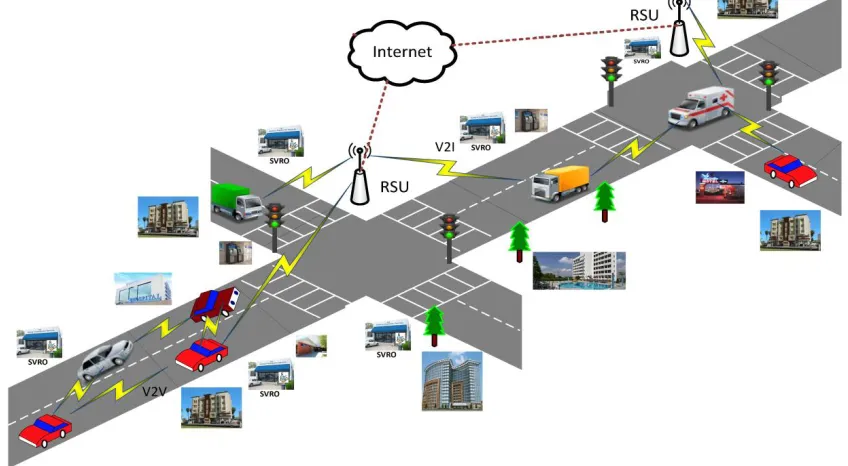
In the proposed architecture, the roads are divided into cells of 1 km where all vehicles will form a vehicular ad hoc network and can communicate with each other. Each cell consists of the following entities: Static vehicle registration office, Road Side Unit (RSU), Vehicle equipped with cloud, normal vehicle likes car, bus, truck, motorcycle, pedestrian, vehicular static cloud, vehicular dynamic cloud, road infrastructure with traffic lights and other road side facilities like motel, hotel, fuel station, ATM, bank, post office, police station etc. as shown in the figure.
Figure 1 Architecture of Proposed Model
ISSN(Online): 2320-9801
ISSN (Print): 2320-9798
I
nternational
J
ournal of
I
nnovative
R
esearch in
C
omputer
and
C
ommunication
E
ngineering
(A High Impact Factor, Monthly, Peer Reviewed Journal)
Vol. 4, Issue 1, January 2016
Table 1: Vehicle Registration details at SVRO
Vehicle _Id
Vehicle_Registration_ Number
Vehicle_Type Time of
Registration
Service Availability
Service Type
V001 #VC001 Car 10:30:15 AM Yes NaaS
V002 #VC002 Car 10:35:20 AM No NIL
V003 #VB001 Bus 11:12:25 AM Yes STaaS
V004 #VC003 Car 13:12:12 PM Yes PaaS
V005 #VC004 Car 14:16:35 PM No NIL
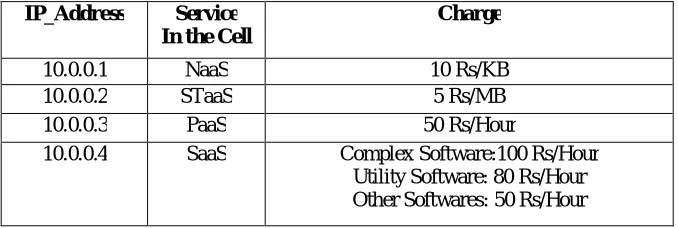
5) All types of local services, free cloud services and static cloud services based on pay as you go model present outside the road can be registered at RSU as per the registration format shown in table 2 and will be provided through directory look up procedure.
Table 2: Service Type description at RSU
IP_Address Service In the Cell
Charge
10.0.0.1 NaaS 10 Rs/KB 10.0.0.2 STaaS 5 Rs/MB 10.0.0.3 PaaS 50 Rs/Hour
10.0.0.4 SaaS Complex Software:100 Rs/Hour Utility Software: 80 Rs/Hour Other Softwares: 50 Rs/Hour
6) The RSU can also act as a gateway to provide internet service and ubiquitous global communication.
7) SVRO multicast the updated information regardingregistered vehicles (beacon) to all other vehicles in the cell periodically (default every 2 Sec).
8) Each vehicle saves updated registration information for its use.
9) Based on the requirement, Consumer vehicles(CV) can send request packet to the desired vehicular cloud (VC) for its service.
10) VC exchange service agreement information with consumer vehicle for its static and dynamic services based on pay as you go model as per the format shown in table 3.1,3.2 and 3.3.
Table 3.1: NaaS Agreement between VC and CV
Ip_Address Type of Service Service Parameter Bandwidth Access
Delay
Charge
10.0.1.1 NaaS 2 Mbps 100 ms 10 Rs/10 Kb 10.0.1.2 NaaS 4 Mbps 100 ms 40 Rs/10
ISSN(Online): 2320-9801
ISSN (Print): 2320-9798
I
nternational
J
ournal of
I
nnovative
R
esearch in
C
omputer
and
C
ommunication
E
ngineering
(A High Impact Factor, Monthly, Peer Reviewed Journal)
Vol. 4, Issue 1, January 2016
Table 3.2: STaaS Agreement between VC and CV
Ip_Address Type of Service Service Parameter
Time Duration
Max Storage
Cost/Storage Unit
10.4.1.1 STaaS 5 min 1 GB 100 Rs 10.4.1.2 STaaS 4 min 512 MB 50 Rs 10.4.1.4 STaaS 2 min 200 MB 30 Rs
Table 3.3: DaaS Agreement between VC and CV
Ip_Address Type of Service Service Parameter
Type of Data
Max Data Capacity
Cost/Unit
10.0.1.5 DaaS Video 1 GB 100 Rs 10.0.1.7 DaaS Audio 512 MB 60 Rs 10.1.1.8 DaaS Text/Image 300 MB 25 Rs
11) The consumer vehicle, after validation of exchange service agreement information requests for service from the desired VC.
12) The VC provides the desired services to the said CV.
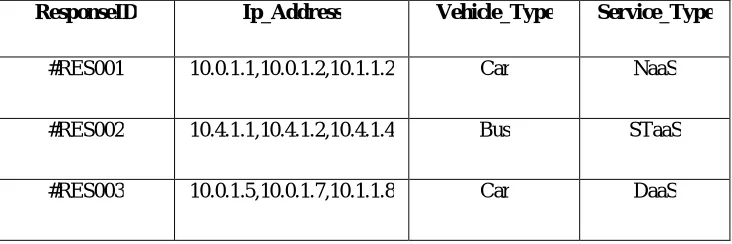
13) For roadside services and global communication with outside the world, Consumer vehicles request to RSU as per the format shown in table 4.1 and 4.2
.
Table 4.1: Consumer vehicles requests
RequestID Vehicle_Id Vehicle_Type Service_Type
#REQ001 V006 Car NaaS #REQ002 V002 Car NIL #REQ003 V003 Bus STaaS #REQ004 V004 Car DaaS
Table 4.2: Consumer vehicles Response
ResponseID Ip_Address Vehicle_Type Service_Type
ISSN(Online): 2320-9801
ISSN (Print): 2320-9798
I
nternational
J
ournal of
I
nnovative
R
esearch in
C
omputer
and
C
ommunication
E
ngineering
(A High Impact Factor, Monthly, Peer Reviewed Journal)
Vol. 4, Issue 1, January 2016
V BRIEF DESCRIPTION OF SUMO
"Simulation of Urban MObility", or "SUMO" is an open source, microscopic, multi-modal traffic simulation. Traffic simulations facilitate the evaluation of infrastructure changes as well as policy changes before implementing them on the road. For example, the effectiveness of environmental zones or traffic light control algorithms can be tested and optimized in a simulation before being deployed in the real world [6].
SUMO is a free and open traffic simulation suite which is available since 2001. SUMO allows modelling of intermodal traffic systems including road vehicles, public transport and pedestrians. Included with SUMO is a wealth of supporting tools which handle tasks such as route finding, visualization, network import and emission calculation.
Its main features include collision free vehicle movement, different vehicle types, single-vehicle routing, multi-lane streets with lane changing, junction-based right-of-way rules, hierarchy of junction types, an OpenGL graphical user interface (GUI), and dynamic routing. SUMO can manage large environments, i.e., 10 000 streets.
Features:The simulation platform SUMO offers many features:
Microscopic simulation - vehicles, pedestrians and public transport are modeled explicitly
Online interaction – control the simulation with TraCI
Simulation of multimodal traffic, e.g., vehicles, public transport and pedestrians
Time schedules of traffic lights can be imported or generated automatically by SUMO
No artificial limitations in network size and number of simulated vehicles
Supported import formats: OpenStreetMap, VISUM, VISSIM, NavTeq
SUMO is implemented in C++ and uses only portable libraries. The SUMO package contains the following applications:
SUMO: command line simulation
GUISIM: simulation with a graphical user interface
NETCONVERT: network importer
NETGEN: abstract network generator
OD2TRIPS: converter from O/D matrices to trips
JTRROUTER: routes generated based on turning ratios at intersections
DUAROUTER: routes generator based on a dynamic user assignment
DFROUTER: route generator with use of detector data
ISSN(Online): 2320-9801
ISSN (Print): 2320-9798
I
nternational
J
ournal of
I
nnovative
R
esearch in
C
omputer
and
C
ommunication
E
ngineering
(A High Impact Factor, Monthly, Peer Reviewed Journal)
Vol. 4, Issue 1, January 2016
Figure2 Simulation input/output flow in SUMO
To build a network in SUMO a street network consists of nodes i.e junctions and edges (streets connecting the given junctions) are necessary.
A SUMO network file describes the traffic-related part of a map. It mainly contains the network of roads/ways, intersections/junctions, and traffic lights in a map
Network Format: At a coarse scale, a SUMO network is a directed graph. "Nodes" represent intersections/junctions, and "edges" roads/streets.
A SUMO network contains further traffic related information:
Every street (edge) as a collection of lanes, including the position, shape and speed limit of every lane,
Traffic light logics referenced by junctions,
Junctions including their right of way regulation,connections between lanes at junctions (nodes).
Also, depending on the used input formats and set processing options, one can also finddistricts,roundabout descriptions.
Files used in SUMO to make a Road Map:
Node file(.nod.xml)
Edge file(.edg.xml
Route file(.rou.xml)
ISSN(Online): 2320-9801
ISSN (Print): 2320-9798
I
nternational
J
ournal of
I
nnovative
R
esearch in
C
omputer
and
C
ommunication
E
ngineering
(A High Impact Factor, Monthly, Peer Reviewed Journal)
Vol. 4, Issue 1, January 2016
VI. TRAFFIC INFRASTRUCTURE GENERATION OF PROPOSED MODEL USING SUMO
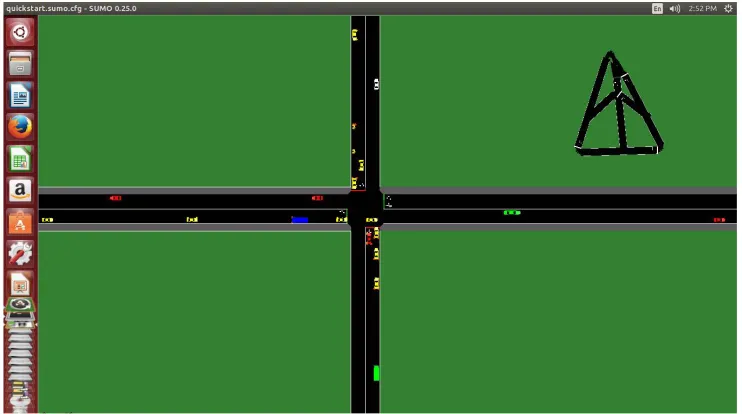
Section IV discusses the detailed methodologies, how to generate traffic infrastructure of any fictitious model . Based on those methodology cum steps, the following snapshots of the vehicular cloud traffic generation of the proposed model are as given in the below figure 3 and figure 4 respectively.
Figure 3 Infrastructure with roadside services
In the below snapshot, the different icons represent different roadside units of the roadside infrastructure as given below.
ISSN(Online): 2320-9801
ISSN (Print): 2320-9798
I
nternational
J
ournal of
I
nnovative
R
esearch in
C
omputer
and
C
ommunication
E
ngineering
(A High Impact Factor, Monthly, Peer Reviewed Journal)
Vol. 4, Issue 1, January 2016
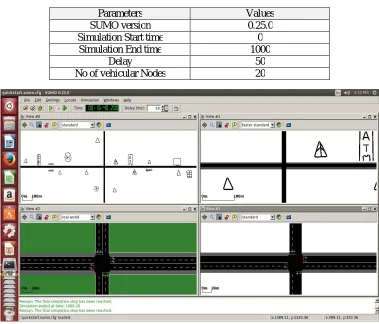
Table 5: Simulation parameter Description
Parameters Values SUMO version 0.25.0 Simulation Start time 0
Simulation End time 1000 Delay 50 No of vehicular Nodes 20
Figure 5 SUMO road infrastructure in different simulation mode
VII.CONCLUSION AND FUTURE WORK
In this paper, wehave designedthe vehicular cloud infrastructure with traffic light according to the proposed protocol using SUMO. It provides various types of services like pay as you go model services (NaaS, STaaS,DaaS,PaaS),free services (Ambulance service,crane service,police service,route broadcast service,VIP movement information etc.),static cloud service and road side service information like ATM,Hospital,Hotel, Motel,Fuel station etc. presented at RSU.Traffic simulation is performed in various modes like standard, fast standard, real world and custom as depicted at figure 5 and its simulation parameters and values are depicted at Table 5. The proposed vehicular cloud network communication protocol design has been given in this paper and its simulation canbe taken as future work.
REFERENCES
ISSN(Online): 2320-9801
ISSN (Print): 2320-9798
I
nternational
J
ournal of
I
nnovative
R
esearch in
C
omputer
and
C
ommunication
E
ngineering
(A High Impact Factor, Monthly, Peer Reviewed Journal)
Vol. 4, Issue 1, January 2016
[5] N. Cao, C. Wang, M. Li, K. Ren, and W. Lou, “Privacy-Preserving Multi-keyword Ranked Search over Encrypted Cloud Data”, Proc. of IEEE INFOCOM 2011, Shanghai, China, Apr. 2011, pp. 829-837.
[6] http://www.dlr.de/ts/en/desktopdefault.aspx/tabid-9883/16931_read-41000/
[7] Michael Behrisch, Laura Bieker, Jakob Erdmann, Daniel Krajzewicz “SUMO – Simulation of Urban Mobility-An Overview, SIMUL 2011: The Third International Conference on Advances in System Simulation.
[8] Md Whaiduzzaman, MehdiSookhak, AbdullahGani, RajkumarBuyya “A survey on vehicular cloud computing” Journal of Networkand Computer Applications 40 (2014) 325–344, journal homepage: www.elsevier.com/locate/jnca
[9] R. Buyya, C. Yeo, and S. Venugopal, “Market-oriented cloud computing:Vision, hype, and reality for delivering it services as computing utilities,” in High Performance Computing and Communications, 2008. HPCC’08. 10th IEEE International Conference on. IEEE, 2008, pp. 5–13 [10] Md Ali Al Mamun, Khairul Anam, Md Fakhrul Alam Onik, A M Esfar- E- Alam “ Deployment of Cloud Computing into VANET to Create Ad Hoc Cloud Network Architecture” Proceedings of the World Congress on Engineering and Computer Science 2012 Vol I WCECS 2012, October 24-26, 2012, San Francisco, USA.
[11] W. Jia, H. Zhu, Z. Cao, L. Wei, and X. Lin, “SDSM: A Secure Data Service Mechanism in Mobile Cloud Computing”, Proc. of the 1st International Workshop on Security in Computers, Networking, and Communications (SCNC), Shanghia, China, Apr. 2011, pp. 1060-65.
[12] K. Mershad and H. Artail, “A Framework for Secure and Efficient Data Acquisition in Vehicular Ad Hoc Networks,” IEEE Tran.OnVehicular Technology, Vol. 62, No. 2 (2013), pages 536 - 551.
[13] G. Yan, D. Wen, S. Olariu, and M. C. Weigle, “Security Challenges in Vehicular Cloud Computing,” IEEE Tran. on Intell. Transp. Systems, Vol. 14, No. 1, Mar. 2013, pp. 284-294.
[14]Chitraxi Raj, Urvik Upadhayaya, Twinkle Makwana and Payal Mahida, “Simulation of VANET Using NS-3 and SUMO” in IJARCSSE Volume 4, Issue 4, April 2014 ISSN: 2277 128X, pages 563-569
[15] Saied Raeeszadeh and Reza Sabbaghi-Nadooshan “A Novel Method for VANET Improvement using Cloud Computing” International Journal of Smart Electrical Engineering, Vol.2, No.1, Winter 2013 ISSN: 2251-9246, pp 39:44.
BIOGRAPHY
Amit Kumar Amar is an M.Tech scholarof Centre for Computer Science and Technology (Mobile Computing), Central University of Jharkhand, Ranchi, India. He received B.Tech in 2009 from Ranchi University, Ranchi, India.
His research interests are Cloud Computing,VANET and CommunicationTechnology.