FLEXURAL STRENGTH OF PRECAST CONCRETE SEGMENTS WITH
JOINT GROUTS
J. G. Jang1, H. K. Kim2, K. A. Ha1, B. J. Yang1 and H. K. Lee3
1 Graduate student, Dept. of Civil and Environmental Engineering, KAIST, Daejeon, South Korea
2 Ph.D, Dept. of Civil and Environmental Engineering, KAIST, Daejeon, South Korea
3 Professor, Dept. of Civil and Environmental Engineering, KAIST, Daejeon, South Korea
ABSTRACT
The precast concrete segmental construction method is an effective method to replace the deteriorated concrete for rapidity. The precast concrete segmental method is widely applicable to various structures with including concrete pavements, bridge decks, buildings, and special structures such as nuclear power plant. The precast concrete is used in the nuclear power plant as the form of precast girder for turbine generator pedestal, supports, wall system, etc (Tatum 1983). This paper presents the result of an experimental study (Jang et al., 2013) conducted to investigate the flexural strength of precast concrete segments with joint grouts. All specimens had no reinforcement. Three types of cementitious grout material, i.e., ordinary cement mortar, shrinkage compensating cement mortar, and polymer cement mortar, were filled between precast concrete segments. In addition, two types of joint space, 2 cm and 5 cm, were examined. The experimental results showed that a typical failure mode was bond failure.
However, only a precast concrete segment with joint space of 5 cm connected by a polymer cement
mortar showed flexural failure mode due to sufficient bond strength between a precast concrete segment and a polymer cement mortar grout to behave in a body. The maximum strengths were high according to the order of polymer cement mortar, shrinkage compensating cement mortar, and ordinary cement mortar. In addition, flexural strength in the case of joint space of 2 cm was larger than that of 5 cm.
INTRODUCTION
In recent years, precast concrete segmental method of construction has been popular as a substitute for cast-in-place method. Cast-in-place construction method is useful to achieve structural integration, however it can lead to extensive traffic delays and rerouting inconveniences. In addition, it has often lack of durability, particularly in harsh environments (Billington et al., 1999). On the other hand, precast concrete segmental method guarantees the speed of erection, improved aesthetics and the ease of quality control (Buyukozturk et. al., 1990). The precast concrete segmental construction method is also an effective method to replace the deteriorated concrete for rapidity. The precast concrete segmental method is widely applicable to various structures with aforementioned advantages. Not to mention precast concrete segmental method is applied to general structures like concrete pavements, bridge decks, and buildings, it is also applied to the special structures such as nuclear power plant. The precast concrete is used in the nuclear power plant as the form of precast girder for turbine generator pedestal, supports, wall system, etc (Tatum 1983).
joints is to transfer the live loads between adjacent panels, key consideration of join details should be prevention of crack formation to ensure the structural stability (Shim et al., 2001).
Several studies about transverse joint behavior focused on the prediction of load transferring mechanism (Sullivan, 2003; Kaneko et al., 1993). However, a few research on the effect of grouting material on durability and structural stability exists. Gulyas et al. (1995) investigated the effect of grout material on the vertical shear, direct tension, and direct longitudinal shear tests of joints via experiments. The used grout material was Set 45 and non-shrinkage mortar, and they found that Set 45 Hot Weather grout gave much higher strength, but also showed larger dry-shrinkage (Gulyas et al., 1995). Set 45 grout was sensitive to the exposure on the air before mixing, while precast concrete segment using Set 45 grout was lighter than the Portland cement concrete specimen (Gulyas et al., 1995). It can be concluded that the recommendation of grout material depends on the environmental condition around construction site. Issa et al. (1995) carried out the visual inspections on the existing precast concrete structures. According to the study, generally used joint types in United States were tongue-and-groove joint, butt joint, and female-to-female joint type. The tongue-and-groove joint was impractical because of difficult grouting process (Issa et al., 1995). The butt joint was known to be ineffective because of leakage under tensile load (Issa et al., 1995). The female-to-female joint had potential problem under repeated loading for mismatching the adjacent slab (Issa et al., 1995). Bridge decks with female-to-female joints had virtually no problem on the top and bottom (Issa et al., 1995). Issa et al. (1995) concluded that the female-to-female joint is the most common joint type and recommended for serviceability.
This study investigated the flexural strength of precast concrete segments with joint grouts. Precast concrete segment with female-to-female shear key was prepared, and all specimens had no reinforcement. Flexural strength of precast concrete segments with joint grouts was evaluated from the experimental results of flexural test, i.e., failure modes, peak loads, and load-displacement relationships, etc.
EXPERIMENTAL PROCEDURE
Specimen Preparation
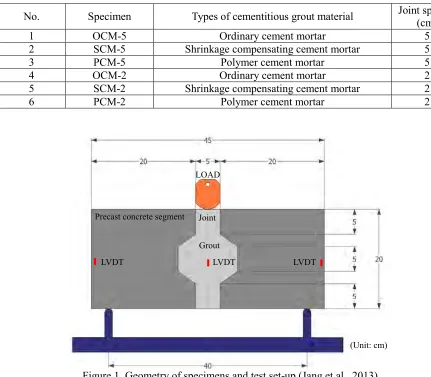
A total of 6 specimens were prepared for this experimental study. All specimens were prepared as a form of two precast concrete segments connected by cementitious grout materials (see Fig. 1). Precast
concretes used in this study were composed of ordinary Portland cement, water, sand, gravel (Gmax=25
mm) and polycarboxylate-based super-plasticizer. Mix proportion and measured compressive strength of the precast concrete is shown in Table 1. A precast concrete segment having a dimension of 200 mm × 200 mm × 200 mm with female-to-female shear key was prepared for the test. Two precast concrete
segments were connected by cementitious grout materials. Three types of cementitious grout materials,
i.e., ordinary cement mortar (W/C=0.4, sand to cement ratio=2, super-plasticizer content=0.6 wt% by cement), shrinkage compensating cement mortar (W/B=0.16), and polymer cement mortar (W/B=0.16) were prepared to fill a space between precast concrete segments. The space between the precast concrete segments was set by 2 cm and 5 cm. In addition, all specimens had no reinforcement.
Table 1: Mix proportion and measured compressive strength of the precast concrete
W/C S/a Unit weight (kg/m
3)
Compressive
strength (MPa)*
Water Cement Sand Gravel plasticizer
Super-35 38.3 171 488 620 1015 3.22 40
Test Methodology
Test plan is summarized in Table 2. Flexural test was conducted by 3 point bending test. Figure 1 represents the geometry of specimens and test set-up. The tests were conducted under displacement control at a constant head loading rate of 0.03 mm/s using 200 kN universal testing machine (UTM). In addition, six linear variable differential transformers (LVDTs) were installed on the specimen to measure vertical displacement. More details of the specimen preparation and test methodology can be found in Jang et al. (2013).
Table 2: Summary of test plan
No. Specimen Types of cementitious grout material Joint spacing (cm)
1 OCM-5 Ordinary cement mortar 5
2 SCM-5 Shrinkage compensating cement mortar 5
3 PCM-5 Polymer cement mortar 5
4 OCM-2 Ordinary cement mortar 2
5 SCM-2 Shrinkage compensating cement mortar 2
6 PCM-2 Polymer cement mortar 2
Figure 1. Geometry of specimens and test set-up (Jang et al., 2013)
RESULTS AND DISCUSSION
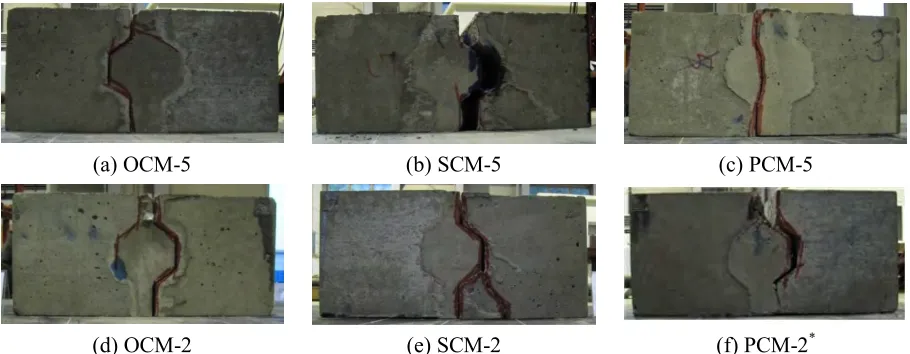
The typical failure modes were shown in Fig. 2. In the case of specimens with joint space of 5 cm, OCM-5 and SCM-5 showed similar failure mode. The first crack was occurred in lower joint, and the cracks were progressed along cross-section of a joint. Failure modes of two specimens were bond failure between a precast concrete segment and a grout. From this result, it can be concluded that a stress concentration occurred in a part of joint, since bond strengths between a precast concrete segment and a joint grout were lower than the flexural strength of specimen. On the other hand, PCM-5 showed different
Precast concrete segment
Grout LOAD
LVDT
Joint
LVDT
failure mode, i.e. flexural failure. This result showed that the bond strength between precast concrete segment and joint grout was sufficient to behave in a body. In cases of specimens with joint space of 2 cm, all specimens showed similar failure mode, i.e. bond failure.
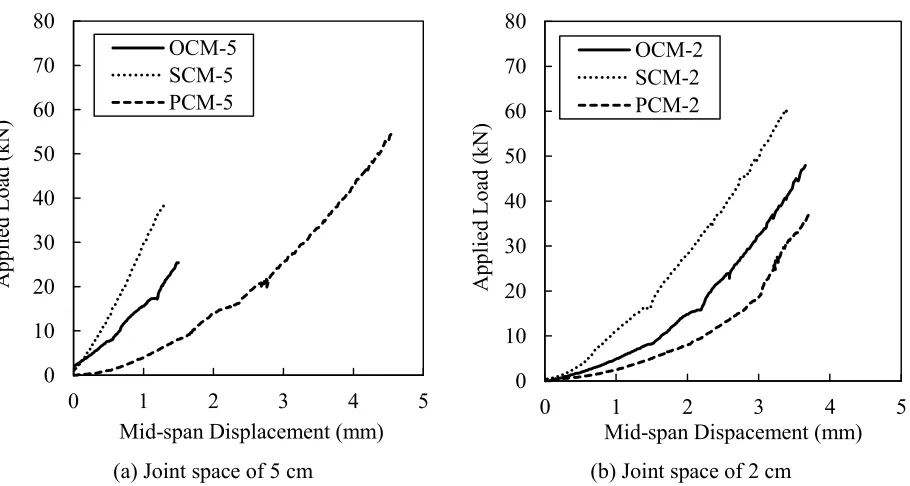
Load-displacement relationships of the flexural test specimens were shown in Fig. 3, and the test results of flexural test were summarized in Table 3. In cases of specimens with joint space of 5 cm, the peak loads of OCM-5, SCM-5, and PCM-5 were 23.58 kN, 38.71 kN, and 54.49 kN, respectively. In addition, the displacements at failure of OCM-5, SCM-5, and PCM-5 were 1.42 mm, 1.35 mm, and 4.54 mm, respectively. It could be inferred that PCM-5 showed the highest flexural strength, since the polymer cement mortar grout has higher compressive, flexural and tensile strength compared to ordinary cement mortar grout or shrinkage compensating cement mortar grout. In cases of specimens with joint space of 2 cm, on the other hand, the peak loads of OCM-2, SCM-2, and PCM-2 were 47.92 kN, 60.96 kN, and 36.85 kN, respectively. It should be noted that a hardened joint grout of PCM-2 showed porous texture, since it was not sufficiently compacted. Therefore, the maximum strength was high according to the order of polymer cement mortar grout, shrinkage compensating cement mortar, and ordinary cement mortar, considering the experimental results of five specimens except PCM-2 which had a manufacturing defect.
(a) OCM-5 (b) SCM-5 (c) PCM-5
(d) OCM-2 (e) SCM-2 (f) PCM-2*
* In case of PCM-2, hardened joint grout showed porous texture, since it was not sufficiently compacted.
Figure 2. Typical failure modes in flexural tests (Jang et al., 2013)
Table 3: Summary of test results of flexural test (Jang et al., 2013)
Specimen Peak load (kN) Displacement at failure (mm) Flexural strength (MPa)
OCM-5 25.38 1.42 1.90
SCM-5 38.71 1.35 2.90
PCM-5 54.49 4.54 4.09
OCM-2 47.92 3.66 3.59
SCM-2 60.96 3.43 4.57
PCM-2* 36.85 3.70 2.76
(a) Joint space of 5 cm (b) Joint space of 2 cm Figure 3. Load-displacement relationships of the flexural test specimens (Jang et al., 2013)
CONCLUSIONS
This study investigates the flexural strength of precast concrete segments with joint grouts. All specimens had no reinforcement. The experimental results showed that the failure mode of precast concrete segments with a polymer cement mortar grout was flexural failure in a relatively large load, whereas the failure modes of precast concrete segments with ordinary cement mortar grout or shrinkage compensating cement mortar grout were bond failure between a precast concrete segment and a joint grout in a relatively small load. The flexural strength was high according to the order of polymer cement mortar, shrinkage compensating cement mortar, and ordinary cement mortar. It is also worth mentioning that the joint space should be installed small in order to withstand larger loads.
ACKNOWLEDGMENTS
This research was supported by a grant (Code 11-F01) from Transportation & Logistics Research
Program funded by Ministry of Land, Infrastructure and Transport Affairs of Korean government. The
authors gratefully acknowledge the support of this work by Prof. Seung-Hee Kwon of the Myongji University.
REFERENCES
Billington, S. L., Barnes, R. W. and Breen, J. E. (1999). “A precast segmental substructure
system for standard bridges”, PCI journal, Vol. 44, No. 4, pp. 56-73.
Buyukozturk, O., Bakhoum, M. M. and Michael Beattie, S. (1990). “Shear behavior of joints in
precast concrete segmental bridges”, Journal of Structural Engineering, Vol. 116, No. 12, pp. 3380-3401.
Gulyas, R. J., Wirthlin, G. J. and Champa, J. T. (1995), “Evaluation of keyway grout test methods
for precast concrete bridges”, PCI journal, Vol. 40, No. 1, pp. 44-57.
Issa, M. A., Idriss, A. T., Kaspar, I. I. and Khayyat, S. Y. (1995), “Full depth precast and precast,
prestressed concrete bridge deck panels”, PCI journal, Vol. 40, No. 1, pp. 59-80.
0 10 20 30 40 50 60 70 80
0 1 2 3 4 5
A ppl ied Load (k N )
Mid-span Displacement (mm) OCM-5 SCM-5 PCM-5 0 10 20 30 40 50 60 70 80
0 1 2 3 4 5
Appl ie d Loa d (k N)
Mid-span Dispacement (mm) OCM-2
Issa, M. A. and Abdalla, H. A. (2007). “Structural behavior of single key joints in precast
concrete segmental bridges”, Journal of Bridge Engineering, Vol. 12, No. 3, pp. 315-324.
Jang, J. G. Kim, H. K. and Lee, H. K. (2013). “Structural behavior of precast concrete segments with cementitious grout materials”, in preparation.
Kaneko, Y., Connor, J. J., Triantafillou, T. C. and Leung, C. K. (1993). “Fracture mechanics
approach for failure of concrete shear key. I: Theory”, Journal of engineering mechanics, Vol. 119, No. 4,
pp. 681-700.
Shim, C. S., Choi, K. Y. and Chang, S. P. (2001). “Design of transverse joints in composite
bridges with precast decks”, KSCE Journal of Civil Engineering, Vol. 5, No. 1, pp. 17-27.
Sullivan, S.R. (2003). “Behavior of Transverse Joints in Precast Deck Panels Systems”, Ohio University.
Tatum, C. B. (1983). "Innovations in nuclear concrete construction", journal of Construction