High Performance Concrete for Containment Structures
A K Chakraborty ~ ), I Ray 2 ) and B Sengupta 3 )
1 ) Department of Civil Engineering, B E College (Deemed University) Howrah, India 2 ) Department of Civil and Environmental Engineering, West Virginia University, USA 3) Department of Civil Engineering, Jadavpur University, Calcutta, India
ABSTRACT
Primary and secondary containment structures are the major components of the nuclear power plant (NPP). The primary and secondary containment structures are mainly composed of prestressed concrete vertical cylindrical shell wall and segmented hemispherical dome with openings. The performance requirements of the concrete of containment structures are mainly radiological protection, structural integrity, controlled deformation, leak tightness, durability etc. For this high performance concrete (HPC) with special attributes such as moderate compressive strength, low shrinkage and high durability are essential. Department of Civil Engineering, Jadavpur University, India had undertaken a project on the development of such HPC suitable for containment structure with financial and technical support from Department of Atomic Energy, Govt. of India. In the project, HPC was developed using Indian ordinary portland cement (a relatively low-alite portland cement compared to ASTM Type I and other equivalent normal cements), locally available aggregates, silica fume and ASTM Type F and G superplasticizers. After several trials a high initial slump of 180 to 200 mm and 30-min. slump of 150 to 170 mm was achieved with a water-cementitious material ratio of 0.32. The mix was cohesive, consistent and free from bleeding and segregation. The maximum compressive strength of 72 MPa, split tensile strength of 4.52MPa and flexuraI strength of 6.7 MPa was achieved after several trials. The HPC with reasonably low absorption value and drying shrinkage was obtained for the mixtures containing silica fume of 7.5 % and above. Though the concretes with silica fume content 7.5, 10 and 12.5 % were acceptable from workability, strength, shrinkage and absorption point of view, the concrete with silica fume greater with 12.5 and 15 % showed more strength-loss than the other mixtures in 10% MgSO4 and 1%
H2SO4
acid solutions in spite of having a better pore size distribution (measured by mercury porosimetry). X-ray diffraction of samples exposed in acid and sulfate solutions revealed that the attack was possibly more chemical than physical in nature and gel structure was particularly attacked. The within-batch variation of compressive strength of some selected types shows that HPC developed in the laboratory was of consistent quality. Finally on the basis of test results, the HPC with silica fume content 7.5 and 10 %, Indian cement and aggregate is recommended for the use in containment structure. The final field application is, however, subjected to 'Information and qualification test' which is in progress.I N T R O D U C T I O N
The structures and buildings of nuclear power plant (NPP) are designed to house and support structures, systems and components (SSC). The Primary containment structures (PCS), secondary containment structures (SCS) and major components of the NPP structure are mainly composed of prestressed concrete vertical cylindrical shell wall and segmented hemispherical dome with openings. Both the primary and secondary containment structures act as a radiation shielding, provide operating environment to the reactor and related SSCs, provide passage for services and withstand all postulated loading effects. The PCS provides shielding against radiation while SCS protects PCS from natural events like wind, rain, solar radiation etc. Depending on their functional roles the performance requirements [ 1] of the concrete of containment structures are mainly radiological protection, structural integrity, controlled deformation, leak tightness, durability etc. To meet such requirements moderate compressive strength, low shrinkage and high durability are essential. In other words a particular class of concrete is to be engineered in such a way so that it satisfies the above properties. This leads to the choice of high performance concrete with some specific attributes. According to the definition of ACI [ 2 ] the High performance concrete is a concrete meeting special combinations of performance and uniformity requirements that cannot be achieved routinely using conventional constituents and normal mixing, placing, and curing practices. For PCS and SCS, the special combinations of performance was defined as follows. The criteria are based on the information and experiences of similar structures within and outside the country.
1) A highly workable, cohesive mixture with ease of placement and pumpability 2) Concrete with uniform density and minimum void
3) Moderately high strength 4) Good split tensile strength
SMiRT 16, Washington DC, August 2001 Paper # 1328
5) Low permeability and shrinkage 6) Good durability
7) Minimum variability
Based on the above requirements design criteria for proposed HPC was defined as follows: 1) A cohesive and non-segregatable mixture without bleeding even under vibration 2) Initial slump = 180 - 200 mm and slump after 30 mins. = 150-170 mm
3) 28 days compressive strength = 65 M P a - 75 MPa 4) 28 days split tensile strength = 4.5 MPa or more
5) Drying shrinkage = 250 microstrain or less
6) Absorption of water = 4% or less 7) Low porosity
8) Low strength loss in dilute acid and sulfate solution 9) Consistent values of strength
In order to obtain the HPC with the above targets by using Indian ordinary portland cement (OPC) and locally available aggregate it was decided to incorporate high quality pozzolanic material like silica fume and superplasticizer alongwith the retarder. Since Indian OPC contains much lower quantity of C3S (about 30 %) compared to many other cements (e.g., ASTM Type I contains about 50-55%), it produces relatively lower quantity of calcium hydroxide, which in turn may influence the pozzolanic reaction with the silica fume. It therefore needs further investigation on the influence of silica fume on Indian OPC and local aggregates for the production of HPC suitable for containment structures. There are good number of information available on'the influence of silica fume on concrete/mortar [3-4, 6-15] and also there are guidelines for the silica
fume in concrete by American Concrete Institute [5], however the information are valid for a particular type of cement,
aggregates, water-cementitious ratios (w/cm), chemical admixtures, curing condition, test condition etc. As a result the information can not be used directly in the present condition. The study therefore aims to develop HPC in the laboratory fulfilling the prescribed design criteria and using Indian OPC, aggregates, commercial silica fume and superplasticizers. Before application in the field it is necessary to conduct 'Information and qualification test' per any standard code of practice which is however in progress.
E X P E R I M E N T A L P R O G R A M M E
Materials and Sample Preparation
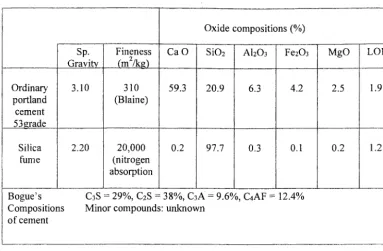
The cement used was 53 grade ordinary portland cement. (OPC) per Indian standard IS 12269. Sand was natural sand per Indian standard IS 383 . Graded 16 m m and graded 12 m m crushed stones were used meeting Indian standard . The aggregates are available abundantly locally and elsewhere within the country. Two types of commercially available liquid superplasticizers, ASTM Type F and Type G were used to get both high range water reduction and retarding action. The active ingredient of Type F was sulphonated naphthalene formaldehyde condensate (SNFC), and for Type G was sulphonated melamine formaldehyde condensate (SMFC) with retarder. The specific gravity for both the superplasticizers was 1.24 and colour was dark brown. Commercially available silica fume was used. Specific gravity, fineness and some of the oxide compositions of cement and silica fume are given in Table 1.
Six mixtures were prepared. Five mixtures were made with variable dosage of silica fume and one control mixture without silica fume. The w/cm, cement content, superplasticizer content and slump range were kept constant. Extra water was added to each mixture to maintain the slump. Table 2 shows the mixture proportions.
All the mixing operations were carried out in tilting drum type mixer, with a speed of 30 revs/min. The concrete mixtures were molded in 100 mm cube molds, 100~ x 200 mm cylinder molds and 50 x 50 x 200 m m small prism molds. The samples were vibrated with standard vibrator and cured in their molds under moist condition for 48 hours (temperature 30-34°C) and then placed in water till the day of testing.
Test Methods
Table 1. Physical and Chemical Properties of Ordinary Portland Cement and Silica Fume.
Ordinary portland cement 53grade
Silica fume
Sp. Gravity
3.10
2.20
Fineness (m2/kg) ,
310 (Blaine)
20,000 (nitrogen absorption
Bogue's Compositions of cement
Oxide compositions (%)
Ca O S i O 2 A1203
59.3 20.9 6.3
0.2 97.7 0.3
Fe203
4.2
0.1
M g O
, ,
2.5
0.2
C3S -- 29%, C2S = 38%, C3A : 9.6%, C4AF = 12.4% Minor compounds" unknown
LOI
1.9
1.2
Table 2. Mixture Proportions, Workability and Character
Mix SF (%) Water Superplasticizer
Addition kg/m 3 (%)
Slump Flow Character
Type F Type G Instant 30-mins (IS 1199)
SF 0 0 144.0 2.5 1.22 190 160 60 % Bleeding
SF 5 5 151.2 2.5 1.22 200 170 65 % Improved
SF 7.5 7.5 154.8 2.5 1.22 195 170 60 % Cohesive
SF 10 10 158.4 2.5 1.22 185 160 55 % Cohesive
SF 12.5 12.5 162.0 2.5 1.22 180 150 55 % Very
Cohesive
SF 15 15 165.6 2.5 1.22 180 150 50 % Cohesive
& Sticky
Notes: Cement = 450 kg/m 3, Sand = 680 kg/m 3 (for SF O) and adjusted for other mixtures, 16 mm graded aggregate = 330 kg/m 3, 12 mm graded aggregate = 770 kg/m 3, water / cementitious material (w/cm) = 0.32, Cementitious materials = Cement + Silica fume.
For reliable data 30 samples were tested for compressive strength, 24 samples for split tensile strength and 6 samples for flexural strength for each mixture. Six samples were cast in a batch. These means samples for compressive strength were cast in 5 batches, samples for split tensile strength in 4 batches and that for flexural strength in 1 batch. Absorption test on 28 days matured specimens were conducted per ASTM C 642.45 days old samples were tested for mercury porosimetry (MIP) by using Mercury porosimeter (Quantachrome, USA). The matured samples were immersed in 10 % MgSO4 and 1 % H2SO4 solutions respectively in confined condition (pH was not adjusted) for 6 months. The solutions were changed once in every month. After 6 months, the samples were removed and loss in compressive, flexural strength (4-point bending in strain control machine) and XRD (by X-ray diffractometer Philips PW 1710 with CuKc~ radiation) were observed compared to a set of companion control samples immersed in potable water at the same temperature.
TEST RESULTS AND DISCUSSIONS Properties of Fresh Concrete
Table 2 shows the fresh properties. During mixing it was found that addition of ASTM Type F superplasticizer (SNFC in this study) increased the cohesiveness and stability of the otherwise segregatable mixtures. But this commercial SNFC superplasticizer even at a dosage of 2 % by weight of cement could not increase the slump up to a level of 180-200 mm as desired. This may be due to much low C3S content (29 % ) of Indian cement (Table 1). However further addition of Type G superplasticizer (SMFC in this study) could enhance the workability or slump up to 180-200 mm. Table 2 shows that the control mixture exhibited bleeding. The bleeding was due to sulphonated melamine formaldehyde group of admixture (reported in previous works). When silica fume was added at 7.5% and above, the bleeding became absent even under vibration though more water was added to maintain the w/cm constant. Mixtures with 7.5% and 10% were just cohesive while that with 12.5% silica fume was very cohesive. The 15 % addition made it sticky which is common in silica fume mixtures [4-7]. Higher dosage of silica fume reduced the slump and flow slightly even with the addition of extra water. The values were 180 mm slump and 50 % flow for mixture SF 15. Nehdi et al [7] observed a similar flow resistance for concrete with ultrafine particles including silica fume. Slump loss, measured after half an hour, was almost uniform for all the mixtures. Addition of only silica fume might have caused much more slump or workability loss as observed by Nehdi et al [7] and Punkki et al [8] but in the present study the additional water and Type G superplasticizer helped to maintain the slump at least at the level of 150 mm after half an hour. Overall, the concrete with silica fume content 7.5, 10 and 12.5% showed acceptable fresh properties in terms of mixture character and slump criteria.
Compressive, Tensile and Flexural Strength of Hardened Concrete
Table 3 shows that addition of silica fume content enhanced the 28-day compressive strength for all percentages. The compressive strength results are mean of 30 samples for each mixture with standard deviation values 3.2, 2.8, 1.9, 2.1, 1.95 and 2.1 for mixtures SF 0 , SF 5, SF 7.5, SF 10, SF 12.5 and SF 15 respectively. The addition of 12.5% of silica fume increased the compressive strength from 55 MPa to 72 MPa (about 31% increase), which was the maximum rise. The concrete with silica fume content of 7.5, 10, 12.5 and 15 % have compressive strength value equal to 65 MPa or more which fulfils the requirement for proposed HPC. The moving average for all 30 samples (taking 5 previous samples) of SF 7.5 and 12.5 show that (Fig. 1) the values are within the range of 62.2 - 68.0 MPa and 69.7 - 74.5 MPa for SF 7.5 and SF 12.5 respectively which means that inter-batch variation is reasonably low. Also the standard deviation data for concrete with silica fume 7.5% and above are very low. This indicates a consistency in results in laboratory produced mixtures of HPC. Table 3. Results of Various Strengths (with n u m b e r of samples), Absorption and Drying Shrinkage Values
Mixtures 28-day compressive strength(MPa) (mean)
SF 5 s F 7 . 5
Number of samples tested
28-day split tensile strength (MPa) Number of samples tested (mean) 28-day flexural strength (MPa)
SF 0 55 30 4.00 24 5.46
63 30 4.36 24 6.30
65 4.52
4 . 5 0 30
72
24 6.70
. . . . .
6.40 SF 10
SF 12.5
Number of samples tested (mean) Water Absorption values
(%)
Drying Shrinkage Values (micro- strain)[ 4.55 320
3.93 280
6 6 6 6 6 6
4 . 0 6
250
68 30 24 3.62 245
30 24 5.90 3.5 230
3.56 22~0
. ,
SF 15 30 24 6.07
4.48 4.38
Khedr and Abou-Zeld [6], Yogendran et al [9], Xie et al [10] and Khatri and Sirivivatnon [11] noticed a significant gain in compressive strength due to addition of silica fume with other types of cement (different alite content) and mixture proportions.
Table 3 further shows that addition of silica fume enhanced both the split tensile and flexural strength. The maximum increase was noticed for the 7.5% silica fume addition. The split tensile strength increased by 13 % MPa (from 4 MPa to 4.52 MPa) and flexural strength by 23 % (from 5.46 MPa to 6.70 MPa). The results of split tensile strength are the mean of 24 samples for each mixture with standard deviation values of 3.75, 3.62, 2.85, 2.76, 2.73 and 3.26 for control (SF 0), SF 5, SF 7.5, SF 10, SF 12.5 and SF 15 respectively. The rise in tensile and flexural strength for all silica fume modified concrete is expected because there was an improvement in compressive strength. But the ratio of split tensile strength to compressive strength for all silica fume modified concrete was slightly lower than control concrete which is probably indicative of
brittleness of silica fume concrete at higher level of addition. The micrograph of failure surface of concrete by SEM (not shown here) justifies this. The criteria for a split tensile strength of 4.5 MPa for HPC is satisfied by SF 7.5 and SF 10 and almost by SF 12.5. The concrete with 7.5, 10 and 12.5% of silica fume was chosen as the acceptable mixtures considering fresh mixture characters, compressive strength and tensile strength. Previous researchers obtained a similar trend of results [6,9,11].
r"
c" i , _
¢9 > r,/)
I . . c'~
E v
0 o ¢o >,, " u o3
8 0 -
7 4 . 5
73 72.8 732 ~ _ 73.4 72s
70 i 7 "e . . . . e~,.,~-"J~'-,--~ ee. 3 ess
65 ~e~ 8 ~ e 3 . 8 ~.~,,,,,.j~r"~L~ ~ r ~ u
6 4 ( ] 2 . 2 6 3 6 6 5
60 4
~ S F 1 2 . 5 %
55
-" ~SF 7 . 5 % I
5 0 " - - - - ~ . . . . . q - - - T - . . . T ' - - - " i ~ " r - - - i . . . i - - - - ~ . . . ~ 1 T - - - ~ . . . I . . . r - . . . . r . . . T - - - f . . . . r - - - r . . . . r - r . . . . r ,
5 6 7 8 9 10 11 12 13 14 15 16 17 18 19 20 21 22 23 24 25 26 27 28 29 30
S a m p l e n u m b e r s
Fig. 1 Moving average for 28 days compressive strength of 30 samples taking 5 previous values
Absorption, porosimetry and drying shrinkage
Absorption values presented in Table 3 shows that there occurred reduction in water absorption with the addition of silica fume for all the mixtures. In this study the water content was increased with the addition of silica fume to maintain both the cement content and w-cm ratio to be constant. Therefore for constant cement content as well as w-cm ratio, the absorption decreases with the increase in silica fume in spite of additional water in the mixture. Since the design criterion of water absorption value of HPC was fixed as 4 % and lower, it is found that almost all the mixtures are qualified for that (the 4.06 %
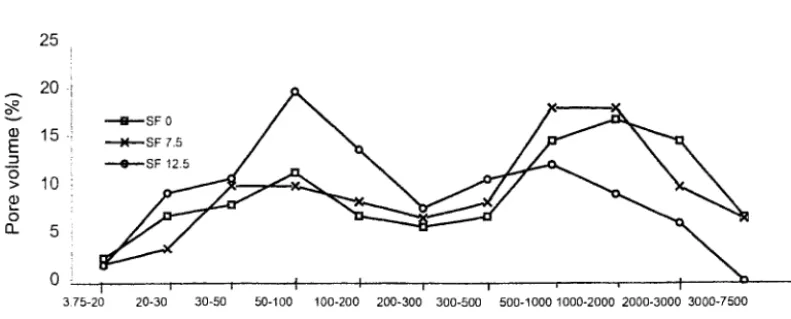
is almost 4%). However the SF 12.5 shows the lowest value of 3.5%. The concrete with silica fume 7.5 and 12.5% had total
pore volumes of 6.1 x 10 -3 cm3/gm and 6.6 x 10 .3 cm 3 / g m respectively, the value is lower than 31% and 26% from concrete
without silica fume (the value is 8.9 x 10 .3 cm 3/gin). The range of pore measurement was from 3.75 to 7500 nm, which
means it includes a wide range of capillary porosity.
A
o~
v
E
,-,1 0 >
!,... 0 13_
25
2 0 -
15 -~
1 0 '
5
E
0 .
3.75-20 i --- SF 0 i ~ SF 7.5 i ~ S F 12.5
... • I I I
20-30 30-50 50-100 100-200 200-300 300-500 500-1000 1000-2000 2000-3000 3000-7500
P o r e r a d i u s ( n m )
Fig. 2 Pore size distribution of concrete samples by MIP
Drying shrinkage values in Table 3 indicates that though extra water was added to maintain constant cement content and w-cm ratio, silica fume could sucessfully reduce the drying shrinkage value. The concrete with silica fume content of 7.5% and more satisfied the criterion of drying shrinkage equal to or less than 250 microstrain, however SF 12.5 shows the lowest value of 230 microstrain of shrinkage.
Effects of Exposure in Sulphate and Acid Solutions
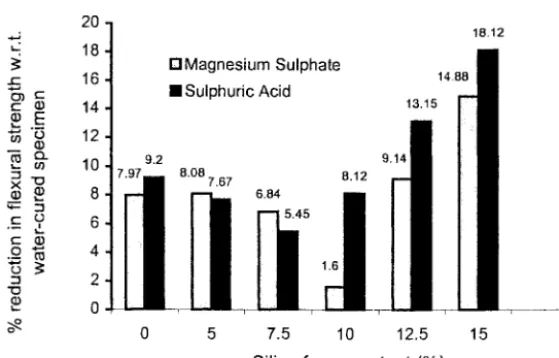
The comparisons of compressive and flexural strengths with respect to a set of water cured control samples are plotted in Figs. 3 and 4. All mixtures show a loss in both compressive and flexural strengths. With the addition of 5, 7.5, and 10 % of silica fume the loss of compressive strength has slightly improved, however, at addition level of 1)-.5 and 15 %, the loss in strength has increased for both compressive and flexural strengths. This is in agreement with the results obtained by Torii and Kawamura [12] in which they observed that for high replacement of 20 % to 30 %, the mortars expanded at early stage exhibited deep cracking. According to Mehta [3] this phenomenon is occurred due to higher quality of gel formation in presence of silica fume and since magnesium sulphate attacks gel more than lime or other components of hydrated structure, the deterioration was more for the silica fume modified concrete particularly at higher silica fume content. Turker et al [13] noticed the fall in compressive and flexural strength in magnesium sulphate solution and Kilinckale [14] observed it for both MgSO4 and HC1 with respect to a water-cured specimen in 56 days. In general the damaging effect of 1 % H2SO4 was slightly more than 10 % MgSO4 when measured upto 6 months. The mechanism of sulphate and acid attack
was judged by XRD (figures not shown for brevity), which show that in case of SF 0, the gypsum peak appeared at 20 = 20.730 (021plane) almost overlapped by C3A. 13H20. For SF 7.5, the gypsum peaks appeared at 20 = 20.730 (overlapped) and 11.60 (020 plane). For SF 12.5, the gypsum peak appeared at 20 = 20.730 (overlapped) and distinctly at 11.60 °.
In magnesium sulphate solution both the portlandite and C-S-H gel of concrete are attacked by sulphate ion to form
21
19
17
• - O9 ,- 15 O9 L)
,' 13
E N ,-" 11 o N ~ o E r- . ~ - ~ 9
o~ .
c
.o_~/~ 7
o c-
:3 ,*-'
- ~ ~ n 5
r "
3
co
1
18.98
18.28
El Magnesium Sulphate
[] Sulphuric Acid
10.3 10.5
13.3
17.1
4.8
1
i
i• , I
0 5 7.5 10 12.5 15
S i l i c a fume content (%)
Fig. 3 Loss in compressive strength of concrete exposed to MgSO4 and
H2S04
Torii and Kawamura [12] observed the same trend of result for 10% MgSO4 in which the gypsum peak was small in 5% and 10% of silica fume and a weak brucite peak was visible for samples with 20% silica fume onwards.
Concrete samples exposed to 1% H2SO4 exhibited strong gypsum peak at 20 = 11.6 °. The other peaks at 20 = 20.70 and 29.5 ° have almost overlapped with calcite. The strong gypsum peak is indicative of dissolution of both portlandite and C-S-H gel structure. In the acid attack the occurrence of gypsum peak has taken place at the expense of portlandite peak for the SF 7.5 and SF 12.5 samples. This means that a substantial leaching of lime occurred in silica fume modified concrete to form
20
18
x:: 16
O3 c -
r- ~ 14
E
,.- .
12
-~-
~ ~023
× 1 3
u
~ - - 23
.c_ ~_ 6
C
.o N 4
= 2
"(:3
,-.. 0
E! Magnesium Sulphate
14.88
II Sulphuric Acid
13.15 r " 18.12
9.2 9.14
8.08 7.67
6.84
8.12
0 5 7.5 10 12.5 15
Silica fume content (%)
Fig. 4 Loss in flexural strength of concrete exposed to M g S 0 4 and H 2 S 0 4
gypsum. This reaction is unlike the magnesium sulphate attack where C-S-H gel was preferentially attacked to form gypsum.
The loss in strength in
H2804
exposure is in agreement with this finding.Torri and Kawamura [ 12] found that the strong gypsum peak for silica fume modified concrete (5% and 30%) exposed to 2% H2SO4 for one year. According to them for the attack by a strong acid and a strong sulphate, the silica fume concrete is not necessarily very effective in preventing the deterioration.
In general the results show that both in sulphate and acid solutions, SF 5, SF 7.5 and SF 10 performed better than SF 12.5 and SF 15.
CONCLUSIONS
1. The mixtures with 7.5, 10 and 12.5% silica fume showed a satisfactory fresh concrete properties with respect to slump
and mix characters. The mixtures with 15 % silica fume were somewhat sticky which is not suitable for pumping and that with 5% exhibited bleeding under vibration.
2. The concrete with silica fume content of 7.5% and more fulfilled the requirement of compressive strength of 65 MPa.
The requirement of split tensile strength (4.5 MPa) was achieved by concrete with 7.5, 10 and 12.5%. The results based on the large number of samples show a small standard deviation. The moving average of 5 previous samples of 30 samples of compressive strength of SF 7.5 and SF 12.5 indicates an insignificant variation within batches.
3. Drying shrinkage values of concrete samples with silica fume of 7.5, 10, 12.5 and 15% are equal to or less than 250
microstrain as needed for the HPC containment structures. Water absorption values of all the silica fume modified concrete was within limit. It is important to note that the above values was achieved in spite of using higher water content for all the silica fume modified concrete to maintain a constant slump range, water-cementitious ratio and cement content.
4. Mercury porosimetry test results show that for 12.5 % silica fume concrete, the pore volume was more for pore radius
smaller than 500 nm and less for pore radius greater than 500 nm. For 7.5 % silica fume, this critical pore radius was
1000 nm.
5. Information on loss in stength and XRD indicates that magnesium sulphate preferentially attacked CSH gel rather than
6. This greater strength loss of SF 12.5 and 15% in spite of having a more refined pore structures ( for SF 12.5) compared to the other mixtures may be due to the fact that since both magnesium sulphate and acid solutions attacked the gel component of the hydrated structure and since concrete with the SF 12.5 and 15 produced additional gel due to pozzolanic reaction they were subjected to a more severe attack and subsequent strength loss compared with the others. The physical advantage of refined pore structure of SF 12.5 (less large size pores) over SF 7.5 was lost by chemical attack.
7. Finally, the HPC with silica fume content of 7.5 and 10% is recommended to be used with low-alite Indian cement and local aggregates. However an 'Information and qualification' test (in progress) is needed to transfer the recipe to field. A C K N O W L E D G E M E N T
The authors gratefully acknowledge BRNS, DAE, Government of India for funding the current research project. The authors are highly grateful due to many useful and practical suggestions made by Dr. P.C. Basu of AERB and Shri S. Ramanujam of BARC, DAE (Principal collabortors) in formulating the program. The help rendered by Dr. S. Mandal, co-investigator of the project is greatly appreciated.
R E F E R E N C E S
1. Basu, P C, "Performance requirements of HPC for Indian NPP structures", Indian Concrete Journal, Vol. 73, 1999, pp. 539-546.
Russel, H G " A C I defines High -performance concrete", Concrete International, Vol. 21, 1999, pp. 56-57
Mehta, P K., "Condensed silica fume. Concrete Technology and Design, Cement Replacement Materials," Ed. R N Swamy, Vol. 3, 1986, pp. 134-168.
Cohen, M. D., "A look at silica fume and its actions in portland cement concrete," The Indian Concrete Journal, Vol. 64, 1990, pp. 429 - 437.
Report by ACI Committee 234, "Guide for the use of silica fume in concrete," American Concrete Institute, 1996, pp 234 R1-234 R 51.
Khedr, S. A. and Abou-Zeld, M. N., "Characteristics of silica fume concrete," Journal of Materials in Civil Engineering, ASCE, Vol. 6, No. 3, 1994, pp 357-375.
Nehdi, M., Mindess, S., and Aitcin, P.C., "Rheology of High Performance Concrete: Effect of ultrafine particles," Cement and Concrete Research, Vol. 28, No 5, 1998, pp. 6 8 7 - 698.
Punkki, J., Golaszewsky, J., and Gjorv. O E., "Workability Loss of High Strength Concrete," ACI Materials Journal, Vol.93, 1996, pp. 4 2 7 - 4 3 1 , 1996,.
Yogendran, V., Langan, B. W., Haque, M.N., and Ward, M.A.., "Silica Fume in High Strength Concrete," ACI Materials Joumal, Vol. 84, 1987, pp. 124 - 129.
10. Xie, J., Elwi A. E., and Mac Gregor, J.G., "Mechanical Properties of Three High Strength Concretes Containing Silica Fume," ACI Materials Journal, Vol. 92, 1995, pp. 135 -145.
11. Khatri, R. P., and Sirivivatnanon, V, "Effect of Different Supplementary Cementitious Materials on Mechanical Properties of High Performance Concrete," Cement and Concrete Research, Vol. 25, 1995, pp. 209 - 220.
12. Torii, K., and Kawamure, M., "Effects of Fly Ash and Silica Fume on the Resistance of Mortar to Sulphuric Acid and Sulphate Attack. Cement and Concrete Research," Vol. 24, 1994, pp. 361 - 370.
13. Turker, F., Akoz, F., Koral, S., and Yuzer, N., "Effects of Magnesium Sulfate Concentration of the Sulfate Resistance of Mortars with and without Silica Fume," Cement and Concrete Research, Vol. 27, 1997, pp. 205 - 214.
14. Kilinckale, F. M., "The Effect of MgSO4 and HCL Solutions on the Strength and Durability of Pozzolan Cement Mortar," Cement and Concrete Research, Vol. 27, 1997, pp 1911 - 1918.