| INVESTIGATION
When Does Frequency-Independent Selection
Maintain Genetic Variation?
Sebastian Novak1and Nicholas H. Barton Institute of Science and Technology Austria, 3400 Klosterneuburg, Austria ORCID IDs: 0000-0002-2519-824X (S.N.); 0000-0002-8548-5240 (N.H.B.)
ABSTRACTFrequency-independent selection is generally considered as a force that acts to reduce the genetic variation in evolving populations, yet rigorous arguments for this idea are scarce. When selection fluctuates in time, it is unclear whether frequency-independent selection may maintain genetic polymorphism without invoking additional mechanisms. We show that constant frequency-independent selection with arbitrary epistasis on a well-mixed haploid population eliminates genetic variation if we assume linkage equilibrium between alleles. To this end, we introduce the notion of frequency-independent selection at the level of alleles, which is sufficient to prove our claim and contains the notion of frequency-independent selection on haploids. When selection and recombination are weak but of the same order, there may be strong linkage disequilibrium; numerical calculations show that stable equilibria are highly unlikely. Using the example of a diallelic two-locus model, we then demonstrate that frequency-independent selection thatfluctuates in time can maintain stable polymorphism if linkage disequilibrium changes its sign periodically. We put our
findings in the context of results from the existing literature and point out those scenarios in which the possible role of frequency-independent selection in maintaining genetic variation remains unclear.
KEYWORDSfrequency-independent selection; genetic variation;fluctuating selection; linkage disequilibrium; epistasis
T
HERE is a general understanding in the population ge-netics community that constant frequency-independent selection on a well-mixed haploid population eliminates ge-netic variation. Selection is called frequency independent if thefitness of a genotype does not depend on the frequencies of the other genotypes in the population. If constant selection acts on a haploid population, each haploid genotype (haplo-type) has an externally determinedfitness value. Hence, in the absence of recombination and mutation, it is clear that the haplotype with the highestfitness replaces the other haplo-types (Bürger 2000, Chap. I.9). With multiple recombining loci and epistasis between alleles, it is much less evident that frequency-independent selection on all haplotypes must reduce the population to a single haplotype. Even more, it remains an open task to identify and characterize the conditions un-der which frequency-independent selection whichfluctuates in time may maintain genetic variation.The matter of debate concerns an idealized population, under the sole influence of selection and recombination. Un-derstanding the action of natural selection is crucial and justifies the analysis of pure selection models (cf. Bürger 2000, and references therein). We therefore neglect direct sources of genetic variation (mutation); spatial heterogene-ities in selection that may protect alleles in spatial refuges (Strobeck 1979); and factors generating frequency-dependent
fitness, e.g., fluctuating selection in combination with overlapping generations (Ellner and Sasaki 1996), or with explicit population regulation (Dean 2005) and other ecolog-ical mechanisms. Similarly, a recent study (Gulisija et al.
2016) showed that the presence of a modifier of phenotypic plasticity may shelter alleles at selected loci from adverse conditions (termed a“genomic storage effect”) and thus lead to a protected polymorphism under temporally varying condi-tions. Here, however, we focus directly onfitness as the only trait being modulated. Furthermore, we consider haploid pop-ulations, since the random combination of gametes into dip-loid genotypes may induce frequency-dependent selection on alleles, even if thefitnesses of the diploid genotypes are fre-quency independent: with heterozygote advantage, even con-stant selection on diploids is capable of maintaining genetic Copyright © 2017 by the Genetics Society of America
doi:https://doi.org/10.1534/genetics.117.300129
Manuscript received December 20, 2016; accepted for publication July 26, 2017; published Early Online August 8, 2017.
1Corresponding author: Institute of Science and Technology Austria, Am Campus 1,
variation. Similar mechanisms apply for diploid systems under
fluctuating selection, which can lead to effective heterozygote advantage in terms of geometric mean fitnesses over time (Haldane and Jayakar 1963; Hoekstra 1975; Nagylaki 1975). Mathematically precise arguments for the erosion of ge-netic variation under constant frequency-independent selec-tion are scarce. Various publicaselec-tions cover special cases of
fixed numbers of loci and alleles (e.g., appendix S5 by Bank
et al. 2012). For arbitrary numbers of loci and alleles, Kirzhner and Lyubich (1997) showed that constant selection on haploids leads to genetic monomorphism in two extreme cases: strong linkage between loci allowing for epistasis be-tween genes, and arbitrary linkage bebe-tween loci, but assum-ing that contributions of individual alleles to fitness are additive. More recently, Mehta et al. (2015) showed that the discrete-replicator dynamics of coordination games al-ways converges to pure Nash equilibria. It follows as a special case that constant haploid selection does not support stable polymorphism under the assumption of linkage equilibrium between loci. However, their intricate proof is cast in the framework of game theory and computer science, and thus may not be accessible to readers with a background in evo-lutionary biology.
Under temporallyfluctuating, frequency-independent se-lection on haploids, Kirzhner et al.(1994) showed numeri-cally that stable polymorphism can be maintained with two diallelic loci, at least for a very narrow range of parameters. Their exemplary gene-frequency dynamics with periodicfl uc-tuations exhibit cyclically converging trajectories, whose pe-riod is typically much longer than the pepe-riod of the selection coefficients. Their examples require strong selection such that gene frequencies change drastically between successive generations. Thus, the parameters needed for maintaining polymorphism may not be representative for natural popula-tions, where frequency changes due to selection are typically small and selection is weaker than recombination, such that the latter efficiently breaks up associations between loci (Nagylaki 1974, 1993). In particular, it has not yet been shown iffluctuating selection may maintain genetic variation in the continuous-time limit, where selection and recombina-tion are both weak.
We consider a well-mixed haploid population with non-overlapping generations and frequency-independent selec-tion on multiple loci, each with any number of alleles. We allow arbitrary epistasis between alleles. This includes non-linear selection on polygenic traits, where epistasis infitness may emerge even if the underlying genes contribute additively to the trait. First, we present a simple yet rigorous proof that, at linkage equilibrium, no genetic variation can be maintained by constant frequency-independent selection alone. We note that the result does not follow from frequency-independent selec-tion at the level of genotypes as defined above, since frequency dependence in thefitnesses of alleles may be induced,e.g., in diploid organisms. Instead, we provide a formal criterion for frequency-independent selection at the allelic level that is sufficient for proving the loss of genetic polymorphism. Our
argument applies to haploid populations when the alleles are at or close to linkage equilibrium, which is the case when selection is weak relative to recombination (Nagylaki 1993). Next, we show numerically that stable equilibria are highly unlikely when selection and recombination are weak but of the same order, so that linkage may be strong. Finally, we provide an example of weak and periodicallyfluctuating fre-quency-independent selection and recombination between two loci that maintains genetic variation at a stable equilib-rium. Wefind that linkage disequilibrium is required for stable polymorphism, though its magnitude can be small. We con-clude by summarizing and discussing our results, and by laying out the remaining open questions concerning the conundrum of frequency-independent selection and genetic variation.
Model
We assume that there areLgenetic loci. LocusihasKipossible allelic variants and we writeK ¼PLi¼1Kifor the total number of alleles across all loci. Denote thek-th allele at locusibyPi
k and the frequency of allelePi
kbypik:Furthermore, we writepi for the vector of allele frequencies at locusiand collect the allele frequencies at all loci in a vectorp¼ ðp1;. . .;pLÞ:
The meanfitnessw of the population is obtained by aver-aging the fitnesses of the genotypes over their frequencies. Similarly, the marginalfitnesswi
kof an allelePikis defined as the meanfitness of all genotypes containing that allele. Con-sequently, the meanfitnesswof the population can be seen as an average over the marginalfitnesses of alleles at any given locus,
w¼X
Ki
k¼1
pikwik ðfor alli¼1;. . .;LÞ: (1a)
Note that the choice of locusito average across does not play a role here,i.e., the sum evaluates to the same value for any locusi.
We say that selection on haploids is frequency independent (at the level of alleles) if the marginalfitness of an allele does not depend on the frequencies of alleles at the same locus. That is, for every choice of allelesjandkon any locusi, we have
@wi
k
@pi j
¼0: (1b)
This definition encompasses the case of frequency-independent selection on haploids, where every haplotype has a fixed
fitness value (Appendix A; Figure A1). However, its scope of application is broader, since it does not require a certain ploidy level and it allows for certain kinds of frequency-dependent interactions between loci.
Importantly, the marginalfitnesseswi
@w
@pik¼w
i
k (2)
(cf. Wright 1937). Hence, the derivative of meanfitness with respect to an allele yields the marginalfitness of that allele under frequency-independent selection.
Data availability
The authors state that all data necessary for confirming the conclusions presented in the article are represented fully within the article.
Results
Constant frequency-independent selection at linkage equilibrium eliminates genetic variation
Assume that theLloci are at linkage equilibrium at all times. This is a restrictive assumption, but is valid in the limit where recombination breaks up linkage disequilibria between loci quickly relative to the rate of selection. At linkage equilib-rium, the frequency of each haplotype is the product of the frequencies of its constituent alleles. Consequently, it suffices to follow the dynamics of allele frequencies instead of those of the genotypes. We consider the standard selection dynam-ics from population genetdynam-ics in discrete time (generations), neglecting all other evolutionary forces (e.g., mutation), and only describing the effect of selection. In particular, there is no genetic drift,i.e., the population is practically infinite and the dynamics are deterministic. The frequencyðpi
kÞ9of allelek on locusiin the next generation is calculated from the fre-quenciespin the previous generation as
pik9¼pikw i k w ¼f
i
kðpÞ ði¼1;. . .;L;k¼1;. . .;KiÞ: (3)
To prove that constant frequency-independent selection at linkage equilibrium eliminates genetic variation, we con-sider the dynamics (3) and assume frequency-independent
selection at the level of alleles as defined in Equation 1b. Our argument consists of three parts. First, the selection dynam-ics converge to the set of its equilibrium points,i.e., there is no complicated dynamical behavior. This result has been established for a wide range of (mostly diploid) selection models,e.g., for additivity (Lyubich 1992), weak epistasis, and weak selection (Nagylaki et al. 1999). It is a conse-quence of the meanfitness increasing steadily under selec-tion, which (assuming linkage equilibrium) is implied by Fisher’s fundamental theorem of natural selection (Fisher 1930) and by Wright’s selection gradient formula (Wright 1937). Note that fitness may decrease when recombina-tion breaks up linkage disequilibria (Bürger 2000, Chap. II.1). For our specific setting with linkage equilibrium, however, a commonly used argument that applies the in-equality of Baum and Eagon (1967) (a method noted by Nagylaki 1977) shows that all trajectories of the dynamics (3) converge to the set of their equilibria (Appendix B). Since the haploid selection dynamics can be seen as a spe-cial case of the diploid dynamics (cf. Bürger 2000, p. 30), the proof may be extended to loose linkage, analogous to Nagylakiet al.(1999).
Second, we establish that every polymorphic equilibrium of the selection dynamics is generically unstable. A polymorphic equilibrium of Equation 3 is a vectorp^¼ ð^p1;. . .;p^LÞof only nonzero entries that satisfy fi
kðp^Þ ¼^p i
k.0: From standard linear stability analysis, the stability of a polymorphic equi-librium ^pis determined by the eigenvalues of the Jacobian matrixJðp^Þ(see Appendix C for details). If all eigenvalues of
Jð^pÞ have a modulus less than one, the equilibrium p^ is asymptotically stable; if the modulus of a single eigenvalue is more than one, it is unstable. In the case when the modulus of the largest eigenvalue equals one, further analysis would be needed. Neglecting this degenerate case, a simple dimensionality argument shows that any polymorphic equilibria of the dynamics (3) under frequency-independent selection, Equation 1b, are unstable (Theorem C1 in Appendix C).
Due to thefirst two parts, all trajectories converge to the boundary of the state space of the dynamics (3). Hence, the selection dynamics cannot maintain all alleles in the popula-tion; some of them are lost, some loci may become mono-morphic, and the set of possible genotypes is reduced. Thus, third, we repeat the argument for the remaining genotypes by restricting the system to the loci that are still polymorphic, thereby iteratively eliminating alleles from the population. This procedure ends when all loci have become monomorphic,
i.e., when only a single genotype is left. Therefore, in the absence of mechanisms creating variation, constant fre-quency-independent selection eventually deprives the popu-lation of all its genetic variation.
Constant frequency-independent selection with weak selection and recombination rates eliminates variation
We have shown that when selection is much weaker than recombination, so that the population is close to linkage equilibrium, constant frequency-independent selection can-not maintain variation. At the opposite extreme, when selec-tion is much stronger than recombinaselec-tion, we know that thefittest haplotype willfix. In the intermediate case, where epistasis and recombination are of the same order, can constant frequency-independent selection maintain variation? To simplify matters, we assume that selection and recombination are weak, but of the same order, so that we can assume continuous time.
Appendix D gives an expression for the Jacobian matrix of the continuous-time dynamics in terms of the equilibrium genotype frequencies and the selection coefficients for each haplotype. Crucially, the equilibrium frequencies uniquely determine the selection coefficients, which are proportional to the recombination rates. Necessarily, linkage equilibrium implies neutrality: both epistasis and directional selection on alleles must be zero. Linkage disequilibrium requires epistasis, and directional selection must be set to the value that keeps allele frequencies constant.
We have not found a way to show that the Jacobian matrix necessarily and in general implies instability. However, we have calculated eigenvalues numerically for random geno-type frequencies, for up to six loci. Table A1 summarizes the leading eigenvalue, and the number of positive eigenvalues, forL¼2;. . .;6 loci; calculations become prohibitively slow for.6 loci, since they involve calculating a 2L32Lmatrix. Results are based on drawing genotype frequencies uni-formly from the space of genotype frequencies. This typi-cally implies strong linkage disequilibrium, and hence epistasis of the same order as the recombination rate. Moreover, if some genotype is by chance very rare, the corresponding selection coefficient is very negative. The leading eigenvaluelis typically of the same order as the recombination rate between adjacent loci, implying that variation is lost over the same timescale as recombi-nation. However, with two loci, the leading eigenvalue may by chance be extremely small, in which case variation would be lost extremely slowly. These results show that stable equilibria are at best rare.
Weak, periodicallyfluctuating, frequency-independent
selection may maintain stable polymorphism in a two-locus model
Specification and intuition:We now consider two linked loci
with two alleles each. The recombination rate between the two loci isr.0:For convenience, we denote the alleles at the
first locus byP1
1¼AandP12 ¼a;and at the second locus by P2
1¼B andP22¼b:Thus, we have four possible genotypes
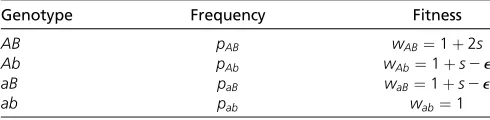
with frequenciespAB;pAb;paB;andpab:We assume a symmet-ric fitness model, in which the allelesAand B provide an additive selective advantages.0;and there is an epistatic coefficientɛin genotypes consisting of an upper- and a lower-case allele, see Table 1 and Table 2.
Instead of following the four genotype frequencies, we may describe the temporal dynamics of selection by the frequen-cies pA and pB of the alleles A and B, and the linkage disequilibrium
D¼pAB pab2pAb paB:
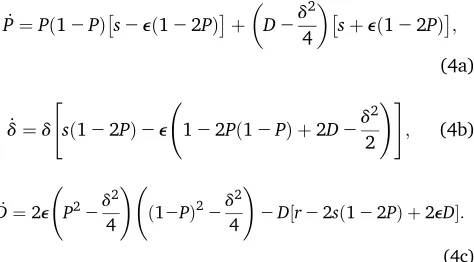
Due to the symmetry of the parameters, however, it is useful to consider the meanPand differencedof the upper-case allele frequencies, i.e., we write pA¼P2d=2 and pB¼Pþd=2: We assume that selection and recombination are both weak, i.e., we consider the limit wheres,e, and rgo to zero simultaneously. Then, the dynamics can be approxi-mated by a set of differential equations in continuous time that may be written as (cf.Formulation of the Dynamicsin Appendix E)
_
P¼Pð12PÞs2eð122PÞþ
D2d 2
4
sþeð122PÞ;
(4a)
_ d¼d
"
sð122PÞ2e 122Pð12PÞ þ2D2d 2
2 !#
; (4b)
_
D¼2e P22d
2
4 !
ð12PÞ22d
2
4 !
2D½r22sð122PÞ þ2eD:
(4c)
Note that the use of all three parameters, s, e, and r, is redundant in this limit since we may always absorb any one of them into the time variabletby proper rescaling. For clarity, however, we explicitly denominate all parameters. Table 1 The minimum, mean, and maximum of the leading eigenvalue,l, and of the number of positive eigenvalues,n No. loci lmin lmean lmax nmin nmean nmax No. replicates
2 0.0000035 0.189 0.497 1 1 1 105
3 0.0338 0.374 0.886 1 1.61 2 104
4 0.130 0.507 1.108 1 2.36 4 104
5 0.207 0.593 1.267 2 3.21 5 104
6 0.365 0.638 1.049 3 4.1 5 103
Consequently, the dynamics remain unchanged if we re-places↦as;e↦ae;r↦ar;andt↦at;for anya.0:
To further exploit the symmetry in thefitness coefficients we imposed above, we look for equilibria aroundd0;where the frequencies of allelesAandBare approximately equal. If additionally the alleles are at linkage equilibrium (D¼0), the dynamics of Pis inverted in time if we replacesand e by2sand2e:Thus,fixingsandɛand periodically applying Equation 4a with parameters ðs;eÞandð2s;2eÞ fort time units each leads to a trajectory that traces itself back to its initial point. This trivially maintains polymorphism, yet in a degenerate way: perturbations tip the balance of forces and lead to thefixation of one of the alleles at each locus. How-ever, as we see below, including the dynamics of linkage dis-equilibrium D may stabilize trajectories and thus lead to protected polymorphism.
To obtain an intuitive understanding of how stability may come about, assume that it suffices to consider stability in the direction ofPonly. Then, the stability of a trajectory ofPis given by the sign (negative sign implies stability) of
E
@P_
@P ¼E½sð122PÞ2E½eð126Pð12PÞÞ22E½eD þ O
d2;
(5)
where the expectationE½is taken across a period of selection of length 2t:Note that besides the variablesP,D, andd, the parameterssandeare also functions of time. We conclude from this expression that including the dynamics ofD explic-itly may stabilize trajectories ofPif linkage disequilibriumD
and epistasise correlate positively (E½eD.0). Equation 4c indicates that the latter may be the case at least for smallD, whenD_}e:
Stable polymorphism in the limit of rapid fluctuations:
We assume that selectionfluctuates through the course of two seasons of equal lengtht. In thefirst season, the intensities of selection and epistasis are given by constantsandɛ, see Table 2. In the second season, selection and epistasis simulta-neously change their signs, yet maintain their moduli. We further assumed0;the consistency of this assumption with our results will be affirmed below. As a consequence, we may neglect terms containing d2 in Equation 4. Thus, the equa-tions forPandDbecome independent ofd.
Finally, we assume quasi-linkage equilibrium, i.e., that
D¼D^ðPÞ is at its equilibrium given P at all times. This quasi-steady-state assumption is only approximate, but the
absolute error in Equations 4a and 4b is likely to be small, at least ifDis small itself. By letting the recombination raterbe large relative tosande, the latter is satisfied and we may neglect terms containing D2: From Equation 4c, we then have
^
DðPÞ ¼2eP
2ð12PÞ2
r22sþ2sP
2eP2ð12PÞ2
r ; (6)
for rs;e: Hence, in particular, D correlates positively withe.
We now iterate the two seasons as described in Table 3 with a very short duration,t¼Dt=2 each, so that we may approximate the solution to the differential Equation 4 by a single step of the Euler method. For season 1 and the equa-tion forP, this means
P
tþDt
2
¼Fðs;eÞ½PðtÞ ¼PðtÞ þ
Dt
2~Fðs;eÞ½PðtÞ;
where ~Fðs;eÞðPÞ¼Pð12PÞ½sþeð122PÞ2D^ðPÞ½sþeð122PÞ
Analogously, the expression for season 2 is PðtþDt=2Þ ¼ Fð2s;2eÞ½PðtÞ:To apply the two seasons in sequence, we thus
need to calculatePðtþDtÞ ¼ ½Fð2s;2eÞ∘Fðs;eÞ½PðtÞ:Neglecting
terms of orderOðDt2Þ;this yields
DP¼PðtþDtÞ2PðtÞ ¼2e r PðtÞ
2½12PðtÞ2f
e½122PðtÞ þsgDt:
(7)
Equating this to zero produces a polymorphic equilibrium at
^
P¼ ðeþsÞ=ð2eÞ;given thatjs=ej#1:
Assuming that D is determined by Equation 6, we thus have an equilibrium at P¼P^ and d¼^d¼0 (the latter is evident from Equation 4b). Since for small dthe equation for Pis independent ofd (see above), the Jacobian matrix at this equilibrium becomes triangular, hence its eigenvalues that determine stability can be read from its diagonal. Thus, stability ofPanddcan be assessed separately. ForP, linear-izing the right-hand side of Equation 7 yields a negative eigenvalue:
@DP
@P
ð^
P;^dÞ
¼ 2
e22s22
2e2r Dt,0: (8)
Deriving the dynamics for Dd similarly to Equation 7 and taking the corresponding derivative shows that the second eigenvalue is negative as well:ð@Dd=@dÞjð^P;^dÞ,0:Thus, we
have a stable polymorphism atP¼^Pandd¼^d¼0:In par-ticular, the above assumptiond0 is justified. Hence, with Table 3 A symmetric parameter configuration affording a stable trajectory under Equation 4 with seasonalfluctuations
Selection Epistasis Recombination Duration
Season 1: s¼0:005 e¼ 20:02 r¼0:01 t¼50 Season 2: s¼20:005 e¼0:02 r¼0:01 t¼50
Table 2 A genotypefitness configuration with an additivefitness increment s and an epistatic coefficient E
Genotype Frequency Fitness
AB pAB wAB¼1þ2s
Ab pAb wAb¼1þs2e
aB paB waB¼1þs2e
ab pab wab¼1
two seasons alternating rapidly, the selection dynamics con-verge to a polymorphic state where the allelesAandBare approximately equally abundant.
Stable oscillations in the symmetric case: The previous
section shows that genetic variation can be maintained in the limit of rapid alternations of the two seasons, assuming quasi-linkage equilibrium. In this section, we numerically demonstrate that protected polymorphism is possible for the full dynamics, Equation 4, with afinite duration of seasons. Assume that both seasons last fort¼50 time units, and thats,e, andrin the two seasons are given by Table 3. This conforms to the symmetric situation of the previous section. We iterate the dynamics (4) through multiple seasons for various initial conditions. Initially,drapidly decays and converges to d¼0: The variables P and D enter periodic oscillations around the point^P¼0:375 andD¼0 (see Fig-ure 1), as predicted by the above analysis. Their limit may be a global attractor of the system, since it is approached from all initial conditions we tested, see Stability of a Periodic Trajectory Under Fluctuating Selection in Appendix E. The correlation between e and Dacross one cycle of selection can be calculated to be aboutE½eD 0:0045:This is found to be the main contribution to the negativity of Equation 5, indicating that these correlations secure the stability of the trajectory.
The stability of the equilibrium trajectory½PðtÞ;dðtÞ;DðtÞ
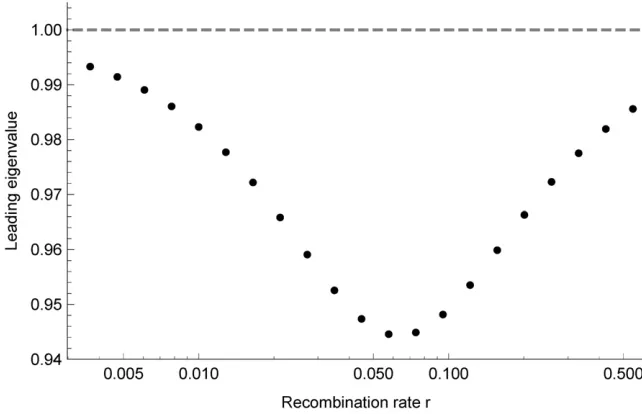
can be confirmed numerically by linearizing a suitable Poin-caré map, seeStability of a Periodic Trajectory Under Fluctu-ating Selectionin Appendix E for details. Figure 2 shows the leading eigenvalue of this linearization as a function of the recombination rater. Its value is a measure of the stability of the limit trajectory; the further it is below one, the larger the perturbations the system can sustain without the trajectory losing its stability. Interestingly, there is an intermediate value ofrfor which stability is greatest. Since the variation in linkage disequilibriumDscales withr(largerrkeepsDcloser to zero),
this implies that intermediate linkage disequilibrium is most likely to lead to stable polymorphism. When recombination dominates, r/N;the alleles remain at linkage equilibrium and polymorphism is maintained in the degenerate way dis-cussed above forD¼0 (the leading eigenvalue equals one). Without recombination (r¼0), we observe that the dynamics (4) similarly become symmetric with respect to replacing ðs;eÞ↦ð2s;2eÞ and the same logic applies. The latter is in concordance with the literature about fluctuating selection on a single haploid locus which predicts thefixation of the allele with the highest geometric mean fitness over time (Felsenstein 1976). Thus, intermediate linkage disequilibrium is required to maintain stable polymorphism in our example.
Stable oscillations in asymmetric cases:Our analysis of the
leading eigenvalue confirms stability in two ways. First, the periodic trajectory is dynamically stable with respect to per-turbations of the variables,e.g., due to genetic drift. Second, the model is structurally stable because of its continuous de-pendence on the model parameters. This implies that a stable periodic trajectory continues to exist under deviations from our reference parameters, even if they break the symmetry between the two seasons we imposed earlier. In particular, this concerns variation in the selection or epistatic coeffi -cients of one or both seasons (e.g., a systematic bias such that the mean selection coefficient is nonzero), random perturba-tions tosandɛbetween seasons, and variation in the dura-tions of seasons.
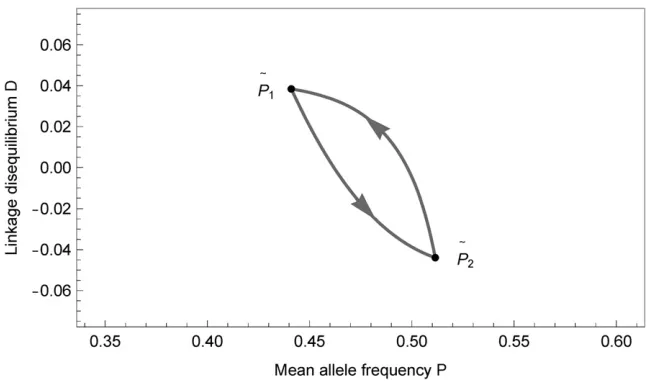
toward the monomorphic equilibria given byP¼0:5;d¼61; andD¼0:Note that rescaling time during one of the seasons corresponds to rescalings,e, andrin this season. Thus, this example also shows that stable polymorphism is possible if the two seasons do not have the same duration.
Stable polymorphism can also be maintained if the sym-metry between the two loci is perturbed, i.e., if the two genotypes Ab and aB have different fitness values. This can be parameterized by assuming two epistatic coeffi -cients,e16¼e2;for these genotypes. InAn Asymmetric Exam-ple of Stable Polymorphismin Appendix E (Table A2; Table A3), we provide a numerical example for stable polymor-phism under this asymmetry with substantial differences betweene1ande2:
Discussion
When discussing the inability of frequency-independent se-lection to maintain genetic variation, population geneticists implicitly refer to constant frequency-independent selection at the allelic level or on haploid populations, rather than to the broader definition of frequency-independent selection at the level of genotypes. For example, consider constant overdom-inance (heterozygote advantage) at a single diploid locus with allelesAanda. In this selection regime, thefitnesses of the three possible genotypesAA;Aa;andaaare typically scaled as 1, 1þhs;and 1þs;respectively, wheres.0 andh.1: These values are independent of the genotype frequencies, so that selection is frequency independent at the level of genotypes. Nevertheless, there is genetic polymorphism at equilibrium under selection; under the dynamics (3), theAallele is maintained at a frequency ofpA¼ ðh21Þ= ð2h21Þ.0:The fact that genetic variation is maintained in this example is not surprising, since with random mating it is simply not possible to have a population that consists solely of heterozygotes (unless both homozygotes are non-viable). One may thus argue that it is not selection that maintains genetic variation, but rather, the random pair-ing of gametes to form diploid organisms. However, since the latter cannot be separated from the dynamics of diploid genotypes, such a discussion is futile. In contrast, the dynamics of allele frequencies, Equation 3, does not involve a pairing process. Accordingly, the notion of frequency-independent selection at the allelic level, as introduced by Equation 1b, is sufficient to prove the erosion of genetic variation, and contains the notion of frequency-independent selection on haploids.
InConstant frequency-independent selection at linkage equi-librium eliminates genetic variation, we show that constant frequency-independent selection on a set of haploid loci at linkage equilibrium eliminates genetic variation. How-ever, it remains unclear if genetic variation may be stably maintained when recombination and selection are com-parable. The case of complete linkage between loci is triv-ial, and Kirzhner and Lyubich (1997) showed that no stable polymorphism is possible with recombination and
additive selection. Our argument covers the complemen-tary case of linkage equilibrium, yet allows for arbitrary epistasis between alleles. For two diallelic loci under constant selection, a complete analysis was performed by Bank et al.(2012), yet the interaction of recombina-tion and epistasis in multi-locus systems is still not well understood.
Trivially,fluctuating selection may maintain polymorphism indefinitely if the direction of selection on two alleles at a single locus changes whenever either allele frequency falls below a threshold value. However, this example is artificial, since the pattern offluctuations depends on the frequencies of the alleles. Inthetime-varyingframework, frequency-independent selection requires that the change of thefitness functions be independent of the allele frequencies. Temporallyfl uc-tuating, frequency-independent selection is capable of maintaining genetic polymorphism, as demonstrated by Kirzhner et al. (1994). Their examples require strong se-lection such that gene frequencies undergo large changes between successive generations, which may be considered unrealistic in practice. In Weak, periodically fluctuating,
frequency-independent selection may maintain stable poly-morphism in a two-locus model, we provide an example of two diallelic loci under weak periodically fluctuating se-lection and recombination that maintains polymorphism in a stable periodic trajectory. Crucially, including linkage disequilibriumDexplicitly is necessary to stabilize the tra-jectory; under complete linkage or at linkage equilibrium, the effect vanishes.
Heuristically, we may conclude from Equation 5 that the dynamics ofDmay lead to a stable trajectory if they correlate positively with epistasis. This is the case if we approximateD
by assuming quasi-linkage equilibrium at all times, when D
has the sign ofe(see Equation 6). Fluctuating epistasis is thus a key element in the maintenance of genetic polymorphism in our example. Patterns of positive correlation between linkage disequilibrium and epistasis emerge naturally under quasi-linkage equilibrium. Thus, they may be of general importance in maintaining stable polymorphism under frequency-independent selection.
Cycling linkage disequilibrium is also present in a study by Gulisijaet al.(2016), who demonstrate that stable polymor-phism can be maintained in a haploid system with a locus subject to periodic frequency-independent selection and a modifier locus for phenotypic plasticity. They argue that an allele that promotes phenotypic plasticity reduces the effect of selection on linked alleles, and hence may cause a geno-mic-storage effect by sheltering deleterious alleles. Their model reduces to a dialellic, two-locus selection model with Table 4 An asymmetric parameter configuration affording a stable trajectory under Equation 4 with seasonalfluctuations
Selection Epistasis Recombination Duration
epistasis in which the genotype fitnesses fluctuate periodi-cally; itsfitness structure, however, differs from the example we present above. Their study provides further indication that the explicit process of recombination between loci is vital for maintaining genetic variation; in the limit of high recom-bination rate (i.e., at linkage equilibrium), their proposed mechanism fails. In some cases, dynamicallyfluctuating link-age disequilibria may indeed give rise to effective negative frequency dependence over time, and thus to stable polymor-phism. Further analyses will be necessary to understand the dynamics of linkage disequilibria and their effect on the persistence of genetic variation.
We have shown that constant frequency-independent se-lection on haploids, or on diploids in the absence of domi-nance, cannot maintain variation at linkage equilibrium; our numerical results show that constant and weak selection and recombination very likely do not maintain variation, even when linkage disequilibrium is strong. However, we do show, using a two-locus example, that fluctuating epistasis can maintain variation when recombination is of the same order as the strength of epistasis. This works through a general mechanism, whereby a positive correlation between linkage disequilibrium and epistasis helps stabilize the polymorphism. Since epistasis among a set of loci generates linkage disequi-librium among those loci, we expect this mechanism to act as a general stabilizing process.
However, this process is likely to be weak, especially when epistasis is weak (e1). The stabilizing force is proportional to E½eD;and sinceD is itself proportional to epistasis, the stabilizing force is of order e2: This makes polymorphisms
sensitive to biases in directional selection, E½s;these must be weaker thane2for the polymorphism to be stable.
More-over, if such biases push the equilibrium away from the center of the allele frequency space, the stabilizing force becomes much weaker, since De pA qA pB qB: A caveat here is that it is not clear how these arguments scale with the numbers of loci: epistatic coefficients become weaker relative to directional coefficients, but there are many more
of them. An extension to many loci would be desirable, though not easy.
Is fluctuating frequency-independent selection likely to maintain variation in nature? We know that selection on traits is typically strong and typicallyfluctuates across generations (Kingsolver et al. 2001); classic examples of selection on discrete loci also involve strong selection which changes through time (Lewontin et al. 1981; Cook et al. 1986; Lenormand et al. 1999). Recent genome-wide surveys of polymorphism inDrosophila melanogastershow that large numbers of SNPs rapidly change frequency through the seasons (Berglandet al. 2014), though it is not clear just how many causal loci drive this pattern. Over the longer timescale of the fossil record, we see that phenotypes may change rapidly in the short term, and yet much more slowly in the long term (Gingerich 2009). This suggests that selec-tion may typicallyfluctuate strongly, yet largely cancel in the long term.
Nevertheless, we believe that the mechanism that we identify is unlikely to be significant in explaining the bulk of variation across the genome. Although selection on the organism can be strong, selection on nucleotide sites must typically be weak; indeed, indirect estimates from patterns of molecular variation suggest selection coefficients that are typically small, even if often strong relative to drift (s,1022;
selection can account for widespread variation across the genome.
Acknowledgments
We thank Katarína Bod’ová, Reinhard Bürger, Josef Hofbauer, Meike Wittmann, and two anonymous reviewers for valuable suggestions and stimulating ideas. This project has received funding from the European Union’s Seventh Framework Pro-gramme for research, technological development, and demon-stration under grant agreement 618091: Speed of Adaptation in Population Genetics and Evolutionary Computation.
Literature Cited
Bank, C., R. Bürger, and J. Hermisson, 2012 The limits to parapatric speciation: Dobzhansky–Muller incompatibilities in a continent– island model. Genetics 191: 845–863.
Baum, L. E., and J. A. Eagon, 1967 An inequality with applica-tions to statistical estimation for probabilistic funcapplica-tions of markov processes and to a model for ecology. Bull. Am. Math. Soc. 73: 360–363.
Bergland, A. O., E. L.Behrman, K. R. O’Brien, P. S. Schmidt, and D. A. Petrov, 2014 Genomic evidence of rapid and stable adap-tive oscillations over seasonal time scales in drosophila. PLoS Genet. 10: e1004775.
Bürger, R., 2000 The Mathematical Theory of Selection,
Recombi-nation,and Mutation, Vol. 228. Wiley, Chichester, United
King-dom.
Charlesworth, B., 2015 Causes of natural variation infitness: ev-idence from studies of drosophila populations. Proc. Natl. Acad. Sci. USA 112: 1662–1669.
Cook, L. M., G. S. Mani, and M. E. Varley, 1986 Postindustrial melanism in the peppered moth. Science 231: 611–613. Dean, A. M., 2005 Protecting haploid polymorphisms in
tempo-rally variable environments. Genetics 169: 1147–1156. Ellner, S., and A. Sasaki, 1996 Patterns of genetic polymorphism
maintained by fluctuating selection with overlapping genera-tions. Theor. Popul. Biol. 50: 31–65.
Felsenstein, J., 1976 The theoretical population genetics of vari-able selection and migration. Annu. Rev. Genet. 10: 253–280. Fisher, R. A., 1930 The Genetical Theory of Natural Selection.
Clarendon Press, Oxford.
Gingerich, P. D., 2009 Rates of evolution. Annu. Rev. Ecol. Evol. Syst. 40: 657–675.
Gulisija, D., Y. Kim, and J. B. Plotkin, 2016 Phenotypic plasticity promotes balanced polymorphism in periodic environments by a genomic storage effect. Genetics 202: 1437–1448.
Haldane, J. B. S., and S. D. Jayakar, 1963 Polymorphism due to selection of varying direction. J. Genet. 58: 237–242.
Hoekstra, R. F., 1975 A deterministic model of cyclical selection. Genet. Res. 25: 1–15.
Kimura, M., 1956 A model of a genetic system which leads to closer linkage by natural selection. Evolution 10: 278–287. Kingsolver, J. G., H. E.Hoekstra, J. M.Hoekstra, D.Berrigan, S. N.
Vignieri, et al., 2001 The strength of phenotypic selection in natural populations. Am. Nat. 157: 245–261.
Kirzhner, V. M., and Y. Lyubich, 1997 Multilocus dynamics under haploid selection. J. Math. Biol. 35: 391–408.
Kirzhner, V. M., A. B.Korol, Y. I.Ronin, and E. Nevo, 1994 Cyclical behavior of genotype frequencies in a two-locus population underfluctuating haploid selection. Proc. Natl. Acad. Sci. USA 91: 11432–11436.
Lenormand, T., D. Bourguet, T. Guillemaud, and M. Raymond, 1999 Tracking the evolution of insecticide resistance in the mosquito culex pipiens. Nature 400: 861–864.
Levene, H., 1953 Genetic equilibrium when more than one eco-logical niche is available. Am. Nat. 87: 331–333.
Lewontin, R. C., J. A. Moore, W. B. Provine, and B. Wallace (Editors), 1981 Dobzhansky’sGenetics ofNaturalPopulations I–XLIII. Co-lumbia University Press, New York.
Lyubich, Y. I., 1992 Mathematical Structures in Population Genet-ics. Springer-Verlag, Berlin.
Maynard Smith, J., and R. Hoekstra, 1980 Polymorphism in a varied environment: how robust are the models? Genet. Res. 35: 45–57.
Mehta, R., I. Panageas, and G. Piliouras, 2015 Natural selection as an inhibitor of genetic diversity: multiplicative weights updates algorithm and a conjecture of haploid genetics [working paper abstract], pp. 73 inProceedings of the 2015 Conference on
Inno-vations in Theoretical Computer Science. Association for
Comput-ing Machinery, New York.
Nagylaki, T., 1974 Quasilinkage equilibrium and the evolution of two-locus systems. Proc. Natl. Acad. Sci. USA 71: 526–530. Nagylaki, T., 1975 Polymorphisms in cyclically-varying
environ-ments. Heredity 35: 67–74.
Nagylaki, T., 1977 Selection in One-and Two-Locus Systems (Lec-ture Notes in Biomathematics, Vol. 15). Springer-Verlag, Berlin. Nagylaki, T., 1993 The evolution of multilocus systems under
weak selection. Genetics 134: 627–647.
Nagylaki, T., J. Hofbauer, and P. Brunovský, 1999 Convergence of multilocus systems under weak epistasis or weak selection. J. Math. Biol. 38: 103–133.
Strobeck, C., 1979 Haploid selection with n alleles in m niches. Am. Nat. 113: 439–444.
Wright, S., 1937 The distribution of gene frequencies in popula-tions. Proc. Natl. Acad. Sci. USA 23: 307–320.
Appendix A: Frequency Independence at the Allelic Level
A haplotypefP1
k1;. . .;P L
kLg(whereki2 f1;. . .;Kig) is a list of alleles that sit at their respective loci. Under the assumption of linkage equilibrium between loci, the frequency of any haplotypefP1
k1;. . .;P L
kLgis given by the product of the frequencies of the alleles it consists of,
p P1 k1;...;P
L kL ¼YL
i¼1 piki:
We denote thefitness of the haplotypefP1
k1;. . .;P L
kLgby the constantwfP1k1;...;P L
kLg.0:Note that this does not imply anything about epistatic interactions between the individual alleles.
The meanfitnesswof the population is obtained by averaging the haplotypefitnesses over the haplotype frequencies. Then, the meanfitness is a homogeneous polynomial of degreeL, whose positive coefficients are thefitness values of the haplotypes,
w¼ X
K1
k1¼1
⋯X
KL
kL¼1 w P1
k1;...;PLkL YL
i¼1 piki
!
: (A1a)
Similarly, the marginalfitness of an allelePil
kkcan be written as
wil
kk¼ XK1
k1¼1
⋯ X
Kil21
kil21¼1 X
Kilþ1
kilþ1¼1
⋯XKL
kL¼1 0 @wf
P1 k1;...;P
il kk;...;P
L kLg
Y
i6¼il
piki 1
A: (A1b)
From the mean and marginalfitnesses under constant haploid selection, Equations A1a and A1b, it is straightforward to see that the marginalfitness of an allele is independent of the allele frequency at its locus, Equation 1b.
Here, we show that frequency-independent selection at the allelic level, as defined by Equation 1b, implies that the mean and marginal
fitnesses can be written by Equations A1a and A1b under the assumption of linkage equilibrium. In this sense, constant haploid selection is contained in the notion of frequency-independent selection at the allelic level. Due to its (verbal) definition as the average over genotypes (see the main text), the meanfitness can generally be written as a linear combination of the marginalfitnesses,i.e., Equation 1a holds in general. It thus suffices to show that the meanfitnesswðpÞcan be written as a homogeneous polynomial of degreeLwith positive coefficients under the additional assumption of frequency-independent selection at the allelic level as given by Equation 1b.
From Equation 1a and 1b, it follows that
@2w
@pi j@pik
¼@w
i j
@pi k
¼0 for all p (A2)
at any locusi2 f1;. . .;Lgand for any choice of allelesj;k2 f1;. . .;Kig:Furthermore, from Equation 2 we have
@w
@pi j
¼wij$0 for all p; (A3)
since marginalfitnesses are always nonnegative by definition. Thus, in terms of any given locus, the meanfitnesswis a linear function of the allele frequencies at the locus. Its coefficientswi
jare nonnegative functions only of the frequencies of alleles at other loci. For each pair of loci,i;j2 f1;. . .;Lg;i6¼j;we may write the meanfitness in two ways as
w¼X
Kl
k¼1
plkwlk ¼X Ki
j¼1
pijwij; (A4)
@w
@plk¼w
l k¼
XKi
j¼1 pij
@wi
j
@plk: (A5)
The functionwl
kðpÞis constant in the allele frequenciespljat locusl. Choosingpij¼1 (which impliespim¼0 form6¼j) shows that also the derivative@wi
j=@plkis constant inpjl:Hence, the marginalfitnesseswijare linear functions in the allele frequencies at the loci different from locusi.
Overall, it follows thatwis a polynomial with positive coefficients, whose degree is at mostL. Furthermore, each term of this polynomial contains at most one allele frequency from each locus. If a locusiis not represented in any one of the terms, we may multiply it withPKi
j¼1pij¼1 to homogenize the polynomial. Hence,w is completed to degreeLhomogeneously, and our claim is proved. Appendix B: Convergence to the Set of Equilibrium Points
From Equation 2, it follows that the dynamics (3) for allelekon locusimay be written as
pik
9 ¼
pi k
@w
@pi k
PKi
j¼1pij
@w
@pi j
: (B1)
Furthermore,wis a homogeneous polynomial with positive coefficients, see Appendix A. Thus, the conditions for the inequality of Baum and Eagon (1967) are met. It follows that the meanfitnessw ¼wðpÞis strictly increasing along trajectories ofpunder the dynamics (3), remaining constant only at equilibrium,
wðp9Þ$wðpÞ and wðp9Þ ¼wðpÞ⇔p9¼p:
The space of admissiblepis a compact set, hence the values ofwðpÞare bounded from above. Thus, every trajectory of the dynamics (3) converges to the set of its equilibrium points. This set may be complicated; nevertheless, the existence of other attractors (e.g., periodic orbits, chaotic attractors) can be excluded (e.g., Lyubich 1992, Chap. 9). Further assuming that all equilibria are hyperbolic implies that there are onlyfinitely many equilibria (Nagylakiet al.1999), hence each trajectory of the dynamics converges to an equilibrium; in particular, there is no cycling behavior. The hyperbolicity of equilibria is a generic property (Nagylakiet al.1999, appendix B) which implies the nondegeneracy of equilibria we point out in Theorem C1 below.
Appendix C: Unstable Polymorphism Under Constant Selection
Becausepi
kare frequencies, we have PKi
k¼1pik¼1 for everyi2 f1;. . .;Lg:The dynamics of allele frequencies at locusiwithKi alleles evolve on theðKi21Þ-dimensional simplex
DKi21¼ (
pi1;. . .;piKi
2ℝKi:X
Ki
k¼1 pik¼1
)
: (C1)
The joint Equation 3 for the change of allele frequencies is thus a dynamical system on the product of simplices D¼DK1215DK2215⋯5DKL21;
which hasK2Ldegrees of freedom due to the constraints on thepi
kbeing frequencies.
The linearization of the dynamics (3) around an equilibriump^is given by the JacobianJðp^Þ:This matrix has dimensions K3K;and its entry at positionðm;nÞis obtained from taking the derivative of them-th functionfi
kwith respect to then-th variablepl
j(counting contiguously across loci), and evaluating at^p:For example, the diagonal entries ofJð^pÞare given by
½Jð^pÞm;m¼@f i kðp^Þ
@pik ; (C2)
According to Appendix B, the trajectories of allele frequencies under the dynamics (3) converge to the set of their equilibrium points. These equilibria may be fully polymorphic or on the boundary of the state spaceD:Theorem C1 below states that any polymorphic equilibrium is unstable, hence trajectories converge to the latter type of equilibria and at least one allele is lost from the population. Theorem C1.(Instability of polymorphic equilibria.) Under the assumptions of linkage equilibrium and constant frequency-independent selection,any fully polymorphic equilibrium^pof the dynamics (3) is unstable. This holds for all but a set of degenerate cases of measure zero,where all eigenvalues of the Jacobian Jð^pÞare equal to 1.
For the proof of the theorem, we note two simple results:
Lemma C1.The Jacobian Jð^pÞat a polymorphic equilibriump^of the dynamics (3) has at mostK2L nonzero eigenvalues.
Proof. This is the case because the dynamics (3) are a projection on the space
D¼DK1215DK2215⋯5DKL21;
which has dimensionK2L:h
Lemma C2.Consider a polymorphic equilibriump^of the dynamics (3) under the same assumptions as in Theorem C1. Then,the trace of the Jacobian Jðp^Þ(i.e.,the sum of its diagonal entries) is
tr½Jð^pÞ ¼ K2L:
Proof. At any polymorphic equilibrium of the dynamics (3) we have
wik¼w for all i2 f1;. . .;Lg and k2 f1;. . .;Kig: (C3)
Using this identity together with Equations 1a and 1b, we calculate the diagonal entries ofJð^pÞ(Equation C2) as
@fkið^pÞ
@pi k
¼12^pik:
It follows that the trace ofJðp^Þis
tr½Jð^pÞ ¼X L
i¼1 XKi
ki¼1
@fkiiðp^Þ
@pi ki
¼X
L
i¼1 XKi
ki¼1
12^piki
¼
¼XL
i¼1
ðKi21Þ ¼ K2L:
h
Proof of the theorem. Consider a polymorphic equilibrium^pof Equation 3 and its JacobianJðp^Þ:BecauseJðp^Þis a matrix with dimensionsK3K;it hasKeigenvalues (counting multiplicities). Due to Lemma C1, at mostK2Lare nonzero. According to Lemma C2, the trace and hence the sum of eigenvalues ofJð^pÞis alsoK2L:Therefore, unless all eigenvalues equal one (the degenerate case), at least one of them has a modulus greater than one. Thus, the polymorphic equilibriump^is unstable.h
Appendix D: Stability of Equilibria in the Continuous-Time Limit
We assume that selection and recombination are weak so that we can approximate time to be continuous. Selection and recombination are of the same order so that there may be strong linkage disequilibria. Since only the ratio of the two processes matters, selection scales relative to the recombination rate. We define the genotype by the list of allelesX. There may be multiple alleles per locus; gamete frequencies areg½X;and the correspondingfitnesses ares½X:Because we assume continuous time,
s½Xcan be positive or negative, and adding a constant toswould make no difference. The rates of change of genotype frequencies are
@t g½X ¼ ðs½X2s2R*½XÞg½X þ
X
Y;Z
g½Yg½ZR½XjY;Z; (D1)
equals the sum of the recombination rates,rT¼ Pn21
i¼1ri:Note that this includes recombination events that generateXitself, but these cancel with corresponding terms in the sum overY;Z:Writing this explicitly:
@t g½X ¼ ðs½X2s2rTÞg½X þ
X
n21
i¼1 ri g
h
Xi;& i
ghXi; -i
; (D2)
whereg½Xi;&denotes the frequency of all gametes that matchXto the left of break pointi, and similarly forg½Xi;-:Because
P
Xg½X ¼1;the rates of change@t g½Xsum to zero overX.
At equilibrium,@t g½X ¼0 for allX, and the stability is determined by the matrix
@ @t g½X
@ g½Y ¼ ðs½X2s2rTÞdX;Yþ
X
n21
i¼1 ri
dXi;&;Yi;& g
h
Xi; -i
þg
h
Xi;& i
dXi;-;Yi;
2g½Xs½Y; (D3)
where the last term arises from differentiatings;anddX;Y is one ifX¼Y and zero otherwise. If we specify the equilibrium frequencies and recombination rates, thes½Xis uniquely determined:
ðs½X2s2rTÞg½X ¼ 2
Xn21 i¼1ri g
h
Xi;& i
g
h
Xi; -i
⇒s½X ¼ 2Xn21 i¼1ri
g
h
Xi;& i
g
h
Xi; -i
g½X þ ðsþrTÞ: (D4)
Substituting into Equation D3 yields
@ @t g½X
@ g½Y ¼
¼Xni¼211ri
dXi;&;Yi;& g
h
Xi; -i
þg
h
Xi;& i
dXi;-;Yi;-2
g
h
Xi;& i
g
h
Xi; -i
g½X dX;Y
2g½Xs½Y: (D5)
Note that the sum overXis a constant,
X
X
@ @t g½X
@ g½Y ¼rT2s; (D6)
which implies that there is a constant eigenvector with eigenvaluerT2s:This corresponds to perturbations that violate the constraintPXg½X ¼1;and therefore can be ignored. The stability of the equilibrium is determined by whether the largest real part of the remaining eigenvalues is positive.
We have not found a way to show analytically that this matrix implies instability, even in the three-locus case. However, it is instructive to examine the completely symmetric case, with two alleles per locus, where all haplotypes are equally common. This corresponds to linkage equilibrium and allele frequencies all equal to 1=2:With complete symmetry, the eigenvalues can be calculated for up to four loci, and depend in a simple way on the recombination rates; Table A1 shows the 16 eigenvalues for four loci, and suggests the obvious generalization tonloci. There arenzero eigenvalues, corresponding to neutral change in allele frequency; the question is how these change when the frequencies are perturbed away from linkage equilibrium, and hence away from neutrality. Numerically, one or more of these eigenvalues becomes positive, consistent with our previous result that when selection is much weaker than recombination, so that linkage equilibrium is approached, polymorphism is unstable. However, this does not tell us whether stable equilibria exist when epistasis and linkage equilibria are strong. To investigate that, we calculate eigenvalues of the stability matrix numerically (see the main text).
Appendix E: Stable Polymorphism at Two Diallelic Loci Under Fluctuating Selection
Formulation of the Dynamics
Consider two diallelic loci with genotypefitnesses as given in Table 2. Under weak selection and recombination [formally: replacingðs;e;rÞ↦ðas;ae;arÞand lettinga/0], the dynamics of genotype frequencies is
_
_
pAb¼pAbðs2e2mÞ þrD; (E1b)
_
pbB¼pbBðs2e2mÞ þrD; (E1c)
_
pab¼ 2pab m2rD; (E1d)
asfirst derived by Kimura (1956) (see also Bürger 2000, Chap. II.1). The measure of linkage disequilibriumDis given by
D¼pABpab2pAbpaB;as in the main text, andm ¼2spABþ ðs2eÞðpAbþpaBÞ:Due to the constraintpABþpAbþpaBþpab¼1; one of these equations is redundant. Rewriting the system (E1) in terms of the allele frequencies pA¼pABþpAb and
pB¼pABþpaByields
_
pA¼pA qA½s2eðqB2pBÞ þD½sþeðqA2pAÞ; (E2a)
_
pB¼pB qB½s2eðqA2pAÞ þD½sþeðqB2pBÞ; (E2b)
_
D¼2e pA pB qA qA2D½rþ2sðpA pB2qA qBÞ þ2eD; (E2c)
whereqA¼12pAandqB¼12pB:IntroducingP¼ ðpAþpBÞ=2 andd¼pB2pAthen leads to the system (4).
Stability of a Periodic Trajectory Under Fluctuating Selection
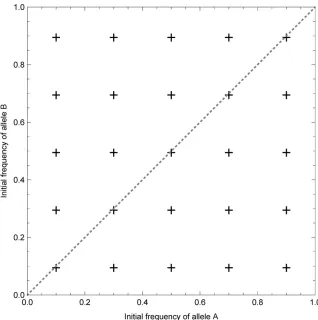
Using numerical routines of the computer algebra software Mathematica, we simulatefluctuating selection on two diallelic loci by iterating two seasons, as described in the main text inWeak,periodicallyfluctuating,frequency-independent selection may maintain stable polymorphism in a two-locus model. For all tested initial conditions [two sets of initial conditions were tested: (i) 103randomly drawn starting points, and (ii)p
AandpBdistributed on a regular grid in thepA2pBplane as displayed in Figure A1, andD¼60:1], the dynamics converge to the periodic trajectory displayed in Figure 1. Through the course of the two seasons, the periodic trajectory interpolates between the approximate values
ðP;d;DÞ ð0:3106;0;0:0471Þ and ðP;d;DÞ ð0:4259;0;20:0560Þ;
see the bold points in Figure 1. These values were calculated numerically as thefixed points of two Poincaré maps,P1andP2;
defined by the values ofP,d, andD at the transition between season 1 and 2, and season 2 and 1 [i.e., at the time points ð2k21Þtand 2ktfork¼1;2;3;. . .respectively],
P1ðkÞ ¼ fP½ð2k21Þt;d½ð2k21Þt;D½ð2k21Þtg
P2ðkÞ ¼ ½Pð2ktÞ;dð2ktÞ;Dð2ktÞ ðk¼1;2;3;. . .Þ: (E3)
Numerically calculating the eigenvaluesl1;l2;andl3of the linearization of either Poincaré map at its equilibrium yields l10:9823; l20:9822; and l30:3549;
hence the periodic trajectory is asymptotically stable. Repeating the procedure for different recombination ratesrproduces the data presented in Figure 2.
An Asymmetric Example of Stable Polymorphism
We simulate the dynamics given by Equation 4 using different epistatic coefficientse16¼e2 in thefitness values of the two
genotypes with mixed upper- and lower-case letters,AbandaB:Thefitness configurations are given by Table A2. We assume the two seasons to be of equal lengtht¼50 and the recombination rate to ber¼0:05:The specific values ofs,e1;ande2in
Table A1 Eigenvalues for the symmetric and neutral case, with four loci
Eigenvalue Multiplicity
2r12r22r3 4
2r22r3 2
2r12r2 2
2r3 1
2r2 1
2r1 1
0 4
r1þr2þr3 1
The eigenvaluerT¼r1þr2þr3corresponds to the trivial constant eigenvector, and
should be disregarded.
Table A2 A generalized genotypefitness configuration
Genotype Frequency Fitness
AB pAB wAB¼1þ2s
Ab pAb wAb¼1þs2e1
aB paB waB¼1þs2e2
ab pab wab¼1
A genotype-fitness configuration generalizing Table 2. Using two epistatic coeffi -cientse1ande2disrupts the symmetry between the two loci.
Table A3 A parameter configuration that disrupts the symmetry between the two loci and leads to a stable trajectory under Equation 4 with seasonalfluctuations
Selection Epistasis Recombination Duration
Season 1: s¼0:00525 e1¼20:021;e2¼20:031 r¼0:05 t¼50
Figure A1Each of these 25 points with both D¼0:1 andD¼20:1 were used as initial condi-tions for the dynamics given by Equation 4 and Table 3; each led to the convergence of the simulation to the periodic trajectory displayed in Figure 1.
Figure A2 The stable trajectory in theP–Dplane under Equation 4, based on the parameters given in Table A3. The trajectory is locally stable. In season 1 the dynamics evolve fromP1toP2;season 2 maps