2498
The Effect And Implications Of Work Stress And
Workload On Job Satisfaction
Fatwa Tentama, Pusparina Arum Rahmawati, Pipih Muhopilah
Abstract: Job satisfaction is very important for the work productivity of employees. This study aimed to empirically examine the effect of work stress and workload on job satisfaction of employees. The study sample was 40 educational support staff who were permanent employees at the University of X in Yogyakarta. This study used simple random sampling technique. Data collection was conducted using the job satisfaction scale, work stress scale, and workload scale with a semantic differential and Likert scale model. Data were analyzed using multiple linear regression analysis supported by assumption tests, which includes the normality test, linearity test, and multicollinearity test. The results of the data analysis show that work stress and workload simultaneously affect job satisfaction and obtained an F-value =12.274 and significance p=.000 (p<.01). There is a very significant effect of work stress on job satisfaction with a t-value =4.307 and significance of p=.000 (p <.01). There is also a very significant effect of workload on job satisfaction, which obtained a t-value = 4.656 and significance of p=.000 (p <.01). Job stress and workload offer a contribution of 39.9% to job satisfaction with the remaining 61% being influenced by other variables.
Index Terms: Educational Support Staff, Employee, Human Resources, Job Satisfaction, Organization, Workload, Work Stress —————————— ——————————
1.
INTRODUCTION
Human resources have a strategic position that contributes to realizing organizational goals that have a competitive advantage [1]. Employees with knowledge, skills, and creativity will greatly contribute to the achievement of company goals, indicating that human resources play the most crucial role in a company [2]. According to Harris, Winskowski, and Engdahl [3] organizations need to pay attention to human resource-related, among which are employee job satisfaction. Employee job satisfaction is an aspect that needs particular consideration from the organization because job satisfaction of employees determine organizational performance while low employee performance will determine whether or not organizational goals will be achieved [4]. Job satisfaction is considered a vital welfare index due to its influence on employee performance. The benefits of job satisfaction are not limited to individuals but also extend to organizations and even to co-workers [5]. According to Baloch [6], job satisfaction of employees impact organizations in such a way that allows employees to become more motivated and committed to improving the quality of their performance. Findings of Hsieh and Wu [7] show that individuals who have higher job satisfaction will work more optimally and productively. Thus by increasing employee job satisfaction, the organization’s operational costs will decrease as a result of an increase in productivity, both in terms of quantity and quality, due to the job satisfaction of employees [5]. Conversely, the impact of employee job dissatisfaction is employees’ resignation from their jobs, numerous complaints on assignments, transgression, stealing the organization’s property or avoiding responsibilities given by the organization [8]. Employees tend to leave the organization if they feel dissatisfied with their jobs in the workplace [9]. According to McCalister, Dolbier, Webster, Mallon, and Steinhardt [10] a decrease in job satisfaction will result in low quality and quantity of work outputs and organizational commitment as well as high rates of absenteeism and turnover. Job satisfaction is the effectivity
or emotional response to various aspects of work [11]. Robbins [12] defines job satisfaction as an accumulation of an individual’s feelings towards his or her performance. According to Wexley and Yuki [13] job satisfaction is a generalization of an individual’s attitude towards his or her work, based on various aspects of the work. Meanwhile, according to George and Jones [14] job satisfaction is an accumulation of feelings and beliefs (presuppositions) that each has about his or her current job. Job satisfaction reflects the feelings and attitudes of an individual toward his or her job [15].
Smith, Kendall, and Hulin [16] mentioned five aspects of job satisfaction, which include: 1). The aspect of work itself that is, a general attitude which comprises of an individual’s perception, an individual’s emotional reactions and opportunities for learning, as well as acceptance of work responsibility. 2). Salary aspects that is a general attitude which comprises of an individual’s perception and an individual’s emotional reactions to compensation or salary as a result of completing an assignment. 3). The promotional aspect that is a general attitude which includes an individual’s perception and an individual’s emotional reactions to aspirations, justice, or opportunities to develop/be promoted. 4). Supervision aspects that is a general attitude which includes an individual’s perception and an individual’s emotional reactions to the quality of supervision and the leadership style of superiors. 5). Co-worker aspects, that is a general attitude that includes an individual’s perceptions of his or her co-workers in the organization. One of the factors involved in the formation of job satisfaction is high and low work stress [17]. According to McCalister, Dolbier, Webster, Mallon, and Steinhardt [10], high work stress has been proven to affect the level of welfare of organizations and employees. Excessive job stress leads to high job dissatisfaction, due to high demands, workplace conflicts, and lack of clarity regarding assignments that can, in turn, affect employee job satisfaction [18]. Job stress is a physiological and psychological reaction that results from an individual’s interactions with threatening environmental situations [15]. This is in line with the opinion of Aamodt [19] who defined work stress as a psychological and physical reaction to (threatening) events or situations that originate from the work environment. Luthans [16] states that stress is the body's unspecific response to a demand or burden laid upon by superiors. Work stress is a condition that suppresses a ————————————————
Fatwa Tentama, Master in Psychology Ahmad Dahlan University,
Indonesia, PH-081904100008. E-mail: [email protected]
Pusparina Arum Rahmawati, Master in Psychology Ahmad Dahlan
University, Indonesia, PH-089672153594. E-mail: [email protected]
Pipih Muhopilah, Master in Psychology Ahmad Dahlan University,
2499
person's psychological state in achieving an opportunity which requires the individual to overcome limits or barriers [8]. Another factor that determines employee job satisfaction is the amount of workload given by the organization [20]. The findings of Zamanian Sarvestani, Sedaghati, Ghatmiri, and Kouhnavard [20] is supported by the findings of Butt and Lance [21] in which the amount of workload can affect job satisfaction. According to Khandan and Maghsoudipour [22], job satisfaction can be improved by reconsidering employees’ amount of workload, as the excessive workload can reduce employee job satisfaction. The workload is defined as a variety of demands that include quantitative, qualitative, mental, and physical tasks [23]. According to Haga, Shinoda, and Kokubun [24], workload is a level of processing capacity exerted during work that reflects one’s energy supply and task demand. Workload reflects the level or difficulty of one's work that may include any variable [25]. The workload is the total amount of work that must be completed by individuals within a specified period [26]. According to several experts, workload is the degree of attentional resource needed to fulfil the performance criteria affected by task demands and experience [27]. The workload can also be defined as the number of resources needed by a series of concurrent tasks as well as the use of resources needed to complete the task [28].Based on the explanation above, the effect of work stress and workload on employee job satisfaction can be illustrated as fig.1 below:
The purpose of this study was to empirically examine the effect of work stress and workload on employee job satisfaction. The hypothesis of this study ware 1). There is an
effect of work stress and workload on employee job satisfaction; 2). There is an effect of work stress on employee job satisfaction, and; 3). There is an effect of workload on employee job satisfaction.
2
RESEARCH
METHOD
2.1 Population and Sample
The population of this study was educational support staff at the University of X. The sample was 40 educational employees who worked at the University of X as permanent employees and had worked for at least one year. This study employed a simple random sampling technique.
2.2 Measurement Instruments
Job satisfaction was tested using a job satisfaction scale that refers to aspects of job satisfaction according to Smith, Kendall and Hulin [16], [11] namely aspects of the work itself, salary, promotion, supervision, and co-workers. Work stress was tested using the work stress scale which refers to aspects
of work stress according to Schultz and Schultz [29], Beehr and Newman [30], and Robbins [31], namely physiological, psychological and psychomotor aspects. The workload is tested using the workload scale, which refers to the intrinsic factors of workload according to Munandar [32], namely aspects of physical demands and task demands.
2.3 Instrument Validity and Reliability
Trial of measuring instruments was carried out on 60 educational support staff at the University of X Yogyakarta. The job satisfaction scale consists of 20 items. After testing, the scale achieved a reliability coefficient (α) of .957 with discrimination index (corrected item-total correlation) that ranges between .421 to .841. Based on these results, the job satisfaction scale is deemed a valid and reliable data collection tool. The job satisfaction scale takes form as a semantic differential scale. The work stress scale consists of 12 items. After testing the scale, the scale achieved a reliability coefficient (α) of .913 with a discrimination index (corrected item-total correlation) that range between .325 to .820. Based on these results, the work stress scale can be used as a valid and reliable data collection tool. The work stress scale takes form as a semantic differential scale.
The workload scale consists of 18 items. After testing the scale, its reliability coefficient (α) is .836 with a discrimination index (corrected item-total correlation) that range between .306 to .557. Based on these results, the workload scale can be used as a valid and reliable data collection tool. The workload scale takes form as a Likert scale.
2.4 Data Analysis
The research data were analyzed using parametric statistical methods. Data analysis was performed using IBM SPSS 21 through multiple regression techniques, which is a statistical analysis technique to determine the effect of two independent variables (work stress and workload) towards one dependent variable (job satisfaction). Assumptions testing was carried out before hypothesis testing, including normality test, linearity test, multicollinearity test, and heteroscedasticity test.
3
RESULT
AND
ANALYSIS
3.1 Assumption Test
3.1.1 Normality Test
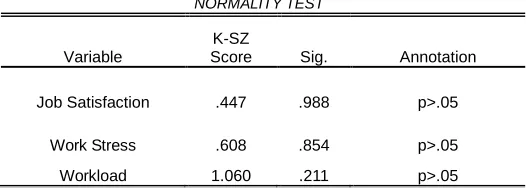
The result of the normality test can be seen in table 1 below.
TABLE1
NORMALITY TEST
Variable
K-SZ
Score Sig. Annotation
Job Satisfaction .447 .988 p>.05
Work Stress .608 .854 p>.05
Workload 1.060 .211 p>.05
Source: Research Result, 2019 (processed data)
Based on the results of normality test shown in table 1 it was known that the significance values of job satisfaction, work stress, and workload were respectively .988, .854, and .211 which have p>.05, meaning that each data was normally
Work Stress - Physiological - Psychological - Psychomotor
Workload - Physical Demands - Task Demands
Job satisfaction - The work itself - Salary - Promotion - Supervision - Co-workers
2500
distributed so that it can be concluded that each variable had a distribution of normally distributed data.
3.1.2 Linearity Test
The results of the linearity test of work stress on job satisfaction obtained an F linearity of 21.869 with a significance level (p) of .000, which indicates linearity or the presence of a line that connects the work stress and job satisfaction variables. The linearity test results of workload on job satisfaction obtained an F linearity of 4.398 with a significance level (p) of .046, which indicates linearity or the presence of a straight line that connects the workload and job satisfaction variables. The linearity test results can be seen in table 2.
TABLE2
LINEARITY TEST
Variable F Linearity Sig. Threshold Annotation
Work Stress
21.869 .000 P<.05 Linear
Workload 4.398 .046 P<.05 Linear
Source: Research Result, 2019 (processed data)
3.1.3 Multicollinearility Test
The multicollinearity test was conducted to ensure that there is no multicollinear relationship between the two independent variables. Based on table 3, work stress and workload have a VIF = 1.250 (VIF <10) and tolerance =.800 (tolerance >.1), indicating no multicollinearity between work stress and workload. The multicollinearity test results can be seen in table 3.
TABLE3
MULTICOLLINEARITY TEST
Variable Tolerance VIF Annotation
Work Stress .800 1.250 No multicollinearity
Workload .800 1.250 No multicollinearity
Source: Research Result, 2019 (processed data)
3.1.4 Heteroscedasticity Test
The heteroscedasticity test aimed to ensure that there is no problem with the heteroscedasticity. Heteroscedasticity was tested using the Spearman Rho test. Based on table 4, the significance value (p) of work stress is .223 (p>.05), and workload is .437 (p>.05), which means that there is no problem with heteroscedasticity in both variables. The heteroscedasticity test results can be seen in table 2.
TABLE4
HETEROSCEDASTICITY TEST
Variable Sig. Tolerance Annotation
Work Stress .223 P >.05 No heteroscedasticity
Workload .437 P>.05 No heteroscedasticity
Source: Research Result, 2019 (processed data)
3.1.5 Hypotheses Test
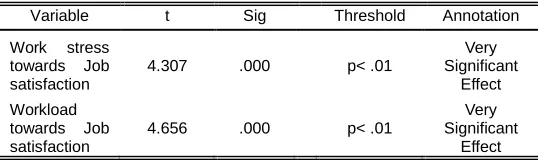
The result of the analysis of the relationship between variables test can be seen in table 5 below.
TABLE5
ANALYSIS RESULT OF THE RELATIONSHIP BETWEEN VARIABLES
Variable t Sig Threshold Annotation
Work stress towards Job satisfaction
4.307 .000 p< .01
Very Significant
Effect Workload
towards Job satisfaction
4.656 .000 p< .01
Very Significant
Effect
Source: Research Result, 2019 (processed data)
2501
satisfaction towards one’s job can be fulfilled. The so-called workload is a series of circumstances that mediate individual performance and perceptual, cognitive, and motorized tasks [38]. A high workload that is followed by consistency will have a positive effect, but high workload that is not accompanied by consistency will have a negative effect [39]. Perception about workloads and work problems will also change if employees receive support from their colleagues, supervision from superiors, as well as the autonomy/authority to complete their work [40]. The findings of this study have several practical implications. First, this research has reinforced that work stress is one of the main determinants of job satisfaction. Leaders of the university need to pay attention to the psychological conditions of their employees, and not to give demands and burdens that are too high as not to stress the employees. Leaders also need to create a comfortable work atmosphere and system in order for employees to work optimally in accordance with their abilities, subsequently achieving satisfaction with the results. Second, this study reinforces that workload is one of the main determinants of job satisfaction. Thus university leaders need to pay attention to the abilities and conditions of employees before defining and assigning tasks. Assignment of challenging assignments should be accompanied by direction and supervision and relevant time limits so that employees can do each task optimally. When there is a new assignment, the leader should provide clear instructions and assistance. The number of assignments given to employees should be adjusted to the abilities of employees, both in terms of physical and cognitive abilities. These efforts are carried out in order to allow employees to execute their tasks properly, in turn, leading them to feel satisfied with the results of their work and become motivated to complete other tasks. The current study is not without limitation. The sample is limited in educational employees who worked in university, and the number of subjects was limited. So it is unclear if results would generalize employees in another workplace. Future research should continue to examine this variable in another workplace with a greater subject number.
4 CONCLUSION
Based on the results of data analysis in this research, it can be concluded that: 1) Simultaneously, there is a significant effect of work stress and workload on job satisfaction. 2) There is a very significant effect of work stress on job satisfaction. 3) There is a very significant effect of workload on job satisfaction. Job stress and workload contribute 39.9% to job satisfaction with the remaining 61% being influenced by other variables.
ACKNOWLEDGMENT
The author would like to thank the Institute of Research and Community Service (LPPM) of Universitas Ahmad Dahlan Yogyakarta for providing research funds so that this research could be carried out and resolve smoothly.
REFERENCES
[1] P.M. Wright, T.M. Gardner, L.M. Moynihan, and M.R. Allen, ―The Relationship Between HR Practices and Firm Performance: Examining Causal Order,‖ Personnel Psychology, vol. 2, no. 58, pp. 409-446, 2005.
[2] M. Buble, and D. Kružić, Entrepreneurship Reality of
Present and Future Challenge (in Croatia). Zagreb:
RRiF-Plus, 2006.
[3] J.I. Harris, A.M. Winskowski, and B.E. Engdahl, ―Types of
Workplace Social Support in The Prediction of Job Satisfaction,‖ The Career Development Quarterly, vol. 2, no. 56, pp. 150-156, 2007
[4] L.D. Serrano and J.A.C Vieira, ―Low Pay, Higher Pay and
Job Satisfaction Within The European, Union: Empirical Evidence from Fourteen Countries,‖ Discussion Papers, Institute for the Study of Labour, no. 1585, Apr. 2005.
[5] M.Y. Chen, ―Validation of The Wood’s Job Satisfaction
Questionnaire Among Taiwanese Nonprofit Sport Organization Workers,‖ Social Indicators Research, vol. 3, no. 4, pp. 437-447, 2009.
[6] Q.B. Baloch, ―Effects of Job Satisfaction on Employees
Motivation and Turn Over Intentions,‖ Journal of Managerial Sciences, vol. 1, no. 2, pp. 1-21, 2009.
[7] A.T. Hsieh, and D.H. Wu, ―The Relationship Between
Timing of Tipping and Service Effort.‖ Service Industries Journal, vol. 1, no. 27, pp. 1–14, 2007.
[8] S.P. Robbins, Organizational Behavior. Upper Saddle River, New Jersey: Pearson Prentice Hall, 2007.
[9] T.H. Hammer, and A. Avgar, ―The Impact of Union On Job
Satisfaction, Organizational Commitment and Turnover,‖ Journal of Labour Research, vol. 2, no. 26, pp. 241-266, 2005.
[10] K.T. McCalister, C.L. Dolbier, J.A. Webster, M.W. Mallon, and, M.A. Steinhardt, ―Hardiness and Support at Work as Predictors af Work Stress and Job Satisfaction,‖ American Journal of Health Promotion, vol. 3, no. 20, pp. 183-191, 2006.
[11] R. Kreitner and A. Kinicki, Organizational Behavior. New York: Irwin McGraw-Hill, 2003.
[12] S.P. Robbins, Organizational Behavior. London: Pearson, 2005.
[13] N.K. Wexley and A.G. Yuki, Organizational Behavior and Personel Psychology. Homewood, Ill: R.D. Irwin, 2005.
[14] J.M. George, and G.R. Jones, Understanding and Managing Organizational Behavior. Upper Saddle River: New Jersey, Pearson Prentice Hall, 2008.
[15] R.E. Riggio, Introduction to Industrial/ Organizational Psychology. New Jersey: Pearson Prentice Hall, 2009.
[16] F. Luthans, Organizational Behavior. Boston: McGraw-Hill, 2008.
[17] J.O. Okpara, M. Squillace, and E.A. Erondu, ―Gender
Differences and Job Satisfaction Study of University Teachers in The United States,‖ Journal of Woman Manage, vol. ,3, no. 20, pp. 177-190, 2005.
[18] E. Brewer and J. Mcmahan-Landers, ―The Relationship Between Job Stress and Job Satisfaction Among Industrial and Technical Teacher Educators,‖ E-Journal JVER, vol. 2, no. 28, pp. 37-50, 2003.
[19] Aamodt, Applied Industrial/ Organizational Psychology, Belmont: Wadsworth, 2004.
[20] Z. Zamanian, M.R. Sarvestani, M. Sedaghati, M. Ghatmiri, and B. Kouhnavard, ―Assessment of The Relation Between Subjective Workload and Job Satisfaction in University Faculty and Staff,‖ Journal of Ergonomics, vol. 4, no. 3, pp. 1-10, 2016.
[21] G. Butt and A. Lance, ―Secondary Teacher Workload and
Job Satisfaction: Do Successful Strategies for Change Exist?,‖ Educational Management Administration & Leadership, vol. 4, no. 33, pp. 401-422, 2005.
2502
and Job Satisfaction Relationship in a Productive Company,‖ Iran Occupational Health, vol. 1 no. 9, pp. 30-36, 2012.
[23] C.L. Cooper, P.J. Dewe and M.P. O'Driscoll, Organizational Stress: A Review and Critique of Theory, Research, and Applications. Thousand Oaks, CA: Sage Publications, 2001.
[24] S. Haga, H. Shinoda, and M. Kokubun, ―Effect of Task
Difficulty and Time-On-Task on Mental Workload,‖ Japanese Psychological Research, vol. 3, no. 44, pp. 134-143, 2002.
[25] N.A. Bowling, and C. Kirkendall, Workload: A Review of Potential Causes, Consequences, and Interventions. New York: John Wiley & Sons, 2012.
[26] R. Morris, P. MacNeela, A. Scott, P. Treacy and A. Hyde, ―Reconsidering The Conceptualization of Nursing Workload: Literature Review.‖ Journal of Advanced Nursing, vol. 5, no. 57, pp. 463-471, 2007.
[27] M.S. Young, and N. A. Stanton, ―What's Skill Got to Do
With It? Vehicle Automation and Driver Mental Workload, Ergonomics, vol. 8, no. 50, pp. 1324-1339, 2007.
[28] M. Hoedemaeker, Summary Description of Workload Indicators: WP1 Workload Measures. Leeds, UK: University of Leeds, 2002.
[29] D.P. Schultz, and, S.E. Schultz, Psychology and Work Today. New York: Mc Millan Publishing Company, Inc, 1994.
[30] T.A. Beehr and J.E. Newman, ―Job Stress, Employee Health and Organizational Effectiveness: A Facet Analysis, Model and Literature Review,‖ Personnel Psychology, vol. 4, no. 31, pp. 665-669, 1978.
[31] S.P. Robbins, Organizational Behaviour Concept, Controversies, Applications. New Jersey: Prentice-Hall, 2004.
[32] A.S. Munandar, Industrial Psychology and Organization (In Indonesia). Jakarta: UI Press. 2001.
[33] D. Al Khalidi, and M. Wazaify, ―Assessment of
Pharmacists’ Job Satisfaction and Job Related Stress in Amman,‖ International Journal of Clinical Pharmacy, vol. 5, no. 35, pp. 821-828, 2013.
[34] M. Kivimaki and I. Kawachi, ―Work Stress as A Risk Factor
for Cardiovascular Disease,‖ Curr Cardio Rep, pp. 73-81, 2015.
[35] J.P. Mulki, F. Jaramillo, E.A. Goad, and M.R. Pesquera, ―Regulation of Emotions, Interpersonal Conflict, and Job Performance for Sales People,‖ Journal of Business Research, pp. 8-16, 2014.
[36] V.M. Lea, S.A. Corlett, and R.M. Rodgers, "Workload and Its Impact on Community Pharmacists' Job Satisfaction and Stress: A Review of the Literature,‖ International Journal of Pharmacy Practice, vol. 4, no. 20, pp. 259-271, 2012.
[37] S.G. Hart, NASA-Task Load Index (NASA-TLX); 20 Years later. Los Angeles, CA: Sage Publications, 2006.
[38] R. Parasuraman, and D. Caggiano, Mental Workload. San Diego: Academic Press, 2002.
[39] G.B. Yeo, E.R. Frederiks, C. Kiewitz and A. Neal, ―A Dynamic, Self-Regulatory Model of Affect and Performance: Interactions Between States, Traits and Task Demands,‖ Motiv Emot, vol. 3, no. 8, pp. 429-443, 2014.
[40] E. Kokoroko, and M.A. Sanda, ―Effect of Workload on Job
Stress of Ghanaian OPD Nurses: The Role of Coworker