IJEDR1401149
International Journal of Engineering Development and Research (www.ijedr.org)828
Predictable Model Using Spatio Temporal
Suppression in LAN
1
T.Priya,
2P.R.Ragavi,
3D.Vivethitha
SKP Engineering College, Tiruvannamalai, TamilNadu
1[email protected], 2[email protected] , 3[email protected] Guided by, Mr S.Raam khishore M.E (AP/IT)
_________________________________________________________________________________________________________
Abstract- The project introduces the idea of reducing the communication cost and to recover the data which is failed and
missing. In previous method it is implemented in wireless sensor network which is not efficient because it uses battery power that leads to increase the communication cost. To reduce the communication cost it uses suppression technique that use cascaded. Even though it reduces the communication cost but it is not efficient to recover the data that which is lost are missing. To overcome this problem and to reduce the energy that are consumed by the wireless sensor network it is implemented in LAN which uses cascaded suppression that uses both spatio and temporal technique to reduce the communication. It is efficient to reduce the communication but now the problem persist in handling the failure and to interpret the missing data previously it uses retransmission and time stamp mechanism in which it is not efficient so now it uses Bayesian inference and coding theory to recover the missing and failed data.
Keywords- cascaded suppression, Spatio temporal suppression, Greedy algorithm, Bayesian inference.
________________________________________________________________________________________________________
I. INTRODUCTION
The problem persist in the wireless sensor networks is battery power consumption it leads to high communication cost because of sensing the data regularly and to reporting it to the base station. In order to handle the failure and missing data it applies coding theory and Bayesian inference to recover the failed data efficiently and retransmit the data to destination by using LAN.
II. CASCADED SUPPRESSION
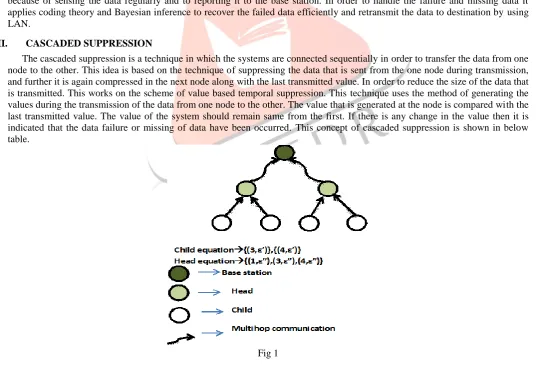
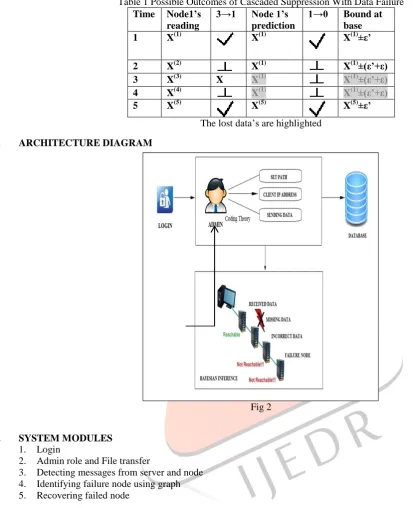
The cascaded suppression is a technique in which the systems are connected sequentially in order to transfer the data from one node to the other. This idea is based on the technique of suppressing the data that is sent from the one node during transmission, and further it is again compressed in the next node along with the last transmitted value. In order to reduce the size of the data that is transmitted. This works on the scheme of value based temporal suppression. This technique uses the method of generating the values during the transmission of the data from one node to the other. The value that is generated at the node is compared with the last transmitted value. The value of the system should remain same from the first. If there is any change in the value then it is indicated that the data failure or missing of data have been occurred. This concept of cascaded suppression is shown in below table.
IJEDR1401149
International Journal of Engineering Development and Research (www.ijedr.org)829
Table 1 Possible Outcomes of Cascaded Suppression With Data FailureTime Node1’s
reading
3→1 Node 1’s
prediction
1→0 Bound at
base
1 X(1) X(1) X(1)±ε’
2 X(2) X(1) X(1)±(ε’+ε)
3 X(3) X X(1) X(1)±(ε’+ε)
4 X(4) X(1) X(1)±(ε’+ε)
5 X(5) X(5) X(5)±ε’
The lost data’s are highlighted
III. ARCHITECTURE DIAGRAM
Fig 2
IV. SYSTEM MODULES
1. Login
2. Admin role and File transfer
3. Detecting messages from server and node 4. Identifying failure node using graph 5. Recovering failed node
LOGIN
IJEDR1401149
International Journal of Engineering Development and Research (www.ijedr.org)830
Fig 3ADMIN ROLE AND FILE TRANSFER
After the user Id and password is entered then it check its authenticity with the help of a database. If they are the eligible person, then the admin selected the clients to transfer the data from the server. He sets the path of the data in which is it is present and he sets the IP address in which client he wants to send the data. After the completion of this process the admin select the particular file that want to send it to the client system.
Fig 4
DETECTING MESSAGE FROM SERVER AND NODE
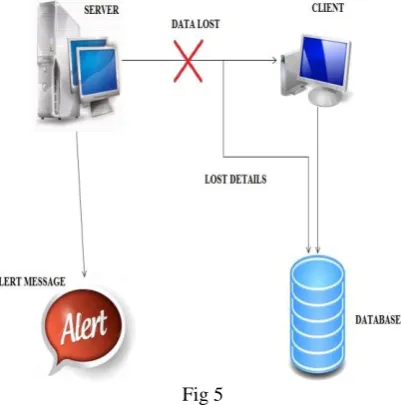
During the transmission of data files if any of the node failure occurs, then the information about the failure node and the reason for the data failure is sent to the server along with the alert message and the failed information like hardware problem, etc. are also stored in the client system. The information about the failure is also stored in the database in order to verify the failure rate and the reason for the failure.
IJEDR1401149
International Journal of Engineering Development and Research (www.ijedr.org)831
IDENTIFYING FAILURE NODE USING GRAPH
While transferring the data from the server to the client node the missing data or the node failure occurs. During the transmission of data the suppression process takes place at the every node and value is generated automatically. This value is considered to draw the graph of the data flow path. That failed node can be identified by using the Bayesian inference and Bayesian network to draw the graph.
X (t) =AX (t-1) +c+E (t) X(t)-readings from node.
t- Time stamp
Fig 6
RECOVERING FAILED NODE
The failed node can be recovered using the Fault tolerant algorithm which is used to recover the missing data efficiently. It can be done by the process that the when the indication of the node failure occurs then the algorithm which is used to invoke automatically and retransmit it from the failure node itself.
Fig 7
V. CONCLUSION
In wireless sensor networks the continuous transmission of information leads to large amount of energy consumption. Since all the sensor networks uses only battery powered systems the energy consumption cannot be reduced easily. Since this concept uses the cascaded suppression technique which is used to recover the failed data efficiently which are connected in LAN. Since the wireless sensor networks have some disadvantage over them we use LAN to implement the concept. These efficiently find out the failed node and used to retransmit the data.
VI. FUTURE WORK
IJEDR1401149
International Journal of Engineering Development and Research (www.ijedr.org)832
REFERENCE[1] A. Guitton, N. Trigoni, and S. Helmer, “Fault-Tolerant Compression Algorithms for Delay-Sensitive Sensor Networks with Unreliable Links,” Proc. IEEE Int’l Conf. Distributed Computing in Sensor Systems (DCOSS), 2008.
[2] A. Mainwaring, D. Culler, J. Polastre, R. Szewczyk, and J.Anderson, “Wireless Sensor Networks for Habitat Monitoring,”Proc. Int’l Workshop Wireless Sensor Networks and Applications (WSNA), 2002.
[3] A.Deshpande, C. Guestrin, S. Madden, J.Hellerstein, and W.Hong, “Model-Driven Data Acquisition in Sensor Networks,”Proc. Int’l Conf. Very Large Data Bases (VLDB), 2004.
[4] D.Tulone and S. Madden, “PAQ: Time Series Forecasting for Approximate Query Answering in Sensor Networks,” Proc. Third European Conf. Wireless Sensor Networks (EWSN), 2006.
[5] H.Yang and C.-W. Chung, “An Effective and Efficient Method for Handling Transmission Failures in Sensor Networks,” Proc. Int’l Conf. Database Systems for Advanced Applications (DASFAA), 2009.
[6] D.Chu, A. Deshpande, J. Hellerstein, and W. Hong, “Approximate Data Collection in Sensor Networks Using Probabilistic Models,” Proc. Int’l Conf. Data Eng. (ICDE), 2006.