University of South Carolina
Scholar Commons
Theses and Dissertations
12-14-2015
Forgotten Science of Bird Eggs: The Life Cycle of
Oology at the Smithsonian Institution
Katherine Nicole Crosby University of South Carolina - Columbia
Follow this and additional works at:https://scholarcommons.sc.edu/etd
Part of thePublic History Commons
This Open Access Thesis is brought to you by Scholar Commons. It has been accepted for inclusion in Theses and Dissertations by an authorized administrator of Scholar Commons. For more information, please [email protected].
Recommended Citation
F
ORGOTTENS
CIENCE OFB
IRDE
GGS:
T
HEL
IFEC
YCLE OFO
OLOGY AT THES
MITHSONIANI
NSTITUTIONby
Katherine Nicole Crosby
Bachelor of Arts University of Michigan,2011
Submitted in Partial Fulfillment of the Requirements
For the Degree of Master of Arts in
Public History
College of Arts and Sciences
University of South Carolina
2015
Accepted by:
Allison Marsh, Director of Thesis
Ann Johnson, Reader
DEDICATION
This thesis is dedicated to my family. Thank you to my parents, Kristy, Mike,
Gary, and Cheryl, for providing encouragement and humor when I needed it most. To my
siblings, Cody, Alexi, Zoe, and Tobin, thank you for always making me laugh and
keeping me honest. To my grandparents, Max, Phyllis, Gary, Jane, Sue, Mike, Roger,
Nancy, and Charlotte, thank you for the many adventures and for helping me grow. I love
ACKNOWLEDGEMENTS
This thesis would not have been possible without the assistance of the following
people, to whom the author is deeply indebted. At the University of South Carolina, my
advisor, Dr. Allison Marsh, who provided insightful guidance and feedback at every step
of the writing process. At the University of Cornell, Dr. Ann Johnson, my second reader,
whose independent study course proved foundational to my approach for this thesis. At
the National Museum of Natural History, Division of Birds, Christina Gebhard and Brian
Schmidt, who assisted me immeasurably with locating materials and gave me their
thoughts on the contemporary state of the egg collection at the NMNH. At the Field
Museum, Dr. John Bates and Armand Esai, who assisted me with my research and
ABSTRACT
This thesis analyzes the influence the Smithsonian Institution had over the
development of oology as a science from the mid-19th to the early 20th century. The
Smithsonian promoted oology, or the study of bird eggs, through publications and
collections of eggs in the mid-19th century, and the science enjoyed a brief period of
proliferation and approval. In the end, however, the popularity of egg collecting as a
hobby, in-fighting between oologists and ornithologists over the validity of oology as a
science, and bird conservation groups opposed to collecting eggs, all conspired to halt
oology’s professionalization, and ultimately led to the downfall of the science, which is
no longer practiced today. Museums still house these collections, and their history
matters, particularly when the specimens are used to help make scientific discoveries that
drive policy, as was the case with the 1972 ban of DDT. The thesis speaks to broader
conversations in the history of science and public history about why scientific collections
TABLE OF CONTENTS
DEDICATION ... iii
ACKNOWLEDGEMENTS ... iv
ABSTRACT ...v
CHAPTER 1:INTRODUCTION ...1
CHAPTER 2:HISTORIOGRAPHY ...7
CHAPTER 3:BACKGROUND ...11
CHAPTER 4:EARLY SMITHSONIAN INTERVENTIONS IN OOLOGY ...20
CHAPTER 5:THE ZENITH OF OOLOGY AT THE SMITHSONIAN ...36
CHAPTER 6:THE WANING YEARS OF OOLOGY AT THE INSTITUTION ...51
CHAPTER 7:CONCLUSION ...75
C
HAPTER1
INTRODUCTION
Why do some practices become sciences, while others, like oology, experience
moments of popularity but are ultimately abandoned? In the nineteenth century, natural
history began to split into the various professional scientific disciplines with which we
are familiar today, such as zoology, geology, and physics, among others. The
professionalization of science produced divisions within scientific disciplines; in the case
of zoology, the process of professionalization created branches based on the study of
specific classes of animals, such that the study of birds (ornithology) was separated from
the study of fish (ichthyology). While in retrospect these divisions seem logical, if not
inevitable, they were not the only specializations naturalists attempted to professionalize
within natural history. Some sciences were created and supported in this period that failed
to maintain their scientific status to the present, and oology was one such science.
Oology1, or the collection and study of bird eggs, was once pursued as a scientific
practice in the United States. Starting in Great Britain in the 1830s, oology as a scientific
practice grew throughout the 19th century, and the first text on North American oology
was published in 1857.2 Originally, the principle object of oology was to collect bird eggs
1 The word is spelled as both oology and oölogy, and the spelling in this document will
mirror how it was spelled in the relevant texts.
for scientific study. Some oologists would also collect the nests of birds, but the study of
nests, or nidology, was considered a separate science. The popularity of egg collecting as
a hobby led to two groups of people who engaged in egg collecting: hobbyists and
oologists. Some behaviors were common to both the hobbyist and the oologist: both
identified the species of egg by observing the parents at the nest; collected the whole
clutch of eggs laid by a bird, rather than just taking one egg; drilled a hole into the egg,
blew out the contents, and rinsed the egg to preserve the shell; and placed markings upon
the eggs for the purpose of identifying them within their collections.
With oologists, however, these activities were augmented with documentation
throughout the collecting process for the purpose of preparing the eggs as scientific
specimens. Oologists would not always identify the eggs simply by observing the birds at
the nest, but would often shoot the bird to collect with the eggs, so that the specific
species and subspecies could be determined with a greater degree of certainty. They filled
out collection slips with detailed information about the location of the eggs, position of
the nest with respect to trees, bushes, bodies of water and other landmarks, the date, the
degree of certainty they felt about their identification of the species, and the level of
incubation the eggs had undergone by the time they were collected. They standardized
tools for drilling into and cleaning out the eggs, up to and including the proper size and
location of holes on the eggs. Oologists also made some efforts at standardized marking
practices for the eggs they collected; in addition to a set mark used to identify the eggs
within their collection, they were also instructed to identify the species on the egg (in
later years this would be done through the use of the American Ornithologists’ Union
number of eggs in the set.3 All of these activities were intended to ensure that the eggs
had value as scientific specimens, that is, that they could be properly identified based on
species, date, and location for the purposes of comparison with other eggs within the
same species and for comparisons between species.
The main material products of scientific oology were collections of bird eggs;
these collections ranged in size from a few clutches to several thousand eggs carefully
stored in custom-made cabinets. Many of these collections found their way into
museums. But what role did museums play in the development of oology as a science?
Museums were not simply passive recipients of egg collections, but frequently weighed
in on the quantities and species that scientists should be collecting, the appropriate
purposes for which eggs should be collected, and who these collectors should be.
Beginning in the mid-19th century with the Smithsonian Institution’s circulars
until shortly after the founding of the National Audubon Society, museums exerted their
influence over scientific oologists through circulars, journal articles, annual reports, and
correspondence between museum officials, including curators who were also collectors,
and collectors outside of the museum. The beginning of oology’s decline was caused by
the foundation of societies like the National Audubon Society, as these groups were
horrified by the wanton destruction of birds in this period, and in their backlash, began to
question the validity of oology as a science. Scientific oology had several challenges that
ultimately contributed to its failure to remain a scientific specialization separate from
3 For example, an egg marked with “15/3” would indicate that it was the 15th set of this
ornithology: the activity’s popularity as a hobby in the same period, pushback from
ornithologists, and conservation efforts made by groups like the Audubon Society.
The stakes concerning oology for museums were immense. By influencing
scientific collectors in terms of who should be collecting and what they should be
collecting (which species, from which regions, with how many specimens, etc.),
museums were attempting to control the types of donations that they would receive from
collectors. In the early years of popular oology, museums wanted to have collections that
were as complete as possible, including eggs that were rare or difficult to obtain, and as
such they would encourage patterns of collection and donation that would produce
diverse and voluminous collections of eggs. Later, as the backlash against egg collecting
picked up steam, museums attempted to temper hobbyist collecting in favor of scientific
collecting; these efforts included language emphasizing the differences in purpose of
scientific and hobbyist collecting, elevating the scientific over the hobbyist approaches.
In addition to contributing to the museums’ prestige at the height of oology,
museum bird egg collections have had a continuing importance for scientific discoveries,
including the research that contributed to the ban on the use of DDT.4 Studying the
influence that museums had on oology demonstrates the strengths and weaknesses that
museums like the Smithsonian Institution had in determining the course of a scientific
practice. Ultimately, studying how that influence resulted in changes in museum bird egg
collections is critical to understanding how museums obtained the collections they have
today, and what the consequences of those collections could be for science in the future.
If museums do not understand how they acquired their collections and the forces that
influenced them, the accuracy of the science to which their collections contribute could
come into question.
This thesis examines the role of one museum, the Smithsonian Institution’s
National Museum, in shaping the history of oology in the United States. The selection of
this museum in particular was based on the fact that this institution had the most notable
documentation on the process of shaping oology as a scientific practice in a single
institution, as well as its later importance as an influential player in the museum world
with respect to collection policy and philosophy. Chapter one of this thesis introduces the
topic of oology at the Institution and provides a roadmap for the remainder of the thesis.
The second chapter gives important historiographical background on the thesis to situate
it within several conversations in the field. The third chapter starts with a brief section
detailing the early history of oology prior to the January 1st, 1860 Smithsonian Institution
circular by Joseph Henry, including oology’s move across the Atlantic from Great Britain
to the United States and the influence of early oologists and museums on the
development of oology. Chapter four covers the period from 1860 to 1884, when the
Institution made its first tentative steps toward promoting oology as a science. Chapter
five covers the period from 1884 to 1897, the height of oology as a scientific practice and
a hobby. The Smithsonian Institution enjoyed considerable influence in this period and
the involvement of oologists in the Institution increased substantially. The sixth chapter
examines the backlash against hobbyists and oologists and the decline of oology as a
specialization, from 1897 to 1922, when the Division of Birds permanently absorbed the
implications of the history of oology at the Smithsonian for the present day state of
museum collections and ornithology.
Oology at the Smithsonian Institution was driven by individuals in positions as
Honorary Curators and Custodians, whose enthusiasm for the science of oology provided
important catalysts for its growth and development, and when they died off, so did the
practice. With the deaths of these individuals, the science faltered and eventually
collapsed without their sponsorship, as it was unable to withstand criticisms voiced
outside the Institution without a persuasive advocate. Oology reached its zenith in the
1880s-1900s, with declining popularity and prestige afterward, particularly in light of the
Audubon Society’s activities in the late 19th and early 20th centuries. Although the
Audubon Society was founded primarily in reaction to the slaughter of birds for fashion
purposes, it encouraged criticism of all activities that resulted in the death of birds,
including hunting and scientific practices.5 While ornithology was able to adapt its
practices to remain palatable to the Audubon Society, the unscientific popularity of egg
collecting as a hobby combined with already extant derision of oology on the part of
ornithologists, and the Migratory Bird Treaty Act to ring the death knell for oology as a
science. While some individuals held out until the 1920s and beyond, the practice
ultimately died off with the practitioners that had pursued it in its heyday.
5 Mark V. Barrow, Jr., A Passion for Birds: American Ornithology after Audubon
CHAPTER
2
HISTORIOGRAPHY
This thesis is in conversation with other works describing the role of museums in
natural history. The first of these works is Paula Findlen’s Possessing Nature: Museums,
Collecting, and Scientific Culture in Early Modern Italy, published in 1996. This work examined the early development of museums in Italy and the role that they played in
natural history in the period, and argued that the explosion of collecting related to natural
history created the necessity for museums, but museums then in turn influenced the
theoretical underpinnings of natural history.6 Temporally and geographically, Findlen’s
work and this thesis are obviously distinct, yet in many ways their arguments
complement each other, for this thesis also argues that museums, and in this case the
Smithsonian Institution in particular, played a role in the development and change of
natural history. In the case of this thesis, however, the focus is specifically on oology
rather than all of natural history, and the change in question is from bird egg collecting as
an encyclopedic process suitable as both a hobby and scientific practice to an illegitimate
and outdated science harming bird conservation efforts. Findlen’s work nonetheless
provides an excellent framework for analyzing how museums and natural history
influenced each other through her examination of changes in natural history philosophy,
and this thesis uses a similar methodology to prove its argument.
The next work with which this thesis converses is Mark V. Barrow Jr.’s A Passion for Birds: American Ornithology After Audubon, published in 2000. Barrow’s work
analyzes the history of American ornithology from the end of the Civil War to World
War II, and argues that ornithology struggled to differentiate itself from birdwatchers and
was not completely successful in doing so due to the ornithologists’ reliance on amateur
bird watchers for sighting data.7 Barrow’s work contains rich detail on the development
of ornithology as a professional science, including an emphasis on the role of amateurs in
the production of knowledge for ornithology. In this work, Barrow describes how
ornithology and oology had a contentious relationship, with some ornithologists
discrediting oology as a mere hobby, rather than a science, while others argued that
oology was an important part of ornithology and was therefore deserving of serious
study.8
This thesis studies the other side of this coin, examining how the Smithsonian
Institution contributed to the growth of oology as well as its ultimate downfall, and
demonstrates how museums can make or break the chances for the professionalization of
sciences. Furthermore, Barrow emphasizes the influence the conservation movement, in
the form of the American Ornithologists’ Union’s Committee on Bird Protection and the
Audubon Society, had on ornithology and how these organizations curtailed the
collecting practices of ornithologists, first with the 1886 model law and later with other
pieces of legislation. 9 This process of censure and debate is mirrored in the debates
surrounding the legitimacy of oology as a science, with nuances specific to oology into
which this thesis will delve further.
Also in 2000, Mark V. Barrow Jr. published an article in The Journal of the History of Biology titled, “The Specimen Dealer: Entrepreneurial Natural History in America’s Gilded Age.” In this article, Barrow argues that professional specimen
collectors and dealers played a major part in the development of natural history in the
United States.10 This article therefore examines an intermediate collecting position
between those that this thesis studies, the hobbyists and the scientists, and demonstrates
the importance that specimen dealers had to both types of collecting. This thesis
complements the work done in this article by digging deeper into the history of a specific
type of collecting, oology, and how a powerful institution, the Smithsonian, influenced
that hobby to demonstrate that the popularity of activities like natural history collecting
was influenced by multiple sources.
Finally, Robert Kohler’s All Creatures: Naturalists, Collectors, and Biodiversity,
1850-1950, published in 2006, converses with this thesis through their mutual analysis of museum influence on natural history. Covering the same geography and the same period,
All Creatures and this thesis nonetheless have different arguments to make about how museums influenced natural history. Kohler’s work argues that museums sponsored
expeditions to collect as many specimens as possible and in the process helped to
discover biodiversity, therefore emphasizing the importance of museums as influential
institutions in the production of science.11 This thesis, while also interested in
understanding how museums influenced science production, attempts to answer that
question using oology as a case study to examine the Smithsonian Institution’s influence
10 Mark V. Barrow, Jr., “The Specimen Dealer: Entrepreneurial Natural History in
America’s Gilded Age,” Journal of the History of Biology 33, no. 3 (2000): #.
11 Robert E. Kohler, All Creatures: Naturalists, Collectors, and Biodiversity, 1850-1950
over the philosophy of natural history collecting and the behavioral changes of hobbyists
and scientific oologists that occurred as a result. It is important to note that oology was
one of many specializations at the National Museum to benefit from the Institution’s
penchant for expeditions, but for most of the expeditions that the Institution supported or
CHAPTER
3
BACKGROUND
In 1846, the Smithsonian Institution was founded for the purpose of the increase
and diffusion of knowledge, and Joseph Henry, the first Secretary of the Institution, had
definite ideas about how that increase and diffusion should be enacted. Specifically,
Henry argued that “no particular kind of knowledge is designated, hence a liberal
interpretation of the bequest will exclude no part of the great domain of science and
literature from the degree of attention its importance may demand.”12 Henry envisioned
the Institution investigating a multitude of sciences, from meteorology to zoology, and
from mineralogy to astronomy. With substantial monetary support (in the form of a large
annual income), this new Institution was poised to promote a variety of sciences,
including the exciting and nascent science of oology.
Oology as a science dates to the 1830s in Great Britain, and its leap across the
pond was due in no small part to the actions of the Smithsonian Institution shortly after it
was founded. In 1831, William C. Hewitson published the first volume of British oölogy; being illustrations of the eggs of British birds, the first monograph on oology.13 Hewitson published subsequent volumes of the first edition until 1838, with a second edition
12 Smithsonian Institution, Fifth Annual Report of the Board of Regents of the Smithsonian Institution, to the Senate and House Representatives, showing the Operations, Expenditures, and Condition of the Institution during the year 1850, by Joseph Henry and Spencer Fullerton Baird, (Washington D.C.: United States Government Printing Office, 1851), 6.
printed from 1842-1846 and a third edition from 1853-1858, demonstrating the popularity
and demand for Hewitson’s work in Great Britain.14 Hewitson’s work provided an
important foundation for the science of oology globally, and the existence of such a
popular and well-respected series in Great Britain encouraged American ornithologists to
pursue similar investigations in the United States.
In the 1855 Annual Report of the Board of Regents of the Smithsonian Institution, Joseph Henry discussed Brewer’s monograph, as it had been submitted, and the reasons
why the Smithsonian was interested in promoting the science of oology. First, Henry
noted that this paper, should the Smithsonian decide to publish it, would fill a gap in the
existing literature, as no American ornithologist had published a work on oology or
provided extensive descriptions on bird eggs in their works.15 This echoes the intent of
the Smithsonian’s bequest to advance and diffuse knowledge, as it expands research in an
otherwise uncharted territory. Henry further expounded upon the value of encouraging
individuals like Brewer to write on obscure topics like oology. While he argued that it
would be “a perversion of intellect” to encourage a large number of people to investigate
a small field like oology, the Smithsonian’s mission could support one individual’s
dedication to research in an obscure field.16 By encouraging individuals to delve deeply
into less popular sciences, Henry hoped that the Smithsonian would be able to increase
14 Elliot Coues, “Fourth Installment of Ornithological Bibliography: Being a List of
Faunal Publications Relating to British Birds,” Proceedings of the United States National Museum 1 (1878): 474.
15 Smithsonian Institution, Tenth Annual Report of the Board of Regents of the Smithsonian Institution, to the Senate and House Representatives, showing the Operations, Expenditures, and Condition of the Institution during the year 1855, by Joseph Henry and Spencer Fullerton Baird, (Washington D.C.: United States Government Printing Office, 1856), 19.
the knowledge of the greatest number of sciences possible, and therefore honor the terms
of Smithson’s will.
From this, we can draw two conclusions, and of these, the first is that the
Smithsonian did not see oology as a major science during this time period. Unlike its
more popular sister science, ornithology, publishing a work on oology required a
justification about the merits of the act in terms of a more broad ideology of the
advancement of science, rather than standing on the value of the science alone. The
second conclusion to be drawn from this description of the proposal to publish Brewer’s
work is an emphasis on pursuing smaller branches of science, like oology, in a highly
systematized manner in order to create as complete a stock of knowledge as possible. In
this pursuit, creating an encyclopedic collection for reference would have been
advantageous, if not necessary, and here we can see the beginnings of tensions over how
the Smithsonian Institution viewed the purpose of its museum at the outset and how that
purpose changed over the course of the 19th and 20th centuries.
In the United States, Thomas M. Brewer’s work was probably one of the first to
be written on the subject of oology. Published as a separate memoir in 1857, the first
volume of North American Oölogy analyzed the eggs of Raptores and Fissirostres, which he intended to follow with volumes on the other classifications of birds.17 In an article
written for Bulletin of the Nuttall Ornithological Club, editors J. A. Allen (the first president of the American Ornithologists’ Union and first curator of birds and mammals
at the American Museum of Natural History), Spencer Fullerton Baird (curator and
17 Thomas M. Brewer, North American Oölogy: Being an Account of the Habits and Geographical Distribution of the Birds of North America during their Breeding Season; with Figures and Descriptions of their Eggs, Part I – Raptores and Fissirostres,
Assistant Secretary of the Institution from 1850 to 1878, and the second Secretary of the
Smithsonian Institution from 1878 to 1887), and Dr. Elliott Coues (a noted American
ornithologist) claimed that Brewer was one of the first to write on oology and that he was
considered “a leading authority” on the subject.18 Interestingly, Brewer credited his
fascination with bird eggs to John James Audubon, the naturalist and artist renowned for
his paintings of birds. In the introduction of his work on oology in North America,
Brewer wrote that he owed his interest in oology to Audubon, stating that, “he must give
credit for having been the first to warm into a permanent and enduring aim the earlier
germs of interest in this subject.”19 It is unclear whether or not Audubon himself engaged
in oology, but Brewer’s admiration for the man makes it clear that Audubon was
responsible for Brewer’s interest in ornithology, at the very least.
In an effort to encourage memoirs like Brewer’s work on oology, the Smithsonian
had to solicit donations of specimens for investigators to study. In the appendix to the
1855 Annual Report, Baird specifically mentioned in a list of desiderata that bird eggs
were “always desirable, especially such as may serve to complete the work of Dr. Brewer
on American eggs, now underway.”20 Prior to 1855, there were few donations of birds’
eggs to the Smithsonian Institution, so increasing the size of the collection was of critical
importance to be able to assist Brewer in his work. The first donation of bird eggs to the
Institution occurred in 1850, when Baird donated eggs representing approximately 150
species of North American birds and nests and eggs representing approximately 75
species of European birds; although a sizeable donation (some species had over 100
18 J. A. Allen, Spencer F. Baird, and Elliot Coues, “Thomas Mayo Brewer,” Bulletin of the Nuttall Ornithological Club 5, no. 2 (1880): 103.
19 Brewer, iv.
duplicates) it was the only donation of eggs for that year.21 In 1851 there were two
donations of bird eggs, but one was of European species (not useful for Brewer’s work on
American species) and the other was a donation of eggs from one species of bird, the
guillemot.22 There was only one donation of bird eggs in 1852, hailing from Florida, but
no donations of eggs in 1853 or 1854.23 In 1855, the number of bird egg donations
climbed to five, and only one of these was not from North America.24 Given the small
number of donations the Institution had received, the sense of urgency present in the
1855 Annual Report reflects the Institution’s knowledge that donations would have to
increase in order for its collection to be of use to Brewer in his work.
After 1855, the number of bird egg donations remained steady. In 1856, there
were only three donations of bird eggs.25 There were no bird egg donations in 1857, but
21Fifth Annual Report, 43.
22 Smithsonian Institution, Sixth Annual Report of the Board of Regents of the Smithsonian Institution, to the Senate and House Representatives, showing the Operations, Expenditures, and Condition of the Institution during the year 1851, by Joseph Henry and Spencer Fullerton Baird, (Washington D.C.: United States Government Printing Office, 1852), 46 and 61-62.
23 Smithsonian Institution, Seventh Annual Report of the Board of Regents of the Smithsonian Institution, to the Senate and House Representatives, showing the Operations, Expenditures, and Condition of the Institution during the year 1852, by Joseph Henry and Spencer Fullerton Baird, (Washington D.C.: United States Government Printing Office, 1853), 68. Smithsonian Institution, Eighth Annual Report of the Board of Regents of the Smithsonian Institution, to the Senate and House Representatives, showing the Operations, Expenditures, and Condition of the Institution during the year 1853, by Joseph Henry and Spencer Fullerton Baird, (Washington D.C.: United States Government Printing Office, 1854). Smithsonian Institution, Ninth Annual Report of the Board of Regents of the Smithsonian Institution, to the Senate and House Representatives, showing the Operations, Expenditures, and Condition of the Institution during the year 1854, by Joseph Henry and Spencer Fullerton Baird, (Washington D.C.: United States Government Printing Office, 1855).
24Tenth Annual Report, 59-61.
the previous year’s discussion of Brewer’s work on oology had prompted several
individuals to enter into correspondence with the Institution in an effort to express their
interest and contribute to the work.26 The year 1858 saw an increase in activity
surrounding the eggs at the Institution, as the Institution made a point of arranging the
nest and egg collection to create a “highly attractive feature,” and the number of
donations jumped to five; the most notable donation for this year was that of John
Xantus, who donated hundreds of bird nests and eggs in addition to other natural history
specimens.27 In this early period, the Institution was attempting to promote the increase
and diffusion not just of oology, but also of a substantial number of other sciences
including other branches of zoology, meteorology, geology, and astronomy, among
others. In this case, while Baird and the rest of the Institution may have hoped that a
brief mention of eggs as desiderata in the Annual Report would garner them an increase
in donations, they were ultimately proven wrong on this score, as the Institution was too
small and too young to be influential through suggestions yet, and it was forced to be
much more explicit in its requests in order to acquire the materials Brewer needed for his
work.
In total, there were fifty-eight donations of bird eggs to the Institution in 1859, a
massive jump from previous years where donations had been in the single digits.28
26 Smithsonian Institution, Annual Report of the Board of Regents of the Smithsonian Institution, Showing the Operations, Expenditures, and Condition of the Institution, for the Year 1857, by Joseph Henry and Spencer Fullerton Baird, (Washington, D.C.: United States Government Printing Office, 1858), 18, 50-54.
27 Smithsonian Institution, Annual Report of the Board of Regents of the Smithsonian Institution, Showing the Operations, Expenditures, and Condition of the Institution, for the Year 1858, by Joseph Henry and Spencer Fullerton Baird, (Washington, D.C.: United States Government Printing Office, 1859), 51-62.
Because of this dramatic increase, the entire collection of skins and eggs had to be
rearranged to include the new accessions.29 While this increase was due to an overall
increase in the number of accessions from 1858 (127 accessions) to 1859 (301
accessions), the Smithsonian was still unsatisfied with the quantity of oological
specimens they had received, as was made evident by its decision to produce a circular in
spite of the large increase in collections.
The year 1859 saw several important changes in how the Smithsonian Institution
approached the practice of oology. In 1859, the Institution took a new step in soliciting
collections from the public for the purpose of supporting publications: the circular. Sent
to individuals to encourage the study of natural history, the first batch of circulars
focused on American grasshoppers (due to their destructive tendencies with respect to
American crops) and the nests and eggs of birds.30 Of all the topics the Institution could
have focused the first circulars on, entomology and oology were the first. The
prioritization of these two topics in the first circulars is telling, as the Institution hoped to
promote entomology along with oology in its early years, and it clearly emphasized this
by publishing and circulating requests for further data on these subjects to assist its
collaborators with publications on the subjects.
Also in 1859, the first expedition to have a naturalist travelling with an expressed
emphasis on collecting bird eggs took place.31 By the laws establishing the Smithsonian
Institution in 1846, the Institution was (and still is) the legal repository for “all objects of
the Year 1859, by Joseph Henry and Spencer Fullerton Baird, (Washington, D.C.: United States Government Printing Office, 1860), 72-78.
29Annual Report for the Year 1859, 70.
30Annual Report for the Year 1859, 33-34. The Circular in Reference to the Collecting of
Nests and Eggs of North American Birds would not be finished in time for publication in 1859, but was instead distributed in 1860. (1859 Annual Report, page 55).
natural history, plants, and geological and mineralogical specimens belonging to the
United States,”32 meaning that the natural history products of all explorations were sent to
the Institution, a fact that worked in its favor, as it could send naturalists with these
explorations or communicate with those on the explorations regarding its desiderata.33
The National Museum was frequently the beneficiary of expeditions planned by other
government agencies including at various times the War Department, the Interior
Department, and the Fish and Wildlife Service, among others.34 In some instances these
were deliberately planned explorations, while in others, the Institution benefitted from
amateur naturalists stationed at forts throughout the United States, who made
explorations under the Institution’s auspices. Regardless of their form, these explorations
and national surveys were “the most important and constant sources of material” for the
Institution during the period of this thesis.35 Clearly, as a source for materials the
expeditions were without equal, but that did not mean that they were perfectly suited to
the needs of the Institution: because the Institution was not in control of these
32 20 U.S.C. § 50 33 Kohler, 118.
34Annual Report for the Year 1859, 63. Smithsonian Institution, Annual Report of the Board of Regents of the Smithsonian Institution, Showing the Operations, Expenditures, and Condition of the Institution, for the Year 1860, by Joseph Henry and Spencer Fullerton Baird, (Washington, D.C.: United States Government Printing Office, 1861), 67. Smithsonian Institution, Annual Report of the Board of Regents of the Smithsonian Institution, showing the Operations, Expenditures, and Condition of the Institution for the Year Ending June 30, 1886. Part II: Report of the United States National Museum, under the Direction of the Smithsonian Institution for the Year Ending June 30, 1886, by G. Brown Goode, (Washington, D.C.: United States Government Printing Office, 1887), 163.
35 Smithsonian Institution, Annual Report of the Board of Regents of the Smithsonian Institution, showing the Operations, Expenditures, and Condition of the Institution for the Year Ending June 30, 1903. Part II: Report of the United States National Museum, under the Direction of the Smithsonian Institution for the Year Ending June 30, 1903, by
explorations, curators at the Museum had to persuade naturalists affiliated with the
explorations to collect their desiderata, but ultimately could not compel them to do so. In
the case of the 1859 exploration with an emphasis on bird eggs, this benefitted the
development of oology as a scientific specialization. In the case of other explorations,
from which oology occasionally benefitted, the collections were made at the whim of the
particular naturalist attached to the exploration, and therefore could not be counted on as
a reliable source for any one branch of science, including oology.
Most importantly for the science of oology, 1859 was the year that the
Smithsonian republished Brewer’s first volume of North American Oology in the
Smithsonian Contributions.36 The decision to reprint the memoir as a part of the
Smithsonian Contributions demonstrated the investment that Smithsonian had in
Brewer’s work, as they increased the circulation of the memoir at their own expense and
highlights the importance of the work’s contribution to scientific knowledge. It was in the
interest of assisting Brewer in producing the next volume of this work that the Institution
increased its efforts to promote the science of oology, ushering in a new era for the
science at the Institution.
CHAPTER
4
EARLY SMITHSONIAN INTERVENTIONS IN OOLOGY
Joseph Henry, the first Secretary of the Smithsonian Institution, set the tone for
the Institution’s attitude towards the practice of oology in the mid 19th century. Henry
served as the Secretary from 1846 to 1878, and during that period he promoted active
collecting by hobbyists and scientific oologists through circulars and private
correspondence.
One of the earliest Smithsonian publications attempting to influence oologists was
a circular published by the Smithsonian Institution on January 1st, 1860. Written by
Joseph Henry, this circular was titled “Instructions in Reference to Collecting Nests and
Eggs of North American Birds.” The circular starts with eight pages of advice written by
Joseph Henry, followed by a thirteen-page article written by Alfred Newton, an English
oologist, which described egg collecting and preservation as practiced in England.37 In
the section written by Henry, the circular discusses the Smithsonian’s request for bird egg
donations and gives preliminary advice for potential collectors. In Newton’s section, the
circular goes into greater detail regarding the technical aspects of collecting, including
gathering the correct information and how to process and preserve eggs after they had
been collected.
The Smithsonian was not encouraging collecting without a purpose; instead, the
Institution had distinct goals in mind for why oologists should collect the specimens that
the Institution desired. In this circular, the Smithsonian stated that it “[was] desirous of
collecting as full a series as possible of the nests and eggs of birds of North America… to
serve as materials for a work on North American Oölogy, to be prepared by Dr. Brewer,
of Boston, and published in successive parts by the Institution.”38 The goal of attaining an
encyclopedic collection was one the Institution pursued not just with respect to bird eggs,
but for all specimens the Smithsonian could hope to collect. By including Alfred
Newton’s description of how to collect eggs using the most current scientific practices
possible, the Smithsonian Institution further cemented the idea that collecting should be
scientific in nature. Newton’s essay describes several levels of scientific practice
necessary for obtaining information about the eggs and ensuring that they can be used for
research; in particular, Newton emphasized the importance of identification and
authentication for the science of oology and described in great detail how these processes
should be done.39 In the interest of creating a work on North American oology that would
be comparable to William C. Hewitson’s British Oölogy, published in 1833, the Smithsonian Institution recognized the need to solicit donations from members of the
public throughout the country, as their own collections were still too small to be of use,
and recognized the importance of ensuring that these specimens were scientific in nature.
The Institution was soliciting eggs from all but the most common species of North
American birds, and encouraged collectors to gather as many specimens as possible for
their collection. But who were the collectors to which Henry addressed his circular?
38 Joseph Henry, “Instructions in Reference to Collecting Nests and Eggs of North
American Birds,” Smithsonian Miscellaneous Collections 2 (1862), 665.
While Henry concedes that nests should not be disturbed by those that are not
“competent,” he urged that “the services of boys and other persons on farms, plantations,
&c., may be called upon to great advantage into requisition in collecting eggs.”40 He
concluded his circular by stating that the Institution had a pamphlet “containing the
necessary instructions for preserving birds” that it was willing to send to anyone who
asked for it.41 We can conclude much from Henry’s circular about the state of egg
collecting in the United States during this period, and who the collectors were. The most
important of these conclusions that we can reach is that egg collecting during this period
was an activity that was conceived of as something that the average man could do, and
this average man could even solicit the assistance of children. Indeed, with the inclusion
of Newton’s instructions for collecting eggs, the Smithsonian was attempting to turn
interested civilians into oologists, hoping that by instructing them on scientific methods
that they would engage in egg collecting as a science, rather than a hobby.
Two related areas of collecting that the circular addressed were the species and
quantity of specimens that the Institution hoped collectors would collect on their behalf.
The circular stated that the Smithsonian Institution “respectfully [invited] donations from
all parts of the country of as many kinds of nests and eggs as can be obtained.”42 The
Institution even encouraged submitting duplicate eggs, stating that because “duplicate
eggs of all kinds, and in any number, can be readily used in the exchanges of the
Institution, and in supplying other cabinets, no fear need be entertained of sending more
than enough for the purposes in view.”43 This does not mean, however, that the
Institution was interested in having oologists collect completely indiscriminately.
Although the Institution encouraged collecting for all species, it did prioritize species that
it desired over others, including “eagles, hawks, owls, woodpeckers, small waders, [and]
ducks,” among others, and listed specific species in the text of the circular as well as in
an appendix at the end of the circular.44 Some of these species were prioritized for
reasons of scarcity regarding known egg specimens, while others appear to be prioritized
based on the appeal of the birds themselves.45 Other species, however, were less desirable
because of how common the species were, including “the eastern bluebird (Sialia sialis), the robin (Turdus migratorius), the cat-bird (Mimus carolinensis), the red-winged blackbird (Agelaius phoeniceus), and the crow blackbird (Quiscalus versicolor).”46 The emphasis here was on limiting the collection of common, well-represented species, while
at the same time directing oologists to send the Museum more desirable specimens
instead. Even as early as 1860, the Smithsonian had already started to attempt to restrict
the collecting behaviors of oologists to comply with their vision of oology, one where
indiscriminate collecting was discouraged and instead to approach the specialization with
an eye toward increasing knowledge through encyclopedic collections. This push to
standardize the science of oology would not stop with this circular, and reflects the desire
on the part of the Smithsonian to legitimize oology as a science in the way that other
sciences of the period were becoming professionalized.
Viewed as a whole, this document serves to demonstrate the Smithsonian’s
approach to oology in several important ways. First, the purpose of egg collecting in this
44 Henry, 666. 45 Henry, 666.
46 Henry, 666. The Smithsonian did not completely discourage collecting of these
early period was for scientific research, according to the Smithsonian. Second, the style
of scientific collecting, focused on large quantities of eggs, closely mirrored the practice
of egg collecting as a hobby that occurred in the same period. While the Institution may
have had scientific goals in mind when they urged collectors to secure large numbers of
eggs, this may have inadvertently encouraged non-scientific collectors as well. In this
period, the Smithsonian pursued a specific collection policy with respect to natural
history specimens.
In the 1865 Annual Report, Joseph Henry reiterated that this collecting policy
preferred to collect for the advance and diffusion of knowledge, rather than for exhibiting
objects to the general public.47 Because the cost of the museum was consuming an
increasing proportion of the Smithsonian’s annual income, Henry argued that the
museum’s collections should be limited to type specimens, and that the museum should
not collect indiscriminately.48 The results of the 1860 circular contradicted Henry’s hopes
about the collection policy of the Institution. In the wake of the 1860 circular, the number
of donations of eggs to the Smithsonian Institution grew substantially. Donations of eggs
to the Institution went from 58 accessions in 1859 to 85 accessions in 1860.49
Furthermore, oology was one of only three divisions of natural history to have additions
to the collection from every part of the country, a fact that the Institution directly
attributed to the publication of the circular earlier in 1860.50 In this year, six explorations
included bird eggs in their natural history specimens to a degree notable to the Institution,
47 Smithsonian Institution, Annual Report of the Board of Regents of the Smithsonian Institution, Showing the Operations, Expenditures, and Condition of the Institution, for the Year 1865, by Joseph Henry and Spencer Fullerton Baird, (Washington, D.C.: United States Government Printing Office, 1866), 59.
and the Institution also received bird egg donations from Chile and Europe.51 The
increase in specimens from not only expeditions but individuals at home and abroad
demonstrated the growing reach and influence the Smithsonian was beginning to wield
over scientific research, particularly within a field as relatively new as oology.
Unfortunately for the Institution, the Civil War presented an obstacle to continued work,
not only for oology, but for all types of research.
During the Civil War, the collecting practices of the Institution changed to reflect
the necessities of the period. While the Institution continued to function, it deliberately
cut back on expenditures not related to active operations in an effort to ensure the health
of the Institution’s funds.52 The war also curtailed government expeditions, as only one of
them was able to provide specimens during 1861, severely limiting the main source from
which the Institution received its collections.53 One exploration that remained relatively
unaffected by the war was Robert Kennicott’s exploration of the Hudson Bay Territory,
which he continued from 1861 to 1862 with the purpose of collecting eggs of birds,
among other specimens.54 While the activities of the Smithsonian Institution were
decreased during the period, they did not stop completely, particularly as it related to
research and publication activities.
51Annual Report for the Year 1860, 67-72.
52 Smithsonian Institution, Annual Report of the Board of Regents of the Smithsonian Institution, Showing the Operations, Expenditures, and Condition of the Institution, for the Year 1861, by Joseph Henry and Spencer Fullerton Baird, (Washington, D.C.: United States Government Printing Office, 1862), 15-16.
53Annual Report for the Year 1861, 58. The only expedition to provide collections in
1861, the Northwest Boundary Commission, did not actually collect any objects in 1861, but the specimens that they collected in 1860 did not arrive at the Smithsonian until 1861.
In 1862, the Smithsonian published the second volume of its Miscellaneous
Collections, which contained a copy of Joseph Henry’s 1860 circular, “Instructions in
Reference to Collecting Nests and Eggs of North American Birds.”55 While the war made
domestic collecting more difficult, the Smithsonian continued to receive international
donations of bird eggs and nests from expeditions and collectors abroad, including those
based in Canada, Jamaica, Mexico, England, and Palestine.56 Explorations in the eastern
portion of the United States in 1865 focused largely on collecting more eggs for Brewer’s
work on North American Oölogy, demonstrating a continued interest in promoting publications like Brewer’s work to expand scientific knowledge.57 Accessions of bird
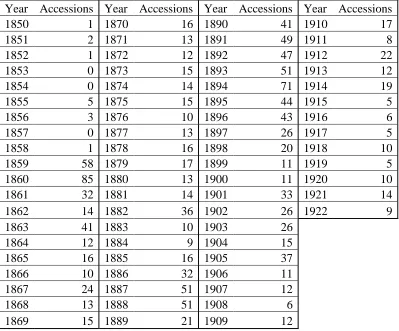
eggs fluctuated wildly during the war, from 85 in 1860, 32 in 1861, 14 in 1862, 41 in
1863, 12 in 1864, to 16 in 1865.58 While the Smithsonian attributes the spike in 1860 to
the publication of a circular with instructions for collecting bird eggs, the variation during
the war must be attributed to the war itself. With the expeditions headed by the army put
on hold for obvious reasons, the Smithsonian was much more dependent on the donations
of individuals for their accessions, which explains the great variation in accessions for
this period.
The years from 1866 to 1877 were largely uneventful ones for oology at the
Smithsonian Institution. Brewer continued to work on Part II of North American Oölogy, and the Smithsonian encouraged this work through lending him specimens in 1866, 1867,
55 Henry, 665.
56Annual Report for the Year 1863, 52-55. Smithsonian Institution, Annual Report of the Board of Regents of the Smithsonian Institution, Showing the Operations, Expenditures, and Condition of the Institution, for the Year 1864, by Joseph Henry and Spencer Fullerton Baird, (Washington, D.C.: United States Government Printing Office, 1865), 82-83. Annual Report for the Year 1865, 62.
and1868; during this period, Brewer also worked with Baird on a monograph describing
North American ornithology, which helped to explain why the second volume was never
published.59 In expeditions for each year, eggs were among the objects collected by
naturalists. In 1876, the second part of an account of the natural history of Kerguelen
Island was published as the third article Bulletin of the National Museum. While the first
part of this work was devoted solely to the ornithology of the Island, the second part
contained smaller sections on a variety of subjects, including oology, botany, geology,
mammalogy, and so on.60 Although oology was not completely forgotten during this
period, it was not strongly emphasized either, in spite of the growing popularity of egg
collecting as a hobby in the United States; this would change dramatically with the
addition of an Honorary Curator for the egg collection in 1884, and may have been one of
the contributing factors to the decision to create such a position in the first place. After
all, the first volume of Brewer’s North American Oölogy was published in 1857 and reprinted in 1859, yet by Brewer’s death in 1880 there had been few other publications on
59 Smithsonian Institution, Annual Report of the Board of Regents of the Smithsonian Institution, Showing the Operations, Expenditures, and Condition of the Institution, for the Year 1866, by Joseph Henry and Spencer Fullerton Baird, (Washington, D.C.: United States Government Printing Office, 1867), 46. Smithsonian Institution, Annual Report of the Board of Regents of the Smithsonian Institution, Showing the Operations,
Expenditures, and Condition of the Institution, for the Year 1867, by Joseph Henry and Spencer Fullerton Baird, (Washington, D.C.: United States Government Printing Office, 1868), 52. Smithsonian Institution, Annual Report of the Board of Regents of the
Smithsonian Institution, Showing the Operations, Expenditures, and Condition of the Institution, for the Year 1868, by Joseph Henry and Spencer Fullerton Baird,
(Washington, D.C.: United States Government Printing Office, 1869), 37. Smithsonian Institution, Annual Report of the Board of Regents of the Smithsonian Institution, Showing the Operations, Expenditures, and Condition of the Institution, for the Year 1870, by Joseph Henry and Spencer Fullerton Baird, (Washington, D.C.: United States Government Printing Office, 1871), 41.
60 J.H. Kidder, “Contributions to the Natural History of Kerguelen Island, made in
connection with the United States Transit of Venus Expedition, 1874-’75, Part II,”
the subject of oology at all. Given the Institution’s emphasis on the primacy of
publication as a method of ensuring the “increase and diffusion of knowledge,” it is not
surprising that they found this period of publication unsatisfactory for the science of
oology.
The museum continued to accession eggs during this period, but at a rate lower
than it sustained during the Civil War. The average number of accessions from 1850 to
1865 was 16.9 per year, with the most accessions in a single year occurring in 1860 (85
accessions containing bird eggs), while the average from 1866 to 1877 was 14.2
accessions per year, with a peak of 24 accessions containing bird eggs in 1867.61 Even
this much growth was cause for concern for Joseph Henry. In 1876, Henry argued in the
Annual Report that the care and expense of the Museum, rather than being a benefit, was
actually harming the intended activities of the Institution, namely that of the advance and
diffusion of knowledge, and called for the museum to be separated from the Institution
and provided for separately.62 Thus, the Institution and its Museum continued their
uneasy truce in the pursuit of knowledge through collecting.
The deaths of Joseph Henry in 1878 and Thomas Brewer in 1880 had dramatic
effects on oology as a science at the Smithsonian. Henry’s death, in 1878, prompted a
change in the leadership of the Institution and the attitude towards collecting and the
Museum. Spencer Fullerton Baird, previously the Assistant Secretary, became the
61 See Table 4.1.
Secretary of the Institution.63 While Baird initially argued in 1878 that the plans for
collecting and scientific knowledge established by Henry should remain the same, he
changed the policies surrounding the museum significantly by 1881. In the 1881 Annual
Report, Assistant Director G. Brown Goode described the periods in the history of the
Museum, which he periodized as follows: 1846 to 1857 – the Museum solely functioning
as a scientific institution; 1857 to 1876 – the Museum as the “National Cabinet of
Curiosities”; and 1876 to 1881 – the Museum as a space of public education in the wake
of the 1876 Philadelphia Exhibition.64 As a result of this change in policy, greater
emphasis was placed on exhibiting natural history collections and demonstrating their
natural history value. Henry was not pleased with the Museum’s existence as a “Cabinet
of Curiosities,” and he mentioned specifically and frequently in the annual reports that
the funds of the Institution should be spent on increase knowledge globally, rather than
creating a museum that could only have a local impact on knowledge.65 It was only under
Baird’s leadership that this transition to an educational museum, with an emphasis on
increasing collections for education and display, was possible, as he embraced the
transition to an educational museum in a way that Henry never would have.
The death of Thomas Brewer in 1880 did not have as profound an effect on the
Institution writ large as that of Joseph Henry, but for the science of oology, it was
significant. Despite many years of work, Brewer had only completed part I of North
63 Smithsonian Institution, Annual Report of the Board of Regents of the Smithsonian Institution, Showing the Operations, Expenditures, and Condition of the Institution, for the Year 1878, by Spencer Fullerton Baird and G. Brown Goode, (Washington, D.C.: United States Government Printing Office, 1879), 9-10.
64 Smithsonian Institution, Annual Report of the Board of Regents of the Smithsonian Institution, Showing the Operations, Expenditures, and Condition of the Institution, for the Year 1881, by Spencer Fullerton Baird and G. Brown Goode, (Washington, D.C.: United States Government Printing Office, 1882), 81-82.
American Oölogy at the time of his death, but had continued to compile materials for later parts until his death.66 With Brewer’s death, it looked as though there was no heir
apparent to continue his work. Robert Ridgway was the curator of birds at the Museum,
but his focus was primarily on ornithology, rather than oology. Furthermore, Ridgway
was already consumed with work on North American ornithology, on which he had
worked with Brewer in the past; with one massive project underway, it was unlikely that
Ridgway would accept the responsibility of taking on another. In order for oology to
survive at the Smithsonian, a new naturalist was needed, one to take oology to previously
unimagined heights of scientific inquiry and public popularity.
The Smithsonian Institution initially promoted oology as a distinct science and
attempted to differentiate it from both ornithology and hobbyist egg collecting through
specific practices the Institution promoted. Specifically, the Smithsonian Institution
defined scientific oology through descriptions of who legitimate scientific oologists were
and toward what purpose they collected eggs. Legitimate, scientific oologists collected
quantities and species of eggs that the Smithsonian suggested, while collecting behaviors
deviating from the suggestions of the Smithsonian were the hallmarks of the hobbyist egg
collector.
In the next phase of oology’s development as a science in the Institution, it
encountered favorable circumstances in the broader world, for oology as a science was
booming outside the Museum as well. Oology’s popularity was most evident through the
multiplicity of journals published specifically for oologists, including: The Oologist
(1875)67, The Young Oologist (1884), The Oologist: for the student of birds, their nests and eggs (1884), The Sunny South Oologist (1886), The Bay State Oologist (1888), The Oologists’ Exchange (1888), The Ornithologists’ and Oologists’ semi-annual (1889), The Oologists’ Journal (1891), and The Bulletin of the Oologists’ Association (1897).
Additionally, journals devoted to ornithology more generally such as The Auk and The Condor frequently featured articles on oology and prominent oologists. Furthermore, oologists banded together to form their own association, the Oologists’ Association,
which they formed with the purpose of “elevating the study above the mere collecting of
birds’ eggs, and to bring itself to that position so that it will be to oologists what the
A.O.U. is to ornithologists.”68 Oology was developing seriously during this period and
making strides towards professionalization through the use of professional journals and
organizations. While the proliferation of journals on the subject of oology benefitted the
science as a whole by putting oologists around the country in conversation with each
other, it also had the effect of toppling the Smithsonian from its position as the primary
source of scientific articles on the subject. Where earlier it had been the loudest voice in
the conversation, it was now one voice among many, and as such, the influence it wielded
over oology was far less than it had before.
But oology did not evolve uncontested, and the forces that ultimately led to the
downfall of oology as a science had their start in oology’s zenith. The fashion industry’s
penchant for feathers in hats incentivized killing birds in large numbers, and these actions
provoked a backlash among members of the general public who mobilized to protect
67 The number in parentheses following each journal title is the first year in which it was
published.
68 Isador S. Trostler, “Dear Brother Oologist,” Bulletin of the Oologists’ Association 1
them.69 As early as 1886, criticisms of oology leveled by John Burroughs, a literary
naturalist, had to be countered by those engaging in egg collecting for scientific reasons.
J.A. Allen, the first president of the American Ornithologists’ Union, countered
Burroughs’s claims that ornithologists were harmful to birds and failed to mention the
damage wrought by killing birds for millinery purposes by arguing that responsible
collecting was important and that “genuine ornithologists… deplore and frown upon
much of the egg-collecting done in the name, but not in the spirit and interest, of
science.”70 Within the community of ornithologists and oologists, this spurred activities
to self-regulate collecting and provided the push to establish the A.O.U. Committee on
Bird Protection, which in 1886 promoted a model law featuring permits for collecting
that was adapted and adopted by the New York state legislature.71 These criticisms
encouraged the growth of organizations devoted to saving the birds, most notably the
Audubon Society.
In 1886, George Bird Grinnell founded the first Audubon Society, and although
this particular society was later discontinued, it provided an important example and name
for later groups. Ten years later, Harriet Hemenway and Mina Hall organized the
Massachusetts Audubon Society in response to the outrage over bird slaughter for the
millinery trade. By 1897, state-level Audubon Societies existed in 8 states and the
District of Columbia, and by 1903, thirty-four states and the District of Columbia had
their own Audubon Societies.72 The shifts in the state of oology and in the public opinion
around bird collecting influenced the development of oology in the Smithsonian through
69 Barrow, A Passion for Birds, 32.
70 J. A. Allen, “Notes and News,” The Auk. 3, no. 1. (1886): 142-143. 71 Barrow, A Passion for Birds. 121.
the institutional and outside support available in the form of specimens, publications, and
Note on the data in the graph and table: The data for the table and the graph came from the Annual Reports of the Smithsonian for every year listed. In some years, the number of accessions was stated in the report, and in other years the author had to count
individual accessions containing eggs. The number of accessions does not indicate the number of eggs accessioned by the Institution, as some accessions contained only one egg, while others contained thousands. Unfortunately, accurate information on the number of specimens for each year was impossible to obtain, and in the interest of accuracy, the author resolved to use the number of accessions instead.
Table 4.1: Number of Smithsonian Institution Accessions Containing Bird Eggs, 1850-1922.
Year Accessions Year Accessions Year Accessions Year Accessions
1850 1 1870 16 1890 41 1910 17
1851 2 1871 13 1891 49 1911 8
1852 1 1872 12 1892 47 1912 22
1853 0 1873 15 1893 51 1913 12
1854 0 1874 14 1894 71 1914 19
1855 5 1875 15 1895 44 1915 5
1856 3 1876 10 1896 43 1916 6
1857 0 1877 13 1897 26 1917 5
1858 1 1878 16 1898 20 1918 10
1859 58 1879 17 1899 11 1919 5
1860 85 1880 13 1900 11 1920 10
1861 32 1881 14 1901 33 1921 14
1862 14 1882 36 1902 26 1922 9
1863 41 1883 10 1903 26
1864 12 1884 9 1904 15
1865 16 1885 16 1905 37
1866 10 1886 32 1906 11
1867 24 1887 51 1907 12
1868 13 1888 51 1908 6
35
CHAPTER
5
THE ZENITH OF OOLOGY AT THE SMITHSONIAN
While Joseph Henry and Spencer Fullerton Baird started the promotion of oology
as a science, they were not the last to do so. The next key player in the development of
oology as a science at the Smithsonian was Major. Charles Emil Bendire. Bendire
(1836-1897) was an Army surgeon and active ornithologist who retired his commission in 1886
after serving for thirty-two years in the Army.73 Bendire began his relationship with the
Smithsonian in 1872, donating collections in conjunction with his work in the Army in
Arizona and Washington.74 In 1884, Baird asked Bendire to accept a position as the
Honorary Curator of the Section of Birds’ Eggs, a section created that same year, perhaps
due to Ridgway’s relative indifference to the subject and Bendire’s overwhelming
enthusiasm for it.75 Indeed, one of the reasons Baird implored Bendire to become the
Honorary Curator was to write about North American oology.76
73 Smithsonian Institution, Annual Report of the Board of Regents of the Smithsonian Institution, showing the Operations, Expenditures, and Condition of the Institution for the Year Ending June 30, 1897. Part II: Report of the United States National Museum, under the Direction of the Smithsonian Institution for the Year Ending June 30, 1897, by
Charles D. Walcott, (Washington, D.C.: United States Government Printing Office, 1898), 35.
74 Smithsonian Institution, Annual Report of the Board of Regents of the Smithsonian Institution, Showing the Operations, Expenditures, and Condition of the Institution, for the Year 1872, by Joseph Henry and Spencer Fullerton Baird, (Washington, D.C.: United States Government Printing Office, 1873), 56.
75Report of the U.S. National Museum for 1897, 35-36.