1
Persistent Borrelia Infection in Patients with Ongoing Symptoms of Lyme Disease 1
2 3 4
Marianne J. Middelveen, Mdes1, Eva Sapi, PhD2, Jennie Burke, MSc (Hons)3, 5
Katherine R. Filush, MS2, Agustin Franco, PhD4, Melissa C. Fesler, FNP-BC5, 6
Raphael B. Stricker, MD5 7
8 9
1Atkins Veterinary Services, Calgary, AB, Canada; 2Department of Biology and Environmental 10
Science, University of New Haven, West Haven, CT, USA; 3Australian Biologics, Sydney, NSW, 11
Australia; 4School of Health Sciences, Universidad Catolica Santiago de Guayaquil, Ecuador; 12
5Union Square Medical Associates, San Francisco, CA, USA. 13
14
Corresponding author: Raphael B. Stricker, MD, 450 Sutter Street, Suite 1504, 15
San Francisco, CA 94108, USA; [email protected] 16
17
Key words: Lyme disease; Borrelia burgdorferi; Tickborne disease; Chronic infection; 18
Spirochete culture 19
Running Head: Persistent Borrelia Infection 20
Abstract 24
25
Introduction 26
Lyme disease is a tickborne illness that generates controversy among medical providers and
27
researchers. One of the key topics of debate is the existence of persistent infection with the
28
Lyme spirochete, Borrelia burgdorferi, in patients who have been treated with recommended
29
doses of antibiotics yet remain symptomatic. Persistent spirochetal infection despite antibiotic
30
therapy has recently been demonstrated in non-human primates. We present evidence of
31
persistent Borrelia infection despite antibiotic therapy in patients with ongoing Lyme disease
32
symptoms.
33
Materials & Methods 34
In this pilot study, culture of body fluids and tissues was performed in a randomly selected
35
group of 12 patients with persistent Lyme disease symptoms who had been treated or who
36
were being treated with antibiotics. Cultures were also performed on a group of 10 control
37
subjects without Lyme disease. The cultures were subjected to corroborative microscopic,
38
histopathological and molecular testing for Borrelia organisms in four independent laboratories
39
in a blinded manner.
40
Results 41
Motile spirochetes identified histopathologically as Borrelia were detected in culture
42
specimens, and these spirochetes weregenetically identified as Borrelia burgdorferi by three
43
distinct polymerase chain reaction (PCR) methods. Spirochetes identified as Borrelia 44
burgdorferi were cultured from the blood of seven subjects, from the genital secretions of ten
45
subjects, and from a skin lesion of one subject. Cultures from control subjects without Lyme
46
disease were negative for Borrelia using these methods.
47
Conclusions 48
Using multiple corroborative detection methods, we showed that patients with persistent Lyme
49
disease symptoms may have ongoing spirochetal infection despite antibiotic treatment, similar
50
to findings in non-human primates. The optimal treatment for persistent Borrelia infection
51
remains to be determined.
Introduction 53
54
Lyme disease (LD) and similar Lyme-like borrelial infections are caused by members of the
55
Borrelia burgdorferi (Bb) sensu lato complex or by members of the Borrelia relapsing fever
56
complex such as B. miyamotoi, respectively.1-4 Following initial infection, Borrelia spirochetes 57
can evade host defenses, sequester in immune privileged sites such as joints or the central
58
nervous system, and persist in pleomorphic forms.5-8 Tickborne coinfections including Babesia, 59
Anaplasma, Ehrlichia, Bartonella and Rickettsia may complicate the clinical picture.6,9,10 If LD is 60
not treated early in the course of infection, chronic illness may result and a variety of symptoms
61
may develop. These symptoms include fatigue, musculoskeletal pain, arthritis, cardiac disease
62
and neurological involvement with peripheral neuropathy, meningitis, encephalitis, cranial
63
neuritis and cognitive dysfunction.6,8,11,12 64
65
Although LD was first recognized in 1975, it remains a controversial illness and the topic of
66
polemic debate.6,10,13-15 One viewpoint claims that persistent Lyme disease symptoms are 67
related to ongoing spirochetal infection despite antibiotic therapy. This scenario has been
68
demonstrated in animal models including rodents, dogs and horses using various detection
69
methods,16-36 and a recent study in non-human primates showing “persistent, intact, 70
metabolically-active B. burgdorferi after antibiotic treatment of disseminated infection” offers
71
the strongest support for this pathogenesis.37 Furthermore, comparable studies have suggested 72
persistent infection after antibiotic therapy as a cause of chronic symptoms in humans.38-60 The 73
opposing viewpoint claims that persistent Lyme disease symptoms may be due to spirochetal
74
“debris” without active infection. While a number of studies from Europe and the USA have
75
demonstrated persistence of Bb DNA or antigens in human bodily tissues or fluids, very few
76
studies have demonstrated culture of live Borrelia spirochetes, the highest form of evidence for
77
persistent infection in chronic Lyme disease patients.4,51,53,59 78
79
In this pilot study, we present detailed evidence of persistent Borrelia infection despite
80
antibiotic therapy in 12 randomly-selected North American patients with ongoing LD
symptoms. Spirochetal infection was demonstrated by corroborative microscopic,
82
histopathological and molecular detection of live Borrelia organisms in cultures of body fluids
83
and tissues from these patients.
84
Methods 85
Subject selection 86
Subjects included in the study were chosen at random from our North American patient
87
population. All of the LD patients in the study were either clinically diagnosed with LD or had
88
positive Bb serological testing prior to study participation. Serological testing for LD was
89
performed by a Clinical Laboratory Improvement Amendments (CLIA)-certified laboratory
90
(IGeneX Laboratory in Palo Alto, CA), as described in detail elsewhere.60 Subjects with 91
Morgellons disease (MD) who were seropositive for LD were included in the study (see
92
below).61 All subjects had been treated with antibiotics prior to the study, and symptomatic 93
patients who remained on antibiotic treatment were included in the study.
94 95
Control selection 96
97
Ten healthy subjects were recruited as controls after informed consent was obtained. These
98
subjects were then tested serologically for LD and those who were negative were accepted as
99
controls. Vaginal or seminal fluids were collected from negative controls and cultured for
100
Borrelia, as described below. Culture pellets underwent PCR testing for Borrelia in a blinded
101
manner at the University of New Haven and Australian Biologics, as described below. All
102
subjects were adults who gave informed consent to participate in the study. Signed informed
103
consent to collect specimens was obtained in accordance with the ethics approval
104
requirements for sample collection of the Western Institutional Review Board, Puyallup, WA.
105
Approval for anonymous sample testing was also obtained from the Institutional Review Board
106
of the University of New Haven, West Haven, CT. Additional signed informed consent to publish
107
the results was obtained from each subject.
Cultures 109
110
To avoid contamination, all cultures were performed under strict aseptic conditions in a
111
laboratory that was free of Borrelia reference strains, and cultures of control and patient
112
samples were processed in an identical manner. Inocula were placed in Barbour–Stoner–Kelly H
113
(BSK) complete medium with 6% rabbit serum (Sigma Aldrich, #B8291) containing the following
114
antibiotics: phosphomycin (0.02 mg/ml) (Sigma Aldrich), rifampicin (0.05 mg/ml) (Sigma
115
Aldrich), and amphotericin B (2.5 μg/ml) (Sigma-Aldrich), as described previously.62 Inocula 116
were prepared as follows:
117
A. Blood – whole blood (10 ml) was collected by venipuncture and left at room temperature to
118
clot, then centrifuged at low speed to separate red blood cells from sera. The serum
119
supernatants with a small amount of blood cells below the serum layer were collected and
120
were inoculated into the BSK medium.
121
B. Skin – whole calluses or skin from lesions were removed from MD subjects by scraping with a
122
scalpel blade.
123
C. Vaginal – vaginal secretions were collected by swabbing inside the vagina with sterile
cotton-124
tipped swabs that were then introduced into the BSK medium.
125
D. Seminal – semen was self-collected into a sterile vial, then was pipetted into the BSK
126
medium.
127 128
Eight ml tubes of inoculated medium were filled to minimize the airspace present, thus
129
providing a microaerobic environment, and incubated at 32°C. Culture fluid was examined by
130
dark-field microscopy for visible spirochetes weekly for up to 4 weeks. Cultures were
131
concentrated by centrifuging the fluid at 15,000 g for 20 minutes, retaining the pellet and
132
discarding the supernatant. For imaging, a small amount of culture pellet was resuspended in
133
50 μl 0.85% saline solution, washed and centrifuged again. The pellet was mixed with gelatin
134
and then fixed with formalin.
135 136
138
Dermatological specimens and/or culture pellets from patients were fixed, sectioned and
139
processed for specialized staining at either McClain Laboratories LLC, Smithtown, NY, or the
140
Department of Biology and Environmental Science, University of New Haven, West Haven, CT,
141
as previously described.59 Dieterle silver-nitrate staining was performed at McClain 142
Laboratories. Anti-Bb immunostaining was performed at McClain Laboratories or the University
143
of New Haven. In brief, immunostaining was performed using an unconjugated rabbit anti-Bb
144
polyclonal antibody (Abcam ab20950), incubated with an alkaline phosphatase probe (Biocare
145
Medical #UP536L), followed by a chromogen substrate (Biocare Medical #FR805CHC), and
146
counterstained with
147
hematoxylin. Positive and negative controls were prepared for comparison purposes using liver
148
sections from Bb-inoculated and uninfected C3H/HeJmice followed by Dieterle and
149
immunostaining. Culture pellets from mixed Gram-positive bacteria (Streptococcus and
150
Staphylococcus) and Gram-negative bacteria (Escherichia coli and Klebsiella) were also prepared
151
for comparison purposes as negative controls to exclude cross-reactivity with commonly
152
encountered microorganisms.
153 154
Molecular testing 155
156
Patient and negative control samples were submitted in a blinded manner to the laboratories
157
performing polymerase chain reaction (PCR) amplification of DNA, as described below.
158 159
PCR - University of New Haven 160
161
DNA was extracted from culture pellets as previously described.59 Reactions of blinded samples 162
were performed in triplicate.
163 164
Borrelia DNA in extracted samples was detected using a published TaqMan assay targeting a
165
Amplifications were conducted on a CFX96 Real-Time System (Bio-Rad) with cycling of 50°C for
167
2 minutes, 95°C for 10 minutes, followed by 40 cycles of 95°C for 15 seconds and 60°C for
168
60 seconds, and fluorescent signals were recorded using CFX96 Real-Time software with the Cq
169
threshold set automatically.
170
171
Nested PCR primers for the 16S rRNA, flagellin (Fla), OspC, uvrA and pyrG genes were used as
172
previously described,59, 64-66 with a final volume of 50 μl using 10 μl template DNA and final 173
concentrations of 20 mM Tris-HCl (pH 8.4), 50 mM KCl (1X Buffer B, Promega), 2 mM
174
MgCl2, 0.4 mM dNTP mix, 2 μM of each primer, and 2.5 U Taq polymerase (Invitrogen). The first
175
reaction used “outer” primers and the second reaction used “inner” primers, and 1 μl of PCR
176
product from the first reaction was used as template for the second. Cycling was programmed
177
as follows: 94°C for 5 minutes followed by 40 cycles of denaturation at 94°C for 1 minute,
178
annealing for 1 minute, and extension at 72°C for 1 minute, with a final extension step at 72°C
179
for 5 minutes. DNA products were visualized in 1-2% agarose gels.
180 181
PCR amplification was followed by Sanger sequencing. PCR products were extracted using the
182
QIAquick Gel Extraction kit (Qiagen) in accordance with the manufacturer’s instructions. Eluates
183
were sequenced in both directions, then were compared by BLAST analysis using the GenBank
184
database (National Center for Biotechnology Information).
185 186
PCR - Australian biologics 187
188
DNA was extracted from culture pellets using the DNeasy Blood and Tissue kit ® (Qiagen) in
189
accordance with the manufacturer’s instructions. Samples were forwarded to Australian
190
Biologics for Borrelia DNA and Treponema denticola/Treponema pallidum DNA testing. Blinded
191
samples were run in duplicate with positive and negative controls using primers for
192
the Borrelia 16S rRNA and rpoC gene targets, as previously described.59,67,68Borrelia DNA was 193
detected by real-time PCR targeting the 16S rRNA gene and/or by endpoint PCR targeting the
194
version 3.0.16.0. Thermal profiles were performed with incubation for 2 minutes at 50°C,
196
polymerase activation for 10 minutes at 95°C then PCR cycling for 40 cycles of 10 secs at 95°C
197
dropping to 60°C sustained for 45 secs. The PCR signal magnitude generated (∆R) was
198
interpreted as either positive or negative as compared to positive and negative controls.
199 200
For endpoint PCR, amplicons were visualized on 1-2% agarose gels and extracted from the gels
201
using the QIAquick Gel Extraction kit (Qiagen) in accordance with the manufacturer’s
202
instructions. Sanger sequencing was used for gene analysis, as described previously.59, 67, 68 203
204
PCR – University California Irvine 205
206
The presence of Bb sensu stricto DNA in a set of blinded samples was confirmed by the
207
laboratory of Dr. Alan Barbour (University of California Irvine) by first quantitative PCR,69 and 208
then by sequence of the PCR-amplified 16S-23S intergenic spacer.70 The samples studied 209
included specimens from two of the subjects in this paper, Case 2 and Case 10, as described
210
below.
211 212
Results 213
214
Subject Histories 215
216
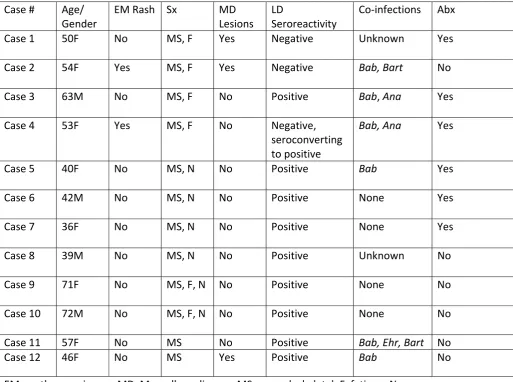
The clinical histories of the 12 study subjects with persistent Lyme disease symptoms (Cases
1-217
12) are provided below, and the clinical characteristics of the subjects are summarized in Table
218
1. All subjects had received treatment with 2-4 weeks of antibiotics as recommended by Lyme
219
treatment guidelines endorsed by the Centers for Disease Control and Prevention (CDC).14 Six 220
patients were taking antibiotics at the time of study sampling, as noted in Table 1. None of the
221
controls had received antibiotic therapy.
222 223
Case 1.
The subject is a 50-year-old native Canadian woman who resided in an area endemic for LD in
225
eastern Canada. She did not recall an erythema migrans (EM) rash. She developed extreme
226
fatigue and musculoskeletal pain as well as ulcerative skin lesions along with symptoms of
227
formication. Magnification demonstrated filamentous inclusions within the lesions. The subject
228
was seronegative for anti-Bb antibodies excepting two indeterminate IgM bands showing
229
reactivity to the 41 kDa and the 93 kDA proteins, and a weakly positive IgG band showing
230
reactivity to the 41 kDa protein. She was clinically diagnosed with LD by a health care provider
231
in Canada and treated with antibiotics. The subject had discontinued antibiotics three weeks
232
prior to the sampling period, but continued treatment with naturopathic remedies. Despite
233
ongoing treatment with amoxicillin, the subject continues to have persistent symptoms of Lyme
234
disease.
235
Case 2.
236
The subject is a 54-year-old Caucasian woman who had a history of outdoor recreational
237
activity in Western Canada including areas in British Columbia that are endemic for LD. She
238
recalled an EM-like rash several years previously, and she did not receive treatment. She
239
developed significant joint pains, muscle aches, headaches, memory loss, fatigue and skin
240
lesions, and she initially tested negative for Lyme disease. She was clinically diagnosed by a
241
Canadian health care provider, and the diagnosis was confirmed later by an American health
242
care provider. She also had positive serological tests for Babesia and Bartonella. She did not
243
have prior knowledge of Morgellons disease, but she did have ulcerative lesions on her face and
244
torso consistent in appearance with the condition. Upon examination with a 50X handheld
245
microscope, filamentous inclusions were observed in her lesions. She has been aggressively
246
treated over the last few years with antibiotic combinations including intravenous ceftriaxone,
247
metronidazole, telithromycin, doxycycline, amoxicillin, ciprofloxacin, tinidazole and atovaquone
248
with little benefit.
249
Case 3.
250
The subject is a 63-year-old Caucasian man who had a history of outdoor recreational activity in
endemic areas for Lyme disease, including Europe, Western Canada, and the USA (Connecticut
252
and Rhode Island). Although he recalls tick bites, he did not recall an EM rash. The subject
253
developed musculoskeletal pain and extreme fatigue. His wife (Case 4) had an EM rash and a LD
254
diagnosis that prompted him to get tested for LD. He was seroreactive for anti-Bb antibodies,
255
and DNA was detected in serum using PCR technology. He tested serologically positive for
256
Babesia microti and Anaplasma phagocytophylum. At the time of sampling he had ongoing
257
treatment with antibiotics, including doxycycline, clarithromycin, cefdinir, clindamycin,
258
tinadazole, atovaquone, clindamycin and hydroxychloroquine. He was symptomatic and taking
259
doxycycline at the time of sampling. His condition has since improved, but he still suffers from
260
musculoskeletal pain.
261
Case 4.
262
The subject is a 53-year-old Caucasian woman and the wife of Case 3. She had a history of
263
outdoor recreational activity in Lyme endemic areas of the USA and Canada. She has a history
264
of tick bites and recalled an EM rash after visiting both Connecticut and Rhode Island. Her
265
symptoms included seizures, neuropathy, palpitations and musculoskeletal pain. She had
266
serological testing for Bb and was initially negative, but she became seropositive after taking
267
antibiotics. She also had positive serological testing for Babesia microti and Anaplasma 268
phagocytophylum. She was symptomatic and taking antibiotics during the time of sample
269
collection. Antibiotics taken included doxycycline, telithromycin, minocycline, clindamycin,
270
clarithromycin, metronidazole, tinidazole, rifampicin, atovaquone, hydroxychloroquine and
271
mefloquine. The subject was taking clarithromycin and cefdinir at the time of sample collection.
272
She is currently asymptomatic.
273
Case 5.
274
The subject is a 40-year-old Caucasian woman living in Calgary, Canada, and the partner of case
275
6. She is a veterinarian and had a history of work exposure to ticks, and she had also travelled
276
to areas endemic for LD in Europe. She did not recall an EM rash. Her symptoms were primarily
277
musculoskeletal and severe headaches. She was seropositive for Bb and Babesia, and she had
been treated with the following antibiotics: doxycycline, clarithromycin, metronidazole and
279
atovaquone. She had been taking doxycycline for one month at the time of sample collection.
280
Case 6.
281
The subject is a 42-year-old Caucasian man living in Calgary, Canada, and the partner of case 5.
282
He is a veterinarian and had a history of work exposure to ticks. He had also travelled to areas
283
endemic for LD in Europe. He did not recall an EM rash. His symptoms were primarily
284
musculoskeletal, severe headaches, memory loss, vision problems and extreme fatigue. He was
285
seropositive for Bb and Babesia, and he had been treated with the following antibiotics:
286
doxycycline, clarithromycin, metronidazole and atovaquone. He had been taking doxycycline
287
for one month at the time of sample collection.
288
Case 7.
289
The subject is a 36-year-old Caucasian woman living in Calgary, Canada. She was bitten by many
290
ticks while working as a tree planter in the mountains, but she does not recall an EM rash. In
291
September 1997 she developed profound fatigue, migratory joint pains, peripheral neuropathy
292
and personality changes consistent with depression. She was seropositive for Bb, and she was
293
eventually treated with intramuscular penicillin, amoxicillin, and minocycline over two years.
294
She remains symptomatic despite antibiotic treatment.
295
Case 8.
296
The subject is a 39-year-old Caucasian man residing in Calgary, Canada. He has a history of
297
hiking, camping and other outdoor activities in Alberta and Manitoba, Canada, but no known
298
tick bites or EM rash. He complains of joint pain, low back pain and headaches, and he has been
299
treated for sciatica, depression, insomnia, and anxiety. He also has an extensive history of
300
periodontal disease with recurrent gingival infections, and he has received multiple courses of
301
penicillin and amoxicillin over many years. He had positive serological testing for Lyme disease,
302
and he has not been tested for tickborne coinfections.
Case 9.
304
The subject is a 71-year-old Caucasian woman living in Ontario, Canada and the partner of Case
305
10. She was 40 years old when she became ill in 1986 with severe flu-like symptoms, fatigue,
306
severe pelvic pain, blurred vision, rib soreness and night sweats. She did not recall a tick bite or
307
an EM rash. The patient had not knowingly visited a Lyme disease endemic area. She consulted
308
six different physicians over a period of four years before being treated with six weeks of
309
doxycycline for what was diagnosed as pelvic inflammatory disease in 1988, and her symptoms
310
transiently improved. She was clinically diagnosed with Lyme disease in 1990 by a physician in
311
Ontario, as the Ontario government's ELISA test was "negative" for Lyme disease. Over the next
312
20 years the subject was intermittently treated with doxycycline and her symptoms improved,
313
but never completely resolved, and other symptoms developed such as muscle aches, joint
314
pains, sleep disturbances, bladder and urethral pain, and cognitive impairment. These
315
symptoms waxed and waned over the years. She experienced multiple Jarisch-Herxheimer
316
reactions with repeated doxycycline treatment. The subject’s two children were treated for
317
congenital Lyme disease between 1990 and 2004 and are asymptomatic today. In May 2011,
318
the subject was tested by a CLIA-approved laboratory in the USA and was found to be
319
serologically positive for Lyme disease.
320
Case 10.
321
The subject is a 72-year-old Caucasian man living in Ontario, Canada and the partner of Case 9.
322
He was 41 years old at the onset of symptoms in 1986 with flu-like muscle aches, joint pains
323
and unrelenting fatigue. He did not recall a tick bite or an EM rash. The subject had not
324
knowingly visited a Lyme disease endemic area. He had consulted 12 different doctors over a
325
period of four years before getting a confirmed diagnosis of Lyme disease, at which point he
326
had developed severe arthritic symptoms, significant neurological symptoms including
327
encephalopathy and dementia with brain magnetic resonance imaging (MRI) showing
328
hyperintense white matter lesions. His antibiotic regimens over 20 years included: tetracycline,
329
amoxicillin plus probenecid, doxycycline, clarithromycin, intravenous ceftriaxone, and
intramuscular benzathine penicillin G. When the subject was on antibiotics he had relief of
331
many symptoms, but he was never completely free of symptoms associated with Lyme disease.
332
He had multiple Jarisch-Herxheimer reactions when new antibiotic regimens were initiated.
333
The two-tiered Lyme disease serology test performed in Canada failed to show positivity for
334
Lyme disease, but the subject subsequently sent blood to a CLIA-approved laboratory in the
335
United States and was found to be seropositive for Lyme disease.
336
Case 11.
337
The subject is a 57-year-old Caucasian woman living in Calgary, Canada. She had exposure to
338
ticks while hiking and camping in Canada, but she did not recall an EM rash. She developed
339
musculoskeletal and neuropsychiatric symptoms and was diagnosed with LD after testing
340
serologically positive. She also had positive testing for Babesia, Ehrlichia and Bartonella. She
341
received intermittent antibiotic therapy with multiple oral, intramuscular and intravenous
342
antibiotics, and her symptoms improved while on antibiotics but relapsed when the antibiotics
343
were discontinued. She remains symptomatic after five years of antibiotic treatment.
344
Case 12.
345
The subject is a 46-year-old Caucasian woman living in Alberta, Canada who did not have a
346
history of tick bite or EM rash. She has suffered with skin lesions consistent with Morgellons
347
disease for more than a decade and was diagnosed with Lyme disease in the USA after testing
348
serologically positive for Bb. She has had severe gastrointestinal problems that have
349
necessitated frequent hospitalizations. The gastrointestinal difficulties began after she had
350
gastric bypass surgery. Her intestines form lesions that fuse together, causing blockages. She
351
has been treated aggressively with antibiotics before and after this study by doctors both in the
352
USA and Canada with only minimal benefit. Antibiotic therapy included multiple treatments
353
with intravenous ceftriaxone, doxycycline, clarithromycin and amoxicillin.
354 355
Microscopy and Histopathology 356
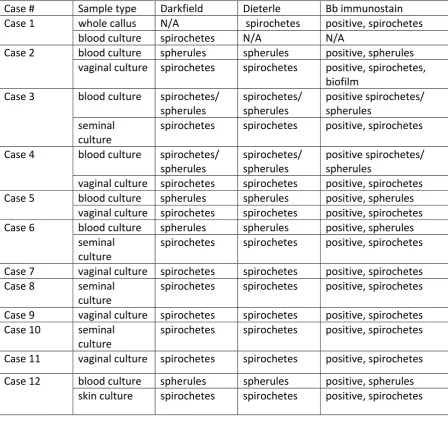
Case 1. Whole calluses were submitted for sectioning, Dieterle and anti-Bb immunostaining.
Spirochetes were visible in both Dieterle and anti-Bb immunostains. Blood culture was
358
performed and fluid from the culture demonstrated spherical bodies under darkfield
359
microscopy. Dieterle staining and anti-Bb immunostaining was not performed.
360
Case 2. Blood culture was performed and fluid from the culture demonstrated spherical bodies
361
under darkfield microscopy. Dieterle staining and anti-Bb immunostains demonstrated
362
spherical bodies. Anti-Bb immunostaining was positive. Vaginal culture was performed and fluid
363
from the culture demonstrated spirochetes and biofilm under darkfield microscopy. Dieterle
364
staining and anti-Bb immunostaining demonstrated spirochetes and biofilm. Skin specimens
365
were not submitted for staining or culture. Repeat blood and vaginal cultures were positive for
366
Borrelia by immunostaining and PCR (see Tables 2-4).
367
Case 3. Blood culture was performed and fluid from the culture demonstrated spherical bodies
368
and occasional spirochetes under darkfield microscopy. Dieterle staining and anti-Bb
369
immunostains demonstrated spherical bodies and occasional spirochetes. Anti-Bb
370
immunostaining was positive. Seminal culture was performed and fluid from the culture
371
demonstrated spirochetes under darkfield microscopy. Dieterle staining and anti-Bb
372
immunostaining demonstrated spirochetes. Repeat blood culture was positive for Borrelia by
373
immunostaining and PCR (see Tables 2-4).
374
Case 4. Blood culture was performed and fluid from the culture demonstrated spherical bodies
375
and occasional spirochetes under darkfield microscopy. Dieterle staining and anti-Bb
376
immunostains demonstrated spherical bodies and occasional spirochetes. Anti-Bb
377
immunostaining was positive. Vaginal culture was performed and fluid from the culture
378
demonstrated spirochetes under darkfield microscopy. Dieterle staining and anti-Bb
379
immunostaining demonstrated spirochetes. Repeat blood culture was positive for Borrelia by
380
immunostaining and PCR (see Tables 2-4).
381
Case 5. Blood culture was performed and fluid from the culture demonstrated spherical bodies
382
under darkfield microscopy. Dieterle staining and anti-Bb immunostaining demonstrated
383
spherical bodies. Vaginal culture was performed and fluid from the culture demonstrated
spirochetes under darkfield microscopy. Dieterle staining and anti-Bb immunostaining
385
demonstrated spirochetes. Repeat blood culture was positive for Borrelia by immunostaining
386
and PCR (see Tables 2-4).
387
Case 6. Blood culture was performed and fluid from the culture demonstrated spherical bodies
388
under darkfield microscopy. Dieterle staining and anti-Bb immunostains demonstrated
389
spherical bodies. Anti-Bb immunostaining was positive. Seminal culture was performed and
390
fluid from the culture demonstrated spirochetes under darkfield microscopy. Dieterle staining
391
and anti-Bb immunostaining demonstrated spirochetes. Repeat blood culture was positive for
392
Borrelia by immunostaining and PCR (see Tables 2-4).
393
Case 7. Vaginal culture was performed and fluid from the culture demonstrated spirochetes
394
under darkfield microscopy. Dieterle staining and anti-Bb immunostaining demonstrated
395
spirochetes.
396
Case 8. Seminal culture was performed and fluid from the culture demonstrated spirochetes
397
under darkfield microscopy. Dieterle staining and anti-Bb immunostaining demonstrated
398
spirochetes.
399
Case 9. Vaginal culture was performed and fluid from the culture demonstrated spirochetes,
400
including one that was quite actively motile, under darkfield microscopy. Dieterle staining and
401
anti-Bb immunostaining demonstrated spirochetes.
402
Case 10. Seminal culture was performed and fluid from the culture demonstrated spirochetes
403
under darkfield microscopy. Dieterle staining and anti-Bb immunostaining demonstrated
404
spirochetes. Repeat seminal culture was positive for Borrelia by immunostaining and PCR (see
405
Tables 2-4).
406
Case 11. Vaginal culture was performed and fluid from the culture demonstrated spirochetes,
407
including one that was quite actively motile, under darkfield microscopy. Dieterle staining and
408
anti-Bb immunostaining demonstrated spirochetes.
Case 12. Blood culture was performed and fluid from the culture demonstrated spherical
410
bodies under darkfield microscopy. Dieterle staining and anti-Bb immunostains demonstrated
411
spherical bodies. Anti-Bb immunostaining was positive. Skin culture was performed and fluid
412
from the culture demonstrated spirochetes under darkfield microscopy. Dieterle staining and
413
anti-Bb immunostaining demonstrated spirochetes.
414
The results of darkfield microscopy, Dieterle silver stains and anti-Bb immunostaining from
415
Cases 1-12 are summarized in Table 2. Examples of these spirochete detection methods are
416
shown in Figure 1A-1C.
417
Molecular testing 418
PCR Detection of Borrelia
419
PCR detection of Borrelia was performed for research purposes only. No data resulting from
420
this study was used diagnostically.
421
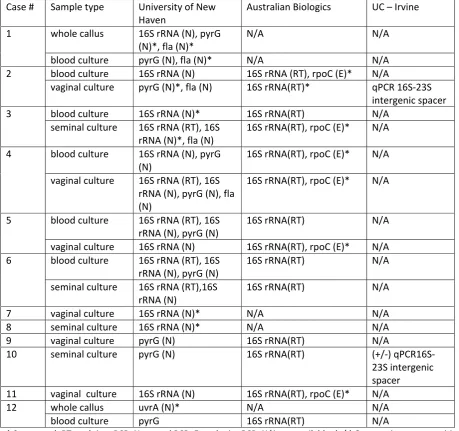
Samples (whole dermatological calluses, blood culture, vaginal cultures, and seminal cultures)
422
from the study patients were submitted for PCR detection and sequencing of Borrelia DNA at
423
both the University of New Haven, CT, and Australian Biologics, Sydney, Australia in a blinded
424
manner. Borrelia DNA was detected by at least one laboratory for all 12 patients, and amplicon
425
sequences consistent with Bb DNA were obtained for 10/12 patients. Blinded negative cultures
426
from healthy, seronegative subjects along with the blinded suspected positive cultures from LD
427
patients were sent to University of New Haven and Australian Biologics. All negative controls
428
were PCR-negative for Borrelia strains.
429
Australian Biologics performed PCR for the detection of Treponema denticola and Treponema 430
pallidum on all study samples and blinded controls. Treponemal DNA was not detected in any
431
samples. For Cases #2 and #10, additional PCR and sequencing on genital cultures was
432
performed at the University of California, Irvine, in the laboratory of Dr. Alan Barbour. In these
433
samples, Borrelia DNA was detected with qPCR and then confirmed as Bb sensu stricto by
434
sequence of the 16S-23S intergenic spacer.
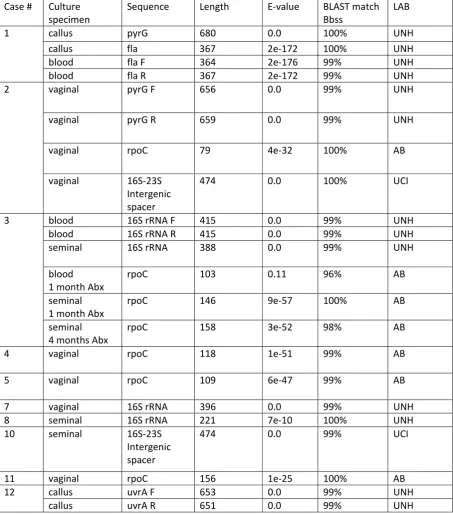
Positive PCR results are summarized in Table 3, and positive sequencing results are summarized
436
in Table 4. PCR sequences and BLAST analyses are shown in Supplemental Figure 1.
437
Discussion 438
439
In this pilot study, we cultured live Borrelia organisms from 12 antibiotic-treated subjects with
440
persistent Lyme disease symptoms, thus showing that viable spirochetes can be found in LD
441
patients despite antibiotic therapy. Half of these subjects were taking antibiotics at the time of
442
sampling. Patient cultures showed Borrelia spiral forms and spherical bodies, as described in
443
other publications.7,59,66 We demonstrated the presence of Borrelia infection in cultures from 444
these patients using corroborative microscopy, histopathology and PCR techniques, and we
445
obtained sequences for amplicons from 10/12 patients. Repeat cultures of blood, semen and
446
vaginal secretions were positive for Bb by microscopy, histopathology and PCR in six patients
447
tested by four different laboratories. Cultures from healthy Borrelia-seronegative controls were
448
consistently negative, making the possibility of Borrelia contamination in LD patient samples
449
extremely unlikely.
450 451
Persistent Borrelia infection may result in part from the wide variety of tissues and fluids that
452
support spirochetal growth.16-37 The tissues susceptible to Borrelia infection include fibroblasts, 453
skin, synovial tissue, ligaments, cardiac tissue, glial cells, neurons, endothelial cells, lymphoid
454
tissue and hepatic tissue.5,48,59,71-81 The pleotropic nature of Borrelia infection may allow the 455
spirochete to evade the host immune system and antibiotic therapy, as outlined below.
456 457
The role of cysts and biofilms in persistent Borrelia infection is controversial.10, 82, 83 Ongoing 458
Lyme disease symptoms may arise from spirochetes hidden in biofilmsor surviving as cell
wall-459
deficient cysts (L-forms), by intracellular Borrelia sequestration or by sequestration within
460
privileged sites where antibiotics do not attain therapeutic levels.13,37,84-86Regardless of the 461
mechanism by which Borrelia spirochetes persist in tissues, persistent Borrelia infection
462
requires treatment, and options at present are limited and controversial.10,13,83 The controversy 463
is fueled by disagreement over viability of the spirochetes, as described below.
465
Although there is evidence of post-treatment Borrelia infection in animals and humans, some
466
researchers speculate that Borrelia antigens and DNA detected in studies are merely
467
spirochetal “debris”.36, 87-89 Wormser et al. offered an “amber” hypothesis as a possible 468
explanation for persistent symptoms, namely that persistent Lyme arthritis is caused by
non-469
viable spirochetes enmeshed in joints within host-derived fibrinous or collagenous matrices.88 470
Bockenstedt et al. proposed that the inflammation seen in mice described in their study
471
following antibiotic treatment was caused by Borrelia DNA and proteins representing
non-472
infectious spirochetal “debris” deposited in tissues.36 473
In contrast, those who support the idea that active infection is responsible for persisting Lyme
474
disease symptoms propose that there are various protective mechanisms providing spirochetal
475
resistance or tolerance to antibiotics including intracellular invasion, biofilm formation, cell-wall
476
deficient L-forms, cysts, and the formation of persister cells.78,84-86 Furthermore the “amber” 477
and “debris” hypotheses of symptom persistence are difficult to support because Borrelia DNA
478
is rapidly cleared from murine tissues after prompt antibiotic treatment,21 and the DNA of non-479
viable spirochetes is cleared from mouse tissue within several hours.90 The present study 480
confirms the presence of live Borrelia spirochetes in patients who had been treated with
481
antibiotics for persistent Lyme disease symptoms.
482 483
Recent studies have focused on “persister cells” and “sleeper cells” as spirochetal agents of
484
persistence in Lyme disease.91-93 The concept involves organisms that are tolerant to antibiotics 485
and can downregulate their metabolic needs via a “stringent response” to survive in a hostile
486
environment, only to reemerge when the environment becomes more favorable. A similar
487
mechanism of persistent infection has been described in E. coli, Mycobacteria and Salmonella.93 488
The survival of metabolically tolerant spirochetes in privileged sites would explain our findings
489
of viable Borrelia in antibiotic-treated patients once the antibiotics are withdrawn and culture
490
conditions are optimized. The factors that influence viability of “persister cells” and “sleeper
491
cells” in patients with persistent Lyme disease symptoms merit further study.
Three of our study subjects had a controversial skin condition commonly called Morgellons
494
disease (MD). 61,94-98The distinguishing feature of this skin condition is the presence of white, 495
black, or brightly colored filaments that lie under, are embedded in, or project from skin lesions
496
(see Figure 1D). While some medical practitioners erroneously consider MD to be a purely
497
delusional disorder, MD appears to be a Borrelia filamentous dermatitis.94,95 MD patients 498
exhibit symptoms that resemble those of Lyme disease, such as fatigue, joint pain, and
499
neuropathy, and the skin condition has been shown to be associated with Borrelia infection.94-98 500
Spirochetes from different Borrelia specieshave been detected in MD patient
501
specimens.61,94,99,100 We obtained positive Borrelia cultures from all three of our MD subjects. 502
The mechanism of MD filament evolution has not been resolved, but as collagen and keratin
503
filaments arise from proliferative keratinocytes and fibroblasts in human epithelial tissue, we
504
speculate that Borrelia infection alters keratin and collagen gene regulation.99,100Borrelia 505
bacteria can invade fibroblasts and keratinocytes where they survive and replicate
506
intracellularly.74,76,101 As shown by in vitro studies, Borrelia spirochetes can be isolated from 507
keratinocyte and fibroblast monolayers despite treatment with antibiotics.74,76 Persistent 508
refractory infection in MD patients may therefore result in part from sequestration of live
509
Borrelia spirochetes within keratinocytes and fibroblasts.
510
Borrelia spirochetes have been detected in vaginal and seminal secretions.13,100 We cultured 511
Borrelia spirochetes in genital secretions from 10 of our study subjects who had taken or were
512
currently taking antibiotic therapy. Bb is a complex organism that is related to the spirochetal
513
agent of syphilis, and therefore may have similar infectious capabilities.13,100,102 As outlined 514
above, Borrelia spirochetes penetrate tissues, can form cystic structures, hide in biofilms,
515
become intracellular, and sequester in privileged sites (brain, eye and synovium).9,10,13,83,103-105 516
These specialized abilities of the Borrelia spirochete suggest that the genital tract could harbor
517
infection. The vagina and the seminal vesicles are privileged sites, and that may explain why the
518
organism can persist in the genital tract despite antimicrobial therapy in a manner similar to
519
syphilis, chlamydia, human immunodeficiency virus (HIV), Ebola and Zika virus.102,106-110 520
In summary, in this pilot study we demonstrated persistent infection despite antibiotic therapy
in 12 North American patients with ongoing symptoms of LD. Cultures were positive in all 12
522
patients in our study, indicating that the Borrelia spirochetes were replicating and therefore
523
alive. The spirochetes were genetically identified as Bb in a blinded fashion using PCR and gene
524
sequencing in three separate laboratories. In contrast, cultures from control subjects without
525
Lyme disease were negative for Borrelia spirochetes. Our findings provide evidence that
526
persistent infection rather than spirochetal “debris” was at least in part responsible for ongoing
527
symptoms in these cases of Lyme disease, and the results mirror recent observations in a
non-528
human primate model of treated Lyme disease.37 Larger clinical studies using corroborative 529
techniques are needed to confirm the findings in this pilot study.
530
531
Acknowledgements 532
The authors thank Dr. Alan Barbour for providing independent evaluation of our samples and
533
for giving permission to publish his results. We are grateful to our patients and control subjects
534
for providing samples for the study.
535 536
Funding
537
Supported in part by a grant from the Lindorf Family Foundation, Newark, OH. The funders had
538
no role in study design, data collection and analysis, decision to publish, or preparation of the
539
manuscript.
540 541
Conflicts of Interest:
542
The authors have no conflicts of interest to declare. 543
545
References 546
1. Steere AC, Malawista SE, Snydman DR, Shope RE, Andiman WA, Ross MR, et al. Lyme
547
arthritis: an epidemic of oligoarticular arthritis in children and adults in three
548
Connecticut Communities. Arthritis Rheum. 1977; 20(1):7-17.
549 550
2. Stanek G, Reiter M. The expanding Lyme Borrelia complex – clinical significance of
551
genomic species? Clin Microbiol Infect. 2011;17:487–93.
552 553
3. Cutler SJ, Ruzic-Sabljic E, Potkonjak A. Emerging borreliae - Expanding beyond Lyme
554
borreliosis. Mol Cell Probes. 2017;31:22-27.
555 556
4. Rudenko N, Golovchenko M, Vancova M, Clark K, Grubhoffer L, Oliver JH Jr.
557
Isolation of live Borrelia burgdorferi sensu lato spirochaetes from patients with
558
undefined disorders and symptoms not typical for Lyme borreliosis. Clin Microbiol Infect.
559
2016;22(3):267.e9-15.
560 561
5. Dorward DW, Fischer ER, Brooks DM. Invasion and cytopathic killing of human
562
lymphocytes by spirochetes causing Lyme disease. Clin Infect Dis. 1997; 25 Suppl 1:S2-8.
563 564
6.Cameron D, Johnson LB, Maloney EL. Evidence assessments and guideline
565
recommendations in Lyme disease: the clinical management of known tick bites,
566
erythema migrans rashes and persistent disease. Expert Rev Anti Infect Ther.
567
2014 Sep;12(9):1103-35.
568 569
7.Meriläinen L, Brander H, Herranen A, Schwarzbach A, Gilbert L. Pleomorphic forms of
570
Borrelia burgdorferi induce distinct immune responses. Microbes Infect. 2016;
18:484-571
95.
8.Miklossy J. Bacterial amyloid and DNA are important constituents of senile plaques:
574
further evidence of the spirochetal and biofilm nature of senile plaques. J Alzheimers 575
Dis. 2016; 53: 1459-73.
576 577
9.Stricker RB, Johnson L. Lyme disease diagnosis and treatment: lessons from the AIDS
578
epidemic. Minerva Med. 2010; 101:419-25. |
579 580
10. Stricker RB, Johnson L. Lyme disease: the next decade. Infect Drug Resist. 2011; 4:1-9.
581 582
11. Caruso VG. Facial paralysis from Lyme disease. Otolaryngol Head Neck Surg.
583
1985;93:550-3.
584 585
12. Habicht GS, Beck G, Benach JL. Lyme disease. Scientific American. 1987; 257:78-83.
586 587
13. Stricker RB, Middelveen MJ. Sexual transmission of Lyme disease: challenging the
588
tickborne disease paradigm. Expert Rev Anti Infect Ther. 2015; 13(11):1303-6.
589 590
14. Feder HM, Johnson BJB, O'Connell S, Shapiro ED, Steere AC, Wormser GP, and the Ad
591
Hoc International Lyme Disease Group. A critical appraisal of “chronic Lyme disease”. N 592
Engl J Med 2007; 357:1422-1430
593 594
15. Stricker RB, Johnson L. Spirochetal 'debris' versus persistent infection in chronic Lyme
595
disease: from semantics to science. Future Microbiol. 2012 Nov; 7(11):1243-6. doi:
596
10.2217/fmb.12.92
597 598
16. Duray PH, Johnson RC. The histopathology of experimentally infected hamsters with the
599
Lyme disease spirochete Borrelia burgdorferi. Proc Soc Exp Biol Med 1986; 181:263-9.
17. Moody KD, Barthold SW, Terwilliger GA. Lyme borreliosis in laboratory animals: effect
602
of host species and in vitro passage Borrelia burgdorferi. Am J Trop Med Hyg 1990;
603
43:87-92
604 605
18. Preac Mursic V, Patsouris E, Wilske B, Reinhardt S, Gross B, Mehraein P. Persistence of
606
Borrelia burgdorferi and histopathological alterations in experimentally infected
607
animals. A comparison with histopathological findings in human Lyme disease.
608
Infection. 1990 Nov-Dec;18(6):332-41.
609 610
19. Goodman JL, Jurkovich P, Kodner C, Johnson RC. Persistent cardiac and urinary tract
611
infections with Borrelia burgdorferi in experimentally infected Syrian hamsters. J Clin 612
Microbiol 1991; 29:894-6.
613 614
20. Schmitz JL, Schell RF, Lovrich SD, Callister SM, Coe JE. Characterization of the protective
615
antibody response to Borrelia burgdorferi in experimentally infected LSH hamsters.
616
Infect Immun. 1991; 59:1916-21
617 618
21. Malawista SE, Barthold SW, Persing DH. Fate of Borrelia burgdorferi DNA in tissues of
619
infected mice after antibiotic treatment. J Infect Dis 1994; 170:1312-6
620 621
22.Moody KD, Adams RL, Barthold SW. Effectiveness of antimicrobial treatment against
622
Borrelia burgdorferi infection in mice. Antimicrob Agents Chemother 1994; 38:1567-72.
623 624
23.Sonnesyn SW, Manivel JC, Johnson RC, Goodman JL. A guinea pig model for Lyme
625
disease. Infect Immun. 1993; 61:4777-84.
626 627
24.Roberts ED, Bohm RP Jr, Cogswell FB, Lanners HN, Lowrie RC Jr, Povinelli L,et al. Chronic
628
Lyme disease in the rhesus monkey. Lab Invest 1995, 72:146-60. 629
25.Straubinger RK, Summers BA, Chang YF, Appel MJ. Persistence of Borrelia burgdorferi in
631
experimentally infected dogs after antibiotic treatment. J Clin Microbiol 1997; 35:111-6.
632 633
26.Straubinger RK. PCR-Based quantification of Borrelia burgdorferi organisms in canine
634
tissues over a 500-Day postinfection period. J Clin Microbiol. 2000; 38:2191-9.
635 636
27.Pachner AR, Cadavid D, Shu G, Dail D, Pachner S, Hodzic E, et al. Central and peripheral
637
nervous system infection, immunity, and inflammation in the NHP model of Lyme
638
borreliosis. Ann Neurol. 2001; 50:330-8. 639
640
28.Cadavid D, Bai Y, Hodzic E, Narayan K, Barthold SW, Pachner AR. Cardiac involvement in
641
non-human primates infected with the Lyme disease spirochete Borrelia burgdorferi.
642
Lab Invest. 2004; 84:1439-50.
643 644
29.Chang YF, Ku YW, Chang CF, Chang CD, McDonough SP, Divers M, et al.
645
Antibiotic treatment of experimentally Borrelia burgdorferi-infected ponies. Vet 646
Microbiol. 2005; 107:285-94. 647
648
30.Miller JC, Narayan K, Stevenson B, Pachner AR. Expression of Borrelia burgdorferi erp
649
genes during infection of non-human primates. Microb Pathog. 2005; 39:27-33.
650 651
31.Bockenstedt LK, Mao J, Hodzic E, Barthold SW, Fish D. Detection of attenuated,
652
noninfectious spirochetes in Borrelia burgdorferi-infected mice after antibiotic
653
treatment. J Infect Dis 2002;186:1430-7.
654 655
32.Hodzic E, Feng S, Holden K, Freet KJ, Barthold SW. Persistence of Borrelia burgdorferi 656
following antibiotic treatment in mice. Antimicrob Agents Chemother. 2008;
52:1728-657
36.
33.Barthold SW, Hodzic E, Imai DM, Feng S, Yang X, Luft BJ. Ineffectiveness of tigecycline
660
against persistent Borrelia burgdorferi. Antimicrob Agents Chemother. 2010; 54:643-51.
661 662
34.Yrjänäinen H, Hytönen J, Hartiala P, Oski J, Vijanen MK. Persistence of borrelial DNA in
663
the joints of Borrelia burgdorferi-infected mice after ceftriaxone treatment. APMIS 664
2010; 118:665-73.
665 666
35.Imai DM, Barr BC, Daft B, Bertone JJ, Feng S, Hodzic E,et al. Lyme neuroborreliosis in 2
667
horses. Vet Pathol. 2011; 48:1151-7. 668
669
36.Bockenstedt LK, Gonzales DG, Haberman AM, Belperron AA. Spirochete antigens persist
670
near cartilage after murine Lyme borreliosis therapy. J Clin Invest. 2012; 122:2652-60.
671 672
37. Embers ME, Hasenkampf NR, Jacobs MB, Tardo AC, Doyle-Meyers LA, Philipp
673
MT, Hodzic E. Variable manifestations, diverse seroreactivity and post-treatment 674
persistence in non-human primates exposed to Borrelia burgdorferi by tick 675
feeding. PLoS One. 2017;12:e0189071.
676 677
38.Craft JE, Fischer DK, Shimamoto GT, Steere AC. Antigens of Borrelia burgdorferi 678
recognized during Lyme disease. Appearance of a new immunoglobulin M response and
679
expansion of the immunoglobulin G response late in the illness. J Clin Invest. 1986;
680
78(4):934-9.
681 682
39.Cimmino MA, Azzolini A, Tobia F, Pesce CM. Spirochetes in the spleen of a patient with
683
chronic Lyme disease. Am J Clin Pathol. 1989 Jan; 91(1):95-7.
684 685
40.de Koning J, Hoogkamp-Korstanje JA, van der Linde MR, Crijns HJ. Demonstration of
686
spirochetes in cardiac biopsies of patients with Lyme disease. J Infect 687
Dis. 1989 Jul;160(1):150-3.
689
41.Preac-Mursic V, Weber K, Pfister HW, Wilske B, Gross B, Baumann A, et al. Survival of
690
Borrelia burgdorferi in antibiotically treated patients with Lyme borreliosis.
691
Infection. 1989 Nov-Dec;17(6):355-9.
692 693
42.Fraser DD, Kong LI, Miller FW. Molecular detection of persistent Borrelia burgdorferi in
694
a man with dermatomyositis. Clin Exp Rheumatol. 1992 Jul-Aug;10(4):387-90.
695 696
43.Battafarano DF, Combs JA, Enzenauer RJ, Fitxpatrick JE. Chronic septic arthritis caused
697
by Borrelia burgdorferi. Clin Orthop Relat Res. 1993 Dec;(297):238-41.
698 699
44.Liegner KB, Shapiro JR, Ramsay D, Halperin AJ, Hogrefe W, Kong L. Recurrent erythema
700
migrans despite extended antibiotic treatment with minocycline in a patient with
701
persisting Borrelia burgdorferi infection. J Am Acad Dermatol. 1993 Feb; 28(2 Pt
2):312-702
4.
703 704
45.Asch ES, Bujak DI, Weiss M, Peterson MG, Weinstein A. Lyme disease: an infectious and
705
postinfectious syndrome. J Rheumatol. 1994 Mar; 21(3):454-61.
706 707
46.Nocton JJ, Dressler F, Rutledge BJ, Rys PN, Persing DH, Steere AC. Detection
708
of Borrelia burgdorferi DNA by polymerase chain reaction in synovial fluid from patients
709
with Lyme arthritis. N Engl J Med. 1994 Jan 27;330(4):229-34.
710 711
47.Bayer ME. Zhang L, Bayer MH. Borrelia burgdorferi DNA in the urine of treated patients
712
with chronic Lyme disease symptoms. A PCR study of 97 cases. Infection. 1996 Sep-Oct;
713
24(5):347-53.
48. Valesova M, Trnavský K, Hulínská D, Alusík S, Janousek J, Jirous J. Detection of Borrelia
716
in the synovial tissue from a patient with Lyme borreliosis by electron microscopy. J 717
Rheumatol. 1989; 16: 1502-1505.
718 719
49.Donta ST. Tetracycline therapy for chronic Lyme disease. Clin Infect Dis. 1997 Jul;25
720
Suppl 1:S52-6.
721 722
50.Priem S, Burmester GR, Kamradt T, Wolbart K, Rittig MG, Krause A. Detection
723
of Borrelia burgdorferi by polymerase chain reaction in synovial membrane, but not in
724
synovial fluid from patients with persisting Lyme arthritis after antibiotic therapy. Ann 725
Rheum Dis. 1998 Feb; 57(2):118-21.
726 727
51.Hudson BJ, Stewart M, Lennox VA, Fukunaga M, Yabuki M, Macorison H,
Kitchener-728
Smith J. Culture-positive Lyme borreliosis. Med J Aust. 1998 May 18; 168(10):500-2.
729 730
52.Oksi J, Nikoskelainen J, Vilajanen MK. Comparison of oral cefixime and intravenous
731
ceftriaxone followed by oral amoxicillin in disseminated Lyme borreliosis. Eur J Clin
732
Microbiol Infect Dis.1998;17(10):715-9.
733 734
53.Oksi J, Marjamäki M, Nikoskelainen J, Vilajanen MK. Borrelia burgdorferi detected by
735
culture and PCR in clinical relapse of disseminated Lyme borreliosis. Ann Med. 1999
736
Jun;31(3):225-32.
737 738
54.Berglund J, Stjernberg L, Ornstein K, Tykesson-Joelsson K, Walter H. Follow-up study of
739
patients with neuroborreliosis. Scand J Infect Dis. 2002; 34(6):421-5.
740 741
55.Kaiser R. Clinical courses of acute and chronic neuroborreliosis following treatment with
742
ceftriaxone. Nervenarzt. 2004 Jun; 75(6):553-7.
56.Cameron D. Severity of Lyme disease with persistent symptoms. Insights from a
double-745
blind placebo-controlled clinical trial. Minerva Med. 2008 Oct; 99(5):489-96.
746 747
57.Fallon BA, Keilp Jg, Corbera KM, Petkova E, Britton CB, Dwyer E, et al. A randomized,
748
placebo-controlled trial of repeated IV antibiotic therapy for Lyme encephalopathy.
749
Neurology. 2008 Mar 25;70(13):992-1003.
750 751
58.Stricker RB, Delong AK, Green CL, Savely VR, Chamallas SN, Johnson L. Benefit of
752
intravenous antibiotic therapy in patients referred for treatment of neurologic Lyme
753
disease. Int J Gen Med. 2011;4:639-46.
754 755
59.Middelveen MJ, McClain SA, Bandoski C, Israel JR, Burke J, MacDonald AB, et al.
756
Granulomatous hepatitis associated with chronic Borrelia burgdorferi infection: a case
757
report. Research Open Access. 2014;1:875.
758 759
60.Shah JS, Du Cruz I, Narciso W, Lo W, Harris NS. Improved sensitivity of Lyme disease
760
Western blots prepared with a mixture of Borrelia burgdorferi strains 297 and B31.
761
Chronic Dis Int. 2014;1:7.
762 763
61.Middelveen MJ, Bandowski C, Burke J, Sapi E, Filush KR, Wang Y. Exploring the
764
association between Morgellons disease and Lyme disease: identification of Borrelia 765
burgdorferi in Morgellons disease patients. BMC Dermatology. 2015 Feb 12;15:1
766 767
62.Bankhead T, Chaconas G. The role of VlsE antigenic variation in the Lyme disease
768
spirochete: persistence through a mechanism that differs from other pathogens. Mol 769
Microbiol. 2007; 65:1547–58.
63.O'Rourke M, Traweger A, Lusa L, Stupica D, Maraspin V, Barrett PN, et al. Quantitative
772
detection of Borrelia burgdorferi sensu lato in erythema migrans skin lesions using
773
internally controlled duplex real time PCR. PLoS One. 2013;8:e63968.
774 775
64.Margos G, Hojgaard A, Lane RS, Cornet M, Fingerle V, Rudenko N, et al. Multilocus
776
sequence analysis of Borrelia bissettii strains from North America reveals a new Borrelia
777
species, Borrelia kurtenbachii. Ticks Tick Borne Dis. 2010;1:151–8.
778 779
65.Clark KL, Leydet B, Hartman S. Lyme borreliosis in human patients in Florida and
780
Georgia, USA. Int J Med Sci. 2013;10:915–31.
781 782
66.Sapi E, Pabbati N, Datar A, Davies EM, Rattelle A, Kuo BA. Improved culture conditions
783
for the growth and detection of Borrelia from human serum. Int J Med Sci. 2013;10:362–
784
76.
785 786
67.Mayne PJ. Investigation of Borrelia burgdorferi genotypes in Australia obtained from
787
erythema migrans tissue. Clin Cosmet Investig Dermatol. 2012;5:69–78.
788 789
68.Mayne P. Clinical determinants of Lyme borreliosis, babesiosis, bartonellosis,
790
anaplasmosis, and ehrlichiosis in an Australian cohort. Int J Gen Med. 2014;8:15-26. 791
792
69.Bunikis J, Tsao J, Garpmo U, Berglund J, Fish D, Barbour AG. Sequence typing reveals
793
extensive strain diversity of the Lyme borreliosis agents Borrelia burgdorferi in North
794
America and Borrelia afzelii in Europe. Microbiology. 2004;150:1741-55.
795 796
70.Travinsky B, Bunikis J, Barbour AG. Geographic differences in genetic locus linkages for
797
Borrelia burgdorferi. Emerg Infect Dis. 2010; 16(7):1147-50.
71.Snydman DR, Schenkein DP, Berardi VP, Lastavica CC, Pariser KM. Borrelia burgdorferi in
800
joint fluid in chronic Lyme arthritis. Ann Intern Med. 1986; 104: 798-800.
801 802
72.Stanek G, Klein J, Bittner R, Glogar D. Isolation of Borrelia burgdorferi from the
803
myocardium of a patient with longstanding cardiomyopathy. N Engl J Med. 1990; 322:
804
249-52.
805 806
73.Ma Y, Sturrock A, Weis JJ. Intracellular localization of Borrelia burgdorferi within human
807
endothelial cells. Infect Immun. 1991; 59: 671-8.
808 809
74.Georgilis K, Peacocke M, Klempner MS. Fibroblasts protect the Lyme disease spirochete,
810
Borrelia burgdorferi, from ceftriaxone in vitro. J Infect Dis. 1992; 166: 440-4.
811 812
75.Haupl T, Hahn G, Rittig M, Krause A, Schoerner C, Schönherr U, et al. Persistence of
813
Borrelia burgdorferi in ligamentous tissue from a patient with chronic Lyme borreliosis.
814
Arthritis Rheum. 1993; 36: 1621-6.
815 816
76.Klempner MS, Noring R, Rogers RA. Invasion of human skin fibroblasts by the Lyme
817
disease spirochete, Borrelia burgdorferi. J Infect Dis. 1993; 167: 1074-81.
818 819
77.Aberer E, Kersten A, Klade H, Poitschek C, Jurecka W. Heterogeneity of Borrelia 820
burgdorferi in the skin. Am J Dermatopathol. 1996; 18: 571-9.
821 822
78.Girschick HJ, Huppertz HI, Rüssmann H, Krenn V, Karch H. Intracellular persistence of
823
Borrelia burgdorferi in human synovial cells. Rheumatol Int. 1996; 16: 125-32.
824 825
79.Nanagara R, Duray PH, Schumacher HR. Ultrastructural demonstration of spirochetal
826
antigens in synovial uid and synovial membrane in chronic Lyme disease: possible
827
factors contributing to persistence of organisms. Hum Pathol. 1996; 27: 1025-34.
829
80.de Koning J, Hoogkamp-Korstanje JA, van der Linde MR, Crijns HJ. Demonstration of
830
spirochetes in cardiac biopsies of patients with Lyme disease. J Infect Dis. 1989; 160:
831
150-3.
832 833
81.Livengood JA, Gilmore RD. Invasion of human neuronal and glial cells by an infectious
834
strain of Borrelia burgdorferi. Microbes Infect. 2006; 8: 2832-40.
835 836
82.Wormser GP, Dattwyler RJ, Shapiro ED, Halperin JJ, Steere AC, Klempner MS, et al. The
837
clinical assessment, treatment, and prevention of lyme disease, human granulocytic
838
anaplasmosis, and babesiosis: clinical practice guidelines by the Infectious Diseases
839
Society of America. Clin Infect Dis. 2006 Nov 1; 43(9):1089-1134.
840 841
83.Stricker RB, Johnson L. Borrelia burgdorferi aggrecanase activity: more evidence for
842
persistent infection in Lyme disease. Front Cell Infect Microbiol. 2013;3:40.
843 844
84.Wu J, Weening EH, Faske JB, Höök M, Skare JT. Invasion of eukaryotic cells
845
by Borrelia burgdorferi requires β(1) integrins and Src kinase activity. Infect Immun. 846
2011 Mar;79(3):1338-48.
847 848
85.Sapi E, Balasubramanian K, Poruri A, Maghsoudlou JS, Socarras KM, Timmaraju AV,
849
Filush KR, Gupta K, Shaikh S, Theophilus PA, Luecke DF, MacDonald A, Zelger B. Evidence
850
of in vivo existence of Borrelia biofilm in Borrelial lymphocytomas. Eur J Microbiol 851
Immunol (Bp). 2016 Feb 9;6(1):9-24.
852 853
86.Feng J, Zhang S, Shi W, Zhang Y. Ceftriaxone pulse dosing fails to eradicate biofilm-like
854
microcolony B. burgdorferi persisters which are sterilized by daptomycin/
855
doxycycline/cefuroxime without pulse dosing. Front Microbiol. 2016; 7:1744.
87.Klempner MS, Hu LT, Evans J, Schmid CH, Johnson GM, Trevino RP, et al. Two controlled
858
trials of antibiotic treatment in patients with persistent symptoms and a history of Lyme
859
disease. N Engl J Med. 2001; Jul 12;345(2):85-92.
860 861
88.Wormser GP, Nadelman RB, Schwartz. The amber theory of Lyme arthritis: initial
862
description and clinical implications. Clin Rheumatol. 2012; 31:989-94.
863 864
89. Aucott JN. Post-treatment Lyme disease syndrome. Infect Dis Clin N Am 2015; 29:309–
865
23.
866 867
90. Lazarus JJ, McCarter AL, Neifer-Sadhwani K, Wooten RM. ELISA-based measurement of
868
antibody responses and PCR-based detection profiles can distinguish between active
869
infection and early clearance of Borrelia burgdorferi. Clin Dev Immunol. 2012;
870
2012:138069.
871 872
91. Feng J, Shi W, Zhang S, Zhang Y. Persister mechanisms in Borrelia burgdorferi: 873
implications for improved intervention. Emerg Microbes Infect. 2015;4:e51. 874
875
92. Sharma B, Brown AV, Matluck NE, Hu LT, Lewis K. Borrelia burgdorferi, the 876
causative agent of Lyme disease, forms drug-tolerant persister cells. Antimicrob
877
Agents Chemother. 2015;59:4616–24. 878
879
93. Cabello FC, Godfrey HP, Bugrysheva J, Newman SA. Sleeper cells: The 880
stringent response and persistence in the Borreliella (Borrelia) burgdorferi
881
enzootic cycle. Environ Microbiol. 2017 Oct;19(10):3846-3862. 882
883
94.Middelveen MJ, Stricker RB. Morgellons disease: a filamentous borrelial dermatitis. Int J 884
Gen Med. 2016; Oct 14;9:349-54.
885 886
95.Middelveen MJ, Fesler MC, Stricker RB. History of Morgellons disease: From delusion to