University of South Carolina
Scholar Commons
Theses and Dissertations
2016
Semiparametric Estimation Methods For Complex
Accelerated Failure Time Model
Yinding Wang
University of South Carolina
Follow this and additional works at:https://scholarcommons.sc.edu/etd Part of theBiostatistics Commons
This Open Access Dissertation is brought to you by Scholar Commons. It has been accepted for inclusion in Theses and Dissertations by an authorized administrator of Scholar Commons. For more information, please [email protected].
Recommended Citation
SEMIPARAMETRIC ESTIMATION METHODS FOR COMPLEX ACCELERATED
FAILURE TIME MODEL
by
Yinding Wang
Bachelor of Engineering Hefei University of Technology, 2005
Master of Engineering Chongqing University, 2008
Master of Science in Public Health University of South Carolina, 2012
Submitted in Partial Fulfillment of the Requirements
For the Degree of Doctor of Philosophy in
Biostatistics
The Norman J. Arnold School of Public Health
University of South Carolina
2016
Accepted by:
Jiajia Zhang, Major Professor
Suzanne McDermott, Committee Member
Bo Cai, Committee Member
Xiaoyan Lin, Committee Member
c
Acknowledgments
This dissertation would not have gotten this far without the guidance of my committee
members, and support from my family.
My first most sincere appreciation must go to my advisor, Dr. Jiajia Zhang, for
her support, encouragement, keen insights, selfless help and patient guidance, as well
as the enormous amount of time she has spent helping me with the preparation of
this dissertation.
Sincere gratitude is also given to my committee members, Dr. Suzanne
McDer-mott, Dr. Bo Cai, and Dr. Xiaoyan Lin, for their precious time, helpful suggestions,
and encouragements. Their contributions substantially improve the quality of this
dissertation.
Especially, I would like to express my sincere gratitude to Dr. Suzanne McDermott
for her selfless help, financial support and advices during my graduate studies in USC.
My gratitude also goes to Dr. Bo Cai for his selfless help and patient guidance during
my research as a research assistant in USC.
Finally, I am very grateful for the unconditional love and full support from my
family. Without their love and support, I would not have the chance to make my
Abstract
The proportional hazards (PH) model and the accelerated failure time (AFT) model
are the two most popular survival models in fitting the right-censored data. The AFT
model is a useful alternative to the PH model, particularly when the PH assumption
is not satisfied. Usually, the linear association is assumed with logarithm of survival
time in the AFT model. However, the nonlinear association may exist in practice.
The first project aims to handle the nonlinear component in the AFT model, which is
called the semiparametric additive partial accelerated failure time (AP-AFT) model.
Two estimation methods based on the rank-smooth method and the profile likelihood
method are proposed, along with the variance estimation.
The other interest situation in practice is heterogeneity among subjects, which
may lead to the different baseline distribution of patients with different characteristics.
The AFT mixture model with latent subgroup is investigated in the second project.
The semiparametric estimation method is improved by the expectation-maximization
(EM) algorithm with the profile likelihood estimation method.
In practice, there exists the cases where either the PH model or the AFT model is
appropriate to capture the data characteristic. The extended hazards (EH) model is
developed to capture more general forms in survival data, which includes the PH and
AFT models as its special cases. With the development of medical research, more
and more diseases can be cured. Thus, patients may not die from the disease even
with enough follow up time. Mixture cure model is developed to handle the survival
data with possible cure fraction. The concepts of mixture model have been adapted
the EH model.
The third and fourth projects aim to estimate the EH and EH mixture cure
models with the monotone splines. The advantage of the monotone spline is that
it can capture any shape of the survival function with the appropriate knots and
degrees. The estimated survival curve is parametric, and the inference is easy.
All the above projects are studied through the comprehensive simulation studies.
The appropriate data are used for illustration purposes. For example , Mayo primary
biliary cirrhosis (PBC) data is used in the AP-AFT model, pregnancy data is applied
in the AFT mixture model, Stanford heart transplant data is used in the EH model,
the melanoma data from the ECOG phase III clinical trial E1684, and the leukemia
Table of Contents
Acknowledgments . . . iii
Abstract . . . iv
List of Tables . . . ix
List of Figures . . . xi
Chapter 1 Introduction . . . 1
1.1 Standard Survival Model . . . 1
1.2 Standard Cure Model . . . 6
1.3 Outline of Dissertation . . . 9
Chapter 2 Semiparametric Estimations for Additive Partial Accelerated Failure Time Models . . . 11
2.1 Abstract . . . 11
2.2 Introduction . . . 11
2.3 Additive Partial Accelerated Failure Time Model . . . 13
2.4 Estimation Procedure . . . 14
2.5 Simulation Study . . . 19
2.6 Real Data Analysis . . . 24
Chapter 3 Profile Likelihood based Estimation Method for the Accelerated Failure Time Mixture Model with
Latent Subgroups . . . 29
3.1 Abstract . . . 29
3.2 Introduction . . . 30
3.3 Semiparametric AFT mixture model . . . 32
3.4 Estimation Procedure . . . 33
3.5 Simulation Study . . . 39
3.6 Real Data Analysis . . . 42
3.7 Discussion and Conclusion . . . 45
Chapter 4 Estimation Method for Extended Hazards Model . . 46
4.1 Abstract . . . 46
4.2 Introduction . . . 46
4.3 Extended Hazards Model . . . 48
4.4 Estimation Procedure . . . 48
4.5 Simulation Study . . . 50
4.6 Real Data Analysis . . . 52
4.7 Discussion and Conclusion . . . 56
Chapter 5 Estimation Method for Extended Hazards Mixture Cure Model . . . 57
5.1 Abstract . . . 57
5.2 Introduction . . . 57
5.4 Estimation Procedure . . . 61
5.5 Simulation Study . . . 63
5.6 Real Data Analysis . . . 67
5.7 Discussion and Conclusion . . . 70
Chapter 6 Conclusions and Future Work . . . 72
List of Tables
Table 2.1 Bias, EMPSD, ESTSD and CP of ˆβ, and IMSE1, IMSE2 for
g1(Z1), g2(Z2) from the 500 simulations data set under normal
distribution: N(0,0.5) . . . 20
Table 2.2 Bias, EMPSD, ESTSD and CP of ˆβ, and IMSE1, IMSE2 for
g1(Z1), g2(Z2) from the 500 simulations data set under mixture
normal distribution: 0.5N(0,0.5)+0.5N(0,5) . . . 21
Table 2.3 Estimates, SD and 95% CI of estimated parameters for the PBC data from AP-AFT model, under rank-like estimation method, rank-smooth estimation method and profile likelihood based
es-timation method . . . 26
Table 3.1 Bias and SE of ˆψ1 of 500 simulated data sets with a sample size
of 200 and 400 from the E-BJ algorithm . . . 40
Table 3.2 Bias, SE, SD and CP of ˆψ1 of 500 simulated data sets with a
sample size of 200 and 400 from the EM algorithm . . . 41
Table 3.3 Demographic characteristics of data of pregnancy mothers (n =
1342) . . . 44
Table 3.4 Semiparametric AFT mixture model results: estimate and 95%
confidence interval for biological efficacy ψ1 . . . 45
Table 4.1 Bias, ESD and BSD of ˆα1, ˆα2, ˆβ1, ˆβ2 of 500 simulated data sets
with a sample size of 200 and 400 from the EH model . . . 51
Table 4.2 Bias, ESD and BSD of ˆα1, ˆα2, ˆβ1, ˆβ2 of 500 simulated data sets
with a sample size of 200 and 400 from the RPH model . . . 53
Table 4.3 Bias, ESD and BSD of ˆα1, ˆα2, ˆβ1, ˆβ2 of 500 simulated data sets
Table 4.4 Estimates, standard errors (SE), and 95% confidence intervals of estimated parameters for the Stanford heart transplant data
under the EH model . . . 55
Table 5.1 Bias, SE, SD and CP of ˆα1, ˆα2, ˆβ1, ˆβ2, ˆd1and ˆd2 of 500 simulated data sets with a sample size of 200 and 400 from the EH mixture
cure model . . . 64
Table 5.2 Bias, SE, SD and CP of ˆα1, ˆα2, ˆβ1, ˆβ2, ˆd1 and ˆd2 of 500 simu-lated data sets with a sample size of 200 and 400 from the RPH
mixture cure model . . . 65
Table 5.3 Bias, SE, SD and CP of ˆα1, ˆα2, ˆβ1, ˆβ2, ˆd1and ˆd2 of 500 simulated data sets with a sample size of 200 and 400 from the RAFT
mixture cure model . . . 66
Table 5.4 Estimates, SE and P values of estimated parameters for the melanoma data from the ECOG phase III clinical trial E1684
under the PH mixture cure model . . . 68
Table 5.5 Estimates, SE and 95% confidence intervals of estimated param-eters for the melanoma data from the ECOG phase III clinical
trial E1684 under the EH mixture cure model . . . 68
Table 5.6 Estimates, SE and P values of estimated parameters for the bone
marrow transplant data under the AFT mixture cure model . . . . 69
Table 5.7 Estimates, SE and 95% confidence intervals of estimated param-eters for the bone marrow transplant data under the EH mixture
List of Figures
Figure 2.1 Estimated g1(Z1) and g2(Z2) obtained from the rank-smooth estimation method with sample size 800 and 15 % censoring
rate when the error term comes from a normal distribution . . . . 23
Figure 2.2 Estimated g1(Z1) and g2(Z2) obtained from the profile likeli-hood based estimation method with sample size 800 and 15 % censoring rate when the error term comes from a normal
distri-bution . . . 23
Figure 2.3 Computational time patterns for rank-like estimation method, rank-smooth estimation method and profile likelihood based es-timation method, under different sample size of 100, 200, 400
and 800 . . . 24
Figure 2.4 Estimated nonlinear terms g1(bilirubin) and g2(albumin) ob-tained from rank-smooth estimation method and profile likeli-hood based estimation method along with their 95% confidence
Chapter 1
Introduction
1.1 Standard Survival Model
Survival data is commonly seen in many areas, such as epidemiological studies, clinical
trails and biomedical science. Survival models are developed to handle survival data,
and the most popular survival models are the proportional hazards (PH) model [13]
and the accelerated failure time (AFT) model [7,60]. One of the special characteristics
in survival data is censoring, which happens when the information about the survival
time is insufficient. For example, during the study, the patients do not experience the
interested event, such as death, or they are loss to follow up. Therefore, the survival
time of these patients is not complete, and what we observe is the last observed time
of patients, which is referred to as censoring. The right censoring is most commonly
seen in survival analysis. The presence of censoring time in the survival data leads
to the investigations on the estimation methods for survival models. We will review
the PH model and the AFT model in this section.
PH Model
The PH model aims to directly evaluate the covariates effects on the hazard function
and assumes the regression structure on the logarithm of hazard function. The PH
model can be expressed as
λT|Z(t) =λ0(t)eα
0Z
where λ0(t) is the baseline hazard function which is unspecified, λT|Z(t) is the
haz-ard function, Z is the covariates, and α is a vector of unknown parameters. The
corresponding survival function is as follows:
ST|Z(t) = S0(t)exp(α
0Z)
(1.2)
where S0(t) =e
−Rt
0λ0(u)du is the survival function of baseline distribution.
The most important indicator to evaluate the effects of the covariates is the hazard
ratio (HR), which can be defined as the ratio of the hazard rates related to the two
levels of covariates. The estimated HR of two individuals with different covariates Z
and Z∗ can be described as
d
HR = λT|Z∗(t)
λT|Z(t)
= λ0(t)e ˆ α0Z∗
λ0(t)eαˆ
0Z =e
ˆ
α0(Z∗−Z) (1.3)
Based on the estimated parameters ˆα, and the known covariates: Z and Z∗, the
estimated HR is a constant independent on time. If HR >d 1, it means a group
under condition of Z∗ has a higher chance to experience event than another group
under condition of Z. If HRd = 1, it means a group under condition of Z∗ has an
equivalent chance to experience event, compared to another group under condition
of Z. If HR <d 1, it means a group under condition of Z∗ has a lower chance to
experience event than another group under condition ofZ. For example, we define the
survival timeTi as the time to death of liver cancer patients, and we want to evaluate
whether the surgery treatmentZi has the significant effects on the death of patients.
We assume that the estimated value of parameter αis -0.6, and its corresponding P
value is less than 0.05. Zi = 1 means the patients received the surgery treatment, and
Zi = 0 means they did not receive any surgery treatment. Based on these conditions,
d
HR related to surgery treatment can be calculated as e−0.6×(1−0) =e−0.6 = 0.5488<
1, which means that patients receiving surgery treatment have lower risk of death
Estimation methods for the PH model have been widely developed. Lin and Wei
[32] derived the maximum partial likelihood estimators, proposed robust covariance
matrix estimators, and performed the robust score tests for the PH model. Schemper
and Smith [50] proposed the probability imputation technique to handle the missing
values. Gray [22] developed flexible methods by using splines and applied penalized
partial likelihood to estimate the parameters. Most statistical software packages,
such as “coxph” in R and “Proc Phreg” in SAS, have been developed for the PH
model, and they have been widely used in dealing with survival data.
AFT Model
Serving as an alternative survival model to the PH model, the AFT model is proposed
to measure the covariates effects on the survival time directly. Let T be the failure
time, the AFT model can be written as
log(T) =β0Z+ε (1.4)
whereβis p-dimensional unknown parameters,Zdenotes thep×1 possible covariates,
andε is a random error independent ofZ. Without the distribution assumption ofε,
model (1.4) is called as the semiparametric AFT model. The corresponding survival
function of failure time T can be written as
S(t|Z) = S0(teβ
0Z
) (1.5)
where S0(t) is the baseline survival function of t.
Different from HR in the PH model, the time ratio (TR) of the two groups are often
used to evaluate the effects of the covariates in the AFT model. After exponentiation
transformation of equation (1.4), we can obtain the following equation
Given Z and Z∗, the estimated TR of the two groups can be expressed as
d
T R = T
∗
T =
eβˆ0Z∗eε eβˆ0Z
eε =e
ˆ
β0(Z∗−Z) (1.7)
Similar toHRd, we can also compare the effects of two covariates on the survival time
based on the value of T Rd. If T R >d 1, it means a group under condition of Z∗ has
a longer survival time to interested event than another group under condition of Z.
If T Rd = 1, it means a group under condition of Z∗ has an equivalent survival time
to interested event, compared to another group under condition of Z. If T R <d 1, it
means a group under condition of Z∗ has a shorter survival time to interested event
than another group under condition of Z. For example, we define the survival time
Ti as the time to death of liver cancer patients, and we want to evaluate whether the
surgery treatmentZi has the significant effects on prolonging the life of patients. We
assume that the estimated value of parameterβis 0.8, and its corresponding P value
is less than 0.05. Zi = 1 means the patients received the surgery treatment, and
Zi = 0 means they did not receive any surgery treatment. Based on these conditions,
d
T R related to surgery treatment can be calculated as e0.8×(1−0) =e0.8 = 2.2255>1,
which means that patients receiving surgery treatment have longer survival time
than those without surgery treatment. That is to say, the surgery treatment has
successfully prolonged the life of liver cancer patients.
The estimation methods for the semiparametric AFT model have been widely
discussed in literature, which includes the least square method, the rank estimation
method, the induced smooth estimation method, and the profile likelihood estimation
method.
The least square method was first proposed by Buckley and James [7]. The
least square method using the Kaplan-Meier weights was further investigated by
Stute and Wang [51]. On the basis of the least square method, Huang, Ma and Xie
[24] used the least absolute shrinkage and selection operator method, as well as the
also applied a bootstrap approach to estimate the variance of estimated parameters.
Jin, Lin and Ying [26] utilized the Gehan rank estimator as its initial values to improve
the least square method.
The rank estimation method is another important estimation method in the AFT
model. Prentice [45] developed linear rank statistics for testing the regression
coeffi-cients, and proved that the log rank test was the asymptotically fully efficient rank
test. Tsiatis [56] proposed the rank estimation method. The equivalence of the rank
estimation method and the least square method were given by Ritov [48]. In order to
overcome the difficulties of variance estimation when censoring information existed,
Wei et al. [61] proposed a simple rank estimation method through considering
nui-sance parameters. Without assuming any parametric form for the distribution of the
error terms in the AFT model, Lai et al. [30] proposed a rank estimation method
for the regression analysis by use of martingale theory and a tightness lemma for
stochastic integrals of multiparameter empirical processes. Yang et al. [67]
devel-oped weighted integrals of the log-rank estimating function for estimating the
pa-rameters in the AFT model, and their asymptotic covariance matrices of estimators
could be estimated reliably and efficiently. Jin, Lin, Wei and Ying [25] simplified
the estimation procedure of the rank estimation method based on the Gehan-type
estimator, and extended it to other weight functions. Additionally, they introduced
the resampling technique to estimate the variance of estimators.
In order to handle the estimation difficulties caused by the non-smoothness, Brown
et al. [5, 6] proposed the induced smoothing to the Gehan-Wilcoxon weighted rank
regression, which could obtain the variance directly. Zeng and Lin [70] proposed
a profile likelihood method by approximating the profile likelihood function with a
kernel function. The variance of estimated parameters can be easily obtained through
the inverse of the second derivative of the kernel-smoothed profile likelihood function.
developed for the AFT model. These software packages have provided effective help
for researchers to deal with survival data.
1.2 Standard Cure Model
In the PH model and the AFT model, we often assume that given long enough
follow-up time, all patients in the studies will finally experience the interesting event, such
as death or relapse of certain disease. However, along with the medical research
development, not all patients will experience the event, since these patients may be
cured. Since diseases can be potentially cured, this motivates researchers to develop
more specific models to evaluate these interesting problems: what is the proportion
of patients who may be cured? What are the risk factors which can influence the cure
rate of cured patients and the failure time of uncured patients? Fortunately, Boag
[4], and Berkson and Gage [3] have successfully developed the mixture cure model,
which can be used to evaluate the cure rate for cured patients and the failure time
for uncured patients. We will review the mixture cure model, the semiparametric PH
mixture cure model and the semiparametric AFT mixture cure model in this section.
Mixture Cure Model
Let T be the survival time, Z be p-dimensional vector of covariates, and X be
another p-dimensional vector of covariates independent from Z, and f(t|X,Z) and
S(t|X,Z) be the probability density function and the survival function of failure time
T, respectively. Then the mixture cure model proposed by Boag [4], and Berkson and
Gage [3] can be expressed as
S(t|X,Z) = 1−π(X) +π(X)Su(t|Z) (1.8)
where π(X), which is called “incidence”, is the proportion of uncured patients
time distribution of uncured patients depending on Z.
Denote the density function of failure time distribution of uncured patients as
fu(t|Z). Let δi be an indicator of censoring with δi = 1 for the uncensored time
and δi = 0 for the censored time. Given the observed value (ti, δi,Zi,Xi) for theith
subject,i= 1,2,3, ..., n, the likelihood function can be written as
lo ∝ n Y
i=1
n
π(Xi)fu(ti|Zi)
oδin
1−π(Xi) +π(Xi)Su(ti|Zi)
o1−δi
(1.9)
Therefore, specifying the distribution of either fu(t|Z) or Su(t|Z) in equation (1.9)
can lead to the parametric mixture model or the semiparametric mixture model.
Many estimation methods have been developed for the parametric mixture cure
model. Farewell [19] employed the Weibull regression for the latency part and the
logistic regression for the incidence part. Yamaguchi [66] utilized the extended family
of generalized Gamma distribution for the latency, and applied the logistic function
for the regression model of the surviving fraction. Peng [44] applied the generalized
F distribution to a mixture model for cure rate estimation, since the generalized F
mixture model could provide great flexibility to model the survival time distribution
of uncured patients, as well as covariate effects on the cure rate.
The disadvantage of the parametric mixture cure model is that unsuitably strong
distributional assumptions are involved. In order to improve this disadvantage, more
and more researchers have committed to develop semiparametric mixture cure models
and their estimation methods. Most of them have been focusing on the two
impor-tant semiparametric mixture cure models: the PH mixture cure model and the AFT
mixture cure model.
Semiparametric PH Mixture Cure Model
If the latency part of the mixture cure model (1.8) is modelled with PH model,
PH mixture cure model is usually modelled with logit link function, which can be
expressed as
π(X) = e
d0X
1 +ed0X (1.10)
whered is a row vector of unknown parameters, X is the vector of covariates. Other
link functions are also used for the incidence part of the PH mixture cure model,
including probit link function, which can be expressed as
π(X) = Φ(d0X) (1.11)
where Φ(·) is the cumulative distribution function of a standard normal distribution
and complementary log-log link function, which is
π(X) = 1−exp(−ed0X) (1.12)
The latency component can be described with PH model as follows:
λu(t|Z) = λ0(t)eα
0Z
(1.13)
where λ0(t) is the baseline hazard function of uncured patients. Based on the PH
assumption of the latency part, the survival function of uncured patients can be
expressed
Su(t|Z) =S0(t)exp(α
0Z)
(1.14)
where S0(t) is the baseline survival function of uncured patients. Until now, many
discussions have been focused on developing the estimation methods for the
semi-parametric PH mixture cure model [18, 29, 43, 52, 53].
Semiparametric AFT Mixture Cure Model
If the latency part of the mixture cure model is modelled with AFT model, the
mixture cure model is called AFT mixture cure model. AFT mixture cure model is
to the PH mixture cure model, the incidence part of AFT mixture cure model is also
modelled with logit link function, probit link function, and complementary log-log
link function. The latency component can be described with AFT model as follows:
log(T) = β0Z+ε (1.15)
whereβis ap-dimensional unknown parameters, and the distribution ofεis unknown.
Then the survival function of uncured patients can be expressed
Su(t|Z) =S0(teβ
0Z
) (1.16)
Similar to the PH mixture cure model, many estimation methods have been discussed
and developed for the semiparametric AFT mixture cure model [31, 35, 64, 65, 71].
1.3 Outline of Dissertation
In Chapter 2, we focus on the AP-AFT model, which incorporates multiple nonlinear
structures of covariates. We propose both rank-smooth estimation method and the
profile likelihood estimation method for the AP-AFT model. We also conduct
sev-eral simulation studies to evaluate the performance of our two proposed estimation
methods. An example is given to illustrate the usage of our two proposed estimation
methods.
In Chapter 3, we propose a profile likelihood based estimation method for the
AFT mixture model with latent subgroups. That is, given the observed subgroup
information for the subjects, we develop an E-step to evaluate the conditional
prob-ability of subgroup membership in the control set. Then we incorporate the profile
likelihood estimation method in the maximization step to maximize the derived
like-lihood functions for the observed data. We also provide simulation studies results
and apply our proposed estimation method to the pregnancy data.
In Chapter 4, we develop an alternative estimation method for the EH model,
esti-mation method aims to use monotone splines of Ramsay to approximate the baseline
hazard functions in the EH model, and apply resampling techniques to evaluate the
variance of parameters. Simulation studies are conducted to investigate the
effective-ness of our proposed estimation method, and a real data analysis is also provided for
illustration.
In Chapter 5, we propose an EH mixture cure model, which incorporates a logistic
regression for the incidence part and an EH model for the latency part of mixture cure
model. Based on monotone splines of Ramsay, we also propose an efficient estimation
method for the EH mixture cure model. Simulation studies based on the proposed
estimation method and application of proposed estimation method to the real data
will be discussed.
We summarize our conclusions of this thesis and discuss the future work in Chapter
Chapter 2
Semiparametric Estimations for Additive
Partial Accelerated Failure Time Models
2.1 Abstract
The semiparametric additive partial accelerated failure time model is more flexible
in use than the semiparametric accelerated failure time partial linear model, since
it incorporates multiple nonlinear structures of covariates. Two estimation methods
based on the rank-smooth method or the profile likelihood method are proposed.
In the rank smooth method, the induced smooth technique is used to estimate the
variance of parameters; while in the profile likelihood, the variance is approximately
calculated by the secondary derivative. The simulation study shows that both
ap-proaches can produce the valid estimations. The proposed estimation methods are
illustrated by the study on primary biliary cirrhosis of the liver.
2.2 Introduction
The AFT model, which regresses the logarithm of the survival time, has been
popu-larly applied in survival analysis. In order to make the AFT model be easily used in
practice, there are many discussions in its estimation procedures. Tsiatis [56] utilized
the linear rank estimate technique to estimate the parameters of the AFT model,
and showed that the estimates are approximately fully efficient with the appropriate
weight function. Since then, many discussions are focused on the improvement of the
rank-based monotone estimating functions for the AFT model, and used the resampling
technique to estimate the covariance matrix of parameters. However, the resampling
technique is time consuming and Brown et al. [5, 6] applied an induced smoothing
technique to handle the estimation difficulties due to the non-smoothness. At the
same time, the profile likelihood estimation was proposed by Zeng et al. [70], which
is easy to estimate the variance of parameters through the inverse of the second
derivative of the kernel-smoothed profile likelihood function.
Partial linear models are widely used in regression in order to model the
non-linear association between the covariate and response variable, especially when the
dependence of the response on one of the covariates is not certain. The AFT partial
linear model (AFT-PLM), which incorporated the nonlinear component into the AFT
model was discussed in [10, 72]. Chen et al. [10] used the rank estimation method
for the AFT-PLM based on stratifying the nonlinear covaraite, which ignored the
nonlinear structure in estimation; Zou et al. [72] developed a rank-like estimation
method for the AFT-PLM based on the penalized method which can estimate the
linear and nonlinear effects simultaneously. The resampling technique was adapted in
its variance estimation. Both discussions were limited to one nonlinear component,
therefore, when there is more than one nonlinear component, the potential extension
and performances need to be investigated.
In this chapter, we extend the partial linear model to the model with more than
one nonlinear component, which is called the additive partial accelerated failure time
(AP-AFT) model. In order to overcome time-consuming issues in the resampling
approach, the induced smoothing technique is applied to the rank estimation
ap-proach. At the same time, we also extend the profile likelihood estimation method
to the AP-AFT model. The comparison between these two approaches is evaluated
through comprehensive simulation studies. The remaining sections in this chapter are
the rank-smooth estimation method and the profile likelihood method. Simulation
studies are conducted in Section 2.5 to investigate the performance of the proposed
methods. Real data analysis about primary biliary cirrhosis of the liver is discussed
in Section 2.6. Finally, discussion and conclusion are made in Section 2.7.
2.3 Additive Partial Accelerated Failure Time Model
LetT be the survival time,Xbe thep-dimensional vector of covariates andZ1, . . . , ZL
be L one-dimensional covariates. The AP-AFT model can be described as:
log(T) = β0+X0β+
L X
l=1
gl(Zl) +ε, (2.1)
where β is the p-dimensional vector of regression coefficient. The AP-AFT model
assumes that the covariate Zl is related with log(T) by a centered nonparametric
function gl(·), l = 1, . . . , L, and ε’s are independent error terms with a common
distribution.
Similar to the definition in Yu and Ruppert [69], we approximategl(·) by centered
rlth-degree spline function with lS fixed knots kl1, . . . , klS for l = 1, . . . , L under the
working assumption. Then we have
gl(zl) =π0l(zl)αl, l = 1, . . . , L
whereπl(zl) = (B1(zl), . . . , BNl(zl))
0 is a vector ofr
lth-degree B-spline basis functions
and αl∈RNl is the spline coefficient vector.
Replacing the nonparametric function gl(zl) by π0l(zl)αl, l = 1, . . . , L, the
AP-AFT model (2.1) can be rewritten as
log(Ti) =Xi0β+ L X
l=1
π0l(zli)αl+εi =Di0θ+εi (2.2)
where Di = (Xi0,π
0
1(z1i), . . . ,π0L(zLi))0 and θ = (β0,α01, . . . ,α
0
L)
2.4 Estimation Procedure
Let (Ti, δi,Xi, Z1i, . . . , ZLi) denote the observed dataset for the ith individual, i =
1, . . . , n, whereTi is the observed survival time,δi is a censoring indicator withδi = 1
for the uncensored time and δi = 0 for the censored one. It is common to assume the
censoring is independent and noninformative about the parameters of interest.
Rank-smooth estimation method
The Gehan-rank estimation method proposed by Jin et al. [25] can be expressed as:
UG(θ) =
1
n
n X
i=1
n X
j=1
δi(Di−Dj)I(ej(θ)≥ei(θ)),
whereei(θ) = log(Ti)−Di0θandI(·) is an indicator function. The estimating equation
is the gradient of the convex function
LG(θ) =
1
n
n X
i=1
n X
j=1
δi(ei(θ)−ej(θ))I(ej(θ)≥ei(θ)), (2.3)
The minimization of LG(θ) with respect to θ can be carried out by the linear
pro-gramming method.
To achieve a smooth fit, a penalty term is added into the loss function (2.3). The
penalized loss function can be defined as
L∗G(θ) = 1
n
n X
i=1
n X
j=1
δi(ei(θ)−ej(θ))I(ej(θ)≥ei(θ)) +
1 2
L X
l=1
λlα0lΨlαl (2.4)
a Nl×Nl matrix. According to Eilers and Marx [17],Ψl is a belt-shaped matrix as
Ψl=
1 −1 0 · · · 0 0 0
−1 2 −1 · · · 0 0 0
0 −1 2 · · · 0 0 0
· · · ·
0 0 0 · · · 2 −1 0
0 0 0 · · · −1 2 −1
0 0 0 · · · 0 −1 1
Nl×Nl
.
The corresponding penalized Gehan-rank estimating equation is
UG∗(θ) = 1
n n X i=1 n X j=1
δi(Di−Dj)I(ej(θ)≥ei(θ)) + (0,(λ1Ψ1α1)0,· · ·,(λLΨLαL)0)
0
where 0 is a p×pzero matrix.
The estimator ˆθ of θ0 can be obtained by either minimizing L∗G(θ) or solving
UG∗(θ) = 0, equivalently. We utilize the Nelder-Mead algorithm in obtaining the
estimator, which is an option in “optim” function in R. The initial value is specified
by the linear regression with respect toDi. Then, ˆgl(zl) can be estimated byπl0(zl) ˆαl.
Assuming λl =op(√1n), l = 1, . . . , L, according to the general asymptotic theory for
the rank estimator, the random vector √n( ˆθ−θ) is asymptotically distributed as a
zero-mean normal.
Choice of smoothing parameters
Selecting suitable values for the smoothing parameters λl is crucial to good curve
fitting. We define the generalized cross-validation (GCV) score [27, 46] as
GCV(λ1, . . . , λL) =
LG(θ)
(1−df /n)2, (2.5)
wheredf = trace{H(λ1, . . . , λL)}is the effective degree of freedom, andH(λ1, . . . , λL)
=∂2LG(θ)
∂θ∂θ0 +Ψ
−1 ∂2L
G(θ)
defined as 0
λ1Ψ1 . ..
λLΨL
and all other elements are zeros. The best combination of smoothing parameters
λ1, . . . , λL will be the minimizer of the GCV score, which is
(ˆλ1, . . . ,λˆL) = argmin
(λ1,...,λL)
GCV(λ1, . . . , λL).
In practice, the minimization can be carried out by grid search over a sequence of
possible (λ1, . . . , λL) values. Similar to Yu and Ruppert [69], we selectλlover 11 grid
points ranging equally from 10−6 to 107 in our study.
Variance estimation
Based on Brown et al. [5, 6], we add a perturbation qΣR
n Z to θ, where Z is a
continuous, mean zero normal random vector independent of all of the data. The
smoothing rank estimating function of θ can be naturally defined as ˜U(θ,ΣR) =
E{UG(θ+ q
ΣR
n Z)}, which is the expectation of the nonsmoothed estimating function
with respect toZ. Then, the smoothing rank estimating function reduces to
˜
U(θ,ΣR) = EZ{UG(θ+ s
ΣR
n Z)}=
1 n n X i=1 n X j=1
δi(Di−Dj)Φ
ej(θ)−ei(θ)
rij
!
(2.6)
where r2ij = n1(Di −Dj)0ΣR(Di−Dj) and Φ(·) is the cumulative density function
of standard normal distribution. When ΣR is given, the smoothing rank estimating
equation (2.6) is convex and continuously differentiable. The asymptotic variance of
estimated parameter can be consistently estimated via ˜H−1BˆH˜−1 where
˜
H(θ,ΣR) =
∂U˜(θ,ΣR)
∂θ =− 1 n n X i=1 n X j=1
and
ˆ
B(θ,ΣR) =
1
n2
n X
i=1
h
δi n X
j=1
(Di−Dj)Φ(dij)
i⊗2
,
where dij =
ej(θ)−ei(θ)
rij , φ(·) is the density function of standard normal distribution. As suggested in Pang et al. [42], an iterative procedure can be used to
simultane-ously estimate the covariance, which also avoids computational challenges. Let initial
˜
ΣR asIp, repeatedly update ˜ΣRas ˜H−1BˆH˜−1 until convergence of ˜ΣR is achieved to
a specified tolerance. ˜ΣR is the variance estimation of θ.
Algorithm
We summarize the algorithm process for the rank-smooth estimation method as
fol-lows:
Step 1: Apply the linear regression model to the data by “glm” in R to obtain
the initial value of θ.
Step 2: For all the combinations of grid points (λ1, . . . , λL), minimize (2.4) to
obtain the estimates of θ. Calculate the GCV score through equation (2.5)
based on optimizedθ at the same time. The combination of (λ1, . . . , λL) which
gives the minimum GCV score can be considered the best choice of (λ1, . . . , λL),
and the corresponding ˆθ can be considered the estimates of θ.
Step 3: The approximation of variance of ˆθ can be obtained through the
Profile Likelihood Based Estimation Method
Based on the theory of Zeng et al. [70], the kernel-smoothed profile likelihood function
of (2.2) can be written as
Lz(θ) =−
1
n
n X
i=1
δi(Di0θ+β0)− 1
n
n X
i=1
δiRi(θ)
+1
n
n X
i=1
δilog
1
nan n X
j=1
δjK
R
j(θ)−Ri(θ)
an −1 n n X i=1
δilog
1 n n X j=1 Z Rj
(θ)−Ri(θ)
an
−∞
K(s)ds
(2.7)
whereRi(θ) = log(Ti)−Di0θ−β0,K(·) is a kernel function, andan is the bandwidth.
In order to obtain the smoothing estimators, we also take into account
incorpo-rating a penalty term into (2.7); then the full penalized profile likelihood function
can be expressed as
P Lz(θ) =Lz(θ) +
1 2
L X
l=1
λlα0lΨlαl=−
1
n
n X
i=1
δi(D0iθ+β0)− 1
n
n X
i=1
δiRi(θ)
+1
n
n X
i=1
δilog
1
nan n X
j=1
δjK
R
j(θ)−Ri(θ)
an −1 n n X i=1
δilog
1 n n X j=1 Z Rj
(θ)−Ri(θ)
an
−∞ K
(s)ds
+1 2 L X l=1
λlα0lΨlαl
(2.8)
Similar to the definition of penalty term in the penalized loss function (2.4),λl is the
smoothing parameter of the function gl(·), where l = 1, . . . , L. Ψl is a belt-shaped
matrix with dimension Nl×Nl [17]. The unknown parameter θ can be obtained by
maximizing the penalized profile likelihood function (2.8).
Similarly to the smoothing parameters selection of the rank-smooth estimation
method, the smoothing parameter λl can be selected through the cross-validation
method [27, 46, 72]. The GCV score can be defined as
GCV(λ1, . . . , λL) =
Lz(θ)
wheredf = trace{H(λ1, . . . , λL)}and H(λ1, . . . , λL) =
∂2L
z(θ)
∂θ∂θ0 +Ψ
−1 ∂2L
z(θ)
∂θ∂θ0 . Here,
Ψ is a (p+PLl=1Nl)×(p+PLl=1Nl) penalized matrix. After minimizing equation
(2.9), we can obtain the best smooth parameter λl.
Compared with the rank-smooth estimation method, the profile likelihood method
can be used to estimate variance of parameters directly. After selecting the optimized
smooth parameter ˆλl through the minimizing equation (2.9), we plug ˆλl back into
the kernel-smoothed profile likelihood function (2.8), and the variance of ˆθ can be
estimated through the inverse of the second derivative of equation (2.8), which is
ΣZ =
1
M
M X
h=1
∂2
∂θ∂θ0P Lz(θ)
!−1
θˆ
The algorithm is similar to that of the rank-smooth estimation method.
2.5 Simulation Study
We evaluate the performance of the proposed methods through simulations. The
model considered is
log(Ti) = 1 +xi+z13i+sin(πz2i) +εi, i= 1, . . . , n,
where xi is from the standard normal distribution N(0,1), andz1i,z2i are generated
from the uniform distributionU(0,1). Two types of error distributions are considered:
one is from the normal distribution with mean 0 and standard deviation 0.5; the other
is from the mixture normal distribution 0.5N(0,0.5) + 0.5N(0,5). The censoring time
is from the exponential distribution, which achieves 15% (light censoring) and 30%
(moderate censoring) censoring rate. 500 simulation data sets are generated under
sample sizes n= 200, n= 400 and n = 800.
We fit the data sets by the proposed methods: rank-smooth estimation method
(rank-smooth) and profile likelihood based estimation method (profile). For the
(rank-like) proposed by Zou et al. [72] . The bias (Bias), empirical standard deviation
(EMPSD) (average of 500 simulations), estimated standard deviation (ESTSD) and
the 95% coverage probability (CP) are recorded for the estimated parameter βˆ. For
the nonparametric functions z3
1 denoted by g1(z1), and sin(πz2) denoted by g2(z2), the estimated integrated mean square errors (IMSE1 and IMSE2) are reported, where
IMSEl =
1
n
n X
i=1
(ˆgl(zli)−gl(zli))2, l= 1,2.
The results reported in Table 2.1 and Table 2.2 are for error distributions: normal
distribution N(0,0.5) and mixture normal distribution 0.5N(0,0.5) + 0.5N(0,5),
re-spectively.
Table 2.1 Bias, EMPSD, ESTSD and CP of ˆβ, and IMSE1, IMSE2 for g1(Z1),
g2(Z2) from the 500 simulations data set under normal distribution: N(0,0.5)
n Rate (%) Method βˆ g1(Z1) g2(Z2)
Bias EMPSD ESTSD CP IMSE1 IMSE2
200 15 rank-like -0.0006 0.0428 0.0318 0.840 0.0376 0.0459 rank-smooth -0.0006 0.0428 0.0572 0.962 0.0376 0.0459 profile 0.0066 0.0459 0.0485 0.964 0.0444 0.0586 30 rank-like -0.0076 0.0446 0.0333 0.844 0.0558 0.0522 rank-smooth -0.0076 0.0446 0.0621 0.952 0.0558 0.0522 profile 0.0073 0.0484 0.0527 0.966 0.0592 0.0679
400 15 rank-like 0.0001 0.0290 0.0287 0.952 0.0224 0.0206 rank-smooth 0.0001 0.0290 0.0338 0.950 0.0224 0.0206 profile 0.0064 0.0325 0.0327 0.956 0.0285 0.0407 30 rank-like -0.0033 0.0314 0.0307 0.936 0.0247 0.0273 rank-smooth -0.0033 0.0314 0.0379 0.958 0.0247 0.0273 profile 0.0085 0.0337 0.0358 0.970 0.0309 0.0404
800 15 rank-like -0.0005 0.0209 0.0254 0.980 0.0105 0.0121 rank-smooth -0.0005 0.0209 0.0226 0.954 0.0105 0.0121 profile 0.0059 0.0215 0.0219 0.950 0.0110 0.0131 30 rank-like -0.0021 0.0223 0.0276 0.974 0.0140 0.0132 rank-smooth -0.0021 0.0223 0.0242 0.941 0.0140 0.0132 profile 0.0089 0.0227 0.0241 0.949 0.0148 0.0130
From Table 2.1-2.2, we can see that the biases, empirical standard deviation,
Table 2.2 Bias, EMPSD, ESTSD and CP of ˆβ, and IMSE1, IMSE2 for g1(Z1),
g2(Z2) from the 500 simulations data set under mixture normal distribution: 0.5N(0,0.5)+0.5N(0,5)
n Rate (%) Method βˆ g1(Z1) g2(Z2)
Bias EMPSD ESTSD CP IMSE1 IMSE2
200 15 rank-like -0.0017 0.0455 0.0384 0.874 0.0753 0.1046 rank-smooth -0.0017 0.0455 0.0640 0.954 0.0753 0.1046 profile 0.0070 0.0484 0.0531 0.956 0.1286 0.1618 30 rank-like 0.0000 0.0541 0.0410 0.850 0.0984 0.0997 rank-smooth 0.0000 0.0541 0.0752 0.968 0.0984 0.0997 profile 0.0208 0.0587 0.0599 0.942 0.1459 0.1449
400 15 rank-like -0.0006 0.0300 0.0354 0.970 0.0324 0.0430 rank-smooth -0.0006 0.0300 0.0383 0.962 0.0324 0.0430 profile 0.0053 0.0325 0.0360 0.970 0.0486 0.0651 30 rank-like -0.0002 0.0371 0.0382 0.942 0.0468 0.0574 rank-smooth -0.0002 0.0371 0.0429 0.948 0.0468 0.0574 profile 0.0146 0.0385 0.0391 0.950 0.0527 0.0727
800 15 rank-like 0.0000 0.0223 0.0322 0.990 0.0210 0.0206 rank-smooth 0.0000 0.0223 0.0246 0.962 0.0210 0.0206 profile 0.0060 0.0223 0.0235 0.964 0.0203 0.0224 30 rank-like 0.0000 0.0246 0.0356 0.988 0.0272 0.0256 rank-smooth 0.0000 0.0246 0.0278 0.938 0.0272 0.0256 profile 0.0145 0.0239 0.0263 0.952 0.0263 0.0245
method, the profile likelihood based estimation method, and the rank-like
estima-tion method are comparable under the normal and mixture normal distribuestima-tions. It
also demonstrates that the empirical standard deviation and the estimated standard
deviation from both the rank-smooth estimation method and the profile likelihood
based estimation method are very similar, which shows that the estimated standard
deviations from both the induced smoothing technique and the inverse of the second
derivative of the kernel-smoothed profile likelihood function work well. The coverage
probabilities are most stable with our two proposed methods, and all their coverage
probabilities are close to 95%. However, the coverage probability of the rank-like
estimation method is far below from 95% when the sample size is 200, which shows
sample size is small.
When the sample size increases, empirical standard deviation, estimated standard
deviation, IMSE1 and IMSE2 tend to decrease. For example, under the normal
dis-tribution, 15% censoring rate, and 200 sample size, the empirical standard deviation,
estimated standard deviation, IMSE1 and IMSE2 are (0.0428, 0.0572, 0.0376, 0.0459)
from the rank-smooth estimation method, (0.0428, 0.0318, 0.0376, 0.0459) from the
rank-like estimation method, and (0.0459, 0.0485, 0.0444, 0.0586) from the profile
likelihood based estimation method. When the sample size increases to 400, the
empirical standard deviation, estimated standard deviation, IMSE1 and IMSE2 are
(0.0290, 0.0338, 0.0224, 0.0206) from the rank-smooth estimation method, (0.0290,
0.0287, 0.0224, 0.0206) from the rank-like estimation method, and (0.0325, 0.0327,
0.0285, 0.0407) from the profile likelihood based estimation method.
We further investigate the proposed methods by comparing the estimated
non-parametric functionsg1(z1) and g2(z2) along with their 95% confidence intervals with
their true functions. The estimated confidence interval is obtained from the normal
approximation using the empirical standard error of ˆg1(z1) and ˆg2(z2). For illustration
purposes, we only illustrate the curve from the normal distribution with sample size
800 under 15% censoring rate. From Figure 2.1 to 2.2, we can see that the estimated
curve ˆg1(z1) is very close to the true curve z13, ˆg2(z2) is very close to sin(πz2) as well,
and both the estimated curves and true curves lie in the 95% confidence intervals.
All the above results show that the two proposed methods are valid.
In order to compare the computational time, we model 10 sets of data with a
sample size of 100, 200, 400, and 800 through the rank-like estimation method, the
rank-smooth estimation method and the profile likelihood based estimation method.
We record the computational time by hours, so under a sample size of 100, 200, 400,
and 800, the computational time of the rank-like estimation method, rank-smooth
0.0 0.2 0.4 0.6 0.8 1.0 −1.0 −0.5 0.0 0.5 1.0
rank−smooth estimation method
Z1
g1(Z1)
(a) 95% confidence interval from empir-ical standard error of g1(Z1)
0.0 0.2 0.4 0.6 0.8 1.0
−1.0
−0.5
0.0
0.5
1.0
rank−smooth estimation method
Z2
g2(Z2)
(b) 95% confidence interval from empir-ical standard error ofg2(Z2)
Figure 2.1 Estimated g1(Z1) andg2(Z2) obtained from the rank-smooth estimation method with sample size 800 and 15 % censoring rate when the error term comes from a normal distribution
0.0 0.2 0.4 0.6 0.8 1.0
−1.0
−0.5
0.0
0.5
1.0
profile likelihood estimation method
Z1
g1(Z1)
(a) 95% confidence interval from empir-ical standard error of g1(Z1)
0.0 0.2 0.4 0.6 0.8 1.0
−1.0
−0.5
0.0
0.5
1.0
profile likelihood estimation method
Z2
g2(Z2)
(b) 95% confidence interval from empir-ical standard error ofg2(Z2)
Figure 2.2 Estimated g1(Z1) and g2(Z2) obtained from the profile likelihood based estimation method with sample size 800 and 15 % censoring rate when the error term comes from a normal distribution
2.4297, 5.4071), (0.1678, 0.1862, 0.3297, 0.6885), (0.1962, 0.6888, 2.3972, 6.6362),
respectively. The time consuming patterns are shown in Figure 2.3. From this
fig-ure, we can see that the rank-smooth estimation method saves more running time
than both the profile likelihood based estimation method and the rank-like estimation
method. In comparison with the rank-like estimation method, the profile likelihood
based estimation method saves lots of time when the sample size is below 400.
How-ever, when the sample size is above 400, especially when the sample size is 800, the
estimation method.
100 200 300 400 500 600 700 800
0
1
2
3
4
5
6
Sample size
Time consuming (hours)
rank−like rank−smooth profile
Figure 2.3 Computational time patterns for rank-like estimation method, rank-smooth estimation method and profile likelihood based estimation method, under different sample size of 100, 200, 400 and 800
2.6 Real Data Analysis
The Mayo primary biliary cirrhosis (PBC) data reported by Fleming and Harrington
and 1984. Similar to [10], we define the survival time as follows: if the patients were
dead, the survival time is the number of days between registration and the earlier of
death; if the patients did the liver transplantation, the survival time is the number
of days between registration and the liver transplantation; if the patients were alive,
the survival time is the number of days between registration and the last time the
patients are found in the study. If the patients were alive or did liver transplantation,
we treat their status as “censored or no event”; If the patients were dead, we treat
their status as “event”. Other risk factors include sex (female vs. male), presence
of edema (0 means no edema and no diuretic therapy for edema; 0.5 means edema
present without diuretics, or edema resolved by diuretics; 1 means edema present
despite diuretic therapy), level of bilirubin (mg/dl) which is a liver bile pigment, and
level of albumin (mg/dl) which is a protein found in the blood.
It is hypothesized that both level of bilirubin and level of albumin would be
nonlin-early related with the time to death of patients. To assess the nonlinear hypotheses,
we utilized the generalized additive model (GAM), which is a well-established
gen-eralized linear model allowing for nonlinear association [23, 63]. When we model the
logarithm of the time to death of patients against the smooth term of bilirubin by
“gam” in R, the result shows that there is a nonlinear relationship between the
loga-rithm of the time to death and bilirubin (estimated degree of freedom: 3.977, p-value
< 0.0001). Similarly, when we model the logarithm of the time to death against the
smooth term of albumin, the result also shows that albumin has a nonlinear
associa-tion with the logarithm of time to death (estimated degree of freedom: 2.424, p-value
<0.0001). Therefore, we consider both bilirubin and albumin with nonlinear effects
in the proposed AP-AFT model.
The AP-AFT model we consider for the PBC data is as follows:
log(Time) =β1×sex +β2×edema +g1(bilirubin) +g2(albumin) +ε (2.10)
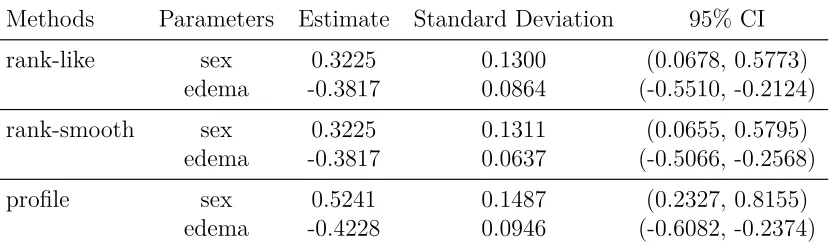
intervals (CI) of parameters for the PBC data through fitting our proposed AP-AFT
model under three estimation methods. From this table, we can see that estimates
and their standard deviations are similar across the rank-like estimation method, the
rank-smooth estimation method and the profile likelihood based estimation method.
There are consistent conclusions for both sex and edema from the three estimation
methods, that is, both sex and edema have the significant effects on the time to death
of patients, since the 95% confidence intervals for either sex or edema do not include
zero. The results also show that under either the rank-like estimation method or the
rank-smooth estimation method, the time to death of male patients is estimated to
reduce to e−0.3225 = 0.7243 of those female patients, and if edema is present among
the patients, the time to death is estimated to reduce to e−0.3817 = 0.6827 of those
without edema. Under the profile likelihood based estimation method, the time to
death of male patients is estimated to reduce to e−0.5241 = 0.5921 of those female
patients, and the time to death of patients with edema is estimated to reduce to
e−0.4228 = 0.6552 of those without edema.
Table 2.3 Estimates, SD and 95% CI of estimated parameters for the PBC data from AP-AFT model, under rank-like estimation method, rank-smooth estimation method and profile likelihood based estimation method
Methods Parameters Estimate Standard Deviation 95% CI
rank-like sex 0.3225 0.1300 (0.0678, 0.5773) edema -0.3817 0.0864 (-0.5510, -0.2124)
rank-smooth sex 0.3225 0.1311 (0.0655, 0.5795) edema -0.3817 0.0637 (-0.5066, -0.2568)
profile sex 0.5241 0.1487 (0.2327, 0.8155) edema -0.4228 0.0946 (-0.6082, -0.2374)
Figure 2.4 shows the nonlinear effects of the risk factors on the time to death
of patients. Both bilirubin and albumin have the nonliner significant effects on the
time to death of patients. Along with the increase of bilirubin, the time to death of
0 5 10 15 20 25
−5
−4
−3
−2
−1
0
bilirubin
f(bilir
ubin)
rank−smooth
95% CI of rank−smooth profile
95% CI of profile
2.0 2.5 3.0 3.5 4.0 4.5
−2
−1
0
1
2
3
albumin
f(alb
umin)
rank−smooth
95% CI of rank−smooth profile
95% CI of profile
Figure 2.4 Estimated nonlinear terms g1(bilirubin) and g2(albumin) obtained from rank-smooth estimation method and profile likelihood based estimation method along with their 95% confidence intervals
tend to have higher death probability than those with low level of bilirubin. We also
2.7 Discussion and Conclusion
In this chapter, we have proposed an additive partial AFT model, and its
corre-sponding estimation methods based on either the rank-smooth method or the profile
likelihood method. The simulation studies show the good performance of the
pro-posed methods. The main difference between the rank-smooth estimation method and
the rank-like estimation method is that the variance of the estimated parameters are
different. The rank-like estimation method used the the resampling techniques while
the other one used the induced smooth techniques. Furthermore, comparing with
the rank-smooth estimation method, the variance estimation of parameters based on
the profile likelihood based method is easy and straightforward, since the variance of
estimated parameters can be obtained through the inverse of the second derivative of
the kernel smoothed profile likelihood function. However, with the increase of sample
size, it may need more time than the rank-smooth method. In summary, we suggest
to using either the rank-smooth method or the profile likelihood method in practice
when sample size is moderate, and otherwise, the rank-smooth estimation method is
Chapter 3
Profile Likelihood based Estimation Method
for the Accelerated Failure Time Mixture
Model with Latent Subgroups
3.1 Abstract
In randomized clinical trials, subgroup analysis is very important and popular. Latent
subgroups arise since we can only know the subgroup membership in the treatment
set, and we know nothing about subgroup membership in the control set.
Biologi-cal efficacy, related to the subgroup of patients who benefit from the treatment, is
an important index for researchers to evaluate the treatment effects in the
treat-ment set. In this chapter, we develop a new estimation method for the
semipara-metric accelerated failure time mixture model with a latent subgroup based on the
expectation-maximization algorithm and the profile likelihood estimation method.
Simulation studies show that the proposed method is comparable to the existing
E-BJ algorithm, which incorporates a weighted Buckley-James optimization in the
maximization step. For illustration, we apply the proposed method to pregnancy data
obtained from Medicaid billing records, birth certificates, Department of Education,
3.2 Introduction
The PH model and the AFT model are the two most popular survival models in
fitting the right censored data. There are broad investigations into the estimation
methods for the AFT model. Miller [40] proposed the least square estimation method
to estimate the parameters in the AFT model. Buckley and James [7] developed a
least square estimation method based on the modified normal equations. Jin, Lin and
Ying [26] proposed one least square estimation method based on the Buckley-James
estimating equation. Tsiatis [56] used the linear rank test technique to estimate the
parameters of the AFT model. Wei, Ying and Lin [61] also used the linear rank
statistics as estimating functions for the regression parameters. Zeng et al. [70]
proposed an approximate nonparametric maximum likelihood method for the AFT
model. This method can be easily used to estimate the variance of parameters through
the inverse of the second derivative of the kernel-smoothed profile likelihood function.
In randomized clinical trials, subgroup analysis is very important and popular,
since it pertains to the assessment of treatment effects for a specific end point in
sub-groups of patients defined by baseline characteristics [58]. We focus on the situation
where patients who are treatable or not treatable do not receive any allocated
treat-ment in the control set. In comparison, patients in the treattreat-ment set may or may not
receive the treatment based on the baseline characteristics. For example, based on
race (African American and White), participants are randomized into two sets:
treat-ment set (all are African American) and control set (all are White) to test prostate
cancer. The participants with positive prostate biopsy are classified as treatable
sub-jects, and untreatable subjects are those without positive prostate biopsy. Whether
the participants are treatable subjects or not is not influenced by the randomization.
Treatable subjects in the treatment set belong to treatable subgroup A. The
untreat-able subjects in the treatment set belong to untreatuntreat-able subgroup B. Whether the