• No results found

Detecting and Measuring Selection from Gene Frequency Data

N/A
N/A
Protected

Academic year: 2020

Share "Detecting and Measuring Selection from Gene Frequency Data"

Copied!
55
0
0

Loading.... (view fulltext now)

Full text

(1)

INVESTIGATION

HIGHLIGHTED ARTICLE

Detecting and Measuring Selection from Gene

Frequency Data

Renaud Vitalis,*

,

,1

Mathieu Gautier,*

,

Kevin J. Dawson,

and Mark A. Beaumont

§

*Institut National de la Recherche Agronomique, Unité Mixte de Recherche CBGP, (Inra, Ird, Cirad, Montpellier-SupAgro) 34988

Montferrier-sur-Lez Cedex, France,

Institut de Biologie Computationnelle, 34095 Montpellier Cedex, France,

Cancer Genome

Project, The Wellcome Trust Sanger Institute, Hinxton, CB10 1SA, United Kingdom,

§

Department of Mathematics and School of

Biological Sciences, University of Bristol, Bristol BS8 1TW, United Kingdom

ABSTRACT

The recent advent of high-throughput sequencing and genotyping technologies makes it possible to produce, easily and cost

effectively, large amounts of detailed data on the genotype composition of populations. Detecting locus-specific effects may help identify

those genes that have been, or are currently, targeted by natural selection. How best to identify these selected regions, loci, or single

nucleotides remains a challenging issue. Here, we introduce a new model-based method, called SelEstim, to distinguish putative selected

polymorphisms from the background of neutral (or nearly neutral) ones and to estimate the intensity of selection at the former. The

underlying population genetic model is a diffusion approximation for the distribution of allele frequency in a population subdivided into

a number of demes that exchange migrants. We use a Markov chain Monte Carlo algorithm for sampling from the joint posterior

distribution of the model parameters, in a hierarchical Bayesian framework. We present evidence from stochastic simulations, which

demonstrates the good power of SelEstim to identify loci targeted by selection and to estimate the strength of selection acting on these

loci, within each deme. We also reanalyze a subset of SNP data from the Stanford HGDP

CEPH Human Genome Diversity Cell Line Panel

to illustrate the performance of SelEstim on real data. In agreement with previous studies, our analyses point to a very strong signal of

positive selection upstream of the

LCT

gene, which encodes for the enzyme lactase

phlorizin hydrolase and is associated with adult-type

hypolactasia. The geographical distribution of the strength of positive selection across the Old World matches the interpolated map of

lactase persistence phenotype frequencies, with the strongest selection coefficients in Europe and in the Indus Valley.

I

N the new era of population genomics, surveys of genetic

polymorphism (“genome scans”) offer the opportunity to

distinguish locus-speci

c from genome-wide effects at many

loci (Black

et al.

2001). Reliable inference of demography

and phylogenetic history depends on being able to identify

putative neutral regions of the genome, which are assumed

to be in

uenced by genome-wide effects only (Ross

et al.

1999). Conversely, detecting locus-speci

c effects may help

identify those genes that have been, or still are, targeted by

natural selection (Luikart

et al.

2003). Such genes may be

involved, for example, in the adaptation to new

environ-ments or in the arms race with pathogens (Nielsen 2005).

The applications for population genomic analyses therefore

cover a wide range of disciplines. Although some progress

has been made (Nielsen 2001), the problem of how best to

identify regions, loci, or single nucleotides that have been,

or are currently, targets of selection remains challenging.

Tests of selective neutrality have been developed for

samples drawn from single populations. Most of them are

based on the comparison of some summary statistics of the

site-frequency spectrum (

i.e.

, the observed distribution of gene

frequencies) to their expected distribution from diffusion

the-ory under an in

nitely many sites mutation model (Bustamante

et al.

2001; Payseur

et al.

2002; Nielsen

et al.

2005b; Williamson

et al.

2005). Accounting for different classes of markers (

e.g.

,

selected and neutral) is achieved by a Poisson random

eld

(PRF) approximation (Sawyer and Hartl 1992), which assumes

independent mutation and selection parameters across sites

(see,

e.g.

, Kim and Stephan 2002; Bustamante

et al.

2003).

In particular, Bustamante

et al.

(2003) developed a hierarchical

Copyright © 2014 by the Genetics Society of America

doi: 10.1534/genetics.113.152991

Manuscript received May 8, 2013; accepted for publication December 9, 2013;

published Early Online December 20, 2013.

Supporting information is available online at

http://www.genetics.org/lookup/suppl/

doi:10.1534/genetics.113.152991/-/DC1

1

Corresponding author: Centre de Biologie pour la Gestion des Populations, Campus

(2)

PRF model that allows the estimation of selection coef

cients

at a set of DNA polymorphisms sampled in a single population

(see also Nielsen

et al.

2005a). Williamson

et al.

(2005) used

a similar approach to infer selection in a nonequilibrium

de-mographic model. Yet, they assume

a priori

which mutations

are selectively neutral and which are not. The putatively

neu-tral class of markers is then used to infer demographic

param-eters and, given these estimates, inferences regarding selection

are performed on the other class of markers.

Other tests of selective neutrality are based on

haplo-type structure. Focusing on haplohaplo-types at a locus of interest

(referred to as

“core haplotypes”), Sabeti

et al.

(2002) analyzed

the decay of gene identity as a function of distance from the

core, as measured by the extended haplotype homozygosity

(EHH). Core haplotypes that have both a high population

frequency and a high EHH are evidence of recent positive

selection. Deriving the expected distribution of the EHH

requires making strong assumptions about the underlying

population history, however, which makes it dif

cult to

eval-uate the signi

cance of observed values. Several extensions

have therefore been proposed and adapted to genome-wide

scans of single nucleotide polymorphism (SNP) data (reviewed

in Gautier and Vitalis 2012), based on the empirical

distribu-tion of EHH-like statistics either for single populadistribu-tions (Voight

et al.

2006) or for pairs of differentiated populations (Tang

et al.

2007). Such approaches therefore rely on the assumption

that most SNPs behave neutrally, so that the observed

distri-bution of the statistics provides a proxy to the null distridistri-bution.

When markers are genotyped across multiple populations, it

has been advocated that signatures of natural selection may

simply be identi

ed in the extreme tails of the empirical

distribution of

F

ST

estimates (Goldstein and Chikhi 2002). The

rationale is that loci that are involved in adaptation to local

environmental conditions are expected to show unusually high

levels of differentiation among populations. Conversely, loci

that are under balancing selection are expected to show

unusually low levels of differentiation. These model-free

approaches are highly computationally ef

cient and, therefore,

have early been applied to large data sets of tens to hundreds

of thousands of SNPs, such as the Perlegen (Hinds

et al.

2005)

and the HapMap (International HapMap Consortium 2003,

2005) data in humans (see,

e.g.

, Akey

et al.

2002; Weir

et al.

2005; Barreiro

et al.

2008). Model-free approaches implicitly

assume that most of the markers analyzed are selectively

neutral, however, and the choice of a decision criterion to

characterize

“outlier loci”

is fairly subjective. These methods

are intended to be immune to arbitrary assumptions about

the (unknown) demographic history of the sample. Dependence

upon the unknown demography (including the geographic and

historical relationship among populations) was indeed a severe

criticism of Lewontin and Krakauer’s model-based test of

selective neutrality (Lewontin and Krakauer 1973), which

relies on the sampling distribution of the parameter

F

ST

(Robertson 1975; Nei and Maryuyama 1975).

Re

nements of this controversial test (see,

e.g.

, Beaumont

and Nichols 1996) were based on the properties of gene

genealogies in structured populations (Beaumont 2005),

which, in many cases, tend toward a simple structure (Nordborg

1997; Wakeley 1999). In this simple structure, the recent

genealogy of genes in each local population can be

sepa-rated from the ancestral genealogy of the whole

meta-population (Wakeley 2004). If this separation-of-timescale

approximation holds, the gene frequency distribution in

each local population may be approximated as a

Dirichlet-multinomial distribution (Balding and Nichols 1995; Balding

2003). Otherwise, it may be necessary to model

demogra-phy explicitly (Nielsen

et al.

2009), to restrict the analysis

to pairwise comparisons (Vitalis

et al.

2001), or to account

for the covariance matrix of the population allele

frequen-cies (Bonhomme

et al.

2010; Coop

et al.

2010; Frichot

et al.

2013; Günther and Coop 2013; Guillot

et al.

2014). Several

likelihood-based approaches that take advantage of the

Dirichlet-multinomial distribution of gene frequencies have

been proposed, generally within a Bayesian framework. In

particular, Beaumont and Balding (2004) proposed

decom-posing

F

ST

into locus-, population-, and locus-by-population

components in a hierarchical model. Their model offered

a new way to formulate the problem of inferring which loci

are targets of selection. This framework was further

ex-tended by Riebler

et al.

(2008), Foll and Gaggiotti (2008),

Guo

et al.

(2009), and Gompert and Buerkle (2011). Yet,

these approaches (as most

F

ST-based methods aimed at

look-ing for locus-speci

c effects on

F

ST

estimates; see Beaumont

and Nichols 1996) are typically not designed to identify

population-speci

c selection. Furthermore, many species

have a hierarchical structure, where a subset of populations

share a recent ancestry, or exchange more migrants, relative

to the full species range. For such complex structures,

exten-sions of the Beaumont and Nichols (1996) test or the

clas-sical Lewontin and Krakauer (1973) test have been proposed

(see Excof

er

et al.

2009; Bonhomme

et al.

2010, respectively).

As an alternative to models based on the Dirichlet-multinomial

distribution of gene frequencies, Coop

et al.

(2010) developed

an extension to the truncated Gaussian model proposed by

Nicholson

et al.

(2002), which accounts for the pattern of

co-variance in allele frequencies between populations (see also

Frichot

et al.

2013; Günther and Coop 2013; Guillot

et al.

2014). The resulting multivariate normal distribution of gene

frequencies allows testing a linear effect of some

environmen-tal variable on the allele frequency at some loci (Hancock

et al.

2010, 2011; Frichot

et al.

2013).

(3)

methods that rely on nonneutral models (see,

e.g.

, Donnelly

et al.

2001). Furthermore, proper tests of selection should

provide estimates of the parameters of interest,

i.e.

, the

strength and the type of selection acting on segregating

polymorphisms.

Here, we provide a new method, called SelEstim, to

distinguish neutral from selected polymorphisms and

esti-mate the intensity of selection at the latter. Our model

accounts explicitly for positive selection, and we suppose

that all marker loci in the data set are responding to

selection, to some extent. The method is based on a diffusion

approximation for the distribution of allele frequency in a

population subdivided in a number of demes that exchange

migrants (

i.e.

, an island model; see Wright 1931). The

framework for statistical inference from this model consists

in a hierarchical Bayesian model (see Gelman

et al.

2004).

We use a componentwise Markov chain Monte Carlo

(MCMC) algorithm to sample from the joint posterior

dis-tribution of the model parameters. We then evaluate the

performance of SelEstim, by means of stochastic

simula-tions. Last, we reanalyze a subset of SNP data from the

Centre d’Etude du Polymorphisme Humain (CEPH) Human

Genome Diversity Panel (HGDP) (Cann

et al.

2003) to

illus-trate the applicability of SelEstim on real data.

Model

Assumptions

We consider an in

nite island model where the

i

th deme

consists of

N

i

diploid individuals and receives immigrants

from the whole population at rate

m

i

. We de

ne the scaled

migration parameter in the

i

th deme as

M

i

[

4

N

i

m

i

. We

consider biallelic markers,

i.e.

, that only two alleles (denoted

by

A

and

a

) may occur at a given locus. We denote by

p

ij

the

frequency of allele

A

in deme

i

at locus

j

and by

p

j

the

fre-quency of allele

A

at the

j

th locus in the whole population.

Since we consider that the population as a whole is made of

an in

nite number of islands,

p

j

gives the frequency of allele

A

in the pool of migrant individuals. The following notations

are used hereafter: the vector of allele frequencies in deme

i

at locus

j

is

p

ij

[

(

p

ij

, 1

2

p

ij

), and the vector of allele

fre-quencies at locus

j

among migrants is

p

j

[

(

p

j

, 1

2

p

j

). We

consider a simple genic model of selection where, at each

locus, the allele

A

provides a selective advantage. The

homo-zygote individuals

AA

and the heterozygotes

Aa

have a

rela-tive increase of

tness of 1 +

s

ij

and 1 +

s

ij

/2, respectively, as

compared to the

aa

homozygotes. We de

ne the scaled

co-ef

cient of selection in deme

i

at locus

j

as

s

ij

[

2

N

i

s

ij

. We

de

ne the indicator variable

k

ij

, which takes the value

k

ij

=

0 if allele

A

is selected for, and

k

ij

= 1 if allele

a

is selected for.

Therefore, the frequency of the selected allele in deme

i

at

locus

j

reads

~

p

ij

[

k

ij

ð1

2

p

ij

Þ þ ð1

2

k

ij

Þ

p

ij

:

The data consist of individuals collected in a set of

n

d

demes and genotyped at

L

loci. We denote by

n

ij

the total

number of genes sampled in the

i

th deme at the

j

th locus,

out of which

x

ij

have allelic state

A

. The vector of allele

counts in deme

i

at locus

j

therefore reads

n

ij

[

(

x

ij

,

n

ij

2

x

ij

).

Given the frequencies

p

ij

of allele

A

, the conditional

dis-tribution of allele counts

n

ij

in population

i

at locus

j

is

binomial:

L

p

ij

;

n

ij

¼

n

ij

x

ij

p

x

ij

ij

1

2

p

ij

n

ij

2

x

ij

:

(1)

In the limit of large deme size, as

N

i

/

N

, and assuming

that selection and random genetic drift are of comparable

strength (

i.e.

, that

M

i

and

s

ij

have a

nite limit as

N

i

/

N

),

the distribution of the

p

ij

may be approximated by the

sta-tionary density of a diffusion process, which has the form

c

p

ij

;

M

i

;

s

ij

;

k

ij

;

p

j

¼

C

2

1

exp

s

ij

~

p

ij

p

M

i

p

j2

1

ij

1

2

p

ij

M

i

ð

1

2

p

j

Þ

2

1

(2)

(Wright 1949; Barton and Turelli 1987; Ethier and Nagylaki

1988; Bürger 2000). In Equation 2,

C

is the constant that

ensures that the distribution integrates to 1. This constant

can be evaluated as

C

¼

R

exp

s

ij

~

p

ij

p

M

ij

ipj

2

1

1

2

p

ij

M

i

ð

1

2

pj

Þ

2

1

d

p

ij

¼

1

F

1

M

i

p

~

ij

;

M

i

;

s

ij

G

ð

M

ipj

Þ

G

ð

M

i

ð

1

2

pj

ÞÞ

G

ð

M

i

Þ

;

(3)

where

1

F

1(

a

;

b

;

z

) is the con

uent hypergeometric, or Kummer’s,

function (see,

e.g.

, Abramowitz and Stegun 1965, p. 504), and

~

p

ij

[

k

ij

ð1

2

p

j

Þ þ ð1

2

k

ij

Þp

j

.

Given the model speci

ed in Equations 1 and 2, we are

interested

in

evaluating

the

parameters

of

interest

M

[

ð

M

1

;

. . .

;

M

i

;

. . .

;

M

n

d

Þ,

p

[

(

p1,

. . .

,

p

j

,

. . .

,

p

L

),

s

[

ðs11

;

. . .

;

s

ij

;

. . .

;

s

n

d

L

Þ, and

k

[

ðk11

;

. . .

;

k

ij

;

. . .

;

k

n

d

L

Þ,

from the observed allele counts

n

over all sampled demes and

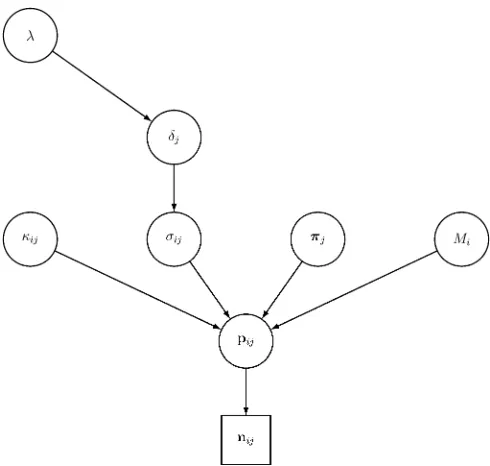
loci. The directed acyclic graph (DAG) for this

hierarchical-Bayesian model is shown in Figure 1.

We assume a Bernoulli prior distribution for the

param-eters

k

ij

,

i.e.

,

k

ij

Ber(0.5), and a uniform prior for the

p

j

’s,

that is

p

j

Beta(1, 1). We further assume a log-uniform

prior for the

M

i

’s with support from 0.001 to 10,000;

i.e.

, the

priors of the

M

i

’s are uniform in log scale: log(

M

i

)

U(log

(10

2

3

), log(10

4

)). The prior distributions for the selection

coef

cients

s

ij

(at each locus, in each deme) are modeled

hierarchically (see,

e.g.

, Gelman

et al.

2004, pp. 124

125).

In particular, we assume that

s

ij

has an exponential prior

distribution

f

ðs

ij

d

j

Þ

expðd

2

j

1

Þ

that depends upon the

locus-speci

c hyperparameter

d

j

, which represents the average

effect of selection at locus

j

(over all demes). We further

assume that this hyperparameter

d

j

has an exponential prior

distribution

f

(

d

j

jl

)

exp(

l

2

1

) that depends, in turn, upon the

(4)

among loci and populations, the posterior distribution of the

parameters

f

(

M

,

p

,

s

,

k

,

d

,

lj

n

),

i.e.

, the conditional

distri-bution of the parameters

M

,

p

,

k

,

s

,

d

, and

l

given the data

n

,

depends upon the prior distributions of the parameters and the

data as

f

ð

M

;

p

;

k

;

s

;

d

;

lj

n

Þ

}

Q

n

d

1

Q

L

1

L

p

ij

;

n

ij

c

p

ij

;

M

i;

p

j;

k

ij;

s

ij

3

f

ð

M

Þ

f

ð

p

Þ

f

ð

k

Þ

f

ð

s

j

d

Þ

f

ð

d

jlÞ

f

ðlÞ

:

(4)

Although in Equation 4 the likelihood from Equation 1

can be integrated analytically over the distribution of

unknown population frequencies given by Equations 2 and

3, we found that it increases the computational burden

signi

cantly. This is so because additional gamma and

con

uent hypergeometric functions are then introduced in

the likelihood function

L

9

(

M

i

,

p

j

,

k

ij

,

s

ij

,

n

ij

).

We implemented a single-component Metropolis

Hastings

(or Metropolis within Gibbs) algorithm (see,

e.g.

, Ntzoufras

2009) to sample from the joint posterior distribution of

f

(

M

,

p

,

k

,

s

,

d

,

lj

n

), which is speci

ed by Equation 4. In practice,

we therefore update one parameter at each time, iteratively,

as detailed in

Supporting Information

,

File S1

. The proposal

distributions for each of the

M

,

p

,

k

,

s

,

d

, and

l

parameters

are adjusted by means of 25 short pilot runs of 1000

itera-tions to obtain acceptance rates between 0.25 and 0.40 (see,

e.g.

, Gilks

et al.

1996).

The software package implementing the model

de-scribed here, called SelEstim, is available at

http://www1.

montpellier.inra.fr/CBGP/software/selestim

. All the

postpro-cessing statistical analyses were performed using the R software

environment for statistical computing, v. 3.0.1 (R Core Team

2013).

Identifying loci under selection from the MCMC outputs

Because the model assumes that each and every locus in

a data set is selected to a certain extent, we are particularly

interested in the posterior densities of the locus-speci

c

hyperparameters

d

j

: we expect the density to be shifted

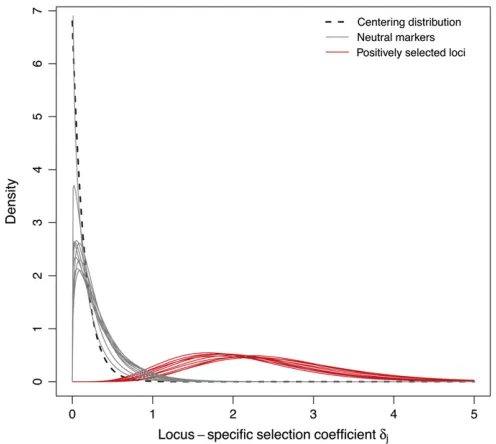
to-ward zero for neutral markers and to positive values for

(presumably) selected loci (see Figure 2). Yet, given the

hierarchical structure of our model, it would not be suf

-cient to simply test whether, at a particular locus, the

pos-terior distribution of

d

j

departs from zero. This approach

would neglect the genome-wide effects of selection. Since

we assume in our model that the

d

j

’s are drawn

indepen-dently from a common hyperdistribution with parameter

l

(which represents the genome-wide effect of selection), it is

indeed more appropriate to compare the posterior

distribu-tions of the locus-speci

c coef

cients of selection with the

“centering”

distribution derived from the hyperdistribution

of the genome-wide effect of selection. This centering

distri-bution is a good choice, rather than, for example, a point

mass at zero, because it leads to consistent estimates (the

hyperprior will shrink toward zero with more data).

Further-more, as becomes apparent, it provides some, albeit very

weak, power to identify loci under balancing selection.

Following Guo

et al.

(2009), we consider the following

steps to detect outlier loci in a data set: (i) approximate the

posterior distributions of the locus-speci

c selection

hyper-parameters (

d

j

); (ii) compare each of these distributions to

a

“centering”

distribution derived from the hyperdistribution

with parameter

l

that describes the among-locus variation

in the locus-speci

c effect of selection; and last (iii) measure

the mean of the posterior distributions of

s

ij

for outlier loci

over sampled populations to summarize the distribution of

selection effects across sampling locations.

Our preliminary analyses suggested that the posterior

distribution of the parameters

d

j

is unimodal. Furthermore,

its support is on [0,

N

), by de

nition of

d

j

. For subsequent

analyses, we approximate the posterior distributions of the

d

j

’s by a gamma distribution with the same mean and

vari-ance as estimated from the MCMC sample. In doing so, we

assume that slight discrepancies in higher-order moments

will not affect the comparison of these distributions with

their centering distribution. In the following, we therefore

consider that the posterior distribution of

d

j

is

G

(

k

0,

u0) with

k

0

¼

x

2

d

j

=

s

2

d

j

and

u0

¼

s

2

d

j

=

x

d

j

, where

x

d

j

and

s

2

d

j

are the mean

and the variance, respectively, of the posterior distribution of

d

j

, as estimated from the MCMC outputs. Since we assumed

an exponential prior distribution for the hyperparameters

d

j

,

i.e.

,

f

(d

j

)

exp(l

2

1

), or equivalently

f

(d

j

)

G

(1,

l), we

de

ned the centering distribution of

d

j

as

G

(1,

u1), where

u1

¼

x

l

is the posterior mean of

l

, as estimated from the

MCMC outputs. We expect that the stronger the intensity of

selection at locus

j

, the larger the departure of the posterior

distribution of

d

j

from the centering distribution. We use the

Figure 1

Directed acyclic graph (DAG) of the hierarchical Bayesian

(5)

Kullback

Leibler divergence (KLD) to measure the distance

of the posterior distribution of

d

j

from the centering

distri-bution. The KLD of a distribution with density

f

(

x

) from

a distribution with density

g

(

x

) is de

ned as

KLD½

f

ð

x

Þk

g

ð

x

Þ ¼

Z

N

2

N

f

ð

x

Þlog

f

ð

x

Þ

g

ð

x

Þ

dx

:

(5)

With a little algebra, one can show that the KLD of a gamma

distribution with shape and scale parameters (

k

0,

u0) from

a gamma distribution with shape and scale parameters (1,

u1) is given by

KLD½

G

ð

k

0

;

u

0

Þk

G

ð

k

1

;

u

1

Þ ¼

log

u

1

G

ðk

0

Þ

u

k

0

0

þ

k

0

u

0

u

2

1

u

1

þð

k

0

2

1Þ½logðu

0

Þ þ

Ϝ

ð

k

0

Þ

;

(6)

where

Ϝ

ð

x

Þ

[

G

9

ð

x

Þ

=

x

Þ

is the digamma function. Note that

as an alternative to these computations, one might use other

KLD estimators, such as those based on nearest neighbors

(see,

e.g.

, Pérez-Cruz 2008).

To provide a decision criterion for discriminating

be-tween neutral and selected markers, we calibrate the KLD

using simulations from a predictive distribution based on the

observed data set. The motivation here is to generate a set of

loci equivalent to those that we observe in their levels of

diversity and genetic variation. Note that generating a full

posterior predictive distribution for KLD is unhelpful here

because extreme

P

-values would indicate poor model

t

rather than give evidence of selection

per se

. A key

require-ment in our calibration is that we generate a distribution of

KLD under a null model in which the

d

j

for each locus are

drawn from their centering distribution. For this reason we

cannot use a strictly neutral model (

i.e.

, the beta-binomial

parameterized by

M

i

). A further assumption that we make,

for otherwise the approach would be computationally

in-tractable, is that the loci are exchangeable. Thus the KLD

computed for each locus in our data set is compared to the

simulated distribution of KLD among all the loci generated

from the predictive distribution. As described in

File S2

, we

parameterize our predictive distribution using the estimated

posterior means for

M

i

,

p

j

,

k

ij

, and

l

. We show below that,

although the method is somewhat conservative, the

calibra-tion based on these posterior means is generally good. Thus,

in practice, for each data set and each analysis, we use the

algorithm detailed in

File S2

to generate pseudo-observed

data (POD). We then analyze that POD, using the same

MCMC parameters (number and length of pilot runs,

burn-in, chain length, etc.) as for the analysis of the original

data set. The KLD values computed for each simulated locus

are then combined to obtain an empirical distribution. The

quantiles of this empirical distribution are computed and are

used to calibrate the KLD observed for each locus in the

original data:

e.g.

, the 99% quantile of the KLD distribution

from the POD analysis provides a 1% threshold KLD value,

which is then used as a decision criterion to discriminate

between selection and neutrality.

Materials and Methods

Simulation study

We evaluated the performance of the method by simulating

arti

cial data sets for

xed parameter values. The

simula-tions were performed according to an island model with 50

demes, each consisting of

N

= 250 diploid individuals.

Fol-lowing Beaumont and Balding (2004), we simulated allele

counts data from a Wright

Fisher model with migration and

selection.

Initialization was achieved by means of a Pólya urn

scheme simulation of the coalescent (Donnelly and Tavaré

1995) with scaled mutation parameter

u

[

4

N

m

= 1. This

amounts to considering selection acting on standing

varia-tion and makes this simulavaria-tion model similar in spirit to the

models considered by Innan and Kim (2004) and Przeworsky

et al.

(2005). At each generation (generations were discrete

and nonoverlapping), each individual produced a random

number of offspring drawn from a Poisson distribution with

mean 100. Mutations then occurred at rate 2

3

10

2

5

.

Dis-persal of the (diploid) offspring then occurred at rate

m

, with

dispersing individuals reaching necessarily a distinct deme.

Selection of the offspring surviving to adulthood was then

achieved, according to the scheme detailed below. A number

N

of adults was drawn from among the offspring, except if the

number of offspring in a deme was

,

N

, in which case all

Figure 2

Examples of posterior densities of the locus-speci

c

hyperpara-meter

d

j

for neutral markers (in gray) and positively selected loci (in red).

The

centering

distribution (dashed line) is derived from the

hyperdis-tribution of the genome-wide effect of selection,

l

, and is de

ned as an

exponential distribution

exp

ð

x

2

1

l

Þ

, where

xl

is the posterior mean of

l

,

(6)

offspring survived. This life cycle was repeated for 25,000

generations. Samples were then taken, but only if the

mini-mum allele frequency (the frequency of the least frequent

allele) was

.

0.01. All loci were considered as independent,

so that each multilocus data set was made of independent

realizations of that process.

To account for the possibility of positive selection to local

environmental conditions, the demes were arbitrarily

pro-vided with attributes (blue, red, or uncolored), which were

assigned at random, independently for each selected locus.

For positively selected loci, one allele

B

was considered as

advantageous in a blue deme (and neutral in a red deme),

while the other allele

R

was considered as advantageous in

a red deme (and neutral in a blue deme). Both alleles were

considered as neutral in uncolored demes. Therefore,

BB

homozygotes had

tness (1 +

s

) in blue demes and 1 in

red and uncolored demes;

RR

homozygotes had

tness

(1 +

s

) in red demes and 1 in blue and uncolored demes;

BR

heterozygotes had

tness 1 +

s

/2 in red and blue demes

and 1 in uncolored demes. For loci under balancing

selec-tion, only the heterozygote genotypes were selected for in

the blue and red demes, with relative

tness (1 +

s

).

Ho-mozygote genotypes were neutral (relative

tness 1) in all

demes, as were the heterozygote genotypes in uncolored

demes.

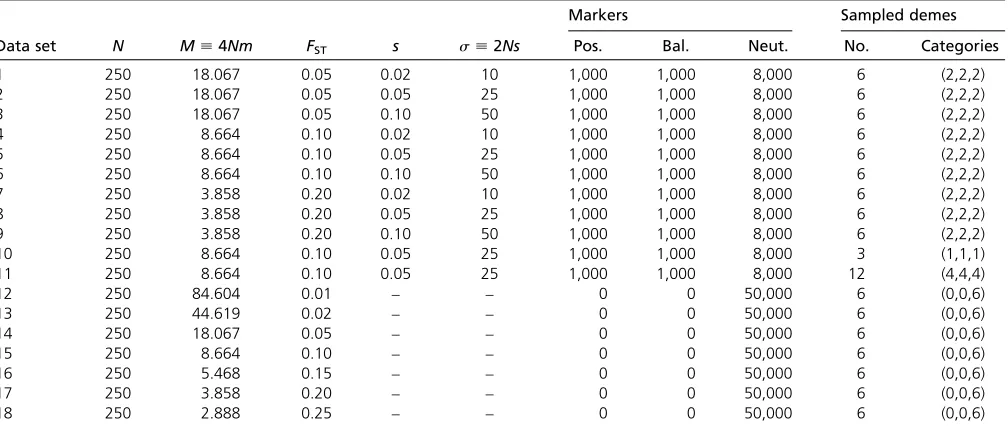
A total of 18 data sets were generated using the Wright

Fisher model described above (see Table 1). For each locus,

50 diploid individuals (100 genes) per deme were sampled.

The details that distinguish the different data sets are given

in Table 1. For example, for data sets 1

9, the samples were

taken in 6 demes: 2 blue demes, 2 red demes, and 2

un-colored demes, and each simulated data set consisted in

10,000 SNPs, with 8000 neutral markers, 1000 positively

selected loci, and 1000 loci under balancing selection. For

data sets with selected loci (data sets 1

11), we assumed

that 30% of all demes were blue demes, 30% were red

demes, and 40% were uncolored demes. For data sets with

neutral markers only (data sets 12

18), 50,000 SNPs were

simulated and all demes were uncolored. Table 1 further

gives the combinations of

F

ST

and

s

values used for the

simulations.

An additional set of four simulations was performed to

test for the robustness to departure from the island model

assumptions. To that end, a classical island model, a

hierar-chical island model (see,

e.g.

, Excof

er

et al.

2009), a

step-ping-stone model in one dimension, and a pure drift model

(whereby nine populations diverge sequentially) were

sim-ulated (see

Figure S1

). The sample characteristics (number

of individuals, number of sampled demes) were the same for

all simulations, and the model parameters were tuned to

achieve an overall realized

F

ST

of

0.24.

For each of these 22 data sets the MCMC algorithm

was run to sample from the joint posterior distribution of

the model parameters. For each Markov chain, 100,000

updating steps were completed after 25 short pilot runs

of 1000 iteration and a burn-in of 25,000 steps. Samples

were collected for all the model parameters every 25

steps (thinning) to reduce autocorrelations, yielding 4000

observations.

The data sets 1

11 (see Table 1) were analyzed using

BayeScan v. 2.1 (Foll and Gaggiotti 2008) with default

op-tion values (except for the MCMC parameters, see below).

BayeScan is based on the Dirichlet-multinomial model for

allele frequencies in an island model of population structure.

At each locus, the distribution of allele frequency in each

subpopulation depends on the allele frequency in the

com-mon pool of migrants and a subpopulation-speci

c

F

ST

ij

pa-rameter. In BayeScan, as in Beaumont and Balding’s model

(Beaumont and Balding 2004), the logit of

F

ST

ij

is

decom-posed additively into a locus-speci

c component (

a

i

) shared

by all populations, and a population-speci

c component (

b

j

)

shared by all loci. Signi

cantly positive (resp., negative)

values of

a

i

are taken as evidence of positive (resp.,

balanc-ing) selection. BayeScan is based on a reversible-jump

MCMC algorithm, which estimates the posterior

probabili-ties of two alternative models, a purely neutral one (a

i

= 0),

and one including selection (a

i

0). Each Markov chain

was run for 100,000 updating steps, after 25 short pilot runs

of 1000 iteration each and a burn-in of 25,000 steps.

Sam-ples were collected every 25 steps (thinning), yielding 4000

observations. For each output, we computed the Bayes

fac-tor (BF) for the model including selection (

a

i

0),

assum-ing prior odds of 10 for the neutral model (

a

i

= 0).

The comparison of the relative ef

ciency of the two

methods was achieved by means of receiver operating

characteristic (ROC) analysis (see,

e.g.

, Fawcett 2006, for

further information), using the R software environment for

statistical computing, v. 3.0.1 (R Core Team 2013).

Application to human data

We applied SelEstim on the Stanford HGDP

CEPH Human

Genome Diversity Cell Line Panel (Cann

et al.

2003) SNP

genotyping data, which consist of genotypes at more than

650,000 SNPs (

ftp://ftp.cephb.fr/hgdp_supp1

). Because we

were interested, for illustrative purpose, in measuring the

genetic signature of selection in the lactase gene, we

con-sidered only the 53,765 SNPs mapping to chromosome 2

(HSA2) and incorporated the genotyping data of the two

SNPs reported to be tightly associated with lactase

persis-tence (

2

13910C

/

T and

2

22018G

/

A) as published by

Bersaglieri

et al.

(2004). All the populations with

,

15

gen-otyped individuals were discarded from the data set.

Fur-thermore, we removed seven populations from Oceania and

Southern America, as well as three populations from

Sub-Saharan Africa (the Biaka Pygmies, Mbuti Pygmies, and the

Mandenka) that were absent from Bersaglieri

et al.

’s data set

(Bersaglieri

et al

. 2004). The two Bantu populations (from

Kenya and South Africa) were merged, as in Bersaglieri

et al.

(7)

Results

Evaluating the performance of SelEstim:

To asses the KLD calibration procedure, we

rst evaluate the

method using simulated data sets made of neutral markers

only (data sets 12

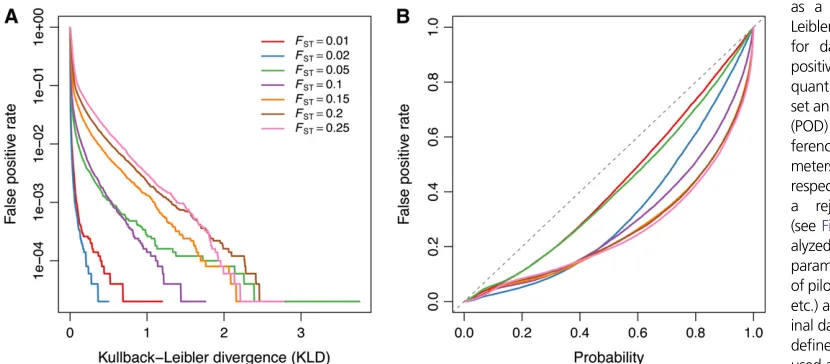
18; see Table 1). Figure 3A shows the

false-positive rate,

i.e.

, the proportion of markers that are

incorrectly classi

ed as under selection, as a function of

various KLD thresholds. For each data set, KLD thresholds

based on the quantiles of the KLD distributions from the

POD analyses were computed and used as a decision

crite-rion for discriminating between neutral and selected

markers. Figure 3B represents the false-positive rate as

a function of the quantile probability (comprised between

0 and 1). Figure 3B shows that, for the data sets considered

here, the false-positive rate at any KLD threshold is always

less than the corresponding quantile probability. This

sug-gests that our calibration procedure is

“conservative,”

at

least for the range of

F

ST

values considered here (ranging

from 0.01 to 0.25).

Figure 4 shows the performance of the method on data

set 5 (see Table 1), which corresponds to

F

ST

= 0.10 and

s

[

2

Ns

= 25.

Figure S2

,

Figure S3

,

Figure S4

,

Figure S5

,

Figure S6

,

Figure S7

,

Figure S8

,

Figure S9

,

Figure S10

, and

Figure S11

provide the same outputs for simulated data sets

1

4 and 6

11. Figure 4A shows that the distribution of KLD

measures for positively selected loci departs from that of the

neutral markers and the loci under balancing selection. This

is essentially true for the data sets for which

F

ST

$

0.05 and

s

$

25, as can be seen from

Figure S2

,

Figure S3

,

Figure S4

,

Figure S5

,

Figure S6

,

Figure S7

,

Figure S8

, and

Figure S9

.

Not surprisingly, large KLD values correspond to large

F

ST

estimates (Figure 4B). This is so because for positively

se-lected loci, one allele is sese-lected for in blue populations and

the other in red populations, which tends to exacerbate

dif-ferentiation. A close examination of Figure 4C further shows

that the false-positive rate (the proportion of neutral

markers that exhibit a signature of selection) at any KLD

threshold is always less than the corresponding KLD

quan-tile probability (as in Figure 3B). This strengthens the notion

that the KLD thresholds should not be interpreted as

fre-quentist

P

-values. All else being equal, increasing the

num-ber of sampled demes improves the discrimination of neutral

and positively selected markers (compare Figure 4,

Figure

S10

, and

Figure S11

). Last, Figure 4 shows that SelEstim has

some weak statistical power to identify loci under balancing

selection. This arises because markers with very low

diver-gence will tend to have posteriors for

d

that are pushed

further toward zero in comparison with the centering

distri-bution and, hence, will also have a higher KLD. Yet,

al-though the KLD for loci under balancing selection is

indeed slightly higher, on average, than for neutral markers

(Figure 4,

Figure S2

,

Figure S3

,

Figure S4

,

Figure S5

,

Figure

S6

,

Figure S7

,

Figure S8

,

Figure S9

,

Figure S10

and

Figure

S11

), it remains very low. This result is not surprising,

though, since the selection scheme considered in our model

of inference accounts only for positive genic selection.

Fur-thermore, previous simulation studies have also shown that,

in the absence of an explicit model of selection, similar

methods generally lack power to detect balancing selection

(Beaumont and Balding 2004; Foll and Gaggiotti 2008; Riebler

et al.

2008).

Table 1 Parameters of simulated data sets

Markers

Sampled demes

Data set

N

M

[

4Nm

F

ST

s

s

[

2Ns

Pos.

Bal.

Neut.

No.

Categories

1

250

18.067

0.05

0.02

10

1,000

1,000

8,000

6

(2,2,2)

2

250

18.067

0.05

0.05

25

1,000

1,000

8,000

6

(2,2,2)

3

250

18.067

0.05

0.10

50

1,000

1,000

8,000

6

(2,2,2)

4

250

8.664

0.10

0.02

10

1,000

1,000

8,000

6

(2,2,2)

5

250

8.664

0.10

0.05

25

1,000

1,000

8,000

6

(2,2,2)

6

250

8.664

0.10

0.10

50

1,000

1,000

8,000

6

(2,2,2)

7

250

3.858

0.20

0.02

10

1,000

1,000

8,000

6

(2,2,2)

8

250

3.858

0.20

0.05

25

1,000

1,000

8,000

6

(2,2,2)

9

250

3.858

0.20

0.10

50

1,000

1,000

8,000

6

(2,2,2)

10

250

8.664

0.10

0.05

25

1,000

1,000

8,000

3

(1,1,1)

11

250

8.664

0.10

0.05

25

1,000

1,000

8,000

12

(4,4,4)

12

250

84.604

0.01

0

0

50,000

6

(0,0,6)

13

250

44.619

0.02

0

0

50,000

6

(0,0,6)

14

250

18.067

0.05

0

0

50,000

6

(0,0,6)

15

250

8.664

0.10

0

0

50,000

6

(0,0,6)

16

250

5.468

0.15

0

0

50,000

6

(0,0,6)

17

250

3.858

0.20

0

0

50,000

6

(0,0,6)

18

250

2.888

0.25

0

0

50,000

6

(0,0,6)

All the simulations were performed according to an island model with

n

d

= 50 demes, each made of

N

= 250 diploid individuals (500 genes). Fifty diploid individuals (100

genes) were sampled per deme. The migration rate

m

was

xed to achieve the desired value of

F

ST

, using Equation 6 in Rousset (1996). The number of loci simulated under

(8)

Comparison with BayeScan:

Figure 4D shows the relationship between BayeScan BF and

the KLD for each and every locus from data set 5. According

to Jeffreys’

rule (Jeffreys 1961; Kass and Raftery 1995),

a BF

.

10 (log10(BF)

$

1) provides

“strong”

evidence for

selection, and for a BF

.

100 (log10(BF)

$

2) the evidence is

“decisive.”

However, it should be noted that, by de

nition,

the BF depends on the prior odds for the neutral model. For

this set of simulated data, there is a good agreement between

BayeScan BF criterion and the KLD, since markers with high

KLD show decisive evidence of selection from BayeScan BF

criterion. For BayeScan analyses, whenever the posterior

probability of the model including selection (

a

i

0) was

equal to 1, we arbitrarily de

ned the log10(posterior odd)

as log10(3999.5/4000)

2

log10(0.5/4000) to account for

the chain length (4000 iterations). By construction, the

max-imum value that the BF can take (log10(BF) = 4.857; see

Figure 4D) therefore depends on the MCMC length and the

prior odds for the neutral model (here equal to 10).

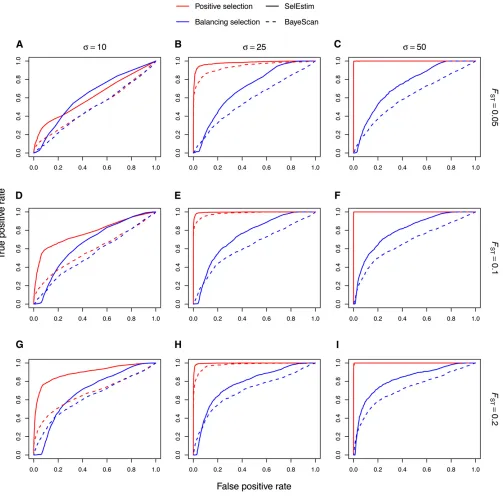
The ROC analysis (Figure 5) further shows a slight

power gain of SelEstim over BayeScan (Foll and Gaggiotti

2008). In the ROC analysis, the proportion of false

pos-itives and true pospos-itives is computed for each possible

value of the threshold that is used to classify a locus under

selection (see,

e.g.

, Fawcett 2006, for further

informa-tion). For SelEstim, the classifying variable was the KLD

of the posterior distribution of the locus-speci

c coef

-cient of selection

d

j

from its centering distribution, while

in the case of BayeScan it was the Bayes factor. The ROC

analysis yields a monotonic curve with no positives (true

or false) at one end and all positives at the other. If

a method has no classi

cation power, the curve should

be linear with slope 1, and the area under the ROC curve

(AUC) should be 0.5. If a method has perfect classi

cation

power, the curve should perfectly superimpose to the left-hand

and top sides of the unit square, and the AUC should be 1.

Considering positively selected loci

rst, the area under the

ROC curve for SelEstim is slightly larger, and closer to 1,

than that obtained for BayeScan (see Figure 5). In

partic-ular SelEstim appears to have progressively improved

rel-ative performance with decreasing values of

s

. As for loci

under balancing selection, SelEstim seems slightly better

than BayeScan based on the ROC analysis, although both

methods lack statistical power in these sets of simulated

data.

The analysis of data sets 1

11 (see Table 1) took 12,175

sec on average per data set (SD = 6921) with BayeScan and

12,633 sec (SD = 6149) with SelEstim. SelEstim is therefore

3.85% slower than BayeScan, based on the same MCMC

parameters (number and length of pilot runs, burn-in, chain

length, etc.) and using the same number of processor cores.

Note, however, that the KLD calibration procedure of SelEstim

comes at the cost of up to a doubled computing time, due to

the additional analysis of the POD.

Robustness to model misspecification

We analyzed simulated data departing from the island

model assumptions (see

Figure S1

). The rate of false positives

detected by SelEstim at a given threshold was higher for data

simulated from a hierarchical island model or a

stepping-stone model, as compared to data simulated from a

nonhier-archical model with the same overall

F

ST

(

Figure S12

). However,

for all scenarios considered, the false-positive rate at any

KLD threshold was less than or nearly equal to the

corre-sponding quantile probability (

Figure S12

F), which suggests

that our calibration procedure is

“conservative,”

even for

strong departures from the island model assumptions.

Fur-thermore, the rates of false positives for these scenarios were

much lower as compared to BayeScan analyses of the same

data (

Figure S13

).

Figure 3

(A) False-positive rate

(neutral loci detected as outliers)

as a function of the Kullback

Leibler divergence (KLD) threshold,

for data sets 12

18. (B)

False-positive rate, as a function of the

quantile probability. For each data

set analysis, pseudo-observed data

(POD) are generated from the

in-ference model with

hyperpara-meters

l

,

p

j

, and

M

i

set to their

respective posterior means, using

a

rejection-sampling

algorithm

(see

File S2

). The POD is then

an-alyzed, using the same MCMC

parameters (number and length

of pilot runs, burn-in, chain length,

etc.) as for the analysis of the

orig-inal data. Each quantile probability

de

nes a KLD threshold, which is

(9)

Inference of selection coef

cients

For data set 5 (see Table 1), we examined the distributions

of the posterior means of the parameters

k

ij

(which indicate

which allele is selected for), for the 1000 positively selected

loci. Here, from the hypotheses of our simulation model,

k

ij

= 0 indicates that the blue allele is selected for, and

k

ij

= 1 indicates that the red allele is selected for. Figure

6A shows the distributions of the posterior means of

k

ij

in

each sampled deme. Consistent with our expectation, it is

ap-parent from Figure 6A that the posterior means of

k

ij

in demes

1 and 2 (blue demes) are shifted toward zero and that the

posterior means of

k

ij

in demes 3 and 4 (red demes) are

shifted toward one. Alleles of the right color are therefore

selected for in the right deme. It is also reassuring to see that

in demes 5 and 6 (uncolored demes), the posterior means of

k

ij

are centered around 0.5, which is consistent with the fact

that neither allele should be selected for in these demes.

For the same 1000 positively selected loci, we further

examined the posterior means of the scaled coef

cients of

selection

s

ij

[

2

N

i

s

ij

, conditionally on

k

ij

. By doing so, we

estimate the coef

cient of selection associated with the

al-lele being effectively targeted by selection. Figure 6B shows

that the posterior means of

f

(

s

ij

jk

ij

= 0) in blue demes and

the posterior means of

f

(

s

ij

jk

ij

= 1) in red demes are very

close to the simulated values (s

[

2

Ns

=25 in data set 5;

see Table 1). By contrast, in uncolored demes, the posterior

means of

s

ij

that were not conditioned upon

k

ij

, are much

lower and closer to the prior distribution of the

hyperpara-meter

l

(which represents the genome-wide effect of

selec-tion over all demes and loci).

Figure S14

,

Figure S15

,

Figure

S16

,

Figure S17

, and

Figure S18

reproduce the same

out-puts as in Figure 6 for data sets 1

4 and 6

11. The posterior

means of the scaled coef

cients of selection

s

ij

conditionally

on

k

ij

are very close to the simulated values, for

F

ST

$

0.05

and

s

$

25 (data sets 2

3, 5

6, and 8

9) and

F

ST

= 0.2 and

s

= 10 (data set 7). All else being equal, increasing the

number of sampled demes improves the estimation of the

scaled coef

cients of selection

s

ij

conditionally on

k

ij

(com-pare Figures 6 and

Figure S18

).

Last, we examined the distributions of the posterior means

of

k

ij

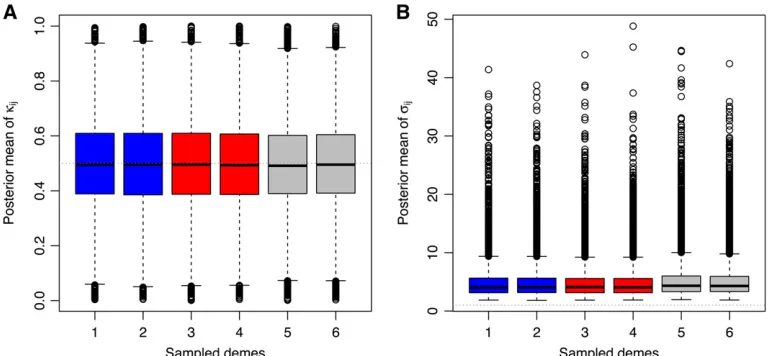
for the 8000 neutral markers in data set 5. Figure 7A

shows that the posterior means of

k

ij

, which do not depend on

the color of the sampled demes, are all centered around 0.5.

This result is consistent with the fact that neither allele should

be selected for in these demes. Furthermore, the distributions

of the posterior means of

k

ij

for neutral markers are narrower,

as compared to the posterior means of

k

ij

for selected loci in

uncolored demes (see Figure 6A). The distributions of the

Figure 4

Analysis of the allele

count data from data set 5. (A)

Kullback

Leibler divergence (KLD)

measure between the posterior of

d

j

and its centering distribution for

all simulated loci. Loci under

posi-tive selection are depicted in red,

loci under balancing selection in

blue, and neutral markers are in

gray. (B)

FST

as a function of the

KLD measure for all loci. (C)

False-positive (neutral loci detected as

outliers) and false-negative

(se-lected loci not detected as outliers)

rates as a function of the KLD

threshold. (D) Relationship between

BayeScan Bayes factor log

10

(BF)

and the KLD for all markers in

data set 5. Positively selected

markers are in red, loci under

bal-ancing selection are in blue, and

neutral markers are in gray. The

horizontal lines in A and the

ver-tical lines in B

D indicate the KLD

thresholds corresponding to the

95%, 99%, and 99.9% quantile

of the KLD distribution from the

POD analysis of data set 5. In D,

the horizontal dotted lines indicate

the log

10

(BF) = 1, log_10(BF) = 1.5

and log

10

(BF) = 2 thresholds,

which correspond to strong, very

strong and decisive support

fol-lowing Jeffreys

s (1961) scale of

(10)

posterior means of

k

ij

for neutral markers are therefore closer

to their prior distribution. Yet, the distributions are still wider

than expected from the prior distribution, since the mean over

4000 independent samples (which corresponds to the MCMC

length) from a Ber(0.5) distribution should be approximately

normally distributed with mean 0.5 and standard deviation

0.008. This extra variance may be due to the hierarchical

struc-ture of the model, which produces a correlation between the

parameters. In addition,

Figure S19

A shows that, in the absence

of selection (data set 16; see Table 1), the distribution of the

posterior means of

k

ij

is centered around 0.5 and narrower

as compared to data sets that include positively selected loci

(compare with Figure 7A). Therefore, the higher variance of

the distributions of

k

ij

for selected loci in uncolored demes

(as compared to neutral markers) certainly stems from the

in

uence of selection occurring for the same loci in blue and

red demes, through the prior on the locus-speci

c

hyper-parameter

d

j

. The posterior means of

s

ij

for neutral markers

Figure 5

Receiver operating characteristic (ROC) analysis for the data sets 1 (A), 2 (B), 3 (C), 4 (D), 5 (E), 6 (F), 7 (G), 8 (H) and 9 (I). In the ROC analysis,

the proportion of false positives and true positives is computed for each possible value of the threshold that is used to classify a locus under selection. For

SelEstim, the classifying variable was the KLD between the posterior distribution of the locus-speci

c coef

cient of selection

d

j

and its centering

(11)

(unconditionally upon

k

ij

) are very low and close to the

poste-rior mean of the hyperparameter

l

. In the absence of selection

(data set 16), the posterior means of

s

ij

for neutral markers

(unconditionally upon

k

ij

) are also very low and not different

from the prior mean of the hyperparameter

l

(

Figure S19

B).

Implicitly, Figure 6 and Figure 7 demonstrate that SelEstim

is able to give accurate measures of the scaled coef

cient of

selection at one locus in different demes and therefore to

provide evidence of local adaptation. This paves the way for

the inference of the distribution of selection strength across

populations in a landscape as is illustrated in the next section.

Last, we analyzed a set of 11 simulations using the same

parameters as for data set 5 (see Table 1), but varying the

proportion of selected loci from 10 to 5000 of 10,000

markers (hence, from 0.1 to 50%). Interestingly, we found

a strong correlation between the posterior mean of the

ge-nome-wide coef

cient of selection

l

and the number of

pos-itively selected loci (see

Figure S20

). However, as the number

of positively selected loci increases, the performance of SelEstim

weakens (

.

20% of selected markers), although less markedly

than BayeScan (see

Figure S21

).

Application to human data

We ran three independent MCMC analyses on a subset of the

Stanford HGDP

CEPH Human Genome Diversity Cell Line

Panel (Cann

et al.

2003) SNP Genotyping Data. The data

consisted in 52,631 SNPs from the HGDP

CEPH data, and

two SNPs (

2

13910C

/

T and

2

22018G

/

A) known to

be tightly associated with lactase persistence (Bersaglieri

et al.

2004), genotyped in 23 populations from Africa and Eurasia.

After 25 pilot runs of 1000 iterations, each MCMC was run for

100,000 updating steps, after a burn-in period of 25,000

steps. Samples were collected from the Markov chains for

all the model parameters every 25 steps (thinning) to reduce

autocorrelations, yielding 4000 samples for each parameter.

Convergence was assessed by computing the

multivar-iate extension of Gelman

Rubin’s diagnostic (Brooks and

Gelman 1998) on the three independent Markov chains.

Figure 6

Analysis of the allele

count data from data set 5. (A)

Boxplot representation of the

posterior means of the

parame-ters

k

ij

(which indicate which

al-lele is selected for) for the 1000

positively selected loci in blue

demes (1

2), red demes (3

4),

and uncolored demes (5

6). (B)

Boxplot representation of the

posterior means of the selection

coef

cients

s

ij

for positively

se-lected loci in data set 5. For blue

demes, the posterior means of

the selection coef

cients

s

ij

are

conditional upon the blue allele

being selected for (

k

ij

= 0). For

red demes, the posterior means

of the selection coef

cients

s

ij

are conditional upon the red allele being selected for (

k

ij

= 1). For uncolored demes, the posterior means of the selection coef

cients

s

ij

are

un-conditional. The horizontal dashed line gives the true (simulated) value of

s

ij

= 25.

Figure 7

Analysis of the allele

count data from data set 5. (A)

Boxplot representation of the

posterior means of the

parame-ters

k

ij

(which indicate which

al-lele is selected for) for the 8000

neutral markers in blue demes

(1

2), red demes (3

4), and

un-colored demes (5

6). (B) Boxplot

representation of the posterior

means of the selection coef

-cients

s

ij

for neutral markers in

data set 5. The posterior means

of the selection coef

cients

s

ij

Figure

Figure 1 Directed acyclic graph (DAG) of the hierarchical Bayesianmodel.
Figure 2 Examples of posterior densities of the locus-speciexponential distributionThetribution of the genome-wide effect of selection,fic hyperpara-meter dj for neutral markers (in gray) and positively selected loci (in red)
Table 1 Parameters of simulated data sets
Figure 3 (A) False-positive rate(neutral loci detected as outliers)as a function of the Kullback–Leibler divergence (KLD) threshold,for data sets 12–18
+7

References

Related documents