Improved Collision Attack on Hash Function MD5
Jie Liang and Xuejia Lai
Department of Computer Science and Engineering Shanghai Jiao Tong University
Shanghai 200240, China Email: [email protected]
Abstract. In this paper, we present a fast attack algorithm to find two-block collision of hash function MD5. The algorithm is based on the two-block colli-sion differential path of MD5 that was presented by Wang et al. in EUROCRYPT 2005[6]. We found that the derived conditions for the desired differential path in [6] were not sufficient to guarantee the differential path to hold and that some conditions could be relaxed to enlarge the collision set. By using technique of small range searching and omitting the computing steps to check the characteristics in algorithm, we can speed up the attack of MD5 effi-ciently. Compared with the Advanced Message Modification technique [5,6], the small range searching technique can correct 4 more conditions for the first iteration differential and 3 more conditions for the second iteration differential, thus improving the probability and the complexity to find collisions. The whole attack on the MD5 can be accomplished within 5 hours using a PC with Pen-tium4 1.70GHZ CPU.
Key words: MD5, collision, differential attacks, fast attack algorithm.
1 Introduction
The hash function MD5 [2] was designed by Ronald Rivest in 1992 as a strengthened version of MD4 [1]. Though some weakness has been found by B.denBoer, A.Bosselaers [3] and H.Dobbertin [4] since its publication, MD5 is widely imple-mented in cryptography such as digital signature, data integrity, user authentication, key agreement, e-cash and many other cryptographic schemes and protocols. Conse-quently, MD5 also have been used in almost all commercial security systems and products.
In the past few years, there has been significant advances in the analysis of hash function MD5. At the rump session of Crypto'04, Wang et al. [10] presented the first collision of MD5. In EUROCRYPT 2005, Wang et al. presented a two-block collision differential path of MD5 [6] that allowed us to search collisions efficiently. The com-plexity of finding one collision is about MD5 operations using the attack algorithm presented in [6] (we consider the extra conditions that will be discussed in section 4). In March 2005, Klima present Multi-message modifications method to find collision of MD5 on a standard notebook PC roughly in 8 hours [7,8], the complexity is
41
about MD5 operations (we consider the extra conditions that will be discussed in section 4).
36
2
In this paper, we show that the conditions in Table 4 and 6 of [6] are not sufficient to ensure the occurrence of the collision path (which was also found in [12] with a different approach) and specify a set of truly sufficient conditions by adding some ex-tra conditions. Additionally, We relax some conditions in Table 4 and 6 of [6] to enlarge the collision set. Finally we propose small range searching technique to cor-rect more conditions in round 2 but keep all the conditions in round 1 hold. By using the small range searching technique and omitting the steps of checking characteristics in algorithm [6,7,8], we can reduce the searching complexity to about MD5 opera-tions for the first block and about MD5 operations for the second block.
34
2
28
2
2 MD5 Algorithm
The MD5 Message-Digest Algorithm [2] is composed of integer modular addition, four auxiliary Boolean functions and left shift rotation. The processing of MD5 in-volves 64 steps, and can be described as following:
The chaining variables are initialized as:
0
a = 0x67452301;d0= 0x10325476;c0= 0x98badcfe;b0= 0xefcdab89; Step1: ∑1= a0+ F(b0, c0, d0) + m0 + 0xd76aa478 a1 = b0+∑1 <<<7; Step2: ∑2= d
0+ F(a1, b0, c0) + m1 + 0xe8c7b756 d1 = a1+∑2<<<12; Step3: ∑3= c
0+ F(d1, a1, b0) + m2 + 0x242070db c1 = d1+∑3<<<17; Step4: ∑4= b
0+ F(c1, d1, a1) + m3 + 0xc1bdceee b1 = c1+∑4<<<22; Step5: ∑5= a1 + F(b1, c1, d1) + m4 + 0xf57c0faf a2 = b1+∑5 <<<7; Step6: ∑6= d1 + F(a2, b1, c1) + m5 + 0x4787c62a d2 = a2+∑6<<<12; Step7: ∑7= c
1 + F(d2, a2, b1) + m6 + 0xa8304613 c2= d2+∑7 <<<17; Step8: ∑8= b
1 + F(c2, d2, a2) + m7 + 0xfd469501 b2 = c2+∑8<<<22; Step9: ∑9= a2 + F(b2, c2, d2) + m8 + 0x698098d8 a3 = b2+∑9 <<<7; Step10: ∑10=d2 + F(a3, b2, c2) + m9 + 0x8b44f7af d3= a3+∑10<<<12; Step11: ∑11= c
2 + F(d3, a3, b2) + m10 + 0xffff5bb1 c3 =d3+∑11<<<17; Step12: ∑12=b
2 + F(c3, d3, a3) + m11 + 0x895cd7be b3 = c3+∑12<<<22; Step13:
13 ∑ = a
3 + F(b3, c3, d3) + m12 + 0x6b901122 a4 = b3+∑13 <<<7; Step14: ∑14=d3 + F(a4, b3, c3) + m13 + 0xfd987193 d4 =a4+∑14<<<12; Step15: ∑15=c
3 + F(d4, a4, b3) + m14 + 0xa679438e c4= d4+∑15<<<17; Step16: ∑16=b
3 + F(c4, d4, a4) + m15 + 0x49b40821 b4 =c4+∑16<<<22; Step17: ∑17=a
4 + G(b4, c4, d4) + m1 + 0xf61e2562 a5 = b4+∑17 <<<5; Step18: ∑18=d4+ G(a5, b4, c4) + m6 + 0xc040b340 d5 = a5+∑18 <<<9; Step19: ∑19=c
Step20: ∑20= b4+ G(c5, d5, a5) + m0 + 0xe9b6c7aa b5 = c5+∑20<<<20; …… …… …… …… …… …… …… Step61: ∑61= a
15+ I(b15, c15, d15) + m4 + 0xf7537e82, a
16 = b15 +∑61<<< 6, aa0 = a16+ a0; Step62: ∑62= d
15+ I(a16, b15, c15) + m11 + 0xbd3af235, d
16 = a16 +∑62<<<10, dd0 = d16+ d0;
Step63: ∑63= c15+ I(d16, a16, b15) + m2 + 0x2ad7d2bb, c
16 = d16 +∑63<<<15, cc0 = c16+ c0; Step64: ∑64= b
15+ I(c16, d16, a16) + m9 + 0xeb86d391, b
16 = c16 +∑64<<<21, bb0 = b16+ b0;
Where <<< K is cyclically left-shift by K bit positions.
Let , , and be the output of compressing one 512-bit message block. If there are more than one message block for compression, repeat the above 64 steps with the next 512-bit message block and ( , , , ) as inputs.
0
aa bb0 cc0 dd0
0
aa bb0 cc0 dd0 The four auxiliary Boolean functions used for MD5 are the following: F(x, y, z) = (x∧y)∨ ¬ ∧( x z)
G(x, y, z) = (x∧z)∨(y∧ ¬z) H(x, y, z) = x⊕y⊕z
I (x, y, z) = y⊕(x∧ ¬z) where x, y, z are 32-bit words.
In the above iterating process, we omit the padding method because it has no in-fluence on the attack.
3 Collision Differentials for MD5
The collision differentials for MD5 with two iterations that Wang et al. presented in EUROCRYPT 2005 is as follows:
ΔH0 = 0 ⎯⎯( ⎯,⎯⎯)→ ' 0 0M M
ΔH1⎯⎯( ⎯, ⎯⎯)→ ' 1 1 M M
ΔH2= 0 Such that
ΔM0=M0'-M0= (0, 0, 0, 0, *231, 0, 0, 0, 0, 0, 0, 215, 0, 0, *231, 0)
ΔM1= '- = (0, 0, 0, 0, , 0, 0, 0, 0, 0, 0, – , 0, 0, , 0) 1
M M1 *231 215 *231
ΔH1= (*231,*231+225,*231+225, *231+225).
Where means it can be or , which is limited to in [6]. We found that it can be relaxed to or but the collision differentials still hold. , , and each is one 512-bit message block. Non-zero entries of
and are located at positions 5, 12 and 15. 31
2
* −231 +231 +231
31 2
− +231
0
M M0' M1 M1'
ΔM0 ΔM1 ΔH1= (Δa, Δb, Δc, d ) is the
difference of the four chaining values (a, d, c, b) after the first iteration.
4 Sufficient Conditions for the Collision Path to Hold
In order to construct a fast attack algorithm without the need to test whether the char-acteristics really hold in every step, we first derive a set of truly sufficient conditions that guarantee the collision differential path described in Table 3 and 5 of [6] to hold. In this section, we show that it needs to add some extra conditions into Table 4 and 6 of [6] to keep the path attained. More detailed explanation has been discussed in [12], they also discover the lack of conditions independently.
For example, in the 5th step computation of the first iteration: Step5: a
2 = b1+ [ a1 + F(b1, c1, d1) + m4 + 0xf57c0faf ] <<<7, Let ∑
5 = a1 + F(b1, c1, d1) + m4 + 0xf57c0faf.
Then, the output difference in the 5th step caused by Δm4= should depend on the value of bit 32 in : if the bit 32 in
31 2 *
∑5 ∑5is zero, then the output difference in the 5th step is 26; if the bit 32 in∑5is one, then the output difference in the 5th
step is
–26. Thus, we need to add the necessary condition∑ 32 ,
5 =1 to keep the output
differ-ence – in Table 3 of [6]. In order to use basic modification technique, we add con-ditions =1, =1 and =0 (these conditions are not necessary) instead of condition =1 to the set of sufficient conditions. We show the 5
6 2
5 , 1
b b1,6 a2,5 ∑5,32
th
step computa-tion of the first iteracomputa-tion in Table 1. According to binary addicomputa-tion properties, for Z=X+Y, we have:
(1) If bit n in X is unknown, bit n in Y is 1 and bit n in Z is 0, then X+Y will have carry to bit n+1.
(2) If bit n in X is unknown, bit n in Y is 0 and bit n in Z is 1, then X+Y will have no carry to bit n+1.
So we can ensure condition∑5,32=1 occur if conditions b1,5=1, b1,6=1 and a2,5=0 hold
( see in Table 1 ).
Table 1. Compute the 5th Step of the First Iteration
bit NO. 1 5 9 11 17 21 25 29
∑5<<<7 ???? ?11? ???? ???? ???? ???? ???? ???? +
b
1 ???? 110? ???1 ???? ???1 ???0 ???? ???1
= a2 1?1? 0100 0000 0000 0000 0010 ?0?1 ???1
From the example, we see that it is necessary to consider the left shift rotation op-eration when we derive sufficient conditions for keeping the collision path. Extra con-ditions for other steps are derived using the same method.
During our research, we found that some conditions in Table 4 and 6 of [6] could be relaxed to enlarge the collision set. We show them as follows:
(1) Conditions in bits c
(2) Conditions a
1,32= d1,32= c1,32= b1,32=1, a2,32= d2,32=0, c2,32= b2,32= a3,32= d3,32= c
3,32= b3,32=1, a4,32= d4,32=0 can be relaxed to bb0,32= a1,32+1= d1,32+1= c1,32+1= b
1,32+1= a2,32= d2,32= c2,32+1= b2,32+1= a3,32+1= d3,32+1= c3,32+1= b3,32+1= a4,32= d4,32 for the second iteration differential.
The conditions’ relaxations do not have any influence on the differential characteristic in Table 3 and 5 of [6], which is easily verified by using the deriving method de-scribed in [6]. After we relax these conditions, the collision set should become at least 8 times larger than before.
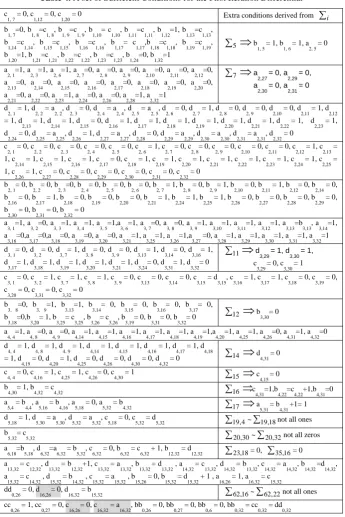
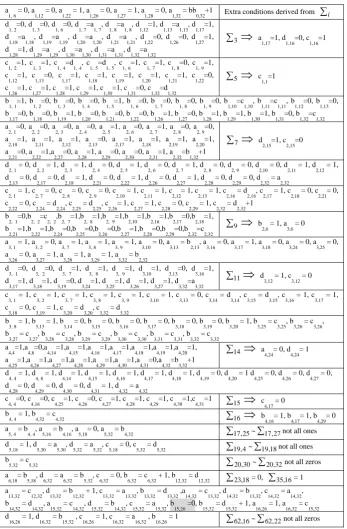
Finally, we give out a set of sufficient conditions in Table 4 and 5 (in appendices) that guarantee the desired differential path to occur. The extra conditions in Table 4 and 5 are just one of the possible extra conditions sets derived from∑i, we choose
them out as they are optimal. Compare with the Table 4 of [6], besides the relaxed conditions and the extra conditions derived from∑i, we also add conditions d16,26= 0,
c
16,26= 0, correct condition c16,32= a16,32 and delete condition a16,27 = 0 in Table 4. The same to extra condition b
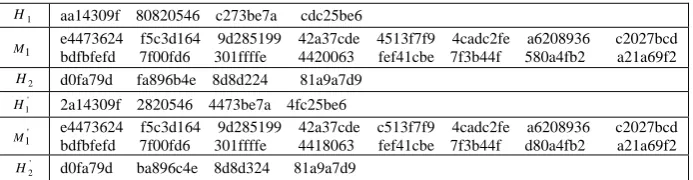
15,26= 0 in Table 5. By using the deriving method described in [6], we confirm that these 5 conditions are lacked conditions or incorrect conditions in [6] (see counterexamples in appendices). In fact, we can derive other set of truly sufficient conditions, but the set that we show in Table 4 and 5 is the best in the sense that it contains the least number of conditions for keeping the collision path.
We note that the extra conditions a
2,27 = 0, a2,29 = 0, a2,30 = 0 and a2,31 = 0, which are derived from∑7of the first iteration, are not only sufficient but also necessary condi-tions for holding the collision path. We present a counterexample with standard IV that satisfies all the conditions in Table 4 except for conditions a
0
M
2,27 = 1, a2,29 = 1, a2,30 = 1and a
2,31 = 1: m
0 =0xe3b50fa3; m1 =0x4be14e05; m2 =0x16a10a8e; m3 =0xf70e2ebe; m
4 =0x5fa664b8; m5 =0xe60b9ef3; m6 =0xe4594b46; m7 =0x49813c40; m
8 =0x1e332d55; m9 =0x2ff43c05; m10 =0x8482ea2f; m11=0x13823723; m
12=0x31c034e3; m13=0x234c14e1; m14=0x14237194; m15=0x34234335. According to Section 3, can easy to get from but they are not collision pairs for the first block at all.
1
M M0
We find that Jun Yajima and Takeshi Shimoyama also discover the lack of conditions in [6]. They try to present a set of sufficient conditions in [13]. By comparing, we found that the sufficient condition set they showed still lacked of conditions. Here we show out a counterexample with standard IV that satisfies all the conditions for First Message Block listed in [13] as follow:
m
0=0x72bcc7d2; m1=0x87fe0ffc; m2=0xc7ee72f1; m3=0x5c92b535; m
4=0xb3fbb6d4; m5=0xc03f68c8; m6=0x95879481; m7=0xf1f48bd6; m
8=0x633ed41; m9 =0x3d3f800; m10 =0x7f80f83b; m11=0x93410102; m
Through verification, we found that b
1,5= 1, b1,6= 0 and a2,5= 0. These three conditions ensure∑5,32=0 occur to break the collision path.
5 Construct a Fast Attack Algorithm
In this section, we propose small range searching technique to obtain a faster attack algorithm. The basic idea of this technique is that for N= U+ [L+ F(X, Y, Z) +M +Constant ] <<< k, we can change the value of bit n in N by searching bit n in U and bit n-k in L, X, Y, Z, M; We can also search the bits lower than n in U and bits lower than n-k in L, X, Y, Z, M to change the value of bit n in N by carry.
Through experiment, we found that the basic message modification technique de-scribed in [6] was not always success because of the Carry or Borrow in bit 32. So our basic message modification technique shown below different from the one presented in [6], and we can make the modification always succeed.
5.1 Fast Attack Algorithm for First Block
(a) Select random 32-bit value for m
0, m1, m2 … m15. (b) Compute step 1 and step 2 of MD5 algorithm, modify m
2 …m13, m14 and m15 by basic message modification technique. For example, m
5 should be modified to en-sure the conditions of d
2 in Table 4 hold (see in Table 2): Step6: d
2 = a2+ [d1 + F(a2, b1, c1) + m5 + 0x4787c62a ] <<<12;
Table 2. Conditions of d
2 for the First Iteration Differential d
2,1 = 1, d2,2 = a2,2, d2,3 = 0, d2,4 = a2,4, d2,5 = a2,5, d2,6 = 0, d2,7 = 1, d2,8 = 0, d2,9 = 0, d
2,10 = 0, d2,11 = 1, d2,12 = 1, d2,13 = 1, d2,14 = 1, d2,15 = 0, d2,16 = 1, d2,17 = 1, d2,18 = 1 d
2,19 = 1, d2,20= 1, d2,21 = 1, d2,22 = 1, d2,23 = 1, d2,24 = 0, d2,25 = a2,25, d2,26 = 1, d
2,27 = a2,27, d2,28 = 0, d2,29 = a2,29, d2,30 = a2,30, d2,31 = a2,31, d2,32 = 0
Basic Modification: d
2 = {( d2 )^[( d2 )&( 0xfd8043be )] ^ [( a2 ) & ( 0x7500001a )]} | ( 0x027fbc41 ) m
5 = [ ( d2- a2 ) >>>12 ] –d1 – F ( a2, b1, c1 ) – 0x4787c62a.
In order to use small range searching technique in the next step, we add three extra conditions c
4, 9 = 0, c4, 21 = 0 and c4, 23 = 0 in c4 when Modify m14.
(c)
Randomly select 32-bit value for a5 but make the conditions a5,4 = b4,4, a5,16 = b4,16, a
5,18 = 0, a5,31=1 and a5,32 = b4,32 hold, then compute the 18 th
If conditions d
5,18 = 1, d5,30 = a5,30 and d5,32 = a5,32 are not all hold, we use small range searching technique to correct them. According to the 18th step computation and extra conditions c
4, 9 = 0, c4, 21 = 0 and c4, 23 = 0 in c4, we notice that by search-ing bits b
4,9, b4,21, b4,23 in b4, we can change the value of bits d5,18, d5,30, d5,32 in d5 to make the conditions d
5,18 = 1, d5,30 = a5,30 and d5,32 = a5,32 hold, then we need to up-date the value of m
15: m
15 = [ (b4– c4 ) >>>22 ] –b3 – F (c4, d4, a4 ) –0x49b40821. (d) Compute the 19th step:
∑19= c
4+ G(d5, a5, b4) + m11 + 0x265e5a51 c5 = d5+∑19<<<14.
If conditions∑19,4~∑19,8not all ones, c5,18 = 0 and c5,32 = d5,32 are not all fulfilled, we use small range searching technique to correct them. By searching bits b
3,4, b3,5, b
3,6, b3,7, b3,21, b3,22, b3,23, b3,24 in b3 and update the value of m11 (m11 = [(b3–c3 ) >>>22 ] –b
2 –F(c3, d3, a3) –0x895cd7be ), we can affect the value of c5 to make the conditions∑19,4~∑19,8not all ones, c5,18 = 0 and c5,32 = d5,32 hold. Finally, we up-date the value of m
12, m13, m14, m15: m
12= [ (a4–b3 ) >>>7 ] –a3 – F (b3, c3, d3 ) –0x6b901122, m
13= [ (d4–a4 ) >>>12 ] –d3 – F (a4, b3, c3 ) –0xfd987193, m
14= [ (c4–d4 ) >>>17 ] –c3 – F (d4, a4, b3 ) –0xa679438e, m
15 = [ (b4– c4 ) >>>22 ] –b3 – F (c4, d4, a4 ) –0x49b40821. (e) Randomly select 32-bit value for b
5 but make the conditions∑20,30~∑20,32not all zeros and b
5,32 = c5,32 hold, then update the value of m1,m0, a1, d1,m2, m3, m4 and m5: m
1= [ (a5–b4 ) >>>5 ] –a4 – G (b4,c4, d4) –0xf61e2562, m
0= [ (b5–c5 ) >>>20 ] –b4 – G (c5, d5, a5) –0xe9b6c7aa, a
1 = b0+ [ a0+ F(b0, c0, d0) + m0 + 0xd76aa478 ]<<<7, d
1 = a1+ [ d0+ F(a1, b0, c0) + m1 + 0xe8c7b756 ]<<<12, m
2 =[ (c1–d1 ) >>>17 ] –c0 –F(d1, a1, b0) –0x242070db, m
3=[ (b1–c1 ) >>>22 ] –b0 –F(c1, d1, a1) –0xc1bdceee, m
4 =[ (a2–b1 ) >>>7 ] –a1 –F(b1, c1, d1) –0xf57c0faf, m
5 =[ (d2–a2 ) >>>12 ] –d1 –F(a2, b1, c1) –0x4787c62a.
(f) Continuing compute with the remaining steps, if any condition in Table 4 is not satisfied, jump to step (c). If all the conditions are satisfied, go to the second block attack algorithm. We pass the output value aa
5.2 Fast Attack Algorithm for Second Block
(a) Select random 32-bit value for m
0, m1, m2 … m13. (b) Modify m
0, m1, m2 … m13 by basic message modification technique. We add three extra conditions d
4, 21= 1, d4, 22 = 1 and d4, 23 =1 in d4 for small range searching technique when modifying m
13. (c) Randomly select 32-bit value for c
4 but make the conditions c4,4=0, c4,16=0, c4,17 = 0, c
4,25=1, c4,26=0, c4,27=1, c4,28=1, c4,29=1, c4,30=1 and c4,31 = 1hold, then compute the value of m
14: m
14= [ (c4–d4 ) >>>17 ] –c3 – F (d4, a4, b3 ) –0xa679438e. Randomly select 32-bit value for b
4 but make the conditions b4,4 = 1, b4,16= 1, b4,17= 1, b
4,29= 0 and b4,32 = c4,32 hold, then compute the value of m15: m
15 = [ (b4– c4 ) >>>22 ] –b3 – F (c4, d4, a4 ) –0x49b40821. (d) Compute the 17th step:
∑17= a
4 + G(b4, c4, d4) + m1 + 0xf61e2562e a5 = b4+∑17<<<5.
If conditions∑17,25~∑17,27not all ones and a5,32 = b4,32 are not all fulfilled, we
search bits d
1,4 , d1,5 in d1 and bits b4,21, b4,22, b4,23 , b4,24 in b4, then update the value of m
1, m15 (m1= [ (d1–a1 ) >>>12 ] –dd0 – F(a1, bb0, cc0) –0xe8c7b756, m15 = [ (b
4– c4) >>>22 ] –b3 – F (c4, d4, a4) –0x49b40821 ) to correct them. Compute the 17th step again, if conditions a
5,4 = b4,4, a5,16 = b4,16 and a5,18= 0 are not all attained, we search bits d
1,11, d1,23 and d1,25 in d1 and update the value of m1 ( m1= [ (d1–a1 ) >>>12 ] –dd
0 – F(a1, bb0, cc0) –0xe8c7b756 ) to correct them. (e) Compute the 18th step:
∑18= d
4+ G(a5, b4, c4) + m6 + 0xc040b340 d5 = a5+∑18<<<9. If conditions d
5,18 = 1 and d5,32 = a5,32 are not all attained, jump to step (c). If d
5,30
≠
a5,30, we change bit c2,6 in c2 and update the value of m6(m6= [(c2–d2 ) >>>17 ] –c1 –F(d2, a2, b1) –0xa8304613 ) to correct it. Then we also need to update the value of m
7, m8, m9 and m10: m
7 = [ (b2 –c2 ) >>>22 ] –b1– F (c2, d2, a2 ) –0xfd469501, m
8 = [ (a3–b2 ) >>>7 ] –a2– F (b2, c2, d2 ) –0x698098d8, m
9 = [ (d3–a3 ) >>>12 ] –d2– F (a3, b2, c2 ) –0x8b44f7af, m
10 = [ (c3–d3 ) >>>17 ] –c2– F (d3, a3, b2) –0xffff5bb1. (f) Compute the 19th step:
∑19= c4+ G(d5, a5, b4) + m11 + 0x265e5a51 c5 = d5+∑19<<<14.
If conditions∑19,4~∑19,18not all ones, c5,18 = 0 and c5,32 = d5,32 are not all attained, we use small range searching technique to correct them. By searching bits b
b
3,6, b3,7, b3,21, b3,22, b3,23 , b3,24 in b3 and update the value of m11 (m11 = [(b3–c3 ) >>>22] –b
2 –F(c3, d3, a3) –0x895cd7be), we can affect the value of c5 to make the conditions∑19,4~∑19,18not all ones, c5,18 = 0, c5,32 = d5,32 hold. Finally, we update the value of m
12, m13, m14 and m15: m
12= [ (a4–b3 ) >>>7 ] –a3 – F (b3, c3, d3 ) –0x6b901122, m
13= [ (d4–a4 ) >>>12 ] –d3 – F (a4, b3, c3 ) –0xfd987193, m
14= [ (c4–d4 ) >>>17 ] –c3 – F (d4, a4, b3 ) –0xa679438e, m
15 = [ (b4– c4 ) >>>22 ] –b3 – F (c4, d4, a4 ) –0x49b40821. (g) Compute the 20th step:
∑20= b4+ G(c5, d5, a5) + m0 + 0xe9b6c7aa b5 = c5+∑20<<<20.
If conditions∑20,30~∑20,32not all zeros and b5,32= c5,32 are not all attained, jump to step (c).
(h) In order to speed up the attack, we want to change the value of m
0 without updat-ing the value of m
1, as updating the value of m1 will cause the conditions in the 17 th
step not hold. By randomly select the value of d
1,7 = a1,7, d1,8 = a1,8, d1,13 = a1,13, d
1,18= a1,18, d1,19 = a1,19, d1,20 = a1,20, d1,21 = a1,21, d1,29 = a1,29, d1,30 = a1,30 and d1,31 = a
1,31 (see in Table 5), we may change the value of m0 without updating the value of m
1 if the value of F(a1, bb0, cc0) is unchanged. For example, according to the prop-erties of Boolean Function F(x, y, z) = (x∧y)∨ ¬( x∧z)[5], if bb
0,7= cc0,7, ran-domly choose the value of d
1,7 = a1,7 will not change the value of F(a1, bb0, cc0), then the value of m
1 ( m1= [ (d1–a1 ) >>>12 ] –dd0 –F(a1, bb0, cc0) –0xe8c7b756 ) will not change at all. After randomly select the values of d
1,7 = a1,7, d1,8 =a1,8, d1,13 =a
1,13, d1,18= a1,18, d1,19 = a1,19, d1,20 = a1,20, d1,21 = a1,21, d1,29 = a1,29, d1,30 = a1,30 and d
1,31 = a1,31 without changing the value of m1, we update the values of m0, m2, m3, m
4 and m5: m
0= [ (a1–bb0 ) >>>7 ] –aa0 –F(bb0, cc0, dd0) –0xd76aa478, m
2= [ (c1–d1 ) >>>17 ] –cc0 –F(d1, a1, bb0) –0x242070db, m
3= [ (b1–c1 ) >>>22 ] –bb0 –F(c1, d1, a1) –0xc1bdceee, m
4= [ (a2 – b1 ) >>>7 ] – a1 –F(b1, c1, d1) –0xf57c0faf, m
5= [ (d2–a2 ) >>>12 ] – d1 –F(a2, b1, c1) –0x4787c62a.
5.3 The Speed of Our Algorithm
By using basic message modification technique and small range searching technique, about 35 conditions in round 2-4 are undetermined in the Table 4, and about 31 con-ditions in round 2-4 are undetermined in the table 5. Consider the extra concon-ditions, the attack algorithm described in [6] should have about 39 conditions in round 2-4 unde-termined in the table 4 and about 34 conditions in round 2-4 undeunde-termined in the table 5. So, using out attack algorithm can speed up the attack of MD5 about 16 times. For each random selection of and in Fast Attack Algorithm for First Block or and in Fast Attack Algorithm for Second Block, we can reasonably assume that each random selection for searching takes about 32 steps of MD5 on average, then the first iteration differential holds within MD5 operations, and the second iteration differ-ential holds within MD5 operations if ignore conditions = 1 and = because of their high success probability. The complexity of finding a 1024-bit colli-sion message of MD5 does not exceed the time of running MD5 operations.
5
a b5 c4
4
b
34
2
28
2 d5,18 d5,32 a5,32
35
2
Compare with the Multi-message Modification technique [7], our small range searching technique should be more efficient for only searching some bits to correct the same conditions in round 2. It seems that the small range searching technique in-tegrates the other two techniques to speed up the attack of MD5. Additionally, our at-tack algorithm is based on the truly sufficient conditions, we don’t need to test whether the characteristics really hold in every step like [6,8], so our attack algorithm could be considered at least 2 times faster than the algorithm present in [7,8].
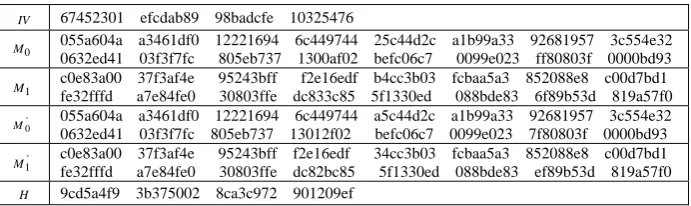
In experiment, the running time for determining the first block is within 4 hours using a PC with 1.70GHZ Pentium4 CPU, and within 20 minutes for the second block. Thus, we can find an example of MD5 collision within 5 hours. A collision example is given in Table 3 with c
4,32= b4,32= a5,32= d5,32= c5,32= b5,32= a6,32= d6,32=1 for the first iteration.
Table 3. A Collision Example for MD5
IV 67452301 efcdab89 98badcfe 10325476
0
M 055a604a a3461df0 12221694 6c449744 25c44d2c a1b99a33 92681957 3c554e32
0632ed41 03f3f7fc 805eb737 1300af02 befc06c7 0099e023 ff80803f 0000bd93
1
M c0e83a00 37f3af4e 95243bff f2e16edf b4cc3b03 fcbaa5a3 852088e8 c00d7bd1
fe32fffd a7e84fe0 30803ffe dc833c85 5f1330ed 088bde83 6f89b53d 819a57f0
' 0
M 055a604a a3461df0 12221694 6c449744 a5c44d2c a1b99a33 92681957 3c554e32
0632ed41 03f3f7fc 805eb737 13012f02 befc06c7 0099e023 7f80803f 0000bd93
' 1
M c0e83a00 37f3af4e 95243bff f2e16edf 34cc3b03 fcbaa5a3 852088e8 c00d7bd1
fe32fffd a7e84fe0 30803ffe dc82bc85 5f1330ed 088bde83 ef89b53d 819a57f0
H 9cd5a4f9 3b375002 8ca3c972 901209ef
6 Summary
the two-block collision differential path. By using small range searching technique and omitting the computing steps to check the characteristics, the probability and the complexity to find a collision of MD5 are greatly improved. The small range search-ing technique can also be used to speed up the attack of other hash functions such as MD4 and RIPEMD.
When we are summarizing our research results, we find that Yu Sasaki etc present their new message modification techniques in [14], they claim that their modification techniques can correct 14 more conditions in round 2 with probability about 1/2. Thus, the complexity is about MD5 operations considering the extra conditions in Table 4 and 5. In fact, by random selection of and in Fast Attack Algorithm for First Block, the conditions a
33
2
5
a b5
6,18= b5,18, d6,32= a6,32 = b5,32, c6,32= 0, b6,32= c6,32+ 1 in round 2 can easily fulfilled with high probability.
References
1. Ronald Rivest, The MD4 Message Digest Algorithm, RFC1320, April 1992. 2. Ronald Rivest, The MD5 Message Digest Algorithm, RFC1321, April 1992.
3. B. den. Boer, A. Bosselaers, Collisions for the Compression Function of MD5, Advances in Cryptology, EUROCRYPT’93 Proceedings, Springer-Verlag, 1994.
4. H.Dobbertin, Cryptanalysis of MD5 compress, presented at the rump session of Eurocrypt’96.
5. Xiaoyun Wang, Xuejia Lai, Dengguo Feng, et al, Cryptanalysis of the Hash Functions MD4 and RIPEMD, EUROCRYPT 2005, LNCS 3494, pp.1-18, Springer-Verlag, 2005.
6. Xiaoyun Wang, Hongbo Yu, How to Break MD5 and Other Hash Functions,
EUROCRYPT 2005, LNCS 3494, pp.19-35, Springer-Verlag, 2005.
7. Vlastimil Klima, Finding MD5 Collisions on a Notebook PC Using Multi-message Modi-fications, http://eprint.iacr.org/2005/102.pdf, 2005.
8. Patrick Stach, MD5 Collision Generator by Patrick Stach <[email protected]>,
http://www.stachliu.com.nyud.net:8090/md5coll.c
9. H. Dobbertin. “Cryptanalysis of MD4.” FSE96,pp.53-69,1996.
10. Xiaoyun Wang, Dengguo Feng, Xuejia Lai, Hongbo Yu, Collisions for Hash Functions MD4, MD5, HAVAL-128 and RIPEMD.rump session of Crypto’04, E-print, 2004/199. 11. Vlastimil Klima: Finding MD5 Collisions – a Toy For a Notebook, Cryptology ePrint
Ar-chive, Report 2005/075, http://eprint.iacr.org/2005/075.pdf, March 5, 2005.
12. Zhang-yi Wang, Huan-guo Zhang, Zhong-ping Qin, Qing-shu Meng, A Fast Attack on the MD5 Hash Function, paper submitted to The 2nd Information Security Practice and Experience Conference (ISPEC 2006).
13. Jun Yajima, Takeshi Shimoyama, Wang’s sufficient conditions of MD5 are not sufficient, http://eprint.iacr.org/2005/263.pdf, 2005.
Appendices
Table 4. A set of Sufficient Conditions for the First Iteration Differential
c
1, 7 = 0, c1,12 = 0, c1,20 = 0 Extra conditions derived from ∑i
b
1, 7=0, b1, 8=c1, 8, b1, 9=c1, 9, b1,10= c1,10, b1,11=c1,11, b1,12=1, b1,13=c1,13,
b 1,14 =c 1,14 , b 1,15 =c 1,15 , b 1,16 =c 1,16 , b 1,17 = c 1,17 ,b 1,18 =c 1,18 , b 1,19 =c 1,19 , b
1,20=1, b1,21=c1,21, b1,22=c1,22, b1,23=c1,23, b1,24=0, b1,32=1
∑5
⇒
b1, 5 = 1, b1, 6 = 1, a2, 5 = 0
a
2, 1=1, a2, 3=1, a2, 6=1, a2, 7=0, a2, 8=0, a2, 9=0, a2,10=0, a2,11=0, a2,12=0,
a
2,13=0, a2,14=0, a2,15=0, a2,16=0, a2,17=0, a2,18=0, a2,19=0, a2,20=0,
a
2,21=0, a2,22=0, a2,23=1, a2,24=0, a2,26=0, a2,28=1, a2,32=1
∑7
⇒
a2,27
= 0, a
2,29
= 0,
a
2,30 = 0, a2,31 = 0
d
2, 1
= 1, d
2, 2
= a
2, 2
, d
2, 3
= 0, d
2, 4 = a 2, 4 , d 2, 5 = a 2, 5 , d 2, 6
= 0, d
2, 7
= 1, d
2, 8
= 0, d
2, 9
= 0, d
2,10
= 0, d
2,11
= 1, d
2,12
= 1, d
2,13 = 1, d2,14 = 1, d2,15 = 0, d2,16 = 1, d2,17 = 1, d2,18 = 1, d2,19 = 1, d2,20= 1, d2,21 = 1, d2,22 = 1, d2,23 = 1,
d
2,24 = 0, d2,25 = a2,25, d2,26 = 1, d2,27 = a2,27, d2,28 = 0, d2,29 = a2,29, d2,30 = a2,30, d2,31 = a2,31, d2,32 = 0
c
2, 1 = 0, c2, 2 = 0, c2, 3 = 0, c2, 4= 0, c2, 5 = 0, c2, 6 = 1, c2, 7 = 0, c2, 8= 0, c2, 9 = 0, c2,10 = 0, c2,11 = 0, c2,12 = 1, c2,13 =
1, c
2,14 = 1, c2,15 = 1, c2,16 = 1, c2,17 = 0, c2,18 = 1, c2,19= 1, c2,20 = 1, c2,21 = 1, c2,22 = 1, c2,23 = 1, c2,24 = 1, c2,25 =
1, c
2,26 = 1, c2,27 = 0, c2,28 = 0, c2,29 = 0, c2,30 = 0, c2,31 = 0, c2,32 = 0
b
2, 1= 0, b2, 2= 0, b2, 3=0, b2, 4= 0, b2, 5= 0, b2, 6= 0, b2, 7 = 1, b2, 8 = 0, b2, 9= 1, b2,10 = 0, b2,11 = 1, b2,12= 0, b2,14 = 0,
b
2,16
= 0, b
2,17
= 1, b
2,18
= 0, b
2,19
= 0, b
2,20
= 0, b
2,21
= 1, b
2,24
= 1, b
2,25
= 1, b
2,26
= 0, b
2,27
= 0, b
2,28
= 0, b
2,29
= 0, b
2,30 = 0, b2,31 = 0, b2,32 = 0
a
3, 1=1, a3, 2=0, a3, 3=1, a3, 4=1, a3, 5=1,a3, 6=1, a3, 7=0, a3, 8=0, a3, 9=1, a3,10=1, a3,11=1, a3,12=1, a3,13=b3,13, a3,14=1,
a
3,16=0,a3,17=0,a3,18=0, a3,19=0, a3,20=0, a3,21=1, a3,25=1, a3,26=1,a3,27 =0, a3,28=1, a3,29=1, a3,30=1, a3,31=1, a3,32=1
d
3, 1= 0, d3, 2= 0, d3, 7= 1, d3, 8= 0, d3, 9= 0, d3,13= 1, d3,14= 0, d3,16= 1,
d
3,17= 1, d3,18= 1, d3,19= 1, d3,20= 1, d3,21= 1, d3,24= 0, d3,31= 1, d3,32= 0
∑11
⇒
d3,29 = 1, d3,30 = 1,
c
3,29 = 0, c3,30 = 1
c
3, 1 = 0, c3, 2 = 1, c3, 7 = 1, c3, 8 = 1, c3, 9 = 0, c3,13 = 0, c3,14 = 0, c3,15 = d3,15, c3,16 = 1, c3,17 = 1, c3,18 = 0, c3,19 = 0,
c
3,20 = 0, c3,31 = 0, c3,32 = 0
b
3, 8=0, b3, 9=1, b3,13=1, b3,14= 0, b3,15= 0, b3,16= 0, b3,17= 0,
b
3,18=0,b3,20= 1, b3,25= c3,25, b3,26= c3,26, b3,19= 0, b3,31= 0, b3,32= 0
∑12
⇒
b3,30= 0a
4, 4=1, a4, 8=0, a4, 9=0, a4,14=1, a4,15=1, a4,16=1, a4,17=1, a4,18=1, a4,19=1,a4,20=1, a4,25=1, a4,26=0, a4,31=1, a4,32=0
d
4, 4 = 1, d4, 8 = 1, d4, 9 = 1, d4,14 = 1, d4,15 = 1, d4,16 = 1, d4,17 = 1, d4,18
= 1, d
4,19 = 0, d4,20 = 1, d4,25= 0, d4,26 = 0, d4,30 = 0, d4,32 = 0
∑14
⇒
d4,31 = 0
c
4, 4 = 0, c4,16 = 1, c4,25 = 1, c4,26= 0, c4,30 = 1 ∑15
⇒
c4,15 = 0b
4,30= 1, b4,32 = c4,32 ∑16
⇒
c4,31=1,b4,22=c4,22+1,b4,31=0a
5,4 = b4,4, a5,16 = b4,16, a5,18 = 0, a5,32 = b4,32 ∑17
⇒
a5,31 = b4,31 +1= 1d
5,18 = 1, d5,30 = a5,30, d5,32 = a5,32, c5,18 = 0, c5,32 = d5,32 ∑19,4~∑19,18not all ones b
5,32
= c
5,32 ∑20,30~∑20,32not all zeros
a
6,18=b5,18, d6,32=a6,32 = b5,32, c6,32 = 0, b6,32 = c6,32 + 1, b12,32 = d12,32 ∑23,18= 0, ∑35,16= 0
a
13,32 = c12,32, d13,32 = b12,32+1, c13,32 = a13,32, b13,32 = d13,32 , a14,32 = c13,32, d14,32 = b13,32, c14,32 = a14,32, b14,32 =d14,32,
a
15,32 = c14,32 , d15,32 = b14,32 , c15,32 = a15,32 , b15,26 = 0, b15,32 = d15,32 + 1 , a16,26 = 1, a16,32 = c15,32
dd
0,26 = 0, d16,26= 0, d16,32 = b15,32 ∑62,16~∑62,22not all ones
cc
Table 5.A set of Sufficient Conditions for the Second Iteration Differential
a
1, 6 = 0, a1,12 = 0, a1,22 = 1, a1,26 = 0, a1,27 = 1, a1,28 = 0, a1,32 = bb0,32+1 Extra conditions derived from ∑i
d 1, 2 =0, d 1, 3 =0, d 1, 6 =0, d 1, 7 =a 1, 7 , d 1, 8 =a 1, 8 , d 1,12 =1, d 1,13 =a 1,13 , d 1,17 =1, d
1,18=a1,18, d1,19=a1,19, d1,20=a1,20, d1,21=a1,21, d1,22=0, d1,26=0, d1,27=1,
d
1,28=1, d1,29=a1,29, d1,30=a1,30, d1,31=a1,31, d1,32=a1,32
∑3
⇒
a1,17=1, d1,16=0, c1,16=1
c
1, 2=1, c1, 3=1, c1, 4=d1, 4, c1, 5=d1, 5, c1, 6=1, c1, 7=1, c1, 8=0, c1, 9=1,
c
1,12=1, c1,13=0, c1,17=1, c1,18=1, c1,19=1, c1,20=1, c1,21=1, c1,22=0,
c
1,26=1, c1,27=1, c1,28=1, c1,29=1, c1,30=1, c1,31=0, c1,32=d1,32
∑5
⇒
c1,1=1b
1, 1=1, b1, 2=0, b1, 3=0, b1, 4=0, b1, 5=1, b1, 6=0, b1, 7=0, b1, 8=0, b1, 9=0, b1,10=c1,10, b1,11=c1,11, b1,12=0, b1,13=0,
b
1,17=0, b1,18=0, b1,19=1, b1,20=0, b1,21=0, b1,22=0, b1,26=1, b1,27=0, b1,28=1, b1,29=1, b1,30=1, b1,31=0, b1,32=c1,32
a
2, 1=0, a2, 2=0, a2, 3=0, a2, 4=0, a2, 5=1, a2, 6=0, a2, 7=1, a2, 8=0, a2, 9=0,
a
2,10=1, a2,11=1, a2,12=1, a2,13=0, a2,17=1, a2,18=1, a2,19=1, a2,20=1,
a
2,21=0, a2,22=1,a2,27=0, a2,28=1, a2,29=0, a2,30=0, a2,31=1, a2,32=b1,32+1
∑7
⇒
d2,15=1, c2,15=0d
2, 1 = 0, d2, 2 = 1, d2, 3 = 1, d2, 4 = 0, d2, 5 = 1, d2, 6 = 0, d2, 7 = 1, d2, 8 = 0, d2, 9 = 0, d2,10 = 0, d2,11 = 1, d2,12 = 1,
d
2,13 = 0, d2,17 = 0, d2,18 = 1, d2,21 = 0, d2,22 = 1, d2,26 = 0, d2,27 = 1, d2,28 = 0, d2,29 = 0, d2,32 = a2,32
c
2, 1 = 1, c2, 7 = 0, c2, 8 = 0, c2, 9 = 0, c2,10 = 1, c2,11 = 1, c2,12= 1, c2,13 = 1, c2,16 = d2,16, c2,17 = 1, c2,18 = 0, c2,21= 0,
c
2,22 = 0, c2,24 = d2,24, c2,25 = d2,25, c2,26= 1, c2,27 = 1, c2,28 = 0, c2,29 = 1, c2,32 = d2,32+1
b
2, 1=0,b2, 2=c2, 2,b2, 7=1,b2, 8=1,b2, 9=1,b2,10=1,b2,16=1,b2,17=0,b2,18=1,
b
2,21=1,b2,22=1,b2,24=0,b2,25=0,b2,26=0,b2,27=1,b2,28=0,b2,29=0,b2,32=c2,32
∑9
⇒
b2,6 = 1, a3,6 = 0
a
3, 1 = 1, a3, 2 = 0, a3, 7 = 1, a3, 8 = 1, a3, 9 = 1, a3,10 = 0, a3,13 = b2,13, a3,16 = 0, a3,17 = 1, a3,18 = 0, a3,24 = 0, a3,25 = 0,
a
3,26
= 0, a
3,27
= 1, a
3,28
= 1, a
3,29
= 1, a
3,32
= b
2,32
d
3, 1=0, d3, 2=0, d3, 7=1, d3, 8=1, d3, 9=1, d3,10=1, d3,13=0, d3,16=1,
d
3,17=1, d3,18=1, d3,19=0, d3,24=1, d3,25=1, d3,26=1, d3,27=1, d3,32=a3,32
∑11
⇒
d3,12 = 1, c3,12 = 0c
3, 1 = 1, c3, 2 = 1, c3, 7 = 1, c3, 8 = 1, c3, 9 = 1, c3,10 = 1, c3,13 = 0, c3,14 = d3,14, c3,15 = d3,15, c3,16 = 1, c3,17 = 1,
c
3,18 = 0, c3,19 = 1, c3,20 = d3,20, c3,32 = d3,32
b
3, 8 = 1, b3,13 = 1, b3,14 = 0, b3,15 = 0, b3,16 = 0, b3,17 = 0, b3,18 = 0, b3,19= 0, b3,20 = 1, b3,25 = c3,25, b3,26 = c3,26,
b
3,27 = c3,27, b3,28 = c3,28, b3,29 = c3,29, b3,30 = c3,30, b3,31 = c3,31, b3,32 = c3,32
a
4,4=1,a4,8=0,a4,14=1,a4,15=1,a4,16=1,a4,17=1,a4,18=1,a4,19=1,a4,20=1,
a
4,25=1,a4,26=1,a4,27=1,a4,28=1,a4,29=1,a4,30=1,a4,31=0,a4,32=b3,32+1
∑14
⇒
a4,24= 0, d4,24= 1
d
4, 4 = 1, d4, 8 = 1, d4,14= 1, d4,15 = 1, d4,16 = 1, d4,17 = 1, d4,18 = 1, d4,19 = 0, d4,20 = 1 d4,25 = 0, d4,26 = 0, d4,27 = 0,
d
4,28
= 0, d
4,29
= 0, d
4,30
= 0, d
4,31
= 1, d
4,32
= a
4,32
c
4, 4=0, c4,16=0, c4,25=1, c4,26=0, c4,27=1, c4,28=1, c4,29=1, c4,30=1,c4,31=1 ∑15
⇒
c4,17 = 0b
4, 4 = 1, b4,32 = c4,32 ∑16
⇒
b4,16= 1, b4,17= 1, b4,29= 0a 5, 4 = b 4, 4 , a 5,16 = b 4,16 , a 5,18
= 0, a
5,32
= b
4,32 ∑17,25~∑17,27not all ones
d
5,18 = 1, d5,30 = a5,30, d5,32 = a5,32, c5,18 = 0, c5,32 = d5,32 ∑19,4~∑19,18not all ones
b
5,32 = c5,32 ∑20,30~∑20,32not all zeros
a
6,18= b5,18, d6,32 = a6,32 = b5,32, c6,32 = 0, b6,32 = c6,32 + 1, b12,32 = d12,32 ∑23,18= 0, ∑35,16= 1 a 13,32 = c 12,32 , d 13,32 = b 12,32
+ 1, c
13,32 = a 13,32 , b 13,32 = d 13,32 ,a 14,32 = c 13,32 , d 14,32 = b 13,32 , c 14,32 = a 14,32 , b
14,32 = d14,32, a15,32 = c14,32, d15,32 = b14,32, c15,32 = a15,32, b15,26 =0, b15,32 = d15,32 + 1, a16,26 = 1, a16,32 = c15,32
d
Table 6. A Counterexample Satisfied Cnditions in Table 5 Ecept for b
15,26= 1
1
H aa14309f 80820546 c273be7a cdc25be6
1
M e4473624 f5c3d164 9d285199 42a37cde 4513f7f9 4cadc2fe a6208936 c2027bcd
bdfbfefd 7f00fd6 301ffffe 4420063 fef41cbe 7f3b44f 580a4fb2 a21a69f2
2
H d0fa79d fa896b4e 8d8d224 81a9a7d9
' 1
H 2a14309f 2820546 4473be7a 4fc25be6
' 1
M e4473624 f5c3d164 9d285199 42a37cde c513f7f9 4cadc2fe a6208936 c2027bcd
bdfbfefd 7f00fd6 301ffffe 4418063 fef41cbe 7f3b44f d80a4fb2 a21a69f2
' 2
H d0fa79d ba896c4e 8d8d324 81a9a7d9
Table 7. A Collision Example for The First Block with a
16,27= 1
IV 67452301 efcdab89 98badcfe 10325476
0
M 10e53c6b 57e8f46b e861c5ea 5736e652 51c3a485 e111fe10 939aa559 e9039a39
6332d51 2341c04 82b0fb4b 57b2e311 429126e3 4a8c20db 62ce4193 52823034
H cdb59525 90550918 b204dbce 99a80f8f '
0
M 10e53c6b 57e8f46b e861c5ea 5736e652 d1c3a485 e111fe10 939aa559 e9039a39
6332d51 2341c04 82b0fb4b 57b36311 429126e3 4a8c20db e2ce4193 52823034
'
H 4db59525 12550918 3404dbce 1ba80f8f
Table 8. A Counterexample Satisfied Cnditions in Table 4 Ecept for c
16,32= d16,32≠a16,32
IV 67452301 efcdab89 98badcfe 10325476
0
M b3ff8745 c72eb352 5f2ff952 a9b33ceb fc7993f8 b7687688 c1548362 8180b92e
6342d45 23f43bfd 7c42a22f 14a14334 332550f3 34ab42c4 7423620c 341f42b4
H a9a392c8 6118e81d 7a12d3b4 d116e78 '
0
M b3ff8745 c72eb352 5f2ff952 a9b33ceb 7c7993f8 b7687688 c1548362 8180b92e
6342d45 23f43bfd 7c42a22f 14a1c334 332550f3 34ab42c4 f423620c 341f42b4
'
H 29a392c8 e308e81d fc12d3b4 8f116e78
Table 9. A Counterexample Satisfied Cnditions in Table 4 Ecept for d
16,26= 1
IV 67452301 efcdab89 98badcfe 10325476
0
M b02f512a c7be044b 13214fe0 c64ba7e7 80c78f18 fd09b7fa 9b9da541 fa069c37
633ed51 3f40000 8060b83f d2026306 df7ea316 59cfe3 fffdf 804c0267
H 69bf3aa8 612a7041 125353f8 24072fa0 '
0
M b02f512a c7be044b 13214fe0 c64ba7e7 00c78f18 fd09b7fa 9b9da541 fa069c37
633ed51 3f40000 8060b83f d202e306 df7ea316 59cfe3 800fffdf 804c0267
'
H e9bf3aa8 a329f241 945355f8 a6072fa0
Table 10. A Counterexample Satisfied Cnditions in Table 4 Ecept for c
16,26= 1
IV 67452301 efcdab89 98badcfe 10325476
0
M fc552b76 58000108 ea1a196e 131f05e1 65ec44b7 74f3a5a7 9b9da541 fa069c37
633ed51 3f40000 8060b84f 12010307 efe02fe c0fdb ff7fffef 7ffc018e
H 2e75bf44 7064f413 230c5438 5cd4be64 '
0
M fc552b76 58000108 ea1a196e 131f05e1 e5ec44b7 74f3a5a7 9b9da541 fa069c37
633ed51 3f40000 8060b84f 12018307 efe02fe c0fdb 7f7fffef 7ffc018e
'