C-l. Subordinate leadership development is
one of the most important responsibilities of
every Army leader. Developing the leaders who will come after you should be one of your
high-est priorities. Your legacy and the Army's
fu-ture rests on the shoulders of those you prepare
for greater responsibility.
C-2. Leadership development reviews are a
means to focus the growing of tomorrow's
lead-ers. Think of them as AARs with a focus of
mak-ing leaders more effective every day. These
important reviews are not necessarily limited
to internal counseling sessions; leadership
feed-back mechanisms also apply in operational
set-tings such as the CTCs.
C-3. Just as training includes AARs and
train-ing strategies to fIx shortcomings, leadership
development includes performance reviews.
These reviews result in agreements between
leader and subordinate on a development
strat-egy or plan of action that builds on the
subordi-nate's strengths and establishes goals to
improve on weaknesses. Leaders conduct
per-formance reviews and create plans of action
during developmental counseling.
C-4. Leadership development reviews are a
component of the broader concept of
develop-mental counseling. Developmental counseling
is subordinate-centered communication that
produces a plan outlining actions that
subordi-nates must take to achieve individual and
or-ganizational goals. During developmental
counseling, subordinates are not merely
pas-sive listeners; they're actively involved in the
process. The Developmental Counseling Form
(DA Form 4856- E, which is discussed at the end
of this appendix) provides a useful framework
to prepare for almost any type of counseling.
Use it to help you mentally organize issues and
isolate important, relevant items to cover
dur-ing counseldur-ing sessions.
C-5. Developmental counseling is a shared
ef-fort. As a leader, you assist your subordinates in
identifying strengths and weaknesses and
cre-ating plans of action. Then you support them
throughout the plan implementation and
as-sessment. However, to achieve success, your
subordinates must be forthright in their
com-mitment to improve and candid in their own
as-sessment and goal setting.
THE LEADER'S RESPONSIBILITIES
C-6. Organizational readiness and mission
ac-complishment depend on every member's
abil-ity to perform to established standards.
Supervisors must mentor their subordinates
through teaching, coaching, and counseling.
Leaders coach subordinates the same way
sports coaches improve their teams: by
identify-ing weaknesses, setting goals, developing and
implementing plans of action, and providing
oversight and motivation throughout the
pro-cess. To be effective coaches, leaders must
thor-oughly understand the strengths, weaknesses,
and professional goals of their subordinates.
(Chapter 5 discusses coaching.)
C-7. Army leaders evaluate DA civilians using
procedures prescribed under the Total Army
Performance Evaluation System (TAPES).
Al-though TAPES doesn't address developmental
counseling, you can use DA Form 4856- E to
counsel DA civilians concerning professional
growth and career goals. DA Form 4856-E is
not appropriate for documenting counseling
concerning DA civilian misconduct or poor
per-formance. The servicing civilian personnel
of-fice can provide guidance for such situations.
C-8. Soldiers and DA civilians often perceive
who counsel properly can change that perception. Anny leaders conduct counseling to help subordi-nates become better members of the team,
main-tain or improve performance, and prepare for the
future. Just as no easy answers exist for exactly
what to do in all leadership situations, no easy
answers exist for exactly what to do in all
counsel-ing situations. However, to conduct effective
counseling, you should develop a counseling style
with the characteristics listed in Figure C-l.
.
Purpose: Clearly define the purpose of the counseling..
Flexibility: Fit the counseling style to the character of each subordinate and to therelation-ship desired.
.
Respect: View subordinates as unique, complex individuals, each with a distinct set of values,beliefs, and attitudes.
.
Communication: Establish open, two-way communication with subordinates using spokenlanguage, nonverbal actions, gestures, and body language. Effective counselors listen more
than they speak.
.
Support: Encourage subordinates through actions while guiding them through theirprob-lems.
Figure C-1. Characteristics of Effective Counseling
THE LEADER
AS A COUNSELOR
C-9. Army leaders must demonstrate certain
qualities to be effective counselors. These
quali-ties include respect for subordinates,
self-awareness and cultural awareness, empathy,
and credibility.
RESPECT FOR SUBORDINATES
C-IO. As an Army leader, you show respect for
subordinates when you allow them to take
re-sponsibility for their own ideas and actions.
Re-specting subordinates helps create mutual
respect in the leader-subordinate relationship.
Mutual respect improves the chances of
chang-ing (or maintainchang-ing) behavior and achieving
goals.
SELF AWARENESS AND CULTURAL
AWARENESS
C-l1. As an Army leader, you must be fully
aware of your own values, needs, and biases
prior to counseling subordinates. Self-aware
leaders are less likely to project their biases
onto subordinates. Also, aware leaders are
more likely to act consistently with their own
values and actions.
C-12. Cultural awareness, as discussed in
Chapter 2, is a mental attribute. As an Army
leader, you need to be aware of the similarities
and differences between individuals of different
cultural backgrounds and how these factors
may influence values, perspectives, and actions.
Don't let unfamiliarity with cultural
back-grounds hinder you in addressing cultural
is-sues, especially if they generate concerns
within the organization or hinder
team-building. Cultural awareness enhances your
EMPATHY
C-13. Empathy is the action of being
understanding of and sensitive to the feelings,
thoughts, and experiences of another person to
the point that you can almost feel or experience
them yourself. Leaders with empathy can put
themselves in their subordinate's shoes; they
can see a situation from the other person's
per-spective. By understanding the subordinate's
position, you can help a subordinate develop a
plan of action that fits the subordinate's
per-sonality and needs, one that works for the
sub-ordinate. If you don't fully comprehend a
situation from your subordinate's point of view,
you have less credibility and influence and your
subordinate is less likely to commit to the
agreed upon plan of action.
CREDmILITY
C-14. Leaders achieve credibility by being
hon-est and consistent in their statements and
ac-tions. To be credible, use a straightforward
style with your subordinates. Behave in a
man-ner that your subordinates respect and trust.
You can earn credibility by repeatedly
demon-strating your willingness to assist a
subordi-nate and being consistent in what you say and
do. If you lack credibility with your
subordi-nates you'll find it difficult to influence them.
LEADER COUNSELING
SKILLS
C-15. One challenging aspect of counseling is
selecting the proper approach to a specific
situation. To counsel effectively, the technique
you use must fit the situation, your capabilities,
and your subordinate's expectations. In some
cases, you may only need to give information or
listen. A subordinate's improvement may call
for just a brief word of praise. Other situations
may require structured counseling followed by
definite actions.
C-16. All leaders should seek to develop and
improve their own counseling abilities. You can
improve your counseling techniques by
study-ing human behavior, learning the kinds
ofprob-lems that affect your subordinates, and
developing your interpersonal skills. The
tech-niques needed to provide effective counseling
will vary from person to person and session to
session. However, general skills that you'll
need in almost every situation include active
listening, responding, and questioning.
ACTIVE LISTENING
C-l 7. During counseling, you must actively
lis-ten to your subordinate. When you're actively
listening, you communicate verbally and
non-verbally that you've received the subordinate's
message. To fully understand a subordinate's
message, you must listen to the words and
ob-serve the subordinate's manners. Elements of
active listening you should consider
include-.
Eye contact. Maintaining eye contactwithout staring helps show sincere interest.
Occasional breaks of contact are normal and
acceptable. Subordinates may perceive
excessive breaks of eye contact, paper
shuf-fling, and clock-watching as a lack of
inter-est or concern. These are guidelines only.
Based on cultural background, participants
in a particular counseling session may have
different ideas about what proper eye
contact is.
Body posture. Being relaxed and
com-fortable will help put the subordinate at
ease. However, a too-relaxed position or
slouching may be interpreted as a lack of
in-terest.
Head
nods. Occasionally nodding yourhead shows you're paying attention and
encourages the subordinate to continue.
Facial expressions. Keep your facial
expressions natural and relaxed. A blank
look or fixed expression may disturb the
subordinate. Smiling too much or frowning
may discourage the subordinate from
continuing.
Verbal expressions. Refrain from talking
too much and avoid interrupting. Let the
subordinate do the talking while keeping
the discussion on the counseling subject.
Speaking only when necessary reinforces
the importance of what the subordinate is
saying and encourages the subordinate to
.
.
.
continue. Silence can also do this, but be
careful. Occasional silence may indicate to
the subordinate that it's okay to continue
talking, but a long silence can sometimes be
distracting and make the subordinate feel
uncomfortable.
C-18. Active listening also means listening
thoughtfully and deliberately to the way a
sub-ordinate says things. Stay alert for common
themes. A subordinate's opening and closing
statements as well as recurring references may
indicate the subordinate's priorities.
Inconsis-tencies and gaps may indicate a subordinate's
avoidance of the real issue. This confusion and
uncertainty may suggest additional questions.
C-19. While listening, pay attention to the
sub-ordinate's gestures. These actions complete the
total message. By watching the subordinate's
actions, you can "see" the feelings behind the
words. Not all actions are proof of a
subordi-nate's feelings, but they should be taken into
consideration. Note differences between what
the subordinate says and does. Nonverbal
indi-cators of a subordinate's attitude
include-.
Boredom. Drumming on the table,doodling, clicking a ball-point pen, or
rest-ing the head in the palm of the hand.
.
Self-confidence. Standing tall, leaningback with hands behind the head, and
maintaining steady eye contact.
.
Defensiveness. Pushing deeply into achair, glaring at the leader, and making
sarcastic comments as well as crossing or
folding arms in front of the chest.
.
Frustration. Rubbing eyes, pulling on anear, taking short breaths, wringing the
hands, or frequently changing total body
po-sition.
.
Interest, friendliness, and openness.Moving toward the leader while sitting.
.
Openness or anxiety. Sitting on the edgeof the chair with arms uncrossed and hands
open.
C-20. Consider these indicators carefully.
Al-though each indicator may show something
about the subordinate, don't assume a
particu-lar behavior absolutely means something. Ask
the subordinate about the indicator so you can
better understand the behavior and allow the
subordinate to take responsibility for it.
RESPONDING
C-21. Responding skills follow-up on active
lis-tening skills. A leader responds to communicate
that the leader understands the subordinate.
From time to time, check your understanding: clarify and confirm what has been said. Respond
to subordinates both verbally and nonverbally.
Verbal responses consist of summarizing,
inter-preting, and clarifying the subordinate's
mes-sage. Nonverbal responses include eye contact
and occasional gestures such as a head nod.
QUESTIONING
C-22. Although questioning is a necessary skill,
you must use it with caution. Too many
ques-tions can aggravate the power differential
be-tween a leader and a subordinate and place the
subordinate in a passive mode. The subordinate
may also react to excessive questioning as an
in-trusion of privacy and become defensive.
Dur-ing a leadership development review, ask
questions to obtain information or to get the
subordinate to think about a particular
situa-tion. Generally, the questions should be
open-ended so as to evoke more than a yes or no
an-swer. Well-posed questions may help to verify
understanding, encourage further explanation,
or help the subordinate move through the
stages of the counseling session.
COUNSELING ERRORS
C-23. Effective leaders avoid common
counseling mistakes. Dominating the
counsel-ing by talkcounsel-ing too much, givcounsel-ing unnecessary or
inappropriate "advice," not truly listening, and
projecting personal likes, dislikes, biases, and
prejudices all interfere with effective
counseling. You should also avoid other
com-mon mistakes such as rash judgments,
stereo-types, loss of emotional control, inflexible
methods of counseling and improper follow-up.
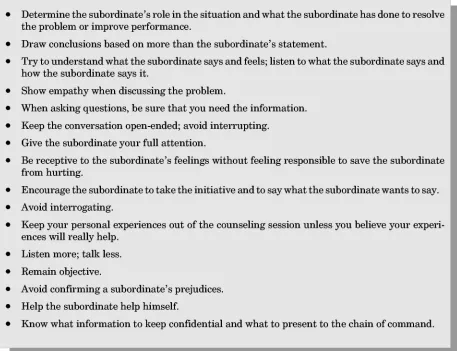
To improve your counseling skills, follow the
.
Determine the subordinate's role in the situation and what the subordinate has done to resolve the problem or improve performance.Draw conclusions based on more than the subordinate's statement.
.
.
Try to understand what the subordinate says and feels; listen to what the subordinate says andhow the subordinate says it.
.
Show empathy when discussing the problem..
When asking questions, be sure that you need the information..
Keep the conversation open-ended; avoid interrupting..
Give the subordinate your full attention..
Be receptive to the subordinate's feelings without feeling responsible to save the subordinatefrom hurting.
.
Encourage the subordinate to take the initiative and to say what the subordinate wants to say..
Avoid interrogating..
Keep your personal experiences out of the counseling session unless you believe yourexperi-ences will really help.
Listen more; talk less.
Remain objective.
.
.
.
Avoid confirming a subordinate's prejudices..
Help the subordinate help himself.Know what information to keep confidential and what to present to the chain of command.
.
Figure C-2. Guidelines to Improve Counseling
THE LEADER'S LIMITATIONS
C-24. Army leaders can't help everyone in every
situation. Even professional counselors can't
provide all the help that a person might need.
You must recognize your limitations and, when
the situation calls for it, refer a subordinate to a
person or agency more qualified to help.
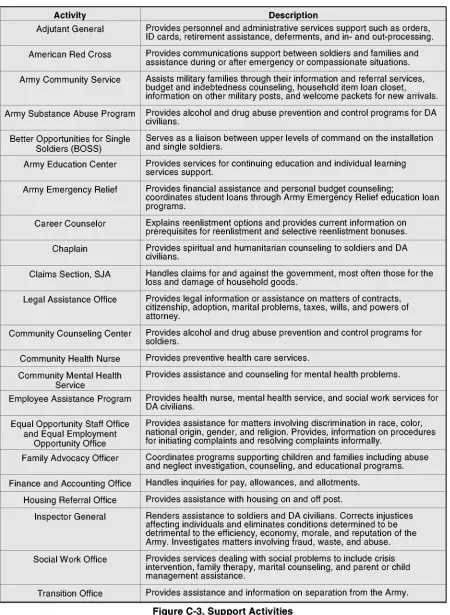
C-25. These agencies Figure C-3 lists can help you and your people resolve problems. Although
it's generally in an individual's best interest to
seek help first from their first-line leaders,
lead-ers must always respect an individual's right to
Activity DescriDtion
Adjutant General Provides personnel and administrative services support such as orders, ID cards, retirement assistance, deferments, and in- and out-processing.
American Red Cross Provides communications support between soldiers and families and assistance during or after emergency or compassionate situations.
Army Community Service Assists military families through their information and referral services, budget and indebtedness counseling, household item loan closet, information on other military posts, and welcome packets for new arrivals.
Army Substance Abuse Program Provides alcohol and drug abuse prevention and control programs for DA civilians.
Better Opportunities for Single Serves as a liaison between upper levels of command on the installation Soldiers (BOSS) and single soldiers.
Army Education Center Provides services for continuing education and individual learning services support.
Army Emergency Relief Provides financial assistance and personal budget counselin~;
coordinates student loans through Army Emergency Relief e ucation loan programs.
Career Counselor Explains reenlistment options and provides current information on prerequisites for reenlistment and selective reenlistment bonuses.
Chaplain Provides spiritual and humanitarian counseling to soldiers and DA civilians.
Claims Section, SJA Handles claims for and against the government, most often those for the loss and damage of household goods.
Legal Assistance Office Provides legal information or assistance on matters of contracts, citizenship, adoption, marital problems, taxes, wills, and powers of attorney.
Community Counseling Center Provides alcohol and drug abuse prevention and control programs for soldiers.
Community Health Nurse Provides preventive health care services.
Community Mental Health Provides assistance and counseling for mental health problems. Service
Employee Assistance Program Provides health nurse, mental health service, and social work services for DA civilians.
Equal Opportunity Staff Office Provides assistance for matters involving discrimination in race, color, and Equal Employment national origin, gender, and religion. Provides, information on procedures
Opportunity Office for initiating complaints and resolving complaints informally.
Family Advocacy Officer Coordinates programs supporting children and families including abuse and neglect investigation, counseling, and educational programs.
Finance and Accounting Office Handles inquiries for pay, allowances, and allotments.
Housing Referral Office Provides assistance with housing on and off post.
Inspector General Renders assistance to soldiers and DA civilians. Corrects injustices affecting individuals and eliminates conditions determined to be detrimental to the efficiency, economrr' morale, and reputation of the Army. Investigates matters involving raud, waste, and abuse.
Social Work Office Provides services dealing with social problems to include crisis intervention, family therapy, marital counseling, and parent or child management assistance.
Transition Office Provides assistance and information on separation from the Army.
TYPES OF DEVELOPMENTAL COUNSELING
C-26. You can often categorize developmental
counseling based on the topic of the session. The
two major categories of counseling are
event-oriented and performance/professional growth.
EVENT-ORIENTED COUNSELING
C-27. Event-oriented counseling involves a
specific event or situation. It may precede
events, such as going to a promotion board or
attending a school; or it may follow events, such
as a noteworthy duty performance, a problem
with performance or mission accomplishment,
or a personal problem. Examples of
event-oriented counseling include, but are not limited
to-Specific instances of superior or
substan-dard performance.
Reception and integration counseling.
Crisis counseling. Referral counseling.
Promotion counseling.
Separation counseling.
Counseling for Specific Instances
C-28. Sometimes counseling is tied to specific
instances of superior or substandard duty
per-formance. You tell your subordinate whether or
not the performance met the standard and what
the subordinate did right or wrong. The key to
successful counseling for specific performance
is to conduct it as close to the event as possible.
.
.
.
.
.
.
C-29. Many leaders focus counseling for
spe-cific instances on poor performance and miss,
or at least fail to acknowledge, excellent
per-formance. You should counsel subordinates for
specific examples of superior as well as
substan-dard duty performance. To measure your own
performance and counseling emphasis, you can
note how often you document counseling for
su-perior versus substandard performance.
C-30. You should counsel subordinates who
don't meet the standard. If the subordinate's
performance is unsatisfactory because of a lack
of knowledge or ability, you and the
subordi-nate should develop a plan to improve the
sub-ordinate's skills. Corrective training may be
required at times to ensure the subordinate
knows and achieves the standard. Once the
sub-ordinate can achieve the standard, you should
end the corrective training.
C-31. When counseling a subordinate for a
spe-cific performance, take the following actions:
.
Tell the subordinate the purpose of thecounseling, what was expected, and how the
subordinate failed to meet the standard.
.
Address the specific unacceptable behavioror action, not the person's character.
.
Tell the subordinate the effect of thebehav-ior, action, or performance on the rest of the
organization.
.
Actively listen to the subordinate'sre-sponse.
.
Remain unemotional..
Teach the subordinate how to meet thestandard.
.
Be prepared to do some personal counseling,since a failure to meet the standard may be
related to or the result of an unresolved
per-sonal problem.
.
Explain to the subordinate what will bedone to improve performance (plan of
ac-tion). Identify your responsibilities in
im-plementing the plan of action; continue to
assess and follow up on the subordinate's progress. Adjust plan of action as necessary.
Reception and Integration Counseling
C-32. As the leader, you must counsel new
team members when they arrive at your
organi-zation. This reception and integration
counsel-ing serves two purposes. First, it identifies and
helps fix any problems or concerns that new
members may have, especially any issues
re-sulting from the new duty assignment. Second,
it lets them know the organizational standards
and how they fit into the team. It clarifies job
ti-tles and sends the message that the chain of
command cares. Reception and integration
counseling should begin immediately upon
arri-val so new team members can quickly become
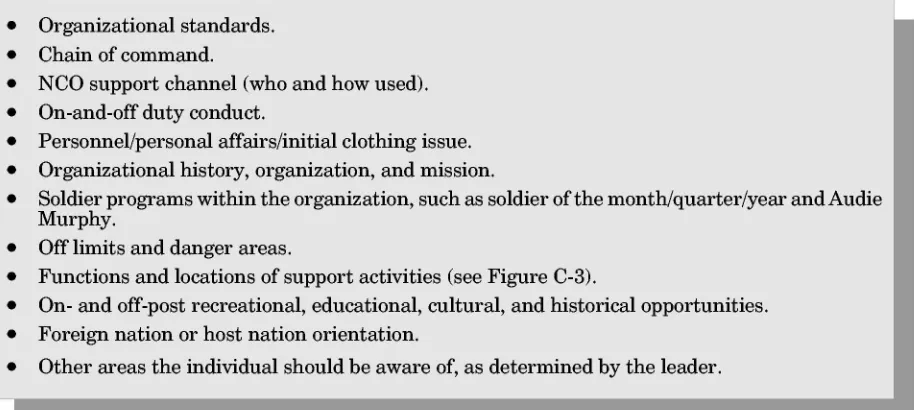
integrated into the organization. (Figure C-4
Organizational standards. Chain of command.
NCO support channel (who and how used).
On-and-off duty conduct.
Personnel/personal affairs/initial clothing issue.
Organizational history, organization, and mission.
Soldier programs within the organization, such as soldier of the month/quarter/year and Audie
Murphy.
Off limits and danger areas.
Functions and locations of support activities (see Figure C-3).
On- and off-post recreational, educational, cultural, and historical opportunities.
Foreign nation or host nation orientation.
Other areas the individual should be aware of, as determined by the leader.
.
.
.
.
.
.
.
.
.
.
.
.
Figure C-4. Reception and Integration Counseling Points
Crisis Counseling
C-33. You may conduct crisis counseling to get
a subordinate through the initial shock after
re-ceiving negative news, such as notification of
the death of a loved one. You may assist the
sub-ordinate by listening and, as appropriate,
pro-viding assistance. Assistance may include
referring the subordinate to a support activity
or coordinating external agency support. Crisis
counseling focuses on the subordinate's
imme-diate, short-term needs.
Referral Counseling
C-34. Referral counseling helps subordinates
work through a personal situation and mayor
may not follow crisis counseling. Referral
coun-seling may also act as preventative counseling
before the situation becomes a problem.
Usu-ally, the leader assists the subordinate in
iden-tifying the problem and refers the subordinate
to the appropriate resource, such as Army
Com-munity Services, a chaplain, or an alcohol and
drug counselor. (Figure C-3 lists support
activi-ties.)
Promotion Counseling
C-35. Leaders must conduct promotion
coun-seling for all specialists and sergeants who are
eligible for advancement without waivers but
not recommended for promotion to the next
higher grade. Army regulations require that
soldiers within this category receive initial
(event-oriented) counseling when they attain
full eligibility and then periodic
(perform-ance/personal growth) counseling thereafter.
Adverse Separation Counseling
C-36. Adverse separation counseling may
in-volve informing the soldier of the
administra-tive actions available to the commander in the
event substandard performance continues and
of the consequences associated with those
ad-ministrative actions (see AR 635-200).
C-3 7. Developmental counseling may not apply
when an individual has engaged in more serious
acts of misconduct. In those situations, you
should refer the matter to the commander and
the servicing staff judge advocate. When the
leader's rehabilitative efforts fail, counseling
with a view towards separation fills an
adminis-trative prerequisite to many administrative
dis-charges and serves as a final warning to the
soldier to improve performance or face
dis-charge. In many situations, it may be beneficial
to involve the chain of command as soon as you
determine that adverse separation counseling
might be required. A unit first sergeant or
com-mander should be the person who informs the
soldier of the notification requirements
PERFORMANCE AND PROFESSIONAL
GROWTH COUNSELING
Performance Counseling
C-38. During performance counseling, you
con-duct a review of a subordinate's duty
perfor-mance during a certain period. You and the
subordinate jointly establish performance
ob-jectives and standards for the next period.
Rather than dwelling on the past, you should
fo-cus the session on the subordinate's strengths,
areas needing improvement, and potential.
C-39. Performance counseling is required
un-der the officer, NCO, and DA civilian evaluation
reporting systems. The OER process requires
periodic performance counseling as part of the
OER Support Form requirements. Mandatory,
face-to-face performance counseling between
the rater and the rated NCO is required under
the NCOERS. TAPES includes a combination
of both of these requirements.
C-40. Counseling at the beginning of and
dur-ing the evaluation period facilitates a
subordi-nate's involvement in the evaluation process.
Performance counseling communicates
stan-dards and is an opportunity for leaders to
estab-lish and clarify the expected values, attributes,
skills, and actions. Part !Vb (Leader
Attrib-utes/Skills/Actions) of the OER Support Form
(DA Form 67-9-1) serves as an excellent tool for
leaders doing performance counseling. For
lieutenants and warrant officers one, the major
performance objectives on the OER Support
Form are used as the basis for determining the
developmental tasks on the Junior Officer
De-velopmental Support Form (DA Form 67-9-1a).
Quarterly face-to-face performance and
devel-opmental counseling is required for these junior
officers as outlined in AR 623-105.
C-41. As an Army leader, you must ensure
you've tied your expectations to performance
objectives and appropriate standards. You must
establish standards that your subordinates can
work towards and must teach them how to
achieve the standards if they are to develop.
Professional Growth Counseling
C-42. Professional growth counseling includes
planning for the accomplishment of individual
and professional goals. You conduct this
counseling to assist subordinates in achieving
organizational and individual goals. During the
counseling, you and your subordinate conduct a
review to identify and discuss the subordinate's
strengths and weaknesses and create a plan of
action to build upon strengths and overcome
weaknesses. This counseling isn't normally
event-driven.
C-43. As part of professional growth
counseling, you may choose to discuss and
de-velop a "pathway to success" with the
subordi-nate. This future-oriented counseling
establishes short- and long-term goals and
ob-jectives. The discussion may include
opportuni-ties for civilian or military schooling, future
duty assignments, special programs, and
reen-listment options. Every person's needs are
dif-ferent, and leaders must apply specific courses
of action tailored to each individual.
C-44. Career field counseling is required for
lieutenants and captains before they're
considered for promotion to major. Raters
and senior raters, in conjunction with the
rated officer, need to determine where the
of-ficer's skills best fit the needs of the Army.
During career field counseling, consideration
must be given to the rated officer's
prefer-ence and his abilities (both performance and
academic). The rater and senior rater should
discuss career field designation with the
offi-cer prior to making a recommendation on the
rated officer's OER.
C-45. While these categories can help you
or-ganize and focus counseling sessions, they
should not be viewed as separate, distinct, or
exhaustive. For example, a counseling
ses-sion that focuses on resolving a problem may
also address improving duty performance. A
session focused on performance may also
in-clude a discussion on opportunities for
pro-fessional growth. Regardless of the topic of
the counseling session, leaders should follow
the same basic format to prepare for and
APPROACHES
TO COUNSELING
C-46. An effective leader approaches each
sub-ordinate as an individual. Different people and
different situations require different
counsel-ing approaches. Three approaches to
counsel-ing include nondirective, directive, and
combined. These approaches differ in the
tech-niques used, but they all fit the definition of
counseling and contribute to its overall
pur-pose. The major difference between the
ap-proaches is the degree to which the subordinate
participates and interacts during a counseling
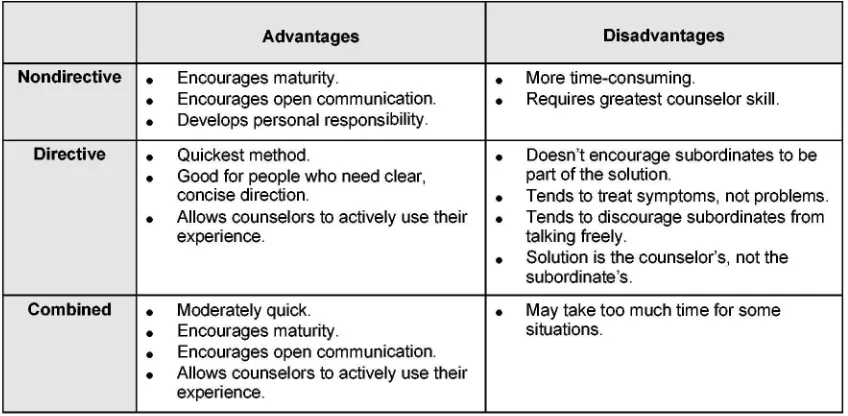
session. Figure C-5 summarizes the advantages
and disadvantages of each approach.
NONDIRECTIVE
C-47. The nondirective approach is preferred
for most counseling sessions. Leaders use their
experienced insight and judgment to assist
sub-ordinates in developing solutions. You should
partially structure this type of counseling by
telling the subordinate about the counseling
process and explaining what you expect.
C-48. During the counseling session, listen
rather than make decisions or give advice.
Clar-ify what's said. Cause the subordinate to bring
out important points, so as to better
under-stand the situation. When appropriate,
summa-rize the discussion. Avoid providing solutions or
rendering opinions; instead, maintain a focus
on individual and organizational goals and
ob-jectives. Ensure the subordinate's plan of
ac-tion supports those goals and objectives.
DIRECTIVE
C-49. The directive approach works best to
cor-rect simple problems, make on-the-spot
correc-tions, and correct aspects of duty performance. The leader using the directive style does most of
the talking and tells the subordinate what to do
and when to do it. In contrast to the
nondirec-tive approach, the leader directs a course of
ac-tion for the subordinate.
C-50. Choose this approach when time is short, when you alone know what to do, or if a
subor-dinate has limited problem-solving skills. It's
also appropriate when a subordinate needs
guidance, is immature, or is insecure.
COMBINED
C-51. In the combined approach, the leader
uses techniques from both the directive and
nondirective approaches, adjusting them to
ar-ticulate what's best for the subordinate. The
combined approach emphasizes the
sub-ordinate's planning and decision-making
responsibilities.
C-52. With your assistance, the subordinate
develops the subordinate's own plan of action.
You should listen, suggest possible courses, and
help analyze each possible solution to
deter-mine its good and bad points. You should then
help the subordinate fully understand all
as-pects of the situation and encourage the
Advantages Disadvantages
Nondirective
.
Encourages maturity..
More time-consuming..
Encourages open communication..
Requires greatest counselor skill..
Develops personal responsibility.Directive . Quickest method.
.
Doesn't encourage subordinates to be.
Good for people who need clear, part of the solution.concise direction.
.
Tends to treat symptoms, not problems..
Allows counselors to actively use their.
Tends to discourage subordinates fromexperience. talking freely.
.
Solution is the counselor's, not thesubordinate's.
Combined
.
Moderately quick..
May take too much time for some.
Encourages maturity. situations..
Encourages open communication..
Allows counselors to actively use theirexperience.
Figure C-5. Counseling Approach Summary Chart
COUNSELING
TECHNIQUES
C-53. As an Army leader, you may select from a
variety of techniques when counseling
subordi-nates. These counseling techniques, when
ap-propriately used, cause subordinates to do
things or improve upon their performance. You
can use these methods during scheduled
coun-seling sessions or while simply coaching a
sub-ordinate. Counseling techniques you can use
during the nondirective or combined
ap-
proachesinclude--.
Suggesting alternatives. Discussal-ternative actions that the subordinate may
take, but both you and the subordinate
de-cide which course of action is most appropri-ate.
.
Recommending. Recommend one courseof action, but leave the decision to accept
the recommended action to the subordinate.
Persuading. Persuade the subordinate
that a given course of action is best, but
.
leave the decision to the subordinate.
Suc-cessful persuasion depends on the leader's
credibility, the subordinate's willingness to
listen, and their mutual trust.
.
Advising. Advise the subordinate that agiven course of action is best. This is the
strongest form of influence not involving a
command.
C-54. Some techniques you can use during the
directive approach to counseling
include--.
Corrective training. Teach and assist thesubordinate in attaining and maintaining
the standards. The subordinate completes
corrective training when the subordinate
attains the standard.
Commanding. Order the subordinate to
take a given course of action in clear, exact
words. The subordinate understands that
he has been given a command and will face
the consequences for failing to carry it out.
THE COUNSELING
PROCESS
C-55. Effective leaders use the counseling
pro-cess. It consists of four stages:
.
Identify the need for counseling..
Prepare for counseling..
Conduct counseling..
Follow up.IDENTIFY THE NEED FOR
COUNSELING
C-56. Quite often organizational policies, such
as counseling associated with an evaluation or
counseling required by the command, focus a
counseling session. However, you may conduct
developmental counseling whenever the need
arises for focused, two-way communication
aimed at subordinate development. Developing
subordinates consists of observing the
subordi-nate's performance, comparing it to the
stan-dard, and then providing feedback to the
subordinate in the form of counseling.
PREPARE FOR COUNSELING
C-57. Successful counseling requires
prepara-tion. To prepare for counseling, do the
following:
.
Select a suitable place..
Schedule the time..
Notify the subordinate well in advance..
Organize information..
Outline the counseling session components..
Plan your counseling strategy..
Establish the right atmosphere.Select a Suitable Place
C-58. Schedule counseling in an environment
that minimizes interruptions and is free from
distracting sights and sounds.
Schedule the Time
C-59. When possible, counsel a subordinate
during the duty day. Counseling after duty
hours may be rushed or perceived as
un-favorable. The length of time required for
counseling depends on the complexity of the
is-sue. Generally a counseling session should last
less than an hour. If you need more time,
schedule a second session. Additionally, select a
time free from competition with other activities
and consider what has been planned after the
counseling session. Important events can
distract a subordinate from concentrating on
the counseling.
Notify the Subordinate Well in Advance
C-60. For a counseling session to be a
subordinate-centered, two-person effort, the
subordinate must have time to prepare for it.
The subordinate should know why, where, and
when the counseling will take place. Counseling
following a specific event should happen as
close to the event as possible. However, for
per-formance or professional development
counsel-ing, subordinates may need a week or more to
prepare or review specific products, such as
support forms or counseling records.
Organize Information
C-61. Solid preparation is essential to
effective counseling. Review all pertinent
in-formation. This includes the purpose of the
counseling, facts and observations about the
subordinate, identification of possible
prob-lems, main points of discussion, and the
de-velopment of a plan of action. Focus on
specific and objective behaviors that the
sub-ordinate must maintain or improve as well as
a plan of action with clear, obtainable goals.
Outline the Components of the
Counseling Session
C-62. Using the information obtained,
deter-mine what to discuss during the counseling
ses-sion. Note what prompted the counseling,
what you aim to achieve, and what your role as
a counselor is. Identify possible comments or
questions to help you keep the counseling
ses-sion subordinate-centered and help the
subor-dinate progress through its stages. Although
you never know what a subordinate will say or
do during counseling, a written outline helps
organize the session and enhances the chance
of positive results. (Figure C-6 is one example
of a counseling outline prepared by a platoon
leader about to conduct an initial NCOER
Type of counseling: Initial NCOER counseling for SFC Taylor, a recently promoted new arrival to the unit.
Place and time: The platoon office, 1500 hours, 9 October.
Time to notify the subordinate: Notify SFC Taylor one week in advance of the scheduled counseling session.
Subordinate preparation: Have SFC Taylor put together a list of goals and objectives he would like to complete over the next 90 to 180 days. Review the values, attributes, skills, and actions from FM 22-100.
Counselor preparation:
.
Review the NCO Counseling Checklist/Record (DA Form 2166-8-1)..
Update or review SFC Taylor's duty description and fill out the rating chain and duty description on the working copy of the NCOER (DA Form 2166-8, Parts II and III)..
Review each of the values and responsibilities in Part IV of the NCOER and the values, attributes, skills and actions in FM 22-100. Think of how each applies to SFC Taylor and the platoon ser-geant position..
Review the actions you consider necessary for a success or excellence in each value and re-sponsibility..
Make notes in blank spaces in Part IV of the NCOER to assist when counseling.Role as counselor: Help SFC Taylor to understand the expectations and standards associated with the platoon sergeant position. Assist SFC Taylor in developing the values, attributes, skills, and actions that will enable him to achieve his performance objectives, consistent with those of the platoon and company. Resolve any aspects of the job that aren't clearly understood.
Session outline: Complete an outline following the counseling session components in Figure C-? and based on the draft duty description on the NCOER, ideally at least two to three days prior to the actual counseling session.
Figure C-G. Example of a Counseling Outline
Plan Counseling Strategy
C-63. As many approaches to counseling exist
as there are leaders. The directive,
nondirec-tive, and combined approaches to counseling
were addressed earlier. Use a strategy that
suits your subordinates and the situation.
Establish the Right Atmosphere
C-64. The right atmosphere promotes two-way
communication between a leader and
subordi-nate. To establish a relaxed atmosphere, you
may offer the subordinate a seat or a cup of
cof-fee. You may want to sit in a chair facing the
subordinate since a desk can act as a barrier.
C-65. Some situations make an informal
atmosphere inappropriate. For example, during
counseling to correct substandard
per-formance, you may direct the subordinate to
remain standing while you remain seated
behind a desk. This formal atmosphere,
normally used to give specific guidance,
reinforces the leader's rank, position in the
chain of command, and authority.
CONDUCT THE COUNSELING
SESSION
C-66. Be flexible when conducting a counseling
session. Often counseling for a specific incident
occurs spontaneously as leaders encounter
sub-ordinates in their daily activities. Such
counsel-ing can occur in the field, motor pool,
barracks-wherever subordinates perform
their duties. Good leaders take advantage of
naturally occurring events to provide
subordi-nates with feedback.
C-67. Even when you haven't prepared for
for-mal counseling, you should address the four
ba-sic components of a counseling session. Their
than mandate a series of rigid steps. Counseling sessions consist
of-.
Opening the session..
Discussing the issues..
Developing the plan of action..
Recording and closing the session.Ideally, a counseling session results in a
subor-dinate's commitment to a plan of action.
As-sessment of the plan of action (discussed below)
becomes the starting point for follow-up
counseling. (Figure C-7 is an example of a
coun-seling session.)
Open the Session
C-68. In the session opening, state the purpose
of the session and establish a
subordinate-centered setting. Establish the preferred setting
early in the session by inviting the subordinate
to speak. The best way to open a counseling
ses-sion is to clearly state its purpose. For example,
an appropriate purpose statement might be:
"The purpose of this counseling is to discuss
your duty performance over the past month and
to create a plan to enhance performance and
at-tain performance goals." If applicable, start the
counseling session by reviewing the status of
the previous plan of action.
C-69. You and the subordinate should attempt
to develop a mutual understanding of the
issues. You can best develop this by letting the
subordinate do most of the talking. Use active
listening; respond, and question without
dominating the conversation. Aim to help the
subordinate better understand the subject of
the counseling, for example, duty performance,
a problem situation and its impact, or potential
areas for growth.
C-70. Both you and the subordinate should
provide examples or cite specific observations
to reduce the perception that either is
unneces-sarily biased or judgmental. However, when the
issue is substandard performance, you should
make clear how the performance didn't meet
the standard. The conversation, which should
be two-way, then addresses what the
subordi-nate needs to do to meet the standard. It's
im-portant that you define the issue as
substandard performance and don't allow the
subordinate to define the issue as an
unreasonable standard-unless you consider
the standard negotiable or are willing to alter
the conditions under which the subordinate
must meet the standard.
Develop a Plan of Action
C-71. A plan of action identifies a method for
achieving a desired result. It specifies what the
subordinate must do to reach the goals set
dur-ing the counseldur-ing session. The plan of action
must be specific: it should show the subordinate
how to modify or maintain his behavior. It
should avoid vague intentions such as "Next
month I want you to improve your land naviga-tion skills." The plan must use concrete and di-rect terms. For example, you might say: "Next
week you'll attend the map reading class with
1st Platoon. Mter the class, SGT Dixon will
coach you through the land navigation course.
He will help you develop your skill with the
compass. I will observe you going through the
course with SGT Dixon, and then I will talk to
you again and determine where and if you still
need additional training." A specific and
achiev-able plan of action sets the stage for successful development.
Recordand Close the Session
C-72. Although requirements to record
coun-seling sessions vary, a leader always benefits by
documenting the main points of a counseling
session. Documentation serves as a reference to
the agreed upon plan of action and the
subordi-nate's accomplishments, improvements,
per-sonal preferences, or problems. A complete
record of counseling aids in making
recommen-dations for professional development, schools,
promotions, and evaluation reports.
C-73. Additionally, Army regulations require
written records of counseling for certain
per-sonnel actions, such as a barring a soldier from
reenlisting, processing a soldier for
administra-tive separation, or placing a soldier in the
over-weight program. When a soldier faces
involuntary separation, the leader must take
special care to maintain accurate counseling
records. Documentation of substandard actions
conveys a strong corrective message to
C-74. To close the session, summarize its key
points and ask if the subordinate understands
the plan of action. Invite the subordinate to
re-view the plan of action and what's expected of
you, the leader. With the subordinate, establish
any follow-up measures necessary to support
the successful implementation of the plan of
ac-tion. These may include providing the
subordi-nate with resources and time, periodically
assessing the plan, and following through on
re-ferrals. Schedule any future meetings, at least
tentatively, before dismissing the subordinate.
FOLLOW UP Leader's Responsibilities
C-75. The counseling process doesn't end with
the counseling session. It continues through
implementation of the plan of action and
evaluation of results. Mter counseling, you
must support subordinates as they implement
their plans of action. Support may include
teaching, coaching, or providing time and
re-sources. You must observe and assess this pro-cess and possibly modify the plan to meet its
goals. Appropriate measures after counseling
include follow-up counseling, making referrals,
informing the chain of command, and taking
corrective measures.
Assess the Plan of Action
C-76. The purpose of counseling is to develop
subordinates who are better able to achieve
per-sonal, professional, and organizational goals.
During the assessment, review the plan of
ac-tion with the subordinate to determine if the
desired results were achieved. You and the
sub-ordinate should determine the date for this
as-sessment during the initial counseling session.
The assessment of the plan of action provides
useful information for future follow-up
counsel-ing sessions.
Open the Session
.
Establish a relaxed environment. Explain to SFC Taylor that the more one discusses and under-stands Army values and leader attributes, skills, and actions, the easier it is to develop and incor-porate them into an individual leadership style..
State the purpose of the counseling session. Explain that the initial counseling is based on leader actions (what SFC Taylor needs to do to be a successful platoon sergeant) and not on profes-sional developmental needs (what SFC Taylor needs to do to develop further as an NCO)..
Come to an agreement on the duty description, the meaning of each value and responsibility, and the standards for success and excellence for each value and responsibility. Explain that subse-quent counseling will focus on SFC Taylor's developmental needs as well as how well SFC Taylor is meeting the jointly agreed upon performance objectives. Instruct SFC Taylor to perform a self-assessment during the next quarter to identify his developmental needs..
Ensure SFC Taylor knows the rating chain. Resolve any questions that SFC Taylor has about the job. Discuss the team relationship that exists between a platoon leader and a platoon sergeant and the importance of two-way communication between them.Discuss the Issue
.
Jointly review the duty description on the NCOER, including the maintenance, training, and taking care of soldiers responsibilities. Mention that the duty description can be revised as necessary. Highlight areas of special emphasis and appointed duties..
Discuss the meaning of each value and responsibility on the NCOER. Discuss the values, attrib-utes, skills, and actions outlined in FM 22-100. Ask open-ended questions to see if SFC Taylor can relate these items to his role as a platoon sergeant..
Explain that even though the developmental tasks focus on developing leader actions, character de-I velopment forms the basis for leadership development. Character and actions can't be viewed as separate; they're closely linked. In formulating the plan of action to accomplish major performancel objectives, the proper values, attributes, and skills form the basis for the plan. As such, character de.! velopment must be incorporated into the plan of action.Assist in DevelopinQ a Plan of Action (DurinQ the CounselinQ Session)
.
Ask SFC Taylor to identify actions that will facilitate the accomplishment of the major performance objectives. Categorize each action into one of the values or responsibilities listed on the NCOER..
Discuss how each value and responsibility applies to the platoon sergeant position. Discuss spe-cific examples of success and excellence in each value and responsibility block. Ask SFC Taylor for suggestions to make the goals more objective, specific, and measurable..
Ensure that SFC Taylor has at least one example of a success or excellence bullet listed under each value and responsibility..
Discuss SFC Taylor's promotion goals and ask him what he considers to be his strengths and weakness. Obtain copies of the last two master sergeant selection board results and match his goals and objectives to these.Close the Session
.
Check SFC Taylor's understanding of the duty description and performance objectives..
Stress the importance of teamwork and two-way communication..
Ensure SFC Taylor understands that you expect him to assist in your development as a platoon leader. This means that both of you have the role of teacher and coach..
Remind SFC Taylor to perform a self-assessment during the next quarter..
Set a tentative date during the next quarter for the routinely scheduled follow-up counseling. Notes on Strategy.
Facilitate answering any questions SFC Taylor may have..
Expect SFC Taylor to be uncomfortable with the terms and the developmental process; respond in a way that encourages participation throughout the session.Figure C-7. Example of a Counseling Session (continued)
SUMMARY
C-77. This appendix has discusseddevelop-mental counseling. Developmental counseling
is subordinate-centered communication that
outlines actions necessary for subordinates to
achieve individual and organizational goals and
objectives. It can be either event-oriented or
fo-cused on personal and professional
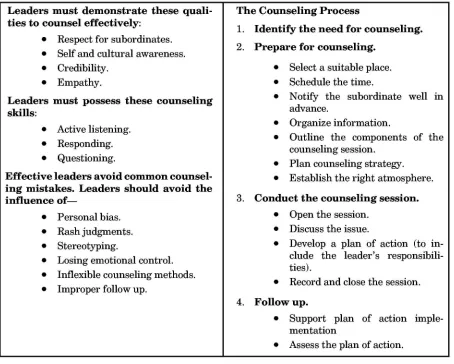
develop-ment. Figure C-8summarizes the major aspects
of developmental counseling and the counseling
Leaders must demonstrate these
quali-ties to counsel effectively:
.
Respect for subordinates..
Self and cultural awareness..
Credibility..
Empathy.Leaders must possess these counseling
skills:
.
Active listening..
Responding..
Questioning.Effective leaders avoid common
counsel-ing mistakes. Leaders should avoid the
influence
of-.
Personal bias..
Rash judgments..
Stereotyping..
Losing emotional control..
Inflexible counseling methods..
Improper follow up.The Counseling Process
1. Identify the need for counseling. 2. Prepare for counseling.
.
Select a suitable place..
Schedule the time..
Notify the subordinate well inadvance.
.
Organize information..
Outline the components of thecounseling session.
.
Plan counseling strategy..
Establish the right atmosphere.3. Conduct the counseling session.
.
Open the session..
Discuss the issue..
Develop a plan of action (toin-clude the leader's
responsibili-ties).
.
Record and close the session.4. Follow up.
.
Support plan of actionmentation
.
Assess the plan of action.
imple-Figure C-8. A Summary of Developmental Counseling
THE DEVELOPMENTAL
COUNSELING
FORM
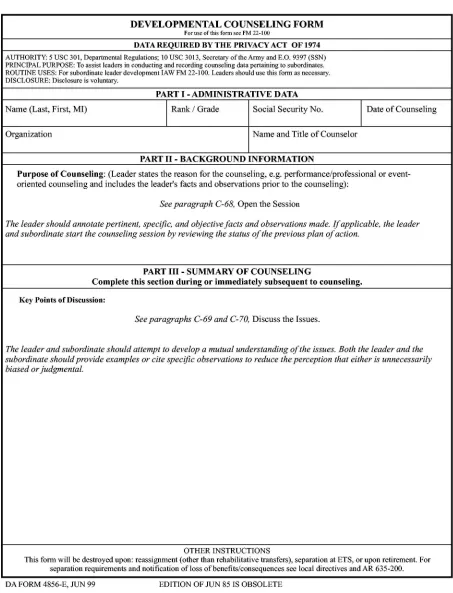
C-78. The Developmental Counseling Form
(DA Form 4856-E) is designed to help Army
leaders conduct and record counseling sessions.
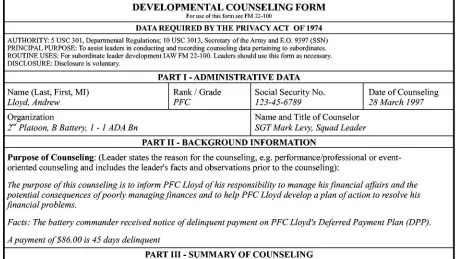
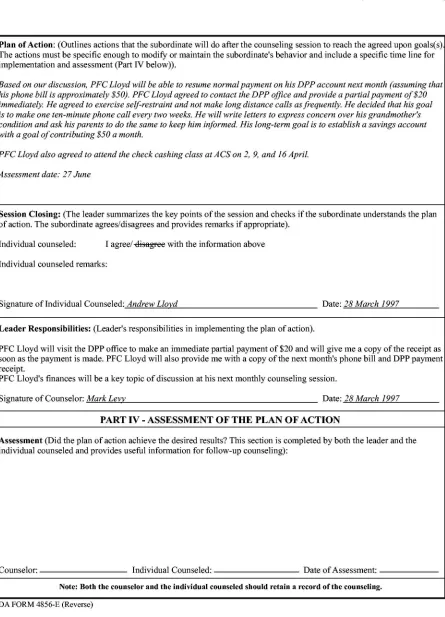
Figure C-9 shows a completed DA Form 4856- E
documenting the counseling of a young soldier
with financial problems. While this is an
exam-ple of a derogatory counseling, you can see that
it is still developmental. Leaders must decide
when counseling, additional training,
rehabilitation, reassignment, or other
develop-mental options have been exhausted. If the
pur-pose of a counseling session is not
developmental, refer to paragraphs C-36 and
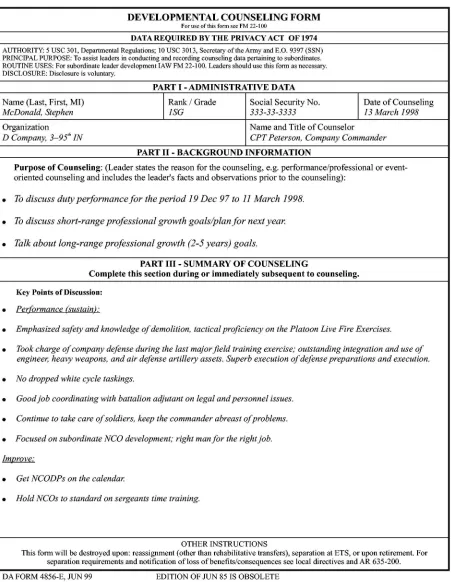
C-37. Figure C-I0 shows a routine
perform-ance/professional growth counseling for a unit
first sergeant. Figure C-ll shows a blank form
with instructions on how to complete each
DEVELOPMENTAL COUNSELING FORM
Foruse of this form see FM 22-100
DATA REQUIRED BY THE PRIVACY ACT OF 1974
AUTHORITY: 5 USC 301, Departmental Regulations; 10 USC 3013, Secretary of the Army and E.O. 9397 (SSN) PRINCIPAL PURPOSE: To assist leaders in conducting and recording counseling data pertaining to subordinates. ROUTINE USES: For subordinate leader development lAW FM 22-100. Leaders should use this form as necessary. DISCLOSURE: Disclosure is voluntary.
PART I -ADMINISTRATIVE DATA Name (Last, First, MI)
I
Rank / Grade Social Security No.
I
Date of Counseling
Lloyd, Andrew PFC 123-45-6789 28 March 1997
Organization Name and Title of Counselor
2"dPlatoon, B Battery, 1 - 1 ADA Bn SGT Mark Levy, Squad Leader
PART II
-
BACKGROUND INFORMATIONPurpose of Counseling: (Leader states the reason for the counseling, e.g. performance/professional or event-oriented counseling and includes the leader's facts and observations prior to the counseling):
The purpose of this counseling is to inform PFC Lloyd of his responsibility to manage his financial affairs and the
potential consequences of poorly managingfinances and to help PFC Lloyd develop a plan of action to resolve his
financial problems.
Facts: The battery commander received notice of delinquent payment on PFC Lloyd's Deferred Payment Plan (DPP).
A payment of$86.00 is 45 days delinquent
PART III
-
SUMMARY OF COUNSELINGComplete this section during or immediately subsequent to counseling.
Key Points of Discussion:
PFC Lloyd, late payments on a DPP account reflect a lack of responsibility and poor managing of finances. You should
know that the letter of lateness has been brought to the attention of the battery commander, the first sergeant, and the
platoon sergeant. They're all questioning your ability to manage your personal affairs. I also remind you that promotions
and awards are based more than on just performing MaS-related duties; soldiers must act professionally and responsibly
in all areas. Per conversation with PFC Lloyd, the following information was obtained:
He didn't make the DPP payment due to a lack of funds in his checking account. His most recent long distance phone bill
was over $220 due to calling his house concerning his grandmother's failing health. PFC Lloyd stated that he wanted to
pay for the phone calls himselfin order not to burden his parents with the expense of collect calls. He also stated that his
calling had tapered down considerably and he expects this month's phone bill to be approximately $50. We made an
appointment at A CS and A CS came up with the following information:
PFC Lloyd's monthly obligations: Car payment: $330
Car insurance: $138
Rent including utilities: $400
Other credit cards: $0
Total monthly obligations: $868.00
Monthly take-home pay: $1232.63
We discussed that with approximately $364 available for monthly living expenses, a phone bill in excess of $200 will
severely affect PFC Lloyd's financial stability and can't continue. We discussed the need for PFC Lloyd to establish a
savings account to help cover emergency expenses. PFC Lloyd agreed that his expensive phone bill and his inability to
make the DPP payment is not responsible behavior. He confirmed that he wants to get his finances back on track and
begin building a savings account.
OTHER INSTRUCTIONS
This form will be destroyed upon: reassignment (other than rehabilitative transfers), separation at ETS, or retirement. For separation requirements and notification of loss of benefits/consequences, see local directives and AR 635-200.
DA FORM 4856-E, JUN 99 EDITION OF JUN 85 IS OBSOLETE
Plan of Action: (Outlines actions that the subordinate will do after the counseling session to reach the agreed upon goals(s) The actions must be specific enough to modify or maintain the subordinate's behavior and include a specific time line for implementation and assessment (part IV below)).
Based on our discussion, PFC Lloyd will be able to resume normal payment on his DPP account next month (assuming that his phone bill is approximately $50). PFC Lloyd agreed to contact the DPP office and provide a partial payment of$20 immediately. He agreed to exercise self-restraint and not make long distance calls asfrequently. He decided that his goal
is to make one ten-minute phone call every two weeks. He will write letters to express concern over his grandmother's
condition and ask his parents to do the same to keep him informed. His long-term goal is to establish a savings account with a goal of contributing $50 a month.
PFC Lloyd also agreed to attend the check cashing class at ACS on 2, 9, and 16 April.
Assessment date: 27 June
Session Closing: (The leader summarizes the key points of the session and checks if the subordinate understands the plan of action. The subordinate agrees/disagrees and provides remarks if appropriate).
Individual counseled: I agree/ cli31lgt'ee with the information above
Individual counseled remarks:
Signature ofIndividual Counseled: Andrew Llovd Date: 28 March 1997
Leader Responsibilities: (Leader's responsibilities in implementing the plan of action).
PFC Lloyd will visit the DPP office to make an immediate partial payment of$20 and will give me a copy of the receipt as soon as the payment is made. PFC Lloyd will also provide me with a copy of the next month's phone bill and DPP payment receipt.
PFC Lloyd's finances will be a key topic of discussion at his next monthly counseling session.
Signature of Counselor: Mark Levv Date: 28 March 1997
PART IV
-
ASSESSMENT OF THE PLAN OF ACTIONAssessment (Did the plan of action achieve the desired results? This section is completed by both the leader and the individual counseled and provides useful information for follow-up counseling):
Counselor: Individual Counseled: Date of Assessment:
Note: Both the counselor and the individual counseled should retain a record ofthe counseling.
DA FORM 4856-E (Reverse)
DEVELOPMENTAL COUNSELING FORM
Foruse of this form see FM 22-100
DATA REQUIRED BY THE PRIVACY ACT OF 1974
AUTHORITY: 5 USC 301, Departmental Regulations; 10 USC 3013, Secretary of the Army and E.O. 9397 (SSN) PRINCIPAL PURPOSE: To assist leaders in conducting and recording counseling data pertaining to subordinates. ROUTINE USES: For subordinate leader development lAW FM 22-100. Leaders should use this form as necessary. DISCLOSURE: Disclosure is voluntary.
PART I -ADMINISTRATIVE DATA Name (Last, First, MI)
I
Rank / Grade Social Security No.
I
Date of Counseling
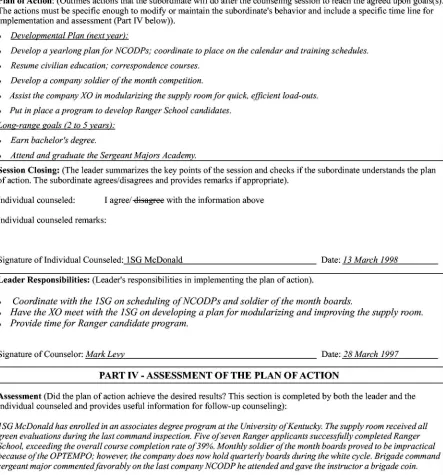
McDonald, Stephen 1SG 333-33-3333 13 March 1998
Organization Name and Title of Counselor
D Company, 3-95" IN CPT Peterson, Company Commander
PART II
-
BACKGROUND INFORMATIONPurpose of Counseling: (Leader states the reason for the counseling, e.g. performance/professional or event-oriented counseling and includes the leader's facts and observations prior to the counseling):
.
Todiscuss dutyperformancefor theperiod 19 Dec 97 to 11March 1998..
To discuss short-range professional growth goalslplan for next year..
Talk about long-range professional growth (2-5 years) goals.PARTIII - SUMMARYOF COUNSELING
Complete this section during or immediately subsequent to counseling.
Key Points of Discussion:
.
Performance(sustain):.
Emphasizedsafety and knowledgeof demolition,tacticalproficiencyon the PlatoonLive Fire Exercises..
Tookchargeof companydefenseduring the last majorfield trainingexercise;outstandingintegrationand use of engineer,heavyweapons,and air defense artilleryassets.Superb executionof defensepreparationsand execution..
No droppedwhite cycle taskings..
Goodjob coordinatingwith battalionadjutanton legal andpersonnel issues..
Continue to take care of soldiers, keep the commander abreast of problems..
Focused on subordinateNCO development;right manfor the rightjob. Imvrove:.
Get NCODPs on the calendar..
Hold NCOs to standard on sergeants time training.OTHER INSTRUCTIONS
This form will be destroyed upon: reassignment (other than rehabilitative transfers), separation at ETS, or upon retirement. For separation requirements and notification ofloss of benefits/consequences see local directives and AR 635-200.
DA FORM 4856-E, JUN 99 EDITION OF JUN 85 IS OBSOLETE
Plan of Action: (Outlines actions that the subordinate will do after the counseling session to reach the agreed upon goals(s) The actions must be specific enough to modify or maintain the subordinate's behavior and include a specific time line for implementation and assessment (part IV below)).
.
Develovmental Plan (next vear):.
Develop a yearlong plan for NCODPs; coordinate to place on the calendar and training schedules..
Resume civilian education; correspondence courses..
Develop a company soldier of the month competition..
Assist the company XO in modularizing the supply room for quick, efficient load-outs..
Put in place a program to develop Ranger School candidates.Lone-ranee eoals (2 to 5 vears):
.
Earn bachelor's degree..
Attend and graduate the Sergeant Majors Academy.Session Closing: (The leader summarizes the key points of the session and checks if the subordinate understands the plan of action. The subordinate agrees/disagrees and provides remarks if appropriate).
Individual counseled: I agree/ cli31lgt'ee with the information above
Individual counseled remarks:
Signature ofIndividual Counseled: lSG McDonald Date: 13 March 1998
Leader Responsibilities: (Leader's responsibilities in implementing the plan of action).
.
Coordinate with the 1SG on scheduling of NCODPs and soldier of the month boards..
Have the XO meet with the 1SG on developing a plan for modularizing and improving the supply room..
Provide time for Ranger candidate program.Signature of Counselor: Mark Levv Date: 28 March 1997
PART IV
-
ASSESSMENT OF THE PLAN OF ACTIONAssessment (Did the plan of action achieve the desired results? This section is completed by both the leader and the individual counseled and provides useful information for follow-up counseling):
1SG McDonald has enrolled in an associates degree program at the University of Kentucky. The supply room received all
green evaluations during the last command inspection. Five of seven Ranger applicants successfully completed Ranger
School, exceeding the overall course completion rate of39%. Monthly soldier of the month boards proved to be impractical
because of the OPTEMPO; however, the company does now hold quarterly boards during the white cycle. Brigade command
sergeant major commented favorably on the last company NCODP he attended and gave the instructor a brigade coin.
Counselor: CPT Peterson Individual Counseled: 1SG McDonald Date of Assessment: 1 Aue 98
Note: Both the counselor and the individual counseled should retain a record ofthe counseling.
DA FORM 4856-E (Reverse)