IN
ALBINO LEAF STRIPES*
Y. EFRON
Department of M&e Breeding and Genetics, Agricultural Research Organization, Newe Ya'ar Experimental Station, Israel
Manuscript received March 15, 1974 Revised copy received July 1, 1974
ABSTRACT
A description is given for a recessiv? EMS-sensitivity factor conditioning albino leaf stripes. In the homozygous condition, there is low frequency of spontaneous leaf stripes. EMS. depending on the concentration, increases markedly the frequency of the stripes in 100% of the treated plants. The effects of EMS, given t o the seeds, starts t o appear from the 6th to 7th leaf and persists in all the leaves throughout the life cycle of the M, plants. Only about 20-25% of the M, plants showed some variegation. These variegated M, plants were not distributed at random among the different ear-to-row M, rows.
HE chemical mutagen ethyl methanesulfonate (EMS) is at the present the Tmost widely used in crop plants. It is a powerful mutagen known for the induction of chlorophyll mutations in higher plants (GAUL et al. 1966). STADLER
(1930) was the first to show that in maize mutations induced by seed irradiation appeared as sectors in the M, plants. These sectors were considered as somatic mutations o r chromosomal abernations and did not draw much research effort. They were uced, f o r example, by ANDERSON et al (1949) and by STEIN and STEFFENSON (1959) to study the ontogeny of organs in the NI, plans of maize.
High rates of MI-induced sectors were reported in maize by MOULI and NOTANI (1968),
BHARATHI
and REDDY (1969) and by TING and DOUGALL(1969). These rates are higher than would be expected from what we know about mutation rates at specific gene loci. High rates of M1-induced sectors were also found in other crops (e.g., SAVIN, SWAMINATHAN and SHARMA 1968; in barley; and SHAMA RAO and SEARS 1964, in wheat).
The present report describes a case of an extremely high rate of EMS-induced M, albino stripes. The EMS-susceptibility is controlled by a single chromosomal recessive allele in a specific inbred line of maize.
MATERIALS A N D METHODS
Three different inbred lines of maize having low (AD-7), normal (AD-I) and high (AD-19) activity of alcohol dehydrogenase (EFRON 1970, 1973a), were initially treated with 0.005 and
* Contribution from the Agricultural Research Organization, The VolcaN Center, Bet Dagan, Israel. 1973 Series, No. 113-E.
860
0.01 M EMS. Albino stripes were found in all treated plants of the inbred line AD-1. This line was used for a more detailed study.
Inheritance studies: All possible MI plants from the inbred line AD-1 were self-pollinated (91 and 205 good ears were obtained from the 0.01 and 0.005 M EMS treatments, respectively).
In the follovhg year, 15 seeds from each ear were planted in the field. Self-pollinated seeds from untreated plants were grown as a control. The plants were scored for the appearance of albino stripes three times: a t the seedling stage (6-7 leaves), 30 days after germination, and at the tasseling stage (65 days after germination). Other M? clilorophyll mutations were scored a t the seedling stage and the degree of variegation was $cored a t the tasseling stage.
Efleci of EMS concentrdon: Seven different EMS concentrations (0 and 0.001.0.0005.0.001, 0.005, 0.01, 0.1 M) were applied to seeds of AD-1. The treated seeds and untreated control seeds
were planted in a greenhouse in four replications. The plants wcre harvested 33 dags after germination (the 0.1 M-treated secds did not germinate) and scored for the degree of variegation
and some other growth characteristics.
Genetic sludies: Seeds of the inbred lines .4D.1 and AD-7, their two reciprocal F, hybrids, and all possible F2 and B.C. progenies, were treated with 0.01 M EMS, planted in the field and classified for their variegation 45 day5 after germination.
EMS /reatmen/: The secds were treated with EMS solutions of the various concentrations for 16 hours a t 25". Then. they were washed for 4 hours in tap water and planted wet in the field
or greenhouse.
Degree of uariegatiom The degree of variegation was scored on a numerical basis (from 0 to 10 in the greenhouse and from 0 to 5 in the inheritance studies), according to the number of stripes per leaf and the number of leaves showing albino stripes. Thus, zero indicates plants without any stripes, 1, a plant showing only one stripe on one leaf, and 10, a plant in which all leaves showed a t least five albino stripes.
RESULTS
An
EMS
mutation study was carried out with three inbred lines of maize having different activity levels of alcohol dehydrogenase ( ADH).Two
concen- trations (0.01 and 0.005M)
ofEMS
were applied. Every one of the34,
plantsof the inbred line AD-1 showed albino stripes on the leaves, while the other two lines
(AD-7
and AD-19) did not show any variegation. At this stage only general observations were made. The number of albino stripes and their width varied from plant to plant and also from leaf to leaf (Figure 1). The albinostripes were found starting from the 6th-7th leaf on, including the uppermost leaf and the outer leaves of the husk. There was a n increase in the degree of variegation and especially in the width of the stripes as the plant grew. Usually, the MI plants treated with 0.01 M EMS were more variegated than those treated with 0.005 NI.
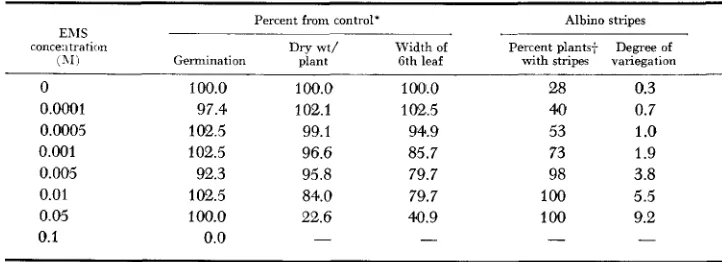
Effect of E M S concentration: A more detailed study of the effect of EMS con- centration was carried out in the greenhouse (Table 1). As observed before, there were no albino stripes of the first 4-5 leaves in any treatments. Twenty- eight percent of the control plants showed albino stripes. However. in almost all of the plants there was only a single very narrow stripe on only one leaf. Therefore, the degree of variegation in the control was 2.95. The number of control plants with albino stripes which were found in this experiment was higher than that observed in the heritability studies under field conditions (Table 2 ) . The control plants in the greenhouse were examined more thoroughly. Therefore, it is possible that a number of plants with stripes were not counted in the field experiment. However, it is also possible that since the control seeds were washed together with the EMS-treated seeds, there was some effect of EMS in the control plants also.
The induction of albino stripes was clearly EMS-concentration-dependent (Table 1 ) . As the concentration of EMS increased, more plants showed albino stripes and a higher degree of variegation. The degree of variegation is only a n estimated number of the events which had occurred leading to the appearance of albino stripes. However, this is a much better estimate than the percent of plants with stripes.
Germination was affected only at the highest EMS concentration. Plant growth was slightly affected at 1 x
M
EMS and to a much larger extent at 5 xTABLE 1
Effect of EMS concentration on the appearance of albino stripes, percent of germination, dry weight and width of the sixth leaf in the inbred AD-l of m ' z e
Percent from control' Albino stripes
EhlS ,
conce:itratl~m Dry wt/ Width of Percent plants: Degree of ( N j Germination plant 6th leaf with stripes variegation 0 0.0001 0.0005 0.001 0.005 0.01 0.05 0.1
1 0 . 0 97.4 102.5 102.5 92.3 102.5 1010.0 0.0 100.0 1 02.1 99.1 96.6 95.8 84.0 22.6 100.0 102.5 94.9 85.7 79.7 79.7 40.9 28 40 53 73 98 100
l a 0
-
0.3 0.7 1
.o
1.93.8
5.5 9.2
-
* Fifteen seeds were planted in each of four replications. After germination the replications
+
Plants with only one narrow albino stripe on one leaf were also considered as having albino were thinned to ten plants each. Measurements were taken from all plants.TABLE 2
Frequency of M , plants with stripes during the growth of the plants
Frequency of plants with stripes (%)
EMS-treated. iV2 plants
Plant age Control 0.005 M 0.01 11
Seedling 30 days 65 days
0.8 0.45 0.72
5.1 4.2 6.4
8.4 23.5 22.8
M. The width of the leaves is a more sensitive seedling measure of EMS sensi- tivity
(EFRON
1973b) and it was already reduced at 1x
Albino striping
in
theM,:
In the inheritance studies, 91 and 205 selfed earto row
M,
rows were planted from the 0.01M
and 0.005M-EMS
treatments, respectively. The number of plants with stripes was increased from the seedling stage to 65 days after germination in both the control and theM,
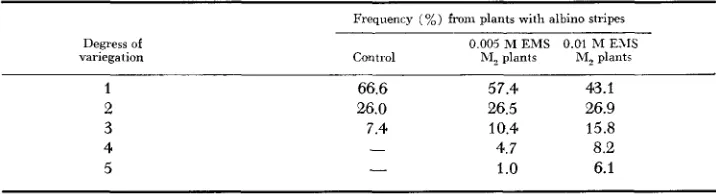
plants (Table 2 ) . At the seedling stage and 30 days after germination there were no differ- ences between the control and the M, plants. However, at 65 days there were significantly more plants with albino stripes in the M, plants. In the control, even though there were more plants with albino stripes at 65 days after germina- tion, the average number of stripes per leaf was more or less constant. At the seedling stage only the upper 1-2 leaves could show the stripes, while at 65 days there were about 12 leaves that could show stripes. A more detailed study has to be done in the future, but it is estimated that the spontaneous rate of stripes per loaf is about 0.8%.At 65 days the difference between the M, and the control plants was not only in the number of plants with stripes but also in the degree of variegation (Table 3). I n the M, generation the number of stripes was smaller than that obtained in the
MI.
Therefore, the plants were classified only on a numerical scale, from 0 to 5. In the control, most of the plants (92.6%) had one or a few stripes only; none of them was classified as4
o r 5. On the other hand, in theM,
there were fewer plants with values of 1 and 2 and more plants with values of 3,4
and 5.M
EMS.
TABLE 3
Distribution of the degree of uariegation among the plants with albino stripes in the M , and the control plants 65 days after germination
Degress of
variegation
Frequency (%) fmni plants with albino stripes
0.005 M EMS 0.01 R.I E l I S Contiol b12 plants MZ plants
66.6 57.4 43.1
26.0 26.5 26.9
7.4 10.4 15.8
- 4.7 8.2
TABLE 4
Distribution of the pooled degree of vmiegation among the individual selfed ear to row M , rows 65 drys after germination
Frequency of M2 rows (%)
of variegation 0.005 M 0.01 M
Pooled degree’ -
0-1 0 11-20 21-30 31-40 41
56.7 54.0
35.3 29.6
5.0 6.8
3.0 6.8
- 2.8
* Pooled degree of variegation = t h e s u m of the degree of variegation values given to all plants in the row.
TABLE 5
Number and type of induced EMS chlorophyll “true” muiation
Xutant
Number of segregating M2 rows
Control 0.005 M 0.01 M
1 1
Albino
-
Yellow leaves
-
2 31 1
Light green leaves
-
7
Yellow stripes -
Total - 11 5
-
TABLE 6
Segregation of plants wilh EMS-induced albino leaf stripes in crosses of the AD-1 EMS-sensitive line and AD-7’
Pedigree
Number of plants With Without
stripes stripes Total X Z P
44
AD-I 44
AD-7 - 4.8 48
AD-I
x
AD-7-
47 47AD-7
x
AD-I-
48 4.8(AD-I x AD-7)
x
AD-7 - 70 70(AD-7xAD-1)
x
AD-7 - 77 77(AD-1 xAD-7)
x
AD-1 32 38 70 .51+ .50-.30(AD-7XAD-1) X AD-I 38 44 82
.*
.70-.50(AD-7xAD-I) (AD-7xAD-1) 62 170 232 .29$ .70-.50
-
(AD-1 XAD-7) (AD-I XAD-7) 72 176 248 2.22$ .20-.10
* All seeds were treated with 0.01 M EMS and tested 45 days after germination.
+
Tested for goodness of fit to 1 :I ratio.This tendency was greater in the 0.01-M than in the 0.005-M-EMS treated M, plants.
The M, plants with albino stripes were not distributed randomly between rows. The range of plants with stripes was 0-10 per row. The same is true f o r the degree of variegation. Table 4 summarizes the distribution of values obtained for each row by summing the values given to all plants in the row.
The EMS treatment was also effective in producing “true mutations.” Sixteen segregating rows (5.4%) of chlorophyll mutants were found (Table
5 ) .
The genetics of EMS susceptibility: The genetics of susceptibility to EMS ex-
pressed by albino leaf stripes was studied by treating the inbred lines AD-I and AD-7. their two reciprocal F, hybrids, and all possible F, and B.C. progenies with 0.01
M
EMS. The results (Table 6) show that the susceptibility is due to a recessive allele of a single chromosomal locus, inherited in a simple mendelian fashion.DISCUSSION
The results presented in this paper clearly indicate that EMS induces a spe- cific variegated phenotype at a specific gene locus presented in inbred AD-1. I n a later study (EFRON and BINIAMINY, unpublished) the same response was not found among 100 different inbred lines treated with EMS at a concentration that induces variegation in 100% of the treated AD-1 plants. The EMS sensi- tivity, conditioning a n albino variegated phenotype, is under genetic control of a single recessive allele of a chromosomal locus.
In
maize there are several fac- tors conditioning albino lea€ stripes (NEUFFER, JONES and ZUBER 1968). It is possible that the sensitive target for the EMS effect is one of these known loci. However, it is also possible that the sensitive primary target could be any other locus and the variegated phenotype is due to a secondary effect. Such a possibility was demonstrated for the iojap phenotype of maize. The iojap phenotype is char- acterized by longitudinal white stripes on the leaves when the gene iojap is in the homozygous recessive condition (JENKINS 1924). REIOADES (1943) has shown that this phenotype may persist in the maternal line even in the absence of the mutant gene. It was suggested (RHOADES 1946) that theij
gene induces plastid mutation o r the production of an abnormal plasmagene which controls plastid development.There are five to six leaf primordia in the dry seed of maize (STEIN and STEF-
opment (those found in the embryo’s leaf primordia) are not subjected to this type of change. As in the case of the iojap gene (RHOADES 1946), it is not known whether EMS induces a direct change in the plastid o r an abnormal plasmagene
o r nuclear gene controlling plastid development.
The generative tissue of the tassel of the main stalk in maize is derived from 7 to 8 cells present in the apex of the
d.y
seed (ANDERSON et al. 1949). It is assumed that the same is true for the generative tissue of the ear. This should be taken into consideration in the interpretation of the results obtained for the M, plants. The EMS-induced stripes are not transmitted as such to the next gen- eration, but there is a residual effect of the EMS in the M, plants. About 20- 25% of the M, plants showed some degree of variegation (Table 2), but om a smaller scale than the MI plants (Table 3 ) . That not all the cells in the embryo were affected by EMS is evident from the variegated pattern obtained. The same is probably true for the primordial cells of the generative tissues. Thus, it is ex- pected that in some of the M, plants, none of the generative primordial cells was affected by the EMS. The progeny of these plants will not show any variegation. The progeny of the other plants are expected to show variation in the number of variegated plants. This depends on the number of the generative primordial cells affected by EMS, and the mode of inheritance (cytoplasmic o r nuclear). In addition, variation might be affected by selection against the EMS-induced cells during the development of the generative tissues. This type of variation was found among the M, rows (Table 4 ) . Although the mode of inheritance is not completely understood at present, the results obtained in the M, showed that the acquired variegation is at least partially inherited.The results obtained in this study are not readily explained in conventional terms. From what we know about the mutation rates usually induced by muta- gens, it is highly improbable to obtain such a high rate of true mutation (Table 1 )
.
This is especially true since the change is from a dominant to a recessive phenotype. A simultaneous change would have to occur in both chromosomes tomanifest such a change in the first generation. Therefore, we would like to pro- pose possible explanations for the results obtained.
I t is possible that the EMS-sensitive factor behaves like, and even might be allelic to, the ij allele (RHOADES 1943, 1946). However, while homozygous ij/ij
genotype is sufficient for the production of irreversible stable change in the chlor- oplasts or the plasmagene, the effect of the EMS-sensitive factor is expressed phenotypically only rarely (spontaneous leaf stripes). According to’ this h y p t h e - sis, EMS “magnifies” the action of the EMS-sensitive factor. As mentioned be-
fore. it is possible that this factor is allelic to the iojap allele. But, it also may be an allele of any other locus controlling plastid structure o r development.
The second possible explanation is that the EMS-sensitive factor is an unstable allele. Locus-specific genetic instabilities have been reported in a variety of eukaryotic organisms. They were recently reviewed by GREEN (1973) for Dro-
sophila and by FINCHAM (1973) for plants. In maize, several systems of mutable
o r unstable loci have been described (for review see MCCLINTOCK 1965 and
above gene control systems. Therefore, the results obtained might fit into the category of unstable alleles. The presence of spontaneous albino stripes favors this explanation. However, from the data available this possibility cannot be accepted o r rejected at present.
The paramutation phenomenon (BRINK 1964) which may be described as allele-specific, directed-phase chaiigesjs a phenomenon related to the category of genetic instability. The finding that the R' alleles are highly sensitive to herit- able changes in response to treatment of heterozygous R/R-st seeds with
DES
and EMS (AXTELL and BRINK 1967) may also support this hypothesis of an un- stable allele. X-rays were also found to be an artificial paramutagen (SHIH and
BRINK 1970). It is of interest to note that the
Ej
allele (extension of japonica) results in extreme expression ofij,
sr2 and certain other striped leaf mutants(NEUFFER, JONES and ZUBER 1968). It is usually found with recessive aleurone color alleles of the R locus. According to STADLER (see NEUFFER, JONES and
ZUBER 1968), it may be an expression of the r allele.
Recently it was found that the element which suppresses iojap and striate-2 chlorophyll variegation is closely linked but separable from the R locus by re- combination (KERMICLE, unpublished). The AD-1 line may be homozygous recessive for either japonica stripe, iojap stripe, striate2 or some unknown locus conditioning chlorophyll variegation, but expression of the variegated phenotype may be suppressed in the presence of an inhibitor located close to the R locus. This presumes that AD-1 is homozygous for a chlorophyll variegation gene which is repressed. Treatments with EMS induced de-repression in either the chloro- phyll variegation gene directly or by inducing de-repression of an inhibitor element at some other site in the genome (possibly near the R locus). It should be noted that the AD-1, AD-7 and AD-19 lines are all homozygous f o r the T- allele (colorless seeds and anthers)
.
LITERATURE CITED
ANDERSON, E. G., E. LONGLEY, C. H. LI and K. L. RETHERFORD, 1949 Hereditary effects pro- duced in maize by radiation from the Bikini atomic bomb. I. Studies on seedlings and pollen of the exposed generation. Genetics 34: 639-646.
Chemically induced paramutation at the R locus in maize.
Induction of chlorophyll sectors by DES. Maize Genet.
Genetic repression of R action in maize. pp. 183-230. In: The Role of Chro-
Alcohol dehydrogenase in maize; genetic control of enzyme activity. Science 170 : 751-753. -, 1973a Specific differences in maize alcohol dehydrogenase: possible explanation of heterosis at the molecular level. Nature New Biol. 241: 41-42. 1973b Variation in the physiological sensitivity of maize inbreds to EMS, a possible correlation with alcohol dehydrogenase activity. Mutation Res. 19 : 319-324.
Genetics (Suppl.) 73: 195-205. AXTELL, J. D. and R. A. BRINK, 1967
BHARATHI, V. S. and G. M. REDDY, 1969
BRINK. R. A., 1964
Proc. Natl. Acad. Sci. U.S. 58: 181-187.
Coop. News Letter 43: 136.
mosomes in Development. Edited by M. LOCKE. Academic Press, New York.
EFRON, Y, 1970
__ ,
EMS-induced genetic variability in barley: the problem of EMS-induced sterility and a method to increase the efficiency of EMS treatment. pp. 63-84. In: Mutation in Plant Breeding. International Atomic Energy Agency, Vienna.
GREEN, M. M., 1973 Some observations and comments on mutable and mutator genes in Dro- sophila. Genetics (Suppl.) 73: 187-194.
JENKINS, M. T., 1924 Heritable characters of maize. XX. Iojap-striping, a chlorophyll defect.
J. Heredity 15: 467472.
MCCLINTOCK, B., 1965 The control of gene action in maize. In: Genetic Control of Differentia- tion. Brookhaven Symp. i n Biology 18: 162-184.
MOULI, C. and N. K. NOTANI, 1968 High rate of induced change f o r anther color i n maize. Maize Genet. Cop. News Letter 42: 10-12.
NEUFFER, M. G., L. JONES and M. S. ZUBER, 1964 T h e Mutants of Maize. Crop Science Society of America, Madison, Wisc.
PETERSON, P. A., 1970 Controlling elements and mutable loci in maize: their relationship to bacterial episomes. Genetica 41 : 33-56.
Genic induction of an inherited cytoplasmic difference. Proc. Natl. Acad. Sci. U.S. 29: 327-329. -, 1946 Plastid mutation. pp. 202-207. In: Cold Spring Harbor Symp. Quant. Bid.
Enhancement of chemically-induced mutation frequency in barley through alteration in the duration of pre-soaking of seeds. Mutation Res. 6 : 101-107.
GAUL, H., K. BENDER, E. ULONSKA and M. SATO, 1966
RHOADES, M. M., 1943
SAVIN, V. N., M. S. SWAMIN~THAN and B. SHARMA, 1968
SHAMA RAO, H. K. and E. R. SEARS, 1964
SHIH, K. L. and R. A. BRINK, 1970
STADLER, L. J., 1930
STEIN, 0. L. and D. M. STEFFENSEN, 1959
TING, Y. C. and M. E. DOUGALL, 1969
Chemical mutagenesis in Triticum aestiuum. Mutation
Effects of X-irradiation and gamma irradiation on paramu- Res. 1 : 337-399.
tation in R heterozygotes in maize. Genetics 6 5 : 473-482.
Some genetic effects of X-rays in plants. J. Heredity 21 : 3-19.
The activity of X-rayed apical meristems: a genetic
The effect of EMS on haploid and diploid maize. Maize
Corresponding editor: 0. E. NELSON and morphogenetic analysis in Zea mays. Z. Vererb. 9 0 : 483-502.