LONG-RANGE SURVEILLANCE
UNIT OPERATIONS
HEADQUARTERS, DEPARTMENT OF THE ARMY
CHAPTER 1
INTRODUCTION
Combat forces need accurate and timely intelligence about enemy forces, terrain, and weather. Commanders must make fast and accurate decisions to have the right combat force at the right place and time. Their decisions are partly based on information gathered for intelligence purposes. Long-range surveillance units are trained and equipped to gather this information.
Section I. OBJECTIVE
Human intelligence is a category of intelligence derived from information collected and provided by human sources (JCS Pub 1-02). Human intelligence has always been a primary source of information within the intelligence collection system. Frontline soldiers and reconnaissance patrols have always provided combat information to tactical commanders. Commanders at all levels need this type of information. The long-range surveillance teams are a primary source of human intelligence.
1-1. INFORMATION GATHERING
Information is collected from every source and disseminated immediately as combat information, or it is first processed into intelligence. Collection of information is one phase of the intelligence cycle. The cycle consists of direction, collection, processing, and dissemination. These phases may be conducted both sequentially and concurrently. While information is being processed, additional information is being collected. At the same time, the intelligence staffs plan and direct the collection effort to meet new requirements. Data gained from the intelligence cycle, coupled with existing data, enable intelligence staffs to predict battlefield events and enemy intentions. By comparing time with actual events, the G2 can provide the commander timely, complete, and accurate intelligence.
1-2. HUMAN INTELLIGENCE CAPABILITIES
Long-range surveillance units provide the corps with a dedicated company and the division with a dedicated detachment. These units are specially trained and equipped to collect human intelligence about forces deep in the enemy’s rear. LRS units are part of the overall intelligence collection process. They augment and complement other collection systems that are more vulnerable to limitations such as weather, range, terrain masking, and enemy countermeasures. LRS units also allow corps and division
commanders to gather timely information that does not need lengthy processing and analysis.
a. The employment ranges for the LRSU missions depend on METT-T, operational tempo, and support considerations. In a fast-paced battlefield environment, the depth of LRSU employment is greater because the area of interest is larger. Long-range surveillance detachment teams operate forward of battalion reconnaissance teams and cavalry scouts in the division area of interest. The long-range surveillance company teams operate forward of the LRSD teams and behind most special operations forces. (See Table 1-1.) The duration of an LRS mission depends on equipment and supplies the team must carry, movement distance to the objective area, and resupply availability. LRSU teams normally operate up to seven days without resupply depending on terrain and weather. Teams may be deployed longer in special cases. Operations other than war are likely to be nonlinear, with no identifiable forward line of own troops. Surveillance must extend in all directions. Deployment considerations are adjusted with the political and geographical effects included. The specific area of operations changes as additional maneuver units are sent into the area of operations.
b. LRS teams are organized, trained, and equipped to enter enemy areas to observe and report enemy dispositions, movements and activities, and battlefield conditions. The teams’ missions, targets, and objectives are based on the intelligence requirements of the commander. Teams infiltrate selected areas by air, ground, water, or stay-behind. While avoiding contact with the enemy and local civilians, these teams observe. They may emplace a variety of unattended sensors and special-purpose equipment to detect, observe, and monitor enemy activities. They perform other specified collection tasks as well. LRS teams are not intended, and lack the capability,
to conduct direct-action missions. Their mission of limited reconnaissance
and stationary surveillance is different from the missions of most special forces and rangers.
1-3. ARMY OPERATIONS DOCTRINE
The most pressing concern of a corps or division commander engaged in combat is knowledge of the enemy to his front or to his flanks, and how that enemy may affect his mission. The commander must surprise the enemy and catch him at a disadvantage as often as possible. To do so, the commander must see well forward and know the areas of operation and interest. He must also know the enemy’s capabilities, strengths, location of reinforcements, density of air defense, and activities. This information is obtained through intelligence activities that provide the basis for tactical and operational decisions. Conduct of Army operations is based on timely intelligence from organic and higher sources at corps. Real-time human intelligence information is needed to complement electronic and imagery intelligence systems. The LRSUs at corps and division play an active part in the Army operations by providing that information. FM 100-5 states that success on the battlefield depends on all commanders knowing and implementing the five basic tenets of Army operations doctrine: initiative, agility, depth, synchronization, and versatility.
a. Initiative. Initiative sets or changes the terms of battle by action. It implies an offensive spirit in all actions. It means departing from planned
actions when an opportunity presents itself to hasten mission accomplishment. The LRSUs provide the corps and division commanders near real-time information on the enemy. This information does not need lengthy processing and analysis, thus enabling commanders to take the initiative when the opportunity presents itself.
b. Agility. Agility involves thinking and acting faster than the enemy. It involves the mental, command and control, and organizational ability to evaluate METT-T factors and then shift rapidly to destroy the enemy. The LRSUs provide commanders timely information that enables them to act swiftly and take advantage of the enemy situation. Because of the commu-nication systems that LRSUs use, and mobility restrictions, LRS teams are not responsive to changes in the mission once deployed.
c. Depth. Depth is measured in time, distance, and resources. The commander uses available time and the depth of the battlefield to employ his forces to defeat the enemy. Depth is the greatest contribution of the LRSUs in Army operations. The units give corps and division commanders the ability to see deep into the enemy’s rear.
d. Synchronization. Synchronization is teamwork and coordination of effort. The commander must know how the combined-arms team is used to defeat the enemy. Synchronization is a unity of effort following the commander’s intent. This unity extends from the maneuver plan to the integration of CS and CSS assets to ensure mission accomplishment. Information provided by the LRSUs and integrated with other forms of information-gathering assets give the commander a coordinated effort and better understanding of the battlefield.
e. Versatility. Versatility is the ability of units to meet diverse mission requirements. Commanders must shift focus, tailor forces, and move from one role or mission to another rapidly and efficiently.
Section II. MISSION
Surveillance is the primary mission of LRS operations. It is the mission that LRS teams are best equipped and trained to perform. Teams maintain surveillance for a specified period or until the required information is collected. Each team records all pertinent data.
1-4. CHARACTERISTICS
a. Clandestine operations require OPSEC procedures before, during, and after mission employment.
b. Team members depend on stealth, cover and concealment, and infantry and ranger skills.
c. Team members avoid contact with enemy forces and local population. d. Teams are employed to obtain timely information.
e. Teams have restricted mobility in the area of operations.
f. Team members depend on communications, knowing the enemy’s order of battle, and equipment identification skills.
g. The surveillance or reconnaissance area is small, has a specified route, or is a specific location or installation.
h. Team equipment and supplies are limited to what can be man packed or cached.
i. Teams require detailed intelligence preparation of the battlefield (IPB) from the G2 for employment.
1-5. MISSION EXECUTION
Long-range surveillance operations are carried out by small, highly trained teams who infiltrate and exfiltrate contested areas by air (helicopter or fixed-wing aircraft), parachute, ground (vehicle or foot), water, or a combination of these methods.
a. During retrograde operations or withdrawal of covering forces in defensive operations, teams may be employed in a stay-behind mode. Once inserted, the teams in a stay-behind role set up a hide site that provides security, cover, and concealment. A surveillance site is then setup, normally during darkness or other limited visibility. The surveillance site is located where it can provide the most coverage of the specific point, route, or area to be observed. Contact is made between the surveillance site and the hide site primarily during limited visibility. In some situations, the hide and surveillance sites are combined. However, the surveillance site frequently obtains information that must be reported immediately. In such cases, a team member goes to the hide site to report the information or uses a tactical FM radio or landline. The long-range surveillance team should use the most secure means of communication available between the hide site and the surveillance site.
b. Combat information reported by the surveillance site is normally consolidated at the hide site. This information is sent to the LRSU operations section by secure, rapid HF or SATCOM devices. A data-burst transmission device enhances communication security and reduces transmission time. Messages are sent at predetermined times or as
immediate spot reports. To reduce the possibility of detection, teams use separate communication sites, directional antennas, and terrain masking techniques. Some areas may be monitored by sensor devices emplaced by the teams. These devices normally transmit their signals to a receiving station in the corps or division area.
Section III. ORGANIZATION
A long-range surveillance unit may be a company or a detachment. This section discusses their organization, capabilities, and limitations.
1-6. LONG-RANGE SURVEILLANCE COMPANY
a. Headquarters Platoon. The headquarters platoon contains two sections for the command and control of the company in the areas of administration, logistics, and operations.
(1) Headquarters section. This section contains the personnel necessary for the command and control of the company and supply support.
(2) Operations section. The personnel in this section plan and control the employment of the teams, coordinate insertion and extraction of the teams to include external support, receive and report information from committed teams, and maintain the operational status of all teams. Liaison duties and planning for future operations are important functions of the operations section.
b. Communications Platoon. The communications platoon operates the base radio stations. It helps the operations section plan and maintain communication with deployed teams. It works with the operations section or separately to relay information from deployed teams. It also performs unit maintenance on communication equipment organic to the unit. The platoon has a headquarters section and four base radio stations.
(1) Headquarters section. The personnel in this section establish command and control over assigned communications elements. They coordinate and set up communication procedures, transmission schedules, frequency allocation, and communication sites. They issue and control encryption code devices and materials. They ensure continuous communication between deployed teams and base radio stations. They provide communication support to detached LRS platoons. They augment division LRSDs with communication support when directed. They also provide unit maintenance for company communication equipment.
(2) Base radio stations. The four base radio stations maintain communication between the operations base and the deployed teams. They operate on a 24-hour basis to make sure all message traffic to and from teams is processed immediately.
c. Long-Range Surveillance Platoon. This platoon has a headquarters section and six surveillance teams.
(1) Headquarters section. This section contains the personnel necessary for command, control, and training of the platoon.
(2) Surveillance teams. Each team consists of a team leader, an assistant team leader, three observers, and a RATELO. The teams obtain and report information about enemy forces within the corps’ area of interest. The teams can operate independently with little or no external support in all environments. They are lightly armed with limited self-defense capabilities. To be easily transportable, they are equipped with lightweight, man-portable equipment. They are limited by the amount of weight that they can carry or
cache. Because all team members are airborne qualified, all means of insertion are available to the commander when planning operations.
1-7. LONG-RANGE SURVEILLANCE DETACHMENT
The LRSD is organized as a detachment organic to the military intelligence battalion at division level (Figure 1-2). The LRSDs are organized into a headquarters section, communications section (two base radio stations), and six surveillance teams. (Light division LRS detachments only have four surveillance teams.) The leaders are airborne and ranger qualified. All other personnel in the detachment are airborne qualified.
a. Headquarters Section. This section contains the personnel necessary for command and control of the detachment.
b. Communications Section. These personnel ensure expeditious processing of all message traffic. The two base stations maintain communication with deployed teams. The LRSD may be augmented with a base station from the corps LRSC if dictated by operational requirements, equipment shortages, or maintenance problems.
information about enemy forces within their assigned areas. They can operate independently with little or no external support in all environments. They are lightly armed with limited self-defense capabilities. To be easily transportable, they are equipped with lightweight, man-portable equipment. The teams are limited by the amount of weight that they can carry or cache. Because all team members are airborne qualified, all means of insertion are available to the commander when planning operations.
1-8. CAPABILITIES
The organization, strength, and equipment of teams are based on the mission and the environment of the operational area. Long-range surveillance units have the capability —
•
•
•
•
• •
•
To be committed in specific locations within enemy-held territory by stay-behind methods or delivery by land, water, or air, to include parachute. Units exfiltrate by land, water, or air. To operate in enemy-held territory for up to seven days
with minimal external direction and support.
To conduct surveillance, reconnaissance, target acquisition, and damage assessment missions in all types of terrain and environments.
To establish communication using HF, VHF, UHF, or SATCOM between the base stations or the controlling headquarters and surveillance teams directly or through airborne relay.
To conduct operations in bad weather and over difficult terrain. To be recovered by air, land, or water; to linkup with advancing forces; or to return using evasion techniques.
To operate using planned, automatic resupply drops or special equipment cache sites set up by the LRSU or other friendly forces. They also use captured supplies and equipment.
1-9. LIMITATIONS
Long-range surveillance units are limited by the following considerations.
a. Mobility is restricted to foot movement in the area of operations.
b. Teams cannot maintain continuous communication with the controlling headquarters because of equipment limitations and the enemy’s use of radio and electronic surveillance devices. Teams only establish communication at scheduled times or to report critical combat information.
c. organic medical capability is limited to individual first aid.
d. Teams are lightly armed and have limited self-defense capabilities. They fight only to break contact.
•
•
•
e. LRSUs require support from higher headquarters in — Maintenance, supply, mess, medical, administration, finance, personnel, and chaplain services.
Area communication integration and access to a common-user telephone system.
Frequency management for HF and SATCOM access. Packing, rigging, and loading supplies arid equipment for aerial resupply operations and parachute
insertion operations. •
•
Army or Air Force air transportation to move the LRSU to the area of operations and ground transportation (provided by the division support command or corps support command) to move personnel and organic equipment in the area of operations.
Intelligence (IPB) products from division or corps headquarters.
1-10. WEAPONS AND EQUIPMENT
LRS teams operate with little or no support once in the area of operations. Operations in the enemy rear area requires the teams to have modern, lightweight weapons and equipment to complete the mission.
a. Weapons. The LRSC and LRSD are lightly armed but have a variety of organic small-arms weapons. Based on specific mission requirements, the unit is task-organized to meet the needs of the teams. The teams try to avoid contact.
b. Equipment. The special equipment they need is as follows.
(1) Communication. Each LRS team has an HF radio with burst device for two-way communication with the base stations. Each team has emergency-distress radios (AN/PRC-90 or AN/PRC-l12) if evasion becomes the means of exfiltration.
(3) Personal clothing and equipment. LRS teams can operate in any environment when equipped with mission-specific items of clothing and equipment (for example, skis, winter clothing, and snow shoes for arctic areas.)
CHAPTER 2
FUNDAMENTALS
Long-range surveillance units use infanty and ranger skills combined with skilled communication operators and intelligence personnel to collect and report battlefield intelligence. The fundamentals of LRS operations are command and control, communication, mission devel-opment, and operational security.
Section I. COMMAND AND CONTROL
Command and control (C2) is the process of directing and controlling military forces. For LRSU operations, C2 must be effective during all conditions, especially across the operational continuum with a special emphasis of operations conducted during the enemy’s use of electronic warfare. (Figure 2-1.)
2-1.
The
STRUCTURE
LRSU’s C2 system is structured for rapid deployment and collecting and reporting information. Communication, SOPs, and training to standard are critical to the success of C2.
b. The LRSD is organic to the MI battalion of the division. The division G2 in coordination with other staff sections determines mission requirements for the LRSD.
2-2. MISSION TASKINGS
Efficient C2 allows the LRSC taskings from the corps or
and the LRSD to respond quickly to mission division G2 (collection management and dissemination [CM&D] section). Missions assigned to LRSUs support corps and division commanders’ priority intelligence requirements (PIR) and information requirements (IR) as stated in the collection plan. The commander’s PIR govern the organization and conduct of reconnaissance, surveillance, target acquisition} and damage assessment operations. First priority usually goes to the information required for continuous operations. The faster the change in battlefield conditions, the more important reconnaissance, surveillance, target acquisition, and damage assessment operations become. The PIR serve to focus the unit’s collection effort on the most important features of the enemy and terrain. Intelligence collection efforts provide the commander with a complete and accurate picture of the total battlefield. The PIR and IR are the basis for collection operations; they are analyzed by the all-source analysis section in conjunction with the IPB. The all-source analysis section develops indicators for each PIR and IR. (Indicators are any evidence of enemy activity or any characteristics of the area of operations that point toward enemy capabilities, vulnerabilities, or intentions.) From those indicators, statements or questions are derived that will satisfy specific information requirements (SIR). These questions or statements form the basis for specific LRS taskings. (For more information, see FM 34-8.) a. Sound tactical planning and operations depend on intelligence. The corps and division G2s plan and coordinate collection capabilities and other intelligence functions to give corps and division commanders the ability to see and fight throughout the depth of the battlefield. The commander can then consistently make decisions faster than the enemy. The corps and division intelligence systems support operations by obtaining specific information required to confirm or deny indicators to satisfy the commander’s PIR. The LRSU is tasked to collect information on surveillance targets to satisfy some of these SIR. The G2 ensures that assigned LRSU targets satisfy both PIR and IR and offer a reasonable chance of mission accomplishment and team survivability. Examples of possible targets are —
Critical points along avenues of approach. Critical points along key lines of communication. •
•
• • • • • • • • • • • • Airfields. River fords.
Bridges or rail junctions.
Ordnance or logistical depots.
Railroad yards.
Known enemy command posts and headquarters.
Assembly areas.
Air base traffic.
Economic activity.
Political and propaganda activity.
Drug processing or drug growing activity. Refuge flow.
In operations other than war, the tasking procedure does not change, but types of surveillance targets do. Targets in an operation other than war environment include infiltration routes, supply bases, training bases, and assembly areas.
(1) The corps G2 nominates LRSC missions, which are normally approved by the corps commander. The G2 ensures the LRSC missions support the collection plan and do not conflict with other collection efforts. Coordination with echelons above corps ensures that LRS operations are planned and coordinated with reconnaissance and strike capabilities (US and allied) that may be used in the corps area. The G2 then coordinates with the G3 to validate external support requirements. The CM&D section then tasks the LRSC. The corps CM&D section coordinates with subordinate division G2s and ensures that LRS operations do not conflict.
(2) The division G2 nominates LRSD missions, which are normally approved by the division commander. The division G2 ensures that LRSD missions support the collection plan and do not conflict with other collection efforts. He then coordinates with the G3 to make sure that the mission can be supported and does not conflict with other unit missions. The CM&D section then tasks the mission to the LRSD.
2-3. TYPES OF MISSIONS
LRSUs are tasked to conduct several different types of missions to satisfy G2 collection requirements. Although surveillance is the primary mission, LRSUs can also perform limited reconnaissance, target acquisition, and battle damage assessment. Weather and terrain conditions reporting is an inherent capability of LRSUs. LRSUs can also perform in limited collateral activities such as pathfinder operations and combat search and rescue operations. The individual unit METL defines the mission it must perform. Surveillance teams use stealth in conducting their missions. Movement within the target areas is limited to mission accomplishment. In restricted visibility conditions, observers may move closer to the target area. Surveillance teams can be assigned the following missions.
a. Surveillance. Surveillance is the primary LRS mission. Surveillance sites are established using mission, enemy, terrain, and troops and time
available (METT-T) factors. Stand-off from the target is desirable, but METT-T factors may dictate the positioning of the surveillance site close to the objective. METT-T factors may also dictate multiple surveillance sites to compensate for daily changes in terrain, weather, and light. Surveillance is either maintained for a specified period or until the required information is obtained.
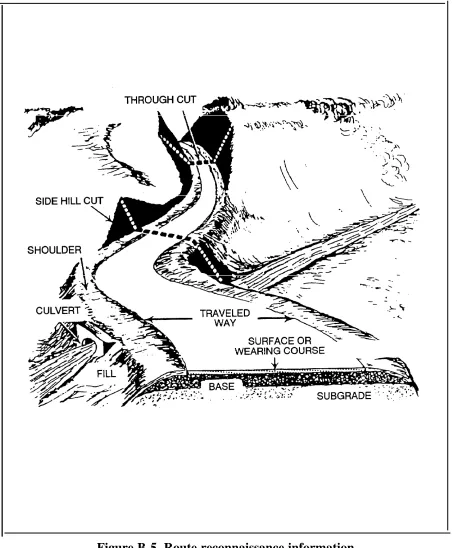
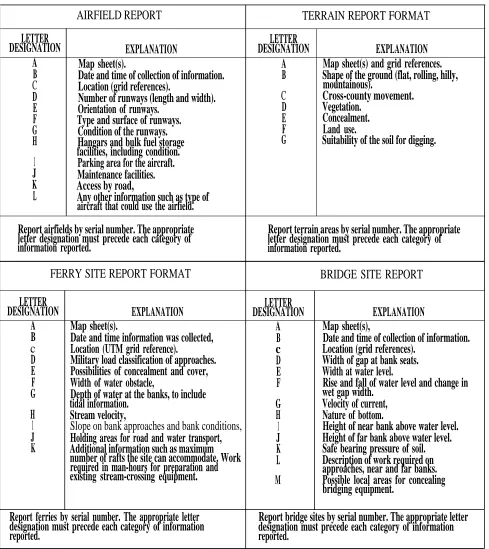
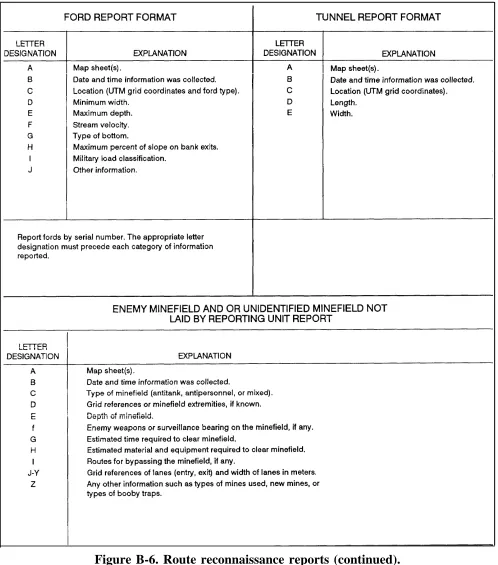
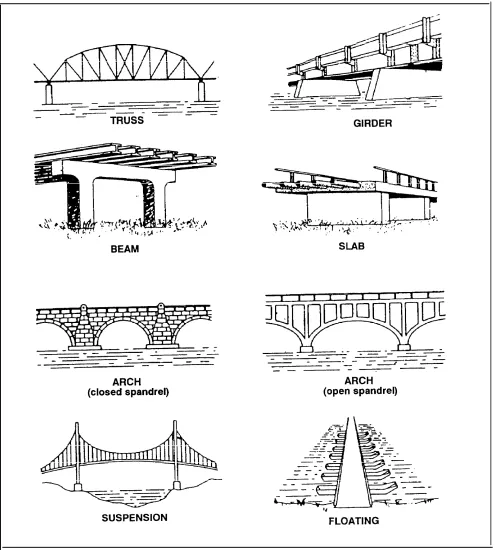
b. Reconnaissance. Surveillance teams can conduct limited reconnaissance missions. Reconnaissance missions are area, zone, and route. Movement by teams is minimized to avoid detection. (See Appendix B for specifics on reconnaissance.)
c. Target Acquisition. The detection, identification, and location of key enemy targets may be a mission of LRS teams. In addition to the acquisition of specific targets, teams may emplace sensors or other unattended devices. d. Damage Assessment. The LRS team members are trained and equipped to conduct tactical damage assessment. They can conduct chemical and radiological monitoring if equipped.
e. Terrain and Weather Reporting. The LRS team can provide accurate terrain data and current weather conditions in and around potential targets. Human intelligence on current conditions helps greatly to ensure success of operations. (See Appendix C for information on operational environments.) f. Collateral Activities. The LRS team can also conduct disaster relief, coalition support, combat search and rescue, and pathfinder operations.
2-4. LEADERSHIP
Leadership gives purpose, direction, and motivation in combat. A leader’s competence and confidence results in effective unit action. A leader must know how to analyze the situation quickly and make decisions rapidly.
a. Long-Range Surveillance Company. LRSC leadership includes the company commander, executive officer, operations officer, intelligence officer, first sergeant, liaison noncommissioned officer, chemical noncommissioned officer, communications platoon leader, surveillance platoon leaders, platoon sergeants, and team leaders.
taskings from the corps G2 CM&D and on his consideration of METT-T. He prepares plans with help from his operations section. He stays abreast of the situation at all times. The commander maintains close coordination and liaison with the military intelligence brigade tactical operations center (TOC) and corps TOC.
(2) Executive officer. The executive officer is the administrative and logistical coordinator for the company. He coordinates supply, maintenance, medical, and mess support. He also supervises the operation, movement, security, internal arrangement, and organization of the company operations base (COB). The executive officer works closely with the operations officer, operations NCO, first sergeant, supply sergeant, communications platoon leader, and communications chief. He keeps abreast of the tactical situation. (3) Operations officer. The operations officer is the main planner and coordinator for the company. He plans in detail the employment of the teams. He coordinates the efforts of the operations section in controlling the execution of team missions. He stays abreast of the tactical situation and advises and assists the company commander.
(4) Intelligence officer. The intelligence officer is directly responsible for all intelligence training within the company. He must devote specific attention to enemy recognition and order of battle training to help the surveillance teams provide accurate combat information. He assists the operations officer in briefing and debriefing surveillance teams. He task-organizes company intelligence personnel to maintain a 24-hour capability. (5) First sergeant. The first sergeant is the senior NCO in the company. He advises the commander and assists him by performing assigned duties to include supervising unit administration, training, logistics, and maintenance activities. He recommends appointments, promotions, reductions, assignments, and disciplinary actions pertaining to NCOs and enlisted soldiers to the commander. He also assists the executive officer in CSS functions.
(6) Liaison noncommissioned officer. The liaison NCO represents the company at higher, supporting, and other headquarters. Through his knowledge of LRS operations and the status of his unit, he coordinates support of ongoing and planned operations, advises, and exchanges essential information.
(7) Chemical noncommissioned officer. The chemical NCO assists the commander in planning and conducting operations in an NBC environment. His assistance primarily includes team training in the area of NBC survival, tactical damage assessment, and chemical and radiological monitoring.
(8) Communications platoon leader The communications platoon leader is the communications planner and coordinator. He keeps abreast of the status of communications personnel and equipment. He is responsible for the tactical employment, training, administration, personnel management, and logistics of his platoon. He advises the commander on matters pertaining to communication security (COMSEC), electronic counter-countermeasures (ECCM), and signal training of the company. He decides and coordinates the location for the alternate operations base (AOB). He disseminates information from current signal operating instructions (SOI) and makes sure that each team radiotelephone operator is briefed before and debriefed after each operation. He identifies, coordinates, and requests external communication and COMSEC support through his MI battalion signal officer.
(9) Surveillance platoon leader. The surveillance platoon leader is responsible for the training, administration, personnel management, and logistics of his platoon. He details teams for assigned missions and makes sure they are available and ready. He assists in the infiltration and exfiltration of his surveillance teams as directed. He accompanies team leaders during aerial reconnaissance and assists in selecting landing zones (LZs), drop zones (DZs), and pickup zones (PZs). During insertion, he flies in the command and control aircraft and exercises overall control of the insertion. He may be required to conduct extractions. He can also serve as a liaison when his platoon is task-organized to another unit.
(10) Platoon sergeant. The platoon sergeant is the senior NCO in the platoon. He advises the platoon leader and helps him with administration, training, logistics, and maintenance activities. He recommends appointments, promotions, reductions, assignments, and disciplinary actions as they pertain to NCOs and enlisted soldiers. He keeps abreast of the tactical situation, and he is prepared to assume platoon leader responsibilities, if required.
(11) Team leader. The team leader is responsible for the tactical employment, training, administration, personnel management, and logistics of his team. He does this by planning, making timely decisions, issuing orders, assigning tasks, and supervising team activities. He must know the capabilities of his team members and supporting units. He is a key man in the planning, preparation, and execution of LRS missions. Success depends largely on how well he performs and influences the performance of his team. He must be alerted early in the planning stage to allow time for him to complete necessary actions.
sergeant, detachment communications sergeant, detachment operations sergeant, base radio station section chief, and team leaders.
(1) Detachment commander. The detachment commander is responsible for the tactical employment, training, administration, personnel management, logistics, and maintenance of the detachment. He does this by planning, making timely decisions, issuing orders, assigning tasks, and supervising detachment activities. He must know the capabilities of his detachment and how to tactically employ them. He must also know the capabilities of the CS and CSS units supporting the detachment. He exercises command through his team leaders, base radio station section chiefs, and detachment sergeant. He employs the detachment based on missions and taskings from the division G2 CM&D. He maintains close liaison with the staff of the headquarters to which he is assigned, to include participation in mission planning. He stays abreast of the situation at all times and locates where he can best influence the action.
(2) Executive officer. The executive officer is the administrative and logistical coordinator for the detachment. He coordinates supply, maintenance, medical, and mess support. He also supervises the operation, movement, security, internal arrangement, and organization of the detachment operations base (DOB). The executive officer works closely with the operations NCO, detachment sergeant, supply sergeant, and detachment communications sergeant. He keeps abreast of the tactical situation.
(3) Detachment first segeant. The detachment first sergeant advises the commander and assists him by performing assigned duties to include supervising unit administration, logistics, and maintenance activities. He is also the primary unit trainer. He recommends appointments, promotions reductions, assignments, and disciplinary actions pertaining to NCOs and enlisted soldiers to the commander. He also assists the executive officer in CSS functions. He keeps abreast of the tactical situation.
(4) Detachment operations sergeant. The detachment operations sergeant assists the commander in planning and coordinating for the detachment. He plans in detail the employment of the teams, and he coordinates the efforts of the headquarters section in controlling the execution of team missions. He stays abreast of the tactical situation and advises and assists the detachment commander. He develops, reviews, and reproduces graphics.
(5) Detachment communications sergeant. The detachment communications sergeant plans and coordinates all communications for the detachment. He maintains the status of the communications equipment and personnel in the detachment. He is responsible for the tactical employment,
training, administration, personnel management, and logistics of all communications assets. He advises the commander on matters concerning COMSEC, ECCM, and signal training of the detachment. He disseminates information from the SOI and makes sure each team RATELO is briefed before and debriefed after each operation. He identifies, requests, and coordinates all external communications and COMSEC through his MI battalion signal officer. He recommends to the commander and coordinates the location for the AOB.
(6) Base radio station section chief. Each section chief is responsible for the tactical employment, training, administration, personnel management, and logistics of his base radio stations. He coordinates with the detachment commander for the employment of his base radio stations and the communications requirements for each operation. He coordinates administrative and logistical support with the detachment sergeant.
(7) Team leader. The team leader is responsible for the tactical employment, training, administration, personnel management, and logistics of his team. He does this by planning, making timely decisions, issuing orders, assigning tasks, and supervising team activities. He must know the capabilities of his team members and supporting units. He is a key man in the planning, preparation, and execution of LRS missions. Success depends largely on how well he performs and influences the performance of his team. He must be alerted early in the planning stage to allow time for him to complete necessary actions.
2-5. SURVEILLANCE TEAM OPERATIONS
Long-range surveillance teams operate within the area of operations of their respective corps or division.
b. Operations by teams in areas forward of friendly soldiers can create possibilities for fratricide. To protect the LRS teams from friendly fires, the following coordination is conducted before insertion.
(1) Hide site and surveillance site locations are normally included in coordination of restricted areas (no-fire areas) established by the controlling headquarters. The controlling headquarters informs higher, lower, and adjacent headquarters of the no-fire areas. For security reasons, the nature of the mission is not normally stated and additional dummy or false no-fire areas are added to reduce the signature of the LRS teams. To maintain operation security, all no-fire areas are listed as on order.
(2) Teams may operate in areas in which fires cannot be restricted. In such instances, the committed team is briefed on known strikes and warning procedures of impending friendly fires, air strikes, and nuclear and chemical operations.
(3) Detailed planning is required in situations where an LRS team may link up with advancing friendly units. The team must be familiar with general linkup procedures. As details become available, the commander informs the team of frequencies, call signs, and code words. The LRS team is normally the stationary element. The linkup unit is briefed to the lowest level possible. A liaison team is sent from the company operations base or detachment operations base or alternate operations base (AOB) to ensure that this coordination takes place. Once linkup has occurred, the team debriefs the S2 of the linkup unit. This ensures that information gets to the organization that needs it the most. The team is then expedited to the COB or DOB for further debriefing and refitting operations.
(4) Detailed planning is required if the team must infiltrate or exfiltrate by foot. Formal passage of lines coordination is essential to prevent fratricide. A liaison team from the COB, DOB, or AOB provides assistance and information to the team or the friendly forward unit.
(5) The G2 normally coordinates with other reconnaissance or surveillance assets to reduce the risk of fratricide.
2-6. OPERATIONS BASE
The operations base is a location from which the LRSC or the LRSD operates. (See Figure 2-4, page 2-12, for an example long-range surveillance company or detachment operations base.) The LRSC operations base locates with or near the CM&D section of the corps G2. The LRSD operations base locates with or near the CM&D section of the division G2. a. The operations base for the LRSC and the LRSD are similar. They include areas for a TOC, company or detachment headquarters, communications platoon or base radio station, motor park, isolation facility or area, LZ, and platoon or team defensive areas.
considerations are based on communication requirements of the COB or DOB and the deployed LRS teams.
(1) The AOB for the LRSC locates with or near the corps rear main, corps artillery headquarters, corps MI brigade, or MI tactical exploitation battalion headquarters. The LRSC AOB can also locate with an LRSD for specific operations requiring coordination or information exchange with a
division. A base station from the LRSC AOB, as part of a liaison team, can locate with a brigade for linkup operations.
(2) The AOB of the LRSD locates with or near the division rear main, the division artillery TOC, MI battalion TOC, or with the COB or LRSC AOB. The LRSD AOB moves toward the rear of the area of operations so it can relay communication between the deployed teams and the DOB. The AOB can locate with the division tactical command post when communication with the deployed teams and the DOB is reliable. A vehicle from the LRSD AOB, as part of a liaison team, can locate with a brigade for linkup operations.
c. The company commander selects the general location of the LRSC COB and AOB.
(1) The company executive officer decides the exact location of the operations base based on the commander’s guidance. He supervises the setting up of both the operations base and security.
(2) The operations section sets up the company TOC. The company TOC is a secure, restricted-access area. In addition to the TOC, the operations section prepares and marks an LZ near the operations base. The LZ is normally controlled by the assistant operations NCO; however, during some operations, a team may be tasked to set up and control the LZ.
(3) Each surveillance platoon is assigned a platoon area within which it sets up a platoon CP. When a team is deployed, the platoon sergeant provides for security in the team area and for equipment not required for the mission.
(4) The communications platoon is assigned a working area where it sets up and operates the company wire net and provides communication equipment maintenance and logistical support. The communications platoon establishes a circuit to the nearest switchboard with access to the corps switching system.
(5) The company headquarters is assigned an area from which it provides administrative and logistical support as required. The executive officer initiates and enforces the operations base security plan.
d. The detachment commander coordinates a location at or near the division main command post for the DOB. He also selects the general location for the AOB.
(1) The detachment executive officer determines the best location within the command post for the detachment headquarters, base radio station, and surveillance teams.
The LZ is normally controlled by the operations NCO; however, during some operations, a team or the communications section is tasked to set up and control the LZ.
(3) Each surveillance team is assigned an area within which it sets up a team CP. When a team is deployed, the detachment sergeant provides security for the team area and equipment not required for the mission.
(4) The communications section is assigned a working area where they set up and operate the detachment wire net and provide communication equipment maintenance and logistical support. The section establishes a telephone circuit to the nearest division switchboard to provide access to the division switching system.
(5) The detachment headquarters is assigned an area from which it provides administrative and logistical support as required. The executive officer initiates and enforces the operations base security plan.
2-7. TACTICAL OPERATIONS CENTER
The LRSC and the LRSD TOCs set up in the operations base. They give LRSU commanders a command and control capability and a communication with higher headquarters capability.
a. LRSC TOC Organization and Responsibilities. In the LRSC TOC, personnel perform specific functions as follows.
(1) Operations officer. The operations officer is responsible for the operation of the TOC. He plans and coordinates the company’s tactical operations based on the commander’s guidance. He also —
•
•
Analyzes assigned missions, plans employment of teams, and prepares or approves operation orders before they go to the commander.
Keeps the commander informed of current and projected tactical situations at all times.
Supervises the preparation of all operational and intelligence documents.
Supervises coordination with higher and supporting headquarters. •
•
• Reports the operational status of committed and uncommitted LRS teams.
(2) Assistant operations officer. The assistant operations officer assumes responsibility for the TOC in the absence of the operations officer. He also —
Makes sure that the current situation is posted on all maps and charts.
•
• • • • • •
Forwards combat information from the LRS teams to higher headquarters.
Approves all situation reports and other status reports in the absence of or at the direction of the operations officer. Maintains the operations workbook.
Approves the TOC personnel work schedule. Ensures preparation of the briefing area and maps. Plans and coordinates training for platoons and sections during temporary lags in operations.
Posts the mission planning chart.
Acts as a shift leader to maintain a 24-hour capability.
•
•
(3) Operations sergeant. The operations sergeant supervises the TOC enlisted personnel and assumes responsibility for the TOC in the absence of the operations officer and the assistant operations officer. He also —
• • •
• •
Helps prepare and edit all tactical operations plans. Supervises the operation of the detailed planning area. Posts the current situation on the friendly situation overlay and ensures that current information received from deployed teams is posted on the mission status charts.
Establishes the TOC personnel work schedule. Coordinates with the first sergeant for TOC messengers and guards.
Makes sure that only authorized personnel have access to the TOC.
Posts the manning chart.
Prepares the situation report for the period.
Assists the assistant operations officer in maintaining the operation workbook.
Acts as a shift leader to maintain a 24-hour capability.
• • • • • •
(4) Intelligence officer. The intelligence officer is responsible for the intelligence personnel in the TOC. He also —
Maintains a data base and map base sufficient to
•
•
•
•
Collects combat information for LRS team operations and keeps mission folders updated after they are received from G2.
Provides intelligence input of the enemy situation for operation orders.
Posts and maintains the enemy situation overlay. Assists the operations officer in briefing and debriefing LRS teams.
Keeps LRS teams informed of critical information impacting on missions.
Conducts final security inspections of LRS teams •
•
before deployment.
(5) Intelligence sergeant. The intelligence sergeant assists the intelligence officer in collecting combat information for LRS team operations and assumes responsibility for the TOC and the planning area in the absence of the operations sergeant. He also —
•
•
Posts the enemy situation overlay in the absence of the intelligence officer.
Assists the operations personnel in ensuring that security and OPSEC measures are followed within the TOC and the planning area.
Briefs and debriefs LRS teams with operations personnel as directed by the intelligence officer. Splits shifts with the intelligence officer to maintain •
•
a 24-hour capability.
(6) Assistant operations sergeant. The assistant operations sergeant coordinates air support with US Army aviation or USAF units supporting team operations. He also —
•
•
•
Assists the operations sergeant.
Maintains a list and an overlay showing locations and descriptions of possible LZs, DZs, and PZs. Coordinates requests for airborne and air movement insertions, extractions, and visual reconnaissance with aviation support units.
Posts the schedule of infiltration and exfiltration operations. •
(7) Chemical NCO. The chemical NCO assists in establishing, administering, and applying defensive NBC operations. He also —
• Supervises preparation of NBC reports, maintenance
of NBC supply, and unit and individual NBC training records. •
•
Collects, interprets, analyzes, and disseminates chemical information and data.
Serves as principal NCO of the NBC defense team.
(8) Liaison NCO. The liaison NCO coordinates operations with supported and adjacent units, higher headquarters, and US Army aviation or USAF units.
b. LRSD TOC Organization and Responsibilities. In the LRSD TOC, the commander, executive officer, detachment sergeant, operations ser-geant, and communications personnel perform all functions.
c. Operations (LRSC or LRSD). Before each mission, the TOC personnel (operations, intelligence, and communication) are prepared to —
Present a detailed briefing to the team leaders on the specific area of operations.
•
• Coordinate infiltration and exfiltration operations. • Assist the team leaders in coordinating fire
support, aviation assets, resupply, and so forth.
• Receive pre-mission briefbacks from committed teams.
(1) Ongoing actions. During the mission, the TOC personnel monitor the progress of surveillance teams and are prepared —
• • • • •
•
To coordinate resupply for committed teams. To coordinate emergency extractions.
To coordinate medical evacuations. To coordinate other required support.
To plan and coordinate additional missions as directed by the commander.
To monitor scheduled communication times. • To coordinate for friendly or partisan linkups by
(2) Debriefing. Immediately after exfiltration, TOC personnel debrief each surveillance team. G2 personnel conduct the debriefing, if available. The LRSC communications platoon leader or LRSD communication section sergeant debriefs the team RATELO.
(3) Messages. The TOC duty officer or NCO provides a receipt for all incoming messages. Other requirements are as follows:
•
•
•
•
•
A receipt of each message is recorded in the staff journal. Information from each message is posted to the appropriate maps and charts.
Each message is filed in the journal file according to the journal entry number.
All outgoing messages originate from the TOC and are recorded in the journal.
Intelligence reports are forwarded from the teams to G2 as necessary.
(4) Journal. The staff journal is a chronological record of events pertaining to the unit during a given period. The TOC duty officer or NCO maintains the journal.
(a) All items are cross-referenced to the journal entries by journal item number.
(b) All messages are posted to the journal with the following information noted: • • • • • • The sender.
The title of the message or a description of the event. The time of receipt of the message.
The journal item number and message center number (if applicable).
The action taken.
The initials of the person making the entry.
(5) Security. Personnel access to the TOC and the predeployment detailed planning area is restricted and controlled. SOP establishes procedures for control and identification of visitors.
(a) The TOC and the detailed planning area should have only one entrance.
(b) Appropriate security measures are taken in the safeguarding and handling of all classified material to include a well-rehearsed emergency destruction SOP.
(6) Displacement. When directed to displace, the on-duty shift continues to operate; the off-duty shift breaks down all equipment and loads it on the vehicles. The COB or DOB notifies the AOB of the departure time and route and the proposed relocation site. The AOB continues to monitor committed teams. When the COB or DOB is once again operational, the AOB sends an update.
2-8 TASK ORGANIZATION
The LRSCs and LRSDs assigned to corps organizations use the same company-level SOPs and communication procedures. Therefore, the corps commander can task-organize LRS assets as battlefield conditions change. LRSC and LRSD teams initially are employed in their respective areas of interest. The rapid pace of operations may require the LRSC and LRSD to coordinate command and control of deployed LRS teams and exchange information to meet the intelligence needs of the commander.
a. Echelons Above Corps. During retrograde operations, command, control, and communications of LRS teams beyond the corps area of operations is given to echelons above corps. This action requires a liaison with a radio station from a LRSU AOB to locate with echelons above corp controlling headquarters. Control of extracted teams is returned to the parent LRSU.
b. Brigade Task Organization. An LRSD, or portions of an LRSC, are under operational control of a brigade for certain operations. This OPCON occurs as part of a contingency operation. It most often occurs in an operation other than war environment and before the main control cell of the G2 deploys to the area of operations. It also occurs when brigades expand control of a sector and deployed LRS teams are operating in that sector. When this situation occurs, a liaison with a base radio station from the COB, DOB, or AOB locates with the brigade TOC. A G2 CM&D liaison may accompany the LRS control element for mission planning.
Section II. COMMUNICATIONS
2-9. COMMUNICATION NETS
The LRSU team deploys out of line-of-sight communication range. Ordinary combat net radio systems cannot support the reporting requirements of the LRSU. Tactical FM radios, like single-channel ground and airborne radio system, must be in sight of each other electronically to communicate.
a. LRSUs must rely on and train with communication systems with extended range capabilities. Two systems available in the Army system are HF and tactical satellite radios.
(1) An HF radio is a reliable communication system with an unlimited range. Manpack improved, high-frequency radios like the AN/PRC-104 have simplified HF radio communication and increased reliability. HF communication requires extensive training and frequency management. The right frequency must be chosen for each communication scenario, and the right antenna must be built to satisfy each transmission path. (See Appendix D for more information.)
(2) Tactical satellite radio is a reliable communication system with an unlimited range. Tactical satellite radios come in manpack versions. However, satellite channels and tactical satellite radios are in short supply and high demand. The priority for tactical satellite circuits goes to echelons above corps and other strategic operations. The LRSU normally does not have access to circuits on a tactical satellite system.
b. The COB or DOB and their respective AOBs maintain communication with employed teams using HF radio. Each team has a separate frequency and cryptographic for OPSEC purposes. Communication between the two operations bases is maintained using the tactical switching system between the two locations. Backup communication between the base operations is maintained using either line-of-sight or HF radio systems as METT-T requires. The LRSC communication net has 18 teams and eight AN/TSC-128s. Figure 2-5 shows the LRSD communications net.
c. The COB or DOB maintains communication with their G2s using the tactical switching system and with combat net radio in the corps or division intelligence net.
d. Communication within the operations bases is accomplished with an internal wire net (Figure 2-6, page 2-22). The unit’s communication personnel establish this net using organic wire and telephones.
2-10. MESSAGES AND REPORTS
The base radio station communicates with teams during specified communication times. A separate time is established for each team. The number of scheduled times used by the LRSU depends on METT-T. The employed team must be protected from enemy interception and direction finding. Too many scheduled times put a team at risk, while not enough scheduled times could minimize the importance of time-sensitive intelligence. OPSEC demands must be weighed with frequency availability. a. In addition to scheduled communication times, an HF guard frequency is established. The base radio station monitors the guard
frequency 24 hours a day. The guard frequency provides the teams with a second frequency for transmitting outside the scheduled time, when communication on the primaary frequency cannot be established. The guard frequency changes periodically to accommodate changes in the atmosphere, but changing it more than twice a day is not recommended; one frequency for daytime operation and one for nighttime operation is suggested. Instances where a team may use the guard frequency include —
• Report PIR. •
• •
Request for extraction or fire support, because the team has been compromised. Request for medical evacuation.
Start of evasion and escape.
b. The base radio station and teams communicate using data-burst devices; for example, the OA-8990 digital message device group (DMDG) and the KL-43C. A data-burst device sends messages over the radio as quickly as possible. The shorter the transmit time, the less likely a team will be detected by enemy direction-finding equipment. Interception is also a major concern of the LRSU. Data-burst devices do not preclude the enemy from intercepting the radio traffic. To minimize the effectiveness of enemy interception, teams and the base radio station encrypt messages. The DMDG has no internal cryptographic capability, so teams use a one-time pad with a trigraph to encode messages before sending them. The KL-43C has an internal cryptographic capability and does not require the team to manually encrypt the message. In addition to encrypting the message, teams can use brevity codes to assist in shortening the message. However, brevity codes increase the message processing time and increase the possibility for error.
c. Message formats between teams and the base radio station are part of the SOP. If a message has an exacting format, even a partially received message is useful, because it is recognizable. The following is an example of the messages a team should be prepared to transmit during a mission. (See Appendix D for illustrations.) (See the Special Forces SOI supplemental instructions for additional message formats.)
• • • • •
ANGUS—Initial entry report. BORIS—Spot intelligence report. CYRIL—Situation report.
UNDER—Cache report.
d. Intelligence reports received by the base radio station go directly to the corps or division G2. The LRSU operations base does not delay or change any intelligence report. If a message is received by the base radio station at the AOB and not the COB or DOB, the message is sent by the fastest, secure means to the corps or division G2 and the COB or DOB exactly as received. (See Figure 2-7.)
2-11. BASE RADIO STATION OPERATIONS
The primary mission of the base radio station is to receive and transmit messages between the operations base and employed teams. Each base radio station monitors all deployed team frequencies. The AN/TSC-128 is the basic system for the base radio station. Two AN/TSC-128s makeup one base radio station. Each AN/TSC-128 maintains communication to three LRSU teams. To accomplish this, the AN/TSC-128 is equipped with three HF radios (AN/GRC-213) to receive communication from deployed team and one HF radio (AN/GRC-193) to transmit to the teams and other stations. In addition, the AN/TSC-128 is equipped with four DMDGs or KL-43Cs, one UGC-74 teletype terminal, one VRC-series radio (or mobile radiotelephone for mobile subscriber equipment), and a UGC-7 facsimile machine.
a. The LRSC establishes two base radio stations at the COB and two at the alternate sites. The LRSD establishes a base radio station at the DOB and at an alternate site. The base radio stations at the COB or DOB are the primary link to teams in the field. The base radio stations at the AOB serve as backup. They are prepared to receive messages the COB or DOB cannot, take over the mission if the COB or DOB displaces, and take over the mission if the COB or DOB is destroyed.
b. The success of HF communication often depends on the type of antenna erected. The best antenna is resonant to the transmitter frequency. The antenna cut to the proper length adds gain to the antenna and increases the success of communication. The base radio station will have the terrain, security, and time to construct matching full-wave and half-wave antennas. Employed LRSU teams often compromise in their antenna selection, depending on METT-T. The base radio station takes all actions necessary to ensure communication. The base radio stations at the AOB build different types of antennas than the COB or DOB. This adds flexibility and provides different paths for transmission. (See Appendix D for more information.)
d. COMSEC is management intensive for LRSU operations. Each team has individual cryptographic for communicating with the base radio station. In addition, local nets have their own cryptographic requirements. The LRSC or LRSD commander ensures the unit’s COMSEC custodian keeps the proper material in the correct amount on hand, both for training and contingency missions. Possible COMSEC keys needed for LRSU operations are —
• • •
Corps or division intelligence net. MI brigade or battalion net.
•
•
Internal company or detachment net.
One key per team (KL-43C or one time pad) with one copy of this key for each base radio station monitoring the team.
Digital secure voice terminal key for mobile subscriber equipment network.
e. In addition to cryptographic, LRSU COMSEC requires intensive frequency management. The nature of HF communication and the OPSEC requirements for LRSU teams places a high demand on multiple HF allocations. HF reliability changes with the time of day, time of year, position of the transmitters on the earth’s surface, and the type of equipment used. Good OPSEC demands different frequencies for each team employed and a separate frequency for the HF guard. For an LRSC, that can mean as many as 19 frequencies at a given time of day and as many as 7 for the LRSD. The LRSU commander coordinates with the corps or division signal officer to ensure the LRSU is allocated the frequencies it needs for the mission.
f. Each base radio station maintains a log of all messages. The team chief ensures all messages for committed teams originate from the operations section. When a team message is received, the operator logs in the message, then forwards it to the operations section for decryption. If there is an outgoing message for a team, the operation section encrypts it. The operator then transmits it to the team during the team’s next scheduled communication time.
2-12. SURVEILLANCE TEAM COMMUNICATIONS
HF radio is the surveillance team’s primary means of communication with the base radio station. Data-burst equipment is used to shorten transmission times. Encryption systems are used to preclude enemy interception. In addition to HF radio, teams use tactical satellite assets when available.
a. The RATELO selects the communication site, with the team leader’s approval, using METT-T. Communication site considerations are security, cover and concealment, space to erect an antenna, and an escape route.
b. Teams transmit and receive routine messages during the scheduled communication times. For messages requiring transmission outside the time schedule, the team first tries to transmit on the designated team frequency. If communication cannot be achieved on the team frequency, the team then transmits on the HF guard frequency.
c. Internal communication within the team is maintained using secure FM and visual and sound signals. (See Appendix E.) Leaders ensure proper OPSEC and COMSEC precautions are followed.
2-13. ELECTRONIC WARFARE
Electronic warfare is a military action used to prevent the enemy’s use of the electromagnetic spectrum, while retaining friendly use of the spectrum. This is accomplished through both offensive and defensive measures.
a. Offensive electronic warfare operations include the use of electronic warfare support measures and electronic countermeasures.
(1) Electronic warfare support measures are actions taken to search for, intercept, locate, record, and analyze radiated electromagnetic energy.
(2) Electronic countermeasures are actions taken to prevent or reduce effective use of the electromagnetic spectrum by the enemy.
b. Defensive electronic warfare operations include electronic counter-countermeasures (ECCM). ECCM are actions taken to ensure effective use of the electromagnetic spectrum despite electronic warfare activity by the enemy.
c. To protect themselves from enemy electronic warfare activity, LRSUs apply ECCM. ECCM have two categories: preventive and remedial.
(1) Preventive measures are those actions taken to prevent or lessen the effectiveness of enemy electronic warfare. They include emission security, transmission security, cryptography security, and physical security.
(a) Emission security includes —
Turning radios and other emitters on only when they are to be used.
Using brevity lists. •
• • • •
Masking antenna locations. Using directional antennas.
(b) Transmission security includes — • • • • • •
Using voice communication only when essential. Developing and using brevity lists.
Minimizing transmission time. Planning messages.
Always using brevity lists when sending essential elements of friendly information.
Encrypting messages.
(c) Cryptography security includes using authorized codes and key lists. Only National Security Agency approved codes are authorized for encoding and decoding US Army message traffic. The same is true of mechanical cryptography systems. • • • • • • • •
All superseded cryptography keys. All current cryptography keys. Zero KL-43C.
All future cryptography keys. Communications log.
KL-43C. Radios. Brevity list.
(d) Physical security of all cryptography and equipment includes a comprehensive and workable plan for the destruction of material and equipment. It also includes the SOPs that identify to all team members where material and equipment are kept by the RATELO. Priority for the destruction of material and equipment is as follows:
(2) Remedial measures apply to interference and jamming. When interference is heard and jamming is suspected, the following actions should be taken:
(a) Remain calm and continue to operate as if nothing is happening.
(b) DO not allow the enemy to know his jamming is successful or
detected.
(c) GO to a higher power on the radio.
(d) Reorient the antenna to the receiving station.
(e) Report the jamming using the rneaconing, intrusion, jamming, and interference report format in the SOI supplemental instructions. Do not file the report on the same net that is being jammed.
(f) Use an alternate frequency if communication cannot be established. or maintained.
Section III. MISSION DEVELOPMENT
Long-range surveillance missions are specific, require detailed planning, and support the collection plan of the supported corps or division. All LRSU missions are carefully planned and coordinated to prevent duplication of effort, conflicting requirements, and the possibility of overlapping or intermingling with other friendly forces in the area. Corps ensure LRSC missions do not conflict with subordinate division LRSDs, between divisions, or with the echelons above corp special operations forces. Divisions ensure LRSD missions do not conflict with friendly forces working in their area.
2-14. PLANNING
The LRSU commander or his representative (liaison officer, operations officer, operations NCO, or platoon leader) assists the intelligence and operations sections of the division or corps headquarters in the initial planning for LRS missions. Methods of operations while deployed, communication procedures, reporting, and other standard practices are in the LRSU SOP. An LRS team normally requires 24 to 48 hours planning time to execute a mission. The recommended planning time is often not available. The following minimum-essential information is provided for hasty mission execution:
• Mission statement to include area or object to be kept under surveillance, eyes-on-target time, and anticipated length of mission.
• • •
PIR, IR, and associated SIR. Enemy situation in the target area. Corps or division commander’s intent for intelligence (can be stated by the G2 or G3). •
•
Method of insertion with abort criteria. Coordination time and place are included, if applicable.
• • •
Exfiltration plan.
Communication plan (provided by the LRSU headquarters). Linkup, if applicable.
a. Special Considerations. METT-T guides the planning for LRS operations. The reverse planning sequence is used during planning. Among the many planning considerations, the following are particular to LRS operations.
(1) Mission. This includes the type of mission (surveillance, reconnaissance, target acquisition, damage assessment), the anticipated length of the mission, and the time the information is required to be collected.
(2) Selection of tentative hide site. The position selected must offer good observation, concealment, communication requirements, and an adequate area for team rest, maintenance, and personal hygiene. When ground or air reconnaissance is impossible, the position is selected by map and photo-graph reconnaissance and line-of-sight survey data. The position should provide observation of the objective, avoid detection, and provide suitable signal communication. Closeness to and access from the infiltration and exfiltration sites are also considered. At a minimum, a tentative primary site and an alternate site are always selected. (See Appendix E.)
(3) Selection of tentative surveillance site. Performing all mission require-ments from the hide site is not always possible or desirable. Under those circumstances, a separate surveillance site(s) is chosen. The general location is determined during planning and pinpointed after the team is on the ground. The surveillance site is normally close to the hide site with an accessible route over terrain that conceals the connecting route. A primary site and an alternate site are always selected. In some environments, primary and alternate sites are selected for both day and limited visibility conditions. (4) Selection of tentative communication site. Conducting communica-tion from the hide site is not always possible or desirable. Under those circumstances, a separate communication site is chosen. The general loca-tion is determined during planning and pinpointed after the team is on the ground. The communication site should be near the hide site with an accessible route over terrain that conceals the connecting route. Addition-ally, when selecting the communication site, the LRS team should consider all aspects of ECCM and site selection criteria discussed in Appendix D.
(5) Selection of tentative infiltration site. The location of the infiltration site is considered after the selection of hide, surveillance, and communica-tion sites. Infiltracommunica-tion site seleccommunica-tion is based on the infiltracommunica-tion method, the distance to the hide site, enemy and local populace activity in the area,