PARTIAL INCOMPATIBILITY NOT AFFECTING TOTAL LITTER SIZE IN THE MOUSE'
PETER HULL2
Department of Biology, University of Rochester, Rochester, N . Y . Received April 23, 1964
theoretical examination has been made (HULL 1964) of the evolutionary
A
consequences of maternal-foetal incompatibility, where off spring of the same genotype as the mother are at a selective disadvantage. It was demonstrated that in this case, where the total number of progeny produced by a mating was assumed to be affected by the incompatibility in that mating, stable gene fre- quency equilibria could be maintained in a population under certain circum- stances. I t is the purpose of this study to present the observed results of certain matings in the mouse, and to explore the evolutionary consequences to be ex- pected in a population having a hypothetical incompatibility mechanism con- sistentwith
the observed results.EXPERIMENTAL CROSSES
Constant differences were noticed between the ratio of off spring produced by reciprocal matings in a stock of mice in which the genes
4-
and at were segre- gating. Matings of all nine possible types involving these genes were then set up to examine the situation more thoroughly.The stock of mice used for these tests was derived from a cross of two inbred strains known as C3Hf/HeHa and Hg/Hu. The former was genetically wild-type. In the latter the genes at (black and tan, described by DUNN [1928]) and a (nonagouti) were segregating. Both strains had been brother-sister mated for at least 35 generations before the cross was made. From this cross, mice were chosen which were +/d. These were then mated among themselves. Some of the mice used as parents for the testcrosses were obtained from these litters, others after one intermediate generation. It is possible to distinguish the three genotypes
f/+,
+ / u t and a t / a t at 12 days of age. All scoring of litter size and genotype was done when the offspring were 12 days old. From one to six litters were obtained from each pair of mice which remained in their original matings throughout the experiment.Results of the nine possible crosses are summarized in Table 1. It will be seen that the observed ratios are significantly different from the expected 1 : 1 or 1 :2: 1 ratios except for the mating of
+/+
females with +/at males, and that in all cases this deviation is due to lack of offspring of genotype the same as their mother.It is also apparent that the effect is not consistent with a particular genotype having a lower fitness regardless of its parental origin, but is due to a specific interaction between mother and offspring.
'l'liis rcwarch was performed under Atomic Energy Commicsion research contract AT(3&1)-2620. ' Present address: Department of Genetics, 'The University, Liverpool 3, England.
5
64
P. HULLbo c
._
2
U
E
4
(r,
.y
Y U
L
2
t
R
4
- 8._
w
-d b
P a -
c
z
b %U
P
y s
cy
h
U
U
U
bo
c a
.U
s
4G
._
$
0.
2
4
U
'G
YPARTIAL INCOMPATIBILITY I N THE MOUSE 565
Interpretation of data: I t is postulated that the observed effect is due to a re- duction in the viability of offspring with a genotype like that of their mother.
If we let:
( l-sl) = probability of survival of an A , A , offspring from an A , A , female. (l-s2) = probability of survival of an A,A, offspring from an A,A, female. ( l-s3) = probability of survival of an A,A, offspring from an A,A, female.
and at the same time assume that such selective elimination takes place in the uterus at a sufficiently early time when an excess of embryos is available, then total litter size will not be affected and the only observed effect will be a devia- tion from the expected values at the time of classification.
Let there also be a component of fitness of genotypes, selection occurring at a sufficiently late stage to affect total litter size, and being independent of parental mating, of:
A , A , individuals: (l-zl)
A , A , individuals: (l-z2) A,A, individuals: (l-z3)
If we define the initial frequencies of A,A,, A,A, and A,A, individuals as
D,
H and R respectively and after one generation of random mating and selection, as D’, H’ and R’, then the expected frequencies of offspring after selection will be as in Table 2. It is convenient to scale the genotypic fitnesses by letting x2 0. We may now obtain two nonlinear difference equations, AD(=
D’
- D ) and A R ( =R’-
R ) inD
and R only. If it is assumed that there is at most one equi- librium gene frequency(4)
between 0 and 1, then, employing the reasoning of LEWONTIN and KOJIMA (1960) it is apparent that this will be a point of stability under the same conditions which determine that4
= 0 and4
= 1 are simultane- ously positions of unstable equilibrium.If
AD
and AR
are regarded as differ- entia1 equations-
= f(D,
R ) and-
= g ( D, R ) , the rates of change of fre- quency with time, then any equilibrium, when AD
= A R = 0 will be stable ifdD dR
d t dt
8 f ( D , R ) + Gg(D,R)
<
()8D
8 R8 f ( D , R ) 8 g ( D , R ) - 8 f ( D , R ) Gg(D,R)
S D
8 R8 R
S D1
Equations (1 ) and ( 2 ) were evaluated at
D
= 1 giving-
2 - SI1
and s1 f x1(2 - s2) ( 2
-
s,)<
sz, and atR
= 1 giving-
2 - SB
and
1
+ 2 x , < 1
+-
2 - s*
2 - s2
t 2 2 , < 1 + - I
and s3
+
x3(2 - s,) ( ‘ 2 - s 3 )<
sz. I n each case the second requirement is thestronger. The intermediate equilibrium will be stable if
h rir
I
.?.
w
U
n
fi
I
II
k
1
V
n
NN
I
*v
,--.
<'
I
*w
a
W
F
z
Q
W
8
2
n
4-
I
h
ti"
h
H"
I
1
w
q
aW
1
v
- I C 4
+
W
z
Q
2
II
b
TI
f f
PARTIAL I N C O M P A T I B I L I T Y IN THE MOUSE 567
unstable if s1
+
x1(2-
s,) (2 - s,)<
sz>
s3 x3(2 - s z ) ( 2 - $ 3 1 , nonexistent otherwise.The exact values of i3 and
k
(and hence $) at equilibrium can be obtained by Newton’s iterative method. However where xl, z2 and x3 are small relative to sl,s2, s3 (as is the case with the estimates from the experimental data) we can obtain in expression for p^ directly from AD and AH by assuming x1 = xZ = z3 = 0. At equilibrium A $ = 0 = D’
+
H‘/2-
( D+
H/2). Henceor
( 5 )
and also H =
1
- D ( 1 + K ) (6)but
D’
=o
= D?+mi(-
1 -SI+
-)
1+H,(-)
1 -D
2-ss, 2-sz 2 - s2
(7)
1 - K K I
+---
1SO 0 = D z [ -
K
-(I+
K ) ])2-( + D[
---
2 - s zG I
4-2szSince H must be between 0 and
+
1,
then from (6), K must be greater than-
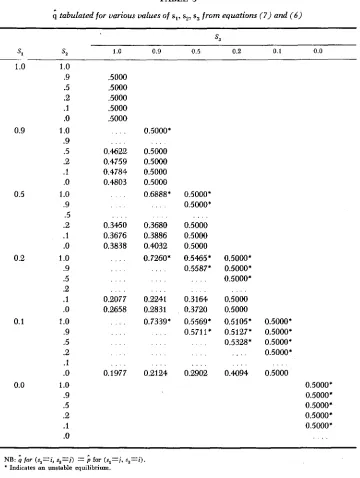
1. From ( 7 ) and (6) we can estimate9
= 1 -b
-
A/2 in any instance. For ex- ample, in those cases where s1 = s3, then from( 5 )
K
= 1 so from (6)D
+
H / 2 =1/2, as expected. Values of
4
are given in Table 3. It will be seen that, in com- parison with the values of8
obtained for incompatibility selection affecting total numbers of offspring produced by a mating type(HULL,
1964), equilibria are possible in fewer cases, a reflection of the more stringent stability requirements for this model. Stable equilibria, where they exist, are shifted more towards the extremes in this case, where incompatibility does not affect total litter size: the points of instability are located nearer 0.5.Application to the experimental data: Letting x2 = 0, an estimate of mean litter size was obtained from Crosses 3 and 6 in Table 1. A linearised least squares procedure was then used to obtain, from the other crosses, estimates of x1 =
+
0.013, x3 = - 0.014, s1 = - 0.036, sz =+
0.191, s3 =+
0.307. We then haves1
+
I] (24,) (%SI) = f0.012.SZ = +0.191.
SO no stable equilibrium is possible from (3): at will be eliminated. Also K =
-1.627 so no value of H between 0 and
+
1 is possible in (6) and hence there is no equilibrium.sj
+
(%sz) ( 5 % ~ ~ ) = $0.264.DISCUSSION
568 P. HULL
TABLE 3
4
tabulated for various values of sl, sp, s3 from equations ( 7 ) and (6)1
.o
0.9
0.5
0.2
0.1
0.0
1
.o
.9 .5 .2 .1 .O 1
.o
.9 .5 .2 .1
.o
1
.o
.9 .5 .2 .1 .O1
.o
.9.5 .2 .1
.o
1
.o
.9 .5 .2 .1.o
1
.o
.9 .5 .2.I
.O
1 .o 0.9 0.5 0.2 0.t 0.0
.5000 ,5000 .5000 .5000 .5000 . . . . . . . . 0.4622 0.4759 0.4784 0.4803 . . . . . . . . . . 0.3460 0.3676 0.3838 . . . . . . . . . . . . . . . . 0.2077 0.2658 . . . . . . . . . . . . . . . . . . . 0.1977 0.5000* 0.5000 0.5000 0.5000 0.5000 0.6888* . . . . . . . . . . . 0.3680 0.3886 0.41332 0.7260' . . . . . . . . . . . . 0.2241 0.2831 0.7339' . . . . . . . . . . . . . . . . 0.2124 0.5000* 0.5000* 0.5000 0.5000 0.5000 0.5465* 0.5587* 0.3164 0.3720 0.5569* 0.571 1 *
0.2902 0.5000* 0.5000* 0.5000* 0.5000 0.5000 0.5 105 * 0.5 127 * 0.5328* . . . . . , . . . , . . 0.4Q94 0.5000* 0.5000* 0.5000* 0.5000* 0.5000 . . . 0.5000* 0.5000* 0.5000* 0.5000* 0.5000* . . .
NB:
4
for ( p = i , s3=j) = for (s,=j, s 3 = i ) . * Indicates an unstable equilibrium.do not seem to indicate any relationship between observed mean litter size and intensity of incompatibility apparent in a given type of mating. Thus s3 = 0.307
PARTIAL INCOMPATIBILITY I N T H E MOUSE 569
incompatibility is expected, is not noticeably high, while the mean size of litters from the reciprocal mating is almost the smallest observed.
If
mean litter size is unaffected by the operation of the incompatibility, then this suggests that the selective elimination is taking place at an early stage inutero, when there is an excess of embryos over those which the female would be able to carry to term in any case. MACDOWELL (1924) estimated by corpora
lutea counts that one third of the eggs shed in normal strains were eliminated
before birth. It is possible that this random elimination could be partly replaced by selective elimination without affecting total litter size.
Since “litter size” for the purposes of this study means litter size at 12 days of age, when the three genotypes can be distinguished without difficulty, any differential elimination of offspring between birth and 12 days would contribute to, or might even totally account for, the observed deviant ratios. It is again possible that random wastage in unaffected litters might compensate for selective elimination in this period, or even at an earlier period, before birth. This effect could not in any event be very large since average litter size decreased by only about 5 percent in this period (8.333 at birth, 7.891 at 12 days).
Because the mice used in this experiment were obtained from the F, or F,
of two inbred strains,
4-
coming from one strain and at from the other, it is possible either that the observed incompatibility may be due to the effect of the two genes+
and at themselves or to a gene or genes sufficiently closely linked to them as to remain associated through several meiotic divisions. It is not possi- ble, from the data available, to decide between these two possibilities. It would be necessary to repeat the test with a population containing these two genes but assumed to be in linkage equilibrium. We can, however, say from the data of Table I, which indicate no heterogeneity of ratio among females in any mating class, that the effect is not due to alleles at another single locus which entered into the original crosses in coupling with+
and at but which were loosely linked to them.I wish to indicate my gratitude to DR. R. C. LEWONTIN for invaluable discussion and sug- gestions.
SUMMARY
Aberrant segregation ratios were noticed in a stock of mice in which the genes
5
70 P. H U L L L I T E R A T U R E C I T E DDUNN, L. C., 1928
HULL, P., 1964
A fifth allelomorph in the agouti series of the house mouse. Proc. Natl. Acad.
Equilibrium of gene frequency produced by partial incompatibility of offspring Evolutionary dynamics of complex polymorphisms.
A method of determining the prenatal mortality in a given pregnancy Sci. U.S. 14: 816-819.
with dam. Proc. Natl. Acad. Sci. US. 51: 461-464. Evolution 14: 458472.
of a mouse without affecting its subsequent reproduction. Anat. Rec. 27: 329-336. LEWONTIN, R. C., and K. KOJIMA, 1960