COMPUTER SIMULATION OF THE
USE
O F DOUBLE TRANSLOCATIONS FOR PEST CONTROLC. F. CURTIS AND A. S. ROBINSON
Tsetse Research Laborarory and Department of Animal Husbandry,
University of Bristol, School of Veterinary Science, Langford, Bristol, England
Received on March 29, 1971
rearing and release of pest insects made homozygous f o r an autosomal T:r!nslocation was proposed, as a means of pest control, by SEREBROVSKI
(1940). This system depends on the semi-sterility of translocation heterozygotes and the full fertility of selected translocation homozygotes. The technique has been further studied by CURTIS (1968 a, b) and CURTIS and HILL (1968,1971), and the limited degree of sterilisation per generation and the difficulty of achiev- ing the optimum translocation frequency in a wild population were emphasised. SEREBROVSKI had perceived the first of these problems and suggested the use of multiple translocations to solve it. The use of a sufficient multiplicity of translo- cations so that the heterozygotes are totally sterile was considered by WHITTEN
(1970, 1971) and by CURTIS and HILL (1971). The production of numerous different translocations. all viable when homozygous, would not be easy, and in this paper we consider only the less demanding case of two reciprocal translo- cations. to try to assess whether such a system would be sufficiently damaging to pzst populations to control them.
Two translocations in the same cell may involve two, three or four different chromosomes and examples of these in maize are described by GOPINATH and BURNHAM (1956) and BURNHAM (1962). In insects three and/or four chromo- some doubles have been found, for example by LEWIS and JOHN (1957), MCDONALD and RAI (1970) and WAGONER, NICKEL and JOHNSON (1969). Many important pest species have few autosomes and in some cases only two or three chromosome doubles would be possible.
In SEREBROVSKI'S treatment of two chromosome doubles, he considered them
as allelic entities, but, in fact, crossing over is to be expected in the intervals between the chromosome break points, i.e. in the differential segments (JOHN and LEWIS 1965). SEREBROVSKI considered that the fertility of a population con- taining four chromosome doubles would be the square of the fertility at the same frequency of single translocations. In fact, this is only true at linkage equilibruim and, after the mass release of two' translocations, either in the form of a double translocation stock or two single translocation stocks, linkage equilibrium would take several generations to be approached.
The fact that semisterility affects translocation heterozygotes but not homozy-
98 C. F. CURTIS A N D A. S. ROBINSON
can favour either allele if its frequency exceeds the equilibrium point (LI 1955). It may be helpful to visualize the various types of double translocation as two negatively heterotic loci with appropriate linkage relations. The analogy with gene loci has been followed in naming the two translocations “TI7’ and “T,” and their non-translocation alternatives “-I-”. However, the analogy is not strictly valid for the following reasons. The reduced fitness of translocation heterozygotes arises because they produce gametes with duplications and deficiencies. In
animals, such abnormalities are lethal to the zygotes but not to the gametes which carry them, and, if the duplication and deficiency of one gamete is complemented by the deficiency and duplication of the one that it fertilises. a viable heterozy- gote is produced (MULLER and SETTLES 1927). This complementation process adds considerably to the fertility of matings bntween translocation heterozygotes, and hence also adds to the fertility of a population containing many such indi- viduals. and it raises the proportion of heterozygotes in the population above the Hardy-Weinberg expectation. These phenomena could not be represented in a simple model of negatively heterotic loci and such a model would also not ade- quately take account of recombination between translocations, which requires that two separate recombination events occur for both segments of a reciprocal translocation to recombine. Also, crossovers in the differential segments may convert normal gametes into duplication/deficiency ones or vice versa, i.e. they have an effect on fertility.
Therefore, in constructing our computer model it seemed necessary to take account of the cytogenetic details of double translocations. Models were set up of the various types of double translocation and the effects were studied of various rates of recombination and release strategies, and a comparison made with the sterile male method of pest control.
THE MODELS
The computation procedure was based on the method for single reciprocal translocations of WRIGHT (1941), also used by CURTIS and HILL (1971). The method assumes discrete generations, and an isolated population so large that stochastic processes are negligible, i.e. the models are deterministic. For given parental frequencies, the overall frequencies of the various types of gamete produced by the population are calculated and, hence, the zygote frequencies, assuming random combination of gametes, are obtained. In order to take account of the complementation phenomenon, the different types of duplication/deficien- cy gametes have each to be considered. The total frequency of viable zygotes gives the population fertility
w,
relative to its normal value, and these frequen- cies also lead to the parental frequencies a t the next generation. Using this method there is no need to consider the frequencies of each of the numerous possible types of mating.GOPINATH and BURNHAM (1956) showed six topologically different types of
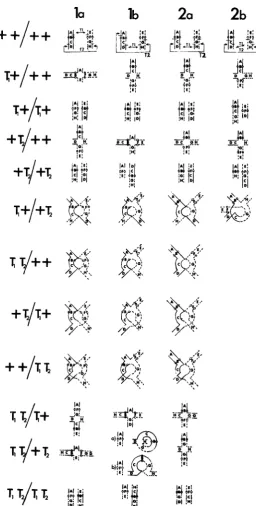
eucentric two-chromosome double translocations that can be formed by exchanges
S I M U L A T I O N O F T R A N S L O C A T I O N S F O R PEST C O N T R O L 99
la
2a
100 C. F. CURTIS A N D A. S . ROBINSON
and BURNHAM’S terminology (la-2b) has been retained for naming the types. In
all these cases the two exchanges, labeled in Figure 1 T , and T,, can occur in different individuals and can be brought together into double heterozygotes by cross breeding. Types l a and l b involve exchanges in opposite arms of the same chromosome; only the other two types could therefore be possible in those species which have all acrocentric chromosomes. In the double heterozygotes of types la. l b and 2a there are two differential segments, and if crossing over can occur in both of these, T I and T , can recombine from the repulsion to the coupling phaso and uice versa, so that all the karyotypes illustrated in Figure 1 can be generated. There are four different forms of double heterozygote which we name T , f / + T , , TIT,/++, +T,/T,f and ++/TIT,. The latter two types arise only as a result of complementation between duplication/deficiency gametes and would allow transition from the pure repulsion to the pure coupling phases to occupy two generations. In a type l b translocation, the karyotype T,T,/+T, can exist in two forms, ( a ) and ( b ) , which can interconvert by a crossover in the differential segment. The double heterozygote of a type 2b translocation re- sembles a paracentric inversion heterozygote in that a crossover in the differential segment generate; a dicentric and an acentric, so that effective recombination to produce the coupling phase could not occur. It is assumed that in the female the dicentric and acentric fragments would be directed into the polar bodies and not into the egg pronucleus (STURTEVANT and BEADLE 1936), but in the male these would presumably be an additional cause of aneuploid gametes. Many of the karyotypes expected with the other types of two-chromosome doubles have no equivalent with type 2b.
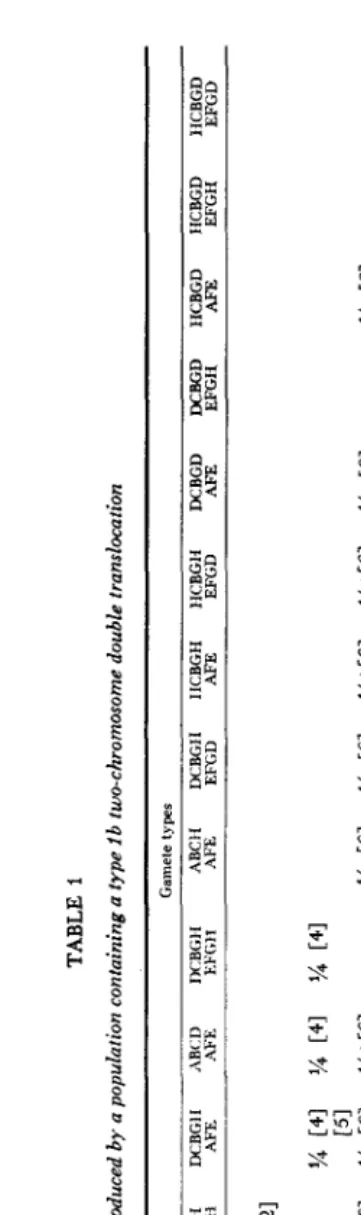
Table 1 shows the method of calculating the gametes produced from a popula- tion containing type l b double translocations. Similar tables have been con- structed for the other three types of two-chromosome doubles but are not shown here. In each case it is assumed that the segments containing homologous centro- meres always cmrient at meiosis; this restriction on random coorientation fre- quently occurs and it simplifies the calculation. The three karyotypes, which have single translocation heterozygote cross-shaped pairing configurations, are assumed to produce the two types of gamete from alternate segregation and the two from adjacent-1 in equal frequency, i.e. there is no directed segregation in favour of. or against, the alternate type. The double heterozygotes are also assumed to give equal numbers of alternate and adjacent-1 segregations if there is no crossover in either differential segment. but if there is crossing over. new gamete types arise. The occurrence of a chiasma in a paired arm of a trans- location complex tends to establish the arm as a plane of coorientation (BURN-
HAM 1962; JOHN and LEWIS 1965) and this restriction has been applied to the model. Thus. in a type 1 b translocation (Figure 1 )
,
a crossover in the differential segment G o r in G and BC allows, in each case, only one type of segregation, i.e. the production of two types of gamete in equal frequency.I n Table 1 the frequincies of crossing over in the differential segments are represented as follows, no crossover : s, in BC only : t , in G only : U , and in BC
TABLE
1
The
gamefes
produced
by
a
population
containing
a
fype
lb
two-chromosome
double
translocafion
Gamete
types
Parental
ABCD
ABCEI
ABCD
ABCH
DCBGlI
ABCD
DCBGII
ABCH
DCBGII
IICBGH
IICBGII
DCBGD
DCBGD
IICBGD
HCBGD
IICBGD
Kawotype
frequency
EFGH
EFGD
EFGD
EFGH
APE
AFR
RYCII
APE
EFGD
AF'E
WGD
AFE
EFGH
AFE
EFGH
102 C. F. CURTIS A N D A. S . ROBINSON
differential segments, and also that there is no interference between the two segments, so that where b and g are the crossover values for the segments BC and G respectively:
s (1-b) (1-g)
U = (1-b)g
U = bg
I n the computer model, b and g can be separately specified for males and females
to accommodate the case of Cyclorrhaphid Diptera with no crossing over in male meiosis. The values of b and g represent the rates of recombination actually occurring in the differential segments; these may not be closely related to the map distance between the loci of the breakages, as determined in the absence of a translocation (MCDONALD and RAI 1970).
As indicated in Table 1, the proportion of each gamete type produced by each parental karyotype is obtained by multiplying the parental frequencies ( [ 11 -
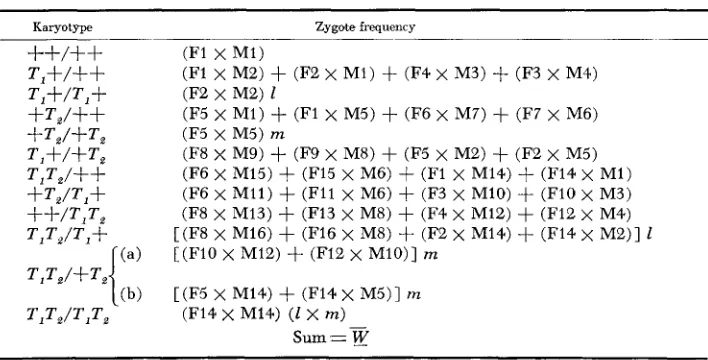
[ 131 ) by the appropriate coefficient, and the total of each gamete type produced by the whole population is obtained by summing the columns. The frequencies for the male gametes (Ml-M16) will differ from the corresponding female gametes (Fl-F16) if there is crossing over in the differential segments of the female, but none in the male.
Table 2 indicates the frequencies of chromosomally balanced zygote types produced by random combination of the male and female gamete frequencies. To represent subnormal viability of translocation homozygotes, the frequencies of karyotypes homozygous for T I and T , are multiplied by coefficients 1 and m
t = b(1-g)
TABLE 2
The frequencies of ihe viable types of zygoie obtained b y combining the gamete frequencies from Table 1
The homozygotes are multiplied by the appropriate viability coefficient, I and m
Karyotppe Zygote frequency
(F1 x M I )
(F1 x M2)
+
(F2x
M I )+
(F4 x M3)+
(F3 x M4) (F2 x M2) I(F5 x M I )
+
(F1 x M5)+
(F6 x M7)+
(F7 x M6) (F5 x M5) m(F8 X M9)
+
(F9 X M8)+
(F5 X M2)+
(Fe X M5) (F6 x M15)+
(F15 x M6)+
(FI X M14)+
(F14 x M I ) (F6 x M11)+
(F11 x M6)+
(F3 x M10)+
(F10 x M3) (F8 x M13)+
(F13 x M8)+
(F4 x M12)+
(F12 x M4) [(F8 x M16)+
(F16 x M8)+
(F2 x M14)+
(F14 x M2)] 1[ (F10 x M12)
+
(F12 x MIO)] m[(F5 X M14)
+
(F14 x M5)] m-
(F14 X M14) (1 X m )
SIMULATION O F TRANSLOCATIONS FOR PEST CONTROL 103 representing the chances, relative to the wild type, of the homozygotes surviving
to breed. The double homozygote is assumed to suffer, without interaction, from both causes of reduced viability. The sum of the surviving zygote frequencies gives w and dividing through by
w
gives the parental frequencies ( [ 11 - [ 131 )at the next generation.
Releases are assumed to be made with pupae or young adult insects, so that the viability factors I and m act o n homozygotes released, before they participate in the first round of mating.
There has been insufficient work on two-chromosome double translocations in insects to provide a firm basis for all the details of the above model and several assumptions have had to be made. However, an example of a type l b double translocation in Drosophila gives progeny and fertility results in crosses between the various karyotypes which are consistent with the above model (ROBINSON and CURTIS, in preparation). For example, the T,S/+T, female showed lower fertility than the corresponding male. This is expected from the model, because crossovers in the differential segment contribute to the production of duplication/ deficiency gametes (Table 1 ) ; such crossovers can occur in female Drosophila, but not in the male.
Figure 2 (3a and 3b) shows the two topologically possible types of three- chromosome double translocations which can occur as a result of separate ex- changes in two individuals and involving a total of four chromosome breaks. They each have a coupling and a repulsion double heterozygote with one differ- ential segment. Types 3a and 3b can be treated as special cases of types l a and 1 b, respectively, of a two-chromosome double, in which there is free recombi- nation in one of the differential segments and this analogy has been emphasised by making the lettering of the diagrams correspond. By setting b at 0.5 in both sexes, the procedure of Tables 1 and 2 can be used to compute cases involving a type 3b, with the following small modifications: the frequency of T,+/+T, is [6] f [8], the frequency of T,T,/++ is [7]
+
[9] and the frequency of T,T,/+T, is [ l l ]+
[12]. Similarly the computing procedure for a type l a translocation can be used f o r a type 3a one. By setting both b and g at 0.5 in both sexes it can also be used for a four-chromosome double (Figure 2(4)).Figure 2 (3c) illustrates a three-chromosome double with no differential seg- ment, which can only occur as a result of three simultaneously open breaks in
one cell. Assuming, as before, that homologous centromeres always coorientate. the procedures of Tables 1 and 2 may be used if b is set at 0.5 and G is reduced to zero size, i.e. g = 0.
If four breaks occur simultaneously in one cell, various types of intercalary translocation are possible, some of which are the coupling versions of double translocations already considered, and others involve paracentric o r pericentric inversions. Such types arise relatively rarely and only a small proportion of these are likely to be viable as homozygotes, so they are unlikely to be used for pest control and are not considered further here.
1 04 C. F. CURTIS AND A. S. ROBINSON
++/++
,
T+/+
+
T + h +
I+TI++
I+q+T,
I
I
I
3a
3b
FIGURE 2.-Diagrams of the three- and four-chromoso'me double translocations.
The models were programmed in ALGOL and run on an Elliott 503 computer.
RESULTS AND DISCUSSION
SIMULATION O F TRANSLOCATIONS F O R PEST CONTROL 105 translocations and their wild-type homologues at a frequency of
SO%,
and for maximum long term control efficiency this frequency should be approximated in the wild population. Using double homozygotes this could be done by a single very large release of males only, but the translocation frequency could be more cheaply raised by repeated releases at several generations, and/or releasing bothsexes (CURTIS 1968b). The extra efficiency of releasing both sexes should more than repay the temporary increase in the breeding population produced, but this procedure might be unacceptable in some species. Releasing double homozygotes repeatedly, and/or releasing both sexes, has the danger of greatly exceeding the optimum frequency, and a good approximation to the optimum frequency could probably only be made by cytological monitoring of the frequency reached in the population as the releases proceeded (CURTIS 1968b).
For illustration it is assumed that a frequency 5
%
above or below the optimum of 50% is achieved, and in Figure 3 lines (a) and (b) show the population fertilityW
in successive generations following a single release of male and female double homozygotes of normal viability. Lines ( a ) and (b) refer. respec- tively, to the cases where recombkation between T , and T , is free ( a four- chromosome double), and to where there is no recombination (a type 3c three- chromosome double as in Figure 2). The depression in w is somewhat more prolonged where there is free recombination, because, without recombination, elimination of a T I in a lethal zygote always eliminates a T , as well. The use of double homozygotes for two o r three chromosome doubles with restricted recombi- nation in the differential segments would give graphs intermediate between ( a ) and (b), but such double homozygotes would be difficult to derive from single translocation stocks if recombination in either differential segment was at all rare. Some idea of the long term genetic load applied to the population is obtained by multiplying the successive values ofw,
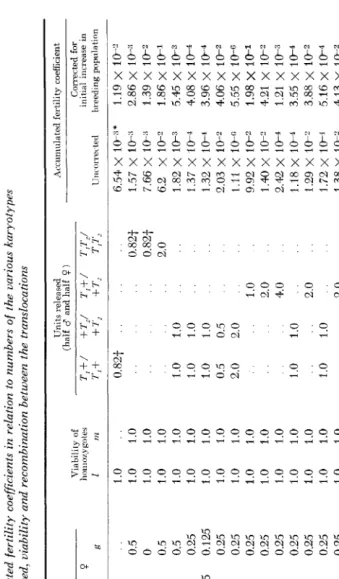
from the time of release to the time when full fertility is restored. CURTIS and HILL (1971) named this quantity the “accumulated fertility coefficient”, and the smaller the coefficient the more favourable the situation f o r pest control. If the coefficient is multiplied by the enlarged breeding population created initially by the release of females, the resulting figure would indicate the final population size that would be achieved, in the absence of density dependent regulation. The effect of such regulation will be considered later.The accumulated fertility coefficient corresponding to Figure 3 line ( a ) is shown in Table 3 (row 2). SEREBROVSKI’S method of squaring the values of
w
for a single translocation would have given 4.28 x which is seriously in error, because linkage equilibrium is only slowly approached. The rate of ap- proach is slower than for genes with the same linkage because of the high sterility of the double heterozygotes.As shown in Table 3 (rows 1 , 2 and 3) there is little advantage to be gained, in terms of the accumulated fertility coefficient, by using double translocation homozygotes (even in the best case of free recombination), over the use of the same number of single reciprocal translocation homozygotes. though the initial depression of
W
is somewhat greater. ‘106 C . F. C U R T I S A N D A. S . R O B I N S O N
FIGURE 3.-The population fertility,
w,
following various releases at generation 0 of fully viable translocations:Type of Recombination in Numbers
Line translocation differential segments released
- _ _ _ _ _ _ _ _ _ _ _ ~ _ _ _ _ _ _ _ _ _ _ _ _ _ ~ _ _
a 4 Free 0.82 T,T,/T,T,
b 3c None 0.82 T , T , / T , T
C I b
a
I be I b
f I b
8 : none
Free
0 : 25% in each
8 : none
TABLE 3 Computed accumulated fertility coefficients in relation to numbers of the uarious karyotypes released, viability and recombination between the translocations Crossover values Type of lranslocation d P [Figures I and 2) b 27 Sterilised insects
1 2 3 4 5 6 7 8 9 10 11 12 13 14 15 16 17 18 19
20 21 22 23 24 25 26
Single*
4 3c 4 lb lb Ib Ib Ib Ib lb Ib la la 2a 2a 2b 3a 3a 3b 3b lb Ib Ib Ib 11)
0.5 0.5 0.5 0.5 0 0.125 0 0 0 0 0 0 0 0 0 0 0.5 0.5 0.5 0.5 0 0 0 0 0
0.5 0.5 0 0.5 0.5 0.5 0.5 0.5 0 0.25 0.125 0.125 0 0.25 0 0.25 0 0.25 0 0.25 0 0.25 0 0.25 0 0.25 0 0.25 0 0.25 0 0.25 0 0.5 0 0.5 0 0.5 0 0.5 0 0.25 0 0.25 0 0.25 0 0.25 0 0.25
g 0.5
0 0.5 0.5 0.25 0.125 0.25 0.25 0.25 0.25 0.25 0.25 0.25 0.25 0.25 0.25 0.25 0.25 0.25 0.25 0.25 0.25 0.25 0.25 0.25
Units released (half d and half 9) Viability of T.+/ +T./
1.0 1 .0 1.0 1 .a 1 .0 1.0 1.0 1 .0 1 .0 1.0 1 .a 1.0 .0 1 1.0 1 .0 1 .(E 1.0 1 .0 .a 1 1 .0 1
.o
0.5 0.25 0.5 0.25 01 .0 .. 0.82t 1 .0 .. 1
.o
..1.0 1 .0
1
.o
1.0 I.o
1 .0 1 .0 1 .0 0.5 1 .0 2.0 1.o
1 .0..
1
.o
1 .01 .0 1 .0 .. 1
.o
1.0 1.0 .. 1.0 .. 1 .0 1.o
1.0 1 .0
1 .U 1 .0 0.5 1 .0 0.25 1 .0 0.5 .. 0.25 .. 0 ..
.. 1 .0 1 .0 1 .0 0.5
2.0 .. 1.0 .. 1 .0 .. .. 1
.o
1.o
1.o
1 .0 ..2.0 Accuniulated fertility coefficient Corrected for initial increase in 111~orrec led Ireeding population 0 82t 0 82t 20
10 20 40 20 20 20
eo
20 20 20 20108 C. F. CURTIS A N D A. S. ROBINSON
then be considered as alleles, and, since the frequencies of T I and T, have been made equal and greater than that of wild type, the latter is eliminated by selec- tion and, using our deterministic model, T , and T , remain in permanent equi- librium, and
W
remains permanently depressed. In reality, this equilibrium would eventually be destroyed by genetic drift (CURTIS andHILL
1971), or by small differences in viability between T , and T,. Where the translocations can recombine, T , and T , must be considered as allelic with, and in competition with, separate wild-type chromosome segments. These wild type segments are always in the majority, because, for instance, the release of T,+/T,+ introduces wild- type homologues of T , into the population. Therefore the balance is not perma- nent (even on the deterministic, equal viability model),
andw
eventually returns to normal. Figure 3 lines ( e ) and (d) refer to the case;, respectively, of free recombination and of 25% crossing over in both differential segments in the female. and none in the male. Where two types of single homozygote are released, the persistence of the depression inw
is inversely related to the rate of recombination between them. in contrast to the direct relationship where double homozygotes are released. Table 3, rows 5 and 6, indicate the same relationship, expressed in the accumulated fertility coefficient, and Table 3, row 7, shows that a given rate of recombination in both sexes gives equivalent results to twice that rate in only one sex.From the above considerations it is clear that if two translocations, which can recombine, are released in the form of equal numbers of the two types of homo- zygote, the more that are released, the closer will each translocation frequency come to 50%, without ever reaching it. Therefore the more translocations that are released in this way the more effectively will the accumulated fertility co- efficient be reduced (Table 3 (rows 6. 8 and 9 ) ) . This advantage over the previous proposals for the use of autosomal translocation homozygotes is bought at the expense of having to release more insects to obtain a given effect, but this would seem to be worth while in view of the likely expense and difficulty of accurate monitoring and adjustment of the translocation frequency in a popu- lation.
If T,+/T,+ and +T,/+T, strains were reared and crossed, the matings would be fertile and repulsion heterozygotes (T,+/+T,) would be produced. Release of these would cause an immediate sharp depression in
W
but a more rapid return to normal than with the release of homozygotes (Figure 3 line f ) . Both of these properties are due to the initial involvement of all the T I and T , chromo- some sets in semisterile matings. The more double heterozygotes that are released, the more the depression in the accumulated fertility coefficient that is achieved (Table 3 (rows 10. 11 and 12)),
but, under the specified conditions of full via- bility. the use of double heterozygotes is much less effective than the same total number of T,+/T,+ and +T,/fT,.S I M U L A T I O N O F TRANSLOCATIONS FOR PE ST C O NT RO L 109
viability and no genetic drift. In three-chromosome doubles, a given crossover value in their one differential segment leads to more effective recombination than the same crossover value in each differential segment of a two-chromosome double. Hence the results for three-chromosome doubles (Table 3 (rows 18-21) )
are more similar to those for four-chromosome ones and less favourable than for the two-chromosome types.
Reduced viability of the homozygote: The reduced viability of translocation homozygotes is proving a source of difficulty in several insect species (e.g. LAVEN,
JOST,
MEYER and SELINGER 1971; CURTIS 1971). This contrasts with the position in mice (CARTER, LYON and PHILLIPS 1955) and maize (GOPINATH and BURN- HAM 1956).The effect of releasing translocations with various levels of viability of the homozygotes in the wild is compared in Table 3 (rows 22-26). Where homo- zygotes are released (Table 3 (rows 22 and 2 3 ) ) the effectiveness is greatly reduced by such viability reductions, mainly because of the excess deaths of the released insects before they have had a chance to mate. Where the viability in the wild is zero, the effectiveness is, of course, zero (accumulated fertility CO- efficient = 1 ) . However, where double heterozygotes are bred and released the
efficiency is only slightly reduced, even by a reduction of the homozygote via- bility in the wild to zero (Table 3 (rows 24-26)); although the deaths of the homozygotes speed the selective elimination of the translocation, these deaths also contribute to the genetic load on the population. The use of double heterozy- gote; is much less efficient than the use of the same total of the two types of
homozygote at high homozygote viability, but it becomes more efficient if the viabilities are depressed to less than half of normal (Table 3 (rows 22-25) )
.
It is assumed in these calculations that the effect of the translocation on via- bility is wholly recessive. It would be uneconomic to rear homozygous lines (as parents for double heterozygotes) if they showed very low viability in captivity. However, it seems probable that translocations will be produced in pest species with adequate viability in pure culture in captivity, but with serious reductions in homozygous viability in competitive conditions in the wild. ROBINSON
(in
preparation) has studied Drosophila translocations which breed very successfully in pure homozygous cultures, but which are at an extreme selective disadvantage in competition with wild type in population cages. Unless one could be sure that two translocation homozygotes would show good viability in the wild, it might be wise to use them to breed double heterozygotes for release, because any recessive deleterious effects of the translocation would then hardly affect the outcome.
Comparison with the sterile male method: Table 3 (row 27) shows the accumulated fertility coefficient for a single release of two units of fully viable male and female sterilised insects. (It is assumed that the presence of sterile females does not affect the chances of a fertile female mating with a fertile male.) The effect, which of course only operates at one generation, is consider- ably less than the accumulated effect of the release of the same number of double translocation heterozygotes.
110 C . F. CURTIS A N D A. S. R O B I N S O N
I I I
lo 15 9 0 IS
GENERATIONS
o m
FIGURE 4.-F’opulation size (on a log scale) following releases of one unit of insects (half male and half female) at generations 0, 1 and 2. The density dependence coefficient is 0.2. Line (a) refers to the release of translocation type I b double heterozygotes with 25% crossing over in each differential segment of the female and none in the male; the homozygote viability coefficients are:
I = 0.5, m = 0.25. Line (b) refers to the release of fully viable sterilised insects.
of the sterile male method, so that at later generations the ratio of sterile : fertile males becomes progressively larger. One may therefore enquire whether the apparent advantage for the translocation method shown in Table 3, which, for simplicity, was based on the assumption of a single release, would still apply if repeated releases were made.
The effect of the later releases depends on the size of the wild population at the time of the releases, and this depends not only on the reductions due to the depression of fertility and any increase of breeding population resulting from previous releases, but also on the moderating influence on both these processes of density dependent regulation. We simulated such regulation by the simplified method of CURTIS and HILL (1971) in which at each generation the total popu- lation of viable zygotes at generation n, Z,, was converted to the population of
breeding adults, A,, as follows:
A , = Z , (1
+ D
(1 - Z n / Z o ) )S I M U L A T I O N O F T R A N S L O C A T I O N S FOR P E S T C O N T R O L 111 coefficient”. We have assumed that the released individuals are very young, so that they contribute to 2, and the density dependent factors tend to moderate the inflation of the population by the presence in it of released individuals
( MONRO 1966). (In this simplified procedure all the events occurring during one
generation are assumed to happen instantaneously, and. consequently, large releases combined with large values of
D
generate a negative population size; however, in the range of values in which we worked, the equation gives bio- logically reasonable results).In the absence of adequate information on likely values of
D,
we adopted a value of 0.2, with the relatively mild density dependent action in mind that may act on tsetse fly populations (CURTIS and HILL 1968, 1971). A type I b double translocation was assumed, with 25%
crossing over in each differential segment in the female and none in the male, and the viability of the T , and T , homozy- gotes was assumed to be severely but unequally reduced, i.e. 1 = 0.5, m = 0.25. Therefore the best policy was to produce double heterozygotes for release. Three releases of one unit each were assumed to be made at successive generations. Asshown in Figure 4 ( a ) , under these conditions the population declines to 1.82 x units after 11 generations and then, as the effect of density dependent regulation begins to overcome the declining effect of the translocation on popu- lation fertility, the population starts to recover.
Such an extreme reduction in density of a real population might lead to failure of males and females to find each other and hence extinction.
Release of the same number of fully viable sterilised males and females gives the result shown in Figure 4 ( b ) . The minimum reached by the population is 1.17 x lo-? units, i.e. considerably higher than with the translocation method. The time scale of both the fall and recovery of the population is much shorter than in the case of the translocation method. In order to reach the same minimum as the translocation method has achieved, three releases of 1.4 units of sterilised insects would be required. The translocation method could be made more efficient than is shown in Figure 4 by leaving longer intervals between the releases, SO that the population had greatly declined before the later releases. thus increasing their effects on translocation frequency. If a decline in viability was an unavoid- able consequence of the application of a radiation or chemical sterilising treat- ment, this would increase the relative advantage of the translocation method. However many translocation double heterozygotes are released,
W
cannot be reduced below about 0.14. This is considerably better t h m the best attainable with single translocations, but a population with a value ofD
larger than about 6 would come to an equilibrium at reduced density and could not be driven towards extinction by repeated releases of double heterozygotes. As quantitative data becom? available on the density dependent relationship in a particular species and on the properties of the available translocations, the above methods will enable assessments to be made of whether double translocations would have economic advantages for the control of that species.112 C. F. CU R TI S A N D A . S . ROB INS ON
E. P. BENNETP for help with programming. We thank Drs. W. P. JAFFE, C. GRANT, P. A. LANGLEY and J. CURTIS for criticizing the manuscript.
S U M M A R Y
A computer model is described for simulating the effects of releasing two-, three- o r four-chromosome double translocations to control a pest population. The model computes the extent to which the population fertility is depressed, as
a result of the semisterility of the translocation heterozygotes, at each generation until homozygosity is restored. If double translocation homozygotes were reared and released it would be necessary to adjust the numbers released close to an optimum, by a process of monitoring the translocation frequency, in order to obtain long term fertility depression. Where the translocations were reared in the form of two different homozygous populations, this monitoring could be avoided, and the more translocations that were released, the greater the control efficiency. The efficiency of this system would be inversely related to the rate of
recombination between the two translocations and the efficiency would be seriously impaired by reduced viability of the homozygotes. Such reductions in viability are not important if the homozygotes were crossed to give double heterozygotes for release. The use of the latter procedure is compared with the use of the sterile male method, and, for a particular set of conditions, it is shown that the translocation method would achieve a given reduction of a population at the cost of rearing fewer insects.
L IT E RA T URE CITED
BURNHAM, C. R., 1962 Discussions in Cytogenetics. Burgess, Minneapolis.
CARTER. T. C., M. F. LYON and R. J. S. PHILLIPS, 1955 Gene-tagged chromosome translocation in eleven stocks of mice. J. Genet. 53: 154-166.
CURTIS, C. F., 1968a Possible use of translocations to fix desirable genes in insect pest popu- lations. Nature 218: 368-369. -, 1968b A possible genetic method for the control of insect pests, with special reference to tsetse flies (Glossina spp.). Bull. Ehtomol. Res. 57:
509-523. -, 1971 Experiments on breeding translacation homozygotes i n tsetse flies.
pp. 425-435. In: Sterility principle for insect control or eradication. I.A.E.A., Vienna.
Theoretical and practical studies on a possible genetic method for tsetse fly control. Isotopes and Radiation in Entomology, pp. 233-247. I.A.E.A., Vienna. - , 1971 Theoretical studies on the use of translocations for the control of tsetse flies and other disease vectors. Theoret. Population Biol. 2: 71-90.
A cytogenetic study in maize of deficiency-dupli- cation produced by crossing interchanges involving the same chromosome. Genetics 41 :
382-395.
CURTIS, C. F. and W. G. HILL, 1968
GOPINATH, D. M. and C. R. BURNHAM, 1956
JOHN, B. and K. R. LEWIS, 1965
LAVEN, H , E. JOST, H. MEYER and R. SELINGER, 1971
LEWIS, K. R. and B. JOHN, 1957
LI, C. C , 1955
The Meiotic System. Springer, Vienna.
Semisterility for insect control. pp. 415-
Studies on Periplaneta americana. 11. Interchange heterozy-
424. In: Sterility principle for insect control or eradication, I.A.E.A., Vienna.
gosity in isolated populations. Heredity 11 : 11-22.
S I M U L A T I O N O F TRANSLOCATIONS FOR PEST CONTROL 113
MCDONALD, P. T. and K. S. RAI, 1970 Aedes aegypti: Origin of a “new” chromosome from a
MONRO, J., 1966 Population flushing with sexually sterile insects. Science 151: 1536-1538.
MULLER, H. J. and F. SETTLES, 1927 The non-functioning of the genes in spermatozoa. Z. Ind. Abst. Vererbungsl. 43: 285301.
SEREBROVSKI, A. S., 1940 On the possibility of a new method for the control of insect pests. Zool. Zh. 19 : 618-630 (In Russian).
STURTEVANT, A. H. and G. W. BEADLE, 1936 The relation of inversions of the X chromosome of
Drosophila melanogaster to crossing over and disjunction. Genetics 21 : 554-562.
WAGONER, D. E., A. C. NICKEL and 0. A. JOHNSON, 1969 Chromosomal translocation heterozy- gotes in the house fly. J. Heredity 60: 301-304..
WHITTEN, M. J., 1970 Genetics of pests in their management. In: Concepts of Pest Manage-
ment. Edited by F. GUTHRIE and R. RABB. -- , 1971 Use of chromosome rearrange-
merits for mosquito control. pp. 399-413. In: Sterility principle for insect control or eradi-
cation, I.A.E.A., Vienna.
On the probabdity of fixation of reciprocal translocations. Am Naturalist double translocation heterozygote. Science 168: 1229-1230.
WRIGHT, S., 1941