Copyright 0 1984 by the Genetics Society of America
SELECTION
WITH
GENE-CYTOPLASM INTERACTIONS.
I.
MAINTENANCE
OF
CYTOPLASM POLYMORPHISMS
H.-R. GREGORIUS AND M. D. ROSS
Abteilung f i r Forstgenetik uiid Forstpfla~zzeiiziichtutzg, Utziversitat Gdtingen, Biisgenweg 2, 3400 Gcittingen-Weende, Federal Republic of Germany
Manuscript received September 2, 1983
Revised copy accepted December 27, 1983
ABSTRACT
General conditions for the protectedness of gene-cytoplasm polymorphisms
are considered for a biallelic model with t w o cytoplasm types and under the
assumption that nuclear polymorphisms cannot be maintained in the presence
of only one cytoplasm type. Analytical results involving male fertilities, female fertilities, viabilities and selfing rates are obtained, and numerical results show spiral and cyclic behavior of population trajectories. It is shown that a mater- nally inherited cytoplasmic polymorphism cannot be maintained in the absence of a nuclear polymorphism, and that a gene-cytoplasm polymorphism can only
be maintained if the population shows sexual asymmetry, i.e., if the ratio of
male to female fertility varies among genotypes. Thus, the classical viability selection model does not allow gene-cytoplasm polymorphisms.
HE occurrence of variation in pollen fertility resulting from gene-cyto-
T
plasm interactions is well documented in natural populations (e.g., some Labiatae and species of Plantago), in crop plants (e.g., maize) and after intra- and interspecific hybridization (see reviews by EDWARDSON 1956, 1970; see also VAN DAMME and VAN DELDEN 1982). Gene-cytoplasm interactions are also known to affect male viability and resistance to CO2 in Drosophila (FLEURIET 1976). Despite the great theoretical, agricultural and perhaps medical impor- tance of such interactions, there appears to be no general population genetic treatment of gene-cytoplasmically controlled fertility and viability variation, and the aim of this paper is to supply such a treatment.When cytoplasmic genes are inherited through only the female line, a cy- toplasmic polymorphism, unaccompanied by a nuclear polymorphism, repre- sents the equivalent of a haploid model. Under these conditions, constant cytoplasmic fitnesses imply the fixation of one cytoplasmic type. This is because it is extremely unlikely that different cytoplasmic types have exactly the same fitnesses, and even for the case of equal fitnesses, genetic drift would ensure cytoplasmic monomorphism in populations of limited size. Therefore, a nec- essary requirement for a cytoplasmic polymorphism is probably a negatively frequency-dependent cytoplasmic fitness. We may ask how such a fitness could arise? Simply to assume an increased fitness for a cytoplasmic type when it becomes rare is a tautology and may have limited biological meaning. But we have seen that the absence of a nuclear polymorphism affecting fitness implies
166 H.-R. GREGORIUS AND M. D. ROSS
constant cytoplasmic fitnesses and results in cytoplasmic fixation. Therefore, in many cases a nuclear polymorphism is a necessary (but not sufficient) con- dition for the persistance of a cytoplasmic polymorphism and may succeed in producing negatively frequency-dependent cytoplasmic fitnesses.
T h e conditions under which a nuclear polymorphism is protected in two cytoplasm types are apparently complicated and difficult to obtain. Such a polymorphism is probably very sensitive to disturbance, so that slight changes in parameter values could result in nuclear or cytoplasmic fixation. If a nuclear allele acts in the same direction in both cytoplasms, there is again the proba- bility of cytoplasmic fixation because of the absence of negative frequency dependence. T h e simplest way to maintain both the nuclear genes and the cytoplasms polymorphic may, therefore, be to assume nuclear effects that act in opposite directions in each cytoplasm. Such a model is also likely to be less sensitive to changes in parameter values. Therefore, we present a two-allele two-cytoplasm model, in which one allele would become fixed in a population, which had only the first type of cytoplasm, and the other allele would become fixed in a population with only the second type of cytoplasm. We then obtain conditions under which both cytoplasms, and, therefore, both nuclear alleles, are protected.
167
ponent of fitness is affected by gene-cytoplasm interactions. Thus, a strain of Epilobiurn hirsutuvi from Germany showed a cytoplasm-induced embryo lethality when crossed with strains from South Africa (MICHAELIS 1954), and maize in Texas cytoplasm is less resistant to a particular strain of southern corn leaf blight than maize of other plasmatypes (FRANKEL and GALUN 1977, p.
222).
In summary, all components of fitness, namely, male fertility, female fertility, viability and selfing rate, are affected by gene-cytoplasm interactions, which, therefore, have great evolutionary importance.GENE-CYTOPLASM INTERACTIONS
THE MODEL
We assume a hermaphrodite population that has cytoplasm types N and S, together with two alleles A1 and A2 at gene locus A. Both the cytoplasm types
and the alleles may influence viability, male or female fertility and selfing rate. Female and male fertilities are denoted by
4’s
and p ’ s , respectively, the selfing rates by U ’ S and the genotype frequencies byP’s.
Thus, the model yields six genotypes:N AlAl
with female, male fertilities4 ~ 1 1 ,
~ ~ 1 ovule selfing rate 1 , uNll and frequencyP N I I ;
SAIAl
with female, male fertilities C#Jsll, p s l l , ovule selfing rate usll and frequencyPSI];
and so on. T h e word “genotype” is used here in a wider sense than usual, to denote both plasmatype and nuclear genotype (nucleotype), because it seems desirable that the cytoplasmic genetic material should be regarded as a normal part of the total genetic material of the cell. T h e main features of the model are given in Table 1.It is assumed that all ovules are fertilized, that the amount of pollen used in selfing is negligible and that the cytoplasmic determinants are always trans- mitted by the ovules only. A number of additional symbols are used in obtain- ing the next-generation frequencies or the results given in the APPENDIX. These are as follows, where primes denote next-generation frequencies:
P,~K
= relative frequency of the A,A,-nucleotype among all individuals withp , l ~
= the relative frequency of gene A, in cytoplasm K(K = N , S;i
= 1,2),
K-plasmatype (K = N , S;
i,
j = 1 ,2)
= P I I I K
+
’/2p12IKPK
= relative frequency of individuals with K-plasmatype4~
= the mean ovule production of individuals with K cytoplasm, =P
.
9
=PK*P,~K
-
~ K l l P I I I K+
4K22p221K+
4K12P121K4
= the mean population ovule production, =PN&
+
Ps&
,G = the mean population pollen production, = P N ~ l p N I I
+
PN22pN22
+
G , I K = the relative number of outcrossed ovules of nucleotype A, in plasma-
PN12pN12
+
PSllpSll+
pS22 pS22+
PS12/.LLs12typeK(K = N ,
s;
i
= 1, 2), = [(I-
C # J K I ~ ) ~ K ~ I P ~ ~ I K
+
‘ 4 1
-
~Kl2)4KL2p121K]/ F Kg, = the relative number of pollen grains of nucleotype
i(i
= 1 , 2), =168 H.-R. GREGORIUS AND M. D. ROSS
TABLE 1
A generytoplastiiic model of fertility variation in hermaphrodites
Genotype
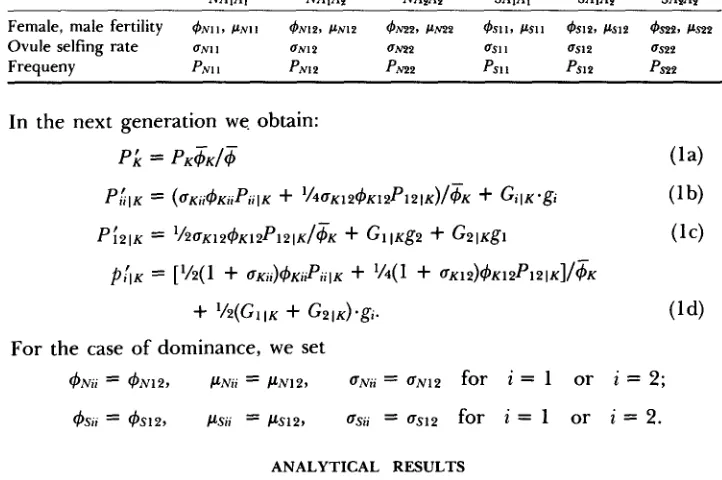
In the next generation w e obtain:
Pk = P K 6 K / 6
ANALYTICAL RESULTS
T h e APPENDIX gives the conditions under which a cytoplasm (plasmagene) is protected. These conditions are based on the particular model assumptions which we have described earlier (it?., fixation of A1 in the presence of N-
cytoplasm only and fixation of A2 in the presence of S-cytoplasm only). Pro-
tectedness is measured by the multiplication rate t9K in relative frequency of
cytoplasm type K, when this type in combination with its favored allele is very rare. Thus, OK
> 1 and
OK< 1 indicate protectedness and nonprotectedness,
respectively, of the K-cytoplasm.An essential feature of OK is that it involves
4’s
and U’S but no p’s, so that the protectedness of the cytoplasms depends on ovule fertilities and selfing rates but is independent of male fertilities. Since the conditions for fixation in the presence of a single cytoplasm for the most general case are complex, involving4’s,
P’S and U ’ S (GREGORIUS 1982), and the conditions for the cyto- plasm polymorphism are fairly complex, it is convenient to first consider some simpler special cases.Before doing so we present some conditions for protectedness of the poly- morphism that hold for all selfing rates, provided they do not invalidate our basic assumptions for fixation.
From the APPENDIX it follows that a necessary condition for protectedness of the polymorphism (Le., OS, ON
> 1) is
GENE-CYTOPLASM INTERACTIONS 169 Note, that this does not depend on the ovule fertilities of the heterozygotes, and it is satisfied if either
~ S I I
>
4~11>
4 ~ 2 2 01- 4 ~ 2 2>
4 ~ 2 2>
4 ~ 1 1
or4~11,
4 ~ 2 2>
4 ~ 1 1
= 4 ~ 2 2 .T h e APPENDIX shows also that a sufficient condition for protectedness of the polymorphism is
If at least one of these two inequalities holds in the reverse direction, then the polymorphism is not protected for small selfing rates and in particular in the absence of selfing. Consequently, if
(2)
holds but (3) does not, protectedness may be achieved by appropriate selfing rates. This situation occurs if either4s11
>
4 ~ 1 1
>
4 ~ 2 2>
max(b22, ‘/24N12} or~ N Z Z
>
4 ~ 2 2>
$ N I ]>
m a x ( h 1 , 1/24~12).No varintion
in
fpinale fertilities within each cytoplasm: By definition our fixation assumptions d o not apply in this case. Equation ( l a ) shows that the cytoplasmic type with the greater female fertility will always increase in frequency in the next generation. Consequently, a cytoplasmic polymorphism can never be pro- tected. Notice that equation (la) does not contain p’s and d s , so that there may be any degree of nucleo-cytoplasmic interaction for male fertility and selfing rate. Such interactions may indeed affect genotype frequencies but have no effect on the protectedness of a cytoplasmic polymorphism. This result confirms the assertion made in the introduction and generalizes results for purely cytoplasmically inherited male sterility (LEWIS 1941 ; LLOYD 1974). Be- cause of this result, all subsequent special cases considered here have varying female fertilities within a cytoplasmic type.Sexunl synmetry nnd all seljing rates identical (including no seljing): If the female and male fertilities of a given genotype differ in exactly the same proportion from those of another genotype, these genotypes are said to be sexually sym- metrical. All such genotypes have the same 4 / p ratio. In the absence of a cytoplasmic polymorphism the biallelic polymorphism is protected if 1/2412
>
411,
4 2 2 (GREGORIUS 1982). Hence, a necessary condition for fixation of the allele A I is1/z412
I>
4z2.
Thus, according to our fixation assumption, we must set l / 2 4 ~ 1 2 I4 s ~ ~
>
4sll and l / 2 4 ~ 1 2 I4 ~ 1 1
>
4N22. Suppose that the cytoplasmic polymorphism is protected. Then, by (2) 4 ~ ~ 2 2>
4 ~ 1 1
and4 ~ 1 1
>
170 H.-R. GREGORIUS AND M. D. ROSS
Sexual asymmetry, resource allocation, dominunce a n d U,, = U : This special case differs from the previous one essentially only in its sexual asymmetry, thus allowing the effects of this factor to be isolated. For sexual asymmetry, the ratio 4 / p is not constant for all of the genotypes in a population. For example, in hermaphrodite plant populations in which reproductive resources are limited and the same for each genotype, those genotypes that produce more ovules produce less pollen, and vice versa. It makes good sense to use such a model of equal reproductive resources for each genotype, since unequal resources are equivalent to an additional symmetrical effect, which is then confounded with the asymmetry to be studied in this section. For such a population, then, where RK, is the proportion of the total reproductive resources devoted to ovules or seeds by genotype N A,AJ, and where 0 1 because of hermaphroditism, we know for a dominant gene
(Ross
and GREGORIUS 1983) that allele A1 is fixed ifRK,,
+
U ) L Rll>
RZ2 or Y2(1+
U ) I RI1<
R22 and that A2 is fixed ifV 2 ( 1
+
U ) 2 R22>
R l l or Y 2 ( 1+
U ) I R22 R l l .In this model RK,/ = &,rP, where rp is the proportion of the total reproductive resources required for one ovule or seed and is the same for all genotypes. Therefore, the proportion 1
-
RK,, = 1-
&,r* of the total reproductive resources are used for pollen grains, of which the quantity ( 1-
RK,)/r* is produced, where r* is the proportion of the total reproductive resources of any genotype required for one pollen grain (Ross and GRECORIUS 1983). We now write a for S cytoplasm (see APPENDIX) in terms of resource allocation aswhere us is the selfing rate for all three nuclear genotypes in S cytoplasm. We now consider several examples within this special case.
(a) l/2(1
+
US) I R~22<
Rsll and Y2(1+
uN) 5 R N I ~<
R~22: From the Appendix r9as I max{l/zR~12, R~22). Since R~22-
l/2Rs12 2 R~22-
'/2 2 V 2 ( 1+
us)
-
'12 = Y2u~ 2 0, we obtain max( l / z R ~ 1 2 , R~22) = R~22 and, thus, r9as 5 RSZ. Hence, max(Rsll, rpw) = R s l l , and, therefore, S is protected if R N ~ I<
R s I ~ . Similarly, '1% is protected if RS22<
RN22. Consequently, the polymorphism is protected if all of the conditions are met, i.e., V2(1+
US) I Rs22<
Rsll,R N I I
<
Rsll and Y2(1+
U N ) I R , w ~<
R ~ 2 2 , RS22<
R~22. These can be writtenin the form
l/2(1
+
US) I R S E , Yz(1+
UN) I R~11, and max(Rs22, R N ~ I )<
min(Rsll, RNZZ). Note that in this case all R's are 2 l/2, i.e., more resources are allocated to female than to male function. Even when there is no selfing, there can be no polymorphism unless the genotypes Rsll, R N 2 2 devote more than half of theirGENE-CYTOPLASM INTERACTIONS 171
(b) l/2( 1
+
U S ) L R S 2 2>
Rsll and l/2( 1+
U N ) I R ~ 1 1>
R ~ 2 2 : In this case, sinceR~12 5 R ~ 2 2 , r'as is an increasing function of US, so that
r'as 5 l / 2 R ~ 2 2
+
' / 4 R S 1 2+
l/2d1/4RS212+
R ~ 2 2 ( R ~ 2 2-
R ~ 1 2 )Hence, for Y 2 ( 1
+
as) L R ~ 2 2>
Rsll and Y 2 ( 1+
U N ) I R N I I>
R ~ 2 2 , max(Rs11,r'as] I R ~ 2 2 and max(R~22, r ' a ~ ) 5 R ~ 1 1 . T h e conditions for protectedness in the APPENDIX would then imply that R N l 1
<
R ~ 2 2<
R ~ 1 1 , which is a contradic-tion. Consequently, in this case, it is not possible to protect the polymorphism. (c) I/z(1
+
US) I R ~ 2 2<
Rsll and ' / 2 ( 1+
UN) 2 R N I ~>
R ~ 2 2 : By (a), S isprotected if R ~ 1 1 R s l l . N is protected if R ~ 2 2
<
max(R~22, ( Y N r ' ) , where by(b) the maximum is 5 R N 1 1 . Hence, a necessary condition for protectedness of
the polymorphism is R ~ 2 2
<
R ~ 1 1<
R s l l [consult also equation(2)],
so that(since l / 2 ( 1
+
US) d R s ~ z ) , R ~ 2 2 , RS12, R s l l and R N l l 2 ' / 2 . Moreover, in thissituation, l / 2 ( 1
+
US) 5 R ~ 2 2 Rw11 5 l / 2 ( 1+
UN), so that US<
UN is also a necessary condition for protectedness of the polymorphism. Consequently, the polymorphism cannot be protected if us = UN or us>
UN.NUMERICAL RESULTS
Population dynamics and equilibria: So far we have only considered whether a
polymorphism is protected or not, but we have no information on whether any polymorphic equilibria exist or whether genotype frequencies will converge upon any such equilibrium. Therefore, in this section we consider some nu- merical results for the special cases considered in subsections (a) and (c) of the previous section. For subsection (a) we first consider the case R N 1 1 = 0.7,
RN12 = R ~ 2 2 = 0.8, UN = 0.2, and Rsll = 0.85, RS12 = R S 2 2 = 0 . 7 5 , us = 0.4.
Thus, allele A2 is dominant in both cytoplasms. Each part of Figure 1 gives
the frequency of cytoplasm type N(PN) on one axis and the frequency of allele
FIGURE 1 .-Population trajectories for three special cases, expressed in terms of frequency PN
of cytoplasm type N , and frequency P I of allele A l . (a) Allele A2 is dominant in both cytoplasms.
Os = 1.214. (b) Allele A2 is dominant in N cytoplasm, and AI is dominant in S-cytoplasm. R N l l =
1.214. (c) Allele A I is dominant in both cytoplasms. RNII = R N I Z = 0.65, RMZ = 0.6, U N = 0.35,
R N I I = 0.7, RNIZ = Rmn = 0.8, ON = 0.2, ON = 1.067; Rsil = 0.85, Rs12 = &22 = 0.75, Us = 0.4, 0.7, R N I ~ = RMZ = 0.8, ON = 0.2, ON = 1.067; & I I = Rsiz = 0.85, Rszz = 0.75, OS = 0.4, Os =
172 H.-R. GREGORIUS AND M. D. ROSS
A l ( p l ) on the other. For the present case, Figure l a shows changes in gene and cytoplasm frequencies for three sets of starting frequencies, where one set is extreme, one is nearer the center of the graph and one is quite near the center. T h e extreme starting frequency is 0.999 of genotype N AlAl and 0.001 of S A2A2. It could thus represent the immigration of a few S A2A2 individuals from a stable monomorphic S A2A2 population into a stable monomorphic N A I A l population. T h e graph shows that the population moves from a state where nearly all individuals are N AIAl via nearly all S AIAI, nearly all S A2A2, nearly all N A2A2 and back close to the starting frequency. In each corner of the graph the genotype frequencies change only very slowly, but changes are much quicker when moving from one corner to the next. Although the
poly-
morphism is theoretically protected, frequencies of the rare types are very low
so that only monomorphic equilibria are likely to occur in populations of limited size. This presumably reflects the relatively low 8 values. In contrast, an intermediate starting frequency, such as could represent the coming to-
gether of two initially distinct populations, shows no tendency to extremely low cytoplasm or gene frequencies and produces a spiral pattern on the graph. Finally, a cycle is found in the interior of the graph. Such cycles in genetic models have been studied, e.g., by HASTINGS (198 1).
We now consider the same situation but with A2 dominant in N cytoplasm
and A l dominant in S cytoplasm. T h e d s and 0’s remain the same, and we have R~11 = 0.7, R ~ 1 2 = R ~ 2 2 = 0.8, Rsll = R ~ 1 2 = 0.85, and R~22 = 0.75. Figure l b shows that the population trajectories move outward from near the center and then reach frequencies at the edge of the graph, such that the maintenance of the gene-cytoplasm polymorphism is endangered for popula- tions of limited size, despite the protectedness of the polymorphism for very large populations.
T h e third graphical example (Figure IC) corresponds to the situation consid- ered under subsection (c) of the previous section. T h e graph shows a spiral that approaches an equilibrium point in the interior. However, there is a very low frequency of N cytoplasm near the beginning of the trajectory, which indicates a possible loss of the polymorphism in any population that is not very large. For such populations the graph suggests that a polymorphism may fail to be maintained if some S A2A2 individuals migrate into an N AIAl population but could be maintained for the opposite situation.
Fitness values: Fitness values and related measures were also studied numer- ically. T h e fitness measure is that studied previously by GRECORIUS and ROSS (1981) and is defined as the number of successful gametes per individual, where a successful gamete is defined as a gamete (of either sex) that takes part in fertilization. Such fitness measures involve selfing rates and are usually frequency dependent. Table 2 gives fitness values and other population meas- ures for a particular population taken from the case studied in Figure la. Since A2 is dominant in both cytoplasms, the fitness value of the nuclear genotype
._ U g CJ
Y
&
'ft U
1
s
E k a Ua
U CJw 7
- 1 $
2 u
b1.19 22 2
2
._ B
t
(s; U U 91 r: EGENE-CYTOPLASM INTERACTIONS 173
8.s
$ 3
w o i o o
,,ass
8 o " * ~ o 22
o q g ss4
8
rz
Km o & ' " 3
g , G
g g
3 8 L 5 22 U o h o c "" " . y g o - 0 - L E * 5 0
w
-
gses
9'p'
$2.5
3
n 00
g g
;$:$ cf2 z g c o
"-q
8
3 %-kc
- ? W a
E
CJ 3 2 4 . 2
g
< 0 $ 2
$ z f
y
11<22 i m
% q e
0-
w v . c 8 2 &;
+
a
0 0 , .r &,,-gq 0 s ; o o .Ilc"aa% $-
3
sa&
B
'",x In 0 0 2 0 . 3 2
-
.2
5
g
r o me":
& G o 0 3 g . s3
2
3
O b 0 0 3 m a 02
.sx
ir, &SE"
Y
K ,g&,g3
- Y i
Fz
fj-DI
-
g5:
5
b.5.- gs o t - 0 0
M * , r c l Z Z S , !j,
a.2 22 0 3 - a l
g
- g
$?$E 8 0 2
.-
c5 n *in b@p y
f
3 O w 6 0 G m
-
J - g E $
5, o m s & %n $ g g
S B d c
E
", @ ? y O o 0 0 0
s
8 m o o ,
" C * M * j ' S2
m O Z ?4
o o o a 2
-
0 -< 7 Z Q $ t
5 2
g z
+ o s ,, y ?
s
o m 0 0 s g 2 r s g2
8 E . 5g
ca $
g g
g'SI r.m > 2 + E S E
$
8
q
a . g . 2 - ~ 0 ~ L O 0 J j W 5 0-
E ; g zs
e
Q 0 - 0
gs
2
8
2 , 2 m O L s 2 , g K"3
g 2 E e g & p j
s
8
g.2
2 < & +
E.24: t + * " m v l ; ; J *
n bo aJ c
3 u)
2 2
% & N u $e y
y y E o * G 2a m 2
PI m w
q g
x z
, C - Q 5E
r*
c?? 3 u o
^ & m . 2 .&
U
w
5 - e* . % K 2 &
2
2
u)
-
* L . ZK L L n U V I -
2
i
;":
S E E m o
x 2 - 2 o m . 2 s
174 H.-R. GREGORIUS AND M. D. ROSS
otypes is taken over both cytoplasms, however, we find that there is under- dominance, despite the dominance of allele A t . Notice that the underdomi- nance refers to fitness, whereas the dominance refers to fertility.
Seljing rates: It has previously been argued
(Ross
1982; Ross and GRECORIUS 1983) that for sexually asymmetric populations the ovule selfing rate alone is insufficient to define selfing. This is because genotypes with more pollen have higher pollen outcrossing rates than those that have less pollen. Thus, even when all ovule selfing rates are the same, the overall selfing rates for all gametes differ among genotypes in sexually asymmetric populations. Such self- ing rates, defined as the number of successful gametes that take part in selfing as a proportion of all successful gametes of an individual, are given in Table 2.Functional sex: Functional sex is defined as the number of successful ovules as a proportion of all successful gametes
(Ross
and GREGORIUS 1983) and is, thus, a measure of female sex functioning. Individuals or genotypes with a functional sex of more than 0.5 specialize more in the female and those with less than 0.5 more in the male direction. From Table2
it is clear that each genotype, each nuclear genotype and each cytoplasm type has its own value for functional sex.DISCUSSION
This paper is apparently the first to demonstrate general conditions under which gene-cytoplasm polymorphisms can be maintained, under the condition of opposing selection in the two cytoplasms. T h e paper generalizes earlier studies of gynodioecy (populations of females and hermaphrodites) made by CHARLESWORTH (1 98 1) and by DELANNAY, GOUYON and VALDEYRON (1 98 1). Perhaps the most significant result of the present paper is the requirement of sexual asymmetry for the maintenance of gene-cytoplasm polymorphisms, and there is plenty of evidence for such asymmetry in monoecious or hermaphro- dite populations (briefly reviewed by ROSS 1977; GREGORIUS and ROSS 1983). However, evidence for gene-cytoplasmically determined sexual asymmetry within populations of higher plants seems to be confined to the relatively extreme asymmetry shown by gynodioecious species. Further studies of the less extreme asymmetry shown by hermaphrodite or monoecious species are re- quired, to show whether such asymmetry may also be determined by gene- cytoplasm interactions. More specifically, provided the fixation assumption are realized, the male fertilities have no further influence on protectedness, which is due to the fact that the cytoplasm is transmitted through the ovules only.
T h e statements about protectedness following (2) show that in one cytoplasm the ovule fertility of the fixation homozygote must be lower than that of the exeinction homozygote, whereas the ovule fertility of the fixation homozygote in the other cytoplasm must be located between the first two. This indicates already that the pollen fertility must compensate for the ovule deficiency in order to reinforce fixation in the absence of the other cytoplasm. Hence, d u e
GENE-CYTOPLASM INTERACTIONS 175 resource allocation we considered asymmetry in both cytoplasms and found that the maintenance of a polymorphism requires that several genotypes devote at least half of their resources to functioning as female. In one case, there could be no polymorphism unless the ovule selfing rates differed between the two cytoplasms. Experimental evidence for different ovule selfing rates among hermaphrodites has been found for the gynodioecious species Origanum vulgare
(LEWIS and CROWE 1956; KHEYR-POUR 1981) and Thymus vulgaris (VALDEY-
RON, D O M M ~ E and VERNET 1977), and both species show gene-cytoplasmic inheritance of male sterility.
Not only hermaphrodite or gynodioecious but also dioecious species may show sexual asymmetry. For example, any autosomal locus that affects male fertility or viability differently from female fertility or viability produces sexual asymmetry and may, therefore, show interactions with the cytoplasm. For ex- ample, the character sex-ratio in Drosophila bifasciata is maternally inherited and results in greatly reduced viabilities of males but not females. T h e equivalent of such reductions is obtained by setting low P’S in the model for sex-ratio
males. In D. zuillistoni the sex-ratio agent is infectious, self-reproducing but de- pendent upon nuclear genes for its persistence (STRICKBERGER 1968), as pre- dicted by the present model. It seems probable that male and female fertility could be affected differentially by autosomal loci in dioecious species, leading to sexual asymmetry. Under certain conditions we may apply the present model
to such species so that it may be useful to look for genes that affect such fertility differences and to test by reciprocal crosses whether such fertility differences are also affected by the cytoplasm.
This work was supported by a Heisenberg Fellowship (H.-R. G.) and under a contract from the Deutsche Forschungsgemeinschaft (M. D. R.). We thank ELIZABETH GILLET and HEIDE CLOCK for help with the computer work.
LITERATURE CITED
ASSOUAD, M. W., B. DOMM~E, R. LUMARET and G. VALDEYRON, 1978 Reproductive capacities in the sexual forms of the gynodioecious species Thymus vulgaris L. Bot. J. Linn. Soc. 77: 29- 39.
A further study of the problem of the maintenance of females in gynodioecious species. Heredity 46 27-39.
Mathematical study of the evolution of gynodioecy with cytoplasmic inheritance under the effect of a nuclear restorer gene. Ge- netics 9 9 169-181.
EUWARDSON, J. R., 1956 Cytoplasmic male sterility. Bot. Rev. 22: 696-738.
EDWARDSON, J. R., 1970 Cytoplasmic male sterility. Bot. Rev. 36 341-420.
FLEURIET, A., 1976 CHARLESWORTH, D., 1981
DELANNAY, X., P. H. GOUYON, and G. VALDEYRON, 1981
Presence of the hereditary rhabdovirus sigma and polymorphism for a gene for resistance to this virus in natural populations of Drosophila melanogaster. Evolution 30 735- 739.
Pollination Mechanisms, Reproduction and Plant Breeding. Sprin- ger, New York.
GREGORIUS, H.-R., 1982 Selection in plant populations of effectively infinite size. 11. Protected- ness of a biallelic polymorphism. J. Theor. Biol. 9 6 689-705.
176 H.-R. GREGORIUS AND M. D. ROSS
GREGORIUS, H.-R. and M. D. Ross, 1981
HASTINGS, A., 1981
Selection in plant populations of effectively infinite size.
Stable cycling in discrete-time genetic models. Proc. Natl. Acad. Sci. USA
Wide nucleocytoplasmic polymorphism for male sterility in Origanum
Male sterility in natural populations of hermaphrodite plants. New Phytol. 4 0
The genetics and evolution of gynodioecy. Evolution 1 0
Theoretical sex ratios of dioecious and gynodioecious Angiosperms. Heredity
MICHAELIS, P., 1954 Cytoplasmic inheritance in Epilobium and its theoretical significance. Adv. I. Realized genotypic fitnesses. Math. Biosci. 54: 291-307.
78: 7224-7225.
KHEYR-POUR, A., 198 1
vulgare L. J. Hered. 7 2 45-51.
LEWIS, D., 1941
LEWIS, D., and L. K. CROWE, 1956 56-63.
115-125.
LLOYD, D. G., 1974 32: 11-34.
Genet. 6 288-401.
OEHLKERS, F., 1964 Cytoplasmic inheritance in the genus Streptocarpus. Adv. Genet. 12: 329- 370.
Ross, M. D., 1977 Behaviour of a sex-differential fertility gene in hermaphrodite populations.
Ross, M. D., 1978 The evolution of gynodioecy and subdioecy. Evolution 32: 174-188.
Ross, M. D., 1982 Five evolutionary pathways to subdioecy. Am. Nat. 1 1 9 297-318.
Ross, M. D., and H.-R. GREGORIUS, 1983
Heredity 38: 279-290.
Outcrossing and sex function in hermaphrodites: a resource-allocation model. Am. Nat. 121: 204-222.
STRICKBERGER, M. W., 1968
VALDEYRON, G., B. DOMMBE and P. VERNET, 1977
VAN DAMME, J. M. M. and W. VAN DELDEN, 1982
Genetics. Macmillan, New York.
Self-fertilization in male-fertile plants of a
Gynodioecy in Plantago lanceolata L. I. Poly-
Corresponding editor: M. T. Clegg gynodioecious species: Thymus vulgaris L. Heredity 39: 243-249.
morphism for plasmon type. Heredity 49: 303-318.
APPENDIX
In the following it is assumed that the conditions for fixation of A1 are realized in the presence
of the N-plasmatype and the conditions for fixation of A2 are realized in the presence of the S-
plasmatype. To find conditions for the protection of the S-plasmatype, for example, we have to consider &/& as PS approaches zero and, at the same time, as A I approaches fixation within the N-plasmatype. If, then, at this limit s > $N, where necessarily
&
= 4~11, the S-plasmatype is protected since by (la) P;/Ps = &/& .--) &s/& > 1. Otherwise, i.e., if&
< J N , then S is not pro-tected. The crucial point is that we do not know the limit of &, since even though Ps is very small the P U I S ’ S may still perform a dynamics. T o analyse this “infinitesimal” dynamics and find out whether it causes
TS
to approach a limiting value I$S, consider the equations (Ib) and (Id) for i =2, K = S as P N l l .--) 1, while the PUIS’S remain constant. This leads us to
p42 IS = (~SZZh?P22 IS + ‘14‘JSIZ ’ @Ss12 . P I 2 IS)/& (AIIa) and
P i l S = %((I
+
us22)4s22P221s + %(1+
us12)~s12P12,s)/~s. (AIIb)GENE-CYTOPLASM INTERACTIONS 177
U12912
+
q(2u22$22-
u12$12)q f = ( 1
+
u12)$12+
q((1+
u22)&!2-
( 1+
u12)$12)'a(a
-
b)+
bThis type of transition equation may be written as q' = f ( q ) = and was analyzed by
GRECORIUS ( 1 9 8 2 ) . There it was shown that q always approaches a limit
i
for which the denomi-nator off(q) has the form
q ( C - d )
+
dNow, (AIIb) can also be written in terms of q so that
(AIIc)
where the denominator is equal to
7s.
In this transition q tends toi ,
which allows us to consider the dynamics for the fixed value q =i.
Consequently, we are again concerned with a transition where now b = 0. Hence, p 2 approaches a value f 2 , and,of the form
p ;
=f(p2) =therefore, global convergence to an equilibrium point of (AIIa) and (AIIb) is guaranteed. More- over, it is shown by GRECORIUS (1982) that f 2 = 0 if and oqly i f y ( p 2 = 0)
=
l . This is easilyshown to be equivalent to as 5 $ 1 1 , so that, in this case, i.e., P Z = 0, 7;s =
7s
= $ 1 1 .On the other hand, if as > $ 1 1 , then f 2 > 0, and one obtains from (AIIc) with p; = p2 =
j2:& =
4,
= as. This follows from the fact that the denominator in (AIIc) is equal toTS
and ( 1+
u22)$22i
+
( 1+
u12)$12( 1-
4)
= 2 . as as was shown before.Henlce, it is pJoven that, in the present limiting situation (PIIN = l ) ,
&
always approaches a value $s, where $S = max($sll, as], so that PS/Ps approaches 0s = max(&l, ~ s ) / $ ~ I I . 0s is, therefore, the multiplication rate of the S-plasmagene when it starts at very low frequency and in combination with the A2 allele only.The proof leading to the conditions for protectedness of the N-plasmatype proceeds analogously, where, however, the subscripts 1 and 2 are interchanged.
Therefore, w e arrive at the result.
Result: Suppose that in the present model the selection parameters are specified in such a way that A , becomes fixed in the absence of the S-plasmagene and A2 becomes fixed in the absence of
the N-plasmagene. Furthermore, let
(1 + ~ 2 2 ) $ 2 2 q + (1 + u12)$12(1
-
q)$11
+
ps(q($zn - $ 1 1 )+
2(1-
q ) ( h-
$11)) p; = 1/2p2.pz(a
-
b) + bpz (C
-
d )+
d '(YS = %US22$S22 + '/4$S12 + 1/2J1/4(2flS22$S22
-
$S12)2+
'JSlS$S12(l-
US22)$S22,(YN = %'JNII$NII
+
'/4$N12+
L ~ 2 J 1 / 4 ( 2 ~ N l l $ N 1 1-
+
~ N l Z $ N l Z ( l-
~ N I I ) $ N I I ,0s = maxl$s1l, ~ S ) / $ N I I and $N = maxl4~22, ~ N ] / $ s z z .
Then, the K-plasmagene (K = S or K = N) is protected if OK > 1 , and it is not protected if
OK < 1 .
To find the limits within which the a's vary as functions of the selfing rates, recall that 2.as,
for example, is the average of (1
+
U S ~ ~ ) $ S Z Z and (1+
USIZ)$SI~ with weights and 1-
4,
respectively.4,
in turn, must lie in the interval with extremities a s 1 2 / ( 1+
USIS) and 2 u s 2 2 / ( 1+
~ ~ 2 2 ) . Hence,us12 2 m 2 2
2 . as lies in the interval with extremities
-
( 1+
USIZ)$SIZ and-
(1+
USZS)$SZ~, the first of which is I $ ~ ~ ~ and the second 1 2 $ ~ 2 2 . Consequently, as 5 max(1/z.$s12, &2). On the otherhand, as 2 1/zus22$s22
+
'/4$S12+
' / 4 1 2 u ~ 2 2 $SZZ - $SIZ I = 1 / z ~ m a x ( 2 u ~ ~ ~ $ ~ ~ ~ , $SIZ] 2 '/Z$SIZ, so thatin summary
%$SIZ as 5 max(1/z$s12, $SZZ) and
%$ivie 5 aiv I max('Izh12 $ N i l ) .
1 + us12 1
+
us22as = %$SIZ if USIS = us22 = 0, and analogously,
178
On the other hand, if us12 = us22 = 1 , then
H.-R. GREGORIUS AND M. D. ROSS
cus = ~/z$sz~
+
% h 2+
' / z . I ~ s z z-
%&SIZ~ = m a x ( l / z h , ~ z z ) .Similarly, CUN = maxl1/z&NI2, q h 1 1 ) if u N l 2 = uNl1 = 1.
Moreover, as it was shown by GRECORIUS (1982), a necessary condition for fixation within the K-plasmatype is 1 / ~ 4 K l ~ 5 m a x l h t , ~ K Z Z ) . Hence, m a x l h W ) 5 m axlh. ,, , maxlYzh2, 4 ~ ~ ) ) =
max14K11, 4 ~ ~ 2 2 1 , and m a x l h , , ad z max{h,,, I / ~ ~ K I z ~ . Therefore, m a x ( h 1 , 1 / ~ h ~ 2 } / b ~ ~ l I 6's I