VOL 5: SEPTEMBER • SEPTEMBRE 2005d Canadian Family Physician • Le Médecin de famille canadien 1245
Eff ectiveness of preventive primary care
outreach interventions aimed at older people
Meta-analysis of randomized controlled trials
Jenny Ploeg,
MSCN, PHDJohn Feightner,
MD, MSC, CFPBrian Hutchison,
MD, MSC, FCFPChristopher Patterson,
MD, FRCPCChristopher Sigouin,
MSCMary Gauld
ABSTRACT
OBJECTIVE
To determine the eff ectiveness of preventive primary care outreach interventions aimed at older people.
Knowing whether such interventions are eff ective could help busy family physicians make choices about which
preventive care services to provide.
DATA SOURCES
We searched MEDLINE, CINAHL, AgeLine, Cochrane Controlled Trials Register, and EMBASE databases
and reviewed the reference lists of retrieved articles.
STUDY SELECTION
We included studies of preventive primary care interventions aimed at patients 65 years and older
if the studies were randomized controlled trials and if any of the following outcomes was reported: mortality, living in
the community, admission to acute care hospitals, and admission to long-term care. We defi ned preventive primary
care outreach as proactive, provider-initiated care, which can be provided by nurses, physicians, other professionals,
or volunteers, that is in addition to usual care and is provided in primary care settings. Such care can be provided
through home visits, offi ce visits, telephone contacts, or a combination of these methods.
SYNTHESIS
We assessed the quality of studies and extracted descriptive information on study populations,
interventions, and outcomes for 19 trials involving 14 911 patients. Summary odds ratios were estimated for each
outcome using a random eff ects model.
CONCLUSION
This review showed that studies of preventive primary care outreach interventions aimed at older
people were associated with a 17% reduction of mortality and a 23% increased likelihood of continuing to live in the
community.
EDITOR’S KEY POINTS
• Results of studies evaluating the effi cacy of preventive primary care interventions aimed at elderly people living in the community are inconclusive.
• This meta-analysis of 19 randomized controlled trials showed that interventions decreased risk of mortality, and that 36 older people would have to be exposed to such interventions to prevent one death. As a comparison, 63 older people with hypertension would have to be treated for 5 years to prevent one death.
• An increased likelihood of being able to continue to live in the commu-nity was also observed among people receiving these interventions.
This article has been peer reviewed.
A
s the percentage of older adults in the Canadian population increases,1 the com-plexity of care required to support those who choose to remain in the community has increased also.2 Th is situation can create challenges for patients, caregivers, their family physicians, and community agencies.Several studies conducted over the past decade have evaluated specialty-based models designed to anticipate and detect early health problems in community-dwelling older adults and interventions to improve health outcomes.3 We know that indi-vidual preventive actions can be eff ective for older adults,4 but it has been less clear whether proactive models anchored in the primary care sector of the health care system are eff ective at improving older adults’ health outcomes.
Innovative approaches to patient care in the community that address the growing challenge of providing high-quality comprehensive care for older adults require evaluation. Th is paper reviews the evidence for one such approach, preventive primary care outreach (PPCO). We defi ne PPCO as proactive, provider-initiated care that is in addition to demand-led usual care, is provided in
community primary care settings, and is linked to the usual care system. Its goal is to identify unrec-ognized problems and people at increased risk and to link those people to appropriate health and social care and support. Family physicians, nurses, or other professionals and volunteers can provide PPCO through home visits, offi ce visits, telephone contacts, or a combination of these methods. Some
Dr Ploeg is an Associate Professor in the School of Nursing at McMaster University in Hamilton, Ont.
Dr Feightner is a Professor in the Department of Family Medicine at the University of Western Ontario in London and is Director of Program Coordination and Development in Elderly Care at St Joseph’s Health Centre in Parkwood Hospital. Dr Hutchison
is a Professor Emeritus in the Departments of Family Medicine, Clinical Epidemiology and Biostatistics, and the Centre for Health Economics and Policy Analysis at McMaster University. Dr Patterson is a Professor in the Division of Geriatric Medicine in the Department of Medicine at McMaster University and is Medical Director of the Rehabilitation and Seniors Health Program at Hamilton Health Sciences. Mr Sigouin is a doctoral student in the Department of Health Policy, Management and Evaluation at the University of Toronto in Ontario. MsGauld is a Research Coordinator in the Department of Clinical Epidemiology and
Biostatistics at McMaster University.
Defi nitions of terms: Pooling of results of primary studies in
a meta-analysis can be done using either a fi xed-eff ects model
or a random-eff ects model.
Fixed-eff ects model: Th is model restricts infer-ences to the set of studies included in the meta-analysis and assumes that a single true value underlies all the study results. It takes into account variability within studies, but does not take into account variability between studies.
Random-effects model: This model assumes
that the studies included are a random sample of a population of studies addressing the question posed in the meta-analysis. It takes into account variability within studies and variability between studies.
Weighting studies: Results from smaller studies are more subject to the play of chance. By incor-porating a weighting scheme, we can reduce the eff ect of studies with more uncertainty on the fi nal summary estimate of eff ect.
Heterogeneity: Th e extent to which results diff er from study to study.
Fitted-cell frequencies: The values we would expect in a two-by-two table if all the studies had similar levels of the covariates for which we adjusted.
reports suggest that a preventive approach based on screening those at risk and providing early inter-vention could help prevent functional decline, pro-mote independence, and control social and health costs.5,6 Knowing whether PPCO is an effective approach is important for family physicians as they make choices about which preventive care services to provide in a busy practice.
Results of primary studies of PPCO interven-tions for older people have been mixed. Only some studies demonstrate benefi ts that are both clinically important and statistically signifi cant. Previous sys-tematic reviews have examined preventive home visits to older people,7,8 home-based support for older people,9 comprehensive geriatric assessment,3 and health assessments of older people.10 These reviews included interventions not consistent with our defi nition of PPCO (eg, studies used resources not readily available in primary care settings, such as consultation with geriatricians) or studies that did not meet our inclusion criteria (eg, non-ran-domized trials, or studies of patients after hospital discharge).
Th is systematic review aimed to determine the effectiveness of PPCO interventions for commu-nity-dwelling older people. We were interested in assessing a model of preventive primary care that used only primary care resources and was consis-tent with current approaches to primary care in the developed world. Our inclusion criteria were care-fully developed to ensure commonality of studies in the meta-analysis.
Methods
Data sources. We searched MEDLINE from
January 1966 to July 2001, CINAHL from January 1982 to July 2001, AgeLine from January 1978 to July 2001, the Cochrane Controlled Trials Register up to July 2001, and EMBASE from January 1988 to July 2001 for reports of primary research, using the indexing terms “aged” combined with “geriat-ric assessment” or “preventive medicine” or “home care services” or “risk assessment” and “random-ized controlled trial.” Articles were limited to “age 65 and over” and “English language.” Searches were
conducted by two people expert in searching for systematic reviews.
Study selection. Two investigators reviewed the searches and the reference lists of all articles retrieved. Th e complete texts of all potentially rel-evant articles were reviewed using the inclusion and exclusion criteria listed in Table 1. Teams of two investigators independently abstracted data from all studies that met the eligibility criteria. We attempted to contact authors when data were missing. The methodologic quality of each study was indepen-dently assessed by two investigators using the Jadad et al scale, which has demonstrated validity.11 Th e Jadad et al scale is scored by awarding 1 point for each “yes” response to the following items: ran-domization is reported; method of ranran-domization is described; double blinding is reported; method used to double blind is described; and withdrawals and drop-outs for each arm are described. A point is subtracted for each “no” response to the following items: randomization method is appropriate; and double-blinding method was appropriate.
Analysis. Summary odds ratios (ORs) were
calcu-lated using methods described by Fleiss.12 Two-by-two tables were constructed for each outcome in double-blinding method was appropriate.
Analysis. Summary odds ratios (ORs) were
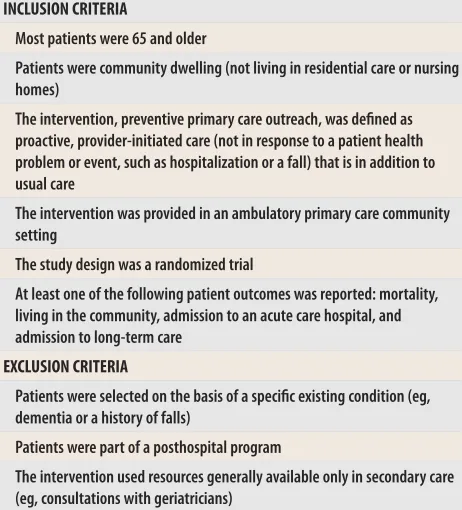
calcu-Table 1. Inclusion and exclusion criteria
INCLUSION CRITERIA
Most patients were 65 and older
Patients were community dwelling (not living in residential care or nursing homes)
The intervention, preventive primary care outreach, was defi ned as proactive, provider-initiated care (not in response to a patient health problem or event, such as hospitalization or a fall) that is in addition to usual care
The intervention was provided in an ambulatory primary care community setting
The study design was a randomized trial
At least one of the following patient outcomes was reported: mortality, living in the community, admission to an acute care hospital, and admission to long-term care
EXCLUSION CRITERIA
Patients were selected on the basis of a specifi c existing condition (eg, dementia or a history of falls)
Patients were part of a posthospital program
each study for which data were available. A value of 0.5 was added to each cell of the two-by-two table to adjust for zero cell frequencies.13 Summary estimates of eff ect were calculated by combining individual trial estimates weighted by the inverse of their variances. Both fi xed and random eff ects14 estimates were calculated. Heterogeneity was assessed using the Q statistic, which follows a chi-square distribution with N-1 degrees of freedom, where N is the number of trials.12 We defi ned sta-tistical heterogeneity as P < .10.
For each outcome, we analyzed data from the fi nal follow-up assessment period. Th e denomina-tor used to calculate eff ect sizes for outcomes was the number of subjects randomized. We also exam-ined the eff ect of duration of follow up on mortal-ity by calculating summary ORs at 6, 12, 24, 36, and 48 months separately using all possible data. In an exploratory analysis, we examined seven methodo-logic, patient population, and intervention char-acteristics that might modify the eff ect of PPCO (Table 2). To test whether diff erences in these char-acteristics infl uenced the magnitude of treatment effect in studies, we divided the trials into two specifi ed categories for each variable. We used the z score to test for a diff erence in eff ect size between the two groups by dividing the diff erence of the summary log relative risk from both groups by the standard error of the diff erence.
We used a logistic regression method to adjust for all seven covariates simultaneously.15 Fitted-cell frequencies were estimated for each study using
logistic regression. Th ese adjusted cell frequencies were then used as input for the standard meta-anal-ysis program to estimate an adjusted summary OR.
Synthesis
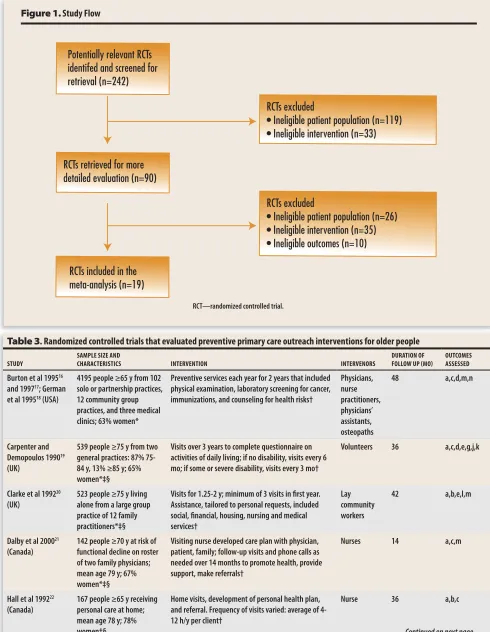
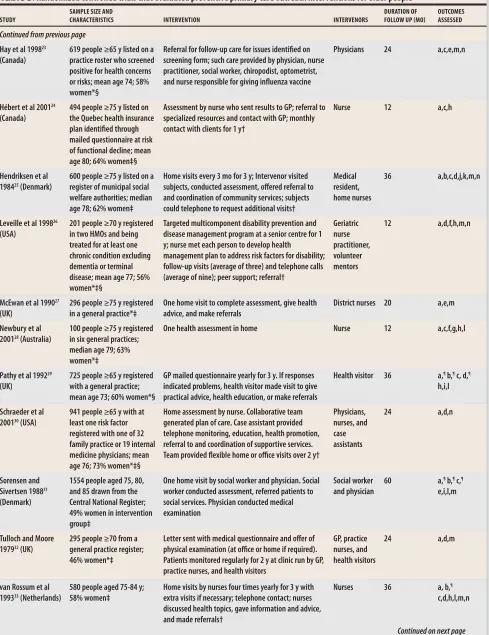
Th e study selection process (Figure 1) yielded 1030 citations. Twenty-two reports of 19 studies met our inclusion criteria.16-36 In 14 studies, samples were selected from primary care practice popu-lations using sampling frames such as practice registries17,19-21,23,26-30,32,34-36; in the other five stud-ies, samples were selected from general population bases using sampling frames such as census lists or health insurance lists.22,24,25,31,33 Descriptive details of these 19 studies are shown in Table 3.16-36
Typically, interventions involved an initial health and social assessment or screening of subjects by a professional or volunteer. Subjects in the inter-vention group received one or more home, tele-phone, or office contacts by family physicians, nurses, social workers, or volunteers. Interventions included education about health-related matters and referrals to relevant community agencies for health and social services (eg, nursing visits, Meals on Wheels, homemaking), and to family physicians. Th e frequency of follow-up contacts varied, as did
the duration of the intervention (12 to 60 months).
Table 316-36 lists outcomes assessed in the 19 trials included in the meta-analysis.
Mortality (19 studies). Th e summary OR was 0.83 (95% confi dence interval [CI] 0.75 to 0.91), a 17% reduction in mortality (Table 416-36). In all but three studies,19-21 the intervention was associated with a reduction in mortality, with exact ORs ranging from 0.25 to 0.91. Heterogeneity of study results was not statistically signifi cant (P = .39). Assuming a mor-tality rate in the absence of intervention equivalent to the overall mortality rate in the control arms of the studies included in our review, PPCO would prevent one death for every 36 elderly people tar-geted for intervention.
Because the study by Burton et al16-18 accounted for 28% of the summary estimate, we conducted a sensitivity analysis to determine the eff ect of this Table 2. Methodologic, patient population, and intervention
characteristics that could modify the eff ect of a preventive primary care outreach intervention
METHODOLOGIC CHARACTERISTIC Methodologic quality (score of ≤ 2 vs ≥ 3) PATIENT POPULATION CHARACTERISTICS
Source of sample (practice-based vs population-based) Age (mean or median age < 75 years vs ≥ 75 years) Targeting a high-risk group (targeting vs not targeting) Geographic area (Canada vs other countries) INTERVENTION CHARACTERISTICS
Potentially relevant RCTs identifed and screened for retrieval (n=242)
RCTs retrieved for more detailed evaluation (n=90)
RCTs excluded
• Ineligible patient population (n=119) • Ineligible intervention (n=33)
RCTs excluded
• Ineligible patient population (n=26) • Ineligible intervention (n=35) • Ineligible outcomes (n=10)
RCTs included in the meta-analysis (n=19)
Figure 1. Study Flow
RCT—randomized controlled trial.
Table 3. Randomized controlled trials that evaluated preventive primary care outreach interventions for older people
STUDY SAMPLE SIZE AND CHARACTERISTICS INTERVENTION INTERVENORS DURATION OF FOLLOW UP (MO) OUTCOMES ASSESSED
Burton et al 199516
and 199717; German
et al 199518 (USA)
4195 people ≥65 y from 102 solo or partnership practices, 12 community group practices, and three medical clinics; 63% women*
Preventive services each year for 2 years that included physical examination, laboratory screening for cancer, immunizations, and counseling for health risks†
Physicians, nurse practitioners, physicians’ assistants, osteopaths
48 a,c,d,m,n
Carpenter and Demopoulos 199019
(UK)
539 people ≥75 y from two general practices: 87% 75-84 y, 13% ≥85 y; 65% women*‡§
Visits over 3 years to complete questionnaire on activities of daily living; if no disability, visits every 6 mo; if some or severe disability, visits every 3 mo†
Volunteers 36 a,c,d,e,g,j,k
Clarke et al 199220
(UK)
523 people ≥75 y living alone from a large group practice of 12 family practitioners*‡§
Visits for 1.25-2 y; minimum of 3 visits in fi rst year. Assistance, tailored to personal requests, included social, fi nancial, housing, nursing and medical services†
Lay community workers
42 a,b,e,l,m
Dalby et al 200021
(Canada)
142 people ≥70 y at risk of functional decline on roster of two family physicians; mean age 79 y; 67% women*‡§
Visiting nurse developed care plan with physician, patient, family; follow-up visits and phone calls as needed over 14 months to promote health, provide support, make referrals†
Nurses 14 a,c,m
Hall et al 199222
(Canada)
167 people ≥65 y receiving personal care at home; mean age 78 y; 78% women‡§
Home visits, development of personal health plan, and referral. Frequency of visits varied: average of 4-12 h/y per client†
Nurse 36 a,b,c
Table 3. Randomized controlled trials that evaluated preventive primary care outreach interventions for older people
STUDY
SAMPLE SIZE AND
CHARACTERISTICS INTERVENTION INTERVENORS
DURATION OF FOLLOW UP (MO)
OUTCOMES ASSESSED
Continued from previous page
Hay et al 199823
(Canada)
619 people ≥65 y listed on a practice roster who screened positive for health concerns or risks; mean age 74; 58% women*§
Referral for follow-up care for issues identifi ed on screening form; such care provided by physician, nurse practitioner, social worker, chiropodist, optometrist, and nurse responsible for giving infl uenza vaccine
Physicians 24 a,c,e,m,n
Hébert et al 200124
(Canada)
494 people ≥75 y listed on the Quebec health insurance plan identifi ed through mailed questionnaire at risk of functional decline; mean age 80; 64% women‡§
Assessment by nurse who sent results to GP; referral to specialized resources and contact with GP; monthly contact with clients for 1 y†
Nurse 12 a,c,h
Hendriksen et al 198425 (Denmark)
600 people ≥75 y listed on a register of municipal social welfare authorities; median age 78; 62% women‡
Home visits every 3 mo for 3 y; Intervenor visited subjects, conducted assessment, off ered referral to and coordination of community services; subjects could telephone to request additional visits†
Medical resident, home nurses
36 a,b,c,d,j,k,m,n
Leveille et al 199826
(USA)
201 people ≥70 y registered in two HMOs and being treated for at least one chronic condition excluding dementia or terminal disease; mean age 77; 56% women*‡§
Targeted multicomponent disability prevention and disease management program at a senior centre for 1 y; nurse met each person to develop health
management plan to address risk factors for disability; follow-up visits (average of three) and telephone calls (average of nine); peer support; referral†
Geriatric nurse practitioner, volunteer mentors 12 a,d,f,h,m,n
McEwan et al 199027
(UK)
296 people ≥75 y registered in a general practice*‡
One home visit to complete assessment, give health advice, and make referrals
District nurses 20 a,e,m
Newbury et al 200128 (Australia)
100 people ≥75 y registered in six general practices; median age 79; 63% women*‡
One health assessment in home Nurse 12 a,c,f,g,h,l
Pathy et al 199229
(UK)
725 people ≥65 y registered with a general practice; mean age 73; 60% women*§
GP mailed questionnaire yearly for 3 y. If responses indicated problems, health visitor made visit to give practical advice, health education, or make referrals
Health visitor 36 a,¶ b,¶ c, d,¶
h,i,l
Schraeder et al 200130 (USA)
941 people ≥65 y with at least one risk factor registered with one of 32 family practice or 19 internal medicine physicians; mean age 76; 73% women*‡§
Home assessment by nurse. Collaborative team generated plan of care. Case assistant provided telephone monitoring, education, health promotion, referral to and coordination of supportive services. Team provided fl exible home or offi ce visits over 2 y†
Physicians, nurses, and case assistants 24 a,d,n Sorensen and Sivertsen 198831
(Denmark)
1554 people aged 75, 80, and 85 drawn from the Central National Register; 49% women in intervention group‡
One home visit by social worker and physician. Social worker conducted assessment, referred patients to social services. Physician conducted medical examination
Social worker and physician
60 a,¶ b,¶ c,¶
e,i,l,m
Tulloch and Moore 197932 (UK)
295 people ≥70 from a general practice register; 46% women*‡
Letter sent with medical questionnaire and off er of physical examination (at offi ce or home if required). Patients monitored regularly for 2 y at clinic run by GP, practice nurses, and health visitors
GP, practice nurses, and health visitors
24 a,d,m
van Rossum et al 199333 (Netherlands)
580 people aged 75-84 y; 58% women‡
Home visits by nurses four times yearly for 3 y with extra visits if necessary; telephone contact; nurses discussed health topics, gave information and advice, and made referrals†
Nurses 36 a, b,¶
c,d,h,l,m,n
�
�
�
�
�
�
�
�
�
�
�
�
�
�
�
�
�
�
�
�
0.01 0.1 1 10
FAVOURS CONTROL FAVOURS INTERVENTION
AUTHOR INTERVENTIONn/N* CONTROLn/N*
Tulloch and Moore, 197932 34/170 42/169 3.3 0.76 (0.46, 1.26)
Hendriksen et al, 198425 56/300 75/300 5.6 0.69 (0.47, 1.02)
Vetter et al, 198434 80/577 105/571 8.2 0.72 (0.52, 0.98)
Sorensen and Sivertsen, 198831 362/777 381/777 18.3 0.91 (0.74, 1.11)
Carpenter and Demopoulos, 199019 66/272 54/267 5.1 1.26 (0.84, 1.89)
McEwan et al, 199027 16/151 23/145 1.9 0.63 (0.32, 1.25)
Clarke et al, 199220 70/261 60/262 5.4 1.23 (0.83, 1.83)
Hall et al, 199222 14/81 18/86 1.5 0.80 (0.37, 1.71)
Pathy et al, 199229 67/369 86/356 6.5 0.70 (0.49, 1.00)
Wasson et al, 199236 10/249 18/248 1.5 0.55 (0.25, 1.19)
Van Rossum et al, 199333 42/292 50/288 4.3 0.80 (0.51, 1.25)
Wagner et al, 199435 17/635 23/607 2.2 0.70 (0.38, 1.32)
Burton et al, 199717 396/2105 454/2090 27.9 0.84 (0.72, 0.97)
Hay et al, 199823 5/209 22/410 1.0 0.46 (0.18, 1.20)
0.59 (0.08, 4.54) 2.14 (0.58, 7.97) 0.67 (0.32, 1.40) 0.25 (0.04, 1.59) 0.77 (0.51, 1.18)
0.83 (0.75, 0.91)
Leveille et al, 199826 1/101 2/100
ODDS RATIO 95% CONFIDENCE INTERVAL
WEIGHT
% (95% CONFIDENCE LIMITS)ODDS RATIO
effects estimate
1304/7452 1486/7459
Heterogeneity chi-square 19.03 (df=18) P=.39
*n/N = number dying/number studied.
Dalby et al, 200021 7/73 3/69
Newbury et al, 200128 1/50 5/50
Hebert et al, 200124 12/250 18/253
Schraederet al, 200130 48/530 47/411
Pooled random
0.2 0.5 1.6 0.3 4.8
Table 4. Odds ratios for mortality
Table 3. Randomized controlled trials that evaluated preventive primary care outreach interventions for older people
STUDY SAMPLE SIZE AND CHARACTERISTICS INTERVENTION INTERVENORS DURATION OF FOLLOW UP (MO) OUTCOMES ASSESSED
Continued from previous page
Vetter et al 198434
(UK)
1148 people aged 70 y from two general practice registers*
Minimum of one home visit yearly for 2 y to provide health education, preventive counseling, referrals, and follow up
Health visitors 24 a,b¶ c,¶ f,m
Wagner et al 199435
(USA)
1559 people ≥65 y enrolled in three group health cooperatives; mean age 72.5; 60% women*§
Assessment visit and follow-up interventions targeting risk factors for disability and falls (exercise, alcohol, medication use, hearing or vision). Referrals. One or two follow-up telephone calls; mailed reminders†
Nurses 24 a,g,h
Wasson et al 199236
(USA)
497 men aged ≥54 attending a primary care clinic; mean age 66*
Clinicians doubled their recommended interval for face-to-face follow up and scheduled three intervening telephone contacts†
Internists, physicians’ assistants, nurse practitioners
24 a,d,m,n
a—mortality, b—living in the community, c—admission to long-term care, d—admission to acute care, e—activities of daily living, f—depression, g—falls, h—physical function, i—quality of life, j—referral to homemaking, k—referral to Meals on Wheels, l—self-rated health, m—use of health services, n—costs of health services.
study on the summary OR and the summary OR’s precision if this study was removed. Th e summary OR for mortality without this study was 0.82 (95% CI 0.73 to 0.92), which is very similar to the sum-mary OR and 95% CI with this study included.
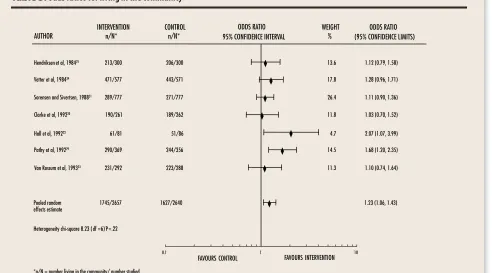
Living in the community (seven studies). In all seven trials, patients receiving PPCO interven-tions were more likely to be living in the commu-nity at the end of the study (Table 520,22,25,29,31,33,34). Summary OR was 1.23 (95% CI 1.06 to 1.43). Heterogeneity of study results was not statistically signifi cant (P = .22).
Other outcomes. Summary ORs for admission to
long-term care (OR 0.88; 95% CI 0.74 to 1.05) and acute care hospital (OR 1.00; 95% CI 0.85 to 1.16) were not statistically signifi cant (data not shown).
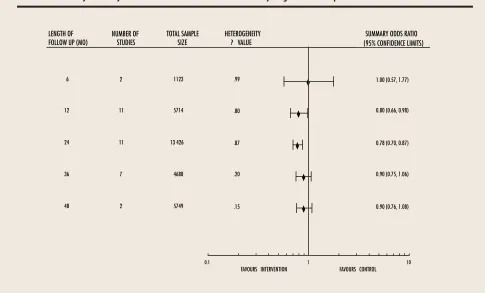
Length of follow up. Th e summary OR for mortal-ity was signifi cant at 12 months (OR 0.80, 95% CI 0.66 to 0.98) and at 24 months (OR 0.78, 95% CI 0.70 to 0.87) (Table 6).
Exploratory analyses. Study quality and interven-tion characteristics (frequency of contact, length of follow up) did not modify the eff ect of PPCO on the outcomes of mortality, living in the community, and admission to long-term care or acute care hos-pitals. Patient population characteristics (source of sample, age, risk status, and geographic area) did not modify the eff ect of PPCO on mortality or on admission to long-term care or acute care hospi-tals. For the outcome of proportion of people living in the community, trials conducted among younger people had signifi cantly higher summary ORs than trials conducted among older people (summary ORs 1.68 and 1.13, respectively, P = .03). For the outcome of mortality, the summary OR for trials conducted in Canada was 0.7521-24 (95% CI 0.46 to 1.22) compared with the summary OR of 0.83 (95% CI 0.75 to 0.92) for trials conducted in other coun-tries (P = .39).
Adjusted analysis. When we adjusted for all covariates listed in Table 2, the adjusted summary random eff ects ORs for the outcomes of mortality,
�
� �
�
�
�
�
�
0.1 1 10
FAVOURS INTERVENTION FAVOURS CONTROL
AUTHOR
INTERVENTION n/N*
Hendriksen et al, 198425 213/300 206/300 13.6 1.12 (0.79, 1.58)
Vetter et al, 198434 471/577 443/571 17.8 1.28 (0.96, 1.71)
Sorensen and Sivertsen, 198831 289/777 271/777 26.4 1.11 (0.90, 1.36)
Clarke et al, 199220 190/261 189/262 11.8 1.03 (0.70, 1.52)
Hall et al, 199222 61/81 51/86 4.7 2.07 (1.07, 3.99)
Pathy et al, 199229 290/369 244/356 14.5 1.68 (1.20, 2.35)
Van Rossum et al, 199333 231/292 223/288 11.3 1.10 (0.74, 1.64)
Pooled random
effects estimate 1745/2657 1627/2640 1.23 (1.06, 1.43)
Heterogeneity chi-square 8.23 (df =6) P=.22
CONTROL n/N*
ODDS RATIO 95% CONFIDENCE INTERVAL
WEIGHT %
ODDS RATIO (95% CONFIDENCE LIMITS)
*n/N = number living in the community/ number studied.
��
�� ��
��
��
0.1 1 10
FAVOURS FAVOURS FA CONTROL FAVOURS
FAVOURS FA INTERVENTION
LENGTH OF
FOLLOW UP (MO) TOTAL SAMPLE TOTAL SAMPLE TOTSIZE
6 1123 .99 1.00 (0.57, 1.77)
12 5714 .80 0.80 (0.66, 0.98)
24 13 426 .87 0.78 (0.70, 0.87)
36 4688 .20 0.90 (0.75, 1.06)
48 5749 .15 0.90 (0.76, 1.08)
HETEROGENEITY
P VALUE (95% CONFIDENCE LIMITS)SUMMARY ODDS RASUMMARY ODDS RASUMMARY ODDS RATIY ODDS RA OTI NUMBER OF
STUDIES
2
11
11
7
2
Table 6. Mortality summary odds ratio and 95% confi dence intervals by length of follow up
living in the community, and admission to long-term care or acute care hospitals were very simi-lar to the unadjusted ORs. Two trials with missing data29,34 were excluded from these analyses.
Random- vs fi xed-eff ects model. We found
min-imal to no differences in summary ORs using random-eff ects or fi xed-eff ects models. For exam-ple, the summary OR for mortality using the random-effects model was 0.83 (95% CI 0.75 to 0.91) and using the fi xed-eff ects model was 0.83 (95% CI 0.76 to 0.90).
Discussion
Results of this meta-analysis of 19 randomized con-trolled trials, most of which were conducted in fam-ily practice settings, provide evidence that PPCO interventions substantially reduce risk of mortality and increase the likelihood of continuing to live in the community. Our fi ndings suggest that PPCO interventions can make an important diff erence in
the lives of community-dwelling older people. Th e eff ect of PPCO interventions on mortality (OR 0.83, 95% CI 0.75 to 0.91) is comparable to the eff ect of pharmacotherapy for hypertension in elderly peo-ple (OR 0.84, 95% CI 0.75 to 0.94).37 Using PPCO would prevent one death for every 36 older people targeted for intervention; one death would be pre-vented for every 63 hypertensive elderly people treated for 5 years with drug therapy.
comorbidity and greater attention to personal and health needs.
The findings of our meta-analysis are generally consistent with results of a recent meta-analysis of home visiting programs that offer health pro-motion and preventive care to older people.9 That
study, which included six of the trials included in our meta-analysis and nine others not meet-ing our inclusion criteria, found that home visitmeet-ing was associated with a 24% reduction in mortal-ity among members of the general elderly popula-tion and a 28% reducpopula-tion in mortality among frail older people. That study also found no significant reduction in admission to hospital (OR 0.95, 0.80 to 1.09), but, unlike ours, found a significant reduc-tion in admission to long-term care of 35%.
The summary OR for the four Canadian trials (0.76) was comparable to the summary OR for all the studies included in this review, but was not sta-tistically significant. This is not surprising, given that these four studies’ sample sizes were generally small and that the four trials together accounted for only 4.6% of the total sample on which the sum-mary estimate for mortality is based. The interven-tion is feasible in the Canadian health care system and the findings of this meta-analysis are highly relevant to policy development in primary care, particularly as it relates to care of older adults. The literature search described earlier was updated to the end of April 2004. We found no studies that met our eligibility criteria.
Our meta-analysis does not include unpublished studies or studies reported in languages other than English. The existence, direction, magnitude, and importance of bias resulting from exclusion of unpublished and non–English-language studies is controversial.38-40
We used a validated scale to determine the qual-ity of studies.11 Double blinding (one of the scale’s
criteria), however, was not applicable to this lit-erature. Given the considerable variability in study quality, we included all studies in the meta-analy-sis and then did an adjusted analymeta-analy-sis that included study quality as a covariate. Some of the random-ized controlled trials included in this meta-analysis had noteworthy limitations. Only eight studies
described the random allocation procedure used. Many studies provided only a minimal description of the intervention itself.
Implications for future research. Some
unan-swered questions remain. It is possible that PPCO interventions, like geriatric evaluation and man-agement interventions,41,42 result in more positive
outcomes when targeting specific groups of frail elderly people. Patient characteristics, such as age and degree of functional impairment, might be useful selection criteria for such interventions.
The effect of PPCO on other important out-comes, such as physical functioning or activities of daily living, quality of life, cognitive or mental sta-tus, and cost-effectiveness, has not been adequately studied. Well designed and adequately powered intervention studies are clearly needed to address these unanswered questions.
Conclusion
Based on a meta-analysis of 19 randomized con-trolled trials, PPCO interventions appeared to reduce mortality by 17% among community-dwelling older people and to increase the likelihood of their continuing to live in the community by 23%. Our analyses do not indicate that PPCO interventions reduce admissions to long-term care or acute care hospitals. Results of this study have important implications for future research and health services planning.
Acknowledgment
This project received funding from the Public Health Research and Education Development Program of the Social and Public Health Services Division of the City of Hamilton, Ont, and from the Health Promotion Theme of the Research in Aging Group at the Faculty of Health Sciences at McMaster University. Dr Ploeg holds an investigator award from the Canadian Institutes of Health Research and St Joseph’s Healthcare in Hamilton.
Contributors
data; and to writing and revising the paper. Dr Feightner contributed to the conceptual framework and design of the study, to the literature review, and to manuscript
revi-sions, and approved the final version of the paper.Drs
Hutchison and Patterson contributed to the conceptual framework and design of the study, to data extraction, to literature evaluation, and to manuscript revisions, and approved the final version of the paper. Mr Siguouin contributed to data analysis and manuscript revisions
and approved the final version of the paper. Ms Gauld
assisted with the literature search; contributed to develop-ment of the data extraction form, data extraction, design and preparation of tables, and manuscript revisions; and approved the final version of the paper.
Competing interests
None declared
Correspondence to: Dr Jenny Ploeg, Associate Professor,
School of Nursing, Room HSc 3N28G, McMaster University, 1200 Main St W, Hamilton, ON L8N 3Z5; telephone (905) 525-9140, extension 22294; fax (905)
521-8834; e-mail [email protected]
References
1. Statistics Canada. 2001 Census analysis series. Profile of the Canadian popula-tion by age and sex: Canada ages. Ottawa, Ont: Statistics Canada; 2002. Catalogue 96F0030XIE2001002.
2. Bergman H, Béland F, Perrault A. The global challenge of understanding and meeting the needs of the frail older population. Aging Clin Exp Res 2002;14:223-5.
3. Stuck AE, Siu AL, Wieland GD, Adams J, Rubenstein LZ. Comprehensive geriatric assess-ment: a meta-analysis of controlled trials. Lancet 1993;342:1032-6.
4. Patterson C, Feightner J. Promoting the health of senior citizens. CMAJ 1997;197:1107-13. 5. Hébert R. Functional decline in old age. CMAJ 1997;157:1037-45.
6. Hirdes JP, Naus PJ, Young JE. The use of preventive home visits among frail elderly persons: evidence from three European countries. Can J Aging 1994;13:499-509.
7. Stuck AE, Egger M, Hammer A, Minder CE, Beck JC. Home visits to prevent nursing home admission and functional decline in elderly people: systematic review and meta-regression analysis. JAMA 2002;287:1022-8.
8. Van Haastregt JC, Diederiks JP, van Rossum E, de Witte LP, Crebolder HF. Effects of pre-ventive home visits to elderly people living in the community: systematic review. BMJ
2000;320:754-8.
9. Elkan R, Kendrick D, Dewey M, Hewitt M, Robinson J, Blair M, et al. Effectiveness of home based support for older people: systematic review and meta-analysis. BMJ 2001;323:1-9. 10. Byles JE. A thorough going over: evidence for health assessments of older persons. Aust N
Z Public Health 2000;24:117-23.
11. Jadad AR, Moore RA, Carroll D, Jenkinson C, Reynolds DJ, Gavaghan DJ, et al. Assessing the quality of reports of randomized clinical trials: is blinding necessary? Control Clin Trials 1996;17:1-12.
12. Fleiss JL. The statistical basis of meta-analysis. Stat Methods Med Res 1993;2:121-45. 13. Naylor AF. Small sample considerations in combining 2x2 tables. Biometrics 1967;23:349-56.
14. DerSimonian R, Laird N. Meta-analysis in clinical trials. Control Clin Trials 1986;7:177-88. 15. Wang MC, Bushman BJ. Integrating results through meta-analytic review using SAS
soft-ware. Cary, NC: SAS Institute Inc; 1999. p. 125-42.
16. Burton LC, Steinwachs DM, German PS, Shapiro S, Brant LJ, Richards TM, et al. Preventive services for the elderly: would coverage affect utilization and costs under Medicare? Am J Public Health 1995;85:387-91.
17. Burton LC, German PS, Shapiro S, Johns Hopkins Medicare Preventive Services Demonstration Team. A preventive services demonstration: health status, health behaviors, and cost outcomes 2 years after intervention. Med Care 1997;35:1149-57.
18. German PS, Burton LC, Shapiro S, Steinwachs DM, Tsuji I, Paglia MJ, et al. Extended cov-erage for preventive services for the elderly: response and results in a demonstration popu-lation. Am J Public Health 1995;85:379-86.
19. Carpenter GI, Demopoulos GR. Screening the elderly in the community: controlled trial of dependency surveillance using a questionnaire administered by volunteers. BMJ
1990;300:1253-6.
20. Clarke M, Clarke SJ, Jagger C. Social intervention and the elderly: a randomized con-trolled trial. Am J Epidemiol 1992;136:1517-23.
21. Dalby DM, Sellors JW, Fraser FD, Fraser C, van Ineveld C, Howard M. Effect of preven-tive home visits by a nurse on the outcomes of frail elderly people in the community: a ran-domized controlled trial. CMAJ 2000;162:497-500.
22. Hall N, De Beck P, Johnson D, Mackinnon K, Gutman G, Glick N. Randomized trial of a health promotion program for frail elders. Can J Aging 1992;11:72-91.
23. Hay WI, van Ineveld C, Browne G, Roberts J, Bell B, Mills M, et al. Prospective care of elderly patients in family practice: is screening effective? Can Fam Physician
1998;44:2677-87.
24. Hébert R, Robichaud L, Roy P, Bravo G, Voyer L. Efficacy of a nurse-led mulidimensional preventive programme for older people at risk of functional decline. A randomized con-trolled trial. Age Ageing 2001;30:147-53.
25. Hendriksen C, Lund E, Stromgard E. Consequences of assessment and intervention among elderly people: a three year randomized controlled trial. BMJ 1984;289:1522-4. 26. Leveille SG, Wagner EH, Davis C, Grothaus L, Wallace J, LoGerfo M, et al. Preventing
disability and managing chronic illness in frail older adults: a randomized trial of a commu-nity-based partnership with primary care. J Am Geriatr Soc 1998;46:1191-8.
27. McEwan RT, Davison N, Forster DP, Pearson P, Stirling E. Screening elderly people in pri-mary care: a randomized controlled trial. Br J Gen Pract 1990;40:94-7.
28. Newbury JW, Marley JE, Beilby JJ. A randomised controlled trial of the outcome of health assessment of people aged 75 years and over. Med J Aust 2001;175:104-7.
29. Pathy MSJ, Bayer A, Harding K, Dibble A. Randomized trial of case finding and surveil-lance of elderly people at home. Lancet 1992;340:890-3.
30. Schraeder C, Shelton P, Sager M. The effects of a collaborative model of primary care on the mortality and hospital use of community-dwelling older adults. J Gerontol 2001;56A: M106-M112.
31. Sorensen KH, Sivertsen J. Follow-up three years after intervention to relieve unmet medi-cal and social needs of old people. Compr Gerontol [B] 1988;2(2):85-91.
32. Tulloch AJ, Moore V. A randomized controlled trial of geriatric screening and surveil-lance in general practice. J R Coll Gen Pract 1979;29:733-42.
33. van Rossum E, Frederiks CM, Philipsen H, Portengen K, Wiskerke J, Knipschild P. Effects of preventive home visits to elderly people. BMJ 1993;307:27-32.
34. Vetter NJ, Jones DA, Victor CR. Effect of health visitors working with elderly patients in general practice: a randomized controlled trial. BMJ 1984;288:369-72.
35. Wagner EH, LaCroix AZ, Grothaus L, Leveille SG, Hecht JA, Artz K, et al. Preventing dis-ability and falls in older adults: a population-based randomized trial. Am J Public Health
1994;84:1800-6.
36. Wasson J, Gaudette C, Whaley F, Sauvigne A, Baribeau P, Welch HG. Telephone care as a substitute for routine clinic follow-up. JAMA 1992;267:1788-93.
37. Mulrow C, Lau J, Cornell J, Brand M. Pharmacotherapy for hypertension in the elderly: review. Cochrane Database Syst Rev 2002;(2):CD000028.
38. McAuley L, Pham B, Tugwell P, Moher D. Does the inclusion of grey literature influence estimates of intervention effectiveness reported in meta-analyses? Lancet 2000;356:1228-31. 39. Grégoire G, Derderian F, Lorier J. Selecting the language of the publications included in a
meta-analysis: is there a Tower of Babel bias? J Clin Epidemiol 1995;48:159-63. 40. Moher D, Pham B, Klassen TP, Schulz KF, Berlin JA, Jadad AR, et al. What contributions
do languages other than English make on the results of meta-analyses? J Clin Epidemiol
2000;53:964-72.
41. Rubenstein LZ, Goodwin M, Hadley E, Patten SK, Rempusheski VF, Reuben D, et al. Working group recommendations: targeting criteria for geriatric evaluation and manage-ment research. J Am Geriatr Soc 1991;39(9 Pt 2):37-41S.
42. Winograd CH. Targeting strategies: an overview of criteria and outcomes. J Am Geriatr Soc 1991;39(9 Pt 2):25-35S.