Building a Collision-Resistant Compression Function from
Non-Compressing Primitives
Thomas Shrimpton1and Martijn Stam2
1
University of Lugano and Portland State [email protected]
2
Abstract. We consider how to build an efficient compression function from a small number of random, non-compressing primitives. Our main goal is to achieve a level of collision resistance as close as possible to the optimal birthday bound. We present a2n-to-n bit compression function based on three independentn-to-nbit random functions, each called only once. We show that if the three random functions are treated as black boxes then finding collisions requiresΘ(2n/2/nc)queries forc≈1. This result remains valid if two of the three random functions are replaced by a fixed-key ideal cipher in Davies-Meyer mode (i.e.,EK(x)⊕xfor permutationEK). We also give a heuristic, backed by experimental results, suggesting that the security loss is at most four bits for block sizes up to 256 bits. We believe this is the best result to date on the matter of building a collision-resistant compression function from non-compressing functions. It also relates to an open question from Black et al. (Eurocrypt’05), who showed that compression functions that invoke a single non-compressing random function cannot suffice. We also explore the relationship of our problem with that of doubling the output of a hash function and we show how our compression function can be used to double the output length of ideal hashes.
Keywords. Hash Functions, Random Oracle Model, Compression Functions, Collision Resistance.
1 Introduction
Hash functions are a central cryptographic primitive, appearing in countless protocols and applications. Dedicated hash functions such as MD5 and SHA1 have dominated practice, as these are relatively fast and, until recently, they were believed to resist collision-finding attacks. But this belief has been shown to be unfounded: successful attacks have been published against most members of the MD/SHA-family. This has prompted a renewed interest in design methodologies for hash functions, with a particular emphasis on providing formal guarantees of collision resistance (along with other properties).
The design of hash functions usually proceeds in two stages. First one designs a compression function with fixed domain, typically bitstrings of some small length. One then applies a domain extension method, such as the Merkle-Damg˚ard transform [11, 24], to the compression function in order to construct a hash function for messages of arbitrary length. The first part has our interest; in particular, the central problem considered by this paper is the following one:
Given a (small) number of independentn-to-nbit random (one-way) functions, construct a2n-to-n
bit compression function with provable collision resistance as close as possible to the optimal2n/2
birthday bound.
This problem is related to one recently considered by Maurer and Tessaro [22], who consider the problem of constructing a functionC :{0,1}m(n)→ {0,1}l(n)given an-to-nbit random one-way functionf. Setting m(n) = 2nandl(n) =ngives rise to a2n-to-nbit compression function. Maurer and Tessaro cast security in the indifferentiability framework, in which case domain extension is actually far more challenging than
range extension. For all > 0 they give a construction indifferentiable from a random function against adversaries makingΘ(2n(1−))queries. Indifferentiability is a much stronger requirement than just collision
resistance, indeed for ≥ 1/2 their functions have better proven security than ours. Unfortunately, the construction by Maurer and Tessaro is not very efficient, to get the required collision resistance for a2n
-to-nbit compression function requires 99 calls to the underlying primitivef.
This raises the question whether more efficient constructions are possible, at least when one focuses primarily on collision resistance. Ideally we would like to make do with just one random function, and to invoke it once for eachn-bit block of message digested; such a compression function would be called rate-1. Unfortunately, Black et al. [6] have given a negative result that all but rules this out. One can also show that rate-1/2 compression functions (with optimal collision resistance) are unlikely to exist. Thus the best one can hope for will be a rate-1/3 compression function.
We show that this hope can be realized. In particular, we present a compression function that calls randomn-to-nbit functionsf1, f2, f3, and that has almost optimal collision resistance (herenis a parameter that can be chosen freely). When we consider the construction for increasingn, we show that any adversary makingΘ(2n/2/nc)total oracle queries, forc >1, has a vanishing probability of finding a collision inH. On the other hand, for c < 1 we provide compelling arguments that an adversary exists that will find a collision with high probability. Thus it is fair to say that finding collisions takes aroundΘ(2n/2/n)queries. For concreteness’ sake, we also develop a heuristic indicating that fornof cryptographic relevance (up to 256 bits), the loss is at most 4 bits of collision resistance. Of course, the standard caveats apply to these results when one instantiates the random functions in practice.
Central to our proof is the concept of theyieldof a set of queries. This is the number of compression function evaluations an adversary can make given a certain number of queries to the underlying primitives. Somewhat surprisingly, we can show that for our compression function an adversary can do not much better than simply optimizing his yield and hoping for a collision via the birthday bound. The yield can also be used to get (crude) negative results, for instance for any rate-1/2 compression function there exists a (greedy) adversary with yield2n/2using only2n/4queries. Since we expect good hash functions to behave randomly, this indicates it is unlikely to find a rate-1/2 compression function with good collision resistance. This use of the yield to obtain impossibility results has recently been extensively generalized by Rogaway and Steinberger [34] and later Stam [38], who pointed out some problems with the above reasoning. In particular, he demonstrates a rate-1/2 compression function that is collision resistant up to almost 2n/3
queries (beating the intuitive2n/4 bound). Our rate-1/3 construction itself is as follows:
Hf1,f2,f3(V, M) =f
3(f1(M)⊕f2(V))⊕f1(M) .
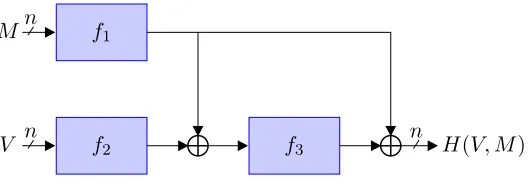
A picture of the compression function is given in Figure 1. The compression function can easily be trans-formed into a hash function with arbitrary domain while preserving the collision resistance (e.g., using the Merkle-Damg˚ard transform). As a note of warning, we do not claim any “beyond-birthday” properties one might hope for from a hash function, such as resistance against multi-collisions and optimal preimage resistance. Indeed, preimages can typically be found inO(22n/3) queries, rather than the desired Ω(2n). Rogaway and Steinberger [34] show that this reduced preimage-resistance is to a large extent inherent to rate-1/3 schemes and not an artefact of our particular scheme.
We also investigate what happens when one wants to instantiatef1, f2,andf3 with a blockcipher with its key fixed (thus supplying the adversary with inverse oracles for each). Whenf1 orf2 are instantiated
V f2
M f1
L
f3
L
H(V, M)
n n
n
Fig. 1: The triple-function compression function. The functionsf1, f2, f3are randomn-to-nbit functions.
place off1 andf2 we can also deal with a fixed-key ideal cipher in those places without loss of security. Using a fixed-key ideal cipher forf3 does not seem to affect collision resistance, yet we do not have a full
proof for this.
The emphasis on blockcipher based hashing can be understood both historically and practically. Block-ciphers have long been the central primitive in symmetric key cryptography, and there exists some measure of confidence in blockcipher designs. From a practical perspective, one might like to reuse optimized code or hardware implementations of blockciphers that are already implemented for encryption and message au-thentication within certain applications. That said, there seems to be no intrinsic theoretical reason to restrict designs to using blockciphers, hence our focus on simple random one-way functions (cf. [5, 22]).
Interestingly, the problem of building a compression function using random functions (as opposed to a fixed-key ideal cipher) has an unexpected link with that of constructing double-length hash functions. Specifically:
Given an ideal 2n-to-nbit compression function create a4n-to-2nbit compression function with collision resistance close to the optimal2n.
In Appendix A we show that range extenders could be used as an alternative means to turn a number of non-compressing random functions into a compressing one, and vice versa. Therefore one could consider
range extensionas the dual problem to domain extension. In particular, one can use our method to get a rate-1/34n-to-2nbit double-length compression function with close to optimal collision resistance (in the output size) based on a set of2n-to-nbit random functions.
RELATED WORK. Bellare and Micciancio [2] introduce incremental hash functions, which in principle
could be built upon a non-compressing primitive. Crucial differences with our work are that they build an entire hash function, not just a compression function, and that the collision resistance of their schemes is not based on query complexity (usually justnqueries suffice for a collision), but on the presumed computational hardness of combining the query answers into an actual collision.
If one is willing to digest onlyone bitat a time (instead ofn), then existing techniques already provide a way to construct an optimally collision-resistant hash function out of two random functionsf0, f1:{0,1}n→
{0,1}n. Define a compression functiong: {0,1}n+1 → {0,1}nby g(b||V) = f
b(V)that takes a single
bitbof message to select which function will process the chaining valueV. One can show thatgis a com-pletely random function iff bothf0 andf1 were, and by usinggin the block-chaining hash function from
Damg˚ard [11] one obtains a hash function that digests one bit per iteration. As an aside, the very same hash function emerges by using Damg˚ard’s construction based on a pair of claw free permutations[10], but using the functionsf0andf1instead.
We already mentioned the work of Maurer and Tessaro [22]. Prior to this work Aiello and Venkatesan [1] considered the secret key equivalent of doubling the length of a random function. That is, given a set ofn
-to-nbit functionsfi(fori= 1, . . . ,8) construct a2n-to-2nbit functionF that is indistinguishable to a random
2n-to-2nbit function for an adversary making up to 2nadaptive queries toF. The crucial difference with our work (and that of Maurer and Tessaro) is that they do not allow the adversary access to the inner random functionsfi. Consequently there is no a priori reason to expect that schemes proven secure in the secret
model, even when beyond the birthday barrier, have good collision resistance in the public world.
Nonetheless, the scheme presented by Aiello and Venkatesan, dubbed Benes, bears some resemblance with ours that is worth pointing out. Given twonbit inputsM andV, first a butterfly construct is used to compute intermediate valuesX=f1(M)⊕f2(V)andY =f3(M)⊕f4(V). This pattern is then repeated
to get the final outputG =f5(X)⊕f6(Y)andH = f7(X)⊕f8(Y). If one ignores the first output (G),
renderingf5 andf6 superfluous and if one simplifies further by settingf2 = f3 = 0 (the constant zero functionality) andf8the identity function, one obtains our construction. As such, the proof we provide for
the collision resistance of our scheme can likely be reused (and probably even strengthened a bit) to prove collision resistance of the general rate-1/6 Benes scheme with one output chopped.
There has also been extensive research into the construction of hash functions based on blockciphers. Davies-Meyer [23], Matyas-Meyer-Oseas [21], and Miyaguchi-Preneel [26, 32] are all well-known2n-to-n
bit compression functions based on a single call to a blockcipher withn-bit key operating onn-bit blocks. These type ofrate-1constructions were later systematically studied by Preneel et al. [32] and Black et al. [7], who identified twelve distinct constructions that provide optimal collision resistance when the blockcipher is modelled as an ideal cipher. Black et al. [7] showed that an additional eight constructions do not yield collision resistant compression functions, yet still lead to collision resistant hash functions when properly MD-iterated.
Most of the work related to blockcipher-based compression functions allows per-round rekeying [7, 16, 28, 32]. As such, the primitive already compresses in the sense that it takes more input (key and plaintext data) than that it provides output. This significantly eases design and proof. Unfortunately, rekeying has the drawback of entailing a significant computational cost: Gladman’s implementation survey [15] shows that AES key scheduling would account for nearly 50% of the overall runtime. Thus a lower rate fixed-key solution might actually be more efficient. Fixing the fixed-key would make use of the blockcipher in a more natural way, namely setting up a key once and then processing relatively large amounts of data with it (the way that blockciphers are used for encryption). A fixed-key blockcipher would be modelled as a random two-way permutation.
Preneel et al. [31] propose a family of fixed-key constructions, but no formal security proof is given. The rate of their scheme is always strictly smaller then 1/2 and typically between 1/4 and 1/8. Knudsen [19] proposed a rate-1 fixed-key construction, however, it was quickly broken [29].
only one call to a randomn-to-n-bit function, then there always exists an information-theoretic adversary that finds collisions efficiently (i.e., using just few calls to the non-compressing primitive). Although Black et al. [6] phrase their results in terms of two-way random permutations, their result holds for the random one-way functions we consider as well. However, they do not consider compression functions that call out to more than one primitive per message block (and thus have a rate less than one).
Recently (but subsequent to the initial presentation of our work [36]), Rogaway and Steinberger [34] have given impossibility results for schemes calling out more than once per message block, although under the assumption that the compression function is suitably uniform (a refinement of their work is given by Stam [38]). They have also constructed a rate-1/3 scheme based on a fixed-key ideal cipher that achieves security comparable to ours [33].
2 Preliminaries
GENERAL NOTATION. For a positive integer n, we write {0,1}n for the set of all bitstrings of length n. When X and Y are strings we write X||Y to mean their concatenation and X ⊕Y to mean their bitwise exclusive-or (xor). Unless specified otherwise, we will consider bitstrings as elements in the group
({0,1}n,⊕).
For positive integersmandn, we letFunc(m, n)denote the set of all functions mapping{0,1}m into
{0,1}n. We write f $
←Func(m, n)to denote random sampling from the set Func(m, n)and assignment tof. Unless otherwise specified, all finite sets are equipped with a uniform distribution.
DISTRIBUTIONS AND TENSORS. With ({0,1}n)q we denote the set of q-element vectors, or q-vectors,
in which each element is an n-bit string. Whena ∈ ({0,1}n)q andb ∈ ({0,1}n)q, we will write a =
(a1, . . . , aq)andb= (b1, . . . , bq)when we wish to stress its components.
Fix a valueq, and letQ=q2. We definea⊗b∈({0,1}n)Q as the tensor product under exclusive-or,
where we identify({0,1}n)q×qwith({0,1}n)q·q= ({0,1}n)Q. More concretely(a⊗b)
i,j =ai⊕bjfori
andjin[1, . . . , q]. (Whenever possible we will try to use dummyito refer to elements ofaand dummyj
to refer to those of b.) If AandB are both distributions over({0,1}n)q, this tensor operation induces a
distribution over({0,1}n)Q, which we will denote by the symbolA⊕B. Unless otherwise specified, we will
assume throughout thatAandBare two distributions induced by sampling from({0,1}n)qwithout
replace-ment. We will useU to denote the uniform distribution over({0,1}n)Q(wherenandQwill often follow
from the context). Thus U corresponds to sampling Qstrings from{0,1}n uniformly and independently
withreplacement.
If in a random sample some value appears exactly k times, we say there is ak-way collision in that sample. LetMU(k)be the random variable describing the number ofk-way collisions when the samples
are drawn according to the distributionU. Similarly, letMA⊕B(k)be the random variable describing the
number ofk-way collisions when the samples are drawn according to the distributionA⊕B.
COMPRESSION FUNCTION SECURITY. When algorithms are provided with oracles, we write them as superscripts. Acompression function is a mapping from{0,1}n× {0,1}m to{0,1}nfor somem, n > 0.
For us, a compression functionHmust be given by a program that, given(V, M), computesH···(V, M)via access to a finite number of specified oracles. Acollision-finding adversary is an algorithm with access to one or more oracles, whose goal it is to find collisions in some specified compression function.
Definition 1 Letn, ` > 0be integer parameters. LetH:{0,1}n× {0,1}n → {0,1}nbe a compression
collision-finding advantage ofAis defined to be
AdvcollH(n)(A) = Prhf1, . . . , f`
$
←Func(n, n),(V, M),(V0, M0)← Af1(·),...,f`(·):
(V, M)6= (V0, M0)andHf1,...f`(V, M) =Hf1,...,f`(V0, M0)
i
Furthermore, forq > 0, we define AdvcollH(n)(q)as the maximum ofAdvcollH(n)(A)over all adversaries A
making at mostqqueries.
When the compression function H is defined for arbitrary positive integers n, we will be able to make asymptotic statements about collision resistance.
We consider information-theoretic adversaries in order to make a strong statement about collision resis-tance. That is, our adversaries are computationally unbounded and their complexity is measured only by the number of queries made to the oracles for the non-compressing primitives. Of course, in practice, time com-plexity or even time-space comcom-plexity (the product of space and time) are arguably more relevant. But query complexity is the most conservative resource measure: it yields a lower bound on the other two measures (and hence the actual costs of mounting an attack). Moreover, findinglowerbounds in the other two models, other than by query complexity, is notoriously hard. Without loss of generality, we assume that adversaries do not repeat queries to oracles and that they do not query an oracle outside of its specified domain.
3 Some Background on Collision Probabilities
COLLISIONS IN UNIFORM SAMPLES. The susceptibility of hash functions to collisions has been heavily studied. The generic case can be termed in the language of occupancy urn models, a well-known tool from discrete probability theory. (Johnson and Kotz [17] and Feller [12] are the standard references, Girault et al. [14] and Preneel [30, Appendix B] are cryptographically oriented.) We give a brief overview of the main results that are relevant to our work.
One central concern for collision-finding attacks is to determine how many k-way collisions are ex-pected for some fixedk, typically k = 2. If the hash function is modelled as a random oracle with range {0,1}n, and Qdomain points are hashed, then the number of k-way collisions isM
U(k) with expected
valueE[MU(k)] =N Qk
1
N
k
1−N1Q−k
, whereN = 2n. Thus,E[MU(k)]follows a (scaled) binomial
distribution with parameters1/N andQ. If we letQandN grow such thatQ/N < 1, the binomial distri-bution can be approximated by a Poisson distridistri-bution with parameterλ = QN. This well known “urns and balls” result is captured in the following theorem (by Kolchin [?]), which also gives a more general result on the distribution ofk-way collisions.
Theorem 2 LetQandN be positive integers, and letλ= NQ. Then fork≥2the random variableMU(k)
follows asymptotically a Poisson distribution with parameterλk, where
Pr[MU(k) =t] =e−λk
λtk
t! and λk=N e
−λλk
k!
whenQ, N tend to infinity such thatλ→0.
The expected number of k-way collisions is thereforeλk (since the parameter of a Poisson distribution
distribution with parameterλ, as expected. The probability of finding any sort of collision is approximately
Q2 2N.
Sometimes one is more interested in the expected waiting time before the firstk-way collision occurs. If the probability for finding a collision afterqqueries is at most, then the expected waiting time is at least
(1−)q. Thus upper bounding collision probabilities simultaneously lower bounds the expected waiting time, which is why we restrict our attention to the former.
In bounding the probability of finding a collision in our compression function, we will also need the distribution ofk-way collisions when the samples from{0,1}nare distributed according toA⊕B. It seems
that occupancy is very similar to that of a fully uniform distribution, and we conjecture that the occupancy distribution arising fromA⊕Bis asymptotically the same as the one from Theorem 2. We could find neither proof nor reference for this conjecture in full, but there is no need to. For the sequel, to bound the collision finding probability either upwards or downwards, the following lemma suffices (proven in Appendix B).
Lemma 3 For some positive integersq, n, letQ=q2andN = 2n, and letλ=Q/N. Letq-vectorsaandb
have elements drawn according toAandB, respectively (i.e., uniformly from{0,1}nwithout replacement).
Then
1. AsymptoticallyE[MA⊕B(k)] =λk=N e−λ λ
k
k! whenq, ntend to infinity such thatλ→0. 2. For allk >0we have
X
κ≥k
Pr[MA⊕B(κ)>0]≤
(q!)22n(2n−k)! ((q−k)!)2k!(2n)! .
For notational convenience, the righthand side of the inequality will be denoted byPq,k,n.
4 The Rate-1/3 Compression Function
We want to show thatH(see Figure 1) is resistant, so that it can be iterated to create a collision-resistant hash function [3, 11, 13, 24]. In the sequel, we will model f1, f2, and f3 as three independent,
uniform elements of Func(n, n), and simply refer to our construction as Hf1,f2,f3 (or just H when it is
not necessary to make the component functions explicit). We proceed to bound the probability that a com-putationally unbounded adversary can find a collision as a function of the number of its oracle queries. In particular, we will prove the following statement.
Theorem 4 Fixn >0and letHf1,f2,f3be as previously defined. Then for allk, q≥0we haveAdvcoll
H(n)(q)≤
q2 2n +
(kq)2
2n +Pq,k,n.
Section 5 is dedicated to a proof of this theorem. What is more, the following lemma provides asymptotic upper and lower bounds on the number of queries required to find collisions. The first item is a corollary of Theorem 4 and we will give a short proof sketch. The second item is proven after the proof of Theorem 4. Lemma 5 can be loosely rephrased by saying that to find collisions with any constant (non-zero) probability,
˜
Θ(2n/2)queries are necessary and sufficient.
Lemma 5 1. For anyc >1and all adversaries making at mostO(2n/2/nc)queries it holds that
lim
n→∞Adv
coll
2. For anyc < 1there exists an >0and an adversary askingΘ(2n/2/nc) queries for which, under a uniformity assumption,
AdvcollH(n)(A)> for all sufficiently largen .
Proof: The first item is a corollary of Theorem 4. Letdbe such thatc > d > 1and consider the upper bound from Theorem 4 withk=ndandq = 2n/2/nc. Then forn→ ∞all three terms tend to zero.
The first term will equal1/n2c, whereas substitution in the second term, givesn2(d−c)which indeed both tend to zero iffc > d >1. For the third term, we need to upper boundPq,k,n(Lemma 3). Using Stirling’s
formulak!≈√2πk(ke)k, substitutingq= 2n/2/ncandk=ndand taking logarithms leads to:
lnp≤(2q+ 1) lnq−2q+nln 2 + (2n−k+ 1 2) ln(2
n−k)−(2n−k)
−(2(q−k) + 1) ln(q−k) + 2(q−k)−(2n+1 2) ln 2
n+ 2n−klnk+k+o(1)
≤2klnqk−klnk+nln 2−knln 2 +o(1)
≤2k(n
2ln 2−clnn)−klnk+nln 2−knln 2 +o(1)
≤ −(2c+d)ndlnn+nln 2 +o(1).
Hence ford≥1this logarithm tends to minus infinity, and thus the probability of ak-way collision occuring, and with it the advantage of the adversary in finding a collision inH, tends to zero.
Q.E.D.
In the remainder of this section we build some intuition about the compression function and the nec-essary requirements onf1, f2, f3 when instantiated in practice. For a classical birthday attack, an attacker
would need to evaluate the compression functionH on roughly2n/2 inputs to succeed. Clearly, one can obtain this many evaluations by querying each of thef1, f2, f3 oracles on this many points. However, the structure of the compression function may make things easier for the adversary. In particular, asking q
queries to each of the oracles can provide more thanqevaluations ofH, due to internal xor-collisions at the input tof3. In the next section we will introduce theyieldof a query set, and use it to measure the number ofHevaluations an adversary can make givenqqueries to each of the oracles.
PRACTICALCONSIDERATIONS. Firstly, we note that in the construction ofHany bijection can be applied to the inputs and the output without affecting the collision resistance as bounded by Theorem 4. This freedom might yield a possible avenue to strengthen the hash function when iterating the compression function, without aversely affecting the security of the compression function itself.
Secondly, a collision in either f1 orf2 easily leads to a collision on the full compression function. In fact, it is even worse, since a single colliding pairM, M0forf1can be used for any chaining valueV. That
is, iff1(M) =f1(M0), then for allV it holds thatH(V, M) =H(V, M0). The precise ramifications of such
Thirdly, from the proof it will be clear that our construction is equally secure if the random functions are replaced by random one-way permutations. However, if either f1 or f2 are invertible, an adversary
can find collisions in H by making O(2n/4) oracle queries. Say that f2 is invertible. Then the adversary makes2n/4queries to bothf1andf3. With reasonable probability this will result in an internal xor-collision f1(M)⊕f3(Z) = f1(M0)⊕f3(Z0). Invertingf2onZ ⊕f1(M), resp.Z0⊕f1(M0)will give a collision
forH. Similarly iff1is invertible, callf2 andf3each2n/4times to find an internal xor-collisionf2(V)⊕
f3(Z)⊕Z = f2(V0) ⊕f3(Z0) ⊕Z0. Now inverting f1 on Z ⊕f2(V) andZ0 ⊕f2(V0) will complete
the collision. If both f1 and f2 are invertible, only two calls to f3 are needed to find a collision. Thus
we will need (at least) forf1 andf2 to be collision-resistant and one-way. In particular, this rules out the straightforward blockcipher implementation fi(M) = EKi(M) for fixed (distinct) keysKi, i ∈ {1,2},
as this violates the one-way requirement. Nonetheless, one could instantiate the functions f1, f2 with a
simple blockcipher-based function. In Appendix C we show that, for example, instantiation as fi(X) =
EKi(X)⊕X, (i∈ {1,2}, whereK1 andK2 are fixed and publicly known keys) gives a collision-resistant
compression function in a combined model using a random oracle forf3 and an ideal cipher forE.
Instantiating f3 with f3(X) = EK3(X) ⊕X is pointless: it essentially results in the original
rate-1/3 scheme with the inputs swapped and f3 replaced with EK3. Luckily, neither invertibility of f3 nor
collisions inf3 appear to be useful for finding collisions inH. It would be interesting to see whether our construction can be proven secure (with similar collision resistance), in the ideal cipher model forf3. Note
that invertibility of f3 is useful for finding preimages, allowing a meet-in-the-middle attack using only
Θ(2n/2)(as shown later).
Again, we stress that there is no need to restrict oneself to blockcipher-based implementations of func-tionsf1, f2, f3. Faster alternatives might be available by using for instance streamcipher-based components
(cf. [5]).
A potential speedup could be obtained in practice when two of the three functions are identical, in particular iff1 = f2. We have reasons to believe that this only results in a marginally decreased security (the proof carries through, apart from the bounding of ak-way collision).
5 Proof of Theorem 4 and Lemma 5
In this section we will prove Theorem 4 and the second item of Lemma 5. Following the proof, we will also give some intuition why one expects thatΘ˜(22n/3)queries are necessary and sufficient to find preimages. This provides a fairly complete asymptotic characterization of the newly proposed construction.
SETTING UP THEPROOF. We will distinguish between three ways for an adversary to find a collision inH. It can try to find a collision inf1 orf2, since either would lead to a collision inH, as already shown above. Failing that, it can try to find a collision in the final output. This leads to the following upper bound
AdvcollH(n)(A)≤Pr[Afinds collision inf1] + Pr[Afinds collision inf2]
+ Pr[Afinds collision inH|no collisions inf1 orf2]
and the corresponding lower bound
max
Pr[Afinds collision inf1],
Pr[Afinds collision inf2],
Pr[Afinds collision inH|no collisions inf1orf2]
The probabilities of finding a collision in f1 orf2 are ordinary collision-finding problems and hence
well understood. Forq ≤ √N these probabilities roughly sum up to (and are upper bounded by) qN2, the first term in the upper bound of Theorem 4. Needless to say, if f1 andf2 are (random) permutations, no collisions exist and both probabilities are always zero. In any case, we can concentrate on the probability of Afinding a collision inHwhenf1andf2are collision free. Henceforth we will therefore modelf1andf2
as random (one-way) permutations, butf3still as a random (one-way) function.
We also make the following standard assumptions, all without loss of generality. Firstly, we assume that the adversary makes exactlyqqueries to each of the three oracles,f1, f2, f3: for any adversary that makes qi queries to fi there is an adversary that makes q = max(q1, q2, q3) queries to eachof the oracles with
identical success probability. Secondly, we will assume that adversaries actually computeHf1,f2,f3(V, M)
andHf1,f2,f3(V0, M0)before outputting their candidate collisions. In particular, this means that all necessary
queries tof1,f2 andf3 are made before halting.
REMOVING THEADVERSARY. Normally we would imagine that the adversary makes queries to all three oracles in some adaptive, probabilistic manner. But here we cannot only argue away the adversary’s adap-tivity, but we can remove the adversary altogether. Recall thatf1, f2, f3 are independent oracles, and let us focus for a moment on the adversary’s queries tof1andf2.
Knowing that Amakesq queries to each, we can imagine preparing the answers in advance. That is, before the adversary starts querying the oracles, we make two lists, each ofqrandom elements, and when the adversary makes a query to one of the two oracles f1 or f2, we supply it with the next element of the respective list. Because the inputs to f1 andf2 are not used elsewhere in the compression function,
the actual correspondence between query and response is irrelevant. Consequently, we might as well have provided the two lists to the adversarybeforeany queries tof1 orf2, and even at the very beginning of the collision-finding game, in advance of anyf3queries, givenf3’s independence off1 andf2.
DEFINING THE YIELD. A central quantity in bounding an adversary’s succes is what we call the yield.
Formally, given a vectorc= (c1, . . . , cQ)∈({0,1}n)Q, define
yield(c) = max
G⊆{0,1}n
|G|=q
X
g∈G Q
X
i=1
[ci=g]
where [true] = 1 and[false] = 0. Thus the yield counts the total number of occurences of theq most frequent elements in a vector. We also define the yield over the tensor of two q-vectors. Given vectors a= (a1, . . . , aq)andb= (b1, . . . , bq)in({0,1}n)q, we will define the yield of tensora⊗bto be
yield(a⊗b) = max
G⊆{0,1}n
|G|=q
X
g∈G q
X
i=1
q
X
j=1
[ai⊕bj =g].
Let us give some intuition for this latter definition, in particular. Recall that we will give the response lists off1 andf2, call these a = (a1, . . . , aq) andb = (b1, . . . , bq) (resp.), to the adversary prior to its
making any f3 queries. These q queries tof3 can be made according to any strategy. One such strategy,
CONNECTING THE PIECES. We still need to show how the yield relates to the collision-finding probability
of the adversary. Let dr, forr = 1, . . . , q, denote the number of pairs (i, j) such thatai⊕bj equals the
input of the r-th query to f3. Suppose that after r −1 queries tof3, the adversary still has not found a collision. Then it will be able to output preimages forPr−1
s=1dshash values (or, equivalently, it will be able
to output the hash value for that many preimages). With itsrth call tof3 it will be able to evaluatedrnew
hash values, and the probability that one collides with one of the older values is therefore upper bounded bydr
Pr−1
s=1ds/2n. The upper bound is not always tight. Consequently, picking the elements corresponding
to the maximal yield is sometimes not the optimal strategy for finding a collision; picking elements that are slightly less common might actually increase the chances of finding a collision, nonetheless the same upper bound will apply.
Summing over all queries tof3 leads us to the following upper bound
Pr[Afinds collision inH|no collisions inf1orf2]≤
q
X
r=1
r−1
X
s=1
drds/2n.
What can we say about this value? Firstly, the possible values ofdrare determined byaandband the
maximumPq
s=1ds = yield(a⊗b). Suppose we allow the adversary to partitionyield(a⊗b) arbitrarily
inq (real) partsdr. The optimal way, in the sense of maximizing the sum above, is then to choosedr =
yield(a⊗b)/q for allr = 1, . . . , q(optimality of this choice can be shown by induction). In that case we have
Pr[Afinds collision inH|no collisions inf1orf2]≤
q
X
r=1
r−1
X
s=1
drds/2n
≤
q
X
r=1
r−1
X
s=1
(yield(a⊗b)/q)2/2n
≤yield(a⊗b)2/2n+1.
Moreover, if we would assume that the compression function outcomes for an adversary optimizing its yield are uniformly distributed, the probability that a collision occurs will satisfy the birthday bound, that is AdvcollH(n)(A) ≈0.63·yield(a⊗b)2/2n+1 giving us nearly matching upper and lower bounds. Our task then is to put bounds on the expected value ofyield(a⊗b), or rather its square, where the elements ina andbare chosen independently, uniformly at random from{0,1}n(without replacement).
To upper bound the yield we recall that it is the sum of the frequencies of theqmost frequent elements ina⊗b. As such, the trivial upper bound on the yield is the cardinality ofa⊗b, that isQ=q2. Moreover, if all collisions ina⊗bare less thank-way, then the yield is (strictly) smaller thankq. We can combine the two bounds as well. Letpbe an upper bound on the probability that at least one collision that is at least
k-way occurs ina⊗b. Then conditioning on this event and employing the above observations yields that
Pr[Afinds collision inH|no collisions inf1orf2]≤(kq)2/2n+p .
By Lemma 3 we can usePq,k,n as our upper boundp. This concludes the proof of the upper bound of an
adversary’s advantage.
consider the expected number ofk-way collisions fork=nd. By Lemma 3, this number is given byλk. We
will show thatλk/qtends to infinity for increasingn. Now, since
λk/q =
2n/2(n12c)n d
nc
(nd)!
we can take logarithms, use Stirling’s formula to approximate the factorial, and ignore smaller order terms, thus arriving at
ln(λk/q)≈
ln 2
2 n−(2c+d)n
dlnn .
Sinced <1the term ln 22 nwill eventually dominate, showing that the expected number ofk-way collisions asymptotically exceedsq. Consequently the yield is at leastkq = 2n/2nd−cand the probability of finding a collision tends to one.
A NOTE ON PREIMAGE RESISTANCE. Although our goal is to demonstrate a construction that yields a compression function with good collision resistance, other useful properties should also be mentioned. Ideally, finding a preimage takes expected time2n for an n-bit primitive. To get an idea of the preimage resistance of the current proposal, we can look at the value ofqfor which the yield is around2n. Ifq >2n/2, a lower bound (and reasonable estimate) for the yield isq3/2n. Sinceq3/2n≈2nforq≈223nit follows that
our construction is not as preimage resistant as one might wish for. However, Rogaway and Steinberger [34] recently showed that this reduced preimage resistance is all but inevitable. Indeed, for any rate-1/3 scheme there exists an adversary whose yield is at least2nafter22n/3queries, which will likely lead to a preimage. When f3 is a random two-way permutation instead of a random one-way function, finding preimages becomes easier due to a meet-in-the-middle attack pointed out to us by Antoine Joux. Given a targeth, the adversary queries f1 on q = 2n/2 arbitrary values leading to f1(V1), . . . , f1(Vq) and subsequently
queries f3−3 on the values h⊕f1(Vi)for i = 1, . . . , q. After queryingf2 on q arbitrary values (leading
tof2(M1), . . . , f2(Mq)) a preimage is obtained iff2(Mi) =f3−1(h⊕f1(Vj))which will occur with
prob-abilityq2/2n ≈ 1. One could defeat the meet-in-the-middle attack for instance by feed-forwardingM as
well, soH0(M, V) = M ⊕H(M, V). Unfortunately this tweak also destroys our proof of collision re-sistance, even though we expectH0 to be as collision resistant asH. In a way, we need to compromise on some security properties in order for our proof of collision-resistance to go through (this is not unlike certain public key schemes where efficiency is sacrificed for security proofs to go through).
POISSON HEURISTIC TO APPROXIMATE THE YIELD. In Appendix D we develop an alternative charac-terization of yield(a⊗b) and recast the problem of finding the expected valueyieldA⊕Bn (q)into that of determining a certain property of the tail of a Poisson distribution. Experimental results give concrete esti-mates of the collision resistance of our proposal in practice, and it turns out that fornup to 256, the loss in collision resistance is at most four bits.
6 Conclusion
In this paper we have proposed a rate-1/32n-to-nbit compression function based on three randomn-to-n
can be found with a time complexity matching these query complexities (meaning our scheme will be harder to break).
ACKNOWLEDGEMENTS. We would like to thank Antoine Joux, Thomas Ristenpart and David Wagner for
clarifying discussions. We also thank the anonymous reviewers for their feedback. Much of this paper was developed while the first author was visiting LACAL at EPFL, and he thanks them for their hospitality. Also, he was supported in part by NSF grant CNS-0627752.
References
1. W. Aiello and R. Venkatesan. Foiling birthday attacks in length-doubling transformations - Benes: A non-reversible alternative to Feistel. InAdvances in Cryptology – EUROCRYPT’96, volume 1070 ofLNCS, pages 307–320. Springer-Verlag, 1996. 2. M. Bellare and D. Micciancio. A new paradigm for collision-free hashing: incrementality at reduced cost. InAdvances in
Cryptology – EUROCRYPT’97, volume 1233 ofLNCS, pages 163–192. Springer-Verlag, 1997.
3. M. Bellare and T. Ristenpart. Multi-property-preserving hash domain extension and the EMD transform. InAdvances in Cryptology – ASIACRYPT’06, volume 4284 ofLNCS, pages 299–314. Springer-Verlag, 2006.
4. M. Bellare and P. Rogaway. The security of triple encryption and a framework for code-based game-playing proofs. In Advances in Cryptology – EUROCRYPT’06, volume 4004 ofLNCS, pages 409–426. Springer-Verlag, 2006.
5. D. Bernstein. The Rumba20 compression function. http://cr.yp.to/rumba20.html, 2007.
6. J. Black, M. Cochran, and T. Shrimpton. On the impossibility of highly efficient blockcipher-based hash functions. InAdvances in Cryptology – EUROCRYPT ’05, volume 3494 ofLNCS, pages 526–541. Springer-Verlag, 2005.
7. J. Black, P. Rogaway, and T. Shrimpton. Black-box analysis of the block-cipher-based hash-function constructions from PGV. InAdvances in Cryptology – CRYPTO ’02, volume 2442 ofLNCS. Springer-Verlag, 2002.
8. D. Chang, S. Lee, M. Nandi, and M. Yung. Indifferentiable security analysis of popular hash functions with prefix-free padding. InAdvances in Cryptology – ASIACRYPT’06, volume 4284 ofLNCS, pages 283–289. Springer-Verlag, 2006.
9. J.-S. Coron, Y. Dodis, C. Malinaud, and P. Puniya. Merkle-D˚amgard revisited: How to construct a hash function. InAdvances in Cryptology – CRYPTO ’05, volume 3621 ofLNCS, pages 430–448. Springer-Verlag, 2005.
10. I. Damg˚ard. Collision free hash functions and public key signature schemes. In D. Chaum and W. L. Price, editors,Advances in Cryptology – EUROCRYPT ’87, volume 304 ofLNCS, pages 203–216. Springer-Verlag, 1988.
11. I. Damg˚ard. A design principle for hash functions. In G. Brassard, editor,Advances in Cryptology – CRYPTO ’89, volume 435 ofLNCS. Springer-Verlag, 1990.
12. W. Feller.An Introduction to Probability Theory and its Applications, volume 1. John Wiley and Sons, Inc., 1968.
13. P. Gauravaram, W. Millan, E. Dawson, and K. Viswanathan. Constructing secure hash functions by enhancing Merkle-Damg˚ard construction. InInformation Security and Privacy, volume 4058 ofLNCS, pages 407–420. Springer-Verlag, 2006.
14. M. Girault, R. Cohen, and M. Campana. A generalized birthday attack. In C. G. Guenther, editor,Advances in Cryptology – EUROCRYPT ’88, volume 330 ofLNCS, pages 129–156. Springer-Verlag, 1988.
15. B. Gladman. Implementation experience with AES candidate algorithms. InSecond AES Conference, 1999.
16. S. Hirose. Provably secure double-block-length hash functions in a black-box model. InInformation Security and Cryptology – ICISC ’04, volume 3506 ofLNCS, pages 330–342. Springer-Verlag, 2005.
17. N. L. Johnson and S. Kotz.Urn Models and Their Applications. John Wiley and Sons, Inc., 1977.
18. A. Joux. Multicollisions in iterated hash functions. Application to cascaded constructions. In M. K. Franklin, editor,Advances in Cryptology – CRYPTO ’04, volume 3621 ofLNCS, pages 306–316. Springer-Verlag, 2004.
19. L. Knudsen. SMASH: A cryptographic hash function. InFast Software Encryption – FSE’05, volume 3557 ofLNCS, pages 228–242. Springer-Verlag, 2005.
20. L. Knudsen and F. Muller. Some attacks against a double length hash proposal. InAdvances in Cryptology – ASIACRYPT’06, volume 4284 ofLNCS, pages 462–473. Springer-Verlag, 2006.
21. S. Matyas, C. Meyer, and J. Oseas. Generating strong one-way functions with cryptographic algorithms. IBM Technical Disclosure Bulletin, 27(10a):5658–5659, 1985.
22. U. Maurer and S. Tessaro. Domain extension of public random functions: Beyond the birthday barrier. In Advances in Cryptology – CRYPTO ’07, volume 4622 ofLNCS, pages 187–204. Springer-Verlag, 2007.
23. A. Menezes, P. van Oorschot, and S. Vanstone.Handbook of Applied Cryptography. CRC Press, 1996.
25. I. Mironov and A. Narayanan. Domain extension for random oracles: Beyond the birthday-paradox bound. ECRYPT Hash Workshop 2007, May 24–25, Barcelona, 2007.
26. S. Miyaguchi, M. Iwata, and K. Ohta. New 128-bit hash function. InProceedings 4th International Joint Workshop on Computer Communications, pages 279–288, 1989.
27. M. Nandi, W. Lee, K. Sakurai, and S. Lee. Security analysis of a 2/3-rate double length compression function in black-box model. InFast Software Encryption – FSE’05, volume 3557 ofLNCS, pages 243–254. Springer-Verlag, 2005.
28. T. Peyrin, H. Gilbert, F. Muller, and M. Robshaw. Combining compression functions and block cipher-based hash functions. InAdvances in Cryptology – ASIACRYPT’06, volume 4284 ofLNCS, pages 315–331. Springer-Verlag, 2006.
29. N. Pramstaller, C. Rechberger, and V. Rijmen. Breaking a new hash function design strategy called SMASH. InSelected Areas in Cryptography – SAC’06, volume 3897 ofLNCS, pages 233–244. Springer-Verlag, 2006.
30. B. Preneel.Analysis and design of cryptographic hash functions. PhD thesis, Katholieke Universiteit Leuven, 1993.
31. B. Preneel, R. Govaerts, and J. Vandewalle. On the power of memory in the design of collision resistant hash functions. In Advances in Cryptology – Auscrypt ’92, volume 718 ofLNCS, pages 105–121. Springer-Verlag, 1992.
32. B. Preneel, R. Govaerts, and J. Vandewalle. Hash functions based on block ciphers: A synthetic approach. InAdvances in Cryptology – CRYPTO ’93, volume 773 ofLNCS, pages 368–378. Springer-Verlag, 1994.
33. P. Rogaway and J. Steinberger. Constructing cryptographic hash functions from fixed-key blockciphers. InAdvances in Cryptology – CRYPTO ’08, volume 5157 ofLNCS, pages 433–450. Springer-Verlag, 2008.
34. P. Rogaway and J. Steinberger. Security/efficiency tradeoffs for permutation-based hashing. InAdvances in Cryptology – EUROCRYPT ’08, volume 4965 ofLNCS, pages 220–236. Springer-Verlag, 2008.
35. Y. Seurin and T. Peyrin. Security analysis of constructions combining FIL random oracles. InFast Software Encryption (FSE’07), volume 4593 ofLNCS, pages 119–136. Springer-Verlag, 2007.
36. T. Shrimpton and M. Stam. Efficient collision-resistant hashing from fixed-length random oracles. ECRYPT Hash Workshop 2007, May 24–25, Barcelona, 2007.
37. T. Shrimpton and M. Stam. Building a collision-resistant compression function from non-compressing primitives. InICALP 2008, Part II, volume 5126, pages 643–654. Springer-Verlag, 2008.
38. M. Stam. Beyond uniformity: Better security/efficiency tradeoffs for compression functions. InAdvances in Cryptology – CRYPTO ’08, volume 5157 ofLNCS, pages 397–412. Springer-Verlag, 2008.
39. J. Steinberger. The collision intractability of MDC-2 in the ideal-cipher model. InAdvances in Cryptology – EUROCRYPT’07, volume 4515 ofLNCS, pages 34–51. Springer-Verlag, 2007.
40. D. Wagner. A generalized birthday problem. In M. Yung, editor,Advances in Cryptology – CRYPTO ’02, volume 2442 of LNCS, pages 288–303. Springer-Verlag, 2002.
A The Dual Relationship with Double-Length Constructions (or Range Extenders)
In the main body we have considered the problem of extending the domain of a cryptographic primitive. One could considerrange extensionas the dual problem to domain extension. A relevant example instance of this problem is:
Given a2n-to-nbit compression function create a4n-to-2nbit compression function with collision resistance close to the optimal2n.
Perhaps a more common approach is to take as the starting primitive a blockcipher operating on n-bit blocks and having keysize (some multiple of)n; see, for example, Peyrin et al. [28]. (This has the practical advantage that one can use blockciphers of 128-bit blocks, which would not be advisable if a square root attack running in time264were possible.)
attacks? As a result, satisfactory bounds on the collision resistance of double-length hash functions have been elusive. For example, Steinberger [39] showed that the collision-resistance of the standardized MDC-2 construction is at leastΩ(23n/5) in the ideal cipher model, when iterated; still considerably shy of the de-siredΘ(2n). Mironov and Narayanan [25] recently claimed that if the MMO constructions in MDC-2 are replaced with random2n-to-nbit compression functions, the double length construction does have collision resistanceΘ(2n).
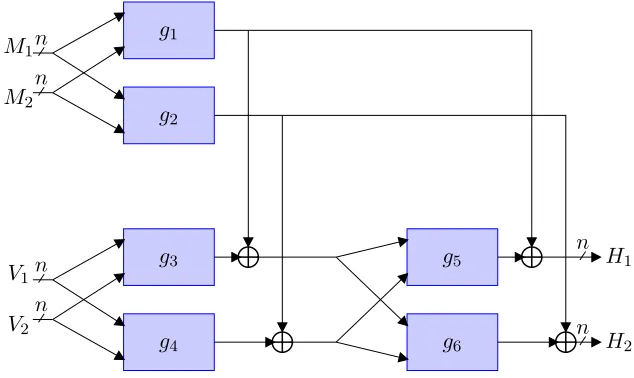
Somewhat paradoxically, range extenders can also be used to solve the problem of building a compress-ing function out of non-compresscompress-ing primitives, and vice versa. As such, they can truly be regarded as dual problems. The resulting constructions are not necessarily very elegant, however, as our two transformations below will show. If applied to our constuction (see Figure 2) one needs six calls to process two blocks of
n-bits (of message) simultaneously, making it rate-1/3. It inherits the collision resistance from Theorem 4, so one provably needs almost2n/2nqueries to find collisions. This compares favourably with Nandi et al.’s construction of rate 1/3 and collision-resistance at mostΘ(22n/3)[20, 27] or Peyrin et al.’s construction of rate 1/5 and collision-resistanceΘ(22n/3)[28, 35].
LetH...:{0,1}2n→ {0,1}nbe some construction to build an optimally collision resistant compression
function out of non-compressing primitivesf1, . . . , fk :{0,1}n → {0,1}n, for arbitraryn. For example,
our triple function construction is such an H for k = 3. Now, let g1, . . . , g2k : {0,1}2m → {0,1}m be
some given (single length) compression functions; we desire to use these 2k functions to build a double length compressing function G... : {0,1}4m → {0,1}2m. We do so as follows. Set n = 2m and define
fi =gi||g2k+1−i fori∈ {1, . . . , k}. If we model thegi as2m-to-mbit, independent random oracles then
thefi are 2m-to-2mbit (i.e., non-compressing) random oracles. Now we apply H to thesefi to obtain a
4m-to-2mbit compression function, ultimately based on thegi, whose collision resistance is2m, as desired.
Conversely (and for evenkandn), letG... : {0,1}4m → {0,1}2m be an optimally collision resistant
double length combiner for primitives g1, . . . , gk : {0,1}2m → {0,1}m. Let f1, . . . , fk/2 : {0,1}n →
{0,1}nbe given. Again, letn= 2mand define theg
i such thatfi =gi||gk+1−ifori∈ {1, . . . , k/2}. Run
the range extenderGwith componentsgi, yielding a hash functionG :{0,1}2n → {0,1}nwith collision
resistance2n/2. (Note that in this construction one should expect to throw half off’s output away all the
time.)
B Proof of Lemma 3
Lemma 6 For some positive integersq, n, letQ=q2andN = 2n, and letλ=Q/N. Letq-vectorsaandb
have elements drawn according toAandB, respectively (i.e., uniformly from{0,1}nwithout replacement).
Then
1. AsymptoticallyE[MA⊕B(k)] =λk=N e−λ λ
k
k! whenq, ntend to infinity such thatλ→0. 2. for allk >0we have
Pr[MA⊕B(k)>0]≤
(q!)22n(2n−k)! ((q−k)!)2k!(2n)! .
Proof: DefineFx,k as the binary random variable taking on 1 iff the valuex ∈ {0,1}noccurs exactlyk
times (when sampling fromA⊕B). This variable is related to the variableGxdenoting how oftenxoccurs,
indeedE(Fx,k) = Pr(Gx = k). Let us try to determinePr(Gx = k). This probability is the same for all
V2
g4 n
V1
g3 n
M2
g2 n
M1n g1
L L
L L
g6 g5
H2 H1
n n
Fig. 2: The rate-1/3 double-length hash function. The functionsg1, g2, g3, g4, g5, g6 are random2n-to-nbit functions.
expectancy (even over dependent variables), we get
E(MA⊕B(k)) =
X
x
E(Fx,k) =NPr[G0=k].
A collision occurs iffai⊕bj = 0n, whereaiis an element in the vectoraandbjin the vectorb; equivalently,
ai =bj. This problem has been studied, for example in the context of meet-in-the-middle attacks [14], and
it turns out that the probability of ak-way collision follows a hypergeometric distribution, thusPr(G0 =
k) = qk N−qq−k/ Nq. Asymptotically this means thatE(MA⊕B(k))behaves as a scaled Poisson distribution
with parameterQ/N, as claimed.
For the second part, we need to upper boundp, the probability of ak-way collision ina⊗bwhenaand b are drawn independent of each other and both uniformly at random from{0,1}n without replacement.
Now suppose that we have a k-way collision, then we can look at the positions in the matrixa⊗bthat contribute to this collision. Suppose both(i, j)and(i0, j0)are involved, soai⊕bj =ai0⊕bj0. We claim that
ifi=i0(orj=j0), then also(i, j) = (i0, j0). Clearly, ifi=i0then alsoai =ai0 and, because both pair of
indices xor to the same value,bj =bj0. Butbdoes not contain any collisions, thusj=j0.
This allows us to bound the probability on a k-way collision. Firstly, we need to choose thekindices
(i, j) that lead to the collision. For the indicesi andj there are qk possibilities each, moreover givenk
indicesiandkindicesj, there arek!ways of hooking them up. Given the locations of the collision, we have
2ndifferent values the collision can take. Then the values ofaiare still unrestricted, but the values ofbj are
now determined. Without restrictions, there would have beenN!/(N −q)!ways to chooseb, but this now reduces to(N −k)!/(N−q)!. This leads us to:
p≤
q k
2
k!2n(2
n−k)!
(2n)! =
(q!)22n(2n−k)! ((q−k)!)2k!(2n)! .
C Instantiatingf1 andf2 in the Ideal Cipher Model
In this appendix we will consider the Davies-Meyer like instantiationf1(X) =EK1(X)⊕Xandf2(X) = EK2(X)⊕X (withK1 6= K2). These are optimally inversion and collision-resistant in the ideal cipher
model [7]. They are not, however, indifferentiable from a random oracle, even when the blockcipher E
is modelled as an ideal cipher [9] (nor are the other 19 provably collision-resistant constructions [8]). As a result, it is not immediate that our bounds on the collision resistance of the compression function will still hold. We will show that ifE is modelled as an ideal cipher (andf3 as a random oracle as before) the
proof goes through with only some minor modifications to show that the oracle acces to bothEK1 and its
inverse will not help the adversary to get a list of outputs off1 that significantly deviates from the list used
in the original proof (wheref1 was modelled by a random oracle). A central tool for this argument it the
Permutation-Pseudo-Permutation (PPP) Switching Lemma below.
A pseudopermutation consists of a pair of oraclesEandDwith joint state, whereDcan be thought of as the inverse ofE. Essentially,E andDimplement dependentrandom functions. Specifically, there is a single, finite setSthat serves as both domain and range of bothEandD. The joint state consists of a list of pairs(x, y)∈S×Ssuch thaty=E(x)andx=D(y). Initially the list is empty. WhenE is queried on a pointxthat does not appear in the list (rather there is noyfor which(x, y)is on the list), it picks a random valueyinS, adds(x, y)to the list and returnsy. IfEis queried on a pointxand there exists aysuch that
(x, y)is in the list, thisyis returned (this is done uniformly if severalysatisfy this criterion). Similary, ifD
is queried ony, it returns a random element fromSunless there exists a pair(x, y)in the list; in this case,
Dreturnsx(uniformly if necessary).
Considered separately, both DandE would (perfectly) implement a random function. The joint state ensures thatDandEare consistent with respect to being each others inverse, however it is not sufficient to ensure both end up being permutations. The PPP Switching Lemma states that as long as no collision is found (that isx 6= x0 such thatE(x) = E(x0)ory 6= y0 such thatD(y) =D(y0)) a random pseudopermutation is indistinguishable from a true random permutation and its inverse. Moreover, the probability of finding a collisions as expressed in the number of queries made adheres to the birthday paradox.
Lemma 7 (PPP Switching Lemma) LetSbe a finite set of cardinalityN. Letπbe a random permutation on S, and letπ−1 be its inverse. Let the pair E, D be a random pseudopermutation on S. Let Abe an adversary with an interface for two oracles making at mostqqueries in total. Moreover, assume thatAis query-respecting. Then the PPP-distinguishing advantage ofAis upper bounded as follows:
|Pr[Aπ,π−1 = 1]−Pr[AE,D= 1]| ≤ q2
2N .
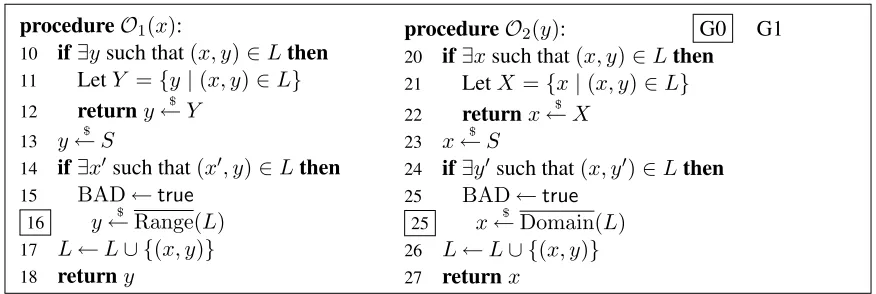
Proof: We refer to Figure 3. LetAG0denote the experiment of running adversaryAwith oracles described
by gameG0, and similarly letAG1denote the experiment of runningAwith oracles described by gameG1.
We claim thatPr[Aπ,π−1
= 1] = Pr[AG0= 1]andPr[AE,D = 1] = Pr[AG1= 1].
For the latter, the proper simulation ofE andDis clear by inspection. Note that since lines 16 and 25 do not exist in gameG1, ifO1is askedxand the test on line 10 is false, then a random valueyis returned
and(x, y) is added to the list. On the other hand, if the test is true, lines 11-12 ensure thatO1 returns a uniformyfrom satisfying pairs(x, y)in the list. Likewise, ifO2 is askedyand the test on line 20 is false, then a random valuexis returned and(x, y)is added to the list. If the test is true, lines 21-22 ensure that a uniformxfrom the satisfying pairs(x, y)is returned.
Arguing that Pr[Aπ,π−1
= 1] = Pr[AG0 = 1] is less obvious. In particular, a permutationπ should
case. If|Y|>1, then there are some two pairs(x0, y),(x0, y0)inL. Notice these cannot appear in the list
as a result of twoO1queries: askingx0 the first time will add(x0, y)to the list (at line 17), and askingx0
a second time will returnywithout adding any pairs to the list; that is, askingx0twice toO1will not result
in pairs(x0, y),(x0, y0) being added toL. Similarly, these cannot appear in the list as a result of twoO2
queries. So it must be that(x0, y)and(x0, y0)are added to the list as a result of a query toO1 and a query
toO2.
– Say thatx0 is asked toO1and that this causes a new pair(x0, y)to be added to the list. A subsequent
query ofy0 (6= y) toO2 will never add(x0, y0)to the list: if line 23 selectsx0 , then line 24 will catch
this and resample from points not yet assigned asxvalues.
– Say thatyis is asked toO2and that this causes a new pair(x0, y)to be added to the list. A subsequent
query ofx0toO1will simply returny, and not add a new pair to the list.
So, in game G0, the setY will never contain more than 1 element. A similar argument shows that the setX
will never contain more than 1 element. Moreover, the (random) resampling on lines 16 and 25 ensures that both oracles observe permutivity, and soO1 andO2 simulate a random permutation and its inverse in
game G0. Thus,
Pr[A
π,π−1 = 1]−Pr[AE,D = 1] =
Pr[AG0= 1]−Pr[AG1 = 1] .
Notice now that games G0 and G1 are identical-until-BAD, as defined in [4], and so we can state that
Pr[AG0 = 1]−Pr[AG1= 1]
≤Pr[AG1sets BAD totrue]
It remains to bound the probability that BAD is set in game G1. But this is almost immediate, since each oracle query adds at most one new pair(x, y)to the list. Thus the probability that BAD is set on thei-th oracle query is at most(i−1)/N, and a union bound gives us that Pr[AG1sets BAD totrue] ≤ q2/2N. Q.E.D.
procedureO1(x):
10 if∃ysuch that(x, y)∈Lthen 11 LetY ={y|(x, y)∈L}
12 returny←$ Y 13 y←$ S
14 if∃x0such that(x0, y)∈Lthen 15 BAD←true
16 y←$ Range(L)
17 L←L∪ {(x, y)} 18 returny
procedureO2(y): G0 G1
20 if∃xsuch that(x, y)∈Lthen 21 LetX={x|(x, y)∈L}
22 returnx←$ X 23 x←$ S
24 if∃y0 such that(x, y0)∈Lthen 25 BAD←true
25 x←$ Domain(L) 26 L←L∪ {(x, y)}
27 returnx
We are now ready to show that replacing the random one-way functions f1 and f2 with respective
random two-way permuations π1 andπ2 (with respective inverses π−11 andπ
−1
2 ) in Davies-Meyer mode
(that is f1(M) = π1(M)⊕M andf2(V) = π2(V)⊕V) hardly affects our proof of security and that, as before, we can replace the queries to π1, π2 and their inverses by two random lists a and b. For this
we replace the pseudopermutationD, Eof the previous Lemma by a slightly different constructionD0, E0. Instead of generating the output ofD0 andE0 on-the-fly for fresh queries, we now commit to a list aof elements inS = {0,1}n in advance and on thei’th fresh query (be ity
i toD0 orxi toE0) we return the
queried value plus thei’th element in the list (soD0(yi) = yi⊕ai, resp.E0(xi) =xi ⊕ai). It is not hard
to see thatD0, E0 has the exact same output distribution as D, E (provided the lista is long enough), so an adversary cannot distinguish between the two. Furthermore, the effect of usingD0, E0 in the place of
π, π−1in the constructionf(x) =π(x)⊕xis that, regardless of which queries the adversary makes, we get
f(xi) =ai.
Another (less exciting) consequence of the PPP Switching Lemma is that finding collisions in the rate-1/2 compression functionf1(M)⊕f2(V)requiresΘ(2n/4)queries in the ideal cipher model whenf1(M) = EK1(M)⊕M andf2(V) =EK2(V)⊕V (withK1 6=K2).
D Poisson Heuristic to Approximate the Yield
In this appendix, we will derive an alternative characterization of yield(a⊗b). We then combine it with the conjectured distribution ofk-way collisions inA⊕B in order to recast the problem of finding the expected value yieldA⊕Bn (q) into that of determining a certain property of the tail of a Poisson distribution. The latter problem can be tackled much more easily numerically for larger values of n. Indeed, we provide experimental results to both validate our reformulation, as well as determining concrete estimates of the collision resistance of our proposal in practice. It turns out that fornup to 256, the loss in collision resistance is at most four bits.
THEORETICAL BACKGROUND. Letc ∈({0,1}n)Q be given (we can ignore for the moment from which
distributionchas arisen). Recall thatyield(c)is the sum of the frequencies of the most frequent elements in c. Thus, to determineyield(c), it suffices to know how manyk-way collisions there are, for allk. Recalling thatMc(k)denotes the number ofk-way collisions inc, then we have:
yield(c) = max
w∈[0,...,Q]Q+1
wk≤Mc(k),PQk=0wk=q
Q
X
k=0 kwk.
To approximate yieldA⊕Bn (q), we can look what happens if we look at yield(c) for an (imaginary) sample cwhose number ofk-way collisions exactly equals the expectation ofMA⊕B(k)(for allk). That
such an idealcmight not exist, since the expected value ofMA⊕B(k)could be fractional, is irrelevant. We
refer Lemma 3 for the expectation of MA⊕B(k). (Ifcwere drawn uniformly at random, rather than from
A⊕B, we could use Theorem 2, leading to the same approximation.) LetyieldPn(q)be the yield based on the Poisson heuristic corresponding to a sample size ofQ=q2elements of{0,1}n. Then we pose the following
approximation, whereλ=Q/N:
yieldA⊕Bn (q)≈yieldPn(q) = max
w∈[0,...,Q]Q+1
wk≤N λkk!eλ,
PQ k=0wk=q
Q
X
Note that we make two types or error in this approximation. The distribution ofE(MA⊕B(k))is not exactly
a scaled Poisson distribution; moreover, the maximum of an expected vector is not the same as the expected maximum of a vector. It is however a lower bound.
EXPERIMENTALJUSTIFICATIONWe provide experimental results to support our claim on the behaviour of expected number ofk-way collisions for the distributionA⊕B. It also suggests thatyieldPn(q)is a very good estimator for the actualyieldA⊕Bn (q).
In order to get accurate estimates, we performed the experiment of picking fromAandBa large number of times per pair(n, q). (Anywhere from103 to106runs per pair.) Given that each run takes time2nwith similar space requirements, we only have the data fornup to 22.
In Table 1 the data is given for query complexity q = 2n/2. SinceN = 2nand Q = q2 this means thatλ = 1. The first column gives the values of n, from which the other parameters (q, Q, andN) can be deduced. We then give three columns with the average yield (or rather the logarithms thereof). The first is the result of experiments based on the distributionA⊕B, the second of experiments based on a uniform distributionU and the final is the Poisson estimation. The remaining five columns give the average numbers
MA⊕B(k), normalized byN. These are the numbers we conjecture are distributed according to a Poisson
distribution with parameter Q/N. So, in the final row we give the Poisson distribution with λ = 1 for reference.
Table 2 gives the analogous results, but forq= 2n/2−1, corresponding toλ= 14.
ESTIMATEDCOLLISION-RESISTANCE. We are now ready to estimate the actual level of collision-resistance our construction offers. For each value ofn, we have determined the smallestqfor which the resulting av-erage yield exceeds 2n/2. (Note that this is not exactly equivalent to having probability half of finding
collisions, but we are confident it gives a faithful indication.)
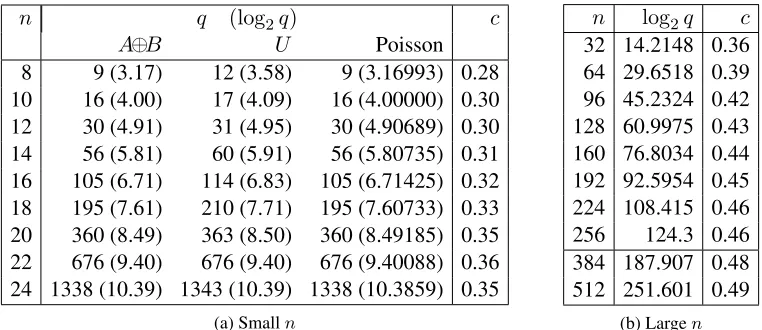
In Table 3a we have tabulatedlog2q for small values of n. Included are three versions. First we give the value ofqthat, when simulating the experiment of pickingAandB and computingyieldA⊕B, gives an average yield exceeding2n/2. Second up is the corresponding result for the experiment of pickingUdirectly uniformly at random. Finally we also give the value oflog2qthat follows from the Poisson estimation. For the latter we also provide the value ofcsuch thatq = 2n/2/n−c, that isc= logn2n/q2.
In Table 3b we have only given the values corresponding to the Poisson estimation, for nof crypto-graphic relevance. Note the very small loss of actual security. Even for a 512-bit primitive the loss is less than five bits. The table also shows the very slow increase inc.
As a consequence oflog2qbeing fairly close to n2, one might want to take the probability of finding a collision in eitherf1 orf2 into account as well. Assumingf1 andf2 are random functions, the probability
of finding a collision in either is about2−6forn= 160, decreasing even further to2−7forn= 256, where
n log2yield Average nr. ofk-way collisions /N
A⊕B U Poisson MA⊕B(1) MA⊕B(2) MA⊕B(3) MA⊕B(4) MA⊕B(5)
4 3.21 3.20 3.15 0.366 0.206 0.054 0.012 0.0016
6 4.47 4.49 4.45 0.367 0.189 0.060 0.014 0.0027
8 5.74 5.75 5.74 0.368 0.185 0.061 0.015 0.0030
10 6.90 6.90 6.90 0.368 0.184 0.061 0.015 0.0030
12 8.09 8.10 8.10 0.368 0.184 0.061 0.015 0.0031
14 9.19 9.19 9.19 0.368 0.184 0.061 0.015 0.0031
16 10.35096 10.35301 10.35384 0.3678 0.1839 0.0613 0.0153 0.00307
18 11.42019 11.42016 11.42020 0.3679 0.1839 0.0613 0.0153 0.00307
20 12.51232 12.51221 12.51233 0.3679 0.1839 0.0613 0.0153 0.00306
22 13.63089 13.63084 13.63085 0.3679 0.1839 0.0613 0.0153 0.00307
Poisson,λ= 1 0.3679 0.1839 0.0613 0.0153 0.00307
Table 1: Comparison of experimental yield and its Poisson estimate forq = 2n2 samples.
n log2yield Average nr. ofk-way collisions /N
A⊕B U Poisson MA⊕B(1) MA⊕B(2) MA⊕B(3) MA⊕B(4) MA⊕B(5)
6 2.52 2.53 2.54 0.787 0.0968 0.00543 0.000636 0.0000313
8 3.85 3.90 3.93 0.781 0.0975 0.00736 0.000517 0.0000302
10 5.10 5.10 5.10 0.780 0.0972 0.00791 0.000501 0.0000283
12 6.20 6.20 6.20 0.779 0.0974 0.00805 0.000505 0.0000261
14 7.37 7.37 7.37 0.779 0.0974 0.00810 0.000506 0.0000259
16 8.613 8.617 8.619 0.779 0.0974 0.00810 0.000507 0.0000254
18 9.653 9.652 9.652 0.779 0.0973 0.00811 0.000507 0.0000254
Poisson,λ= 14 0.779 0.0974 0.00811 0.000507 0.0000254
Table 2: Comparison of experimental yield and its Poisson estimate forq = 2n2−1samples.
n q (log2q) c
A⊕B U Poisson
8 9 (3.17) 12 (3.58) 9 (3.16993) 0.28
10 16 (4.00) 17 (4.09) 16 (4.00000) 0.30
12 30 (4.91) 31 (4.95) 30 (4.90689) 0.30
14 56 (5.81) 60 (5.91) 56 (5.80735) 0.31
16 105 (6.71) 114 (6.83) 105 (6.71425) 0.32 18 195 (7.61) 210 (7.71) 195 (7.60733) 0.33 20 360 (8.49) 363 (8.50) 360 (8.49185) 0.35 22 676 (9.40) 676 (9.40) 676 (9.40088) 0.36 24 1338 (10.39) 1343 (10.39) 1338 (10.3859) 0.35
(a) Smalln
n log2q c
32 14.2148 0.36 64 29.6518 0.39 96 45.2324 0.42 128 60.9975 0.43 160 76.8034 0.44 192 92.5954 0.45 224 108.415 0.46
256 124.3 0.46
384 187.907 0.48 512 251.601 0.49
(b) Largen