Citation:
De Groot, M and Lodal, H and Masuhara, H and Moore, D and Pioro, T and Shelton, J (2008) X-stream inclusion. Assessment, Teaching & Learning Journal, 3. 19 - 25.
Link to Leeds Beckett Repository record: http://eprints.leedsbeckett.ac.uk/1090/
Document Version: Article
The aim of the Leeds Beckett Repository is to provide open access to our research, as required by funder policies and permitted by publishers and copyright law.
The Leeds Beckett repository holds a wide range of publications, each of which has been checked for copyright and the relevant embargo period has been applied by the Research Services team.
We operate on a standard take-down policy. If you are the author or publisher of an output and you would like it removed from the repository, please contact us and we will investigate on a case-by-case basis.
X-stream inclusion
Mark de Groot, Habib Lodal, Hitomi Masuhara, David Moore, Teresa Pioro
and Jane Shelton
Project
Teaching Quality Enhancement Fund (TQEF) funding has been secured to explore the potential of recorded voice messages in the online environment. The 2001 Special Education Needs and Disability Act places an anticipatory duty on institutions to make reasonable adjustments to ensure that disabled students are not disadvantaged, and this includes the e-learning environment (Seale, 2003).
This report summarises early findings on possible methods and circumstances in which the use of recorded voice messages might enhance the inclusion of students currently excluded from or disadvantaged in the online environment through disability or language barriers (Poza, 2005; Seymour & Lupton, 2004). It is also a story of the remarkable pupils of two schools 1,400 miles apart communicating beyond boundaries of language, technology and individual special needs.
Background
The project aimed to enable two groups of disabled students aged 9-18 in different countries to meet and communicate with each other in a virtual environment. As far as possible we wanted the project to be participant-driven and to explore the possibilities and limitations of using online communication to achieve the project aims. The project combines the expertise, efforts and resources of staff and pupils from three areas:
•
Benton Park School. Nine special needs pupils and three support staff from this high performing local technology college.•
Szkola Razem. Eight special needs pupils from this school in eastern Poland and five support staff. Contact has been established and is maintained with this school by Teresa Pioro and the Leeds Met’s volunteer programme.•
Leeds Met staff. A cross-faculty group of academic, research and support staff with interests in inclusive access to technology, linguistics, language learning and technology enhanced learning. Leeds Met has created and hosts an X-stream module to which pupils and staff at both schools have access and which is used in the project.Project plan
The project is scheduled to run from April 2007 through to February 2008. This report summarises our activity prior to the summer break for both schools.
April 2007: Contact with Benton Park
It was important to spend time getting to know each of the students so that they felt comfortable with project staff. It took time also to test locally and familiarise all with the X-stream module they would be using. Basic information about the participants was gathered: name, age and interests and a picture.
May 2007: Initial module design
The intention was to have a section for each school containing "Meet the Pupils" with pupil profiles on flashcards and a separate "Talk to Me" where pupils from both schools could communicate with each other.
The "Talk to Me" section consists of :
• "Read" - flash cards with Polish words or phrases with English translations
• "Listen" - voice recordings in Polish and English to help the schools learn about the languages
• "Let’s Talk" - a Voice Board that pupils use to record, send and store their voice messages to each other.
June 2007: Physical contact with Polish School
Our research assistant, Habib Lodal, had the critical task of establishing physical contact with the pupils and staff in the time he could find outside commitments he had as a volunteer at Szkola Razem. The Razem pupils recorded an introductory voice message including their name, age, and interests and were each photographed. The pupils also had the opportunity to hear messages from Benton Park pupils.
July 2007: Review module design
Poor elements in our initial design soon became clear. The flashcards in the “Meet the Pupils” section had no inherent interactivity. In the "Talk to Me" section we had overestimated reading, speaking and language skills. Additionally we now realised it would be extremely hard for the pupils to find the messages related to them. After each participant had made a recording, the Voice Board was populated with 17 messages and that was before any replies had been made (see Figure 1).
Figure 1: proliferating messages
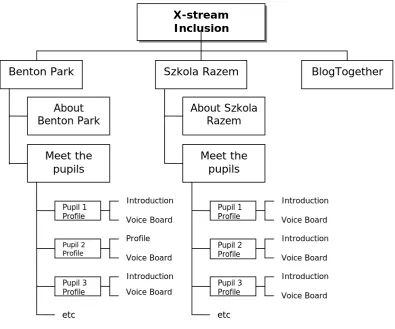
Module redesign
X-stream Inclusion
Benton Park Szkola Razem BlogTogether
Meet the pupils
About
Benton Park About Szkola Razem
Meet the pupils
etc Pupil 1 Profile
Introduction
Voice Board
Pupil 2 Profile
Introduction
Voice Board
Pupil 3 Profile
Introduction
Voice Board
etc Pupil 1 Profile
Introduction
VoiceBoard
Pupil 2 Profile
Profile
Voice Board
Pupil 3 Profile
Introduction Voice Board
[image:4.595.90.486.63.392.2]The first feature of the profile is a simple introduction. This introduction is presented in a table and has details of the pupil’s name and picture, a podcast message created using the Voice Tools and a translation or transcript of that message (see Figure 3).
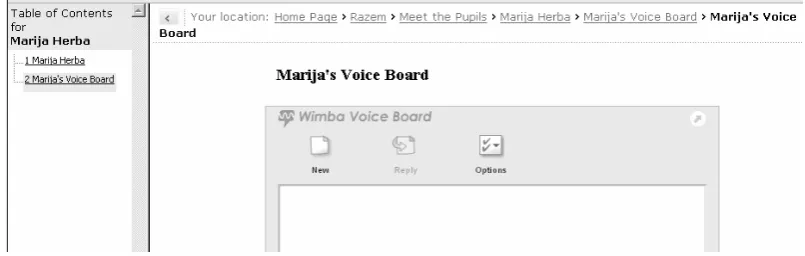
The second feature in each profile is the pupil’s individual Voice Board. This will allow anyone who wishes to send that particular pupil a message.
Figure 4: Example individual Voice Board
These flexible and easy to navigate profiles can also include other features including scanned images, short videos or links to their favourite websites. It is the development of these individual profiles and sharing them with others that will form the main activity for the pupils in the
remaining time of this project.
The module now allows pupils to post a message and communicate with each other using a social networking model similar to MySpace and which learners in general are increasingly using to support their studies (JISC, 2007).
September 2007: Staff Development Festival Workshop
The aim of the Assessment, Learning and Teaching (ALT) workshop at the Staff Development Festival was to demonstrate how our spoken voice (Voice) can be used as a powerful medium for online communication in addition to the currently dominant visual and textual media
(McIntosh et al, 2003; Felix, 2004). Participants were given a hands-on opportunity to explore the potential of Voice Tools in inclusive ALT. Using a specially designed exercise which made use of individual voice boards, participants were encouraged to create, hear and respond to voice messages from both a learning and teaching perspective.
Interim conclusion and recommendations
The project has demonstrated how voice tools might literally give people a voice online. Extrapolating from the initial stages of the project and from discussions at the workshop, we consider:
•
Voice tools present an exciting potential contribution to inclusive learning and widening participation by accommodating different learning abilities and styles, the reduction of place and time dependence for learners and the neutralisation of barriers faced by disadvantaged students•
Voice tools in ALT may be productive for all students, allowing reflections, reports and maintenance of contact while students are offsite on placements. However, while voice tools might indeed enhance current ALT strategies, the challenges the project faced which are outlined below demonstrate that voice tools should be viewed as an additionalALT resource and not as a replacement for existing practice.
•
Technology: Unfamiliar technology and issues of access to appropriate tools, especially offsite, could cause difficulties. This is particularly pertinent when considering parity amongst students if such tools are a required part of ALT. Good instructions, ongoing assistance and time to practise are likely to be critical.•
Overcoming barriers: Technology alone does not overcome language and distance barriers. Translators were needed to provide transcripts for recorded voice messages so pupils could understand them and the physical distance between schools was significant, particularly in the early stages of the project where specialised knowledge was needed to set up and introduce the tools. Once the project is up and running, however, distance should be much less of an issue.•
Design: Ensuring that tools and activities are appropriately matched. Initial assumptions about how a tool might be used may need substantial revision. Tools are more likely to be successful used in combination with others. The recorded voice is more engaging in combination with a picture or a transcript.•
Special needs: Ensuring that materials are designed and presented so that all participants have access to them (Phipps et al, 2002).Surprisingly perhaps, in this project, the special needs of the pupils we are working with did not present the challenges that we initially anticipated. The special needs include physical
impairments, ADHD, autism, epilepsy, Down’s syndrome and a range of social and physical neglect and abuse. It is extremely important as the project continues that we remain aware of the impact of these needs, and in particular that any approach adopted to cope with one set of difficulties doesn't in turn create difficulties for other participants (Mairs, 2007 and Steyeart, 2004). All the participants, particularly the pupils, were extremely enthusiastic about the project. There are many instances where pupils who were apparently otherwise somewhat reticent in communicative tasks not only participated wholeheartedly in the recordings but produced content beyond expectations. The fact that these pupils can and did engage is a credit both to their remarkable resilience and determination but also to the exceptional support they have from their teachers, parents, carers and peers.
Mark de Groot (Libraries and Learning Innovation, Innovation North), Habib Lodal (student, Libraries and Learning Innovation), Hitomi Masuhara (English Language Teaching, Leslie Silver International Faculty), David Moore (Systems for Innovation, Innovation North), Teresa Pioro (Office of the Pro-Vice-Chancellor: Assessment, Learning and Teaching) and Jane Shelton (Speech and Language Therapy, Faculty of Health)
References
Felix U. (2004). Performing beyond the comfort zone: Giving a voice to online communication. In R. Atkinson, C. McBeath, D. Jonas-Dwyer & R. Phillips (eds) Beyond the Comfort Zone:
Proceedings of the 21st ASCILITE Conference. Perth, Western Australia, 5-8 December.
JISC (2007) In their own words: Exploring the learner's perspective on e-learning. HEFCE.
Mairs, C. (2007) Inclusion and Exclusion in the Digital World: Turing Lecture 2006.The
McIntosh, S., Braul, B., & Chao, T. (2003). A case study in asynchronous voice conferencing for language instruction. Educational Media International 40: 63–73.
Phipps, L., Sutherland, A. and Seale, J. (2002) Access All Areas: disability, technology and
learning. York: JISC TechDis Service and ALT.
Poza, M.I.C. (2005) The Effects of Asynchronous Computer Voice Conferencing on Learners’
Anxiety When Speaking a Foreign Language. PhD Dissertation. West Virginia University:
College of Human Resources and Education.
Seale, J (2003) Supporting the development of e-learning accessibility practices: new and emergent roles for staff developers. In G. Crips, D. Thiele, I. Scholten, S. Barker and J. Baron,
Interact, Integrate, Impact. Proceedings of the 20th Annual Conference of the Australasian
Society for Computers in Learning in Tertiary Education (ASCILITE). Adelaide, 7-10 December.
Seymour, W and Lupton, D. (2004) Holding the line online: exploring wired relationships for people with disabilities. Disability & Society 19(4).
Steyaert, J. (2004) Web-Based Higher Education The Inclusion/Exclusion Paradox. Journal of