CAUSES OF DELAY IN CONSTRUCTION PROJECTS IN BENGHAZI
MUNICIPILITY- LIBYA
ZUHIR BUSNEINA1, AKIN MARSAP2 1
Department of Business Management Program, Istanbul Aydin University, Turkey 2
Department of Business Management Program, Istanbul Aydin University, Turkey
ABSTRACT
Benghazi Municipality has a problem in finishing the construction projects in due time which has a negative impact on the success of these projects such as, exceeding the time limit, increasing the cost estimates. These negative effects reflect themselves on the different spheres of life and the whole society in general. It is important to investigate this phenomenon in the period between 2013-2017 through studying the causes behind it.
This research aimed to investigate the main causes of delay in the completion of construction projects in Benghazi Municipality in Libya, and to identify the average of time overrun. It also analysed and ranked the most important causes of delay according to their FI, SI and the importance index II from the point of view of contractors and consultants.
The method used for the analysis was the quantitative method research design. The questionnaire tool has been designed to collect the quantitative data. The field survey of a questionnaire contained 69 possible causes for the delay categorized into four major groups. The questionnaire was distributed to the sample of the study that included 54 participants, which is at the same time the population. The population included 36 contractors and 18 consultants which represents two main parties in construction projects, and the interview tool was selected to study one case with a project exposed to time and cost overrun.
The research showed delay in many construction projects conducted for BM during the period between 2013-2017, where there was a delay in 54 projects out of 104, and this represent 51.9% of the projects. Moreover, the study indicated that the average of time overrun is between (10% and 30%) of the original time of the projects. The study also showed that 41.7% of the respondents believe that the main reason of the delay is the contractor. However, the results concluded that the following are the top five delay causes arranged according to the II:
The delay in paying the financial dues to contractors by the client.
Award project to lowest bid price (the contractor who has the lowest bid).
The delay in due payments to the suppliers by contractor.
Difficulties in financing the project by the contractor.
Dispute with neighbours.
Keywords:Frequency Index (FI), Severity Index (SI), Importance Index (II),Project Management (PM),BenghaziMunicipality (BM).
GE-International Journal of Management Research ISSN (O): (2321-1709), ISSN (P): (2394-4226) Vol. 7, Issue 4, April 2019 Impact Factor: 5.779 © Association of Academic Researchers and Faculties (AARF)
1. Introduction
The construction industry (CI) in Libya gives less to the nation's economy than other services or manufacturing industries. Formally, the CI represents 5.2% of the Libyan gross domestic product (GDP) (Ngab, 2010).
Construction delays are important issues in the construction sector, where the construction sector contributes to Libya's national economy, thus the construction industry must be dynamic to be able to react to the variations that faces the world continuously from social and economic challenges which requires the use of project management successfully and effectively, the progress of any enterprise determined on how well project management is implemented at the specified time and cost while maintaining the quality required.
In Libya, construction projects suffer from delays in completion within the specified time, therefore the researcher visited the city of Benghazi to discover the presence of delay problem in the completion of construction projects and found that the city of Benghazi is facing time and cost overruns in construction projects.
Delays has many reasons and has adverse effects on projects In terms of increasing time, costs and low quality of the project, these undesirable effects are reflected on the aspects of the society as a whole, which calls for the study of this problem by identifying the main reasons of the delay in completion of the construction projects implemented in Benghazi city by identifying the time span of these delays, depending on the frequency of occurrence and degree of severity and evidence of the importance of these causes from the perspective of both parties of the project (contractor and consultant).
Through the study of (Tumi et al., 2009), which conducted in Libya to study the causes of delays in construction projects, it showed that the cause of delay is a common phenomenon in the construction projects in Libya. Hence, this study is an attempt to identify the main causes behind cost and time overruns, which leads to delays in the completion of construction projects in Benghazi city to avoid, control and reduce these causes in the future.
1.2 Problem of the Statement
In Libya, construction projects suffer from delays in completion within the specified time, therefore the researcher visited the city of Benghazi to discover the presence of delay problem in the completion of construction projects and found that the city of Benghazi is facing time and cost overruns in construction projects.
the society as a whole, which calls for the study of this problem by identifying the main reasons of the delay in completion of the construction projects implemented in Benghazi city by identifying the time span of these delays, depending on the frequency of occurrence and degree of severity and evidence of the importance of these causes from the perspective of both parties of the project (contractor and consultant).
1.3 Scope of the Research
This research conducted in the city of Benghazi in Libya, the study will focus humanly on both sides of the project (contractors and consultants), who participated in the execution of construction projects which had a delay in the Municipality of Benghazi.
This research was to identify the causes of delays in finalizing projects in the city of Benghazi, which was limited to this study on the construction projects implemented in which a delay occurred.
2.Literature Review
Construction delays are important issues in the construction sector, where the construction sector contributes to Libya's national economy, thus the construction industry must be dynamic to be able to react to the variations that faces the world continuously from social and economic challenges which requires the use of project management successfully and effectively, the progress of any enterprise determined on how well project management is implemented at the specified time and cost while maintaining the quality required.
2.1 The Project and The Main Objectives
The project is an arranged problem, and the problem means it is in a positive and negative ways. For example, creating a new product is a problem from a positive point while a project environmental problem is a kind of negative type (Heagney, 2012).
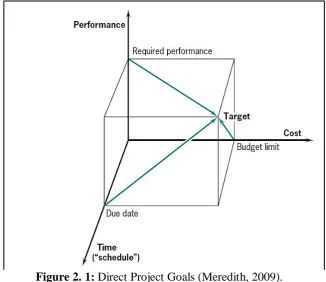
Figure 2. 1: Direct Project Goals (Meredith, 2009).
some have replaced Performance with Scope like (Mantel, 2001), the researcher will explain the concept of each project objective based on (Heravi, 2014) and (Fewings
, 2005) which replaced Performance with quality as follows: Time
All projects are limited by a specific period of time to complete the project,
Finishing the project on time is a huge challenge to project management and a key criterion for project success by the owner, contractor and consultant (Bowen et al., 2002).
Cost
Financial resources are key to the sustainability of project implementation, (Bowen et al., 2002) noted that the owner considers that the lower the cost of the project, the higher the profit.Hence, many owners evaluate and select offers based on the price provided by the contractor.
Quality
2.2 Construction delays
Delays and cost overruns in construction projects is a public phenomenon due to the inputs variety and resources variety. The delay is a multifaceted, expensive and risky problem, where the time is very significant for the owner performance, and for the contractor money. The delay in closing or finishing of construction projects regularly leads to aggressive relationships among participants (owner, contractor, consultant) and distrust, lawsuit and arbitration, also the common sense of fear from the parties of the project towards each other (Ahmed et al., 2003).
(Ndekugri et al., 2008) Noted that the delay affects the development of contractor's effort or reduce it competently than it is assumed, that effect the quality of the project.
2.3 Types of delays
Some studies have divided the delays into three main types, such as a (Hamzah et al.,2011), (Ahmed et al., 2003), (Alaghbari et al., 2007) and (Majid, 2006). Which are Non- Excusable Delays, Excusable Delays and Concurrent .
Non-excusable delays
Non-excusable delays or unexplained postponements are suspensions caused by the contractor or its supplier or subcontractor or its representative, whether by the act of the contractor or by his failure to act (KraiemandDiekmann, 1987).
Excusable delays
Excusable Delays are delays that happen as an outcome of events outside the control of the contractor or the subcontractor, they are often unexpected.
Compensable excusable delays
Compensable delays are the delays produced from the owner and are within his control or by his representatives, which resulting from a fault of the owner or negligence or results from the owner's engineer or consultant. (Hamzah et al., 2011).
Non-compensable excusable delays
Concurrent delays
Concurrent delays are the delays that occur as a result of two or more factors delaying the construction project and occurring in the similar time period or there is an overlap between them, or is the delay that describes two or more delays occurring at the same time where either of them, if it occurs individually, affects the completion date of the project. (Al-AghbariandAbdulmoghni, 2005).
3. Methodology and Data
3.1 Research Methodology
Based on the nature of the research, the researcher used quantitative methodto achieve the objectives of this research, which is based on the study of the phenomenon as it exists in fact and is concerned as a precise description. The quantitative expression gives a numerical description that shows its extent or size or degree of association with other phenomena. The municipality of Benghazi is the largest owner of the construction projects in the city, therefore the research focused on the municipality, because it represents the entire city. The amount of construction projects implemented during the period from 2013 to 2017 were (104) construction projects, divided by the section and type of the project implemented As follows: Department of Architecture and Projects (52), Department of Roads and Bridges (37) and the Department of Sewage (15) construction projects implemented.
The total amount of construction from 2013 to 2017 is (104) construction project. The amount of delayed construction projects reached (54) projects which is 51.9% of the total implemented projects.
The number of Non-delayed construction projects that did not have a delay in time, according to the contract are (50) which is (48%) of the construction projects implemented in the municipality of Benghazi, (25) projects were delayed in the department of Architecture and Projects, (20) delyed projects in the Roads and Bridges department and (9) delyed projects in the Sewage department.
3.2 Research Population and Sample
scope of this research, where (36) contractors and (18) consultants involved and The owner which is the Municipality of Benghazi, was excluded because it represents one side and is not suitable for the statistical analysis also the project parties from the water section were excluded due to the lack of water projects.
The researcher considered that the research sample should be the entire research Population which is 100% of the size of the total study population, due to the limited research population involved in the construction projects that implemented by the Municipality of Benghazi in the period between 2013 and 2017.
3.3 Quantitative Tool
The researcher was guided in writing the questions and paragraphs of the research questionnaire by considering the questionnaires of (Al-Khalil & Al-Ghafly 1999), (Falqi 2004), (Assaf and Al-Hejji 2006), (Albogamy et al. 2012) and (Marzouk and El-Rasas 2014) afterward reformulating these questions, modifying and removing some of them to be appropriate and relevant to the research purposes and objectives, where Interviews and discussions made with experts and some contractors, consultants and project managers who have experience in the construction projects in the Libyan environment to take their opinions on the causes of delays collected from former studies.
A pilot test for the questionnaire has been procced and distributed.
These causes were filtered from (111) causes to (69) possible causes of delay in implementing construction projects by the Municipality of Benghazi.
(36) Contractors and (18) consultants participated in the implementation of (104) construction projects, where the researcher adopt the use of the comprehensive survey method on the research population to collect the primary data, where the number of questionnaires distributed was (54) of which retrieved (54), with a total response rate of (100%) and the percentage of valid questionnaires is (100%).
3.4 Models
Descriptive Statistic Measures: To define the sample of the research, to answer the research questions, and it represents in number of repeats, percentages, and arithmetic. Frequency Index :is to arrange the causes of delays in terms of the frequency of
occurrence for Each cause, using the next equation:
Frequency Index (F.I) (%) = Σa (n / N) * 100/5 (3.1)
Whereas:
(F.I): Frequency Index.
a: The scales given for each option. n: Repeated responses by respondents. N: The total number of respondents.
Severity Index:is to determine the causes of the delay depending on the degree of severity of the cause, using the following equation:
Severity index: (S.I) (%) = Σa (n / N) * 100/5 (3.2)
Whereas:
(S.I): the severity index (Severity Index: a: The scales given for each cause. n: Repeated responses by respondents. N: The total number of respondents.
Importance Index: To determine the importance index for each cause, using the following formula:
Importance Index (IMP.I.)(%) = [F.I (%) ∗S.I (%)]/100(3.3)
Whereas:
(IMP.I): Importance Index (F.I): Frequency Index. (S.I): Severity Index.
4. Results, Conclusions and Recommendations
4.1 Frequency of Occurrence
The Frequency was measured by the Frequency Index which shown in Equation 3.1.
Table 4. 1: FI and Ranking of Delay Causes.
Rank No. Cause of delay Main group Sub-group FI %
1 53 Choosing the contractor with the
lowest bid and lowest price Owner Owner 79.73% 2 46 Delay in progress payments and
settlements by the owner Owner Owner 77.60%
3 32 Delays in payments to suppliers. Contractor Project financing 71.61% 4 68 Problems with neighbors Others External causes 69.13%
5 30 Financial difficulties in financing
the project by the Contractor. Contractor Project financing 67.52%
The previous table shows that the cause (Choosing the contractor with the lowest bid and lowest price) which is related to the owner is the most frequent and occurring from the perspective of the whole respondents.
4.2 Degree of severity
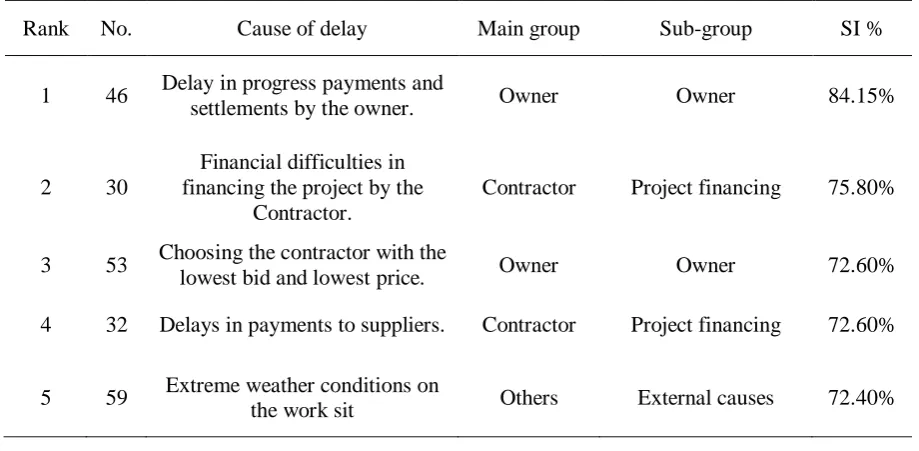
The Severity was measured by the Severity Index which shown in Equation (3.2).
The following table shows the top five causes of delay in construction projects in Benghazi Municipality from the view of all the respondents according to the degree of severity.
Table 4. 2:SI and Ranking of Delay Causes.
It is clear that respondents as a whole identified two of the top five causes that are linked to the Owner set, two causes in Contractor set, and one cause falls within the Other Causes set.
Rank No. Cause of delay Main group Sub-group SI %
1 46 Delay in progress payments and
settlements by the owner. Owner Owner 84.15%
2 30
Financial difficulties in financing the project by the
Contractor.
Contractor Project financing 75.80%
3 53 Choosing the contractor with the
lowest bid and lowest price. Owner Owner 72.60% 4 32 Delays in payments to suppliers. Contractor Project financing 72.60%
5 59 Extreme weather conditions on
[image:9.595.64.524.515.740.2]4.3 Importance Index
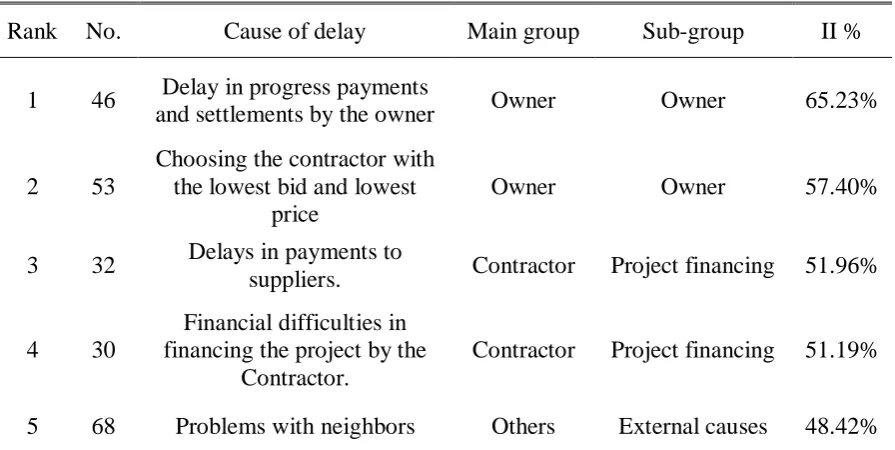
[image:10.595.74.522.130.355.2]The importance was measured by the Importance Index which shown in Equation (3.3).
Table 4. 3:II and ranking of delay causes (Overall).
Rank No. Cause of delay Main group Sub-group II %
1 46 Delay in progress payments
and settlements by the owner Owner Owner 65.23%
2 53
Choosing the contractor with the lowest bid and lowest
price
Owner Owner 57.40%
3 32 Delays in payments to
suppliers. Contractor Project financing 51.96%
4 30
Financial difficulties in financing the project by the
Contractor.
Contractor Project financing 51.19%
5 68 Problems with neighbors Others External causes 48.42%
The table above illustrates that the top five reasons of delay in construction projects in Benghazi Municipality according to its degree of importance are as follows:
Delay in Progress Payments and Settlements by the Owner
The researcher directs this cause to the failure of the Municipality of Benghazi to estimate its budget accurately before starting to implement the project to the lack of sufficient reserve amounts for each project, as well as the lack of commitment by donors to the financial payments covering project costs.
The researcher indicates that the occurrence of this cause by the owner reflects negatively on the financial balance of the contractor and economic problems towards providers or other parties in sponsoring the project, which declines the contractor's capability to execute the project on time and causes the contractor problems with other parties (internal contractor, workers, supplier, etc.)
Choosing the Contractor with the Lowest Bid and Lowest Price
the contractor leads to problems and conflicts between the project parties, especially with the owner In terms of following the specifications and materials according to what is mentioned in the contract.
The researcher believes that the adoption of the municipality at the lowest prices in the selection of the contractor creates a strong race among contractors and causes a decrease in the price of the auction which causing the loss of margin of profit or loss to the contractor, which badly impacts the performance of the contractor in the implementation of the project. Delays in Payments to Suppliers
The researcher points this cause to the financial troubles confronted by the contractor, which the owner may be its source.
The researcher finds that the delays in payments to suppliers by the contractor reflects adversely on the provider, in terms of distrust between the contractor and the provider in the schedule of the financial payments that the supplier may needs it, which leads to the delay of the supplier in providing the contractor with the basic materials used in the construction of the project which causes the work to be stopped or delayed, and the contractor may seek another supplier to supply the required materials and this requires a long time.
Financial difficulties in financing the project by the Contractor
The researcher directs this reason to the depending of the contractor in financing the project on the financial payments which made by the owner
The researcher believes that the payments often delays on its time, also directs this cause to the nonexistence of a financial strategy by the contractor for each project before the start of implementation, a strategy to be capable to expect all the unusual circumstances that occurs through the execution of the project like the lack of liquidity from the contractor or the rise of worker wages or the materials prices or equipment breakdown.
The researcher finds that the access of some contractors in the operation of more than one project in the similar time cause them financial glitches and failure to Commitment to what is contracted upon in the contract and with other parties to finance the project.
Problems with Neighbours
The researcher finds that the problems with neighbours are varied and many, and it depends on the nature of the project.
disputes between neighbours and project parties, and these hitches have a powerful influence on the delay of construction projects, due to the failure of the contractor or the municipalit y to resort to the police or the courts, especially in the case of failure of the friendly methods with the neighbours to resolve the outstanding problems.
4.4 Kendall Coefficient of Concordance
To determine the agreement of ranks between the two parties the consultants and contractors. The Kendall coefficient of concordance (W) is used to measure the communality of ranks for (m)observers. It is computed with the following formula.
𝑊 = 𝑚2(𝑛12𝑆3−𝑛)(4.2)
Where S is the sum of squares of deviations of the rankings, that is:
𝑆 = 𝑁 𝑅𝑖 − 𝑅 2
𝑖=1 (4.3)
m is the number of sets of rankings, n is the number of variables being ranked, 𝑅𝑖 is the sum of ranks for 𝑖𝑡ℎvariable and 𝑅 is mean of sum of the ranks.
𝑊 ranges between 0 and 1, 𝑊 = 1 indicate a perfect agreement; but if the rankings by various groups differ very much, the sum of rankings (𝑅𝑖) is more or less equal for each of the factors and hence the value of 𝑆 becomes small and so does W.
Accordingly, the values of W for rankings of delay causes are found to be 0.763. In order to know whether there is agreement or disagreement between the two groups on ranking the factors, a test of hypothesis is needed.
Null hypothesis: H0: Disagreement in rankings between the two groups. Alternative hypothesis: H1: Agreement in rankings among the two groups.
That probability is called level of significance, and its common values are 0.05 and 0.01. The level of significance of 0.05 is selected for this research.
𝑥𝑟2 = 𝑚 𝑛 − 1 𝑊(4.4)
Table 4. 4: Analysis of Coefficient of Concordance and Significance Level.
Description 𝑚 𝑛 𝑊 𝑥𝑟2 P
Ranking for
Delay variables 3 85 0.763 192.05 0.00000000019 The values of level (P) are less than 0.05, and hence verify that the null hypothesis “there is no agreement among the sets of rankings by the parties (consultant and contractor)” has to be rejected. Subsequently, the alternative hypothesis; i.e., “there is agreement among the sets of rankings by the parties” is supported with confidence level of more than 95%.
4.5 Recommendations
The study endorses that the Municipality of Benghazi should assess and calculate its budget accurately before starting Implementation of the project, as well as covering high prices and payment of contractors' financial dues on time.
The need to develop pure rules to the system of tenders and selection of the contractor, and not only count on the selection of the contractor at the cheapest costs for the execution of the project, but to make attention to the technical and financial productivity of the contractor and his experience, qualifications and previous performance in the construction projects, in addition to the need to take punishing procedures and fine the late contractor to lead to his commitment to the specified time, also the establishment of a accurate duration in the contract to stay far from time overrun by the contractor, also additional works required by the Municipality from the Contractor during the implementation of the Project and focusing on the stage of planning and design to not fall in any errors or struggles or additions to adjustments.
price of the auction, which causes the loss of profit margin or loss due to intense competition, which negatively affects the project.
Contractors should carefully study all the technical and financial aspects, also review the documents of the contract in a scientific and accurate before signing the contract and They should take advice, support and assistance from experts to understand any ambiguous item or unclear requirements, because it is difficult to modify the contract after signing it.
4.6 Future Recommendations
The researcher recommends conducting more investigation and field studies in this zone, especially for truthful cases of implemented and delayed projects, by taking the available archives for those projects, also to make studies on delays in other municipalities and on each the government and private subdivision and compare it with this study.
There is a need to conduct research and studies on several important topics in the Municipality of Benghazi such as:
The causes for growing prices in the construction projects in Benghazi Municipality. Influence of the delayed payments on construction projects.
Elements influencing the funding of construction projects in Benghazi Municipality. The application of risk management in the construction projects in Benghazi
Municipality.
Causes of failure in construction projects in Benghazi Municipality.
Causes of the poor quality of construction projects in the Municipality of Benghazi. Researching problems in tenders official papers and its solutions.
REFERENCES
Ngab, A.S. (2010).Libya -The Construction Industry – An Overview. CBM-CI International Workshop, Karachi, Pakistan.
Tumi, S. A. H., Omran, A., &Pakir, A. H. K. (2009). Causes of delay in construction industry
in Libya. Paper presented at the International Conference on Economics & Administration
Proceedin, University of Bucharest, Romania.
Heagney, J. (2012). Fundamentals of project management 4thedn, (New York: American Management Association).
Meredith, J. R. M. S. J. (2009). Project management: a managerial approach(Hoboken, NJ: Wiley).
Heravi, G. F. S., Group Decision Making for Stochastic Optimization of Time, Cost, and
Quality in Construction Projects. J. Comput. Civ. Eng. Journal of Computing in Civil
Engineering, 28(2),2014, 275-283.
Fewings, P. (2005). Construction project management: an integrated approach. London (New York: Taylor & Francis).
Bowen, P. A., Cattel, K. S., Hall, K. A., Edwards, P. J., & Pearl, R. G., Perceptions of Time
Cost and Quality Management on Building Projects. Australasian Journal of Construction
Economics and Building, 2(2), 2002.
Ahmed, S. M., Azhar, S., Kappagantula, P., &Gollapudi, D. (2003). Delays in Construction:
A Brief Study of the Florida Construction Industry. Paper presented at the ASC Proceedings
of the 39th Annual Conference, Clemson University, Clemson, SC.http://www.cm.fiu.edu/pdfs/Research_Reports/Delays_Project.pdf
Ndekugri I, B. N. G. R., Delay analysis within construction contracting organizations.
Journal of Construction Engineering and Management, 134(9),2008, 692-700.
Hamzah, N., Khoiry, M. A., Arshad, I., Tawil, N. M., & Che Ani, A. I. (2011). Cause of
Construction Delay - Theoretical Framework. Procedia Engineering, 20, 490-495. doi:
http://dx.doi.org/10.1016/j.proeng.2011.11.192
Alaghbari, W. e., Kadir, M. R. A., &Azizah Salim, E., The significant factors causing delay
of building construction projects in Malaysia. Engineering, Construction and Architectural
Management, 14(2),2007, 192-206.
Majid, I. A., Causes and effect of delays in Aceh construction industry. (MSc), UniversitiTeknologi Malaysia, Malaysia, 2006.
Kraiem, Z. M., &Diekmann, J. E., Concurrent Delays in Construction Projects. Journal of Construction Engineering and Management-Asce, 113(4),1987, 591-602.
Ibironke, O. T., Oladinrin, T. O., Adeniyi, O., & Eboreime1, I. V., Analysis of non-excusable
delay factors influencing contractors' performance in Lagos State, Nigeria. Journal of
Construction in Developing Countries, 18(1),2013, 53-72.
Al-Aghbari, M., &Abdulmoghni, W. e., Factors affecting construction speed of
industrialized building system in Malaysia.(Master’s thesis), University Putra Malaysia,
Al-Khalil, M. I., & Al-Ghafly, M. A. (1999). Important causes of delay in public utility
projects in Saudi Arabia. Construction Management and Economics, 17(5),1999, 647-655.
doi: 10.1080/014461999371259
Falqi, I. I. (2004). Delays in Project Completion: A comparative study of construction delay
factors in Saudi Arabia and the United Kingdom. Heriot-Watt University.
Assaf, S. A., & Al-Hejji, S., Causes of delay in large construction projects. International Journal of Project Management, 24(4),2006, 349-357. doi: http://dx.doi.org/10.1016/j.ijproman.2005.11.010
Albogamy, A., Scott, D., & Dawood, N. (2012). Addressing Construction Delays in the
Kingdom of Saudi Arabia. Paper presented at the International Proceedings of Economics
Development & Research.
Marzouk, M. M., & El-Rasas, T. I., Analyzing delay causes in Egyptian construction projects.