GE-International Journal of Management Research
Vol. 5, Issue 2, February 2017 Impact Factor- 5.779 ISSN(O): 2321-1709, ISSN(P): 2394-4226
© Associated Asia Research Foundation (AARF)
Website: www.aarf.asia Email : [email protected] , [email protected]
NEW VIEW ON EFFICIENT AND EFFECTIVE PUBLIC
ADMINISTRATION BASED ON KNOWLEDGE BASES AND THE
SEMANTIC WEB
Simeun Vilendečić1, Snježana Đokić2, Mladen Radivojević3
1
ITEP College, Banja Luka, Bosnia and Herzegovina
2
ITEP College, Banja Luka, Bosnia and Herzegovina
3
ITEP College, Banja Luka, Bosnia and Herzegovina
ABSTRACT
In this work we present a new view of the public administration as service provider
and users of their services. Part of the necessary activities that could lead to a satisfied user
of public services will be presented in the knowledge bases updated using Protégé editor. We
will follow the knowledge necessary for the development of new e-m-Government and its
impact on customer satisfaction and service provider. The emphasis in this paper is on the
necessary horizontal and vertical connection of all segments of the public administration and
of all public administration and users of its services. Knowledge Bases and Semantic Web
can not affect that much the path to satisfied users of public services because it is neither
easy nor simple or inexpensive path, but they can provide adequate knowledge to make it
more visible and achievable. Application of the model of good governance, which includes
customer orientation, increased effectiveness and efficiency, transparency and citizen
participation, at the present time can not even be imagined without the use of new
technologies. New technologies and new tools can enable for this path to be more visible and
achievable using knowledge bases and tools that this knowledge can quickly provide.
KEYWORDS – Public administration, efficient and effective, knowledge bases.
1. INTRODUCTION
New tools, new rules, new economy, new social relations, and more sophisticated
users - all this requires a completely new approach in the work of public administration. For
transform from the base. These changes require for the public administration to adopt new
business strategy reduced to m-Government (electronic and mobile government), or
e-m-Services (via PC or mobile device). New public administration and its services must be based
on new technologies, new work and service processes, and new offers for increasingly
demanding user.
Public administration offers legally prescribed services to companies and individuals
(citizens and business systems).
It must develop a quality infrastructure for e-m-Government, facing continuous
improvement and seeking new paths in the work and servicing. New trends, placing the
service user in focus, urge the employees in the public administration to ask themselves the
following questions:
- How will e-m-Business change the behavior of service users?
- How to develop a design of service activities that will meet the needs of users?
- What investments in people and technology are necessary to realize in order to
make progress in the new environment?
Public administrations in the developed world, which are leading a revolution of
e-m-Government today, are quickly moving and effectively improve their work and services.
Traditional, slow-moving public administrations, have little chance to catch up with them,
and even less chance to overtake them (Radivojević, M., Kremenović, O., 2012.)
The management of public administration often fails to anticipate changes that occur
due to the use of new technology solutions, and become aware of the coming changes, and
successful coping with them. Constant changes mean that public administration must build a
healthy sense of inconvenience to the status quo. They must develop the ability to notice
changes, and make faster decisions and be energetic enough to create new models of service
provision. From now on, public administration will have to live in a state of permanent
transformation. There will be continuous implementation of changes, improvement of
business operations, improvement of services and innovations.
If the business model is incorrect or built on outdated assumptions, the larger number
of patches will not bring anything good. Tapping in the same place and fantasizing of magical
solutions that will appear on their own, leads to a big disappointment when they do not
fear. Neither of these two approaches is suitable for coping with problems and will not lead to
development and progress.
Public administrations that want to effectively and efficiently serve their customers,
who want to be the best, they have to create complex models of services based on new
technologies – the model of e-m-Service. Model of e-m-Government (e-m-Service) is very
complex and one should not even try to copy it from someone else.
To be able to observe different approach to monitoring and implementation of new
ideas necessary to be introduced in the work of administration, we will introduce some
concepts that are essential in here. These are, first of all, the Semantic Web and Knowledge
Bases.
The concept of the Semantic Web was introduced by Tim Berners Lee (2001) as a
clear structure of the content of Web page. It was created as need for more efficient obtaining
of certain information and knowledge. It is based on the idea that information on the web
should become machine readable. Instead of documents linked by hyperlinks, it should use
interconnected data (information) that have a specified structure and meaning.
In order for an idea of the Semantic Web to function, computers should have access to
collections of information. It must provide rules for reasoning about data, and allow
presentation of data and information (Walton, D., 2007.).
We here use Protégé editor, an open source platform for updating knowledge which
allows: reading and storing of knowledge. Protégé Editor provides a rich set of structures for
modeling and activities that support the creation, visualization and manipulation of data and
information that are represented in different formats.
In this paper we look at the work of public administration in transition countries,
because the authors receive services in the public administration of such a country. Public
administration consists of all administration, government organizations and local governance
units.
2. APPROPIRATE VISON OF e-m-BUSINESS
The first step in the transition from classical services to an e-m-Service, from classic
business to e-m-Business (e-m-Government) is creating appropriate e-m-Vision.
For the vision of e-m-Government to be applied in practice, one should define the key
characteristics and choices in four dimensions - What (defines the nature of relationships that
(defines place where the e-m-Government application will be located), and Why (defines
which initiatives of e-m-Business will get priority in terms of expected results, which will
have an impact on the proper sizing of the other three dimensions)1. Within each dimension,
one may differ consideration as narrow, wide and very wide.
E-m-Government allows us to easily overcome the limits that have traditionally been
defined in the work of public administration, even to the point that the term limit becomes
meaningless. First steps in this direction are related to more firmly connections and break
down of barriers for service users.
Due to reviewers and readers, here we quote the author's language so that the
knowledge base could easily be followed.
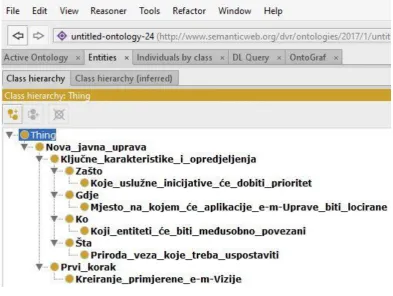
We use Protégé editor, an open source platform to update the first necessary
knowledge (Figure 1): The first step - the creation of appropriate e-m-Vision. (Prvi korak -
kreiranje primjerene e-m-Vizije.)
Key characteristics and choices - What (the nature of the connection to be
established), When (which entities will be connected to each other), Where (place where the
application of e-m-Government be located), and Why (which service initiatives will get
priority). Ključne karakteristike i opredjeljenja - Šta (priroda veza koje treba uspostaviti), Ko
(koji entiteti će biti međusobno povezani), Gdje (mjesto na kojem će aplikacije e-m-Uprave
biti locirane), i Zašto (koje uslužne inicijative će dobiti prioritet).
1
Figure 1. Key characteristics and choices
2. 1. DECOMPOSITION AND CONSTRUCITON OF THE VALUE CHAIN
The value of any work in the public administration is set by the needs they meet, not
the services they offer. The new philosophy of decomposition of the value chain enables the
public administration to recognize the necessary services and offer it to the user at the right
time. Decomposition requires identifying, evaluating and fostering the real core service
activities. This approach allows the decomposition of old structures, a detailed analysis of the
basic possibilities of public administration and establishing new forms and sources of quality
services. Decomposition allows discard of the old paradigm, systems, strategies and classic
services (Gandhi S., Conrad C. 2001.) The decision to discard the functional model of
previous servicing requires great courage because it is risky, but the reward for it will be
great.
Public administration must learn to take advantages of new upcoming technologies.
They provide, create and offer a new form of value, which will be more often required by
service users.
Improved speed of service provision. The service can never be too fast. In real conditions rewarded are immediate, diligent and flexible responses to the needs of
service users. Public administrations that have the vision accept the need for constant
changes and therefore decompose and re-build their business processes and services,
all aimed at faster services provision.
Improved comfort. Users appreciate the comfort of obtaining services in one place via
any communication channel, at any time, and from any place. (Can the user imagine
that the service is offered to him just at the moment when he needs it? Can they
imagine that the public administration "thinks" about them, knows what he needs
(may need) and to offer it at the right time (immediately)).
Appreciation of diversity. Customers want public administration to treat them as a
single personality. In the future we will not offer services that give users little or no
choice. New technologies make it possible for the public administration to give users
exactly what they want and how they want it.
Lower Price. No more talk about the services at "affordable price", accepted are only
integrated services at acceptable price.
The ability to observe the world from the perspective of users of a visionary public
administration, often saves public administration from taking wrong steps and coming to the
wrong destination.
Being the "best" means to restructure the process of providing services in order to
increase their quality. One should not use a new technology just to offer services. They need
to be used to improve and refine all activities surrounding the service.
The activity of classic services user brings him time and geographic limitations. The
user must go to a particular administration body, to particular location and at a certain time
interval. However, the activity of On-line received services is fundamentally different -
almost entirely virtual and independent of place, and as such it has to become known,
informative and usable.
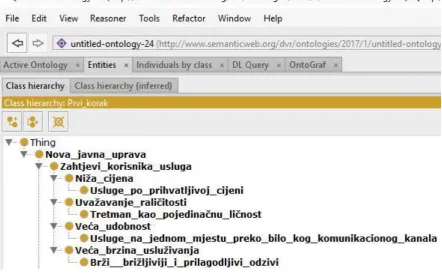
Using Protégé editor in the Knowledge Base enter: What do service users require
(Figure 2) Šta zahtjevaju korisnici usluga (Slika 2.) - A higher speed of service provision
(faster, more careful and adapted responses), Improved comfort (services in one place via any
communication channel) - Appreciation of diversity (treatment as individual personality),
prilagodljivi odzivi), Veću udobnost (usluge na jednom mjestu preko bilo kog komunikacionog kanala), Uvažavanje raličitosti (tretman kao pojedinačnu osobenost), Nižu
[image:7.595.77.520.111.391.2]cijenu (usluge po prihvatljivoj cijeni).
Figure 2. The requirements of service users
The basis of e-m-Servicing is integration. If public administration provides services
through Web access points (portals, nodes), then Web applications need to run any other
applications in the service chain. Full integration of service process is not as easy as it seems
at first sight. Successful integration requires a redesign of existing applications and processes
in order to develop an integrated infrastructure that connects applications of services to
applications of internal processes. A good part of the public administrations does not yet have
a fully integrated infrastructure and so everywhere one faces inefficient processes and
inflexible applications. Lack of integrated application architecture is not new, but the
appearance of e-m-Service becomes crucial. In the traditional model of service activities,
service user had no choice, thus the public administration had no incentives to perform their
services differently. In the new era, new forms of services, are leaving users much greater
choice.
Problems of integrated infrastructure must be a priority for service provision in public
administration. Growth and development of new technological solutions require the need for
redefining architecture of servicing. Public administrations which thing in advance, more and
problems before they are ready to use all the possibilities offered by new technological
solutions.
A good part of the public administrations have reached the upper limit in the
automation of isolated functional processes, which in turn becomes an obstacle to
e-m-Servicing.
The new service climate requires that public administration, in dealing with its
customers, emanates with flexibility, agility and express the inner connection.
3. VISION OF e-m-GOVERNMENT
A substantial number of public administrations in the world already have
implemented some segments of electronic and mobile service activities. How one should
continue research in this area?
One should look for ways to predict the user and technology trends and imagine new
organizational forms that would optimally meet the needs of service users (Specht P. H.,
2003.). A lot of what we find as surprising and unpredictable, is in fact a series of events that
happen in almost the same way in some public administrations. When this pattern is
recognized, we will be able to understand and predict changes. Based on this understanding,
we can build a different e-m-Strategy. Here are also necessary the appropriate knowledge of
the social, economic and technical trends.
Service users quickly change their habit of requesting services, especially by the use
of new technologies. Identifying trends is not only new possibility of e-m-Work of the public
administration, but also the recognition of new services and service ideas.
Here we suggest some trends2 that could lead public administration to an
m-Government. The ability to perceive these trends gives a better chance for a better
understanding of the opportunities that lie ahead of public administration. The most important
thing for those responsible in public administration is to look at: what is the common thread
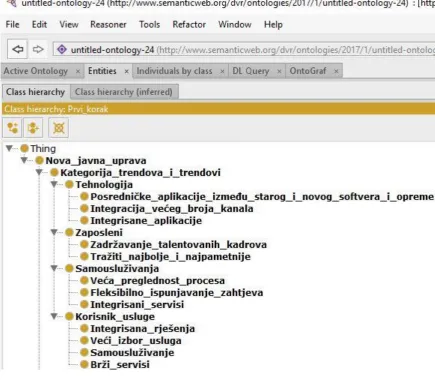
running through all of these trends. We follow the "Categories of trend and trends" within a
particular category (Figure 3).
The client: Faster service, Self-service, The greater range of services, Integrated
solutions. (Korisnik usluge: Brži servisi, Samousluživanje, Veći izbor usluga, Integrisana
rješenja.)
2 Radivojević M., 2012., Od elektronskog poslovanja do poslovne inteligencije u javnoj upravi. JU Službeni glasnik Republike Srpske, Banja Luka,. ISBN 978-99938-22-28-8, COBISS.BH–ID 2411288.
Self-service: Integrated services, Flexible fulfillment of the requirements, Greater
transparency of the process. (Samousluživanje: Integrisani servisi, Fleksibilno ispunjavanje
zahtjeva, Veća preglednost procesa.)
Employees: Search the best and brightest, Retention of talented staff. (Zaposleni:
Tražiti najbolje i najpametnije, Zadržavanje talentovanih kadrova.)
Technology: Integrated applications, Integration of multiple channels, Intermediary
applications between the old and new software and equipment. (Tehnologija: Integrisane
aplikacije, Integracija većeg broja kanala, Posredničke aplikacije između starog i novog
[image:9.595.77.513.243.627.2]softvera i opreme)
Figure 3. Category of trends and trends
3.1 USER ORIENTED TRENDS – FASTER SERVICE
Users appreciate services that are inexpensive and obtained in time (fast). Such
services can be achieved by reducing the number of steps required for service provision to the
user. Users do not like delay in service or waiting in line. As available time of the user
clear: Public administration must reduce process time for service provision (West D. M.,
2013). The delay in any step of the process is unacceptable, and it usually occurs due to
poorly designed processes that contain a lot of unnecessary things.
Trend of e-m-Servicing is change of the entire business model, and it is the only
acceptable strategy.
In order to create innovative business solutions for e-m-Government, one must first be
able to answer the following questions:
What business solutions can contribute to servicing to be unique and unforgettable?
Although it is not easy, one must offer users a new satisfaction and better service.
Performing an assessment of each service process, one should be asked if they meet
the priority needs of users, not only today, but also in the near or even distant future.
How to structure the administration for the service processes to become more efficient? To what extent the public administration itself provides services, and to
what extent is service outsourced to reduce service cycle? How do you deliver your
service?
Prerequisites placed before a more efficient development of electronic and mobile
administration for it to function effectively, i.e. to offer complete electronic and mobile
services to citizens, business and other entities, are as follows: access to the Internet,
adequate communication and computer infrastructure of administration; databases in
electronic form; applications of processing, access and exchange of data; access points for
service delivery; security system, which reflects in the approach to service through
appropriate security mechanisms (smart cards etc.).
Meeting these preconditions is, in fact, a list of activities to be carried out to enable
the establishment and operation of e-m-Government.
To fully implement the concept of e-m-Government, it is necessary to start activities
in two directions: increasing the computer literacy of citizens and building the appropriate
computer infrastructure.
4. MODERNIZATION OF WORK
New technologies make the basis on which is based the development of a modern
administration and society as a whole. They open up new possibilities for problem-solving in
their reengineering, and operational and strategic planning in public administration. Among
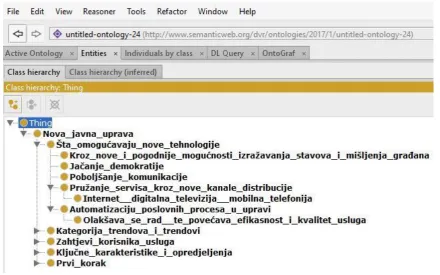
other things, new technologies enable:
automation of service processes, making the work easier, and increasing the
efficiency and quality of services;
offering services through new distribution channels (Internet, digital TV, mobile
phones), eliminating spatial barriers;
improvement of communication within the administration as well as with service
users;
strengthening democracy through new and more suitable means of expressing
attitudes and opinions of citizens, etc.
One of the ways to encourage active participation in the realization of citizens' rights
is to improve access to information and services, and this is one of the goals of the new
e-m-Government.
Model of e-m-Government must be developed in order to improve the quality of work
of administration and local self-governance units, and to allow greater participation of
citizens in local affairs and economic development of local community.
Application of the model of good governance, which includes customer orientation,
increase effectiveness, efficiency, transparency and citizen participation, at the present time
cannot even be imagined without the use of new technological solutions. The increasing use
of these technologies and the progress of the Internet have made very powerful tools
available to citizens, businesses entities, and local self-governance units. Using new
technologies, public administration can improve services, making them faster, far more
accessible and more efficient, and make its business activities closer to citizens, business
entities and other interested parties.
Some of the possibilities available due to new technologies are presented in the
Figure 4. What new technologies made possible
4. 1 IDENTIFICATION OF PRIORITIES
The development of e-m-Government is a long, complex and expensive process. It
requires a large investment in infrastructure in hardware on one hand, and the applications on
the other hand. The development should take place after the previously established priorities.
First of all it is necessary to identify the most important services and implement them, and
then develop services with lower priority.
Defining priorities includes evaluation of the wide possibilities and selection of the
most promising targets. Clearly defined priorities enable us to allocate resources and optimize
service possibilities. It also makes it possible to achieve the speed and development of
services for citizens to be satisfied, and that the relationship between development time and
cost is acceptable.
In order to properly assess the success of the project later on, it is necessary to find
and adopt criteria in the beginning to measure the results. Some of them are customer
satisfaction, quality of service, saving time and money, of citizens and public administration.
The process of creating a strategy of e-m-Government is similar to the completion of a
massive puzzle. Each element that one puts in place most often initiates a large number of
Unlike the hypothetical puzzle, creating e-m-Solutions requires simultaneous combination of
multiple disciplines:
- Strategies of work and service provision,
- Applications for support to work and servicing and
- The introduction of technological solutions.
None of these disciplines is not sufficient for itself. To build a high-quality digital
solutions for fragmented service problems, one needs synergy of all these disciplines.
4. 2 SELF-SERVICE
An increasing number of service users now no longer take the car keys to go for the
service, but are increasingly taking the computer keyboard or mobile device in order to
complete this. Customers are looking for solutions that can offer them self-service, which
will not only save time, but give them certain powers. If they are looking for information or
service without the assistance of administrative staff, then these are solutions based on
self-service that is available 24 hours, 7 days a week and 365 days. Under the self-self-service,
however, we mean the ability for service user to do (provide) service to himself, for instance,
to forward his birth certificate to the agency or organization (where appropriate).
This trend is spreading. The users want to receive service at any time and in any place,
and it can be obtained if the public administration has developed such a services and if the
user has any way of access the Internet (Haznadarević, L. 2016.).
The lesson that the reform public administration in developed world have learned, and
which enabled self-service to their customers are: e-m-Government must focus on the user
and not on the technology. Public administrations that focused their strategy of
e-m-Government on technology instead of the user have Web access points so confused that users
cannot guess how to get On-line services. To focus its attention on the need of users,
management of the public administration must pay attention to the "overall activities". This
can be achieved if:
- the emphasis is on simplicity, joining any request only one goal with the removal of
distracting factors,
- Web pages that are slow to load are removed,
To achieve the trend of self-service means to achieve the strategy of
e-m-Government. The effects in the countries that have adopted it (Canada, Singapore, the USA,
Estonia, ...) are proven to be good. In order for this to be accomplished, public administration
must build new infrastructure and design new protocols that will modernize the process of
self-service. The integration of service processes at the level of administration,
administrative organizations or local governance units is crucial for the quality servicing of
users. The emergence self-service as a key user requirement means that the public
administration, in order to enable it, should work quickly to integrate existing applications,
processes and equipment. It must, however, be emphasized that this is a very complex and
difficult task.
CONCLUSION
The path to satisfied user of public services is neither easy nor simple, not
inexpensive. Application of the model of good governance, which includes customer
orientation, increased effectiveness, efficiency, transparency and citizen participation, at the
present time cannot be imagined without the use of new technologies (computer and mobile
devices).
In this paper, we proposed a new concept of using a Knowledge Bases that could
provide the necessary knowledge to the public administration and the users of their services.
Our goal was not to encompass all knowledge but only to propose a different way to reaching
it. The next step would be to update the Knowledge Base and promote its greater use.
REFERENCES
1. Radivojević, M., Kremenović, O., 2012., Od elektronskog poslovanja do poslovne
inteligencije u javnoj upravi. JU Službeni glasnik Republike Srpske, Banja Luka,
ISBN 978-99938-22-28-8, COBISS.BH–ID 2411288.
2. Walton, D., 2007., Agency and the Semantic Web. New York, Oxford University
Press,
3. Gandhi S., Conrad C. E-Government Initiative At City Of Orlando: Current Trends
And FutureDirections. URISA 2001 Conference, October 2001.
4. Specht P. H., The Impact of IT on Organizational Performance in the Public Sector.
5. West D. M., Assessing e-Government: the Internet, Democracy, and Service Delivery
by State and Federal Government. Brown University Paper, 2013.
6. Haznadarević, L., Radivojević, M., 2016., The new Concept of the Theory of
Organitation Based on the Knowledge Bases and the Semantic Web, IJISET -
International Journal of Innovative Science, Engineering & Technology, Vol. 3 Issue