© Associated Asia Research Foundation (AARF)
A Monthly Double-Blind Peer Reviewed Refereed Open Access International e-Journal - Included in the International Serial Directories.
Page | 1
A STUDY OF VALUES OF B.ED. STUDENTS WITH RESPECT TO
GENDER AND LOCALITY
Mrs. Vandana Chaturvedi
Assistant professor ,R.K.D.F. University, Bhopal (M.P.)
Dr.N.K.Kaushik
Principal,Maharana Pratap College Bhopal (M.P.)
ABSTRACT
In this paper we have studies of values of B.Ed. students with respect to gender & localities.
For measuring values of the teachers trainees’ tool developed by Sherry and Verma was
used. The test presenting more popular Indian condition and situation as required. The
statistical methods used in the present investigation for analyzing the data are given here
objective wise. For analyzing the data Percentage, Mean, S.D. `t'- test and chi-square test.
The study was carried out of 400 students studying in B.Ed. Colleges of Bhopal District .It is
found that; there in no significant differences of values of B.Ed. Teachers Trainees with
respect to their sex and locality.
Key Words- Teaching competency, Personality trades, Introduction:
The study is primarily a survey on Teachers Trainees B.Ed. Colleges of Bhopal District of
Madhya Pradesh State as investigation. The variables An attempt has been made to examine
the Teaching competency, Quality trades and data Teaching competency, Personality trades
and values, Irrespective of Colleges categories, social, economic and biological differences.
Values among B.Ed. Teachers Trainees has been examined with standard test and developed International Research Journal of Human Resources and Social Sciences
ISSN(O): (2349-4085) ISSN(P): (2394-4218) Impact Factor- 5.414, Volume 5, Issue 11, November 2018
Website- www.aarf.asia, Email : [email protected] , [email protected]
© Associated Asia Research Foundation (AARF)
A Monthly Double-Blind Peer Reviewed Refereed Open Access International e-Journal - Included in the International Serial Directories.
Page | 2 questionnaire related to different dimensions of vale related to different conditions
applications with situations were educations in this era.
Objectives:
To compare will be the values of B.Ed. Teachers Trainees with respect to their
locality.
To compare will be the values of B.Ed. Teachers Trainees with respect to their sex.
Hypothesis: .
There will be no significant differences of the values of B.Ed. Teachers Trainees with
respect to their locality.
There will be no significant differences of the values of B.Ed. Teachers Trainees with
respect to their sex.
Sample of the study:
Thestudy was carried out of 400 students studying in B.Ed. Colleges of Bhopal District. Tool Used:
Measures relative strength of Teaching competency, Personality trades and values listed For
measuring values of the teachers trainees’ tool developed by Sherry and Verma was used.
The test presenting more popular Indian condition and situation as required. Ten
comprehensively as follows for measuring the values of age group. Spiritual value; Social
price; Democratic fee; Aesthetic fee; Financial cost; Expertise price; Hedonistic cost;
Strength cost; Family status fee; Fitness price.
All the above ten Teaching competency, Personality trades and values are measured through
40 questions with 3 alternatives
Statistical Techniques used: The statistical methods used in the present investigation for analyzing the data are given here objective wise. For analyzing the data Percentage, Mean,
S.D. `t'- test and chi-square test.
Data Analysis & Interpretation:
Table No. 1 Values Score of with frequency of overall teacher’s trainees at B.Ed. level with respect to their locality
Area N Mean Std. Deviation
Std. Error Mean
Tot_Value Rural 163 71.08 11.312 .886
© Associated Asia Research Foundation (AARF)
A Monthly Double-Blind Peer Reviewed Refereed Open Access International e-Journal - Included in the International Serial Directories.
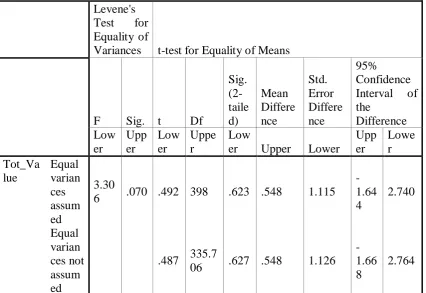
[image:3.595.69.496.77.370.2]Page | 3 Table No. 2 Values Score of with frequency of overall teacher’s trainees at B.Ed. level with respect to their locality
Levene's Test for Equality of
Variances t-test for Equality of Means
F Sig. t Df
Sig. (2-taile d) Mean Differe nce Std. Error Differe nce 95% Confidence Interval of the Difference Low er Upp er Low er Uppe r Low
er Upper Lower
Upp er Lowe r Tot_Va lue Equal varian ces assum ed 3.30
6 .070 .492 398 .623 .548 1.115 -1.64 4 2.740 Equal varian ces not assum ed
.487 335.7
06 .627 .548 1.126 -1.66 8
2.764
From Table 1 it can be seen that the value mean score of Rural and Urban teachers’ trainees
are differ i.e. 71.08 and 70.53 but the number of teacher’s trainees 163 and 237 because of
the colleges are belonging to Rural teachers trainees are less Urban then that of teachers
trainees. In the table 2 it found that, t-value was not found significant (t=3.306 df= 398) in
terms of value with respect to locality i.e. rural and urban irrespective of their other classes.
The mean values for the overall value of the teachers’ trainees were found with S.D. of both
the rural and urban teachers’ trainees 11.312 and 10.709 which are normally not even
projected their value scores of male and female sex teachers’ trainees. It shows that the calculated teachers’ trainees value scores belonging to rural and urban locality are not
differ each other. It means the formulated hypothesis against the objective i.e. there will be
© Associated Asia Research Foundation (AARF)
A Monthly Double-Blind Peer Reviewed Refereed Open Access International e-Journal - Included in the International Serial Directories.
[image:4.595.74.525.209.493.2]Page | 4 Table No. 3 Values Score of with frequency of overall teacher’s trainees at B.Ed. level with respect to their sex
Sex N Mean Std. Deviation
Std. Error Mean
Tot_Value Male 203 70.91 10.948 .768
Female 197 70.59 10.973 .782
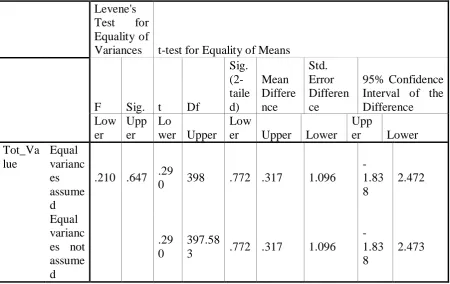
Table No. 4 Values Score of with frequency of overall teacher’s trainees at B.Ed. level with respect to their sex
Levene's Test for Equality of
Variances t-test for Equality of Means
F Sig. t Df
Sig. (2-taile d) Mean Differe nce Std. Error Differen ce 95% Confidence Interval of the Difference Low er Upp er Lo
wer Upper Low
er Upper Lower Upp
er Lower Tot_Va lue Equal varianc es assume d
.210 .647 .29
0 398 .772 .317 1.096 -1.83 8 2.472 Equal varianc es not assume d
.29 0
397.58
3 .772 .317 1.096 -1.83 8
2.473
From Table 3 it can be seen that the value mean score of male and female teachers’ trainees
are differ i.e. 70.91 and 70.59 but the number of teacher’s trainees 203 and 197 because of
the colleges are belonging to male teachers trainees are more female then that of teachers
trainees. In the table 4 it
found that, t-value was not found significant (t=.210 df= 398) in terms of value with respect
to sex i.e. male and female irrespective of their other classes. The mean values for the overall
value of the teachers’ trainees were found with S.D. of both the male and female teachers’
trainees 10.948 and 10.973 which are normally not even projected their value scores of male
and female sex teachers’ trainees. It shows that the calculated teachers’ trainees value scores
© Associated Asia Research Foundation (AARF)
A Monthly Double-Blind Peer Reviewed Refereed Open Access International e-Journal - Included in the International Serial Directories.
Page | 5 hypothesis against the objective i.e. there will be no significant differences of sex traits of
B.Ed. Teachers Trainees are accepted.
Findings:
It is determined that; there in no massive differences of values of B.Ed. teachers
Trainees with recognize to their locality as rural and urban of the lecturers trainees at
B.Ed. degree.
It is found that; there in no significant differences of values of B.Ed. Teachers
Trainees with respect to their sex as male and female.
Educational Implications:
“Through without action is abortion and action without though is fully.” J. Nehru There must
be coordination of thought and action in each ever field of life, but in fact it is not visible in
reality. There is a wide gap between thought and action, theory and practice today. Whatever
one's worth, like an individual, a country also faced such a crisis on its life and philosophy.
Education is one of the important keys that unlock the doors to change and modernization. It
provides one of the most important transitions from tradition to modern sector. It is a forward
looking process. It should prepare the learner for the future, rather than perpetuating the worn
out present. The current study has significant insinuations for the theory and practice of
education because of Teaching competency, personality variables without taking sufficient
care of these aspects of citizens ’s personality neither the educational practice can be
ameliorated nor its desired out comes can be reached.
Psychologists have discussed much about the factor related to the field of individual
differences in human beings. Various teaching strategies and methods as well as techniques
have been developed to deal with this phenomenon. Many theories, paradigms models have
been designed on these lines. Even comprehensive packages, hardware and software devices
have been adopted but the basic problem of individual differences in education perspective
still remain inconclusive. If we know much about the nature of the students, about their
adjustment problem about their teaching competency, personality traits and values status etc,
it would be helpful to the teachers, teacher educators, and administrators/leaders, curriculum
designer, parents to help, guide and arrange proper environmental facilities of each learner
© Associated Asia Research Foundation (AARF)
A Monthly Double-Blind Peer Reviewed Refereed Open Access International e-Journal - Included in the International Serial Directories.
Page | 6 References:
Agarwal, R.N. Acclimation botheration of pupils of Accessory Teachers Training
Colleges-Adjustment troubles of Accessory academy acceptance .as perceived and advised
through dad and mom, trainer and acceptance themselves. Edu., Agra University,
1970.
Allport,G.W.(1970) Hand Book Of Amusing Psychology Worecester Mass.C.A:Stanford
University Press.
Ansari, M.M. (1988). Studies in ambit training. amalgamation of Indian Universities, New
Delhi, IGNOU.
Bhatia, H.R. (1977). A Text Book of Educational Psychology. The Macmillan Aggregation
of India, Delhi.
Buch , M.B. (ed.) Fourth Assay of Assay in Education, New Delhi, NCERT, 1991.
COCHRAN, W.G. (1963), Sampling Tecluuque Indian Copy Bombay: Asian Publishing
Howase, 13 pp.
Ferguson, G.A. (1966) : Statistical appraisal in Psychology and Teachers Training
Collegeing. New York : Mc Graw Hill.
Garrett,H.E.(1985).Statistics In Psychology And Education, Bombay:Vakils Feffer And
Simons Ltd
Kaul,Lokesh.(1998).Methodology Of Educational Research, Noida:Vikas Publishing Abode