International Research Journal of Marketing and Economics
Vol. 3, Issue 5, May 2016 IF- 3.949 ISSN: (2349-0314)
© Associated Asia Research Foundation (AARF)
Website: www.aarf.asiaEmail : [email protected], [email protected]
STUDY OF THE FACTORS INFLUENCING THE USAGE OF MOBILE BANKING
1. Dr. Aman Khera
Assistant Professor
UIAMS, Panjab University, Chandigarh.
2. Ms. Marvi Arora
MBA (Banking and Insurance).
ABSTRACT
In India Mobile Banking is the latest useful technological development system introduced by
financial institutions (Banks) to bring banking to the unbanked. Mobile Banking is an
application of mobile computing that provides customers with support needed to be able to bank
at anytime and anywhere using a mobile handheld device. It is an application of computing the
mobiles which will offer the customers with the much needed assistance to be able to bank
anywhere anytime using a mobile device and mobile services such as text messaging. The
exploration model incorporates the essential ideas of the Technology Acceptance Model (TAM).
The model is tried to decide its prescient force as for individual's conduct while considering the
utilization of SMS-based Mobile Banking. A review survey was created and utilized to gather
information from 101 respondents in Chandigarh. This study recognizes and examines the
components which impact customers’ decision to use a particular form of mobile banking, and
specifically focuses on the evaluation of SMS-based mobile banking.
Keywords: Mobile Banking, Technology Acceptance Model, Mobile Services, Mobile Devices.
Introduction
Mobile banking (also known as M Banking, m-banking, SMS Banking) is a term used for
banking transactions via a mobile device such as a Mobile Phone or Personal Digital Assistant
(PDA). The earliest mobile banking services were offered over SMS. With the introduction of
the first fundamental smart phones with WAP abutment premising the use of the mobile web in
1999, the first European banks started to present mobile banking on this staging to their valuable
customers.
Mobile banking has until recently (2010) time after time has been performed through SMS or the
Mobile Web. Apple's foremost success with iPhone and the swift growth of phones based on
Google's Android (operating system) have led to increasing use of special client programs, called
applications i.e. apps, downloaded to the mobile device. With that said, advancements in web
technologies such as HTML5, CSS3 and JavaScript have seen more banks flinging mobile web
based services to enhance original and genuine applications. A recent study (May 2012) by Mapa
Research suggests that over a third of banks have mobile device apprehension upon visiting the
banks' main website. A number of things can happen on mobile uncovering such as redirecting to
an app store, redirection to a mobile banking specific website or administering a menu of mobile
banking options for the user to choose from.
According to the conceptual model of Mobile Banking can be said to consist of three interrelated
concepts:
Mobile Financial Information Services
Mobile Accounting
Mobile Brokerage
Review of Literature
Cope et al (2013) studied the risk perception, risk tolerance and consumer adoption of Mobile
Banking services. They utilized one of a kind dataset to look at how buyers' impression of the
dangers of utilizing Mobile Banking, and in addition their very own level of danger resistance,
influence reception of versatile saving money. The survey data included 85 questions relating to
mobile banking; its usage and consumer behavior, as well as a set of demographic, economic,
and geographic information. Authors find that customers who trust that portable keeping money
is dangerous or who don't know how safe it is embrace versatile managing an account at much
more elevated amounts of danger resilience will probably receive portable saving money, even in
the wake of controlling for their impression of the wellbeing of versatile Mobile Banking.
Niina Mallat (2007) explored consumer adoption of mobile payments. It displayed a subjective
study on customer selection of mobile payments. The discoveries recommended that the relative
point of preference of mobile payments was not the same as that predetermined in reception
speculations and incorporate autonomy of time and place, accessibility, conceivable outcomes
for remote payments, and line shirking. To gain further insight on factors affecting consumer
choice of payment instruments, variables such as Relative advantages of mobile
payments,Compatibility,Complexity,Network externalities and creation of critical mass, Costs
and Payment system securities and trust in payment system providers were taken into
consideration. Moreover, the reception of mobile payments was observed to be changing,
contingent upon certain situational variables, for example, an absence of other payment
techniques or desperation.
Lee et al (2009) studied the determinants of behavioral intention to mobile banking. The study
examined and validated determinants of users‟ intention to mobile banking. The research used a
structural equation modeling (SEM) to test the causalities in the proposed model. The results
indicated strong support for the validity of proposed model with 72.2% of the variance in
behavioral intention to mobile banking. A web-based survey was employed to test the model. A
web-questionnaire page was prepared by using an Active Server Page (ASP). The major data
was collected from customers who used mobile banking service within Woori Bank in Korea. A
pop-up message was announced in the web site, which explained the objectives of the research
and contained the link to the Web-Survey. The web-based survey yielded 910 usable responses.
The study found that self-efficiency was the strongest antecedent of perceived ease-of-use, which
directly and indirectly affected behavioral intention through perceived usefulness in mobile
banking. Structural assurances were the strongest antecedent of trust, which could increase
behavioral intention of mobile banking. The research verified the effect of perceived usefulness,
trust and perceived ease-of-use on behavioral intention in mobile banking.
Ghodke et al (2013) studied consumer awareness & perception towards usage of Mobile
Banking. The study attempted to know the consumer awareness about mobile banking &
perception about the same. The major focus of the study was on Consumer awareness and
factors on other to determine the consumer awareness and perception about M-Banking. The
study shows that consumers are aware about mobile banking service provided by their bank.
Consumers are familiar about various banking transactions that can be done with the help of
mobile banking. Consumers think that mobile banking is easy to use; it is very useful for them as
it will give them flexibility to do transactions irrespective the time of day. Consumers think that
major advantage of mobile banking is „Anywhere anytime banking‟.
Pahnila et al (2004) studied the consumer acceptance of online banking. The study focused on
advancements in electronic banking technology which have created innovative ways of handling
daily banking errands, especially via the online channel. The acceptance of online banking
services has been rapid in many parts of the world, and in the principal e-banking countries the
number of e-banking contracts has crossed 50 percent. Their study investigated online banking
acceptance in the light of the traditional technology acceptance model (TAM), which is
leveraged into the online environment. On the basis of a focus group interview with banking
professionals, TAM literature and e-banking studies, they developed a model indicating online
banking acceptance among private banking customers in Finland. Out of 427, only 268
questionnaires were being filled by the respondents thus making it 68% of the survey. The
findings of the study indicated that the perceived usefulness and information on online banking
on the Web site were the main factors influencing online-banking acceptance.
Objectives of the study
The objectives of the study are:
1) To assess the factors that impact on the usage of Mobile Banking.
2) To assess the factors that best evaluate a Mobile Banking application or service in terms
of its adoptability.
Formulation of Hypotheses
The various hypotheses which have been developed are the following:
H1a: Speed is having significant positive effect on the perceived usefulness of Mobile Banking
H1b: Mobility Access is having significant a positive effect on the perceived usefulness of
H1c: Advertising is having significant a positive effect on the perceived usefulness of Mobile
Banking
H1d: Enhanced functions is having significant a positive effect on the perceived usefulness of
Mobile Banking
H2: Alternatives is having significant a negative effect on the perceived usefulness of Mobile
Banking
H3: Compatibility is having significant a positive effect on the perceived ease of use of Mobile
Banking
H4: Self efficacy is having significant a positive effect on the perceived ease of use of Mobile
Banking
H5: Perceived cost is having significant a negative effect on behavioral intention to use Mobile
Banking
H6: Perceived risk is having significant a negative effect on behavioral intention to use Mobile
Banking
H7: Perceived usefulness is having significant a positive effect on behavioral intention to use
Mobile Banking
H8: Perceived ease of use is having significant a positive effect on behavioral intention to use
Mobile Banking.
Research Methodology
The sample size was consisted of one hundred and one respondents from Chandigarh
region. Convenience sampling method has been used. It is a type of non-probability sampling
which involves the sample being drawn from that part of the population which is close to hand.
The respondents include population from public sector banks and private sector banks, working
professions, students and general customers of banks. Structured questionnaire has been used to
gather information. Closed ended questions and Likert scale questions have been included in the
Questionnaire
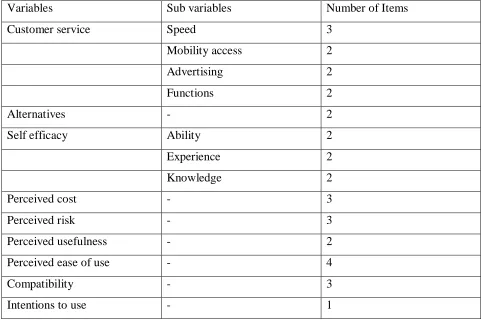
Independent variables in this study were selected on the basis of extensive literature survey. All
the variables (9) are tabulated in Table 1 each of these variables measured between two to four
questions which tailored with the mobile banking context. Hence, a total of 33 questions were
constructed and captured the intention to adopt mobile banking. Responses to these questions
were measured by a five-point Likert scale. For example, “1” denoted as strongly disagree, “2”
denoted as disagree, “3” denoted as neutral, “4” as agree, and “5” as strongly agree. Negatively
stated items from the survey are reversely coded. These items are Item 2 and Item 3 of perceived
of ease of use, Item 2 of advertising, Item 1 of functions, and Item 3 of compatibility i.e.
[image:6.612.65.546.304.624.2]question numbers 4,5,13,14, and 32.
Table 1: Constructs and Number of Items
Variables Sub variables Number of Items
Customer service Speed 3
Mobility access 2
Advertising 2
Functions 2
Alternatives - 2
Self efficacy Ability 2
Experience 2
Knowledge 2
Perceived cost - 3
Perceived risk - 3
Perceived usefulness - 2
Perceived ease of use - 4
Compatibility - 3
Data Analysis
Linear regression and correlation are widely used to explore a relationship between the
variables in the research projects. Hypothesis testing is based on the standardized path coefficient
(r-path coefficient). To support the hypothesis, the p-value of the r-path coefficient should be
significant at the 0.05 level. In this research, r-path coefficient calculation is conducted through
the following steps:
1) Independent variables: speed, mobility access, advertising, functions and mobility access
are individually correlated against the dependent variable perceived usefulness
(Hypotheses H1a,H1b,H1c,H1d and H2)
2) Independent variables : compatibility and self efficacy are individually regressed against
the dependent variable perceived ease of use (Hypotheses H3 and H4)
3) Independent variables: perceived cost, perceived risk, perceived usefulness and perceived
ease of use are individually regressed against the dependent variable intention to use
(Hypotheses H5, H6, H7 and H8).
H1a: Speed and Perceived usefulness
Correlations
mnperceaseofsue mnspeed
Pearson
Correlation
mnperceaseofsue 1.000 .238
mnspeed .238 1.000
Sig. (1-tailed) mnperceaseofsue . .008
mnspeed .008 .
N
mnperceaseofsue 101 101
Model Summary
Model R R
Square
Adjusted R
Square
Std. Error of
the Estimate
Change Statistics
R Square
Change F
Change
df1 df2 Sig. F
Change
1 .238a .057 .047 .63529 .057 5.962 1 99 .016
a. Predictors: (Constant), mnspeed
Hypothesis H1a, that speed is having significant positive effect on the perceived usefulness of
Mobile Banking, is supported (r=0.238, p< 0.05). This states that Mobile Baking is useful to the
customers as it provides with faster transactions than other options. Hence, Hypothesis H1a is
accepted.
H1b: Mobility access and Perceived usefulness
Correlations
mnpercusefulnes
s
mnmobility
Pearson
Correlation
mnpercusefulness 1.000 .600
mnmobility .600 1.000
Sig. (1-tailed) mnpercusefulness . .000
mnmobility .000 .
N
mnpercusefulness 101 101
mnmobility 101 101
Model Summary
Model R R
Square
Adjusted R
Square
Std. Error of
the Estimate
Change Statistics
R Square
Change F
Change
df1 df2 Sig. F
Change
1 .600a .360 .353 .88576 .360 55.646 1 99 .000
Hypothesis H1b, that mobility access is having significant positive effect on the perceived
usefulness of Mobile Banking, is supported (r=0.60, p<0.05). This suggests that Mobile Banking
is useful for users as they are able to access their bank account and do banking anywhere at any
time. Hence, Hypothesis H1b is accepted.
H1c: Advertising and Perceived Usefulness
Correlations
mnpercusefulnes
s
mnadv
Pearson
Correlation
mnpercusefulness 1.000 .255
mnadv .255 1.000
Sig. (1-tailed) mnpercusefulness . .005
mnadv .005 .
N
mnpercusefulness 101 101
mnadv 101 101
Model Summary
Model R R
Square
Adjusted R
Square
Std. Error of
the Estimate
Change Statistics
R Square
Change F
Change
df1 df2 Sig. F
Change
1 .255a .065 .055 1.07054 .065 6.869 1 99 .010
a. Predictors: (Constant), mnadv
Hypothesis H1c, that advertising is having significant positive effect on the perceived usefulness
of Mobile Banking, is supported (r= 0.255, p<0.05). This suggests that it would be useful for the
customers to use Mobile Baking if they had enough knowledge about it and also about the
different services that it provided. Hence, Hypothesis H1c is accepted.
Correlations
mnpercusefulnes
s
mnfunction
s
Pearson
Correlation
mnpercusefulness 1.000 .071
mnfunctions .071 1.000
Sig. (1-tailed) mnpercusefulness . .239
mnfunctions .239 .
N
mnpercusefulness 101 101
mnfunctions 101 101
Model Summary
Model R R
Square
Adjusted R
Square
Std. Error of
the Estimate
Change Statistics
R Square
Change F
Change
df1 df2 Sig. F
Change
1 .071a .005 -.005 1.10423 .005 .507 1 99 .478
a. Predictors: (Constant), mnfunctions
Hypothesis H1d, that functions is having significant a positive effect upon the perceived
usefulness is not supported as (r=0.71, p>0.05). This relationship is not significant. This suggests
that enhanced functions of Mobile Banking are not useful to the customers. Hence, Hypothesis
H1d is not accepted.
H2: Alternatives and perceived usefulness
Correlations
mnpercusefulnes s
mnalternative s
Pearson Correlation
mnpercusefulness 1.000 .096
mnalternatives .096 1.000
Sig. (1-tailed) mnpercusefulness . .169
mnalternatives .169 .
N mnpercusefulness 101 101
Model Summary
Model R R
Square
Adjusted R
Square
Std. Error of
the Estimate
Change Statistics
R Square
Change F
Change
df1 df2 Sig. F
Change
1 .096a .009 -.001 1.10191 .009 .927 1 99 .338
a. Predictors: (Constant), mnalternatives
Hypothesis H2, that alternatives is having significant affect on perceived usefulness is not
supported as (r=0.96, p>0.05). This relationship is not significant. This suggests that alternatives
of Mobile Banking are not having perceived usefulness to the customers. Hence, Hypothesis H2
is not accepted.
H3: Compatibility is having significant a positive effect on the perceived ease of use of Mobile
Banking
H4: Self efficacy is having significant a positive effect on the perceived ease of use of Mobile
Banking Correlations mnselfefficac y mncompatibili ty mnperceaseofsue mnselfefficacy Pearson
Correlation 1 .583
**
.356**
Sig. (2-tailed) .000 .000
N 101 101 101
mncompatibility
Pearson
Correlation .583
**
1 .342**
Sig. (2-tailed) .000 .000
N 101 101 101
mnperceaseofsue
Pearson
Correlation .356
**
.342** 1
Sig. (2-tailed) .000 .000
N 101 101 101
**. Correlation is significant at the 0.01 level (2-tailed).
From the above table it is clear that compatibility is having positive relation with perceived ease
of use (p<0.05). Further, the self-efficacy is also having positive relation with perceived ease of
Correlations Mn cost Mn risk Mn percusefulness Mn
Per cease of use Mn
Intention to use
Mn cost
Pearson
Correlation 1 .395
**
-.154 .211* .122
Sig.
(2-tailed) .000 .125 .034 .223
N 101 101 101 101 101
Mn risk
Pearson Correlation
.395*
* 1 -.027 .295** .280**
Sig.
(2-tailed) .000 .788 .003 .005
N 101 101 101 101 101
Mn per
cusefulness
Pearson
Correlation -.154 -.027 1 .283
**
.244*
Sig.
(2-tailed) .125 .788 .004 .014
N 101 101 101 101 101
Mn per cease of use
Pearson
Correlation .211
*
.295** .283** 1 .180
Sig.
(2-tailed) .034 .003 .004 .071
N 101 101 101 101 101
Mn intention to use
Pearson
Correlation .122 .280
**
.244* .180 1
Sig.
(2-tailed) .223 .005 .014 .071
N 101 101 101 101 101
**. Correlation is significant at the 0.01 level (2-tailed). *. Correlation is significant at the 0.05 level (2-tailed).
The result shows a lack of support for hypothesis H5 that perceived cost has a negative effect on
the intention to use mobile banking since the data is (p=0.223) is rejected.
The result demonstrates a lack of support for hypothesis H6 that perceived risk has a negative
effect on the intention to use mobile banking (p=0.005) is accepted.
Hypothesis H7, that perceived usefulness has a positive effect on intention to use mobile
banking, is supported (p=0.014) is accepted.
H8, that perceived ease of use has a positive effect on the intention to use mobile banking
Conclusions
On the basis of results, it is concluded that most of the factors have significant and
positive impact on the usage of Mobile Banking. There is a significant difference in the usage of
Mobile Banking among the respondents of different professions. Amongst a total of 101
respondents, the respondents within the age group 21-30 years of age were found to be using the
Mobile Banking the most. The variables such as speed, mobility access and advertising have a
positive impact on the perceived usefulness suggesting that Mobile Banking is useful to the
customers as it provides faster transactions, anywhere/anytime access along with good teaching
lessons on how to use Mobile Banking. The result shows a lack of support for the perceived cost
has a negative effect on the intention to use mobile banking. The perceived risk has a negative
effect on the intention to use mobile banking and the perceived usefulness has a positive effect
on intention to use mobile banking. Lastly, the perceived ease of use has a positive effect on the
intention to use mobile banking. Thus, it can be concluded that speed, mobility access and
advertising have a positive impact on the perceived usefulness suggesting that Mobile Banking is
useful but perceived risk, function and alternatives are having a negative effect on intention to
use mobile banking.
References
• Prof. Amit P. Wadhe, Prof Shamrao Ghodke,(2013) "To study consumer awareness and
perception towards usage of Mobile Banking”, IBMRD‟s Journal of Management &
Research
• JC Gu, SC Lee, YH Suh,(2009) "Determinants of behavioral intention to mobile
banking", Expert Systems with Applications, Elsevier, Volume 36, Issue 9, November
2009, Pages 11605–11616
• N Mallat,(2007) "Exploring consumer adoption of mobile payments–A qualitative
study", The Journal of Strategic Information Systems, Volume 16, Issue 4, Pages 413–
432
• Tero Pikkarainen, Kari Pikkarainen, Heikki Karjaluoto, Seppo Pahnila, (2004)
"Consumer acceptance of online banking: an extension of the technology acceptance
model", Internet Research, Vol. 14 Iss: 3, pp.224 - 235
• T Dahlberg, N Mallat, J Ondrus, A Zmijewska, (2008), "Past, present and future of
• Laforet, S. and Li, Xiaoyan (2005), “Consumers' attitudes towards online and mobile banking in China”, The International Journal of Bank Marketing, Vol. 23 No. 4/5, pp.
362-380
• Laukkanen T. and Lauronen, J. (2005), “Consumer value creation in mobile banking
services”, International Journal of Mobile Communication, Vol. 3 No. 4, pp. 325-338
• Palani, A. and Yasodha, P. (2012), “A study on customer perception towards mobile
banking in Indian Overseas Bank Chennai”, International Journal of Marketing and
Technology, Vol. 2 No. 4, pp. 262-276.
• Amin, H. Hamid, M., Lada, S. and Anis, Z. (2008), “The adoption of mobile banking in
Malaysia: the case of Bank Islam Malaysia Berhad (BIMB)”, International Journal of
Business and Society, Vol. 9 No. 2, pp. 43-53
• Han Li, Jie Zhang, J.P. Shim,(2010) "Examining dimensional trust and
multi-faceted risk in initial acceptance of emerging technologies: An empirical study of mobile
banking services", Decision Support Systems, Elsevier, Volume 49, Issue 2, May 2010,
Pages 222–234
• Mattila,M.(2002) “Factors affecting the Adoption of Mobile Banking services , Journal of
Internet Banking and Commerce(JIBC)”. November 28,2008 from