BUSINESS INTELLIGENCE IN CLOUD ENVIRONMENT
R K Jena,
Institute of Management Technology, Nagpur, India.
ABSTRACT
The complexity of data resulting from business process is becoming overwhelming for the Business Intelligence systems that don’t use shared resources. Many aspects of the business Intelligence process must be processes in real times without any error. In order to obtain error free results in quick time by using shared resources, cloud computing is one of the best available solution. Organizations can achieve many benefits by the integration of Cloud computing approaches in their Business Intelligence (BI) environments. This paper constitutes the first steps to understand the landscape of Business Intelligence under Cloud infrastructure.
KEYWORDS: Business Intelligence, Cloud Computing, Cloud BI, SaaS, PaaS, IaaS
INTRODUCTION
Recently there has been a lot of talk about Cloud computing. Many people consider this new technology has transformed a large part of the IT industry. (Armbrust et al., 2010; Fenn & LeHong, 2011; Wallraff & Weber, 2012). The alignment of BI process in cloud environment are still holds many challenges (Baars & Kemper, 2010; Reyes, 2010; Willem & Jakobus, 2010). Business Intelligence (BI) characterizes holistic approaches to build and run an integrated management support infrastructure. (Baars & Kemper, 2008; Moss & Atre, 2003). The volumes, variety and velocity of data used for this task raises the need for a great number of heterogeneous systems. (Kimball & Ross, 2002; McKnight, Mohammed, Altmann, & Hwang, 2010). Over time, these systems often evolve into integrated and highly complex BI architectures.
with outsourcing, the Cloud comes with additional challenges that have to be taken into account when integrating this new technology into proprietary BI architectures. (Baars & Kemper, 2010; Willem & Jakobus, 2010). Problems often associated with Cloud-based BI such as vague data confidentiality, the fear of a vendor lock-in or simply technological limits indicate that not every service is appropriate to be obtained from the Cloud. (Armbrust et al., 2010; Chow et al., 2009; Reyes, 2010). It is therefore essential to be clear about the Cloud suitability of individual components and services in order to include Cloud Computing into a BI architecture successfully. Thus, the goal of this paper is to gather and structure impacts that have to be considered when planning the use of Cloud computing in the sophisticated domain of Business Intelligence.
In spite of many obstacles, cloud based business intelligence is a game changer in the digital business. All types of businesses, from small to large enterprises are equally adapting to the emergence of cloud based tools to enhance business intelligence. Small to medium business enterprises are now embracing cloud based applications to make their marketing strategies highly competitive. Large firms, on the other hand, are using cloud business intelligence solutions in further expanding their market and using it for experimentation in furtherance of building a more productive market environment. Cloud business intelligence (BI) delivers productivity tools and applications that are highly beneficial to businesses. Among these benefits include the speed of deployment and implementation of various business apps, scaling up of web applications and the integration of business intelligence apps to enhance business productivity and cost effectiveness. If you are not yet embracing cloud business intelligence solutions, it is about time that you should try to make your business more adaptive to this driver of change in the digital marketing industry.
CLOUD COMPUTING
example, a cloud computer facility that serves Asian users during European business hours with a specific application (e.g., email) may reallocate the same resources to serve North American users during America's business hours with a different application (e.g., a web server). This approach should maximize the use of computing power thus reducing environmental damage as well since less power, air conditioning, rack space, etc. are required for a variety of functions. With cloud computing, multiple users can access a single server to retrieve and update their data without purchasing licenses for different applications.
Cloud computing providers offer their services according to three fundamental models i,e Infrastructure as a service (IaaS), Platform as a service (PaaS), Software as a service (SaaS) as shown in the figure adopted from Voorsluys, William et. al. (2011).
support-system can support large numbers of virtual machines and the ability to scale services up and down according to customers' varying requirements. IaaS clouds often offer additional resources such as a virtual-machine disk image library, raw block storage, and file or object storage, firewalls, load balancers, IP addresses, virtual local area networks (VLANs), and software bundles (Amies, Alex et. al, 2012). IaaS-cloud providers supply these resources on-demand from their large pools installed in data centers. To deploy their applications, cloud users install operating-system images and their application software on the cloud infrastructure. In this model, the cloud user patches and maintains the operating systems and the application software. Cloud providers typically bill IaaS services on a utility computing basis: cost reflects the amount of resources allocated and consumed.
Platform as a service (PaaS) : In the PaaS models, cloud providers deliver a computing platform, typically including operating system, programming language execution environment, database, and web server. Application developers can develop and run their software solutions on a cloud platform without the cost and complexity of buying and managing the underlying hardware and software layers. With some PaaS offers like Microsoft Azure and Google App Engine, the underlying computer and storage resources scale automatically to match application demand so that the cloud user does not have to allocate resources manually (Boniface, M. et al. (2010).
the business to reallocate IT operations costs away from hardware/software spending and personnel expenses, towards meeting other goals. In addition, with applications hosted centrally, updates can be released without the need for users to install new software. One drawback of SaaS is that the users' data are stored on the cloud provider's server. As a result, there could be unauthorized access to the data. For this reason, users are increasingly adopting intelligent third-party key management systems to help secure their data.
Cloud computing providers offer fully integrated BI solutions that are capable of fulfilling most of the companies’ needs regarding BI software. By doing this, a company has the advantage of externalizing this type of service. In this case there is no need for software maintenance at all or any other backup concerns. Any software update will be handled by the Cloud provider. There is another advantage in using web based BI software. Web development is gaining more and more control and traditional software programs are replaced by web based software. A huge advantage in web developing is the use of frameworks. This accelerates the software building process and eases the future developing of modules for the software created. Also, web based software allows users to access data from almost any device through a web browser or a specially designed application. Developing BI solutions with web technology can also reduce the costs of resulted software. In some cases there can be no costs at all.
INTEGRATING BUSINESS INTELLIGENCE INTO CLOUD ( CLOUD BI)
Integrating a BI into a cloud environment will overcome the technology obsolescence problem. By doing this scalability will be achieved. In this case, no matter how much the data complexity and amount from a company will evolve a BI integrated into a cloud infrastructure can handle
non-stationed users informed about the changes . This also provides accessibility. The BI can be accessed on any web browser. Shimaa Oufand Mona Nasrsuggest that BI solutions can be moved to cloud using PaaS (Shimaa Ouf and Mona Nasr , 2011). By using platform-as-a-service model a BI solution can be implemented in a short period of time. The solution can take advantage of the PaaS preinstalled software such as relational database software. Users will not engage into a continuous software managing and patching activity. The database platform that is present on cloud is scalable so it will meet the needs of resources available to handle an organization information volume. Also, another advantage that Cloud provides to BI integration is reduced costs. Sharing resources will result in a lower cost per machine. Also, hardware maintenance will be handled by the cloud provider as well as the implementation of hardware firewalls and load balancers to handle the traffic towards the data center.
Availability of BI solutions is another gain for companies that chose to integrate it into Cloud. Cloud infrastructure is capable of working regardless of Cloud Computing and Business
Intelligence failure. Also, cloud providers ensure their internet connectivity by one or more alternate connection so if one fails, another will take over the traffic. There are many pros and cons of integrating BI in to cloud architecture.
Pros:
Scalability and elasticity; Reduced costs;
Ease of use and access; Cloud relational database; Availability;
Hardware maintenance. Cons:
Privacy;
Government regulations (where applied).
Government regulations are, in some cases, a barrier in the migration of BI solutions of companies to a Cloud infrastructure outside the border. This represents a downside in terms of cloud computing expenses.
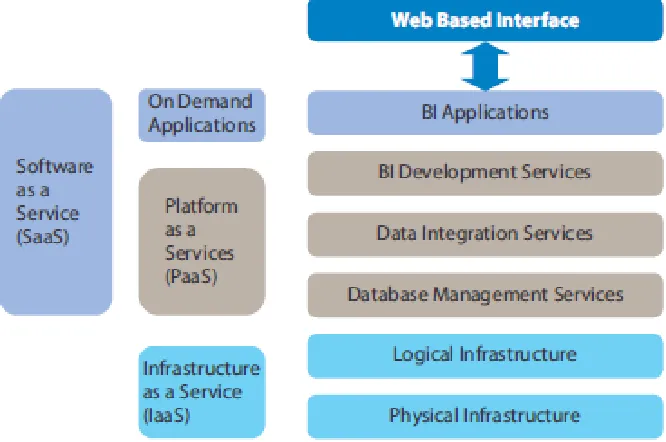
[image:7.612.139.472.335.556.2]Cloud deployment strategies are often categorized either as Infrastructure-as-a-Service (IaaS), Platformas-a-Service (PaaS), or Software-as-a-Service (SaaS).In IaaS typically provides managed networking, servers, storage, platform virtualization, and operating system environments. In PaaS builds on IaaS to further include managed middleware, such as application servers, database management systems, data integration services, BI development services, etc. In SaaS extends this stack to also incorporate the application layer. Figure below shows a typical cloud and BI integration adopted from TCS white paper (Lekha Menon and Bhawna Rehani,
Figure -6. : Integrating Business Intelligence solutions into Cloud.
The adoption of BI in Cloud environment has been observed in the following categories:
Large Enterprises: Used as a horizontal tool to provide a simple, distinct, affordable IT sandbox where project experimentation and evaluation can occur far from a production environment.
Systems Integrators (Sis): Used as an application framework or pre-built reporting and analysis template for assembling customer-specific functional or domain solutions more quickly. These contain reusable components and application logic that can be tailored to specific needs
CLOUD BI SOLUTIONS
There are many cloud business intelligence solutions available in the market today and choosing the best one for your business may be a painstaking task for you. Here is our review of the best cloud business intelligence solutions that you can find in the market today to help you choose the one that most fit your business solution needs.
SAS
SAS offers cloud BI solutions that will give relief to your IT department in conducting a more thorough analytics of your data. Its visual analytics feature provides network diagram reports, decision trees and business intelligence analysis in real time with the least effort of coding done by your IT staff. The tool exerts better efficiency with sophisticated results. A plus is its visualization software that makes data interpretation easier. SAS cloud BI solution provides collaboration tools with innovative applications to various industries like education, banking, automotive, manufacturing, and communications. SAS can detect data anomalies and predict future business outcomes. Most of the users of SAS rely on its ability to provide insightful analytic reports that help them make informed and educated business decisions. You can use SAS for data visualization, data mining, statistical analysis, and business forecasting.
IBM
Cognos and SPSS deployed in their Education Cloud infrastructure. Its apps are also used in various industries and enterprise levels. The majority of the users of IBM cloud BI solutions are able to enjoy a more cost effective solution for managing data to increase return on investment. The data collection is highly scalable and user friendly. It provides dynamic queries and broad data collected that can be accessed in the cloud using Smartphones, tablets and computers. The IBM’s Cognos system has more than 23,000 subscribers and many ascribe productivity in using the app that reduces the analysis time on their data by about 50% with a markup of 20% on their return on investment.
Good Data
This business intelligence solution provides a cloud based platform for analytics. Most of its users benefit from using its analytic tools in monetizing their business data. The app is useful for any company or industry, offering a highly scalable platform on the cloud that is reliable and secure in collecting and analyzing large data. Businesses derive the benefit of obtaining business insights, sales performance, marketing strategies and predict customer behavior. The platform
can easily share and collaborate other data from sources like SaaS and both structured and unstructured data. Its powerful feature comes from the data analytics tools using the Extensible Analytics Engine and Multidimensional Analytics Query Language (MAQL). The combined feature of these systems offers the users more advanced metrics and data analytic performance. Among its best features include the customizable data, user friendly console and is cross platform compatible. Team collaboration on the cloud is enhanced with its sophisticated cloud BI apps.
Birst
its ability to integrate data coming from various systems, deploy business analytics and even automate management tasks.
Bime
Bime provides a solution that simplifies business intelligence usage using cloud computing and data visualization. Most businesses can use its simplified applications for accessing and analyzing data. It creates innovative user friendly products for data analytics that allow the users to take control, manage, and share data. The cloud BI tool of Bime provides you the ability to access multiple data sources and use them in your customizable dashboard.
Zephyr Health
Zephyr Health is a data management software and health data management application that allows the user to exercise more insightful decision making process using the data that is ordinarily difficult to extract. This solution is highly popular in the health sectors and is widely used by medical practitioners and researchers in the health industry. Its cloud based platform allows the collaborative sharing of data by its users using their acquired information from various sources like other vendors and different customers. You can focus the acquisition of data, whether structured or unstructured.
CONCLUSIONS
a Business Intelligence solution in a cloud environment is related to privacy. This issue will persist until a viable solution will be found.
REFERENCES
Amies, Alex; Sluiman, Harm; Tong, Qiang Guo; Liu, Guo Ning, Infrastructure as a Service Cloud Concepts ( Developing and Hosting Applications on the Cloud. IBM Press. ISBN 978-0-13-306684-5, 2012).
Armbrust, Michael, Fox, Armando, Griffith, Rean, Joseph, Anthony D., Katz, Randy, Konwinski, Andy, Zaharia, Matei, A view of cloud computing. Commun, ACM, 53(4), 2010, 50-58.
Baars, Henning, & Kemper, Hans-Georg, Business Intelligence in the Cloud? Paper presented at the PACIS, 2010.
Boniface, M. et al., Platform-as-a-Service Architecture for Real-Time Quality of Service Management in Clouds, 5th International Conference on Internet and Web Applications and Services (ICIW), Barcelona, Spain: IEEE, 2010, 155–160.
Böhm, Markus, Leimeister, Stefanie, Riedl, Christoph, & Krcmar, Helmut, Cloud Computing – Outsourcing 2.0 or a new Business Model for IT Provisioning? In F. Keuper, C. Oecking & A. Degenhardt (Eds.), Application Management, 2011, 31-56.
Chou, Timothy, Introduction to Cloud Computing: Business & Technology, 2011.
http://www.scribd.com/doc/64699897/Introduction-to-Cloud-Computing-Business-and-Technology, Accessed on 1.05.2015.
Chow, Richard, Golle, Philippe, Jakobsson, Markus, Shi, Elaine, Staddon, Jessica, Masuoka, Ryusuke, & Molina, Jesus, Controlling data in the cloud:outsourcing computation without outsourcing control. Paper presented at the Proceedings of the 2009 ACM workshop on Cloud computing security, 2009.
Fenn, Jackie, & LeHong, Hung, Hype cycle for emerging technologies, 2011. Gartner, July, 2011. Jason Bowden, The Best Cloud Business Intelligence Solutions for Marketing Analytics
http://www.business2community.com/cloud-computing/best-cloud-business-intelligence-solutions-marketing-analytics-01006959#ODMf3rftrh1FJXlu.99. Accessed on 20.12.14.
KNAUS, GUNNAR. "Cloud Computing-An Implementation Storyline Of Computing." Scholedge International Journal Of Multidisciplinary & Allied Studies ISSN 2394-336X [Online], 1.2 (2014): 11-14.
Lekha Menon and Bhawna Rehani, Business Intelligence on the Cloud: Overview and Use Cases.
http://www.tcs.com/resources/white_papers/Pages/Business-Intelligence-Cloud.aspx,
Accesses on 20.05.2015.
Limon, Dr. Nikki. "Mobile Cloud Computing Applications for Smart Computing - A Study." Scholedge International Journal Of Multidisciplinary & Allied Studies ISSN 2394-336X [Online], 1.2 (2014): 5-10.
Masuoka, Ryusuke, & Molina, Jesus, Controlling data in the cloud:outsourcing computation without outsourcing control. Paper presented at the Proceedings of the 2009 ACM workshop on Cloud computing security, 2009.
Mohammed, AshrafBany, Altmann, Jörn, & Hwang, Junseok, Cloud Computing Value Chains:
Understanding Businesses and Value Creation in the Cloud. In D.Neumann, M. Baker, J. Altmann & O. Rana (Eds.), Economic Models and Algorithms for Distributed Systems, 2010, 187-208.
Moss, L.T., & Atre, S., Business Intelligence Roadmap: The Complete Project Lifecycle for Decision-Support Applications, (Pearson Education, 2003).
Palo, John, & Newman Ray. "Creation and Adoption of On-Line Analytical Process (Olap) Into the Management Decision Support System Aided By Computers." Scholedge International Journal of Business Policy & Governance ISSN 2394-3351 [Online], 2.5 (2015): 8-13. Ronnie, Michal. "Reliability and Relevance of Data Mining For Modern Age Database
Management System As Well As Management Information System." Scholedge International Journal of Management & Development ISSN 2394-3378[Online], 2.5 (2015): 56-63.
Reyes, Eumir P., A systems Thinking approach to business intelligence solutions based on cloud computing. Massachusetts Institute of Technology, 2010.
Voorsluys, William; Broberg, James; Buyya, Rajkumar , Introduction to Cloud Computing, In R. Buyya, J. Broberg, A.Goscinski. Cloud Computing: Principles and Paradigms, New York, USA: Wiley Press, 2012, 1–44.
Wallraff, Bruno, & Weber, Mathias., Cloud Monitor 2012. KPMG Studies, 2012.