International Research Journal of Human Resources and Social Sciences Impact Factor- 3.866
Vol. 3, Issue 4, April 2016 ISSN(O): (2349-4085) ISSN(P): (2394-4218)
© Associated Asia Research Foundation (AARF)
Website: www.aarf.asia Email : [email protected] , [email protected]
EFFECT OF WILLIAMS’ COGNITIVE – AFFECTIVE INTERACTION
MODEL ON CREATIVITY IN MATHEMATICS
Dr. H.S. Brar (Principal, GHG Khalsa College of Education, Gurusar- Sadhar)
Rachhpal Singh (Asstt. Prof., GHG Khalsa College of Education, Gurusar- Sadhar)
ABSTRACT
This study was focused to see the effect of Williams’ Cognitive – Affective Interaction model on
creativity in mathematics. This was a true experimental study. The research was carried out in
schools in Ludhiana district on a sample of 160 students. Two equal groups were formed on the
basis of intelligence. Effect of Williams Model and Traditional Method of Teaching on Creativity
was assessed by S2MCT tool developed by Sharma and Sansanwal (2012). The result revealed
that Williams’ model proved to be better for enriching creativity over traditional method of
teaching mathematics. Students of both low and high intelligence do not differ significantly in
their scores of creativity in Mathematics and there is no significant interaction between teaching
strategies and intelligence on the creativity in Mathematics.
Keywords: Williams‟ Model, Traditional Method, Creativity in Mathematics.
Introduction
Innovations are directly or indirectly related to human originality and creative potentialities. As
such, creative potentialities of the individuals need to be developed among all the individuals
through appropriate means for the greater benefit to the society. Education, as we know, is the
most effective means for development of the innate abilities of the individuals, appropriate
educational programmes needs to be evolved in the form of teaching strategies and techniques
for the development of creative potential among the learners. Present day classroom transaction
developed to enhance creativity among the learners like Inductive Thinking model (Taba, 1966),
Synectics Model (Gordon, 1961), Kaplan Model (1993), Maker‟s Model (1993), and Williams (1993). Among all of the above the Williams‟ Frank E. model of teaching is one such approach
specifically meant for enhancing creativity among learners. Making our classrooms more
interactive, interesting and teaching through creative programme enables the students to feel that
mathematics is very practical, easy to learn and close to real life.
Williams had developed a cognitive-affective teaching model. William‟s argument was based on
the principle “Thinking processes cannot really operate without feeling processes. Nearly all
cognitive Behaviour has an affective component” For effective human development, the
combination of both cognitive and affective domains is needed. The pupils‟ need for knowledge
and information is closely related to his personality dispositions and his internal set of values.
Williams discussed the theoretical basis and educational uses of 4 models of cognitive-affective
behavior: (a) Piaget's stage theory of intellectual development, (b) Bloom's taxonomy of the
cognitive domain, (c) Krathwohl's taxonomy of the affective domain, and (d) Guilford's structure
of intellect model. A new model, an outgrowth is presented which is designed for use by the
teacher in encouraging creativity in young children. Dimension 1 of the model lists subject
matter, Dimension 2 lists 18 teaching strategies, and Dimension 3 lists 4 cognitive and 4
affective pupil behaviors. Use of the model in curriculum planning, teacher instruction,
classification and analysis of instructional media, and in educational programs for the gifted are
described. It is concluded that this model may narrow the distance between what is known about
the cognitive-affective processes and how this is utilized in educational practices. This model is
based upon studies of the creative person and process. This model has three dimensions:
Dimension 1 consists of subjects that comprise the school curriculum, Dimension 2 includes
teacher behaviour, these comprise 18 strategies to be used by the teacher to develop student
thinking and creativity and Dimension 3 consists of eight student processes that have been shown
empirically to be involved in creative thinking. The model has been devised to give students the
opportunity for creative thinking (characterized by fluency, flexibility, originality, and
elaboration).
Development of creativity in mathematics is priority area among researchers and
is the ability to choose between useful and useless combinations. It is also multifaceted construct
involving both divergent and convergent thinking, problem finding and problem solving,
self-expression, intrinsic motivation, a questioning attitude and self-confidence (Runco, 1993)..
Mathematical creativity is ability to solve problems and to develop thinking in structures of
mathematics (Ervynck, 1991), to observe patterns (Laylock, 1970), to abstract and
generalize mathematical content (Krutetskii, 1976), to understand which patterns are acceptable
(Birkhoff, 1969) and to make connections between unrelated ideas (Haylock, 1987).
Creative teaching strategies encourage expressions of inquisitiveness, risk-taking (educational),
achievement, creative abilities, imagination, and intricacy that research has recognized as
significant factors in demonstration of creativity, Williams (1986). This model (a) stimulates
creativity and task commitment in students selected for the program, (b) facilitates the
development of more diverse and sophisticated students creative product, Renzulli and Reis
(1994). Teaching by this model encourage fluent and elaborative thinking, curiosity, risk taking,
complexity and imagination of students, Shah (2011).
Objectives
1. To investigate the significant difference in creativity in Mathematics of the groups taught
through Williams‟ model and conventional teaching.
2. To investigate the significant difference in creativity in Mathematics of the groups having
high and low Intelligence.
3. To investigate the significant interaction between teaching strategies and intelligence on
creativity in Mathematics.
Hypotheses
1. There will be no significant difference in the creativity in Mathematics of the groups taught
through traditional method of teaching and through William‟s model.
2. There will be no significant difference in the creativity in Mathematics of the groups having
high and low Intelligence.
3. There will be no significant interaction between teaching strategies and intelligence on the
Sample of the study
A sample comprising 160 students was raised for the study. The sample included male as well as
female students studying in the class IX.
Design of the Study
To study the effectiveness of Williams‟ cognitive-affective interaction model of teaching on the
Achievement and creativity in mathematics, “pre-test post-test parallel group” design was be
used.
Procedure
The investigator developed a test of achievement in Mathematics for the 9th class students. In the
first step, Intelligence test was employed on 160 students to classify the sample into two matched
groups (Group A and Group B). In pre-test phase both the groups were given Mathematical
creativity test. The obtained scores were tabulated. One group was assigned to the treatment.
This was termed as experimental group and the other was termed as control group. The
experimental group was taught by William‟s Cognitive-affective Interaction Model strategy
(with modules prepared by researcher) for a period of 50 sessions at the rate of 30 minute per
day. On the other hand control group was taught the same concepts with the help of conventional
method for the same period. After completion of the treatment the Mathematical creativity test
was again administered to both the groups as post-test. Analysis was done as per the objectives
of the study.
Tools used
The following tools were used to collect the data.
1. Teaching modules based on Williams‟ Model and Conventional teaching for different
Mathematical concepts for Class IX developed by the investigator.
2. Mathematical Creativity Test by Sharma and Sansanwal (2012).
Analysis and Interpretation of data
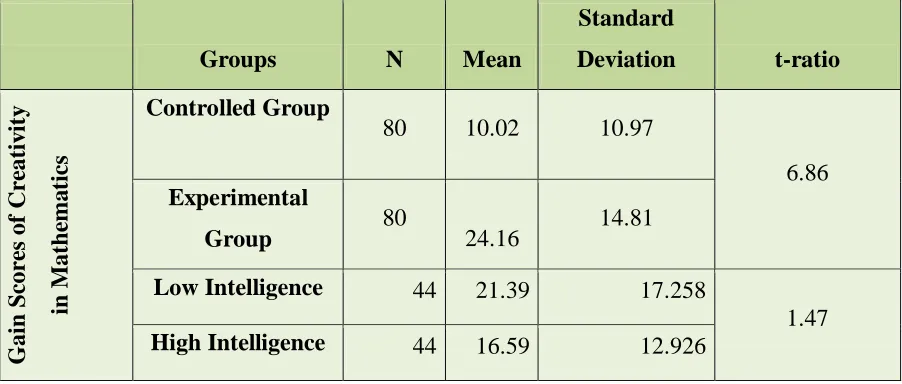
Table 1: t-test Group Statistics
Table 1 reveals that values of mean for controlled group and experimental group are
10.02 and 24.16 respectively. The value of t-ratio is 6.86 which is significant. Therefore, the
hypothesis „ There will be no significant difference in creativity in Mathematics of the groups
taught through Williams‟ Model and traditional Method’ is rejected at both i.e. 0.05 and 0.01
levels of significance, which means that the Creativity in Mathematics of the groups taught
through Williams‟ Model and traditional Method are significantly different. The creativity in
Mathematics of experimental group (Mean = 24.16) is thus significantly higher as compared to
controlled group (Mean = 10.02).
Mean for Low intelligence and high intelligence are 21.39 and 16.59 respectively. The t-ratio
value is 1.47 .Therefore the hypothesis, „There will be no significant difference in creativity in
Mathematics of the groups having low and high Intelligence’ is accepted at both 0.05 and 0.01
level of significance.
Groups N Mean
Standard
Deviation t-ratio
Gai
n
S
cor
es
of
Cr
eat
iv
it
y
in
M
at
h
em
a
tics
Controlled Group
80 10.02 10.97
6.86 Experimental
Group 80 24.16 14.81
Low Intelligence 44 21.39 17.258
1.47
Table 2
Tests of Between-Subjects Effect
Dependent Variable: Scores of Creativity in Math
Source
Type III
Sum of
Squares Df Mean Square F Sig.
Corrected Model 7369.48a 3 2456.49 15.71 0.00
Intercept 31730.01 1 31730.01 203.03 0.00
Intelligence 505.92 1 505.92 3.23 0.07
Group 6650.28 1 6650.28 42.55 0.00
Intelligence * Group 213.28 1 213.28 1.36 0.24
Error 13127.50 84 156.28
Total 52227.00 88
Corrected Total 20496.98 87
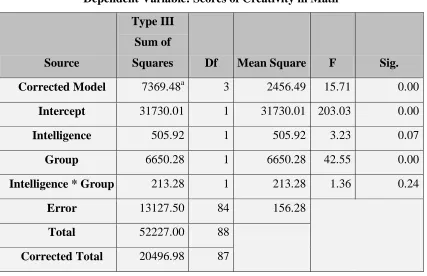
Table 2 reveals that the F-statistic corresponding to intelligence is 3.23, which is significant at p
= 0.07. The F-statistic corresponding to group (method of teaching) is 42.55, which is significant
at p<0.01. The interaction between Intelligence and group is non-significant as p = 0.24 with F
statistic 1.36. Therefore the hypothesis, „There will be no significant interaction between
teaching strategies and intelligence on the creativity in Mathematics‟, is partially accepted.
Implications of the Findings of the study:
Creativity in mathematics of group taught through Williams‟ model is significantly more
as compared to group taught through traditional method. Thus Williams‟ model proved
to be better for enriching creativity over traditional method of teaching mathematics.
Therefore Williams‟s method should be applied in mathematics classrooms to enrich
and high group students on the basis of intelligence. So, all kind of students be they
gifted, average and below average in intelligence can be taught through Williams‟ model
to enhance their creativity.
There is no significant interaction between teaching strategies and intelligence on the
creativity in Mathematics. Creativity being the highest order in taxonomy of learning
objectives should be inculcated among all the students irrespective of intelligence,
gender or locale.
References
Asha, C. B. (1980). Creativity and academic achievement among secondary school children.
Asian Journal of Psychology and Education, 6(3),1-4.
Baskara, S. (1981). A Study of the effectiveness of verbal creativity instructional materials at
school stage. Unpublished M.Ed. dissertation Maharaja Sayajiro University of Baroda, Vadodra.
Best, J.W. (1983). Research in Education (4th ed.). New Delhi: Prentice Hall of India Pvt. Ltd.
Birkhoff, G. D. (1969). Mathematics and Psychology. Society for Industrial and Applied
Mathematics Review, 11(17), 429-469. Retrieved on March 30, 2014 from
http://www.siam.org/journals/sirev.php
Ervynck, G. (1991). Mathematical Creativity. Journal of Advanced mathematical thinking.
Retrieved on March 25, 2014 from http://www.siam.org/journals/mathcre.php
Haylock, D.W. (1987). Mathematical creativity in school children. The Journal of Creative
Behavior, 21(1), 48-59.
Joyce, B. & Weil, M. (2003). Models of Teaching (5th ed.). New Delhi: Prentice Hall of India
Private Limited.
Krutetskii, V. A. (1976). The Psychology of Mathematical Abilities in School Children. Chicago:
University of Chicago Press.
Laycock, M. (1970). Creative Mathematics at Nueva. Arithmetic Teacher, 17(4), 325–328.
Retrieved from http://www.nctm.org/publications/content.aspx?id=8590
Mann, E. L. (2005). A study of mathematical creativity and school mathematics indicators of
mathematical creativity in middle school students. Unpublished Ph.D. thesis, University of
Connecticut. Retrieved on March 29, 2014 from http://www.gifted.uconn.edu/
Mann, E. L. (2006). Creativity: The essence of Mathematics. Journal for the Education of the
Gifted, 30 (2), 236-262.
NSW Department of Education and Training (2004). Policy and Implementation strategies for
the education of gifted and talented students. Sydney: New South Wales Department of
Education and Training, Curriculum K-12 Directorate.
Ojha, R.K., & Roychoudhary, K. (2001). Verbal Intelligence Test. Agra: National Psychological
Corporation.
Renzulli, J.S. (1993). Systems and Models for developing programs for the gifted and talented.
Sydney: Hawker Brownlow Education.
Renzulli, J. S., & Reis, S. M. (1994). research on school wide enrichment triad model. Gifted
Child Quarterly, 38(3), 7–20. Retrieved on March 11, 2014 from www.casenex.com/casenex/
cecReadings/revisitingTheSchoolwide.pdf
Shah, G. C. (2011). A study of effectiveness of creative teaching programme on the achievement
of students of standard VII in mathematics. Unpublished Ph.D. thesis, Gujarat University,
Ahmedabad. Retrieved on March 29, 2014 from http://shodhganga.inflibnet.ac.in/
handle/10603/4345
Sharma, Y. & Sansanwal, S. S (2012). Mathematical creativity test. Kapurthala: Axiomatic
Educational Services, 455, Urban Estate.
Williams, F. E. (1969). Models for encouraging creativity in the classroom by integrating
cognitive-affective behaviors. Educational Technology, 9(12), 7-13. Retrieved on March 21,
2014 from http://psycnet.apa.org/psycinfo/1971-23874-001.
Williams, F.E. (1970). Classroom ideas for encouraging thinking and feeling (2nd ed.). New
York: D.O.K Publishers. Retrieved on March 11, 2014 from http://www.sengifted.org /
archives/articles/a-case-for-affective-education-addressing-the-social-and-emotionalneeds
-of-gifted-students-in-the-classroom#sthash.wWAuBOfp.dpuf
Williams, F. E (1993). The Cognitive-Affective Interaction Model for enriching gifted programs.
In Renzulli, J.S. (Edu.), Systems and Models for developing programs for gifted and talented,