(2015) The Way Forward Evaluation Final Report. Project Report. Leeds Beckett University. Link to Leeds Beckett Repository record:
http://eprints.leedsbeckett.ac.uk/1930/
Document Version: Monograph
The aim of the Leeds Beckett Repository is to provide open access to our research, as required by funder policies and permitted by publishers and copyright law.
The Leeds Beckett repository holds a wide range of publications, each of which has been checked for copyright and the relevant embargo period has been applied by the Research Services team.
We operate on a standard take-down policy. If you are the author or publisher of an output and you would like it removed from the repository, please contact us and we will investigate on a case-by-case basis.
LEEDS BECKETT UNIVERSITY
THE WAY FORWARD EVALUATION
FINAL REPORT
Dr Louise Warwick-Booth, Dr Ruth Cross, Dr
James Woodall, Karina Kinsella, Dr Joanne
Trigwell and Susan Coan
September 2015
Executive Summary including summary of evaluation findings
Introduction
The Way Forward Project was set up in January 2013 as a prototype approach aiming to identify and engage with girls and young women who were slipping between existing offers of service provision and who would otherwise enter adulthood with severe and escalating levels of disadvantage. The project is located within the WomenCentre, Halifax a provider of gender specific services based in the voluntary sector. This report presents the findings from an evaluation of The Way Forward conducted by the Centre for Health Promotion Research, Leeds Beckett University. It presents evidence about the project’s journey, young women’s needs, the outcomes for young women as a result of engagement with the project, the operation of the project, multi-agency working and overall learning from the project.
Background
It has been argued that women’s centres produce improvements in wellbeing and can be a viable and effective setting for providing mental health interventions to meet client needs (Nicholles and Whitehead, 2012, Hatchett et al., 2014). Moreover, evidence suggests return on investment in women’s services, in terms of social value and savings from reduced demand in areas of health, reoffending and housing. Women’s community services can support clients in making positive changes to their lives, reducing demands on other service such as police, courts, offender management whilst improving outcomes for their children (Nicholles and Whitehead, 2012). This evaluation will contribute to this evidence base about the work of women centres by exploring The Way Forward Project’s approach to identifying and engaging with girls and young women and by assessing the extent to which the project has met its aims and objectives.
Evaluation aims and objectives
The evaluation used a mixed method approach including data from focus group
discussions with young women, focus groups and semi-structured interviews with project staff and stakeholders and desk-based analysis of monitoring data. The evaluation sought the views and experiences of Way Forward staff, stakeholders and service users, in order to address the following 5 objectives:
Firstly to investigate how and in what ways The Way Forward has made a positive
difference to the life trajectory of the girls and young women encompassed within its remit;
Secondly, to identify the ways in which The Way Forward operates and delivers its
provision, identifying the factors that are important in developing and supporting progress. This included an assessment of the importance of the engagement worker role;
how the project informs local decision making and commissioning arrangements. Fourthly, to examine the economic case for The Way Forward, tracking contributions in relation to added value and examining sustainability.
Finally, to map the potential replication of The Way Forward as a model that could be applied within other areas.
Key Messages from the Evaluation
1. The Way Forward is an example of effective, gendered, personalised, preventative approach with young women at risk.
2. Young women using the Way Forward Project have trust and confidence in it.
3. Young women using the Way Forward have high levels of need and distress that are not recognised or do not reach the thresholds for other services.
4. The Way Forward leads us to consider how many fewer women might be in
abusive relationships if young women developed resilience and self-esteem through projects such as this; and how many fewer children would be involved in child
protection proceedings or in local authority care if young women were supported in their own right and not just in relation to parenting abilities/capabilities.
Overall summary of evaluation findings
The Way Forward Project has succeeded in identifying and addressing unmet need for 165 young women.
The Way Forward Project provides a good example of preventative, early intervention work with young women from which critical success factors can be identified. These are:
o Its person-centred, flexible and adaptable approach o The gendered approach
o The skill, commitment, empowerment and supervision/support of the Engagement Worker
o The embedding of the project within the voluntary sector based
WomenCentre, with a specific holistic ethos, high levels of knowledge and expertise in relation to issues for girls and women, and strong local
The Way Forward has put young women at the heart of the project. It exists solely to offer effective support and encouragement to young women at times of
vulnerability and the original expectations of the project have had to give way to the experience of the contact between the Engagement Worker and each young
woman. This central position of young women themselves has produced publicity and language for project publicity that speaks to other young women. It also kept the whole project committed to the reality of the lives of each individual young woman, resisting the management temptation to oversimplify or constrain for ease or control of service delivery.
The Way Forward was developed and continued to hold a cross borough perspective. It remains concerned with the lives of young women across the communities of Calderdale who fail to find the help they need at critical times. The Project therefore attends not only to the situations and needs of those engaging with the project but also to those who have not been reached or have failed to engage successfully.
The cross agency involvement in the Project has been fundamental to maximise reach as well as enabling organisations to learn together about the needs and lives of young women at times of vulnerability as well as the current local service
availability and response.
The Way Forward Project has benefitted and been dependent on the flexibility of its funders, the Paul Hamlyn Foundation and Lankelly Chase, to enable it to keep true to its core intention to firstly get to know about the needs of young women and then to respond to these as helpfully as possible. The Project’s understanding of the nature of its work has been growing throughout and the Project continues to learn and adapt.
The Project has enabled staff within WomenCentre to observe and analyse the lives and experiences of young women at times of risk and crisis, to begin to explore patterns beneath the widely diverse nature of each young woman’s experience. The Project has not been able to develop any greater level of depth of understanding at this stage but is continuing to analyse project data and investigate possible patterns further.
The Way Forward Project has shone a light on the experience of young women in relation to other services and the systems within which these operate. For example it has enabled an initial view of the journeys of young women from a first point of contact with services and their experience from this point onwards. Points of referral into the Way Forward Project are from a wide range of agencies, thus The Way Forward has in particular provided more generalist follow on support
intervention. The Engagement Worker has sometimes found difficulty in supporting young women into other, more specialist services.
Listening closely to the experience of young women at a time of need has enabled the Project to understand the impact of the current system on their lives and can clearly see so many missed opportunities. This is an area that may benefit from further focus.
Learning from the Way Forward
• Learning captured by the WomenCentre team in the delivery of the project shows that some of the young women who engage with the project have no obvious referral routes i.e. the young women discuss their needs and their way forward can be identified however there is not an organisation/agency that can provide self-development and emotional support in relation to confidence, self-esteem, reassurance, coping strategies and resilience building. Herein is the value of The Way Forward in providing gender-specific, holistic support to young women in need.
• Threshold criteria cited by other agencies is a barrier to engaging with young women who clearly have high levels of unmet need. Young women under the remit of The Way Forward were falling through the gaps if they did not meet statutory threshold criteria. Some were also unable to work with other agencies in terms of accessing provision and some were not held by other agencies, which were also perceived negatively by the young women. This reflects that existing service provision is not meeting the current needs of vulnerable young women, and that wider statutory provision is failing in its remit to support vulnerable young women. However, as The Way Forward is a generic project without any threshold criteria it has a much broader scope and thus can meet the gender-specific needs of young women.
• The critical factor of the qualities of the Engagement Worker are central to the success of the project, (see Jones 2014) as she is able to develop trust and provide support in a solution focused approach to meeting the needs of young women, without being too focused upon outcome measures. Thus the distance travelled is considered as more important for young women, rather than specific targets that need to be met. This is related to the overall project approach in which permanence for young women is understood as crucial. This project is based around long term gain and not short term
• Learning from the project also shows the importance of the flexibility adopted in relation to the project development and delivery mechanisms. This level of flexibility and adaptability enabled the project to respond to young women’s individual need and experiences. The funders of this project were also important in enabling this approach.
Issues for consideration
Whilst the Way Forward has successful established an effective approach to engaging with young women with a variety of need and successfully working with them to improve their life chances, this evaluation has raised some issues which can be considered in relation to future planning. These are discussed below:
• Whilst evidence of short-term impact on participating individuals has been demonstrated, it is important that the medium and longer term impacts are captured over time. Nevertheless, it will be challenging to capture such data given the nature of the project and its work.
• Whilst stakeholders have reported positive perceptions of The Way Forward, evidence has shown that the project is working in a twin track manner both as an early intervention approach and as a holding point. The project is early intervention in the sense that it is acting as a mechanism to capture young women before their needs escalate into demands upon adult services and thus has a preventative focus. The project is also ‘holding’ young women and offering case work in instances where other provision is not available. This flexibility of delivery may not possible within all gender-specific services.
• The sustainability of continued delivery needs attention given the short-term nature of the funding cycle, and the issues with referring young women on. If The Way Forward ceases to exist, what will happen to the young women currently being ‘held’ given the difficulties raised in referring on, and the issues associated with threshold criteria specified by other agencies?
• Further research needs to be considered in relation to two key areas: o Firstly, the impact of the Vanguard approach upon The Way Forward
requires exploration.
1. The Way Forward Project background
WomenCentre is a provider of gender-specific services, based outside of statutory service provision and located within the voluntary sector. WomenCentre was established to deliver such holistic and empowering services to all women within the Halifax and
Huddersfield localities in West Yorkshire in 1985. The gendered nature of the work done by WomenCentre focuses upon prevention, holistic service provision and is driven by an individualised needs-based approach.
It is within this context that The Way Forward Project was established by WomenCentre, Halifax in West Yorkshire in 2012. The Way Forward Project is a prototype approach with a remit to identify and engage with girls and young women who are slipping between existing offers of service provision and who would otherwise enter adulthood with severe and escalating levels of disadvantage. The Project located within and led by
WomenCentre, aims to address the marginalization of girls and young women, work with them in ways that statutory agencies are unable to due to service restrictions and enable them to have a central and empowered place within the project itself. The project aims to make a significant positive difference to the lives of 200 young women with high levels of unmet need and vulnerability over a 3 year period, October 2012-October 2015. The project is based upon a key worker model (the Engagement Worker) and is located within strong multi-agency partnerships. The location of the project within an existing
organisation provides the ethos and understandings that underpin it, namely the value of gendered approaches for girls and women with vulnerabilities, empowerment and self-determination as the core attitude and the ability to operate in the dual structures of children’s services and adult policy and provision.
The Way Forward project aims to involve all relevant local agencies to identify and engage with girls and young women who are slipping between service provision and who would otherwise enter adulthood with severe and escalating levels of disadvantage. The Project is led by WomenCentre to address the marginalization of girls and young women and statutory restrictions within current universal provision and to support girls and young women themselves to have a central and empowered place within the project.
The Way Forward Project is embedded within a multi team service area of WomenCentre in Calderdale. Other teams include domestic violence services, including those for families and young people and an advice service. The whole service works to CAADA Leading Light standards and receive high standards clinical and casework supervision and robust guidance in relation to partnership structures and safeguarding practice. The organisation as whole provides the ethos and understandings that underpin this project.
The project is overseen by a multi-agency steering group established at the outset, which meets every two months. The Steering Group has a core membership of 6 key
The Project delivery has been largely undertaken by the Engagement Workers who takes referrals, makes assessments, provides supportive engagement and links with other agencies for signposting and referral. The scope of her work is diverse, challenging and unpredictable as she proactively seeks engagement of some referrals, builds a trusting relationship within which she supports girls and young women to share and look for
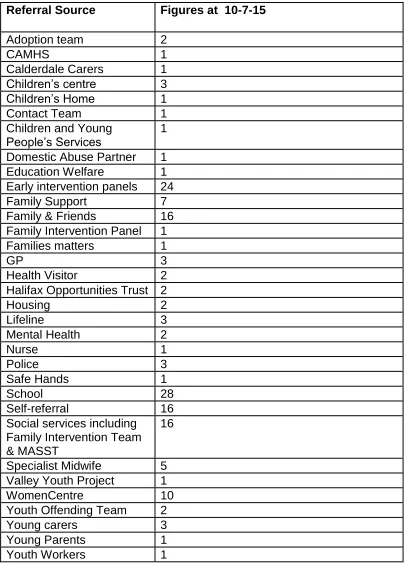
Table 1.1 – Partners involved in the referral of young women to the Way Forward Referral Source Figures at 10-7-15
Adoption team 2
CAMHS 1
Calderdale Carers 1
Children’s centre 3
Children’s Home 1
Contact Team 1
Children and Young
People’s Services 1
Domestic Abuse Partner 1
Education Welfare 1
Early intervention panels 24
Family Support 7
Family & Friends 16 Family Intervention Panel 1
Families matters 1
GP 3
Health Visitor 2
Halifax Opportunities Trust 2
Housing 2
Lifeline 3
Mental Health 2
Nurse 1
Police 3
Safe Hands 1
School 28
Self-referral 16
Social services including Family Intervention Team & MASST
16
Specialist Midwife 5
Valley Youth Project 1
WomenCentre 10
Youth Offending Team 2
Young carers 3
Young Parents 1
Youth Workers 1
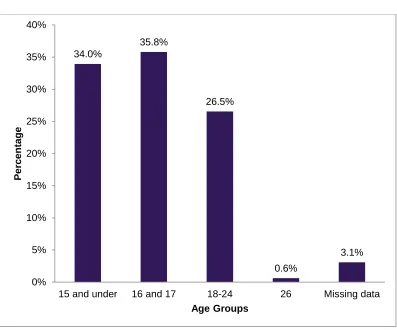
By 10th July 2015, the project had dealt with 165 referrals in total. An analysis of the project monitoring data until July 2015 showed that the majority of young women whose ages were recorded (162 of the 165 referrals), were aged 18 and
Table 1.2 Ages of young women within The Way Forward Project
The April 2015 steering group meeting reported an increase in referrals of young women aged 23 but despite this the general pattern shown above was still evident in that most referrals were for young women in younger age ranges, particularly aged 14-18.
Analysis of other demographic data held showed that the majority of young women within the remit of the project were White British (163 referrals had a recorded ethnicity).
34.0%
35.8%
26.5%
0.6%
3.1%
0% 5% 10% 15% 20% 25% 30% 35% 40%
15 and under 16 and 17 18-24 26 Missing data
P
er
ce
n
tage
Table 1.3 Ethnicity of young women within The Way Forward Project
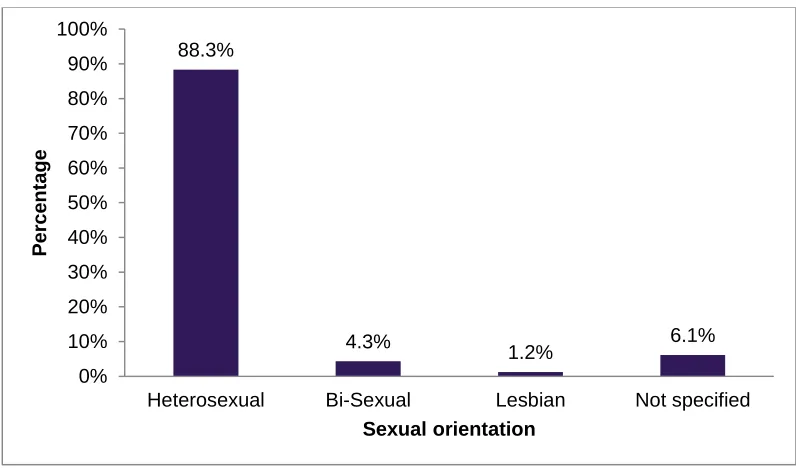
In terms of sexual orientation those that identified themselves with a particular category were in the main heterosexual. 163 had recorded their sexual orientation.
Table 1.4 Sexual orientation of young women within The Way Forward Project
89.0%
1.2% 0.6% 1.8% 1.8% 0.0%
5.5% 0% 10% 20% 30% 40% 50% 60% 70% 80% 90% 100% White British
White Other White Eastern European Black African Mixed -White and Asian Mixed -White and Black Caribbean Asian Pakistani P er ce n tage Ethnicity 88.3% 4.3% 1.2% 6.1% 0% 10% 20% 30% 40% 50% 60% 70% 80% 90% 100%
Heterosexual Bi-Sexual Lesbian Not specified
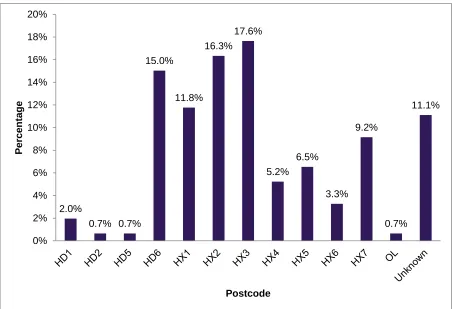
[image:12.595.56.454.489.723.2]The monitoring data held by the project also showed the areas in which the young women were living, with clear trends emerging in terms of the project drawing from specific postal codes. The HX1, HX2, HX3 and HD6 areas had the largest numbers of young women (153 postal codes were recorded).
Table 1.5 Postcode data for young women within The Way Forward Project
2.0%
0.7% 0.7% 15.0%
11.8% 16.3%
17.6%
5.2% 6.5%
3.3% 9.2%
0.7% 11.1%
0% 2% 4% 6% 8% 10% 12% 14% 16% 18% 20%
P
er
ce
n
tage
1.1 Principles of the Way Forward
The Way Forward has a specific approach in working with young women, and the key facets of this are:
1. A women-centred ethos underpins the approach - the value of gendered
approaches for girls and women with vulnerabilities underpins the entire approach and is the ethic upon which The Way Forward was established;
2. Client-led, individualised support – the project is flexible in working with a range of young women and works with a variety of needs (see section 1.3)
3. Lack of thresholds – the project does not use or apply any criteria for referrals of young women into the service ( see section 1.3), which is a different approach to other local agencies (see section 3.2)
4. Engagement and empowerment - the project works to empower and develop self-determination among young women as the core attitude (see section 4, making a difference and section 5.1. the role of the Engagement Worker)
1.2 Project Journey
1.2.1 Changes in the project approach
The original project design has changed during the evaluation time-scale. There is
flexibility in the on-going delivery of the project: the project is not what it set out to be and it has transformed through an organic evolution into a model that works in practice in terms of what is needed locally. This also resulted in re-defined project targets because the nature of the engagement carried out has proved to be more time-consuming than originally envisaged. The Way Forward currently monitors project progress against outcomes such as the number of girls/young women referred, the number of girls/young women with high level of unmet need show positive outcomes, the number of girls/young women taking active role in project review and development and the number of girls/young women who demonstrate improved relationships with partner agencies.
The initial design of the project was focused upon the use of in-house panels as a mechanism for referral. The project initially aimed to engage young women and then identify their main areas of unmet need. Following on from this first piece of engagement, the project aimed to launch a mini panel run in-house involving the relevant agencies to link into the identified unmet need e.g. housing and drug services. However, early
intervention panels were launched by the local authority to improve multi-agency working, information sharing and future planning for families on the continuum of need at the start of The Way Forward. Consequently, to avoid a clash of panels The Way Forward team decided not to operate via a mini panel approach. Given these changes, the Way Forward developed a more flexible approach based upon the centrality of
The second diversion from the original plan was a broadening of the role of the
Engagement Worker in order to respond effectively to the needs of the young women being engaged. The engagement process has proved more complex and varied than anticipated, with some girls taking months to engage after initial contact and others needing higher levels of intensive intervention before being ready to develop their Way Forward Plan and moving on to other agencies or activities, as demonstrated in the interview data from the Engagement Worker:
“We’re persistent, constant texting, phoning, not giving up, perseverance, so that young woman knows that we’re there. You know we’re not one of these that says well we’ve rang twice so that’s it so I think it’s still important to mention about this project that engagement is crucial” Engagement Worker
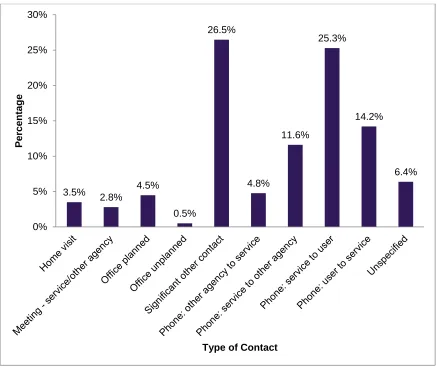
Table 1.2.1 – Type of contact carried out by the Engagement Workers
Indeed, analysis of the referral patterns demonstrated that whilst the project was
established as early intervention, a variety of need across a range of levels can be seen by the young women included within the project. Where data was available 66.67% of the young women fall into tier 3 or above, in which young women already have a range of emotional and behavioural difficulties. Tiers 4 and 5 are the level at which a young woman is considered as requiring child protection. Young women at tier 2 are classed as early intervention. July 2015 figures show that 38 of the total referrals are at level 2 (23%) thus the project has a twin-track approach of reaching those in need of early intervention, as well as working with more serious levels of need.
A further change that was experienced on the project journey is that in some instances moving the young women on is not an option therefore The Way Forward ‘holds’ young women and does case work. This is different to the original project design in that the planned process was going to be to engage and then refer on to appropriate agencies. This was again emphasised within the interview data with the Engagement Worker;
3.5%
2.8%
4.5%
0.5%
26.5%
4.8%
11.6%
25.3%
14.2%
6.4%
0% 5% 10% 15% 20% 25% 30%
P
er
ce
n
tage
“The role has changed because we’ve identified that there is no follow-on services and we’re holding cases and meeting that need ourselves through lots and lots of different routes by delivering more of a service as oppose to just engagement. There’s no ultimate service that will offer the needs that we’re finding.” Engagement Worker
“So we’re doing engagement plus delivery” Engagement Worker
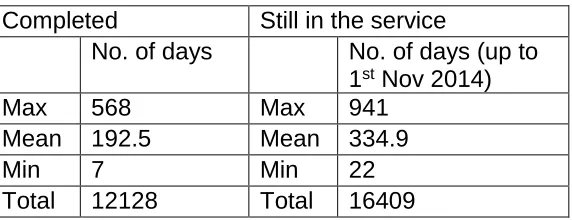
[image:17.595.62.348.262.372.2]The monitoring data also shows the length of time that young women have been held in the service. Table 1.2.3 clearly illustrates that The Way Forward is serving a holding function with many young women remaining in the project for lengthy periods of time. Table 1.2.3 – Number of days that young women remain in The Way Forward
Completed Still in the service
No. of days No. of days (up to 1st Nov 2014)
Max 568 Max 941
Mean 192.5 Mean 334.9
Min 7 Min 22
Total 12128 Total 16409
Further analysis of the monitoring data related to the days that the young women remained in service showed that
1 individual was in the service twice but is no longer using it: 89 and 133 days.
1 individual is currently in the service for the third time: 68, 268 and 39 days (up to 1st Nov 2014).
1 individual is currently in the service for the second time: 118 and 22 days (up to 1st Nov 2014)
This demonstrates that in some instances young women are returning to The Way Forward Project so that cases are not always referred on, and do not necessarily remain closed. In some cases, young women are able to return to the service because they have built both confidence and trust in the project. In some instances The Way Forward have successfully and appropriately referred young women onto other services however, for a variety of reasons young women return. For example, the limitations associated with some services i.e. only being offered 6-8 sessions can result in the continuation of unmet need, in some cases young women have reported not being able to connect or work with other staff.
As a result of this change in delivery, capacity and isolation issues for the Engagement Worker were identified as a key concern within the Interim Evaluation
emotional support including some longer term follow up to which will help share the work-load. The complexity of need presented by the young women who have become involved with the project, also had an impact upon the way in which the project has worked in that cases have been more time-consuming than initially expected:
“Most of the cases are very complex cases. The referral may come is identified as low need depression anxiety, not attending school but when we unravel it and get to the root core, we open up a whole can of worms and identify much more complex needs” Engagement Worker
The multi-agency steering group has also functioned in a way that was different to expectations. The initial project design envisaged involving of a wide range of
organisations and services to support outcomes for those engaging. In reality it has been a small number of agencies who have been involved with the steering group, offering advice and support in relation to specific cases through conversation with the Engagement
Worker and wider project team.
Finally, WomenCentre has been working with AdviceUK, which uses the Vanguard Method to help leaders in voluntary sector services and others to understand their work as a
system and re-think its purpose from a service user perspective. Vanguard uses specific principles such as citizens setting their own priorities in terms of delivery (working
alongside people to find out what matters to them, and learning how to deliver exactly and only that) and deploying best resources on the frontline (learning how to respond first time to predictable demand and how to quickly connect service users with the person or people who will fix their problem), see https://www.vanguard-method.com/. Part of this process resulted in the Engagement Worker reflecting upon her own role, and producing an analysis of how she views the project operating. She sees girls and young women
experiencing distress and in need help however, if the issue is non-specific or not serious enough to reach service thresholds then these young women face a brick wall or
alternately will slip between any existing service offers. The Way Forward then acts as a service net, catching these girls and young women who fail to get the service they need or who engage with services for a limited time but still need further support. The Way
Forward can also direct girls and young women to appropriate services when their needs become specified through the engagement process. This is represented diagrammatically in figure 1. This work was conducted separately from the evaluation and whilst the
evaluation team were able to learn about the approach and share some information, the impact of the Vanguard approach upon the Way Forward Project was beyond the scope of the evaluation remit itself. Therefore the evaluation team recommends that further
Figure 1 – The Engagement Worker’s View of The Way Forward
The Engagement Worker also described her role as assertive outreach focusing upon interactions with young women to gain understanding of them, and to make them feel involved within decision making in their own lives by allowing them to be heard, working alongside them, being with them and not for them, helping to make a difference. She described the uniqueness of her role within an overall the holistic approach, working closely with internal well-being, self-esteem, identity, self-acceptance and worth as ultimately one of the projects strongest points. This runs alongside some of the more practical work carried out such as advocacy, mediation and building bridges between family members.
Statutory and existing services
Statutory and existing services
Statutory and existing services
Girls
and
young
wome
n
1.3 Young women’s needs
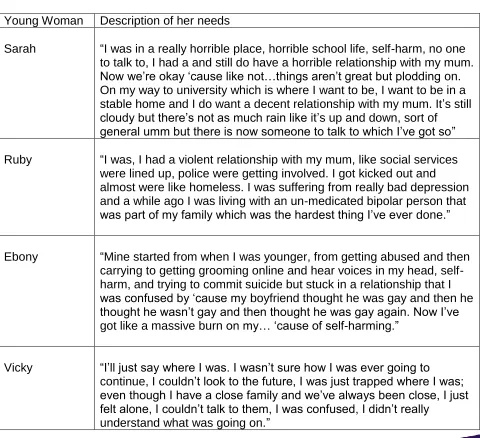
[image:20.595.59.539.293.731.2]Another area in which the project has learned has been in relation to the nature and scope of young women’s needs. At the outset of the project, the team anticipated working with young women with a range of unmet need and whilst this has been the case, many of the young women coming into the project have complex social and emotional problems and a broad variety of need. The project team and the Engagement Worker have faced the challenge of dealing with a variety of need along a continuum of seriousness, without any particular patterns being evident. This was evidenced through the stories of the young women as well as stakeholder and engagement worker reflections. The table below uses selected case study examples to illustrate the range of issues experienced by young women in the project, described in their own words:
Table 1.3.1 – Detailed examples to illustrate the complexity of young women’s needs at the point of engagement (taken from focus group discussions with the young women)
Young Woman Description of her needs
Sarah “I was in a really horrible place, horrible school life, self-harm, no one to talk to, I had a and still do have a horrible relationship with my mum. Now we’re okay ‘cause like not…things aren’t great but plodding on. On my way to university which is where I want to be, I want to be in a stable home and I do want a decent relationship with my mum. It’s still cloudy but there’s not as much rain like it’s up and down, sort of
general umm but there is now someone to talk to which I’ve got so” Ruby “I was, I had a violent relationship with my mum, like social services
were lined up, police were getting involved. I got kicked out and almost were like homeless. I was suffering from really bad depression and a while ago I was living with an un-medicated bipolar person that was part of my family which was the hardest thing I’ve ever done.”
Ebony “Mine started from when I was younger, from getting abused and then carrying to getting grooming online and hear voices in my head, self-harm, and trying to commit suicide but stuck in a relationship that I was confused by ‘cause my boyfriend thought he was gay and then he thought he wasn’t gay and then thought he was gay again. Now I’ve got like a massive burn on my… ‘cause of self-harming.”
Vicky “I’ll just say where I was. I wasn’t sure how I was ever going to
continue, I couldn’t look to the future, I was just trapped where I was; even though I have a close family and we’ve always been close, I just felt alone, I couldn’t talk to them, I was confused, I didn’t really
Anna “Well I attempted suicide ‘cause I’ve watched my mum in a lot of abusive relationships. I used stupid acts (referring to risky online actions and risky sexual behaviour) to meet people and feel better about myself. I was raped last year, it’s coming up to a year now. I recovered from my abusive relationship myself of 3 years…battling depression still but I’ve got medication for it now and I was bullied by my dad a lot, he used to be horrible like physical and mentally just a horrible person. Yeah he was just…like watching…I used to go to college with like alcohol, drunk all the time and I was moving from my mum’s to my dad’s to my gran’s back to my dad’s – horrible.”
The issues experienced range from problems abusing alcohol or drugs, to complex family problems and caring responsibilities, to abusive and controlling relationships, to having been in care or having their own children taken into care, to severe mental health and emotional health challenges to ‘very complex relationship and wellbeing issues’ (Engagement Worker).
“‘Some of these girls are absolutely desperate when they arrive at the project…by the time [the EW] gets a relationship built with them, their needs are just enormous” Stakeholder
Indeed, some of the needs were reported as being different for the young women dependent upon their age range:
“I think when they get to a certain age once they’ve come out of school and hitting the 16 upwards, I think that’s where we struggle even more because between 16 and say 19 that’s when chaotic behaviour starts happening, they’re very vulnerable, they’re not an adult but they can be classed as an adult and there’s nobody there. There’s nobody there to guide them” Engagement Worker
Key findings – project journey
The Way Forward operates with specific principles underpinning the delivery of the work. Firstly, a women-centred ethos, secondly client-led; individualised support, thirdly a lack of thresholds and finally engagement and empowerment as the central core of the work with young women.
1. Planned referrals changed upon project establishment and this resulted in changed referral pathways into The Way Forward.
2. The role of the Engagement Worker became broader to deal with the variety and scope of contacting young women and engaging them and thus also became more time-consuming.
3. The project has also ‘held’ some young women and done case work with them rather than simply referring them on. This is necessary because other services are not available and withdrawal of support at this point would not support the project’s objectives of early prevention and holistic care.
4. The steering group has also operated in a supporting/advisory capacity with a small number of organisations committing to this role.
The project has dealt with a range of needs amongst young women under its remit. These are complex and various and exist along a continuum of
2. Findings: Making a difference: improvements in the girls and
women’s life chances
One of the aims of the evaluation was to explore the impact that the project had in relation to the young female participants. The immediate impact of the project upon the young women was clear from the discussions with the stakeholders:
“Yeah, which I think is really good because otherwise they are invisible, they just tend to drift and it’s not until much later down the line when things are much more serious that anybody notices them I suppose” Stakeholder
The young women involved in the focus group discussions were also able to very clearly articulate the impact that being involved in The Way Forward had made to their lives:
“‘I have been very very very miserable, Like, when I met [EW] I was not in a good place at all but I’m getting there now and I know I have got support…I feel like I am getting somewhere.” Young woman
“I started working with [EW] last year and she came up with millions and trillions of ways she could help me with everything because I got in really bad debts and got myself in a bit of a pickle and all sorts of stuff’ Young woman
“…help me sort everything out and supporting with everything under me so it was a lot easier just having someone there because half the time you feel you’re on your tod (local slang for being alone) and that everyone is ganging up on you.” Young woman
The young women in discussing the ways that the project had helped them emphasized the importance of having emotional support, the ways in which they were listened to and ‘heard’ and the different style used by the Engagement Worker which was based upon trust and a holistic approach. Reported project impacts related to soft outcomes for many of the young women and the stakeholders. For example, knowing that someone is there to help and take a personal interest in the young women was seen as important which in turn led to a positive impact on confidence and self-esteem:
“For some it’s helped with their confidence, their self-esteem and for others it’s actually made a real difference to their day-to-day functioning because they’ve felt like they could function at a very practical level much better because they’ve got the support they needed. So it’s had an impact in very different way from just simply better choices and to move on with themselves. But for others there there’s been so much practical and overview support at a very hands-on level, I think it’s made a difference in that sense as they’ve been able to see a tangible real difference in that very practical day-to-day way” Stakeholder
“I think somebody to just listen is so vital to these young women. Somebody to listen, who has the knowledge of what’s out there to help to the next
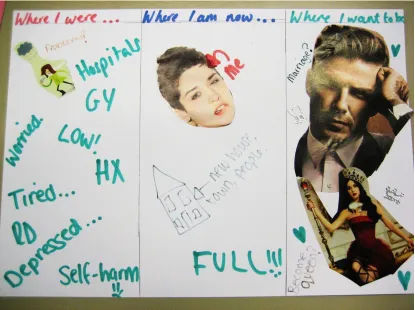
During the focus groups the young women were invited to produce a story board to record their journey through the project, and they were asked to talk about what they had
produced relating to the impact that the project had upon them. Their stories reflected many positive changes, and examples from the perspective of the young women about how the project had helped them to be able to cope with their problems, or at least to start to address their problems. For example:
“‘But I’m stopping drinking. I’ve been drinking too much and I don’t want to end up like my mum, it got to the point where I was just using it as a release of my
problems and it’s not healthy so I’ve decided to stop drinking for a bit until I get myself sorted. Probably get some counselling and stuff like that” Young woman
Another young woman reported a different journey through the project, depicted again in her storyboard (see below). When she began the project she described herself as
experiencing a range of emotions such as being angry, not caring about anything, feeling depressed. She had also experienced the care system and described herself as ‘cuckoo’ in reference to her own unstable emotional position. She has engaged in risk-taking behaviours such as running away, taking drugs and using alcohol. After support from the Engagement Worker, she described herself as being happy, relaxed and calm which is a very different emotional position. She said
“I had a lot of problems which is like being on a low day so that’s why there’s a picture of a woman trying. I was low and depressed which led to self-harming a lot more. Now I have short hair, got a new house, new people, new town
Further storyboard images are available in appendix 2.
Much of the impact of the project related to the future aspirations of the young women, they had a future focus and goals that they hoped to achieve despite their complex needs upon engagement. Thus, the project had an impact upon longer term vision for some of the young women. One young woman said simply,
[image:26.595.58.473.71.381.2]“‘I’ve got where I hope to be” Young woman
Table 2.1 illustrates the hopes that some of the young women had in relation to their future, following involvement with The Way Forward
Before the project Where they hope to be
1. At school, always crying,
had no control of my life,
dad is an alcoholic and has been sectioned,
Forensic scientist, Want to go to university,
feel as if ‘the lights were on but no one was home.’
mum is ill,
have a very controlling boyfriend
2. Rollercoaster,
Up and down all the time, Scared of failing my GCSEs, Had a meltdown in a school toilet cubicle, feel like everyone wants a piece of me,
My mum is an alcoholic and she has been in a critical condition in
hospital twice.
Referred through school.
Family, settle down, stability control
to be a better version of me, good grades,
to go to university
Further changes in one young woman’s longer term future aspirations are illustrated in the storyboard below. When asked to talk about her storyboard the young woman
commented,
Table 2.2 – Distance travelled according to young women within The Way Forward
There were some minor areas in which young women reported that they had found progress difficult, as reflected in table 2.3. However, this is unsurprising given the complexity of needs being dealt with by The Way Forward.
0.0 0.5 1.0 1.5 2.0 2.5 3.0
Imp
ro
v
emen
t
Table 2.3 – Overview of young women’s perception of progress
In general changes resulting from involvement within The Way Forward were positive. Indeed, these positive changes reported by the young women themselves in terms of the impact of the project were also echoed by stakeholders:
“She’s confident, she works on a Saturday now, when I see her she’s much more bubbly. She said to me, I would never have this without your help” Stakeholder
0 9
2.9 2.9
2.4 2.4
2.1 2.3
1.6 1.7 1.5
1.0 1.0 1.3
-10 -8 -6 -4 -2 0 2 4 6 8 10
P
o
sitiv
it
y
/is
sue
fr
ee
Review Question Topics
Young Women's Perception of Progress
Made with Way Forward
“When I went she was cheery, I could tell in her voice and in her body language, she was so much better and she said she was really grateful” Engagement Worker
“Giving girls an opportunity to have much more control or sense of control but also with that control comes a sense of responsibility within their lives” Stakeholder
The Engagement Worker, when asked to comment upon the changes experienced by the young women when they had been involved with the project said:
“We can save lives and I think some of my young women have said literally that September their involvement with the Way Forward has saved their lives. You provide them with a safety net, you can reduce the amount of drinking and drugs they are taking, they’re not as at risk, you’re providing more safety, you find them housing, all that kinds of stuff. But I would say ultimately the impact is you can save lives because they can be a rock bottom point can’t they?” Engagement Worker
Again this reflects a variety of journeys for young women travelling through the project, with a range of issues being focused upon too. Commenting further upon the outcomes that young women report the Engagement Worker outlining the importance of
empowerment and resilience building as a base for working with young women with such complex and variable needs.
“So I think yeah we encourage them, we empower them, we create resilience as well which is what the project is about – it’s about building resilience. It’s about helping them cope with what they’re going through and we’re never going to mend it, we’re never going to change it…sorry we’re never going to…we can change how they are at the moment, we’re never going to change what’s happened to them so we can just help them build strategies around their traumas and things”
Engagement Worker
The Engagement Worker also suggested that another way in which the project was having an impact was in relation to prevention, suggesting The Way Forward prevented harm, reduced pregnancies and involvement with the criminal justice system:
“If this service wasn’t here, without the work that we’ve done we maybe have more crisis around mental health with more self-harming, more girls displaying risk of behaviour or putting themselves at risk or harm, the crime rate could go up, further sexual exploitation, .pregnancies, working girls, all of that and then we hit the criminal justice system.” Engagement Worker
The positive outcomes reported already are further reflected in the testimonies provided by some young women who were confident enough to talk about their experiences at a
Testimony – Julia
The Way forward has helped me because Anne-Marie and Mel are different due to the help that they give. I feel it is not as formal as it would be if I was assigned a ‘counsellor’. By that, I mean we are able to have a chuckle and a giggle about certain things that have happened and dip in and out of irrelevant things if needed. I feel I can also get upset if I need to let my emotions out and am not judged, other organisations have. I have felt in the past I haven’t been able to talk to people for this reason and my emotions have been all locked up inside.
There have been a few things that have got me angry in the past and one of these are; when people judge me because of what’s happened in my life, for example when I was younger my mum got herself into a lot of debt and this affected me, when I have told people this in the past they have looked down on me, that’s not fair my mums actions are not my fault.
In the past I have found that people struggle to understand me as a person due to my happy smiley nature yet having so much going on at home and on the inside. Mel and Anne-Marie understood me straight away and we clicked. Mel and Anne-Marie could see if there is something wrong straight away and always ensure that I knew they were there for me to talk to if I needed to.
They understand what women and young girls need for a start, whether it is professional help from the police or social services or just a friendly face (which in my experience Anne-Marie and Mel are always there to offer). The WomensCentre do not offer specific times for the help that they offer, you can ring them whatever time if you need a chat even if it is 10 minutes after your appointment. They are always there! The things that are difficult are; women over-think, not many people understand this especially if they are older or male! The WomensCentre is there to help and put your mind at rest when you need it.
I think it’s very important that ‘the way forward’ is a gender specific project, this is because women are the weaker gender at a young age (14-25) mentally, they have got a lot more going on (hormones), and if there is any problem with relationships then it tends to be the women that gets upset. I feel that girls and young women are more likely to fall out with parents at this age because of hormones and the imbalance around emotions.
Testimony – Frances
As teenagers and young women, we are constantly made to feel we’re inadequate, through the media, our peers and a society where feminism has become a dirty word. And if the people, who are supposed to support us, such as our partners and family, do the same, it can be impossible to see that we’re not. That’s why I believe it’s so
important for young women to have places like the women’s centre and projects like this one, to be empowered and educated by other women, by people who get it! Especially those of us lacking a female role model ourselves.
And the Way Forward does exactly that. I have been given the tools to see not only what I am capable of but what I have already achieved, just how resilient I am and most
importantly how I deserve to be treated.
When I was first asked what made the Way Forward different I didn’t know where to start. Before I became involved with the project my life was chaos, I was helpless and desperate. Then Anne-Marie came along and suddenly it was like somebody had hold of me and they weren’t going to let me fall again. I was never judged or told what to do, never pushed and unlike other places I wasn’t passed from pillar to post, she was there to stay.
From day one she treated me like an equal human and not a statistic, she cared and went above and beyond the call of duty to ensure my safety. From not letting me off the phone till she knew I was ok, to working late to move me somewhere safe and so much more. That’s what makes this project stand out, the people involved. Having somebody who refuses to give up on you no matter how tough it gets, who is your voice when you cannot speak but who never puts words in your mouth
France’s testimony demonstrates the central role of the Engagement Worker and the trusting relationship that has been at the core of the project, seen in France’s statement that the Engagement Worker was ‘there to stay’. For her the gender-specific focus of the project was also very important.
Key findings – making a difference
The young women report a variety of different outcomes as a result of their journey through the project including, being able to make decisions
independently, feeling better emotionally, being more empowered,
The project is impacting upon young women by focusing upon their life chances and by helping them to focus upon their future aspirations via future planning and encouraging them to realise that they do have a future.
3.
Findings: Project operation and delivery of provision
3.1 The role of the Engagement Worker
The Engagement Worker’s role has already been highlighted as crucial in relation to the impact of the project upon the young women from their perspective. The intricacies and skills involved in the provision of the Way Forward were clear from the qualitative data gathered. At the outset of the project, there was clear commitment to the role with the Engagement Worker taking ownership in a positive way in order to appropriately support young women with various needs:
“all my girls’; ‘when I get a chance to reflect on my cases...I was holding onto all of my ladies…my women, I call them my girls” Engagement Worker
The Engagement Worker role is varied but involves advocacy and giving young women a voice:
“Link them into the agencies that are there and try and bend or fight your way through some of the barrier that agencies… and I think it’s putting up a case for these young women as well”. Engagement Worker
“[The EW] has had to take on practical tasks but also, like an advocacy role. Much more than we thought we were going to have to do…making links and being an advocate and helping that young girl or woman to have a voice…for somebody to actually listen to what they were saying and take it seriously and them make
changes. So that very real advocacy role of reaching the right people” Stakeholder
In addition to the young women’s discussion of the importance of the Engagement Worker, the 12 detailed case notes analysed bear out a range of issues experienced by each young woman – there are common themes across these such as complicated,
unsupportive family relationships, problems at school, drug and alcohol dependency (in the young women and the parents themselves), self-harm as well as mental health issues such as low mood and anger management. Often the young women have complicated circumstances that vary – spiralling out of control can been seen frequently within the case notes. Thus working with the young women is a ‘moving feast’, they can report being fine/stable in one meeting with the Engagement Worker and then text her a few hours later after experiencing a crisis.
“It’s like when you go to a GP and it’s on a scale of 1 to 10 you know that they’re doing solution focus, well that young girl might come in today and 10 be a good day, she might come in tomorrow or Friday, something can happen in that 24 hours and we’re back down at 1. So we can never say we can go on a role and we think everything’s okay and then we’re pulled straight back in because we’re nearly at closure thinking it’s been going along good and then within 24 hours it can just be turned upside down.” Engagement Worker
women cannot be classified as static or stable. However, due to the nature of this work and the role, it is sometimes difficult to disengage from the young women and move them on:
“It’s then difficult to move them onto someone else even when we have identified somebody else who could take on some of the delivery role. It’s been quite difficult to move them on to have trust with another worker so yes, some of the girls and young women have stayed perhaps longer than we’d intended”. Stakeholder
The Engagement Worker in this post recognised that the process of working with the young women often does not have a clear end point, and needs to be offered outside of traditional service barriers:
“All it takes is a phone call and I’ll start doing visits again even after a case has been closed” Engagement Worker
“She [EW] even came to see me on a Saturday because I was really, really
depressed, and she came out of her way to see me. I felt a bit tight.’ Young woman
It is this approach to the work that is seen as different from the perspective of those delivering it;
“The unique selling point of my project was my level of engagement and I felt that’s why it was working because I was texting them every couple of days, I was ringing them every couple of days’ Engagement Worker
Analysis of thecase notes show different needs in the young women accessing the
[image:37.595.57.537.581.724.2]project both in scope and severity, ranging from cases where supportive conversations are provided to much more complicated cases in which a variety of agencies are involved over a longer-period of time. This demonstrates the Engagement Workers varied role within the Way Forward provision and supports her question in relation to the other provision on offer locally – can other agencies provide this level of flexibility in support? In case 7, there were no referral pathways due to the lack of significant issues/needs according to other threshold criteria, the impact of the engagement worker is positive.
Table 3.1 – The impact of the Engagement Worker in case 7 Issues experienced Engagement Worker
support
Impact
Case 7:
Young woman already working with student social worker but her placement was ending, so young woman referred into Way
Meetings with young woman
Contact with parents – discussions with mum
Forward. Also family
support worker referral had been made.
Young woman had sexual intercourse at age 14, parents were aware and had concerns about her vulnerability and child sexual exploitation Engagement worker
reported that the step-father was very strict – no longer allows young woman to go out of the house – strained relationships
Young woman reported issues in the relationship between her mother and step-father
Parents not engaging with the social worker/family support worker
Young woman said that she just needed someone to talk to and that she is aware of her own risky behaviour
On-going issues with
parental relationship- mum allows her to go out and meet friends behind step-dads back, step dad grounds her for kissing a boy
Young woman admits telling lies to parents and sneaking out to meet boys
about young woman’s behaviour, creating a peaceful home
environment, young woman telling lies to her parents No texts in this instance as the young woman was not allowed a mobile phone until the case was at a point of closure
On-going supportive advice and conversations with young woman about relationships, self, safety and trust
Young woman made improvements in terms of her behaviour, being honest with parents and her
parental relationship also improved with step-dad relaxing more – allowing her a mobile phone and being less strict
Young woman told
engagement workers that she ‘had sorted her out’ and made her understand the difference between ‘good and bad’
Young woman doing well educationally and was happier in mood – case closed
In case 8, the Way Forward worked as it was designed to do – linking a young woman into other agencies/support systems and then closing the case after short
Engagement Worker again and was able to discuss her emotions after requesting this support. This is reflective of the trust built up in the relationship during the engagement period, which was also discussed by the Engagement Worker when she was reflecting upon her own role:
“I’ve had a young woman come in today and says to me that, it may take her a while ‘cause it’s the first time I’ve seen her, it may take her a while because she struggles with trust and I have said to her ‘fine it takes you as long as it takes you’ and I think that, they are out, they suss you out, they test you, they’ll challenge you, they’ll push boundaries, they might not turn up and they’ll do that to test ’cause they’ll say “right I wonder if she’s going to contact me, I wonder if she’s going to text me when I don’t turn up for a visit or is going to be the last time I see her”. So
there’s all that kind of thing about trust, trust is huge, and if they’ve never been able to trust anybody to build up trust is really difficult.” Engagement Worker
The approach used by the Engagement Worker is very much focused upon flexibility in working with young women – cases may be closed but then have to be revisited/reopened depending upon changing circumstances. The young women are also given lots of
opportunities to work with the project, which is a different approach to what is offered by other service providers:
“Another thing as well that the impact is allowing them to, not allowing them to fail but allow them to make mistakes and allowing them to be human and say ‘right you didn’t turn up on Wednesday but hey ho let’s get on with it’ and not victimise them and say ‘you haven’t been to your last 3 appointments’ – can you imagine if we did that?” Engagement Worker
Further analysis of the case notes demonstrated that the young women within The Way Forward are treated on a case by case basis which is a key strength of this project. The Engagement Worker provides tailored individual support depending upon what the young woman need and ask for. Support is often issue related e.g. discussing staying safe, safeguarding issues or dealing with mental health problems and is focused upon building resilience via supportive and open communication with the Engagement Worker. The Engagement Worker reflected upon her own practice in terms of working on a case by case basis
“It’s about being quite creative as well. So it’s about being innovative in your
approach to work you know, which again comes to the no criteria, you know just try and think about it from a like a normal human being and think what do we need to do?” Engagement Worker
Table 3.2 – The impact of the Engagement Worker in case 8 Issues experienced Engagement Worker
support
Impact
Case 8:
Family relationship issues – step-mother perceived as not liking the young woman by the young woman
herself, and young
woman’s dad drinks alcohol every evening with friends at home, but he is verbally supportive of her going back to college, and reports that he has tried to manage unsupportive peer
relationships
Dad reported concerns about cannabis use in young woman to
engagement worker. Dad also reports feelings of depression himself
Young woman reported for drinking alcohol and anti-social behaviour – often involved in situations that are problematic related to peer group
Young woman reported not eating for long periods of time to engagement worker Young woman reported not having things to do/occupy her time
Young woman misses mum who left the family home several years ago – reports
On-going meetings with young woman
Meetings with Dad and other workers such as parent link worker
Further meetings with other workers to discuss issues being dealt with, ways to manage and improve the situation
Conversations with young woman about anti-social behaviour, alcohol use, consequences of behaviour e.g. related to arrest and peer group, cannabis use and longer-term
implications, sexual
relationships, social circles she is part of
Linking young woman to project challenge
Liaison with college
regarding her re-engaging with course
Referral to Lifeline
(Substance Misuse Service) Work with Early Intervention Panel – referral to a young person’s support worker to provide help with house conditions. Youth worker
Continued support, listening and advice role for the young woman
Young woman attended project challenge Once additional support was in place from other agencies, closed the case but due to multi-agency context found that situation had worsened despite the other agency support – young woman expressed support to work with engagement worker again so re-opened case
Young woman attending college
Young woman attending WomenCentre office to meet engagement worker Young woman engaging with substance misuse support worker
Young woman attending Orangebox (Young
lacking motivation and being low in mood
Young woman self-harms Young woman not
engaging with college course
Young woman arrested for arson and other police involvement at various points related to anti-social behaviour – police
considering ASBO Young woman admitted cannabis use to
engagement worker
involvement followed on from this
Referral to WomenCentre counselling service (after the case was re-opened) and liaison to ensure counselling session was arranged
More time spent with engagement worker discussing emotions – at the request of the young woman
Further meetings and emotional support provided to young woman
The case notes demonstrate that a key area of support given is emotional - the
engagement worker is someone who provides independent support for young woman, a ‘listening ear’ thus emotional labour is a key aspect of the engagement worker role. Emotional labour is used as a mechanism to develop resilience.
“They get to feel comfortable around us. We do the nurturing side of it as well as the you know we still hold the professional side of keeping the boundaries but we do the nurturing side because we have identified there is a lot of family breakdown and so they need the guidance.” Engagement Worker
“I think it’s because they know that it is a safe place. They know that there will have that voice and they will be listened to and I think that’s where we’ve got the
breakdown with some of the services that we are trying.” Engagement Worker
“With us doing the emotional support, we’ll take them for a coffee and some of them have never had that, some of them have never been for a coffee yet and they don’t even know what to order when they go in. You can see their face, they’re so
excited.” Engagement Worker
The importance of this type of support was cited as being a unique aspect of The Way Forward Project, and one of the centrally important components of working with the young women.
“It’s a unique service; they’ve not had that support from another agency of what we deliver, not you know saying that we are absolutely wonderful, but I
much as, they can feel it as much as we can feel it and they know that if we say we’re going to deliver, if we say we’re going to support then we do do it.”
Engagement Worker
In case 9 the young woman said that she enjoyed the visits from the Engagement Worker and did not want the case to be closed despite improvements reflecting the importance of this approach to the work, as well as the trust developed.
Table 3.3 – The impact of the Engagement Worker in case 9 Issues experienced Engagement Worker
support
Impact
Case 9:
Young woman with substance misuse; both drugs and alcohol
Young woman reported the ending of a relationship, and her experiences of a termination (without follow-up sfollow-upport)
Young woman reported issues within the family home – parental separation, dad has a new young girlfriend who the young woman doesn’t like, she also feels that her mum is unsupportive
Young woman’s peer group potentially negative e.g. discussing/focusing upon social anxiety
Mum reports concerns about daughter drug use, inappropriate sexual
behaviour and relationships (in one instance with a much older man), lies, honesty between both parties and lack of trust;
Meetings with young woman
Supportive conversations with young woman related to substance misuse, dangers, safety, follow-up support after the
termination (young woman did not want this at the time it was suggested)
Texts to dad to discuss situation
Conversation with mum around trust (mum checking Facebook and twitter), relationship with dad, suggestion of family mediation
Further support to young woman and mum following row at the family home Referral to Lifeline (Substance Misuse Service)
Further supportive conversations with mum and daughter about
Continued support, listening and advice role for the young woman
Reported improvements in parental relationships with both mum and dad
Young woman explored course options at college but then decided not to pursue
Reported behaviour change by young woman –
detaching herself from risky situations, not going to the houses that she was previously, less drug use Much less evidence of chaos seen by the engagement worker
mum checking Facebook and twitter
compromise, taking time out, showing each other affection, being non-judgemental in relation to the termination
Supportive conversations with young woman about her future – college and work
The impact of the Engagement Worker could be seen in the case notes in relation to outcomes such as improved circumstances, less chaos, links into other
services/appropriate provision, focus on the future e.g. uptake of college and improved attendance at school. These are quantifiable and related to the holistic approach taken by the Engagement Worker in which the role looks at all areas of the young women’s lives and works with them to try to find solutions and make improvements.
In some of the cases, it was clear that the Engagement Worker spoke to other workers internally for advice/guidance and this supportive environment is mentioned in interviews with stakeholders when they were discussing the delivery of the project. Despite this supportive environment, it is clear that the role of the Engagement Worker is demanding because it involves so many aspects:
“It’s not just about going out and visiting because then you’ve got to try and reach out to all the professionals about who may be working with them or you might want to refer onto, so there is all that information sharing, there is attending meetings, there is doing the hands on visits. And a lot of the time when you visit them, you are actually reacting to chaos.” Engagement Worker
3.2 Project operation and delivery
These findings are organised in relation to the cross-cutting themes that emerged from both the interviews and focus groups with steering group members and referrers. Organisational components for success
Across the data gathered, participants mentioned several ‘ingredients’ that were critical for the success of Way Forward.
The positioning of Way Forward in the non-statutory sector
“A lot of the times, you know, young people come to you and the last thing they want to do is work with a Social Worker. You know, they’ve had enough of that thank you very much. They have no trust for adults in their lives: parents, teachers, you name it, we’re all no good as far as they’re concerned, and yet I think that the engagement workers can come in on a different level that we have been able to.” Referrer
The importance of consistency was also discussed. Those individuals currently providing statutory provision discussed the challenges within the sector and the way that young people may be passed from professional-to-professional. The Way Forward project,