THE DIGITAL PERFORMER: PERFORMANCE ,
TECHNOLOGY AND NEW PERFORMANCE
PARADIGMS
Mary Lyon Oliver
School of Arts and Media
College of Arts and Social Sciences
University of Salford, Salford, UK
Table of Contents
PART I Critical Contextual Study
Introduction 1 Section 1
Liveness revisited 7 Section 2
The impact of the digital performer on our understanding 15 of performer presence
Section 3
Experiments with narrative 26 Section 4
The actor slave and the diabolical digital performer 37 Summary 48 References 54
PART II Portfolio of works List of Publications 61 Performance Scripts and Visual Documentation
Introduction 65 Mother Tongue 67 Wednesday, Wednesday 114 Never Work With Animals Children and Digital Characters 141 Almost 157 Fly Me To The Moon 188 Nana’s New Pet 207 Published Texts
List of Illustrations:
Fig 1 & 2. Mother Tongue (Photo: Ian Currie) 68 Fig 3 & 4 Wednesday, Wednesday (Photo: Christian Weaver) 115 Fig 4 & 5 Never Work With Animals Children and Digital Characters 142 Fig 6 & 7 Almost (Photo: Geoff Barnett) 158 Fig 8 Astro Mary Stage 1 (Illustration Mick Lockwood) 189 Fig 9 Astro Mary Stage 2 (Illustration: Matthew Robson)
Fig 10 Fly Me To The Moon (Photo: Geoff Barnett)
Fig 11 Blue 201 Fig 12 Blue live performance
Fig 13 & 14 Unfinished Business (Photo: Ian Currie) 202 Fig 15 & 16 The Screaming Head (Images from installation) 203 Fig 17 & 18 Swimmers (Images from live video recording) 204 Fig 19 & 20 Talk to Me 205 Fig 21 & 22 Nana’s New Pet (Photo: David Dewsnip) 208
Appendices (available in hard copy only)
Appendix i DVD Mother Tongue Live Recording Appendix ii DVD Mother Tongue Sample Clip Appendix iii DVD Compilation DVD:
Wednesday, Wednesday Fly Me To The Moon Almost
Blue
Acknowledgements
Over this period of study I have had the privilege of working with so many extraordinary people. It is with enormous gratitude that I would like to thank Robert Ayers, Geoff Barnett, Tony Bessick, Teresa Brayshaw, Michael Clements, Stella Couloutbanis, Mark Creamer, Ian Currie, David Dewsnip, Steve Gumbley, Rozi Fuller, Edwin Hasler, Susan Kennard, Mick Lockwood, Matt Locke, Kenny Lozowski, Lisa Moore, Mem Morrison, Adele Myers, Eirini Nedelkopoulou, Robin Nelson, Sara Robinson, Matthew Robson, Kath Sandys, Janet Sumner, Carmen Szabo, Rob Thirtle, Gavin Weaver, Mark Whitelaw, Matthew Wood and Niki Woods.
Thanks also goes to Philip Auslander, Helen Bailey, Joan Beadle, Jill Butterworth, Matthew Causey, Steve Dixon, Niamh Dowling, Ruth Gibson & Bruno Martelli, Jo Hewitt, Lois Klassen, Lorraine Oliver, Jennifer Parker-‐Starbuck, Sita Popat, Heidi Reitmaier, Outi Remes, Rivca Rubin, Dick Van-‐Dijk and Andrea Zapp for their inspirational ideas, friendship and the tremendous fun that they have brought into my life.
Thank you to my supervisor Professor George McKay for encouraging me to take this step, for his support and exquisitely precise critique.
I would like to give special thanks to my supportive family -‐ my wonderful sisters Mag, Kate and Joss, and my lovely brother Rob for not minding when I left him out of the work. All my love and appreciation goes to my wonderful daughter Rowan -‐ enthusiastic runner, designer, costume advisor and unerring fan. Last but not least, my husband Christian -‐ soundscape artist, video editor, technical advisor and the one who has always supported every new creative adventure without question.
For Mum and Dad,
who paved the way for me to live the life that I have had the privilege to choose
Abstract
PART I
Critical Contextual Study
Introduction
Since the late 1990s I have undertaken practice as research in which the staged and mediatised meeting point of the actual and digital performer has become the central concern of the research. During this period I have explored the extent to which one can create an equitable and convincing ‘live’ performance presence when creating performances that incorporate mediatised performers. Issues around liveness, physical presence, actual / virtual performer discourses and performer / spectator relationships have dominated the activities to date. The experimental process has fore-‐fronted the dialogic relationship of the onstage to the on-‐screen performer, as such the devising methodology has primarily been focused on experimentation with the scripted narrative. My working process has undergone significant technological and formal transitions during this research period, which has also seen the development from analogue to digital formats. That profound technological shift alone has of course altered my practice.
I began working with my early version of the ‘digital double’ in 1998, almost ten years before Steve Dixon coined this phrase in 2007. When Philip Auslander was writing his
now seminal work Liveness: Performance in a Mediatized Society (1999) I was undertaking
Arts Council England-‐funded research and development on Mother Tongue (20011), a
computer driven performance in which I simultaneously performed as my mother and three sisters. I have worked consistently through this transitional period of technological
development and have, through ‘the doing’ of it, highlighted a number of issues not critiqued by Auslander or by subsequent work on his ideas.
For the purpose of this examination I am presenting a coherent and substantial body of ten digital performance works performed or produced since 2002. The majority of these have been funded through national and international competitive and peer-‐reviewed award processes, by bodies such as Arts Council England, the Arts and Humanities Research Council, my then employer Manchester Metropolitan University, Kirklees Council, the Canadian Cultural Council, and my current employer the University of Salford. In addition to these public funding sources I have received national and international commissions and sponsorship from organisations including the Storyroom Project, Sumners Post-‐Production House, South Hill Park Arts Centre, and Banff New Media Institute, Canada.
I have raised over £60,000 for this research, which I have performed nationally at notable venues such as the Institute for Contemporary Arts, London; Royal Exchange Studio Theatre, Manchester; the Lowry Centre, Salford. I have performed several of the works internationally at the Rex Cramphorn Studio, Sydney; the Ashanti Dance Studio, Rhode Island; the Pratt Institute, New York; and Banff Theatre Arts, Canada. I have disseminated my understanding and findings from each of these performance outputs through peer-‐ assessed papers, mostly at international conferences, in published articles in academic and trade journals and edited texts.
presence in contemporary performance. This critical contextual analysis examines twelve selected outputs. These are a combination of original performances, written, directed and performed (mostly by myself), and selected publications, where I have reflexively discussed my practice. This critical contextual study is presented in four sections: Liveness revisited; The impact of the digital performer on our understanding of performer presence; Experiments with narrative; The actor slave and the diabolical digital performer.
Theoretically my analysis is cross-‐disciplinary, and draws on a number of critical voices from varying but cognate fields. I suggest that I produce a mutable genre of performance
practice and as such, the critical context is still finding its own form.2
In this study I reflect on both the use of the ‘digital performer’ and the ‘digital double’ in my collection of works and performances that feature the digital double dominate this portfolio. Amongst the theoretical analyses of this particular mode of digital performer I have engaged with Steve Dixon’s incorporative analysis of the wide spectrum of digital doubles as mutable entities that can be interpreted as possessing a range of qualities from the dark doppelganger to the ability to be ‘indistinguishable from its human counterpart’ (Dixon 2007, 268). I have examined the work of Matthew Causey who places the digital double largely within the concept of the uncanny, informed (in part) by a psychoanalytical Lacanian position, which proposes that the double represents a mutilation of the self through technology (1999, 394). I have also responded to Causey’s provocative notion that when we are performing with our digital ‘Other’ we are in fact enacting our own
death. 3 In each of the performances there is an attempt to illustrate that the presence of
our digital double or indeed any digital performer who is in conversation with the actual performer onstage, allows both performer and audience to transcend our corporeally-‐ based understanding of the ‘live’ and enter into the realm of some kind of ‘magic.’ Rather
2 Matthew Causey (2006, 39) proposes that we should conceive of theatre as a medium that overlaps and
is always subsumed by other media including television, film, radio, print and computer-aided hyper media. Such a process he proposes will considerably change our definition of the boundaries of the theatre and the ontology of performance.
3 The concern with the inevitable death of the live performer, in what she calls ‘an economy of
than highlighting death, I propose that the exchange between the performers has the ability to create a heightened sense of the self in the present.
Gilles Deleuze (via David Hume) offers both a philosophical and cognitive interpretation of the repeated self, which has assisted in explaining not just the uncanny interpretation of the digital double, but the magical properties that the repeated self can achieve. In
Repetition for Itself, Deleuze writes that ‘[r]epetition changes nothing in the object repeated, but does change something in the mind which contemplates it’ (1994, 90). This proposition resonates quite clearly when applied to the mediatised human subject with its myriad of signifiers. Unlike the photographic still, the uncanny moving image of the double in proximity to the corporeal presence of the original appears to cloak the technology that delivers its presence through its ability to both confuse and entertain the
mind of both performer and audience—also a common response to seeing a magic trick. 4
I have taken inspiration directly into the making of the work from Jean Baudrillard’s notion of the malefice of the double on-‐screen, that bewitches and beguiles its audience into believing it is more real than the original (2008, 84). Certainly in my experience, the digital double has threatened to destabilize my authority as both actually present
performer and author, through its ability to appear more natural and more real than me.5
In each of these digital performances in this portfolio I have consistently used technological innovations to bring impossible performers to the stage: a digital self; a cartoon self, a phenomenal animation who can do anything except leave the screen; and the world’s smallest performer, viewed with the aid of opera glasses. Through this critical
4 The magical double and ghosting effects have been used since the late 18th Century with such technical
innovations as the Magic Lantern, Pepper’s Ghost and the Corsican Trap. In ‘The Cinema Today - 1939’ how to achieve the doubling effect on film is explained. Spencer, D.A. and Waley, H.D. OUP, Oxford 1939, 130-132.
5 Re-‐visiting Walter Benjamin’s The Work Of Art in the Age of Mechanical Reproduction I have
contextual study I summarise, reflect and interrogate whether I was successful in finding a method through which it is possible to create performances in which the actual and digital performer can take equal footing on stage.
1. Liveness revisited
In my understanding, the whole art of theatre revolves entirely around cheating—knowing when to trick the audience, when to cheat and when not to cheat.
Robert Lepage 1998, 141.
During the years of my creative practice there has been a major shift in society’s relationship to technology with an exponential rise in the development of, and dependency on, personal digital devices. These new technologies have significantly altered our patterns of behaviour and we have moved to a world in which we are, in the words of Sherry Turkle ‘always on’ (2012, 151). Viewing the world through a screen has become a ubiquitous and even twenty-‐four-‐hour-‐round activity, and the camera lens has become the eye that watches almost every public space. Such shifts in behaviour need to be take into consideration when contextualising my research, particularly how our understanding of connecting with ‘performers’ on screens, both as entertainment and as part of daily life, has changed.
In this section I discuss the first three performance works in the portfolio, Mother Tongue
feed technologies into their devising and presentation methodologies.6 However, the impact of these emergent digital technologies on performance methodology had not adequately been explored, in part due to the dearth of published outcomes on 'process'
from an emic stance. 7Where impact was discussed, it was almost entirely dominated by
computation and engineering concerns (Laurel 1992, Turkle 1995, Balsamo 1995, Cubitt
1996, Murray 1998).8 In addition, the complexities of discourse exploring the reliance on
technology in contemporary society, I felt, had led to an over-‐theorisation of the subject, removing it from the very human qualities that make the ‘live’ performer essential, and which was presented as a growing body of theories on the disappearing body (Kroker and Kroker 1987, Foucault 1987, Haraway 1991, Kroker and Kroker 1996, Causey 1999,
Hayles 1999). Peggy Phelan’s Unmarked (1993) was highly influential for me at this time.
Phelan’s hypothesis that the ontology of live performance was bound to its non-‐ reproducibility and disappearance, had great impact for me as a performer who had spent the first 15 years of her practice ‘living in the moment’ of performance and who had proudly not documented these works, created for what I would have thought of as the few privileged audiences who witnessed them. In 1998 I attended a talk by Philip Auslander in Manchester, who introduced his theories on the relationship between mediatisation and liveness and I disagreed with his proposal that ‘live’ performance could include ‘recorded’
elements. 9
It is within this historical context, funded by an Arts Council research and development award, and on the cusp of the digital revolution, that I first began experimenting with
6 For example, Wooster Group (USA), Blast Theory (UK), Robert Lepage (Canada), The Builder’s
Association (USA), Station House Opera (UK), Gob Squad (UK/Germany), Rimini Protokoll (Germany/Netherlands), Toneelgroep, Netherlands.
7 Emic : of, relating to, or involving analysis of cultural phenomena from the perspective of one
who participates in the culture being studied. Reference Source Merriam-‐Webster (http://www.merriam-‐webster.com/dictionary/emic) (accessed February 2013).
8 From the outset there was a separation between scientific research into the development of
conversational agents and the theatre maker who was bringing affective artificial actors into their work. See Weizenbaum (1966), the Gesture and Narrative Language Group Embodiment in Conversational Interfaces: REA project, Cassell et al, (1999) and Semaine: The Sensitive Agent Project and is an interesting comparison to the Synthetic Interviews Project (http://www.semaine-‐project.eu) (2011).
9 A record of the event ‘Mediated Mind’ can be seen at
analogue video to record myself in the guise of several characters from distinctly different social classes, in conversation with one another. The embryonic plan was to present this conversational video-‐work as an installation, but my unhappiness with what appeared to be caricature performances curtailed this ambition. From this experiment I moved away from the idea of a gallery based installation towards the idea of creating a conversational
performance with a single, repeated actor. This became Mother Tongue, a work written for
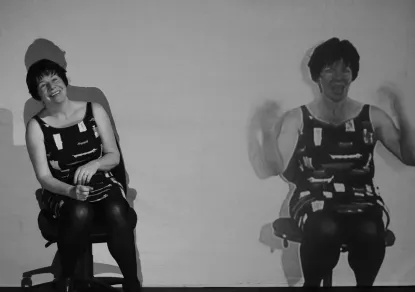
five performers, a mother and four daughters, all played by the same person, and only one of them ‘in the flesh’. My intention was not to create a work of technical wizardry, nor indeed to disprove Phelan’s argument in favour of Auslander’s, but simply to find a way of allowing one character to play several. Initially I chose to perform as my (female) family members because it is still a wonder to me that we all speak so differently. I wanted to emphasise the different ways in which we speak by using the same person, dressed exactly alike, to play all five actors and allow the voice to be read, not just as ‘part’ of an individual personality, or a signifier of birthplace and culture, but an extension of one’s psyche.
The need to employ digital technology to create the doubling effect had an unexpected
impact on the direction of my practice. The making of Mother Tongue was a truly inverted
process, fixed in place at the point of scripting, with every attempt to deliver the recorded lines with a casual air, so that when the show was finally performed 18 months after inception, it would appear spontaneous, not systematic. Although the recording process was at the heart of this performance which consisted of —script to CD—to digital video— to edit—to Mpeg—to computer (via the internet; this show was networked to me before it could be performed)—what happened at the point of performance could not have been predicted. It was as if the technical nightmare had never existed. Presented on four
televisions, the ‘talking heads’ appeared to be ‘live’.10 Not with one present person and
four copies, but five seemingly live characters. It was a revelation to me, that in performance, I felt as though I was not alone on stage, I experienced being with four other
10 Early writers on the liveness of television, largely informed by theorist Jane Feuer, generally
cast members (who all happened to be line perfect) and even the technical crew, could not help but refer to the televisions by their character’s names.
It was clear from the reception of the work the audience also experienced this sense of liveness. Some of my harshest critics, my own family members, saw the show and having once threatened to sue me if I cast them in a negative light, were physically moved by my attempt to regroup our fractured family. The review in the Manchester Evening News
reported: ‘you would almost think that it was spontaneous.’11 The dramatic setting was
not novel, just five women sitting around talking. It was the application of new digital
technology that was transformational.12
The conclusions that I formed from this key work impacted directly on my practice and shifted the critical and theoretical framework that I used to create and analyse my
performance work. Mother Tongue illustrated that the digital double in performance
possessed ‘live’ qualities that could be exploited in the creation of other work that incorporated onstage and on-‐screen performers. I felt that this seminal work demonstrated that even though the machines that supported the artificial performers were completely visible, the liveness generated through their casual conversation could
effectively overcome the artificial mise-‐en-‐scène. Realising Philip Auslander’s hypothesis
on Liveness in his now published text, David Saltz was one of the first performance studies theorists to write in support of Auslander’s ideas, with his proposition that the incorporation of 'interactive technology into theatre opens up dynamic new possibilities for theatre artists, and ...compels us to re-‐examine some of our most basic assumptions about the nature of theatre and the meaning of liveness' (Saltz 2001, 107). Certainly the
surprising impact of the computer driven Mother Tongue invited more investigation in
this respect and the Liveness debate has since been continued and developed (see for
example Causey 2006, Dixon 2007, Giesekam 2007, Bay Cheng et al 2010) and also
11 Manchester Evening News, April 18 2002.
12 In order to maintain complete synchrony between the recorded elements I used the newly released
revisited by Philip Auslander in his second edition (2008). It is however Jennifer Parker-‐ Starbuck who I feel accurately sums up current ideas on the Auslander versus Phelan debate when she declares that the argument:
simply fall[s] into a certain historical moment between the desire to use the term “live” as Peggy Phelan does, to mean a bodily present capable of resisting the onslaught of commercial capitalism, and a tacit acceptance of Auslander's argument that this “live” is also, in the contemporary moment of globalised technology, already ‘mediatised’ (2011,9).
While post-‐digital performance theory may be moving beyond Philip Auslander’s original ideas (Lehmann 2006, Chapple and Kattenbelt 2006, Causey 2006, Broadhurst 2007, Benford and Giannachi, 2011) and while I acknowledge that Auslander’s theory on
liveness in ‘theatre’, is only part of the discussions in his text,13 nonetheless, in its time,
this seminal work offered an invaluable new conceptual and contextual framework for discussing the introduction of the digital performer into my practice, and I have returned to the author’s theorisations, throughout this period of research. The instigation to
develop a series of works in the vein of Mother Tongue was in part prompted by Auslander
who proposed that in comparison to the luminosity of the screen-‐based performer, the
actual performer on stage has all the luminescence of a ‘50 watt light bulb’ (1999, 3814). I
was concerned that my actual stage presence had suffered in this respect, but was fairly convinced that as the central protagonist in the performance both onstage and on-‐screen,
13 Auslander has often informally remarked that his ideas on liveness go beyond the relationship
of the live to mediatised performer, that people cite his first two chapters and do not address the rest of the book. The latter part of the book delves into legal implications and intellectual property rights, as well as conceptual ideas around liveness that extend beyond the actual comparative experience of live versus screen to ‘being there’ in the moment when listening to live recordings. For me however the fundamental premise that he cites of a shift in consciousness to accept the screen-‐based presence as a live performer, is without question the most influential concept in relation to my own studies.
14 I refer to Philip Auslander’s use of Robert Blossom’s article “On Filmstage” (1966) TDR: Tulane
that this had not been the case and that in Mother Tongue I had perhaps found a way of producing an equivalence of presence through the conversational nature of the work.
In the early-‐mid 2000s, moving into middle age, my body seemed to be taking on a will of its own. Perhaps it is little wonder then that my writing took a turn towards the construction of a work in which my now imperfect, badly-‐behaved form, performed with my perfect televisual image. The hilarious grotesque-‐real stories of French Renaissance writer Francois Rabelais were inspirational; the ‘real’ body of the ageing female performer was central to my next performance narrative and became a source of humour.
Performed by Mary Oliver and Mary Oliver, Wednesday, Wednesday was a metacomedy
(Giesekam 2007, 243) that interplayed on-‐screen L’Oreal perfection with the heightened presence of the grotesque vaudevillian stage performer. I used the now familiar theories of Auslander as my challenge, and offered an entertaining response to his work.
Employing technically what I had learned from Mother Tongue, I developed a story of the
imagined space of the ‘living’ television portal as a place that exists beyond the glass screen; where a woman sits both inside and outside real time and even has the ability to talk to God. The comedy monopolised the intimate knowledge of the ‘other’ that the onstage and on-‐screen doubles both share. Secrets that should never be told were revealed, but further embarrassment for both performer and audience was saved with the use of the handy remote control. The visual comedy heavily referenced the language of video technology alongside the gravity-‐bound corporeal presence of the grotesque musical performer. With this performance I found that there was laughter to be found at the meeting point of these two modes of performance and the person who laughed
loudest when I performed Wednesday, Wednesday was Philip Auslander.
Following directly Never Work with Animals, Children and Digital Characters (2006) was a
and more like nature itself” (1995, 224). I suggested through the making of this work that the ‘digi-‐self’ is a reminder that we are moments away from becoming the gods of our own
universe in our continued desire to create and control life (Kurzweil 1999, 1-‐2)15.
Using the digital double both metaphorically and illustratively in Never Work with Animals
Children and Digital Characters, I hypothesised that the performer, whether on or off screen, has the ability to transcend the physical and psychological gap of pretence to become live at the point of performance, through the power of their intention at the point
of recording. 16 I proposed that even when creating impossible relationships, such as the
performer onstage appearing alongside their recorded double, that the ‘liveness’ of the on-‐screen performer does not depend on his or her actual proximity to the spectator, but rather the ability to communicate liveness at the moment of performance, whenever and wherever this is taking place. From my perception as both the digital performer and the performer onstage, I was performing live at the point of recording and that my ‘intention’ to ‘be live’ affectively translated across the temporal and spatial distances between myself
in the past and in the future-‐present. 17 The intention to be live on the part of the digital
performer illustrates and extends Auslander’s claim that “if the mediatized image can be
recreated in a live setting, it must have been real to begin with” (1999, 43). 18 Just as
Deleuze had proposed that the impact act of repetition has no impact on the object but
15 Amelia Jones proposes that the “Behind the development of advanced technologies is the age old
desire to extend the body in space and time (through machinic, communications, and biotechnological tools) and thus to transcend it (to become “God”)” Jones, A, Body Art: Performing the Subject, University of Minnesota Press, (1998, 205)
16 David Freedberg, and Vittorio Gallese offer an interesting set of results that support the idea of
liveness as perceptual. In their 2007 paper ‘Motion, emotion and empathy in esthetic experience’ Freedberg and Gallese explored cognitive responses to looking at art works. They found that the viewer produces empathetic somatic responses to the (abstract) marks made by the artist, particularly when there is a vigorous handling of the medium. ‘We propose that even the artist’s gestures in producing the art work induce the empathetic engagement of the observer, by activating simulation of the motor program that corresponds to the gesture implied by the trace. The marks on the painting or sculpture are the visible traces of goal-directed movements; hence, they are capable of activating the relevant motor areas in the observer’s brain’. It is my proposal that when we watch the onscreen performer, we recognise their liveness at the point of performance and that this is most effectively communicated when the performance is recorded in real-time.
17 The intention to be live on the part of the digital performer illustrates and extends Auslander’s
claim that “if the mediatized image can be recreated in a live setting, it must have been real to begin with” (1999, 43).
18 Auslander is applying Jean Baudrillard’s notion that the real consists of that which it is possible to
only on the mind that perceives it, so the digital double could be ‘perceived’ as having live qualities in the mind of the other actually present performers (in my case) and in the audience, who made the decision to enjoy the illusion.
It was my conclusion at this stage that liveness is not a physical but perceptual state and was dependent on its quality of believability. In this (now) post-‐digital age it is this very attribute of liveness that has been appropriated for the purposes of assessing the effectiveness of artificial intelligence and interactive communication systems. Computational researchers have begun to assess the quality of liveness in the human-‐to-‐
machine interface through truthfulness (Newell, Edwards and Cairns 2011, 221-‐22419).
Such a development suggests that the success of an artificially produced, engaging human, is dependent on whether the interactor believes that what they are interacting with, is human-‐like. From very early on in this process I have used believability as the primary test as to whether the artificial (human) performer is convincing, and this ability I considered might be attributed to the quality of their presence.
19 Christopher Newell, Alistair Edwards and Paul Cairns propose that human to machine interactions
2. The impact of the digital performer on our understanding of performer presence
There is perhaps no art form better suited to making presence ‘enigmatic’ than the theatre, where the 'immediate' is represented, and where the character or stage world is in 'proximity', while being, in a very real sense, absent.
Jacques Derrida (1974, 70)
We know we exist, only through the act of recognition. For Lacan it is the mirror that serves this function, for Hegel, it is through the eye of the other that we become self-conscious, for Merleau-Ponty it is through the body that we develop our self image: our realisation that when our left hand touches our right hand, when we simultaneously touch and are touched, we experience ourselves in the world because, as Merleau-Ponty states, ‘my body is me’ and ‘I am it’ (2004, 113). In relation to the performer-spectator relationship and in my efforts to introduce the digital performer as a believable presence, it has been important for me to understand how we recognise the ‘presence’ of performers (onstage) in relation to ourselves (as audience). Herbert Blau offers a seemingly simple coverall solution with his proposal that, ‘aall living presence on stage is illusory and contains the appearance of spontaneity’ (1987, 164-5). Cormac Power’s narrower and potentially more constructive definition suggests that all theatrical presence is ‘a function of theatrical signification…. a constant dynamic process of disclosure’ (2006, 227).
performer to rise above what is actually possible, an experience that Steve Dixon cites as Artaudian in principle (2007, 241). 20
The stage presence of the digital performer has been a relatively under-‐debated
discussion in intermedial performance. 21 In a number of texts (Dixon 2007, Causey 2007,
Giesekam 2006, Power 2006, and Parker-‐Starbuck 2011) the subject of the digital performer is discussed, but not to any great degree with regard to the direct relationship between the actors onstage and on-‐screen. Gabriella Giannachi and Nick Kaye’s Performing Presence project, (Exeter University 2008 to 2011), undertook the most comprehensive study to date of the impact of new media on our understanding of the
subject.22 Their investigation into the Latin etymology of the word ‘presence’ is itself
helpful in our understanding of how the performer on-‐screen can be experienced as
having presence. Presence as prae (before) and sens (past participle of sum, 'I am')
suggests 'before I am' or that which is 'in front of' me or 'in view' of me. Presence can also be interpreted as part of a principle of unfolding, as something that is revealed to us, and therefore suggests ‘alterity’ (Giannachi and Kaye 2011, 4) which could explain why when someone is filmed in the past, the recorded performer has the ability to ‘become’ present in the future, unlike the static image of the photograph which invokes memory and a sense of a person, but not the experience of their actual presence at the moment of
viewing. Although the Performing Presence project offers a comprehensive discussion on
the changing perceptions of presence brought about by our growing engagement with new media technologies, few of the artists and performance companies selected for analysis incorporate the digital performer within a dialogic performance structure. The
20 Steve Dixon is referring to the Digital Double when he cites that this kind of ‘transcendence’ is
Artaudian in principle, but I would also propose that such an idea applies to any digital performer who manages to convince the audience to believe in their presence.
21 I am using the term ‘intermedial’ in reference to the term introduced by Freda Chapple and Chiel
Kattenbelt. They describe intermedial performance as “a meeting point in-between the performers, the observers, and the confluence of media involved in the performance at a particular moment in time” (2006, 12). The change in terminology reflects a 21st Century approach to contemporary performance making and I am using it in preference to ‘multimedia’ whose roots can be traced back to early 20th Century avant-garde movements. For a further elaboration on this I refer to Steve Dixon (2007, 87).
22 My work was however discussed by Claudia Georgi in her paper Live and Mediatized Presence in Mary Oliver’s Performance Art, Georg-‐August-‐Universität Göttingen
exception is the work of The Builder’s Association whose artistic director Marianne Weems claims their work relates primarily to dislocated connectivity (2011, 179). The company does not attempt to represent the physically absent performer as seemingly present in the same space, but as someone linked, spatially and temporally through the science of technology, to the performers onstage.
Through studying the work of contemporary performance companies (among them Prototype, the Wooster Group, DV8, imitating the dog, Forkbeard Fantasy, The Builders Association, Toneelgroep, Station House Opera, Blast Theory, The Chameleon Group) and through creating my own body of work, I understand that, unlike performance with ‘cinematic’ or ‘technologised’ bodies, the simply filmed presence of the digital performer in one-‐take can appear to have the same sense of presence as the actual performer
onstage. 23 This is a return to a historical period in which early film-‐makers, emulated
stage-‐based plays with the camera fixed in one position and the action literally staged
before the eye of the recording machine 24 (Spencer and Waley 1939, 131). Watching the
cinematic body is a skill that we have acquired. We learn to make associations with one image and another and construct a sense of the whole person from these dislocated
images 25 (Parker 1998, 107). It is my assertion that this different viewing experience is
perceptually different from watching the constant actor onstage. I propose that these formal differences interrupt the conversation between the two kinds of performer. In my work I have chosen to embed the presence of the digital performer within a story that asserts that the digital performer is not separate but part of the stage-‐based ensemble at the point of performance.
23 Audiences have responded to my digital double work with such comments as “We know there can’t be
two of you, but there simply are” (Wednesday, Wednesday Reading University 2005) and “I know it’s silly, but I keep waiting for you/her to come back out from the wings” (Falmouth College of Art 2007).
24 It was the static nature of the filming process that led to the accidental discovery of trick film
processes very early on in the process of development of what this new medium could do. George Méliès was the master craftsman of trick film and doubling techniques.
25 The linking of images is known as the Kuleshov effect– The Russian film-‐maker discovered that
In my previous works it had been a surprise that the formal differences between the performers could be enjoyed in spite of the technological ‘reveal’. The encouragement to look beyond the machinery to the actor is different from other contemporary artists whose work makes a feature of the differences between the technologised or mediatised body in relation to the actor onstage. With reference to the Wooster Group’s use of actual and screen-‐based modes of performance, Matthew Causey observes that the company creates ‘a conflation of the mechanics and the products of their respective image manufacturing’ (2006, 45). In my research, the intention was not that the onstage performer should take on the mantle of mediatisation, but conversely, that the mediatised
performer, should appear to be present.26
It is with the benefit of this insight that I decided to test my ability to bring other kinds of digital performers to the stage and to see whether I could maintain a convincing and equitable presence in performance. I began formally with scale and introduced Doris, the
world’s smallest performer viewed with the aid of opera glasses. Almost is a story of a
woman and her giant of a husband who are living in the last occupied house in a street,
due for demolition. Aesthetically, this work expanded the mise-‐en-‐scène by embedding the
television screen inside a bespoke model house. I employed professional actors to appear in the work, with the virtual Lisa Moore performing as the nine-‐inch-‐high character who occupied the house, and onstage actor Anthony Bessick as the giant.
Technically it was a complex work which was only possible with the skills of a greatly expanded industrial team that included, writer, director, professional actors, designer, composer, foley artist, film crew and composite video editor. By being outside of the work
26 In Martin Heidegger’s notion of the essence of technology as that which functions to bring forth the