International Journal of Emerging Technology and Advanced Engineering
Website: www.ijetae.com (ISSN 2250-2459, ISO 9001:2008 Certified Journal, Volume 7, Issue 8, August 2017)
86
Smart Irrigation Optimum Utilization of Resources - Future
Needs
Santosh Durugkar
1, Ramesh C Poonia
2, R. B. Naik
31Research Scholar, 2Assosciate Professor, AIIT, Amity University Rajasthan, Jaipur, India
3
Professor, MIT College of Engineering, Aurangabad, India
Abstract— An effective management of ground water in all
aspects is very important nowadays. We have proposed a WSN aspect to tie up agriculture field with the technology. So later on we can this system as an example of interdisciplinary approach. WSN with an approach of priority driven scheduling in garden is proposed. Smart irrigation is the new trend now a days and it is the major requirement due to many critical factors such as irregularity of monsoon, less availability of water etc. We are observing the irregular nature of monsoon nowadays. Though sufficient ground water is available still we have to make sure it is good to use for better yielding of crops, few factors such as temperature, humidity, air flow, soil moisture plays an important roles in better crop yielding.Development in this field is snatching the opportunity to design and integrate more additional functions and services in future. In this proposed idea we are presenting irrigation system for a smart home garden (by creating different test beds for different soil structures) which can be integrated with existing smart home irrigation systems and obviously can be extended to large filed too. In this proposed system there will be few slave nodesand master nodes each of which will be equipped with a microcontroller.
Keywords— Wireless Irrigation System, x-bee, DHT 11, Priority Driven Scheduling, Controller, Smart Irrigation
I. INTRODUCTION
A report from NAPCC states that India has also revisited the National Missions under the NAPCC in the light of new scientific information and technological advances and identified new missions or programs on wind energy, health, waste to energy, and coastal areas. It is also
redesigning the National Water Mission and National
Mission on Sustainable Agriculture. [17] Therefore we can say that in future steps will be initiated by the governments to preserve and effectively utilize the natural resources. Monsoon, meaning season, is the wind system over India and adjoining oceanic regions that blows from the southwest half the year and from the northeast during the other half.
The winter monsoon or the northeast monsoon brings rainfall to the southeastern part of India through north easterlies during October to December and contributes a small percentage to the annual Indian rainfall. [16]
“Water” is tonic of life to survive and all developmental activities require water, it may be an agriculture sector or industrial purpose and even human being totally depends upon the water. As day to day population is increasing which consumes huge amount of water and for agriculture and gardening too water is being consumed at highest level. Water as a resource available either as surface water which is very less due to irregularity of monsoon and groundwater which is day by day reducing. Government reports states that groundwater availability and movement varies region wise and temporally and it is also non-uniform. Thus, the strategy for sustainable development and management becomes a challenging task. We have initiated a scheme to tie up technology with the agriculture field. Since last few years huge problem occurred due to monsoon‟s irregular behavior and ground water level is reduced. People faced many problems even for drinking water and therefore question raised about the farming. As farming (agriculture and gardening) plants require more water so we have proposed an idea to tackle with this type of situation. We have proposed an interdisciplinary system by combining wireless sensor networks and agriculture sector.
II. PROPOSED SYSTEM
International Journal of Emerging Technology and Advanced Engineering
Website: www.ijetae.com (ISSN 2250-2459, ISO 9001:2008 Certified Journal, Volume 7, Issue 8, August 2017)
[image:2.612.109.220.148.254.2]87
Figure 1 Basic Communication of WSN
A Wireless Sensor Network consists of multiple detection stations called as sensor nodes (slave nodes), each of which is small, lightweight and portable (vary with the application). Every sensor node can be equipped with a transducer, microcomputer, transceiver and power source. The use of transducer is to generate the electrical signals based on sensed physical effects. The microcomputer i.e. master node processes and stores the sensor output. The transceiver receives commands from a central computer i.e. either control panel or master node that is taking care of all the sensor nodes.
2.1 Effective Irrigation
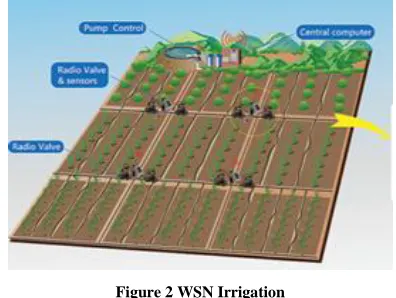
Use of proper method of irrigation is important because of irregular monsoon and less availability of ground water for agriculture and gardening. The advantage of using this method is to reduce human intervention and to ensure proper irrigation. Important aspect is to save the natural resources.
Figure 2 WSN Irrigation
Recent technological improvements have made the deployment of small, inexpensive, low-power, distributed devices, which are capable of local processing and wireless communication, a reality.
Such nodes are called as sensor nodes (slave nodes). Slave nodes coordinated with the information from a large number of other nodes, they have the ability to measure a given physical environment in great detail. Thus, a sensor network can be described as a collection of sensor nodes which co-ordinate to perform some specific action.
2.2 Need of the Proposed System
There are variety of irrigation systems exists which farmers are using for agriculture and gardening & one of the system is automatic sprinkler systems can save water if and only if they are well installed and maintained but still we cannot say utilization of water will be less. Normally people opt for automatic sprinkler systems to avoid being bothered with the irrigating to the lawns, but people just have habit to “set them in the field and after some time forget them”. Ultimately it increases the wastage of water which is not acceptable. Definitely this method of automatic watering accomplishes the task of keeping the lawn green and beautiful, but still it uses significantly more water than the grass requires. Once installed in the fields we can observe that many people uses automatic sprinkler systems have broken pipes and because of this wastage of water cannot be controlled, broken sprinkler heads may be one of the reason and human being we are tolerating these things. Sprinkler heads are also not correctly aligned as alignment is important. These problems contribute to unnecessary water wastage and especially they are unnoticed when the lawn is being watered at night while people sleep. Nowadays there is need to encourage people to be better water managers to save it, as it is a natural resource and we are observing irregular nature of monsoon. But to spread a message and make people aware about the water utilization, it is a difficult and challenging task. But as time has been passed and due to advancements in technology all irrigation controllers are programmed which is very good. In this paper authors also stated that, there needs to be a better way for controlling sprinkler systems to conserve water and every one must go for it.
[image:2.612.68.266.505.654.2]International Journal of Emerging Technology and Advanced Engineering
Website: www.ijetae.com (ISSN 2250-2459, ISO 9001:2008 Certified Journal, Volume 7, Issue 8, August 2017)
88
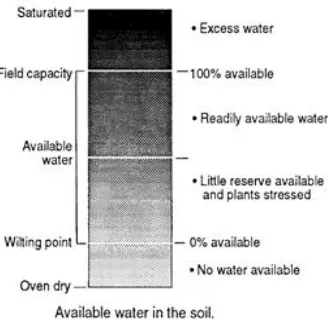
For such preemption to occur in a systematic manner Scheduling is required. E.g. priority driven scheduling can be programmed in a way that high priority task will preempts low priority tasks. With this scheduling technique the irrigation will takes place. [54]2.3 Root Zone Moisture Extraction
Good and important points noted in this article are as follows:
The best time for irrigation is the morning time when wind flow is low, water pressure is highest, demand from the plants is low, and evaporation rate ET is also low as temperature is low.
Irrigating in the evening will places water drops on the leaves for long time, which enhances various disease to the plants.
[image:3.612.325.562.229.406.2] If possible, during irrigation care has to be taken about the water level inthe soil. We can also go for additional cycle of the irrigation system to avoid the losses w.r.t. less irrigation also one should take care that excess amount of water cannot be given to plants else it will affect the production yield
Figure 3 Root Zone Moisture Extraction
2.4 Wastage of Natural Resources
In the following picture from this article it is easily observable that as we are talking about the water utilization, in all the formats / types water utilization is not taken seriously.
[image:3.612.94.258.410.572.2]In the proper irrigation system management, focus should be on conserving the water at any cost. As we are observing day to day ground water level is decreasing and drinking as well as for irrigation water required is not sufficient. In such a situation it is important to consider water as import natural resource and everyone must try to utilize it in the optimum way.
Figure 4 Existing Irrigation Systems
III. IMPLEMENTATION DETAILS
3.1 Use of WSN
International Journal of Emerging Technology and Advanced Engineering
Website: www.ijetae.com (ISSN 2250-2459, ISO 9001:2008 Certified Journal, Volume 7, Issue 8, August 2017)
[image:4.612.65.274.149.365.2]89
Figure 5 Framework of WSN
3.2 Best Water Utilization
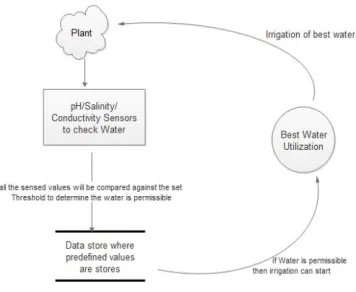
[image:4.612.362.540.154.300.2]It is assumed that any water can be given to the irrigation but it is not correct and good. As water will have its TDS, pH, Salinity etc. by which we can decide whether water is good for the production yield of the crops. Because it directly impacts on the growth of the plant / crops. Therefore in the above mentioned diagram we have shown pH, Salinity and TDS of the water can be checked at first and then if the retrieved values are permissible then only water will be irrigated to the plants. That is the ultimate one of the goal of the proposed system, we are expecting that system will immediately display message on the desktop application to the user if the values are acceptable. In our proposed system this will be the advantage that we are checking these parameters of the water and then utilizing the water. Up till now, existing systems are just focusing on the irrigation but we are focusing on the optimal utilization of best water for the crops. Ultimately these will impacts on the crop growth and production yield. As we are focusing on the calculation of the weekly, monthly, bi-monthly utilization of the water, these sensed and calculated values must be stored somewhere. In database we will store those values and at any time for analysis purpose we can fetch from the database.
Figure 6 Best Water Utilization
3.3 Storing and Retrieving Values
As we are developing a application through which we are indirectly communicating with the nodes involved in the proposed system. In the above diagram we are observing that „n‟ values will be retrieved and those will be stored in database e.g. we are using MySQL. Therefore MySQL query calls will be executed during storing and retrieving the values to and from database.
[image:4.612.327.547.451.598.2]International Journal of Emerging Technology and Advanced Engineering
Website: www.ijetae.com (ISSN 2250-2459, ISO 9001:2008 Certified Journal, Volume 7, Issue 8, August 2017)
90
3.4 X-Bee
Node connected to moisture sensor that gives off its reading in volts and Data transmits to Coordinator (receiver) node. X-CTU is a free software tool available from Digi International to interface with X-bee modules. The tool provides a GUI and terminal interface to configure the modules as well as a built in tool to test the X-bee range and reliability of packet transmissions.
Figure 8 X-Bee Device Series 2
3.4.1 X-bee data transmission
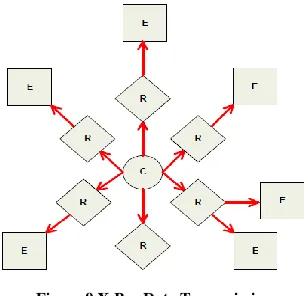
[image:5.612.336.562.189.348.2]X-Bee data packets can be transmit as either unicast or broadcast transmissions. Unicast transmissions route data from one source device to one destination device, whereas broadcast transmissions are sent to many or all devices in the network.
Figure 9 X-Bee Data Transmission
3.5 Moisture Sensing Subsystem
Following diagram is moisture sensing sub system
which shows Water Supply module, Control Station, Nodes
with Sensors. Water supply at this module we are
checking
first whether water is good for the crops or not. Then with the help of solenoid valve only that crop will be immediately irrigated where moisture level is very low.Control Station will fetch the moisture readings from sensor nodes and will invoke priority driven method which will irrigate the crop where moisture is very low.
Figure 10 Moisture Sensing Subsystem
IV. SOIL SAMPLE TESTING &RESULTS
4.1 Based on pH
[image:5.612.91.245.447.595.2]Soil samples have given to Agriculture University so that at initial we can conclude which soil sample is good as compare to other soil sample. Then we will correlate these values after applying our Priority Driven Strategy approach. Our intention is to show how priority driven approach will save the unnecessary wastage of the water and how the moisture of soil will be maintained. We will show the importance of priority driven approach in recent days where monsoon is irregular and maintaining ground water level is very important. Initial comparative results before using soil samples for the proposed system are as follows:
[image:5.612.329.558.541.682.2]International Journal of Emerging Technology and Advanced Engineering
Website: www.ijetae.com (ISSN 2250-2459, ISO 9001:2008 Certified Journal, Volume 7, Issue 8, August 2017)
91
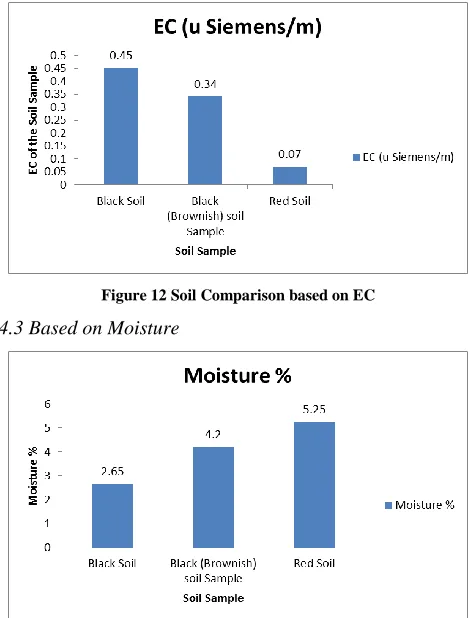
[image:6.612.49.287.162.471.2]4.2 Based on EC
Figure 12 Soil Comparison based on EC
4.3 Based on Moisture
Figure 13 Soil Comparison based on moisture
V. CONCLUSION
People says these type of systems are future needs but according to us intention behind developing such systems are the current needs as climate is changing rapidly and every citizen is responsible for preserving our nature and natural resource too. In our day to day life few good things we must adopt to reduce and managing the risks else next generations won‟t be survived. Utilization of natural resources is the important challenge and everyone should contribute to climate-resilient pathways for sustainable development. It is nothing but utilizing the natural resources in an effective way. With this regard we have proposed a system which is based on priority driven approach which proves that in wireless sensor network environment can be a better option for better crop yielding. With this WSN approach few of the nodes will acts as a sensor nodes (slaves) and two or three will acts as master nodes (processing center).
Acknowledgement
This work is supervised by Prof. (Dr.) R.C.Poonia, Amity University, Rajasthan, Jaipur & Prof. (Dr.) R.B.Naik, MIT CoE, and Aurangabad. Author thanks both of them for their continuous guidance and timely help. S.R.Durugkar also likes to thank Prof. (Dr.) Deepshikha Bhargava, Director & Head of Institution Amity Institute of Information Technology, Amity University, Rajasthan, Jaipur for her continuous guidance and help & other technical staff of institution too.
REFERENCES
[1] Chen, Hamid Al-Hamadi;Ing-Ray chen "Redundancy Management of Multipath Routing for Intrusion Tolerance in Heterogeneous Wireless Sensor networks." IEEE transactions on network and service management, vol. 10, NO. 2 (june 2013): 189-203.
[2] Chia-Pang Chen; Subhas Chandra Mukhopadhyay; Cheng-Long Chuang; Maw-Yang Liu; Joe-Air Jiang "Efficient Coverage and Connectivity Preservation With Load Balance for wireless sensor networks." IEEE sensors journal, vol. 15, no. 1 (january 2015): 48-62.
[3] Hady S. AbdelSalam; Stephan Olariu "Toward Efficient Task Management in wireless sensor networks." IEEE transactions on computers, vol. 60, no. 11 ( november 2011): 1638-1651.
[4] Hamidreza Salarian; Kwan-Wu Chin; Fazel Naghdy "An Energy-Efficient Mobile-Sink Path Selection Selection for wireless sensor networks." IEEE transactions on vehicular technology, vol. 63, no. 5 (June 2014): 2407-2419.
[5] Jing Chen, Ruiying Du; Qian Wang; Shixiong Yao "Secure Routing Based on Network Coding in Wireless sensor networks." 12th IEEE International Conference on Trust, Security and Privacy in Computing and Communications (2013 ): 58-64.
[6] Kejie Lu; Yi Qian; Mohsen Guizani; Hsiao- Hwa Chen "A Framework for a distributed key management scheme in heterogenous wireless sensor networks." IEEE transactions on wireless communications, vol. 7, no. 2 ( february 2008): 639-647. [7] Khan Mahmudul Alam,; Joarder Kamruzzaman; Gour Karmakar;
Manzur Murshed "Dynamic Event Coverage in Hybrid Wireless sensor networks." IEEE International Symposium on Network Computing and Applications (2011): 348-353.
[8] Melike Erol-Kantarci; Hussein T. Mouftah "Wireless Sensor Networks for Cost-Efficient residential energy management in the smart grid." IEEE Transactions on smart grid, vol. 2, no. 2 (june 2011): 314-325.
[9] Nicolò Michelusi; Michele Zorzi "Optimal Adaptive Random Multiaccess in Energy Harvesting Wireless Sensor Networks." IEEE transactions on communications, vol. 63, no. 4 (april 2015): 1355-1372.
[10] Rajib Rana; Wen Hu; Chun Tung Chou "Optimal Sampling Strategy Enabling Energy-Neutral Operations at Rechargeable Wireless Sensor Networks." IEEE sensors journal, vol. 15, no. 1 (january 2015): 201-208.
International Journal of Emerging Technology and Advanced Engineering
Website: www.ijetae.com (ISSN 2250-2459, ISO 9001:2008 Certified Journal, Volume 7, Issue 8, August 2017)
92
[12] S.M.Nandhagopal; S.N.Sivanandam "Reliable Data Delivery inMobile Adhoc Networks Using Light Weight Verification Algorithm with High Node Mobility." International Journal of Innovative Technology and Exploring Engineering (IJITEE) ISSN: 2278-3075, Volume-2, Issue-5 (April 2013): 176-180.
[13] Weiqiang Xu; Yushu Zhang; Qingjiang Shi; Xiaodong Wang "Energy Management and Cross Layer Optimization for Wireless Sensor Network Powered by Heterogeneous Energy Sources." IEEE transactions on wireless communications, vol. 14, no. 5 (may 2015): 2814-2826.
[14] Xufei Mao; Yunhao Liu; Shaojie Tang; Huafu Liu; Jiankang Han; Xiang-Yang Li "Finding Best and Worst k-Coverage Paths in multihop wireless sensor networks." IEEE transactions on parallel and distributed systems, vol. 24, no. 12 ( december 2013): 2396-2406.
[15] Yibo Chen "Routing algorithm dedicated to environmental data." Thesis. 12 Nov 2015.
[16] Manijeh Keshtgari; Amene Deljoo "A Wireless Sensor Network Solution for Precision Agriculture Based on ZigBee Technology." Scientific Research Publications (January 2012): 25-30.
[17] Government of India "Agricultural Statistics 2014",. Summarized Report. New Delhi: Oxford University Press, 2014.
[18] Government of India "Statistics Related to Cliamte Change India - 2015", Statistical Report. New Delhi: Ministry of Statistics and Programme Implementation, 2015.
[19] Guillaume Lacombe; Matthew McCartney "Uncovering consistencies in Indian rainfall trends observed." Springer (18 January 2014): 01-13.
[20] P. Guhathakurta; M. Rajeevan “Trends in the rainfall pattern” research Report. Pune: National Climate Centre, 2006.
[21] Waltenegus Dargie; Christian Poellabauer (2010). Fundamentals of Wireless Sensor Networks. Chichester, West Sussex,United Kingdom: John Wiley & Sons Ltd.
[22] Holger Karl; Andreas. Wilig (2005). Protocols and Architecture for Wireless Sensor Networks. Chichester,West Sussex,united kingdom: John Wiley & Sons Ltd.
[23] Kazem Sohraby; Daniel Minol;Taieb Znati (2007) Wireless Sensor Networks: Technonolgy,Protocols and Applications. New Jersey: John Wiley & Sons Inc.
[24] Anna Hac (2003). Wireless Sensor Network Designs. Chichetsre,West Sussex, United Kingdom: John Wiley & Sons Ltd. [25] M.A.Labrador; P.M.Wightman (2009). Topology control in Wireless
Sensor Networks. Tampa FL, USA: Springer.
[26] Ananthram Swami; Qing Zhaho; Yao-Win Hang, Lang Tang (2007). Wireless Sensor Networks Signal Processing and Communications Perspectives. Chichester.West Sussex, United Kingdom: John wiley & Sons Ltd.
[27] Goldsmith; Andrea (2004). Wireless Communications. Standford University: Standford University.
[28] Stojmenovic; Ivan (2002). Handbook of Wireless Networks and Mobile Computing. University of Ottawa: John Wiley & Sons Inc. [29] D P Mishra; Ramesh Kumar (2015). Qualitative Analysis of
wireless sensor network Simulators. IJCA, 11-18.
[30] Jerry Wright; Dave Wildung;Terry Nennich (2012). Irrigation Considerations and Soil Moisture Monitoring Tools. University of Minnesota.
[31] Gadgil Sulochana (2013) The Indian monsoon and its variability. Clouds, climate and Tropical Meteorology ICTS,CAOS.
[32] M.D.Dukes; L.Zotarelli; G.D.Liu; E.H. Simonne (2015) Principles and Practices of Irrigation Management for Vegetables. IFAS University of Florida, 01-15.
[33] J. Anguilar; D.Rogers; I.Kisseka. Irrigation Scheduling Based on Soil Moisture Sensors and Evapotranpiration. Kanas: Kanas State University, 2015.
[34] Davood Izadi; Jemal Abawajy; Sara Ghanavati "An Alternative Node Deployment Scheme for WSNs." IEEE (2015): 667-675. [35] Bahia Zebbane; Manel Chenaiit; Nadjib Badache "RTCP :
Redundancy aware Topology Control for WSN." IEEE (2014): 1-6.
[36] Chih-Ming Hseih; Farzad Samie; M.Sammer Srouji
"Hardware/Software Co-design for A WSN Platform." ACM (2014): 01-10.
[37] Milos Blagojevic;Majid Nabi; Teun hendriks, Twan Basten; Marc Geilen "Fast Simulation Methods to Predict WSN Performance." ACM (2009): 41-48.
[38] R.Poornachandran; H.Ahmad; H.cam "Energy-Efficient Task Scheduling for WSN with Multiple Sensing Units." IEEE (2005): 409-414.
[39] Hock Guan Goh; Hsian Kwong; Craig Michie; Ivan Andonovic "Performance Evaluation of Priority Packet for WSN." IEEE (2008): 494-499.
[40] Yanwei Wu; Xiang-Yang Li; YunHao Liu; Wei Lou "Energy Efficient Wake Up Scheduling for Data Collection and Aggregation." IEEE (2010): 275-287.
[41] Hassan Harb; Abdallah Makhoul,; Rami Tawil; Ali Jaber "Energy Efiicient Data Aggregation and Transfer in Periodic Sensor Transfer." IET Wireless Sensor Systems (2014): 149-158.
[42] Liu Qianlin; ZHAO Dongfeng "Priority Polling Strategy for Wireless Sensor Networks." IEEE (2009): 4062-4065.
[43] Hari Rangarajan; J.J.Garcia-Luna-Aceves. "Reliable Data Delievery in Event Driven Wireless Sensor networks." IEEE (2004): 232-237. [44] Hari Prasad Gupta; S.V.Rao; T.Venkatesh "Sleep Scheduling for
Partial Coverage in Heterogenous Wireless Sensor Networks ." IEEE (2013): 01-10.
[45] Haibo Zhang; hong Shen "Balancing Energy Consumption to Maximize Network Lifetime in Data-Gathering Sensor Networks." IEEE (2009): 1526-1539.
[46] Mohammed Ebada; Husein T. Mouftah "Traffic Splitting Protocol for Multipath Routing in Wireless Sensor Networks ." IEEE (2011): 503-507.
[47] Aditi Chatterjee; Debaprasad Mukharjeee "Reliable Multipath Wireless Sensor Network Routing Protocol Scheme for Network Lifetime Maximization." IEEE (2014): 64-68.
[48] V Sundaram; Saurabh Bagchi; Yung-Hsiang Lu; Zhiyuan Li "SeNDORComm: An Energy Efficient Priority Driven Communication Layer for Reliable Wireless Sensor Networks." IEEE (2008): 23-32.
International Journal of Emerging Technology and Advanced Engineering
Website: www.ijetae.com (ISSN 2250-2459, ISO 9001:2008 Certified Journal, Volume 7, Issue 8, August 2017)
93
[50] Fatma Bouabdallah; Nizar Bouabdallah; Raouf Boutaba "OnBalancing Energy Consumption in Wireless Sensor Networks." IEEE (2009): 2909-2924.
[51] Hock Guan Goh; Kae Hsiang Kwong; Craing Michie; Ivan Andonovic "Performance Evaluation of Priority Packet for WSN." IEEE (2008): 494-499.
[52] R.Poornachandran; H.Ahmad; H.Cam. "Energy Efficient Task Scheduling for WSN Nodes with Multiplt Sensing Units." IEEE (2005): 409-414.
[53] Sohini Roy; Ayan Kumar Das "Energy Efficient Clster Based routing Protocol for WSN." IEEE (2014): 25-29.