International Journal of Emerging Technology and Advanced Engineering
Website: www.ijetae.com (ISSN 2250-2459,ISO 9001:2008 Certified Journal, Volume 5, Issue 9, September 2015)
142
Usage Based Method for Fixed Cost Allocation in Deregulated
Energy Markets
S. L. Shaikh
1, L. I. Shaikh
21Assistant Professor, W.C.E.Sangli, Maharastra, INDIA.
2Researcher, W.C.E.Sangli, Maharastra, INDIA.
Abstract-- The use of game theory may be extended to assess the performance of the existing usage based methods. Such methods are widely used by the independent system operators so as to charge the market participants regarding the power system fixed cost.
This paper seeks to assess the usage based allocations regarding the core of the game.
As already stated an allocation that belongs to the core is more likely to be accepted by the market participants. Furthermore, a new method which finds core points from usage based methods is presented.
Keywords-- game theory,deregulated energy markets
I. INTRODUCTION
The fixed cost allocation as cost game
Generally, a cost allocation problem may be formed either as savings or as cost game. The latter means that the characteristic function value represents the costs caused by any coalition. In the case of fixed cost allocation game the characteristic function value of the cost game is given by:
Where c (S) is the costs allocated to the coalition S. The only difference is that the solution of cost game is the amount that each player has to pay while the solution of a savings game is the amount towards a more proper definition of stand-alone usage may result in an improved incorporation of cooperative game theory in fixed cost allocation problem.
That is abstracted from the stand-alone payment of a player. In any case, the final payment for each player is the same no matter which kind of game, savings or cost, is applied.
II. ATHREE PLAYERS’ PARADIGM
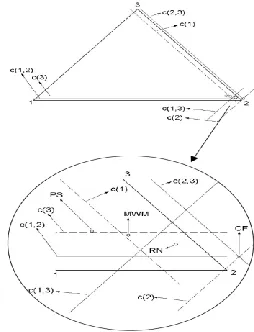
In order to assess the performance of usage based allocations, regarding the core of the game, a paradigm with three transactions is considered. The marketplace is the AC 10-bus test system illustrated in Figure 1. The first transaction injects 15 MW at node 1 and withdraws them at node 2. The agent of the second transaction coordinates a purchase of 275 MW produced at node 3 and delivered at node 7. The third transaction involves the injection of 15 MW at node 10 and their take-over at node 4. This game, played as cost game, is geometrically illustrated in Figure 1. The core of the game embraces a limited space because of the large difference between the second transaction and the other two. This place is confined by all the lines corresponding to characteristic function value of one or two players’ coalitions.
In order to make this allocations comparable to the game
the total amount K, is set equal to the cost of grand
coalition c(N). These allocations are then located in the
imputation space of the fixed cost allocation game. As can be seen, only the allocation resulted by zero counter flow method is placed into the core. The counter flow method allocation is located outside the triangle because player one is charged with a negative amount.
Although that some of the usage based methods do not yield core allocations such allocations may be obtained by combining several usage based methods. In paradigm of the three transactions, a convex combination of postage stamp and MW-mile method results in points those are located along the dashed line. A part of this line is inside the core.
International Journal of Emerging Technology and Advanced Engineering
Website: www.ijetae.com (ISSN 2250-2459,ISO 9001:2008 Certified Journal, Volume 5, Issue 9, September 2015)
[image:2.612.103.216.140.331.2]143
Figure 1 Core of a three transactions game
III. CORE POINTS FROM USAGE BASED ALLOCATIONS
Let Ω be the set of usage based allocations and j κ i the
allocation to the i-th player by the j-th method. In order to
find allocations that are as central to the core as possible, the algorithm of (4.18) is used. This algorithm calculates the nucleolus of the game and so maximises the dissatisfaction of the most unhappy coalition. This will be also the criterion so as to find the optimal combination of
the usage based methods. Each method j is weighted by a
factor wj which varies between zero and unit. The cost yi
allocated to any player i will be a convex combination of
the weighted allocations obtained by the different usage methods. These prerequisites are summarized as follows:
---1
The conditions of 1 are incorporated in and the linear program which calculates the optimal combination of the usage based methods is formulated as follows:
---2
The resulting allocation vector y is called restricted
nucleolus (RN).
[image:2.612.370.497.225.391.2]The set of the three methods that are outside the core is considered, i.e. Ω = {PS,MWM,CF}. The method results in the weights wPS = 0, wMWM = 0.573, wCF = 0.427.
[image:2.612.65.218.518.587.2]Figure 2 illustrates the restricted nucleolus as well as the three usage based methods.
Figure 2 The restricted nucleolus placed in the core.
The above presented procedure places the restricted nucleolus into the core of the game if the topology of the usage based methods enables this placement. Otherwise, this method brings the restricted nucleolus as close as possible to the core. In order to obtain a unique solution through (4.44) the allocations obtained by the usage based methods must be linearly independent. Furthermore, the number of players must be at least equal to the number of methods in order to have enough equations to determine a unique solution.
In case that the set of methods consists of the MW-mile, counter flow and zero counter flow methods the allocations are not linearly independent. Assuming, for simplicity, that K = Cl = 1, the usage measured by these three methods are:
---3 From (4.45) one easily finds out that
International Journal of Emerging Technology and Advanced Engineering
Website: www.ijetae.com (ISSN 2250-2459,ISO 9001:2008 Certified Journal, Volume 5, Issue 9, September 2015)
144 ---4
The set of these three methods is not linearly independent.
Therefore, in the framework of the proposed method, it is not possible the synchronous use of these three methods.
IV. NUMERICAL RESULTS
One of the central issues by such a system is the choice of the proper usage based method. The new method provides the flexibility to the network operator of using a synthesis of usage based methods by adjusting the optimal weights.
In order to illustrate further this method and investigate its possible application mode a case with seven transactions is considered. Each transaction corresponds to an agent and so there are seven players in the game. The marketplace is the 14-bus test system shown in Figure 3.
[image:3.612.335.554.162.312.2]From the usage based methods, the following triples can be formed: {PS,MWM,CF},{PS,MWM,ZCF} and {PS, CF,ZCF}. Neither the set {PS,MWM,CF,ZCF} nor the triple {MWM,CF,ZCF} can be incorporated in the method because of the linear dependency of MW-mile, counter flow and zero counter flow methods.
Figure 3 The 14-bus test system
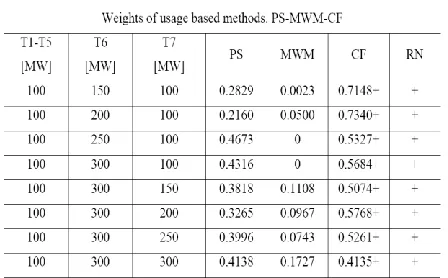
Table 1
It is essential to examine the performance of the suggested method by different load patterns. Therefore, eight different cases are taken into account. In all the cases, the power traded by each of the first five transactions is fixed to 100 MW. The power of the sixth transaction varies from 150 MW to 300 MW keeping the seventh transaction fixed to 100 MW. The sixth transaction is fixed when it reaches the 300 MW and then the seventh transaction increases the delivering power, in steps of 50 MW, up to 300 MW.
[image:3.612.333.557.492.631.2]Defining the eight different load patterns the fixed cost allocated to each agent by each usage based method is estimated.
International Journal of Emerging Technology and Advanced Engineering
Website: www.ijetae.com (ISSN 2250-2459,ISO 9001:2008 Certified Journal, Volume 5, Issue 9, September 2015)
145
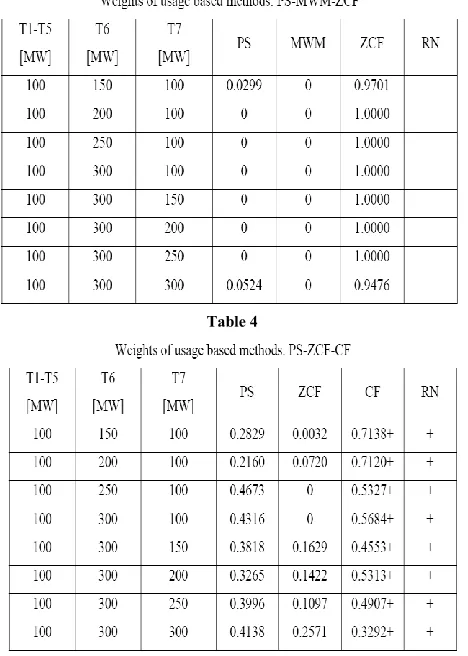
[image:4.612.52.286.154.482.2]Table 3
Table 4
Then, for all the load patterns, the suggested method is applied using the three triples mentioned above. The total amount K is always equal to the corresponding cost of the grand coalition c(N) . Tables1,2 and 3 show the weights of the usage based methods by applying the suggested method. The symbol + denotes that the corresponding allocation is part of the core. As can be seen, the weights are not stable.
Their spectrum becomes quite wide by changing the load patterns. This remark is applied to any triple with the exception of PS-MWM-ZCF where the zero counter flow method seems to have a dominating role. The weights’ variation has also been noticed in other networks that have been investigated in the framework of this research work.
However, from the Tables 2 and 3 it can be seen that for relative small changes in load patterns the weights may not drastically vary.
For an independent system operator it is of great significance to define a stable charging framework. For that reason, the weights should remain unchanged as much as possible. A solution to this problem is the allocation of fixed cost according to average weights. The ISO may calculate the weights corresponding to the usage based methods for any set of methods for an extended spectrum of load patterns. Then, the ISO can determine the average weight of each method. Using these average weights the ISO could charge the market participants for any load pattern. A regular updating of those weights, but not too often, taking into account the most current load patterns, would be necessary. This idea is implied in case of the three triples shown above. The average weights have been calculated and then the players have been charged for each case using those weights.
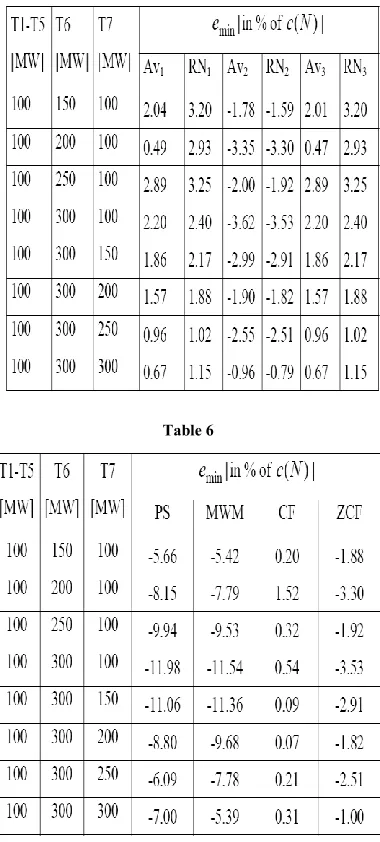
An essential criterion for the performance of any
allocation vector y is the excess e of the most
dissatisfactory coalition. In case of cost game this excess is
given as e c(S) yi . Hence, the higher the excess the more
satisfactory is the coalition.
International Journal of Emerging Technology and Advanced Engineering
Website: www.ijetae.com (ISSN 2250-2459,ISO 9001:2008 Certified Journal, Volume 5, Issue 9, September 2015)
146
[image:5.612.74.264.169.590.2]Table 5
Table 6
Since ZCF is a convex combination of MWM and CF, any triple where ZCF substitutes one of MWM and CF cannot lead to a better placement of the combined allocation in comparison to the allocation obtained by the original triple.
Thus, from all the triples investigated in the present work the most efficient is the set of postage stamp, MW-mile and counter flow methods.
REFERENCES
[1] P. Marannino, R. Vailati, F. Zanellini, E. Bompard, G. Gross, “OPF tools for optimal pricing and congestion management in a two sided auction market structure’’, in Proc. of the IEEE Power Tech 2001 Conference, 2001.
[2] S. Stoft, Power System Economics. Piscataway: IEEE Press, 2002, pp. 390-394.
[3] D. Schmeidler, “The nucleolus of a characteristic function game’’, S.I.A.M. Journal of Applied Mathematics, vol. 17, pp. 1163-1170, November 1969.
[4] L.S. Shapley, “A value for n-person games’’, in Contributions to the Theory of Games II. Princeton. Princeton University Press, pp. 307-317, 1953.
[5] J.W.M., Lima, “Allocation of transmission fixed charges: an overview’’, IEEE Trans. on Power Systems, vol. 11, pp. 1409-1418, November 1996.
[6] J. von Neumann, O. Morgenstern, Theory of Games and Economic Behavior,Princeton University Press, Princeton, 3rd Edition, 1963. [7] J. Nash, “Non-cooperative games’’, Annals of Mathematics, vol. 54,
pp. 286-295,1951.