International Journal of Emerging Technology and Advanced Engineering
Website: www.ijetae.com (ISSN 2250-2459,ISO 9001:2008 Certified Journal, Volume 5, Issue 6, June 2015)
487
Improvement in Performace of Advanced Encryption Standard
Algorithm Using SLSB
Renu Yadav
1, Dr Nasib Singh Gill
21M.Tech Student, 2Professor, Department of Computer Science and Application, M.D University Rohtak, Haryana, India
Abstract: -Most companies and government agencies have a dire need for protecting sensitive information. Encryption, access restriction, and locking documents behind firewalls are some common techniques for protecting sensitive information. Encryption is an effective way for preventing an unauthorized person from viewing the content of a sensitive document. Nonetheless, once the document is decrypted for viewing using the secret key, an ill-intentioned authorized person can save, copy, print, or transmit the unencrypted document anywhere he or she wants without any major difficulty. Many algorithms are invented by researcher for avoidance of risk. One of them is AES algorithm which play important role for better security. In this paper we study about an invention on AES algorithm using SLSB technique. This technique is applied directly on output of AES algorithm. AES is implemented in two ways one is using standard key and other using private key of RSA algorithm. Finally we compare the both results.
Keyword: Encryption, RSA, AES, SLSB
I. INTRODUCTION
Cryptography is best method to protect data and Important files from unauthorized parties. It is the science of writing the data in secret code and about the design and analysis of mathematical techniques that is enables secure communication in the presence of millions adversaries. Cryptography is the art of secret writing [1, 2]. The basic service provided by cryptography is the ability to send information between participants in a way that prevents others from reading it [6]. Cryptographic systems involve both an algorithm and a secret value. The secret value is known as the key [3, 4]. The reason for having a key in addition to an algorithm is that it is difficult to keep devising new algorithms and it will allow reversible scrambling of information’s.
Symmetric cryptography's distinctive feature is the use of the same key (hence symmetric) for encryption and decryption [5]. The key represents therefore a shared secret between two (or more) parties that wish to communicate. A Symmetric Encryption (SE) scheme is a 6-tuple (K; P; C; KeyGen; Enc; Dec) defined as follows.
Table I
Symmetric Encryption scheme
K The key space.
P The set of messages to be encrypted, or plaintext space.
C The set of the messages transmitted over the channel, or ciphertext space.
KeyGen A probabilistic key generation algorithm that takes as input a security parameter 1 and outputs a
key 2 K.
Enc A deterministic encryption algorithm that receives as input a key 2 K and a plaintext - 2 P and
returns a ciphertext 2 C.
Dec A deterministic decryption algorithm that receives as input a key 2 K and a ciphertext 2 C and
outputs a plaintext - 2 P.
Symmetric schemes are commonly called ciphers. The first cipher known dates back to the Romans: there is evidence of Julius Caesar using this method to communicate with his generals, hence the scheme is usually referred to as \Caesar cipher" [7]. It consists simply of shifting the letters in a message by a certain number of positions. Modern ciphers are divided into two families: stream ciphers and block ciphers.
International Journal of Emerging Technology and Advanced Engineering
Website: www.ijetae.com (ISSN 2250-2459,ISO 9001:2008 Certified Journal, Volume 5, Issue 6, June 2015)
488
II. RSA
RSA based on a public key system that is generated by Ron Rivest, Adi Shamir, and Leonard Adleman in 1978 [9]. Three basic steps are required to complete the process of RSA operations that are; key generation, encryption and decryption. First, messages are converted to numbers (integers), and then the numbers are manipulated according to the prescribed encryption scheme. Here is the description of the RSA cryptosystem. For the implementation of RSA we have to follow following steps [10]:
Step 1 Firstly Choose two prime number p and q. Step 2 Then compute value of n= p x q.
Step 3 Chooses e with (e, (p − 1)(q − 1)) = 1 and computes d with de ≡ 1(mod(p − 1)(q − 1)).
Step 4 Makes n and e public and keeps p, q, d secret. Step 5 Sender encrypts m as c ≡ me (modn) and sends c to Receiver
Step 6 Bob decrypts by computing m ≡ cd (modn).
In this set up, the integer n is called the RSA modulus, e is called the encryption exponent and d is called the decryption exponent. RSA can be understood by the following example.
Consider value of p=101 and q=113, then n=11413
ᶲ (n) = 100x113=11200
Since 11200 = 26 52 7, an integer e can be used as an encryption exponent if e is not divisible by 2, 5 or 7.
(Receiver will verify (e, ᶲ (n)) = 1 by using extended Euclidean algorithm and will compute d (= e-1 mod ᶲ (n)) at the same time. Suppose Bob chooses e = 3533. Then e-1 mod 11200 = 6597 = d (which is secret)
Receiver publishes n = 11413 and e = 3533 in a directory. Now, suppose Sender wants to send the plaintext 9726 to Receiver. She will compute
c = 97263533 mod 11413 = 5761
And sends cipher text c = 5761 to Receiver over the channel.
III. ANDVANCED ENCRYPTION ALGORITHM (AES)
Advanced Encryption Standard (AES) algorithm [11] is not only for security but also for great speed.
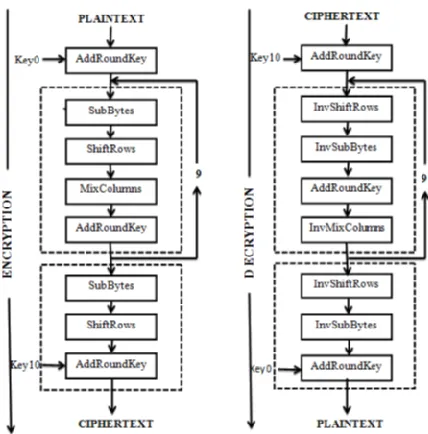
Both hardware and software implementation are faster still. New encryption standard is recommended by NIST to replace DES. Encrypts data blocks of 128 bits [12] in 10, 12 and 14 round are depending on key size as shown in Figure 1. It can be implemented on various platforms especially in small devices. It is carefully tested for many security applications.
i Algorithm Steps: These steps used to encrypt 128-bit block
1. The set of round keys from the cipher key. 2. Initialize state array and add the initial round key
to the starting state array.
3. Perform round = 1 to 9: Execute Usual Round.
4. Execute Final Round.
5. Corresponding cipher text chunk output of Final Round Step.
ii Encryption : Each round consists of the following four steps [13]:
1. Sub Bytes: The first transformation, Sub Bytes, is used at the encryption site. To substitute a byte, we interpret the byte as two hexadecimal digits. 2. Shift Rows: In the encryption, the transformation
is called Shift Rows.
3. Mix Columns: The Mix Columns transformation operates at the column level; it transforms each column of the state to a new column.
4. Add Round Key: Add Round Key precedes one column at a time. Add Round Key adds a round key word with each state column matrix; the operation in Add Round Key is matrix addition. The last step consists of XO Ring the output of the previous three steps with four words from the key schedule. And the last round for encryption does not involve the “Mix columns” step. [14]
iii Decryption: Decryption involves reversing all the steps taken in encryption using inverse functions like a) Inverse shift rows, b) Inverse substitute bytes, c) Add round key, and d) Inverse mix columns.
International Journal of Emerging Technology and Advanced Engineering
Website: www.ijetae.com (ISSN 2250-2459,ISO 9001:2008 Certified Journal, Volume 5, Issue 6, June 2015)
[image:3.612.197.411.134.351.2]489
Fig 1 AES Encryption and Decryptionon
IV. OBJECTIVE OF RESEARCH WORK We shall follow these objectives as following:
1) Study cryptography concept in security
mechanism.
2) Implement RSA algorithm on a plain text and this
will generate public & private key.
3) Use private key of RSA as encryption key for AES algorithm.
4) Ciphertext generated by AES is taken as input of
SLSB technique and encrypted text is further encrypted.
5) Now implement AES algorithm with standard key
and generate encrypted text of plaintext.
6) This encrypted text is further as input of SLSB technique. SLSB generate final ciphertext of plaintext.
International Journal of Emerging Technology and Advanced Engineering
Website: www.ijetae.com (ISSN 2250-2459,ISO 9001:2008 Certified Journal, Volume 5, Issue 6, June 2015)
490
V. FLOWCHART OF RESEARCH WORK
VI. RESULTS
PLAIN TEXT
ENTER VALUE OF p & q
FOR PROCESSING
IMPLMENT RSA
ALGORITHM
IMPLEMENTATION RSA
ALGORITHM
IMPLEMENTATION RSA
ALGORITHM
PUBLIC & PRIVATE KEY
GENERATE
IMPLEMENTATION RSA
ALGORITHM
IMPLEMENTATION RSA
ALGORITHM
APPLY AES
ALGORITHM ON GIVEN
TEXT USING PRIVATE
KEY OF RSA
IMPLEMENTATION RSA
ALGORITHM
IMPLEMENTATION RSA
ALGORITHM
ENCRYPTED MESSAGE
IMPLEMENTATION RSA
ALGORITHM
IMPLEMENTATION RSA
ALGORITHM
APPLY SLSB FOR
STENOGRAPHY
IMPLEMENTATION RSA
ALGORITHM
IMPLEMENTATION RSA
ALGORITHM
Private keyaccessed
IMPLEMENT AES
ALGORITHM
FOLLOW STANDRAD
PROCESS FOR
ENCRYPTION
ENCRYPTED MESSAGE
APPLY SLSB FOR
STENOGRAPHY
RESULTS
RESULTS
International Journal of Emerging Technology and Advanced Engineering
Website: www.ijetae.com (ISSN 2250-2459,ISO 9001:2008 Certified Journal, Volume 5, Issue 6, June 2015)
International Journal of Emerging Technology and Advanced Engineering
Website: www.ijetae.com (ISSN 2250-2459,ISO 9001:2008 Certified Journal, Volume 5, Issue 6, June 2015)
492
VII. CONCLUSION
From the introduction it has been concluded that the Cryptography provides the confidentially, privacy and secrecy in unsecure communication channel. Literature Survey has been successfully carried out and objectives have also been drawn. Cryptography provides solution for data integrity, authentication and non-reproduction. The proposed algorithm has been compared with other algorithms and found that throughput of proposed algorithm is greater than other encryption algorithms. More several systems can also be optimizing if multiple keys can be used. Future work will be carried out to decrease the complexity of the proposed algorithm.
REFERENCES
[1] W. Stallings; “Cryptography and Network Security” 2nd Edition, Prentice Hall, 1999
[2] Bruce Schneir: Applied Cryptography, 2nd edition, John Wiley & Sons, 1996
[3] Cryptography and Network Security – Behrouz Forouzan
[4] D. R. Stinson, “Cryptography Theory and Practice”, 3rd edition Chapman Hall, Vol. 1, pp. 13-37, 2006.
[5] S. Verma, R. Choubey and R. Soni, “An Efficient Developed New Symmetric Key Cryptography Algorithm for Information Security”, International Journal of Emerging Technology and Advanced Engineering, Vol. 1, pp. 18-21, 2012
[6] J. Daemen and V. Rijmen, “The Design of Rijndael: AES - The Advanced Encryption Standard”, Springer, 2002
[7] M. N. Islam, M. M. H. Mia, M.F. I. Chowdhury and M.A. Matin, “Effect of Security Increment to Symmetric Data Encryption through AES Methodology”, International Conference on Software Engineering, Artificial Intelligence Networking and Parallel Distributed Computing, Vol. 1, pp. 291-294, 2008.
[8] J. Daemen and V. Rijmen, The Design of Rijndael: AES - The Advanced Encryption Standard", 2009
[9] R.L. Rivest, A. Shamir, and L.M. Adleman, “A method for obtaining digital signatures and public-key cryptosystems”, Communications of the ACM (2) 21, 120-126, 1978
[10] Nuh Aydin, “Public Key Cryptography and the RSA Cryptosystem”, National Science Foundation, NSF CCLI Grant (DUE 0618252) [11] Rohan Rayarikar, Sanket Upadhyay, Priyanka Pimpale, “SMS
International Journal of Emerging Technology and Advanced Engineering
Website: www.ijetae.com (ISSN 2250-2459,ISO 9001:2008 Certified Journal, Volume 5, Issue 6, June 2015)
493
[12] M.Anand Kumar and Dr.S .Karthikeyan, “Investigating the Efficiency of Blow-fish and Rijndael (AES) Algorithms”, I. J. Computer Network and Information Security, 2012
[13] M. Alqdah and L.Y. Hui, “Simple Encryption and Decryption Algorithm”, International Journal of Computer Science and Security, Vol. 1, pp. 14-17, 2008