Journal of Criminal Law and Criminology
Volume 42
Issue 1
May-June
Article 3
Summer 1951
Crime and the Constitution Human: A Survey
Richard M. Snodgrasse
Follow this and additional works at:
https://scholarlycommons.law.northwestern.edu/jclc
Part of the
Criminal Law Commons,
Criminology Commons, and the
Criminology and Criminal
Justice Commons
This Article is brought to you for free and open access by Northwestern University School of Law Scholarly Commons. It has been accepted for inclusion in Journal of Criminal Law and Criminology by an authorized editor of Northwestern University School of Law Scholarly Commons.
Recommended Citation
CRIME AND THE CONSTITUTION HUMAN:
A SURVEY
Richard M. Snodgrasse
The author was formerly Curator of Anthropology in the University of Chicago. At present he is a member of the staffs of the Department of Dentistry, the Gradu-ate School of Medicine, University of Pennsylvania, of the Department of Anthro-pology in the same University, of the Philadelphia Center for Research in Child
Growth and the Children's Hospital of Philadelphia.
This paper was a contribution to the program of the International Congress of Criminology in Paris, September, 1950.
Citations in the text refer to the bibliography at the end of this article-alpha-betically arranged.EDITOR.
The common belief that body build is somehow related to function not only in general behavior, temperament, and disease as well as in socially unacceptable acts finds expression in folk-saying, verse, clinical observation, etc. Thus Shakespear's Caesar reflects:
"Let me have men about me that are fat; Sleek-headed men, and such as sleep o' nights; Yon Cassius has a lean and hungry look;
He thinks too much; such men are dangerous."
And E. A. Robinson's
Miniver Cheevy, child of scorn
Grew lean while he assailed the seasons; He wept that he was born
And he had reasons.
The aim of the present paper is to survey the extent to which American investigators continue to rely on constitution, especially body build, and other morphological traits, in the study of crime causation. The period involved will be that from about the beginning of World War II in 1939 to the present.
Historically, the term constitution has usually denoted body build as produced by internal factors. Awareness of external influences-especially nutrition-on body build has, however, long affected discus-sions of human constitution. The most inclusive definition of consti-tution is that by Tucker and Lessa (1940) as "the sum total of the morphological, physiological, and psychological characters of an indi-vidual, with additional variables of race, sex, and age, all in large part determined by heredity but influenced in varying degrees by environ-, mental factors, all of which, when integrated and expressed as a single biological entity, fluctuate in varying degrees over a wide range of
'abnor-CRIME AND THE CONSTITUTION HUMAN
mality' or pathology." A similar definition of constitution, though not so adequately phrased, is that by Draper, Dupertuis, and Caughey
(1944, pp. 1, 15) who equate (p. 2) constitution with personality.
BRIEF HISTORY
American interest in the possible relation between constitution and crime appeared as early as the late 1920's, but has not developed so extensively as in Europe. Kretschmer's theory and typology, which had found favor among European criminologists, was applied by Mohr and Gundlach (1927 and 1929) to native White male prison inmates in Illinois. An anthropometric study of body-build among Illinois adult male prisoners was made by Gray (1934). The major study of crime and morphology is that by Hooton (1939a, 1939b) which had its incep-tion in 1926 with a study of the male prisoners in Massachusetts county jails and, eventually, was extended to include male criminals in ten regionally distributed states. The most recent report on crime and constitution is Sheldon's (1949) Varieties of Delinquent Youth' the advent of which was indicated in his The Varieties of Temperament' (1943). The foundation for the later studies was published as The
Varieties of Human Physique (1940). 1 Minor studies of the relation between crime and morphology are those which concern only one or, at most, a very few traits-usually defects-in relation to delinquent behavior. Within this category belongs Kilmer's (1932) report that 44 per cent of a group of criminals has " 'flap' " ears against 23 per cent in a control sample.
A most significant study for the problem of crime and the constitu-tion, since the obverse facet of behavior is presented, is that by Damon (1946) on the subject of physique and achievement in military flying. Almost equally important is Seltzer's (1946) "Study of body dispro-portions and dominant personality traits."
Another approach to the relation of morphology and behavior is that of factor analysis by which one or a few "weighted" factors represent an entire set of dimensions (Thurstone, 1946, 1947).
THEORIES, METHODS, AND TECHNIQUES
Many, if not the majority, of the theories, methods, and techniques used by American students of crime and constitution have been adopted from*European sources and modified or supplemented when advisable. Kretschner's essentially inspectional technique of classifying body
1. Hereafter designated by the abbreviations: vDn, vr and vHP, respectively.
RICHARD M. SNODGRA4SSE
build, which was objectified by a few measurements, was adopted by Mohr and Gundlach (1927, 1929-1930) and used in conjunction with a battery of psychological tests.
A covert premise that the body-build of convicts may be more or less distinctive apparently underlies Gray's (1934) study of Illinois convicts. Measurements of head and body were taken according to anthropometric technique as prescribed by Hrdlicka.
The major premise of Hooton's study of the American criminal is that the behavior of the various kinds of animals is, in a general way, an expression of their specific structure; likewise, the behavior of Man, subject to individual variation and some environmental modification, is a function of structure. Further,
"It may . . .be postulated that different physical racial types of man will display mental and emotional qualities diverging one from another, in conformity to their respective peculiarities of physical organization which are of hereditary origin . . . Again, since different types of criminal acts are obviously the results of diverse motives and widely different psychological causes, it is clear that any physical or mental differentiation of the criminal should manifest itself amongst criminals classified according to their types of offense, as well as between criminals as a group and non-criminals." (CM,2 pp. 7, 9-10)
The specific problem considered by Hooton is whether the physical characteristics of criminals are related to anti-social conduct. (The extent to which such conduct is influenced by mental sufficiency or insuffi-ciency, or by mental health, or by social milieu was not part of the investigation.) The methodology and techniques used in the research are those of physical anthropology. The measurements taken were essentially in accord with Martin's (1928) Lehrbuch while the stand-ards for the somatoscopic (inspectional observation or morphology) characters for the Whites, at least, were based (,C, 2 p. 37) on the modal development of each feature of the adult male of northwestern Europe. Body build was expressed by categorizing the total offense group of the native Whites of native parentage as well as that of the Negroes and Negroids, respectively, into stature-weight classes on the basis of the distribution of height and weight between plus and minus one standard deviation and beyond plus and minus one standard devia-tion.
The concepts and theories, the methods and techniques, of Sheldon represent an attempt to develop a biologically oriented psychology, i. e., an operational or constitutional psychology. The basic premise is "that behavior is a function of structure." (VDY, p. 3.) Structure and
2. CM, the abbreviation for CRIME AND THE MAN, will be used hereafter in referring
to that book while AC will be used as the abbreviation for THE AMERICAN CRIMINAL.
CRIME AND THE CONSTITUTION HUMAN
behavior, it is postulated, are a continuum which constitute the person-ality of the individual. To implement research in this field a methodol-ogy is required which will express this continuum in terms of compo-nents-or more aptly stated, variables-"which can be measured and quantified at both the structural and behavioral ends," i. e., "the anthropological and psychological ends." (VDY, p. xv.) The methods of constitutional psychology begin with an analysis and description of body build (physical constitution). The technique of somatotyping, a term coined by Sheldon, involves an inspectional judgment and rating of the amount of each of three components which-as is widely assumed in Europe-Sheldon believes are the constitutent parts of bodily build. The somatotype rating is expressed by a 3-digit number. The index of temperament devised by Sheldon consists of a 3-digit number, one for each component of the index; likewise, for the index of psycho-neurotic tendency. Standardized lists of structural traits have been developed for assessing each of the components of the respective indices. The implicit thesis of Damon's study may be stated as a paraphrase of that of Sheldon: performance is a function of structure. Specifically, the hypothesis is to the effect that physical traits may be consistently associated with success in training and combat flying. The task was to discover any such traits, to ascertain their strength and the scopo-metric3 (measui ement and observation) techniques most likely to reveal them. Groups at four levels of flying achievement were compared by: 1) standard anthropometic measurements; 2) by disproportions in certain body ratios; and 3) by Sheldon's somatotypes. Somatotypes were rated by direct inspection and height/ /weight,3 instead of the prescribed photographic techniques. (Original classification of the men into the different grades of flight personnel was chiefly by an elaborate battery of psychological aptitude tests.)
The statistical methods and techniques employed are the common statistical constants: mean, standard deviation, coefficient of variation, and probable error. For testing the significance of the difference between means, Mohr and Gundlach used the standard error of the difference while Hooton used the probable error of the difference. The product-moment coefficient of correlation was used generally. Mohr
and Gundlach employed also partial correlation while Hooton used the correlation ratio. The coefficient of mean square contingency was used by Hooton in order to test the association of pairs of qualitative characters. Adequate sampling is a basic problem, one with which Hooton was especially plagued. In Hooton's study, personal error,
3. A term employed here, but introduced by Cabot (1938).
RICHARD M. SNODGRASSE
variation due to inbred physical types within each state, age factors, etc. were all subjected to statistical check. Extensive use of frequency distribution tables is made by Sheldon who uses, also, scattergrams to show the distributions of somatotypes, indices of temperament, and the psychiatric index.
Multiple factor analysis, which involves "weighting" of factors, is a relatively recent approach to the analysis of body types (Thurstone,
1946, 1947). The major premise is that one or more linearly inde-pendent parameters or factors suffice to describe an entire set of body measurements if the latter are generally correlated. A secondary premise (Thurstone, 1947) is that one or more of these factors may be functionally related to temperamental characteristics.
BIOTYPOLOGY AND INTERPRETATION
"Our task," Hooton announces in Crime and the Man which describes and summarizes his entire investigation of the American male criminal -White, Negro, and Negroid, "is to study the physical characters of criminals for the purpose of discovering whether or not these are related to anti-social conduct." His approach is soon disclosed as essentially a metric and morphologic assay of physique-behavioral entities whose conduct is premised as organically determined for the most part. The criminal (p. 8) is "a person who is under sentence in a penal institution, having been convicted for an antisocial act punishable by imprisonment."
Data were obtained from prisoners of the county jails in Massa-chusetts as well as from the subadult and adult male prisoners in the reformatories and prisons of North Carolina, Tennessee, Kentucky, Wisconsin, Missouri, Texas, Colorado, Arizona, and New Mexico.
For control samples, criminal insane males in Massachusetts and Colorado were matched against a civil insane series; the criminal insane Negroes of North Carolina were similarly matched. Control samples for sane Negro criminals were found in North Carolina and Tennessee. The check samples for comparison with the 4,212 Old American White offenders (native whites of native parentage) consisted of 146 Nash-ville, Tennessee, firemen and 167 Massachusetts civilians, preponder-antly militiamen.
The distribution of the entire sample was: prison and reformatory inmates 10,953; county jail (Mass.) 2,004; criminal insane 743; defec-tive delinquents 173; insane civilians 1,227; sane civilians (White 909; Negro and Negroid 1,067) 1,976; total 17,076.
The data collected for each individual comprise 22 measurements and 13 indices (percental relation of one dimension to another) together
CRIME AND THE CONSTITUTION HUMAN
with 33 main categories and 72 sub-categories of morphological fea-' tures. Name, age, birthplace, birthplace of parents, occupation, educa-tion, previous convictions, length of sentence, marital status, offense, religion, race and ethnic (nationality) derivation were obtained also. Where reliable data was recorded, IQ's, mental classification, and medical pathologies were collected.
The total offense group was divided into ten categories: murder-first degree, second degree; assault; robbery; burglary and larceny;
forgery and fraud; rape; other sex offenses; versus public welfare; arson and all other offenses. Differences between the means of the measure-ments for the Old American civilians and for the total offense group of Old Americans as well as for the various offense groups with respect to the total offense group of Old Americans are shown in Hooton's tables, XI-30 and V-79 to V-88 (Ac). Scrutiny of the tables reveals that in 17 of 19 measurements, the means for the total offense group (mean age ca. 31 yrs.) are smaller than those of the civilian check sample. The total offense group differs from the total civilian group in being significantly less-i. e., 4 or more X P. E. diff.-in age (3.8 yrs.); weight (11.7 lb.) ; stature (1.0 cm.) ; in shoulder and chest breadth
by 0.4 and 0.7 cm., respectively; and in several head and face dimen-sions by 0.8-6.6 mm.a Nose breadth relative to nose length and ear breadth relative to ear length is significantly greater in the total offense group. Among five traits for which the total offense group differs from the total cavilian group by 3-4 x P. E. diff., the offense group is
smaller in three characters.
RICHARD M. SNODGRASSE
offense group in from two (for the assault group) to seven (for the versus public welfare group) traits among a total of 32 physical char-acters.
With respect to the several offense groups, Hooton found that:
* . eight of ten offense groups of criminals are anthropometrically
distinct each from the total series. In general, also, we may assert that the average bodily form of the criminal varies with the type of offense he commits." (cM, p. 70.) Further, "Native White criminals of native parentage are not only distinguished from each other by offense groups in sociological characteristics, but also in anthropometric and morphological features. Thus, it is suggested that crime is not an
exclu-sively sociological phenomenon, but is also biological." (cM, p. 75.)
Additionally, Hooton discovered (cM, pp. 366-367) that:
"The ordinary offense group distinctions which have been demonstrated in Whites
seem to obtain to a large extent in Negroes and Negroids . . . At present, I can offer no satisfactory explanation of the fact that bootleggers persistently have broad noses and short faces with flaring jaw angles, while rapists monotonously display narrow foreheads and elongated, pinched noses. It is well nigh incredible
that these features should manifest themselves alike in the Whites, Negroes, and
Negroids of these offense categories, but they in fact do."
In view of the interest in the possible association of physique and crime, which the work of Kretschner and others had stimulated, Hooton sought the expression of body-build types in the several offense groups. The Old American total offense group was classified into nine stature-weight categories. Summarizing the data, Hooton found (cM, p. 376) that: "tall, thin men tend to murder and to rob; tall, heavy men to kill and to commit forgery and fraud; undersize, thin men to steal and to burglarize; short, heavy men to assault, to rape, and to commit other sex crimes, whereas men of mediocre body build tend to break the law without obvious discrimination or preference." Burglary and larceny form the bulk of crime by all varieties of body-build. Recidivists are most frequent among those of short-slender build, but are almost as numerous among those of short-medium and those of medium-slender build. The majority of offenders among all body-types when in civilian life were engaged in extractive pursuits (agriculture, animal husbandry, forestry, fishing, and mining) ; or, secondly, in factory work, or thirdly, in unskilled labor. Contrariwise (CM, p. 339), "The marked associa-tions of body build with offense found in the Old American Whites are conspicuous by their absence in the Negroes and Negroids."
To study the relation of ethnic background to crime, Hooton classi-fied the native white criminals of foreign parentage and the foreign white criminals into nine groups: Irish; Italian; British; Scandinavian;
CRIME AND THE CONSTITUTION HUMAN
Teutonic; French-Canadian; Spanish-Portugese; Croats, Slovenes, Czechs, and Austrians; and Eastern and Near Eastern. The author reports (CM, p. 200) that criminals of these groups "are as clearly and consistently different from their comparable check samples in physical anthropological features as in their sociological features."
To investigate the association of race with crime, a racial classifica-tion of the whites was established on the basis of stature, the cephalic index, and the nasal index. Employing these criteria, 5,689 criminals-native whites of criminals-native parents, criminals-native whites of foreign parents, and foreign-born whites-were typed in one or another of the following nine categories: Pure Mediterranean; Keltic; Nordic Mediterranean; Predominantly Nordic; Pure Nordic; East Baltic; Nordic Alpine, Dinaric, and Pure Alpine. The conclusion reached (CM, pp. 250-252) is that "race is definitely associated with choice of crime, and with sociological status" and that, with the exception of the Italian, "race seems to be a stronger determinant of crime than [does] nationality." Considering Negroes, Negroids, and whites, Hooton finds (CM, pp. 335-336) that "irrespective of racial differences, rather similar anthro-pological types and persons of equivalent sociological status appear to
exercise the same criminal preferences."
The criminal insane Hooton found to differ significantly from the civil insane in deeper chests, lower relative sitting height, and longer
and narrower ears as well as in several morphological traits. A suc-cessive decrease in quality of physical and mental traits was discovered
in'a comparison of civilian sane, criminal sane, civilian insane, and criminal insane. Strong evidence was disclosed of the existence of specific racial tendencies to insanity, and particularly of insanity com-bined with criminality. (CM, pp. 270-275, 289, 383.)
Environment-which many would regard as potent, if not deter-minative, in criminal behavior-is characterized by Hooton (CM, p. 181) as: "the universal alibi for failure." Within the environment, the element common to all constitutions, the organically inadequate precipitate to their own level: "It is not inequality of oppoftunity, but inferior capacity for grasping environmental opportunity which stigmatizes the anti-social New American." (CM, p. 190) Yet,
Hooton finds (cM, p. 369) it ".. . rather difficult to avoid the
conclu-sion that a depressed physical and social environment determines Negro and Negroid delinquency to a much greater extent than it does in the case of the whites."
Seven hundred fifty tables-which bolster The Avmerican Criminal, Vol. I, and presumably similar numbers for the remaining two
RICHARD M. SNODGR4MSE
ised volumes, loom in the background of Hooton's major conclusions:
"Criminals are organically inferior. Crime is the resultant of the impact of
enviror-ment on low grade organisms [AC, I: 309] . . . within every race it is the
biologically inferior, the organically unadaptable, the mentally and physically stunted and warped, and the sociologically debased-who are responsible for the majority
of crimes committed." (cM, p. 252)
What, then, are the physical stigmata of biological inferiority which distinguish the criminal from the civilian? For the Old American criminal (CM, pp. 120, 128), it is his significant deficiency in age, stature, weight, shoulder breadth, chest breadth and depth, total face height and nose height, and height of face relative to breadth as well as his significantly greater breadth of nose relative to its height, his greater
breadth of forehead relative to facial breadth, his greater sitting
height relative to stature, his narrow jaws, and his rather small but
relatively broad ears. Similar differences were found (cM, p. 195)
between the New American criminals and civilians. Of the
measure-ments of the nine racial types of white criminals, 33.9 per cent were
significantly smaller, 8.5 per cent significantly larger, and 57.6 per cent
indifferent. The general trend of the morphological differences among
these same racial types of criminals disclosed that, compared with the
corresponding civilian check samples, the criminals
"have straighter hair, more mixed patterns of eye color, more of the various kinds of skin folds in the upper eyelid, lower and more sloping foreheads, more pointed chins, more extreme variations in the projection of cheek bones, ears with less roll of the rim, and a greater frequency of Darwin's tubercle-a cartilaginous nodule on the free margin of the ear." (cM, pp. 238, 240) Yet, Hooton is quick to emphasize (cM, p. 104) the non-existence of any such creature as a criminal type identifiable by "any rigid multiple combination of morphological
features . . . All that can be expected of the typing of criminals is that excesses
of this or that kind of offense may be demonstrated for the several type subgroups."
A barrage of criticism showered Hooton's reports. The chief items
under fire were the statistical methods and techniques, and the
infer-ences and interpretations.
From the demonstration of significant differences between the offense
group and his civilian check samples in the frequencies of a melange of
physical characters, Hooton inferred an association between such a
high frequency and criminal behavior. He then felt warranted (cM, pp.
342-343) in the inference that these characters are indicative of
bio-logical inferiority. Thus, seemingly, he arrived at the conclusion that
"criminals are organically inferior," (Ac, p. 309) and "that the
pri-mary cause of crime is biological inferiority." (CM, p. 130.)
This
physical inferiority is assumed by Hooton to be chiefly hereditary
(Ac,
I: 308) ; likewise, that these inferiors drift into unfavorable social
GRIME AND THE CONSTITUTION HUMAN
environments where the weaker among them yield to social stresses which force them into crime.
The tacit assumptions and the circular reasoning involved in the fore-going conclusions have been noted by several critics (Sutherland, 1939; Merton and Ashley-Montagu, 1940; Lessa, 1943; Reckless, 1943) and others. The obverse of Hooton's findings lends, however, some
support to his thesis. In a study of physique in relation to personality traits, Cabot (1938, p. 92) discovered that the athletosome (meso-morph in Sheldonian terminology) is superior to the average leptosome and to the pyknosome in psycho-social characteristics. Cabot, therefore, postulates "a new theory of sociobiological advantages in terms of which socio-sthenic traits and personality characteristics are associated with biologically 'good' physique."
Increased linearity of the white criminal which Hooton views as one of the stigmata of biological inferiority, certainly does not obtain among his Negro and Negroid criminals (cM, p. 353 ff.) unless comparisons are made with college Negroes and Negroids. The increased linearity of
Hooton's white criminals may involve some other factor, possibly sampling, since Mohr and Gundlach found (1929) that, even with age controlled, Illinois criminals were more robust than the average of World War I draftees; hence, the authors concluded that criminals are from the more athletic segment of the general population. These findings recall those of von Rhoden in Europe who found criminals more likely to be of athletic build than pyknic or leptosome. In a study of delinquent Chicago boys, Rosenbaum (1941) and Reynolds found Negro delinquents to be physically superior to Negro non-delinquents in the delinquency areas.4 Similarly, the 200 delinquent Boston youths studied by Sheldon (vDY) have a mean somatotype preponderant in mesomorphy with a moderate amount of endomorphy and a little ectomorphy.
On the assumption that Hooton, when he spoke of biological infe-riority, meant morphological nearness to the anthropoid apes or to primitive peoples, Merton and Ashley-Montagu (1940) proceeded to demolish the pertinent evidence they found Hooton had adduced.
The majority of the metric and many of the morphologic stigmata enumerated by Hooton have impressed the student of human growth
(cf. also Sheldon, vDY, p. 754) as chiefly symptomatic of growth failure, whether hereditary or socio-economic or both sets of influences are
4. Clifford Shaw ventured the hypothesis that in a delinquency area into which Negro families have recently immigrated, the dominant delinquent groups accept into their ranks those Negro boys most similar to them in appearance and these acquire and transmit patterns of delinquent conduct.
RICHARD M. SNODGRMSSE
causal. Well-authenticated increases in human stature and weight during the last half century or so have been described (Bowles, 1932; Shapiro, 1939; Andrews, 1943; Goldstein, 1943; and Meredith and Meredith, 1944). The consensus among observers is that increased height and weight of today's children and adults in comparison with those of previous decades have resulted chiefly from improved socio-economic and health factors. The continued presence, however, of deficient growth has been indicated by Stuart (1946, p. 202) who states that study of the growth and development of adolescents "has recently been greatly stimulated by a national realization that an unnec-essarily large proportion of American youths are handicapped by faulty development or physical defects at the time when they must begin to assume the responsibilities of adult life." The effects of neglect (Tal-bot, Sobel, and associates, 1947) as well as the results of intelligent treatment in growth failure (Wetzel, 1948) have dramatized the course and consequences of growth failure as well as of successful growth. While the factors of improved food supply and hygienic conditions are important to successful growth (Cohen and Abram, 1948; Litman and Bosma, 1948, et al.), the influence of peaceful, con-genial home and community surroundings are not to be minimized
(Talbot, Sobel, and associates, 1947; Binning, 1948; Angel, 1949). "It does appear," says Stuart (1946), "that psychologic problems in adolescence may have much to do with the rounding out of physical development in this respect [adequate growth and development of muscle] and that they deserve attention." The role of heredity in successful or unsuccessful growth is obviously important (Gates, 1946; Little, 1947; Streeter, Park, and Jackson, 1931), but must be evaluated along with environmental factors. In brief, to paraphrase Bauer (1945), heredity determines what the organism can do while environ-ment determines what it does do.
One of the major weak points, of which Hooton was aware and for which he tried to compensate statistically, in so far as possible, is the small size of the control samples, especially that for the Old American criminals. Modern sampling theory would insist that not only must the control samples be commensurate in numbers, but they should rep-resent adequately the racial, ethnic, age, geographic area, and socio-economic attributes which characterize the social stratum of the civilian population from which the offense group (s) derive. Various weak-nesses in the sampling for The American Criminal were reported by Ross (1939) ; Merton and Ashley-Montagu (1940) ; et al.
CRIME AND THE CONSTITUTION HUMAN
Old American criminal (AC, vol. 1), Wallerstein and Wyle (1947) ultimately find scarcely any connection between Hooton's data and his conclusions.
The most definitive judgment of Hooton's contribution to crim-inology is perhaps that rendered by 45 persons-psychiatrists, psy-chologists, sociologists, and a few others doing research in the field of delinquency and crime. (Reckless, 1943, p. 159.) Among the ten studies "which they believed had contributed most to the increase of our knowledge of delinquent and criminal behavior, and [ranked] in or~er of importance," Hooton's work is not named.
A more explicitly formulated and comprehensive approach than that of Hooton to crime and constitution is embraced within Sheldon's operational or constitutional psychology which, like Hooton's study, has for its thesis: "behavior is a function of structure."
The body is considered (VHF, pp. 4, 46) as comprised of three com-ponents of which the first is endomorphy (distinguished by soft round-ness), the second mesomorphy (square muscularity and skeletal mas-siveness), and the third ectomorphy (linearity and fragility of build). Each component is postulated as present to some extent in every build
(pp. 29, 47), and each component is regarded (pp. 36, 111) as dom-inated by tissue derived from the respective embryonic layers: endoderm, mesoderm, and ectoderm. Two Europeans, Huter (1880) and von Rhoden (1927), likewise, used this derivational concept, but Sheldon is responsible for its present elaboration.
Identification of the characteristics distinctive of each of the three components resulted from scrutiny of 100 selected, precisely standard-ized photographic examples of each extreme variant from the " 'aver-age' " male body in a sample of 4,000. A component is defined, then, in terms of those traits of morphological variation which distinguish one extreme variant from the others. For the study, 4,000 men of college age were photographed in accordance with rigid standards for posing, lighting, and scale. Front, back, and profile views of the nude body could be examined on the same print. (The chief traits for each somatotype (body-type) are listed in Table I, below).
RICHARD M. SNODGRASSE
1-1-7 while an individual at the midpoint in all three scales is
char-acterized as 4-4-4. Among the 343 (i.e., 73) possible combinations,
only 76 were found in actual practice and even these may be arranged
in certain basic clusters.
Recognition that the several parts of the body may exhibit different
amounts of each component led Sheldon to study the body in five
regions: 1) head, face, and neck; 2) thoracic trunk; 3) shoulders, arms,
and hands; 4) abdominal trunk; 5) legs and feet. The sum of the
regional assessments is then averaged to give the somatotype rating
for the entire body.
The qualitative assessment of somatotyping is supplemented by a
quantitative approach. Seventeen horizontal dimensions, some taken
in the antero-posterior direction and others transversely, are measured
directly on the photographic negative and expressed as percentage
ratios of stature. (Stature and weight are obtained directly.) These
seventeen indices, together with height /we-ight, are used in conjunction
with a series of tables which represent the distribution of the means
for the 76 somatotypes against the 18 anthropometic criteria.
Somatotyping may be done also by using only the measurements. A
suitably designed machine expedites the task. Much less time is
re-quired, however, for somatotyping directly from photographs and
adequately trained independent observers show a marked degree of
agreement in their ratings.
The three components-endomorphy, mesomorphy, and ectomorphy
-are
recognized by Sheldon as primary variables. Additionally, he
categorizes other variables as belonging to second, third, etc. orders.
The second order variables which he rectognizes include dysplasia,
gynandromorphy, a textural aspect, and hirsutism. Dysplasia, used
with different meaning than that given by Kretschmer, applies to
dis-harmonious mixtures of the three primary components in different
regions of the body. Measured in terms of differences among the
soma-totype ratings for the five regions of the body, the amount of total
dysplasia is evaluated against a 7-point scale. Gynandromorphy refers
to the expression of secondary sex characteristics of the opposite sex
and is rated, likewise, by means of a 7-point scale. The textural variable,
which Sheldon usually terms the t-component, is in the nature of an
aesthetic judgment as to
"
'fineness'
"
or
"
'coarseness' " of structure
and contour. A 7-point scale is used to rate it. Hirsutism-or hairiness
-of trunk, arms, and legs is rated by means of a 5-point scale.
CRIME AND THE CONSTITUTION HUMAN
mental-as well as influence reaction to pathological agents and condi-tions. Function, therefore, may be investigated at any one of several levels of manifestation.
Constitutional psychology seeks (VT) for the correlates between mental function and physique. For its goal, a basic taxonomy is re-quired by which individuality may be denoted, classified, and scaled in order to account for most of the diversity of human differences. The taxonomy of structure was developed in The Varieties of Human
Physique. That study of the size and shape of human beings comprises
the statics of constitutional psychology. The dynamics embraces the study of temperament. "When structure takes on function, when man gets up and moves around, expressing his desires and motivations and interacting with his fellows, then he becomes a dynamic organism. And the study of his behavior in its more elemental manifestations is the part of dynamics called the science of temperament." (VT, p. 4.) From this viewpoint, physique and temperament are two facets of the same thing; hence, we may "expect that the dynamics of an individual should be related to the static picture he presents."
TABLE I
PRINCIPAL CHARACTERISTICS OF EACH SOMATOTYPE5
Characteristic Endomorlihy Mesomorphy Ectomorphy
Body, general Round, soft contours; antero -posterior and
transverse diameters about equal.
Concentration Abdomen and thorax of mass predominate over ex-tremities, a b d o m e n
over thorax, thigh over lower leg and upper arm over lower arm; rounding and "'ham-ming"' of thighs and upper arms; neck short.
Head Large, almost spher-ical in pronounced en-domorphy.
Face Wide; lower face breadth approximates that of upper face; soft, round.
Contours, Smooth, muscle relief
general lacking.
5. From VHP, pp. 3745.
Square, hard contours; m u s c l e s prominent, massive; trans. diam-eters exceed ant.-post. Trunk large, but con-centration not central; thoracic segment pre-dominant over abdom-inal; distal (lower) limb segments heavy.
Size varies much; bones heavy, thick; ridges strong.
Large relative to skull; long, broad massive, bony.
Sharp, high muscle re-lief, especially deltoid
& trapezius.
Linear, fragile, deli-cate; ant.-post. & trans. diameters reduced, trans. less reduced. M a s s decentralized;
abdomen flat, short; thorax long relative to abdomen; neck long, slender.
Slight, bosses com-mon; ridges slight; occipital projection common; breadth pre-dominantly narrow relative to length Small relative to skull; features fragile; trian-gular in frontal view.
Muscle relief lacking; supra-clavicular hol-lows; "winging" of scapulae.
[image:15.505.38.406.315.610.2]RICHAIRD M. SNODGRASSE Mesomorphy Ectomorphy Limbs Bones Vertebral column Trunk
Outer contour of thigh Skin
Hair
Genitalia
Short, tapering; hands
& feet small.
Small on palpation; cortex thin in x-ray.
"S" curve weak, padded out.
Relatively long; chest wide at base; maxi-mum transverse breadth of body near iliac crest; waist high, slightly indicated;
wide angle of ribs with sternum.
Frontal and dorsal
feminine-like. Soft, smooth, velvety.
Quantity slight to me-dium; tendency to early baldness; pubic distribution pattern feminine.
Hypoplastic; u n d e
-scended testes com-mon.
Length variable; wrist & hand largo
Large, prominent; bones thick; ribs strong, heavy. Lumbar curve marked; buttocks prominent muscularity.
Thorax wide at apex; shoulders broad; waist slender; trunk long, upright; pelvis sturdy, hips broad; waist low;
abdominal muscles strong, prominent.
Rugged, masculine.
Thick, coarse; large pores; connective tis-sue heavy; wrinkling heavy, coarse.
Coarse; luxuriant to sparse; hair growth slow.
Well-developed, com-pact.
Temperament is defined (VT, p. 4) as "the level of personality just
above physiological function and below acquired attitudes and beliefs. It is the level where the basic patterns of motivation manifest them-selves."
Search among several hundred alleged traits of temperament for the criteria requisite for a taxonomy of temperament resulted even-tually in the standardization of sixty traits. Use of correlation tech-niques in standardizing the sixty and in exploring their relationships re-vealed that they fall into three clusters of twenty each. The traits within each cluster correlate positively with each other and negatively with those of the other clusters. Collectively, these traits form the scale for assessing the seemingly three primary components of tem-perament.
Fiscerotonia, the first component, is characterized in its extreme
form by general relaxation; sociability; by love of physical comfort, food, the company of others, and for the affection and approval of
Characteristic Endomorphy
Relatively long, espe-cially in distal (lower)
segment; weak thighs
& upper arms; hands
& feet long.
Small, delicate; ribs delicate, prominent; thin in x-ray.
Lumbar curve flat, high; thoracic curve sharp, high.
Trunk short relatively; shoulder droop con-stant; acute angle of ribs with vertebrae.
Weak; relief scant or lacking.
Thin, dry; elastic & connective tissue scant; fine wrinkling early.
Fine; grows rapidly; baldness rare; pubic distribution variable.
Linear, relatively hy-pertrophic.
[Vol. 42
CRIME AND THE CONSTITUTION HUMAN
others. "The motivational organization is dominated by the gut
and by the function of anabolism .... The digestive tract is king, and
its welfare appears to define the primary purpose in life." (VT, p. 10.)
Somatonia, the term applied to the second component, is distinguished
by muscular activity as revealed by vigorous assertiveness of posture and movement, "by aggressiveness, general noisiness, by the love to dominate and the lust for power." The organization of motives is dominated by the somatic muscular system. (VT, p. 26.)
Cerebrotonia, the third component, is marked by restraint in posture
and movement, by inhibition, the desire for privacy, and by hyperatten-tiveness. The motivational organization appears to be antithetical to that of the other two components.
(Exaggerated manifestations of the components as revealed by mal-adaptive or inept behavior are termed, respectively: viscerosis,
somato-rosis, cerebrosis. Similarly, visceropenia, somatopenia, and penia refer to deficiencies of viscerotonia, somatotonia, and
cerebro-tonia).
The degree of each primary component present in an individual is rated against a 7-point scale, with 1 the minimum. The component values are then combined to give an index of temperament similar to the rating for a somatotype.
For 200 White college males the correlations between the two levels of personality (morphological and temperamental) were: endomorphy with viscerotonia,
+
.79, mesomorphy with somatonia,+
.82; and ectomorphy with cerebrotonia, + .83. (VT, p. 401.) Thus thecorre-lation between physique and temperament appears considerably higher than one might suspect. (In a sample of 260 young adult males attend-ing Harvard University, Seltzer, Wells, and McTernan (1948) found 51-i.e., 19.6 per cent-dominantly ectomorphic and that for 84 per cent of the 51-a statistically significant result-the dominant trait of temperament was cerebrotonia.)
In his latest volume, Varieties of Delinquent Youth, Sheldon announces (p. 85): "The main purpose of this book is to contribute
to a psychology adequate ... to describe and interpret human
RICHARD M. SNODGRASSE
which necessitate institutional care; neither organic nor functional are specified. The secondary order is that of the psychoneuroses for which institutional care is not required.
The primary components of the index, which are rated against a 7-point scale, are: manic-depressive, paranoid, and heboid. The com-plete manic-depressive would have a psychiatric index of '7-1-1 which would fall as nearly as possible to the 7-7-1 somatotype if there were such a somatotype. Such an individual would be so much over-endowed with viscerotonia and somatonia that it would be impossible to achieve any kind of effective or adaptive integration of his agitated impulses. (The symbol P is placed before the psychiatric index in order to dis-tinguish this index from a somatotype rating.) The totally paranoid, characterized by p1-7-1, coinsides as nearly as possible with the hypo-thetical 1-7-7 somatotype. A person thus marked "would reach the extreme in aggressive energy and hyperawareness, but would be without affect, i. e., empathy or compassion, and without relaxability." (p. 60.) The p1-1-7, or complete heboid, is as nearly as possible the counterpart of the hypothetical 7-1-7 somatotype. Such a person is mentally asthenic, the very antithesis of positive affirmation or projection, completely withdrawn and with a lack of both energy and motivation. The catatonic shows tendencies in the direction of each of the primary components.
The traits distinguishing each of the components were elaborated and tested with the cooperation of Dr. Phyllis Wittman at the Elgin, Illinois, state hospital. Psychiatric ratings were made by Wittman for each of
155 patients on the basis of the hospital records while somatotype
ratings for them were made by Sheldon. Each observer separately submitted his data for statistical analysis at an independent statistical laboratary. The correlations appear in the following table (VDY, p. 69)
'TABLE II
"CORRELATIONS BETWEEN THE PRIMARY MORPHOLOGICAL
COMPONENTS AND THE PSYCHIATRIC COMPONENTS:
ELGIN STUDY
(N - 155)
Psychiatric Psychiatric Psychiatric Component I Component II Component III
(Manic Depressive) (Paranoid) (Heboid)
Endomorphy -[-.54 -. 04 ---. 25
Mesomorphy -f-.41 +.57 - .68
Ectomorphy .59 - .34 - .64
CRME AND THE CONSTITUTION HUM.AN
primary components of temperament, but turned a little off their axes, so that each of the psychiatric components seems to be principally the consequence of a failure of one of the components found basic to general psychology." (p. 85) More formally, Sheldon's principal thesis in the development of the psychiatric index is: "That the reaction patterns on which the psychiatric index is based are part of a con-tinuous multi-dimensional distribution of human behavior which em-braces not only the whole range of maladaptive behavior but likewise the range of adaptive and superior behavior; that, therefore, the prob-lem of psychiatric classification is part and parcel-one and the same-with the problem of general psychological classification." (p. 89.) This thesis demands (p. 85), "that not only must psychiatry rest on a
frame of reference common to general psychology, but so must any other discipline attempting to describe and interpret human beings in action
[italics by Sheldon]."
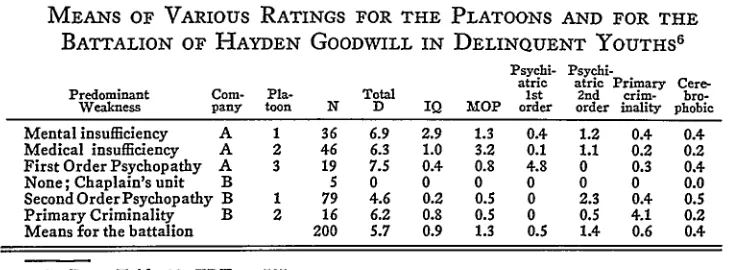
With the psychiatric index added to the battery of techniques for constitutional psychology, Sheldon advances on the problem of juvenile delinquency. The first objective is a study of delinquent youths at the Hayden Goodwill Inn, Boston, Massachusetts. The Inn is a privately supported institution intended and operated as a rehabilitation home for boys. Two hundred of these boys, chiefly White but a few Negro, for whom the data were most complete with respect to both length of time and adequacy of record were selected for individual and group report in the VDY. The sample does not include any boys suffering from specific and gross physical handicap. The IQ ratings, interview data on personal and familiar background (Sheldon's, that of the Inn and other welfare agencies as well as court and state correctional school records) were all drawn upon for data. The following table, abstracted from a more lengthy one, recapitulates Sheldon's principal findings:
TABLE I
MEANS OF VARIOUS RATINGS FOR THE PLATOONS AND FOR THE
BATTALION OF HAYDEN GOODWILL IN DELINQUENT YOUTHS6
Psychi-atric atric Primary Cere-Predominant Corn- Pla- Total 1st 2nd crim-
bro-Weakness pany toon N D IQ MOP order order inality phobic
Mental insufficiency A 1 36 6.9 2.9 1.3 0.4 1.2 0.4 0.4 Medical insufficiency A 2 46 6.3 1.0 3.2 0.1 1.1 0.2 0.2 First Order Psychopathy A 3 19 7.5 0.4 0.8 4.8 0 0.3 0.4
None; Chaplain's unit B 5 0 0 0 0 0 0 0.0
Second Order Psychopathy B 1 79 4.6 0.2 0.5 0 2.3 0.4 0.5
Primary Criminality B 2 16 6.2 0.8 0.5 0 0.5 4.1 0.2 Means for the battalion 200 5.7 0.9 1.3 0.5 1.4 0.6 0.4
[image:19.505.31.402.457.592.2]RICHARD M. SNODGRASSE
Gynan- Psychia- Sta- Pri- Sec- Gen-Predominant dro- Somato- tric ture mary ondary eral IQ
Weakness phrenic type Index (inches) t t Strength Score
Mental insufficiency 0.2 3.6-4.5-2.5 2.7-1.7-1.4 68.3 2.3 2.1 3.0 76.6 Medical insufficiency 0.5 3.3-4.5-2.8 2.4-1.9-1.3 68.6 2.3 2.3 2.5 85.6 First Order Psychopathy 0.7 3.9-4.5-2.7 3.7-2.6-2.2 69.2 2.6 2.8 2.7 92.1 None; Chaplain's unit 0.0 3.0-4.9-2.8 1 -1 -1 69.4 3.2 3.4 3.6 111.6
Second Order
Psychopathy 0.7 3.6-4.5-2.9 2.8-2.0-1.4 69.6 2.9 2.7 3.1 99.2 Primary Criminality 0.1 3.4-5.4-1.8 3.2-2.1-1.0 67.7 2.8 2.4 3.9 85.8
Means for the
battalion 0.5 3.5-4.6-2.7 2.8-1.9-1.4 69.0 2.6 2.5 3.0 89.2
Several headings in Table III require definition: "Total D," i. e., total delinquency, represents the sum of the following seven scores: 1) IQ; 2) MOP; 3) first order psychiatric; 4) second order psychiatric;
5)
cerebrophobia; 6) gynandrophrenia; 7) primary criminality. The individual items, except IQ, are rated against a scale of 1-10 with 10 designating a hopeless case.1) "IQ:" The IQ's were standardized on scores for 16 year old males. The standardized ratings were then translated into a 5-point Index of Delinqency by means of a special conversion table in which 5
indicates maximal insufficiency.
2) "MOP:" medical insufficiency other than psychiatric, i. e., "any apparently lifelong organic deficiency resulting in permanent poor resistance to infection or impairment of some physiological function which is vital to development of an adequate personality." (VDY,
p. 105) Briefly, MOP designates constitutional inferiority.
(3) "First order psychiatric:" delinquency at the psychotic level of behavioral inappropriateness, considered apart from or over and above insufficiency.
(4) "Second order psychiatric:" delinquency at the " 'psychoneu-rotic' " level of behavioral ineptitude. "Psychotic" and "psychoneu-rotic" are here used with their conventional meanings and indicate merely levels of seriousness of inept ideation and behavior.
(5) "Cerebrophobia :" delinquency associated with inability to tol-erate the third component of temperament, i. e., cerebrotonia, and with inability to tolerate depressants of that component; e. g., alcohol, etc. (6) "Gynandrotrophic delinquency:" gynandrophrenic behavior (i.e., behavior characteristic of the opposite sex) with consequences serious for the individual and others.
(7) "Primary criminality:" "persistent misbehavior without any evi-dence of a condoning insufficiency or of clinically recognized psychiatric pathology." (VDY, p. 105)
CRIME AND THE CONSTITUTION HUMAN
"Primary t:" Aesthetic symmetry of structure and contour as re-vealed in somatotype photograph (VDY, p. 22)
"Secondary t:" aesthetic qualities of facial features, hair, and pig-mentation as well as structure of hands and feet as judged by personal inspection. A 5-point rating scale was used for these judgments, with 1 minimal. The 7-point scale used in VT is more precise. With the latter scale, the general American public averages ca. 1.8 which corre-sponds to 3 on the 5-point scale. (vDx, p. 756)
"General strength:" estimate of total muscular power of individual; expressed by 5-point scale. Mean of 3.0 for the HGI sample equals the assumed mean for the population at large.
The general characteristics of the HGI delinquents may be gleaned from Table III, p.
53.
The somatotype is predominantly mesomorphic with moderate endomorphy and slight ectomorphy. The somatotype differs (VDY, pp. 726-730) from that of Sheldon's 4,000 college men in that the distribution of the somatotypes of the college group approxi-mates more nearly a normal curve while the HGI somatotypes are con-centrated chiefly within the endomorphic mesomorph range. Striking is the marked mesomorphy of the "primary criminality" group of 16 boys (Company B, Platoon 2). The mean psychiatric index for the entire group indicates (p. 746) a mild degree of psychoneurotic be-havior. With respect to this character, the "primary criminality" group is outranked only by the first-order psychopaths (Company A, Platoon 3) in the first, i. e., manic-depressive, component of the index. The psychoneurotic behavior of the "primary criminality" group is exclu-sively of the second order; their IQ is 85.8, i. e., dull.RICHARD M. SNODGRASSE
Andrews (1941) also. The inadequacies of Sheldon's hypothesis of the dominance of the somatotype by one or another of the embryonic germ layers, or the existence of a balance among such, have been described by Hunt (1949).
More enthusiasm has been shown by Hooton (1940, 1946) who, nevertheless, has suggested (1940, pp. 216-219) that the scale for rating components be reduced from seven to five points, and notes that race, sex, and age factors have received inadequate consideration in the somatotyping technique. These lacks had been recognized by Sheldon.
Deficiencies in systematization beset Shaplin (1942) when he tried to apply the somatotyping technique as described in VHP. He found his efforts hampered by: "1. Lack of standardization of values;
2. Problem of establishing personal standards through observational
experience; 3. Need for means of body build description without photos when desirable; 4. Problems of stature and gross size." Similar difficulties with systematization led Bellak and Holt (1948), who somatotyped a sample of deceased psychotics, to declare: "To have studied with the originator of the technique and to have tried conscientiously to follow the book is not enough to enable one to apply it to subjects who differ appreciably from those Sheldon used and end up confident that the results are not a function of errors in method." They urge normative studies with respect to sex, age, ethnic, and socio-economic factors.
Many persons may discover objections similar to the foregoing in the last publications.
Despite some adverse comment the somatotyping technique con-tinues in use, either alone or in combination with other techniques. Thus, Draper, Dupertuis, and Caughey (1944, p. 143) find that:
"While
it is probably not possible to make a completely accurate study of humanmorphology, a fair approximation can be made with the three methods now employed in the Constitution Clinic. Direct measurement of the body
(anthropo-metry) indicates the size and proportions of the bony skeleton. The somatotype describes soft part relationships and body contours. And, finally, observation of non-measurable characters throughout the body discloses many details of design which may be associated with faulty growth and development and which so subtly reveal the distinctive quality of the individual's total being." (Italics added.)
The clearly formulated problem which Damon (1946) investigated
was that of the relationship between physique and successful military flying. Any physical traits consistently associated with success in training and combat were to be discovered and, if the associations were positive, their strength was to be determined as well as the scopometric
CRIME AND THE CONSTITUTION HUMAN
(measurement and observation) techniques most likely to reveal them. Four groups, in terms of flying achievement, were compared: (1) non-flyers, from which aviators were drawn; (2) beginning flyers; (3) recent graduates; (4) successful combat flyers. Additionally, graduate bomber pilots and co-pilots graduates, thus classified chiefly because of training performance and qualities of leadership, were compared. Physique analysis involved three procedures: standard anthropometry; Seltzer's disproportions of body ratios and Sheldon's somatotyping.
The data comprised measurements and observational ratings on
3,675 men, made by one observer, and were supplemented by additional series drawn from the literature. The 3,675 subjects were distributed among the following groups: (1) two college series-one Harvard and one Chicago; (2) one group of AAF ground troops, "'represent-ing' " the non-flying personnel from which flight officers and gunners, respectively, were obtained; (3) aviation cadets; (4) aerial gunner trainees; (5) graduate flying officers; (6) graduate gunners; (7) " 'returnee' "bomber and fighter pilots with 10 or more combat missions.
The results obtained reflect the procedures used. Anthropometry revealed some pronounced and consistent differences. Chest circum-ference was found to increase regularly and significantly from non-flyers to flyers, from cadets to graduate flyers, and thence to successful com-bat pilots. Significant increase at each stage was shown also for chest circumference relative to stature and head circumference. Thus, as chest circumference/stature increased, head circumference/chest circum-ference decreased, and the percentage of disproportion in each index (i. e., beyond the critical value found by Seltzer for another sample) decreased constantly with success in military flying. In somatotype, mesomorphy-in mean amount as a separate component and in per-centage of dominance over endomorphy and mesomorphy-increased
steadily while gynandromorphy (feminoid traits) decreased progres-sively; both mesomorphy and gynandromorphy decreased in variability from, stage to stage in flying achievement. Qualitative mo-rphology yielded mostly negative results. The notable exception was greater muscle tonus of successful combat pilots in comparison with cadets and gunner trainees. No differences were found for hair color or hair form. Returnee flyers possessed more pure light eyes than novice flyers, and returnee fighter pilots had the fewest pure dark eyes of any group. Vascularity (blood in surface tissue) and skin color differed more between bomber and fighter pilots than between cadets and returnees; however, returnees had fewer brunet skins and slightly less vascularity than cadets.
RICHARD M. SNODGRASSE
Group differences, in general, revealed physique as larger at each of
the four stages, as more mesomorphic and masculine, with fewer dis-proportions, and less variability at each successive stage. The most marked differences between adjacent groups were between non-flyers and flyers, while successful combat pilots differed pronouncedly from college students, but less distinctly from cadets.
Some socio-economic differentiation of successful combat flyers was discovered, notably in national extraction (less mixed ancestry and more Old Americans), in education, occupation, and marital status. Traits in which all flyers apparently differed from non-flyers, but which did not differ between cadets and returnees, were the basis of induction (flyers had higher ratio of volunteers to draftees than did Army at large), and birthplace within United States (excess representation of West South Central states).
Multiple factorial analysis of body build represents a more strictly mathematical methodology than the others hitherto discussed. Utiliz-ing a series of 12 measurements taken on adult males (Hammond's data), Thurstone (1946) found four primary factors: head size; bone length; transverse measures or girth; and size of extremities. With a series of 17 measurements on another sample of adult males (Rees and Eysenck's data), Thurstone (1947) demonstrated seven primary factors: chest width; limb length; trunk size; size, generally; bicristal (hip) width, provisionally; chest depth; and hand length, tentatively. The second study supports the first and indicates the probable utility of factorial analysis of body dimensions. An analysis of Sheldon's photometric data, made by Waldrop (Krogman, 1941) disclosed three primary factors: general size; a size factor for arm, neck, and chest; and another for leg breadths. Before attempting investigation of the relation between body-build and temperament, Thurstone suggests it would be advantageous probably to identify the primary factors in body growth. Both interest and practical importance lie in whether any primary factor(s) are related to temperament. Growth data have been subjected to factorial analysis by McCloy, Marshall, and Mullen, respectively.
Factors which influence or are involved in the interpretation of body
build include age, sex, and race or stock, physical activity (exercise or work), and mentality and personality.
The stability of body-build with age involves both child and adult. In VHT, Sheldon held that the somatotype is permanent and probably
can be determined at least as early as the sixth year or earlier. Some doubt of this has been voiced. A change in weight during a psychosis
CRIME AND THE CONSTITUTION HUMAN
sufficient to shift a leptosome or an athletic physique to that of a pyknic had been noted by Wertheimer and Hesketh (1926). In a study of body build in schizophrenic males, Gray and Ayres (1939) found nose breadth, chest circumference, antero-posterior and transverse chest measurements and dimensions relative to height to be significantly larger in the 40-60 year old than in the 20-40 year old group. The effects of a European type of famine diet on the somatotypes of 34 conscientious objectors were such as to decrease (Lasker, 1947) the mean somatotype values, based on observational ratings of photographs, as follows: endomorphy 49.4 per cent, mesomorphy 25.2 per cent, ecto-morphy 66.7 per cent. In some individuals, the alteration involved a shift in dominance from one component to another. The distribution of the somatotype ratings for a sample of 33 adolescent boys (mean age ca. 14.5 years) at an Eastern "prep" school were found by Seltzer and Gallagher (1946) to differ little from those for Sheldon's 4,000 college men and for Dupertuis' 1,000 Harvard freshmen. The healthy, satisfactorily growing child, after the age of about 6 years, Wetzel declares (1948), shows very little fluctuation in body-build during his entire growth period. Adequate standards for assessing the somato-type of children have not yet been developed; hence, stability of the somatotype during the entire growing period remains to be demon-strated. In his recent review of the question of stability (vDY, pp. 33-40) Sheldon indicates that the hereditarily determined "morphogeno-type"-subject to some change by nutritional, physical activity, and pathological factors-yields the somatotype; however, he apparently considers that the dominant component remains the same. The impli-cation of the foregoing is that the body build of the individual, even when free from pathological influences, exhibits some variation; hence, it is necessary to determine the range of variability of the somatotype-probably around a recognized dominant component.
The effect of sex on somatotype had been declared by Sheldon (vHP, p. 66) to result in endomorphy as well as a strong endomorphy and ectomorphy being more frequent in women while mesomorphy as well as a strong endomorphy and mesomorphy are more common in men. At the time, his findings were tentative because based on bromide sil-houettes of 2,500 women. Except for the mesomorphic component these findings are contrary to those for 175 Radcliffe college women whom Bullen and Hardy (1946) found to be slightly less endomorphic and slightly less ectomorphic than Sheldon's 4,000 college males. For a sample of 159 girls from a midwestern college, Racher (1948) found the amounts of endomorphy and mesomorphy, in the order